서 론
자궁경부암은 여성의 건강을 위협하는 주요 질환으로, 전 세계적으 로 1980년 378,000명에서 2010년 454,000명이 발생하여 지난 20년간
연 평균 0.6%의 증가율을 보였으며, 이 중 약 20만 명 정도가 사망한 것 으로 보고되고 있다[1]. 세계보건기구(World Health Organization) 에 의하면 자궁경부암은 정기적인 조기검진을 통해 효과적으로 발생 률과 사망률을 낮출 수 있다[2]. 또한 Papanicolaou (Pap) test, 자궁경
한국 성인여성의 자궁경부암 미수검 관련 요인분석:
국민건강영양조사(2010–2012년) 자료 이용
최원미1·한남경2·정우진3,4
1미즈메디병원 QI실, 2경북보건대학교 간호학부, 3연세대학교 보건대학원 보건정책학과, 4연세대학교 보건정책 및 관리연구소
Factors Associated with the Non-screening Status of Cervical Cancer Screening Test in Korean Adult Women: Korea National Health and Nutrition
Examination Survey (2010–2012)
Won-Mi Choi
1, Nam-Kyung Han
2, Woojin Chung
3,41Department of QI, MizMedi Hospital, Seoul; 2Department of Nursing, Gyeongbuk College of Health, Gimcheon; 3Department of Health Policy and Management, Yonsei University Graduate School of Public Health; 4Institute of Health Services Research, Yonsei University, Seoul, Korea
Background: This study aimed to explore the associations of social-demographic, health-behavioral, and woman-specific factors with the non-screening status of the cervical cancer screening test in Korean adult women.
Methods: This study was a cross-sectional analysis of 9,698 Korean adult women aged 20 years or more who participated in the Korea National Health and Nutrition Examination Surveys V (2010–2012). Rao-Scott chi-square tests and survey logistic regression analyses were employed respectively to analyze the difference in the non-screening status of the cervical cancer screening test by each characteristic and to explore the factors related to the non-screening status.
Results: The rate of the non-screening status of the cervical cancer screening test was 53.5% over the previous 2 years. In the survey logistics regression analysis, age, marital status, educational levels, income levels, residential area, occupation, private health insurance, smoking, alcohol, obesity, menstrual status, pregnancy experience, and hormone replacement therapy were significantly associated with the non-screening status of the cervical cancer screening test.
Conclusion: On the basis of the results of this study, some social-demographic, health-behavioral, and woman-specific characteristics of Korean adult women seem to affect the non-screening status of the cervical cancer screening test. Therefore, appropriate health policies need to be designed, implemented, monitored, and evaluated to reduce the non-screening status of the cervical cancer screening test of them.
Keywords: Screening; Non-screening; Uterine cervical neoplasms; Korean adult women; Korea National Health and Nutrition Examination Survey
Correspondence to: Woojin Chung
Department of Health Policy and Management, Yonsei University Graduate School of Public Health, 50-1 Yonsei-ro, Seodaemun-gu, Seoul 03722, Korea
Tel: +82-2-2228-1522, Fax: +82-2-392-7734, E-mail: [email protected]
Received: August 12, 2019, Revised: September 7, 2019, Accepted after revision: December 1, 2019
© Korean Academy of Health Policy and Management
◯
㏄This is an open-access article distributed under the terms of the Creative Commons Attribution Non-Commercial License (http://creativecommons.org/licenses/by-nc/4.0) which permits unrestricted non-commercial use,
distribution, and reproduction in any medium, provided the original work is properly cited.
부암 백신 예방접종 등의 검진사업이 제대로 실시되어 조기에 발견하 여 치료할 경우 약 90% 이상 완치가 가능한 것으로 알려져 있다[3].
International Agency for Research on Cancer에서 발표한 선진국의 2012년 자궁경부암 연령표준화 발생률은 인구 100,000명당 미국 6.6 명, 영국 7.1명 등이며, 사망률은 100,000명당 영국 1.8명, 호주 1.6명 등으로 개발도상국에 비해 발생률과 사망률이 낮은 경향을 보였다 [4]. 한편, 대한민국에서 자궁경부암은 2015년 여성에게 발생하는 암 중 발생률 및 2016년 암에 의한 사망원인의 7위를 차지하고 있으며, 2016년 여성의 주요 암종별 유병자 중 갑상선암, 유방암, 대장암, 위암 에 이어 다섯 번째로 많은 것으로 나타났다[5-7]. 또한 대한민국의 자 궁경부암 연령표준화 발생률은 2013년 기준 100,000명당 11.1명으로 세계 평균인 14.0명에 비해 낮으나, 영국 7.1명이나 미국 6.6명 등에 비 해 높은 수준을 유지하고 있다[4,7,8]. 또한 암 치료기술의 발달 및 암 조기검진 등의 영향 등으로 대한민국 여성의 주요 10대 암종의 평균 5 년 이상 상대생존율은 1993–1995년에 비해 2010–2014년 18.2%p 증 가하였으나 자궁경부암은 2.2%p로 미미하게 증가하여 10대 암종 중 두 번째로 증가 폭이 낮은 것으로 나타났다[5,7].
미국이나 영국 등은 국립암연구소의 주관하에 예방 중심의 국가암 관리사업을 추진하고, 자궁경부암 검진지침 또는 권고안에 따라 3-5 년마다 정기적인 선별검사 실시와 미국암협회(American Cancer Society, ACS)에서 암환자 내비게이션 프로그램 등을 제공하여 조기 검진의 중요성 및 재정적 지원에 대한 정보 홍보정책 등을 시행하고 있다[9,10]. 대한민국은 보건복지부의 주관하에 암 정복 10개년 계획 으로 1999년부터 자궁경부암, 유방암, 위암의 3대 암 중심의 검진을 시작하였으며, 2004년부터 간암과 대장암을 추가하여 5대 암을 중심 으로 의료접근성이 낮은 저소득층 대상의 National Cancer Screening Program과 일반 국민 대상의 국민건강보험공단에서 시행하는 암검 진을 실시하고 있다[11]. 이 중 자궁경부암 검진의 경우 20세 이상 여 성을 대상으로 2년마다 Pap smear test를 실시하고 있다[11,12].
이러한 노력에도 불구하고 대한민국의 자궁경부암 검진 미수검률 은 2004–2013년까지 지난 10년간 33.0%–41.7%를 보이고 있으며, 선 진국인 미국 2010년 26.2%, 영국 2011년 21.0%에 비하여 여전히 높은 수준이다[13]. 따라서 자궁경부암은 대한민국의 10대 암 사망원인일 뿐만 아니라 선진국에 비해 자궁경부암 검진 미수검률이 높아 여성들 의 건강수준 저하 및 국민의료비 증가 등을 초래하므로 국가 차원의 보건의료정책적 관리방안 모색이 중요하다고 할 수 있다.
자궁경부암 수검 관련 국내외의 선행연구를 살펴보면, 자궁경부암 미수검에 영향을 미치는 요인은 연령[14-28], 가족 수[16,29], 교육수 준[15,16,19,21,22,26,28,30-43], 소득수준[14,18,19,23,28,30,36,40-42, 44-47], 건강보장상태[26,46,48,49], 결혼상태[30,33-35,50], 거주지역
[19,21,30,36,40,42,51], 직업[22,49,52], 임신경험[15,32], 흡연 [21,23,25,33,50,53], 언어[46], 음주[15,44,50], 운동[14,21,53-55], 비 만[26,53,56], 성경험[42,48,57-59], 출산경험[16], 여성호르몬제 복용 [31,33] 등인 것으로 나타났다. 이와 같이 자궁경부암 미수검 관련 선 행연구는 인구사회적 요인, 건강행태요인 그리고 여성특화 요인 등 이 있는 것으로 파악되고 있으나, 일부 연구를 제외하고 대부분의 연 구가 일부 지역이나 대상에 국한하여 분석하였기에 연구의 대표성 확 보에 어려움이 있다. 또한 선행연구는 자궁경부암 검진에 영향을 미 치는 것으로 판단되는 월경상태 등의 여성 관련 변수 등을 포함하여 분석하지 않은 측면이 있으며, 월경상태는 병원 방문 등의 의료이용 과 밀접한 관련이 있기 때문에 검진에 영향을 미칠 가능성이 존재하 여 추가적으로 분석할 필요가 있다. 이러한 다양한 변수를 고려해서 분석 가능한 패널 데이터로 국민건강영양조사(Korea National Health and Nutrition Examination Surveys)가 적합하나, 제6기(2013 –2015)부터 현재의 제7기(2016–2017)까지 기존의 세분화된 암 설문 내용을 삭제하고 전체 암에 대한 검진 여부 중심으로 간소화한 한계 가 있어, 자궁경부암 검진 여부와 관련된 데이터가 있는 제5기(2010–
2012) 데이터를 심층 분석할 필요가 있다.
따라서 본 연구는 전국 수준의 표준화된 자료인 대한민국 국민건강 영양조사 제5기(2010–2012) 데이터를 사용하여, 인구사회적 및 건강 행태 그리고 여성특화 요인 등을 고려하여 한국 성인여성의 자궁경부 암 미수검 관련 요인을 분석하였다.
방 법
1. 연구설계
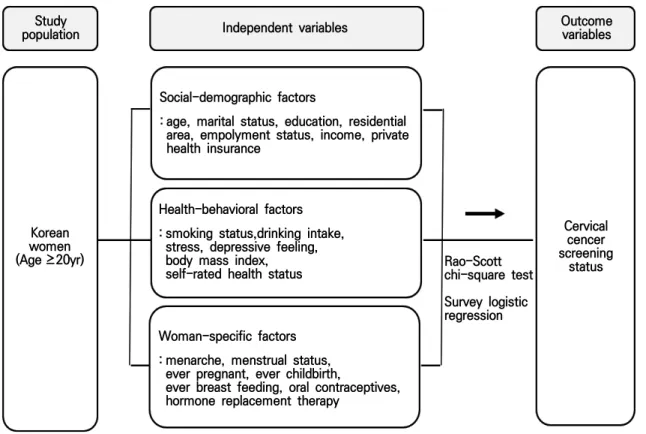
본 연구는 20세 이상 한국 성인여성의 자궁경부암 미수검 관련 요 인을 파악하기 위한 이차자료 단면분석연구로 제5기 국민건강영양 조사(2010–2012년)에서 건강설문조사 결과를 활용하여 분석하였다 (Figure 1).
2. 연구대상 및 자료
본 연구에서 사용한 보건복지부의 국민건강영양조사는 대한민국 국민건강증진법 제16조에 근거하여 1998년부터 실시하고 있으며, 전 국민을 대상으로 표본을 구축하여 대표성이 있는 자료이며, 연구수 행에 앞서 보건복지부 지정 공용기관생명윤리위원회의 승인 (P01-201910-21-013)을 받았다. 국민건강영양조사의 데이터 중 제6 기(2013–2015)부터 현재의 제7기(2016–2017) 데이터는 기존의 세분
화된 암 설문내용을 삭제하고 전체 암에 대한 검진 여부 중심으로 간 소화한 한계가 있기 때문에 제5기(2010–2012) 원시자료 중 건강설문 조사 자료에 가중치 적용 후 복합표본설계(complex sampling design) 를 구축하여 분석하였다. 국민건강영양조사의 제5기 표본 추출 틀은 대한민국에 거주하는 국민을 대상으로 주민등록인구 및 아파트단지 시세조사 자료를 토대로 구축되었으며, 조사구 및 가구를 1, 2차 추출 단위로 하는 2단계 층화집락표본 추출방법을 사용하였다. 또한 국민 건강영양조사는 표본설계를 통해 추출된 표본을 이동검진센터 또는 대상가구를 직접 방문하여 조사하고 조사에 참여한 표본이 대한민국 국민을 대표하도록 가중치를 부여하여 국민의 건강행태 및 수준을 측 정하였다. 제5기 건강설문조사의 응답자는 2010년 8,958명, 2011년 8,518명, 2012년 8,058명을 포함한 총 25,534명이다. 한편, 대한민국 자궁경부암 검진 권고안 개정위원회는 자궁경부암 권고기준에서 검 진대상을 성경험이 있는 무증상 20세 이상 여성으로 제시한 바가 있 다[60]. 성경험 여부의 경우 국민건강영양조사 설문조사에 관련 변수 가 없어, 연구의 정확도 제고 차원에서 자궁경부암을 진단받지 않은 20세 이상의 성인여성으로 국한하였다. 따라서 만 19세 이하 6,140명, 남성 8,378명, 자궁경부암 진단자 6명을 제외하였다. 또한 item nonresponse 또는 ‘모름’에 응답한 1,312명의 결측치를 제외하여
9,698명을 최종 연구대상으로 추출하였다(Figure 2). 한편, 최종 연구 대상인 9,698명과 결측된 1,312명의 자궁경부암 미수검률을 chi-square 검정으로 비교한 결과 두 그룹 간 유의적 차이가 없음을 확 인하였다(p-value=0.722).
3. 변수의 선정 및 정의 1) 종속변수
본 연구의 종속변수는 ‘대한민국 20세 이상 한국 여성의 최근 2년간 자궁경부암 검진 수검 여부’이다. 대한민국의 5대 국가암검진 대상인 자궁경부암의 검진주기 권장안은 일본 2년, 미국 및 캐나다 3년 등으 로 다양한데, 대한민국의 경우 2015년에 3년으로 개정되었지만, 2002 년에서 2014년까지의 권고기준 및 국가암검진 실시주기를 고려하여 최근 2년간 수검 여부로 결정하였다. 따라서 국민건강영양조사 건강 설문조사에서 ‘가장 최근에 받아보신 자궁경부암검사는 언제입니 까?’라는 질문에 ‘검진을 받은 적이 없거나 2년을 초과하여 수검’ 응답 자를 미수검자로, ‘1년 이내 또는 1년 이상 2년 이내에 수검’ 응답자를 수검자로 구분하였다.
Korean women (Age ≥20yr)
Study
population Independent variables Outcome
variables
Social-demographic factors
: age, marital status, education, residential area, empolyment status, income, private health insurance
Cervical cencer screening
status Health-behavioral factors
: smoking status,drinking intake, stress, depressive feeling, body mass index, self-rated health status
Woman-specific factors : menarche, menstrual status,
ever pregnant, ever childbirth,
ever breast feeding, oral contraceptives, hormone replacement therapy
Rao-Scott chi-square test Survey logistic regression
Figure 1. Research design frame.
2) 독립변수
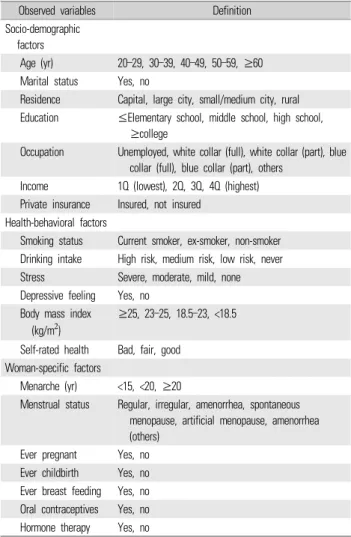
독립변수는 선행 문헌고찰을 통해 암검진 미수검에 영향을 미치는 인구사회적 요인, 건강행태요인, 여성특화 요인으로 구분하였다. 인 구사회적 요인으로 연령(20–29세, 30–39세, 40–49세, 50–59세, ≥60 세), 결혼 여부(기혼, 미혼), 거주지역(특별시, 광역시, 중소도시, 농어 촌), 교육수준(초졸 이하, 중졸 이하, 고졸 이하, 대졸 이상), 직업유형 (무직, 임금근로자 중 비육체노동직 전일제, 임금근로자 중 화이트칼 라 시간제, 임금근로자 중 육체노동직 전일제, 임금근로자 중 육체노 동직 시간제, 기타), 소득수준(월 가구균등화 소득 하, 중하, 중상, 상 으로 분류), 민간건강보험(예, 아니오) 변수를 선정하였다. 건강행태 요인으로 흡연(현재 흡연자, 과거 흡연자, 비흡연자), 음주(고위험 음 주, 중간위험, 저위험, 비음주), 스트레스(대단히 많이 느낌, 많이 느 낌, 조금 느낌, 거의 느끼지 않음), 우울(예, 아니오), 체질량지수(비만, 과체중, 보통, 저체중), 주관적 건강상태(나쁨, 보통, 좋음) 변수를 선 정하였다. 여성특화 요인으로 초경연령(15세 미만, 20세 미만, 20세 이상), 월경상태(규칙적인 월경, 불규칙적인 월경, 임신출산으로 인 한 무월경, 자연폐경, 인공폐경, 기타), 임신경험(예, 아니오), 출산경 험(예, 아니오), 모유수유 경험 여부(예, 아니오), 경구피임약 복용 여
부(예, 아니오), 여성호르몬제 복용 여부(예, 아니오) 변수를 선정하였 다(Table 1).
4. 분석방법
연구대상자인 한국 성인여성의 자궁경부암 검진 미수검 영향요인 분석은 SAS ver. 9.4 (SAS Institute Inc., Cary, NC, USA)를 사용하였으 며, 유의수준은 p값이 0.05 미만인 경우를 통계적으로 유의한 것으로 판단하였다. 연구대상자의 일반적 특성과 자궁경부암 검진 미수검 현황을 빈도와 백분율로 분석하였다. 암검진 수검 여부와 인구사회 적 요인, 건강행태요인, 여성특화 요인의 관련성을 비교 및 분석하기 위해 survey 특성을 고려한 Rao-Scott chi-square 검정을 실시하였다.
독립변수들 간의 분산확대인자(variance inflation factor)는 1.07–9.11 사이에 분포하여 다중공선성이 발생하지 않아, 전체 변수를 포함하 여 survey logistic regression 분석을 수행하였다. 구체적으로 인구사 회적 요인을 보정한 모델 1, 모델 1에 건강행태요인을 추가로 보정한 모델 2, 모델 2에 여성특화 요인을 추가로 보정한 모델 3에 따라 각 모 델에서 추가된 각 변수가 자궁경부암 미수검에 미치는 영향을 adjusted odds ratio (OR)와 95% 신뢰구간(confidence interval, CI)으
Health interview survey of KNHANES V (2010–2012)
(n=25,534)
Age ≥20 yr (N=19,394)
Korean adult women (N=11,010)
Study population (N=9,698)
Age ≥20 yr (N=6,140 excluded)
Male: 8,378 Cervical cancer: 6 (N=8,384 excluded)
Item nonresponse or unknowing response: 1,312
(N=1,312 excluded)
Figure 2. Subjective selection. KNHANES, Korea National Health and Nutrition Examination Surveys.
로 산출하였다. 각 모델의 C-통계량은 모든 모델에서 65%를 초과하 였으며, Hosmer and Lemeshow goodness-of-fit test 결과, 모델 1
p=0.7311, 모델 2 p=0.7518, 모델 3 p=0.4881으로 모든 모델의 p값이
0.05 이상으로 적합한 모델인 것으로 나타났다.결 과
1. 연구대상의 일반적 특성과 암검진 미수검률의 차이
연구대상자인 20세 이상의 성인여성 9,698명 중에서 최근 2년 이내 에 자궁경부암 검진을 받지 않은 대상자 수는 5,192명(53.5%)이었다.
자궁경부암 미수검률 비교는 Table 1과 같다. 인구사회적 요인에서 다른 연령대에 비해 20–29세 연령 81.0% (p<0.001), 기혼여성에 비해 미혼여성 87.3% (p<0.001), 도시지역에 비해 농어촌 거주자 60.6%
(p=0.001), 중졸 이상에 비해 초졸 이하의 학력 62.4% (p<0.001), 고용
형태 중 사무직의 정규직 64.7% (p<0.001), 소득수준이 낮을수록 (p<0.001), 민간건강보험 가입자에 비해 미가입자 70.2% (p<0.001)에 서 통계적으로 유의하게 자궁경부암 미수검률이 높은 것으로 나타났 다. 건강행태요인에서 비흡연자나 과거 흡연자에 비해 현재 흡연자 66.4% (p<.001), 중위험군 이하의 음주자에 비해 고위험군 음주자 70.9% (p<0.001), 스트레스 및 우울감을 매우 높게 느끼는 경우 64.7%
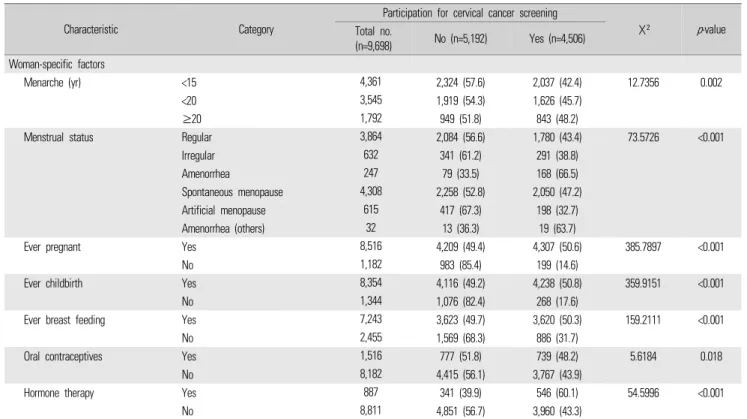
(p<0.001), 저체중자 67.9% (p<0.001), 주관적 건강상태가 나쁜 경우 60.3% (p=0.000)가 상대적으로 통계적으로 유의하게 자궁경부암 미 수검률이 높았다. 여성특화 요인에서 초경 시작연령이 낮을수록 (p=0.002), 인공폐경 67.3% (p<0.001), 임신 및 출산 미경험자가 각각 85.4% (p<0.001), 82.4% (p<0.001), 모유수유 미경험자 68.3%
(p<0.001), 경구피임약 미복용자 56.1% (p=0.018), 여성호르몬 미복 용자 56.7% (p<0.001)가 상대적으로 통계적으로 유의하게 자궁경부 암 미수검률이 높았다(Table 2).
2. 한국 성인여성의 자궁경부암 미수검 관련 요인
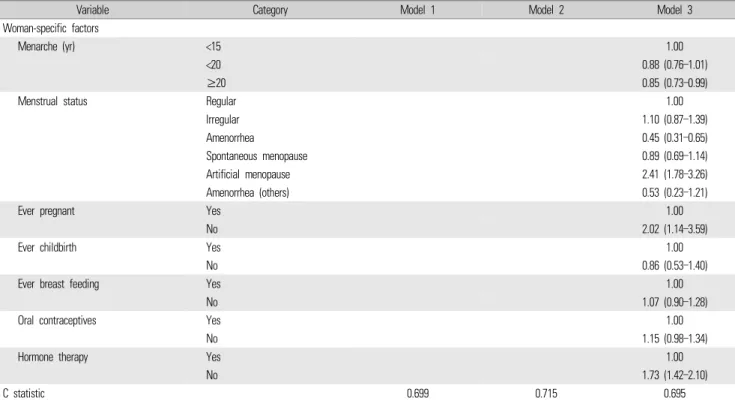
Logistic regression 분석에서 모델 3은 자궁경부암 미수검과 관련, 모델 1의 인구사회적 통제변수인 연령, 결혼 여부, 교육수준, 거주지 역, 직업상태, 소득수준, 민간건강보험 가입 여부와 모델 2의 추가적 건강행태 통제변수인 흡연, 음주, 스트레스 인지 및 우울감 여부, 체질 량지수, 주관적 건강상태 변수에 여성특화 변수인 초경 시작 나이, 월 경상태, 임신 및 출산 그리고 모유수유 경험, 경구피임약 및 여성호르 몬제 복용 여부 변수를 추가적으로 통제하여 분석하였다. 연령은 20–
29세에 비해 많은 모든 연령, 교육수준은 초졸 이하에 비해 고졸(OR, 0.79; 95% CI, 0.63–0.78), 전문대졸 이상(OR, 0.72; 95% CI, 0.55–0.70), 월 가구균등화 소득수준이 1사분위수에 비해 4사분위수(OR, 0.94;
95% CI, 0.77–0.92)인 경우에 자궁경부암 검진 미수검률이 통계적으 로 유의하게 낮았으며, 인구사회적 특성을 통제한 모델 1과 인구사회 적 및 건강행태 특성을 통제한 모델 2 분석결과 역시 비슷한 경향을 보 였다. 또한 현재 흡연자에 비해 과거 흡연자(OR, 0.91; 95% CI, 0.67–
0.95), 고위험음주에 비해 저위험음주(OR, 0.94; 95% CI, 0.74–0.95), 비만에 비해 과체중(OR, 0.92; 95% CI, 0.82–0.94)인 경우에 자궁경부 암 검진 미수검률이 통계적으로 유의하게 낮았으며, 모델 2 분석결과 역시 비슷한 경향을 보였다. 그리고 초경연령이 15세 미만에 비해 20 세 이상(OR, 0.85; 95% CI, 0.73–0.99), 규칙적인 월경에 비해 임신출산 으로 인한 무월경(OR, 0.45; 95% CI, 0.31–0.65)인 경우에 자궁경부암 검진 미수검률이 통계적으로 유의하게 낮았다. 반면, 기혼여성에 비 해 미혼여성(OR, 7.86; 95% CI, 3.04–4.92), 특별시에 비해 광역시(OR, 1.51; 95% CI, 1.27–1.50), 중소도시(OR, 1.37; 95% CI, 1.18–1.38), 농어
Observed variables Definition
Socio-demographic factors
Age (yr) 20–29, 30–39, 40–49, 50–59, ≥60 Marital status Yes, no
Residence Capital, large city, small/medium city, rural Education ≤Elementary school, middle school, high school,
≥college
Occupation Unemployed, white collar (full), white collar (part), blue collar (full), blue collar (part), others
Income 1Q (lowest), 2Q, 3Q, 4Q (highest) Private insurance Insured, not insured
Health-behavioral factors
Smoking status Current smoker, ex-smoker, non-smoker Drinking intake High risk, medium risk, low risk, never Stress Severe, moderate, mild, none Depressive feeling Yes, no
Body mass index (kg/m2)
≥25, 23–25, 18.5–23, <18.5
Self-rated health Bad, fair, good Woman-specific factors
Menarche (yr) <15, <20, ≥20
Menstrual status Regular, irregular, amenorrhea, spontaneous menopause, artificial menopause, amenorrhea (others)
Ever pregnant Yes, no Ever childbirth Yes, no Ever breast feeding Yes, no Oral contraceptives Yes, no Hormone therapy Yes, no
Table 1. Classification and definition of independent variables
Characteristic Category
Participation for cervical cancer screening
Х² p-value
Total no.
(n=9,698) No (n=5,192) Yes (n=4,506) Socio-demographic factors
Age (yr) 20–29 1,050 850 (81.0) 200 (19.0) 458.2082 <0.001
30–39 1,874 939 (51.2) 935 (48.8)
40–49 1,732 695 (43.2) 1,037 (56.8)
50–59 1,936 793 (42.5) 1,143 (57.5)
≥60 3,106 1,915 (63.5) 1,191 (36.5)
Marital status Yes 8,627 4,272 (49.5) 4,355 (50.5) 386.9177 <0.001
No 1,071 920 (87.3) 151 (12.7)
Residence Capital 1,978 962 (51.9) 1,016 (48.1) 19.9398 0.000
Large city 2,469 1,346 (56.4) 1,123 (43.6)
Small/medium city 3,420 1,755 (54.3) 1,665 (45.7)
Rural 1,831 1,129 (60.6) 702 (39.4)
Education ≤Elementary school 2,856 1,780 (62.4) 1,076 (37.6) 81.5084 <0.001
Middle school 1,120 546 (51.2) 574 (48.8)
High school 2,669 1,214 (47.8) 1,455 (52.2)
≥College 3,053 1,652 (59.0) 1,401 (41.0)
Occupation Unemployed 5,077 2,698 (54.9) 2,379 (45.1) 44.3289 <0.001
White collar (full) 1,024 599 (64.7) 425 (35.3)
White collar (part) 236 140 (63.8) 96 (36.2)
Blue collar (full) 1,039 533 (52.3) 506 (47.7)
Blue collar (part) 532 263 (49.5) 269 (50.5)
Others 1,790 959 (53.6) 831 (46.4)
Income 1Q (lowest) 2,001 1,286 (65.0) 715 (35.0) 69.0271 <0.001
2Q 2,483 1,369 (56.6) 1,114 (43.4)
3Q 2,592 1,326 (54.0) 1,266 (46.0)
4Q (highest) 2,622 1,211 (49.9) 1,411 (50.1)
Private insurance Insured 6,985 3,337 (50.6) 3,648 (49.4) 198.9478 <0.001
Not insured 2,713 1,855 (70.2) 858 (29.8)
Health-behavioral factors
Smoking status Current smoker 517 339 (66.4) 178 (33.6) 20.4843 <0.001
Ex-smoker 530 297 (52.7) 233 (47.3)
Non-smoker 8,651 4,556 (54.8) 4,095 (45.2)
Drinking intake High risk 552 380 (70.9) 172 (29.1) 69.9261 <0.001
Medium risk 603 363 (63.5) 240 (36.5)
Low risk 4,895 2,416 (51.2) 2,479 (48.8)
Never 3,648 2,033 (56.6) 1,615 (43.4)
Stress Severe 476 308 (64.7) 168 (35.3) 52.1214 <0.001
Moderate 2,313 1,356 (60.9) 957 (39.1)
Mild 5,498 2,716 (51.7) 2,782 (48.3)
None 1,411 812 (58.1) 599 (41.9)
Depressive feeling Yes 1,607 916 (59.2) 691 (40.8) 7.8679 0.005
No 8,091 4,276 (54.8) 3,815 (45.2)
Body mass index (kg/m2) ≥25 2,889 1,599 (56.2) 1,290 (43.8) 48.3896 <0.001
23–25 2,094 1,033 (49.3) 1,061 (50.7)
18.5–23 4,174 2,209 (56.1) 1,965 (43.9)
<18.5 541 351 (67.9) 190 (32.1)
Self-rated health Bad 2,185 1,309 (60.3) 876 (39.7) 16,7668 0.000
Fair 4,606 2,383 (53.9) 2,223 (46.1)
Good 2,907 1,500 (54.7) 1,407 (45.3)
(Continued to the next page)
Table 2. Comparisons of non-screening of cervical cancer by selected variables
촌지역(OR, 1.64; 95% CI, 1.37–1.65), 무직에 비해 화이트칼라의 정규 직(OR, 1.29; 95% CI, 1.02–1.25), 화이트칼라의 비정규직(OR, 1.93;
95% CI, 1.31–1.87), 기타 직종(OR, 1.31; 95% CI, 1.12–1.31), 민간건강 보험을 가입한 경우에 비해 가입하지 않은 경우(OR, 2.12; 95% CI, 1.78–2.05)인 경우에 자궁경부암 검진 미수검률이 통계적으로 유의 하게 높았으며, 모델 1 및 모델 2 분석결과 역시 비슷한 경향을 보였다.
규칙적 월경인 경우에 비해 인공폐경인 경우(OR, 2.41; 95% CI, 1.78–
3.26), 임신경험이 있는 경우에 비해 없는 경우(OR, 2.02; 95% CI, 1.14 –3.59), 여성호르몬제를 복용하는 경우에 비해 아닌 경우(OR, 1.73;
95% CI, 1.42–2.10)의 자궁경부암 검진 미수검률이 통계적으로 유의 하게 높았다(Table 3).
고 찰
본 연구는 한국 성인여성의 인구사회적 요인과 건강행태요인 및 여 성특화 요인을 고려하여 자궁경부암 검진 미수검 관련 요인을 분석함 으로써 향후 성인여성의 자궁경부암 검진 활성화 및 관련 보건의료정 책을 수립하기 위한 기초자료를 제공하고자 실시하였다. 연구대상은 2010년부터 2012년까지 제5기 국민건강영양조사 건강설문조사 응
답자 중 20세 이상 성인여성 9,698명이었으며, 지난 2년간 자궁경부 암 검진 미수검률은 53.5%였다. Logistic regression 분석결과, 인구사 회적 요인 중 연령, 결혼 여부, 교육수준, 거주지역, 직업, 소득수준, 민 간건강보험 가입 여부 변수가 통계적으로 유의하게 자궁경부암 검진 미수검률에 영향을 미치는 것으로 나타났다. 또한 건강행태요인 중 흡연, 음주, 체중과 여성특화 요인 중 초경연령, 월경상태, 임신 여부, 여성호르몬제 복용 여부 변수가 통계적으로 유의하게 자궁경부암 검 진 미수검률에 영향을 미쳤다. 이는 선행연구에서 유의하게 나온 결 과와 대부분 일치하였으며, 월경상태 변수는 본 연구에서 새롭게 도 출된 영향요인에 해당된다.
인구사회적 요인 중 교육수준은 초졸 이하에 비해 고졸과 전문대졸 이상의 자궁경부암 검진 미수검률이 유의하게 낮았는데, 이는 대부 분의 선행연구결과와 일치하여 이는 교육수준이 높을수록 건강정보 습득이나 건강신념 그리고 예방적 건강행위 등에 영향을 미치기 때문 인 것으로 생각된다[15,16,19,21,22,26,28,30-43]. 연령은 30세 이상에 비해 20–29세의 여성이, 결혼 여부는 기혼여성에 비해 미혼여성의 자 궁경부암 미수검률이 높았는데, 연령이 적고 결혼을 하지 않은 여성 일수록 임신력 및 출산력 등이 낮아 산전 및 산후검진을 받을 기회가 적음에 따른 것으로 보인다. 경제적 상태와 관련이 있는 소득수준은
Characteristic Category
Participation for cervical cancer screening
Х² p-value
Total no.
(n=9,698) No (n=5,192) Yes (n=4,506) Woman-specific factors
Menarche (yr) <15 4,361 2,324 (57.6) 2,037 (42.4) 12.7356 0.002
<20 3,545 1,919 (54.3) 1,626 (45.7)
≥20 1,792 949 (51.8) 843 (48.2)
Menstrual status Regular 3,864 2,084 (56.6) 1,780 (43.4) 73.5726 <0.001
Irregular 632 341 (61.2) 291 (38.8)
Amenorrhea 247 79 (33.5) 168 (66.5)
Spontaneous menopause 4,308 2,258 (52.8) 2,050 (47.2)
Artificial menopause 615 417 (67.3) 198 (32.7)
Amenorrhea (others) 32 13 (36.3) 19 (63.7)
Ever pregnant Yes 8,516 4,209 (49.4) 4,307 (50.6) 385.7897 <0.001
No 1,182 983 (85.4) 199 (14.6)
Ever childbirth Yes 8,354 4,116 (49.2) 4,238 (50.8) 359.9151 <0.001
No 1,344 1,076 (82.4) 268 (17.6)
Ever breast feeding Yes 7,243 3,623 (49.7) 3,620 (50.3) 159.2111 <0.001
No 2,455 1,569 (68.3) 886 (31.7)
Oral contraceptives Yes 1,516 777 (51.8) 739 (48.2) 5.6184 0.018
No 8,182 4,415 (56.1) 3,767 (43.9)
Hormone therapy Yes 887 341 (39.9) 546 (60.1) 54.5996 <0.001
No 8,811 4,851 (56.7) 3,960 (43.3)
Values are presented as number (%).
Table 2. Continued
Variable Category Model 1 Model 2 Model 3 Socio-demographic factors
Age (yr) 20–29 1.00 1.00 1.00
30–39 0.68 (0.52–0.88) 0.70 (0.54–0.91) 0.67 (0.51)
40–49 0.51 (0.39–0.68) 0.53 (0.41–0.71) 0.48 (0.36)
50–59 0.40 (0.30–0.54) 0.42 (0.31–0.57) 0.41 (0.29)
≥60 0.56 (0.41–0.76) 0.58 (0.43–0.80) 0.63 (0.42)
Marital status Yes 1.00 1.00 1.00
No 5.99 (4.40–9.15) 5.77 (4.24–7.86) 3.04 (4.92)
Residence Capital 1.00 1.00 1.00
Large city 1.28 (1.09–1.51) 1.28 (1.08–1.51) 1.27 (1.50)
Small/medium city 1.19 (1.02–1.38) 1.18 (1.02–1.37) 1.18 (1.38)
Rural 1.38 (1.15–1.66) 1.37 (1.14–1.64) 1.37 (1.65)
Education ≤Elementary school 1.00 1.00 1.00
Middle school 0.87 (0.71–1.06) 0.88 (0.72–1.08) 0.88 (1.08)
High school 0.64 (0.53–0.78) 0.65 (0.54–0.79) 0.63 (0.78)
≥College 0.55 (0.44–0.69) 0.57 (0.46–0.72) 0.55 (0.70)
Occupation Unemployed 1.00 1.00 1.00
White collar (full) 1.05 (0.86–1.28) 1.05 (0.86–1.29) 1.02 (1.25)
White collar (part) 1.37 (0.96–1.96) 1.36 (0.96–1.93) 1.31 (1.87)
Blue collar (full) 1.00 (0.84–1.18) 1.00 (0.84–1.19) 1.01 (1.20)
Blue collar (part) 0.86 (0.69–1.09) 0.88 (0.69–1.11) 0.82 (1.03)
Others 1.13 (0.97–1.32) 1.12 (0.97–1.31) 1.12 (1.31)
Income 1Q (lowest) 1.00 1.00 1.00
2Q 0.96 (0.81–1.14) 0.97 (0.82–1.15) 0.98 (1.17)
3Q 0.86 (0.72–1.03) 0.89 (0.74–1.06) 0.89 (1.07)
4Q (highest) 0.76 (0.63–0.91) 0.79 (0.66–0.94) 0.77 (0.92)
Private insurance Insured 1.00 1.00 1.00
Not insured 1.90 (1.64–2.17) 1.84 (1.60–2.12) 1.78 (2.05)
Health–behavioral factors
Smoking status Current smoker 1.00 1.00
Ex–smoker 0.64 (0.45–0.91) 0.67 (0.95)
Non–smoker 0.90 (0.69–1.18) 0.91 (1.19)
Drinking intake High risk 1.00 1.00
Medium risk 0.90 (0.66–1.22) 0.89 (1.21)
Low risk 0.74 (0.57–0.94) 0.74 (0.95)
Never 0.83 (0.64–1.09) 0.87 (1.14)
Stress Severe 1.00 1.00
Moderate 0.92 (0.70–1.21) 0.93 (1.22)
Mild 0.78 (0.59–1.02) 0.78 (1.03)
None 0.93 (0.69–1.24) 0.94 (1.04)
Depressive feeling Yes 1.00 1.00
No 0.93 (0.79–1.08) 0.89 (1.04)
Body mass index (kg/m2) ≥25 1.00 1.00
23–25 0.80 (0.70–0.92) 0.82 (0.94)
18.5–23 0.94 (0.82–1.08) 0.96 (1.10)
<18.5 0.93 (0.72–1.20) 0.91 (1.17)
Health-behavioral factors
Self-rated health Bad 1.00 1.00
Fair 0.94 (0.81–1.08) 0.95 (0.83–1.10)
Good 0.99 (0.84–1.16) 1.02 (0.87–1.20)
(Continued to the next page)
Table 3. Factors affecting non-practice of cervical cancer screening for Korean adult women (n=9,698)
월 가구균등화 소득수준이 가장 낮은 1사분위수에 비해 가장 높은 4 사분위수인 경우에 자궁경부암 검진 미수검률이 유의하게 낮았다.
또한 소득수준에 영향을 받는 민간건강보험을 가입한 경우에 비해 가 입하지 않은 경우에 미수검률이 높은 것으로 나타났다. 이는 소득수 준이 높을수록 미수검률이 낮게 나온 선행연구결과와 일치한 결과로 소득수준이 높을수록 국가암검진사업 이외에도 민간 차원의 암검진 기회가 높을 가능성 등에 기인한 것으로 보여[14,18,19,23,28,30,36, 40-42,44-47], 소득에 따른 격차가 여전히 존재함을 시사한다. 이와 같 이 본 연구에서 도출된 교육 및 소득수준이나 민간건강보험 가입 여 부에 따른 미수검 차이는 선행연구결과뿐만 아니라 ACS에서 소득 및 교육 등 사회경제적 수준이 낮을수록 암사망률이 높고[10], 2003년 전미과학아카데미 의학협회(Institute of Medicine)가 소득 및 교육수 준, 의료보험 가입 여부에 따라 암치료를 위한 조기발견 및 치료에 영 향을 미친다는 보고와 일치하여[61], 선진국뿐만 아니라 한국 역시도 자궁경부암 검진 또한 사회경제적 요인에 영향을 받아 의료이용의 형 평성에 문제가 있음을 시사한다. 거주지역은 특별시에 비해 광역시, 중소도시, 농어촌지역의 자궁경부암 미수검률이 유의하게 높았다.
이는 일부 연구에서 유의하지 않거나[31] 농촌지역에 비해 도시지역
의 미수검률이 유의하게 높게 나온 결과와 상이하나[30], 대다수의 연 구결과와 일치하였다[19,21,36,40,42,51]. 이는 도시지역에 비해 농촌 지역은 사회경제적 수준이나 예방적 서비스의 접근성이 취약하기 때 문인 것으로 보인다[62]. 직업의 경우 무직자에 비해 화이트칼라의 정 규직이나 시간제 근무자와 기타 직업을 있는 자의 미수검률이 유의하 게 높았다. 선행연구를 살펴보면 직업 여부에 유의한 차이가 없기도 하였지만[31], 대부분의 선행연구는 무직자보다 유직자의 미수검률 이 높게 나온 본 연구결과를 지지하였다[22,30,48]. 이는 근무시간이 적을수록 검진 등의 건강추구행위를 더 많이 한다는 보고가 있고[63], 수년간 한국의 근로시간이 경제협력개발기구(Organization for Economic Cooperation and Development) 국가 중 상위권을 차지함 에 따라[64], 업무시간에 따로 시간을 내어 평일에 검진을 받기가 힘 든 데에 기인한 것으로 생각된다.
건강행태요인 중 흡연은 현재 흡연자에 비해 과거 흡연자, 고위험 음주자에 비해 저위험 음주자, 비만에 비해 과체중자의 미수검률이 유의하게 낮게 나와, 대부분의 선행연구와 일치하였다[21,23, 25,26,33,50,53,56]. 이는 흡연이나 음주, 그리고 체중 등을 적정하게 관리하는 경우 상대적으로 건강관리에 대한 관심이 높기 때문에 미수
Variable Category Model 1 Model 2 Model 3
Woman-specific factors
Menarche (yr) <15 1.00
<20 0.88 (0.76–1.01)
≥20 0.85 (0.73–0.99)
Menstrual status Regular 1.00
Irregular 1.10 (0.87–1.39)
Amenorrhea 0.45 (0.31–0.65)
Spontaneous menopause 0.89 (0.69–1.14)
Artificial menopause 2.41 (1.78–3.26)
Amenorrhea (others) 0.53 (0.23–1.21)
Ever pregnant Yes 1.00
No 2.02 (1.14–3.59)
Ever childbirth Yes 1.00
No 0.86 (0.53–1.40)
Ever breast feeding Yes 1.00
No 1.07 (0.90–1.28)
Oral contraceptives Yes 1.00
No 1.15 (0.98–1.34)
Hormone therapy Yes 1.00
No 1.73 (1.42–2.10)
C statistic 0.699 0.715 0.695
Values are presented as odds ratio (95% confidence interval). Hosmer and Lemeshow test: model 1 (x2=5.2451, df=8,
p
=0.7311); model 2 (x2=5.0537, df=8,p=0.7518); model 3 (x
2=7.4579, df=8p=0.4881). Model 1: adjusted for social-demographic factors; model 2: adjusted for model 1 plus health-behavioral factors; model 3: adjusted for model 2 plus women-specific factors.
df, degrees of freedom.
Table 3. Continued
검률에 영향을 미친 것을 시사한다.
여성특화 요인에서 월경상태 변수는 자궁경부암과 같은 대표적인 여성암의 일종인 유방암 수검에서 분석한 바 있으나 자궁경부암의 경 우 본 연구에서 처음으로 분석했기 때문에 의미가 있다. 분석결과 초 경연령이 15세 미만에 비해 20세 이상과 규칙적인 월경에 비해 임신 출산으로 인한 무월경의 경우 유의하게 미수검률이 낮은 반면에, 임 신경험이 없거나 인공폐경인 경우에는 유의하게 자궁경부암 검진 미 수검률이 높았다. 이는 임신 또는 출산으로 인한 무월경 대상자의 경 우 규칙적인 월경을 하는 경우에 비해 산전검진과 산후검진을 받기 위한 병원 방문횟수가 증가하면서 의료진의 영향을 받아 수검의 기회 확대에 따른 것으로 보인다. 또한 임신경험이 없거나 인공폐경 대상 자인 자궁절제술을 한 대상자의 경우는 자궁경부암 검진의 필요성을 느끼지 못하여 미수검률이 높은 것으로 생각된다. 특히 여성호르몬 제를 복용하는 경우에 비해 아닌 경우의 미수검률이 유의하게 높아 선행연구와 일치하였는데[31,33], 이는 앞서 서술한 월경상태 변수와 마찬가지로 여성호르몬제를 복용하려면 병원진료가 필수적으로 수반 됨에 따라 의료진 접촉의 증가에 따른 것에 기인한 것으로 판단된다.
본 연구는 다음과 같은 제한점이 있다. 첫째, 국민건강영양조사가 자가기입식 설문응답형태로 자료수집을 함에 따라 설문문항을 이해 하는데 일부 편견 개입 및 기억에 의존하기 때문에 기억회상 오류 발 생 가능성이 있으며, 요인별 격차 발생의 원인에 대한 구체적인 이유 를 파악하기 어려운 측면이 있다.
둘째, 자궁경부암을 현재 앓고 있는 대상자만 제외하여 과거 기왕 력이 있는 대상자를 제외하지 못하였으며, 국가암검진의 경우 암종 별 수검현황의 정보는 있으나 연령 제한이 있고 민간에서 실시하는 암검진의 경우 연령 제한은 없으나 자료접근상의 문제로 수검현황에 대한 세부정보가 없어 암검진별 세부분석을 못한 측면이 있다.
셋째, 국민건강영양조사의 자료 출처상의 한계로 암검진 수검에 영 향을 줄 수 있는 필요요인과 주변 영향요소에 대한 변수를 고려하여 분석하지 못하였다. 특히 자궁경부암 검진은 반복수검이 중요한데, 최근 검사시기만 확인 가능하여 직전의 검사시기만을 기준으로 미수 검 요인을 파악하였으며, 국가암검진이나 민간검진 등의 유형을 파 악할 수 있는 정보가 없어 분석하지 못하였다.
넷째, 이 연구자료는 국민건강영양조사의 2012–2012년 3개 연도를 중심으로 조사시점의 인구사회적 요인 및 건강행태요인 그리고 여성 특화 요인을 분석한 단면연구인데, 최신 데이터를 활용하여 분석할 필요에도 2013년 제6기 1차년도 건강설문조사부터 세부 암의 건강검 진에 대한 설문조사를 삭제하고 모든 암검진을 포괄적으로 파악하는 한 문항으로 대폭 축소하여 제5기 데이터를 분석한 한계가 있다. 건강 행태 변수 간의 시간적 선후관계 파악이나 인구사회적 요인, 건강행
태요인, 여성특화 요인 간의 상호관계, 자궁경부암 미수검과 관련 요 인에 대한 인과관계를 설명하기에는 부족함이 있다.
다섯째, 이 연구는 무응답 등에 따른 결측치가 1,312명으로 결측치 를 포함하여 분석한 특성과 제외한 특성이 통계적으로 유의한 차이가 없어 표본의 동질성을 확보하였지만, 그 중 529명은 전체 설문을 완료 하지 않아 그들의 특성이 반영되지 못한 한계가 있다.
이상으로 본 연구는 대한민국 2010–2012년 제5기 국민건강영양조 사의 건강설문조사 자료를 활용하여 한국 성인여성의 자궁경부암 미 수검에 영향을 주는 요인을 분석하였다. 분석결과 연구대상자 9,698 명 중 자궁경부암 검진 미수검률은 53.5%였으며, 인구사회적 요인 중 20–29세 연령, 미혼, 교육 및 소득수준이 낮은 경우, 농어촌지역, 무직 자에 비해 유직자, 민간건강보험 가입을 하지 않은 경우, 건강행태요 인 중 현재 흡연자, 과음주자, 비만, 여성특화 요인 중 초경연령이 15 세 미만, 인공폐경인 경우, 여성호르몬제 복용을 하지 않는 경우에 통 계적으로 유의하게 자궁경부암 검진 미수검률이 높은 것으로 파악되 었다.
본 연구결과는 대부분의 선행연구결과와 일치하였으며, 이 중 월경 상태는 본 연구에서 처음으로 밝혀낸 영향요인에 해당되며, 규칙적 인 월경을 하는 대상자에 비해 병원 진료횟수가 상대적으로 많은 임 신출산으로 인한 무월경의 대상자의 미수검률은 더 낮았고, 자궁절 제술 등으로 검진 필요성을 느끼지 못할 가능성이 큰 인공폐경 대상 자의 미수검률은 더 높은 것으로 나타났다.
자궁경부암은 다른 장기와 비교하여 조기검진을 통해 진단과 치료 가 용이하고 생존율도 높기 때문에 여성의 건강을 위협하는 자궁경부 암 수검의 활성화는 오늘날 국제사회 보건분야의 중요한 과제이다.
본 연구결과와 선행연구를 종합해보면, 자궁경부암 검진에 대한 순 응도가 낮은 이유에는 거주지역이나 교육 및 소득수준 등의 사회경제 적 요인뿐만 아니라 흡연, 음주, 비만 등의 건강행태와 월경상태 등의 여성특화 요인 등이 작용하고 있다. 따라서 사회경제적 요인에 따른 건강불평등의 완화 정책과 더불어 건강행위 독려정책 마련 그리고 선 진국의 체계적인 암검진 모니터링과 정보 제공, 평가시스템 등을 활 용하여 자궁경부암 검진율을 향상시킬 수 있는 제도 개선 및 대안마 련이 필요하다. 또한 수십 년간 우리나라 사망원인의 1위를 자궁경부 암을 포함한 암이 지속적으로 차지하고 있는 현실을 고려했을 때, 기 존 제5기 이전의 암검진 관련 세부내역을 파악하는 건강설문조사를 복원 또는 좀 더 세분화하여 강화할 필요가 있음을 제언한다.
ORCID
Won-Mi Choi: https://orcid.org/0000-0001-7450-9182;
Nam-Kyung Han: https://orcid.org/0000-0003-4858-0916;
Woojin Chung: https://orcid.org/0000-0003-2090-4851
REFERENCES