개선된 공간 탐색 알고리즘을 이용한 정보입자 기반 퍼지모델 설계
Design of IG-based Fuzzy Models Using Improved Space Search Algorithm
오성권․김현기
Sung-Kwun Oh and Hyun-Ki Kim 수원대학교 전기공학과
E-mail: [email protected] Abstract
This study is concerned with the identification of fuzzy models. To address the optimization of fuzzy model, we proposed an improved space search evolutionary algorithm (ISSA) which is realized with the combination of space search algorithm and Gaussian mutation. The proposed ISSA is exploited here as the optimization vehicle for the design of fuzzy models. Considering the design of fuzzy models, we developed a hybrid identification method using information granulation and the ISSA. Information granules are treated as collections of objects (e.g. data) brought together by the criteria of proximity, similarity, or functionality. The overall hybrid identification comes in the form of two optimization mechanisms: structure identification and parameter identification. The structure identification is supported by the ISSA and C-Means while the parameter estimation is realized via the ISSA and weighted least square error method. A suite of comparative studies show that the proposed model leads to better performance in comparison with some existing models.
Key Words:Improved space search algorithm (ISSA), Fuzzy inference systems (FIS), Information Granulation (IG)
접수일자 : 2011년 11월 19일 완료일자 : 2011년 12월 16일
"본 논문은 본 학회 2011년도 추계학술대회에서 선정 된 우수논문입니다."
감사의 글 : 본 연구는 중소기업청에서 지원하는 2011년도 산학연 공동 기술개발사업(No. 00047478)의 연구수행으로 인한 결과물임을 밝힙니다 그리고 2010년도 정부(과학기술부) 의 재원으로 한국연구 재단의 지원을 받아 수행된연구임 (NRF-2010-D00065).
1. Introduction
Fuzzy modeling may be considered as a system based on fuzzy logic with fuzzy predicates and it is widely used in many application fields. Lots of pioneering works such as Tong et. al [1], Xu et. al [2] and Pedrycz [3] have studied different problems for fuzzy modeling. When designing a fuzzy models, identifying “good” initial parameters of the fuzzy rules is an important problem. In [4] Oh presented that using genetic algorithm and a concept of Information granulation (IG) to develop fuzzy inference systems. In our previous study [5-8], we proposed a space search algorithm (SSA) and used it as a vehicle to finding the parameters of fuzzy rules. Here we present an improved space search algorithm (ISSA) by means of gaussian mutation [9]. A hybrid optimization of fuzzy inference systems based on the improved space search
algorithm (ISSA) and information granulation (IG) is constructed. ISSA is exploited here to carry out the parameter estimation of the fuzzy models as well as to realize structural optimization. The identification process is comprised of two phases, namely a structural optimization and parametric optimization.
The ISSA and the weighted least square method (WLSE) are used in each phase of this sequence.
Information granulation is realized with the aid of HCM, ISSA and WLSE. Hard Clustering Method (HCM) is used to help determine the initial parameters of the fuzzy model such as the initial location of apexes of the membership functions and the prototypes of the polynomial functions being used in the premise and consequence parts of the fuzzy rules, while ISSA and WLSE are employed to adjust the initial values of the parameters. The evaluation of the performance of the proposed model is carried out by using two well-known data sets. To demonstrate the performance of ISSA, we compared it with some existing fuzzy models reported in the literature.
2. Improved space search algorithm
The SSA is a heuristic algorithm whose search method comes with the analysis of the solution space.
In essence, the solution space is the set of all feasible solutions for the optimization problem (or
mathematical programming problem), which is stated as the problem of determining the best solution coming from the solution space. In SSA, the search method is based on the operator of space search, which generates two basic steps: generate a new subspace and search the new space. Search in the new space is realized by randomly generating a new solution located in this space. Regarding the generation of the new space, we consider two cases:
(a) space search based on M selected solutions, and (b) space search based on one selected solution.
In Case I, the new subspace is generated by M selected solutions. For convenience, a solution can be presented in another way ⋯ , where
is the index of the dimension. Regarding the solutions, we use the following representations:
⋯ , ⋯. We generate the new space based on the following expression:
∪ ∈
≤ ≤
(1)
In Case II, the space search operation is based on a given solution. In this case, the given solution is the best solution in the current solution set. Assume that we randomly select is an integer of [1, n]. The new space is generated based on the following expression:
≠ ∪ ⋯ ∈ (2)
In the ISSA, the operator of case I is the same as SSA. However, a new operator is employed in case II.
The expression that generates a new solution is as follows:
⋯ ⋯
(3)
exp
(4)
where is a coefficient, and are random real numbers generated by the normal distribution, respectively. The initial value of is set as 3.0.
3. Design of the IG-based fuzzy models
Considering the identification of fuzzy models, we realized the structure identification as well as parameter identification. The structure identification is supported by the ISSA and C-means while the parameter estimation is
realized via the ISSA and weighted least square error method. IG is aimed at transforming the problem at hand into several smaller and therefore more manageable tasks.
In this study granulation of information is aimed at transforming the problem at hand into several smaller and therefore more manageable tasks. In this way, we partition the task into a series of well-defined subproblems (modules) of far lower computational complexity than the original one. The identification procedure for fuzzy models is split into the identification activities dealing with the development of the premise and the consequence part of rules. The identification completed at the premise level consists of two main steps. First, we select the input variables x1,x2,…, xk of the rules. Second, we form fuzzy partitions (by specifying fuzzy sets of well-defined semantics such as e.g., Low, High, etc.) of the spaces over which these individual variables are defined. In such a sense, this phase is all about information granulation as the elements of the fuzzy partitions we are interested in when developing any rule-based model. The number of the fuzzy sets constructed there implies directly the number of the rules of the model itself. In addition, one has to determine membership functions of the information granules.
The identification of the premise part is completed in the following manner.
Given is a set of data ⋯, where
⋯ ⋯ , where l is the number of variables and m is the number of data.
[Step 1] Arrange a set of data into data set
composed of the corresponding input and output data.
(5)
[Step 2] Run the K-Means to determine the centers (prototypes) within the data set .
[Step 2-1] Arrange data set into c-clusters (in essence this is effectively the granulation of information)
[Step 2-2] Calculate the centers of each cluster.
⋯ (6) [Step 3] Partition the corresponding input space using the prototypes of the clusters . Associate each cluster with some meaning (semantics), say Small, Large, etc.
[Step 4] Set the initial apexes of the membership functions using the prototypes .
The identification of the conclusion parts of the rules deals with a selection of their structure (type 1, type 2, type 3 and type 4) that is followed by the
determination of the respective parameters of the local functions occurring there. The conclusion part of the rule that is extended form of a typical fuzzy rule in the TSK (Takagi-Sugeno-Kang) fuzzy model has the form.
and⋯ and (7) Type 1 (Simplified Inference):
(8)
Type 2 (Linear Inference):
⋯ (9) Type 3 (Quadratic Inference):
⋯
⋯
(10)
Type 4 (Modified Quadratic Inference):
⋯
⋯
(11)
The optimal coefficients of the model is estimated through the minimization of the objective function
xk vi (12)
Where is the normalized firing strength (activation level) of the i th rule.
The performance index can be rearranged as
(13)
Where is the vector of coefficients of ith consequent polynomial (local model), is the vector of output data, is the diagonal matrix (weighting factor matrix) which represents degree of activation of the individual information granules by the input data.
is a matrix which is formed with input data and information granules (centers of cluster). In case the consequent polynomial is Type 2 (linear or a first-order polynomial), and read as follows
⋯
⋯
⋮ ⋮ ⋱ ⋮
⋯
∈ × (14)
⋯
⋯
⋮ ⋱ ⋮
⋯
(15)
⋯ (16) For the local learning algorithm, the objective function is defined as a linear combination of the squared error, which is a difference between output data and the result produced each fuzzy rule when considering the weighting factor matrix . This matrix captures the activation levels of input data with respect to ith sub-space. In this sense we can consider the weighting factor matrix as a discrete version of the fuzzy (linguistic) representation for the corresponding sub-space.
The optimal coefficients of the consequent polynomial of the ith fuzzy rule can be determined in a usual manner that is
(17) Notice that the coefficients of the consequent polynomial of each fuzzy rule have been computed independently using a subset of training data. These computations can be implemented in parallel and in this case the overall computing load becomes unaffected by the total number of the rules.
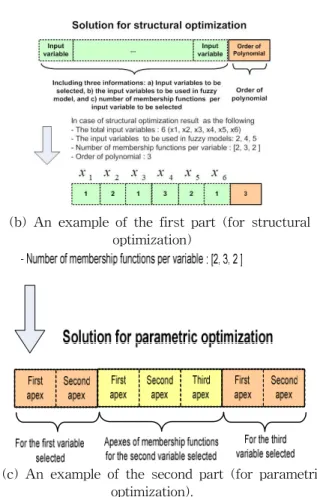
The proposed ISSA is exploited here to optimize the fuzzy models. Figure 1 depicts the arrangement of chromosomes. Genes for structural optimization are linked up with genes used for parametric optimization. The size of the chromosomes for structural optimization of the IG-based fuzzy model is determined according to the number of all input variables of the system. The size of the chromosomes for parametric optimization depends on structurally optimized fuzzy inference system. When constructing fuzzy models, we simultaneously realize the structural as well as parametric optimization of the model.
(a) Arrangement of solutions
(b) An example of the first part (for structural optimization)
(c) An example of the second part (for parametric optimization).
Fig. 1. Arrangement of the chromosome in ISSA Fig. 1 depicts the arrangement of solutions in the SSA-based sequential tuning method. The first part for structural optimization is separated from the second part used for parametric optimization. The size of the solutions for structural optimization of the IG-based fuzzy model is determined according to the number of all input variables of the system. The size of the solutions for parametric optimization depends on structurally optimized fuzzy inference system. In a nutshell, from the viewpoint of structure identification, only one fixed parameter set, which is the assigned apexes of membership functions obtained by C-Means clustering, is considered to carry out the overall structural optimization of fuzzy model. From the viewpoint of parameter identification, only one structurally optimized model that is obtained during the structure identification is considered to be involved in the overall parametric optimization. We simultaneously realize the structural as well as parametric optimization of the model. The second part for parametric identification is linked up with the first part for structure identification within a solution (an individual). The size and arrangement of the first part for structure identification is the same as those in the sequential tuning method, while the size of the second part for parameter identification is determined by considering both the number of the system’s input variables and the number of the membership functions being used in their representation. A stochastic variable (a variant identification ratio) used within a modified simple search
space operator in the ISSA is used support an efficient successive tuning embracing both the structural as well as parametric optimization of the model. During the initial generations of the ISSA, the space search operator is assigned with higher probability to the solution region involving the first part responsible for structural optimization. This probability becomes lower when dealing with a region of the solution involving the second part responsible for parametric optimization. In this manner, the optimization becomes mostly focused on the structural optimization. Over the course of the space search optimization (for higher generations), the probability that the first part can be generated (assigned) within the second part responsible for parameter optimization gradually increases. In this sense, the optimization of the IG-based fuzzy set model becomes predominantly focused on the parametric optimization. The second part related to the parameter optimization of model is serially connected with the first part related to the structural optimization of model. Therefore the “simultaneous topology/parameter search” is carried out for optimization, and the successive tuning method enables us to consider much more extensive topology/parameter search space for optimization.
The space search operator in the ISSA for the successive tuning method being realized with the aid of a variant identification ratio is implemented. Their essential parameters such as gen, maxgen, and l are given. Here, gen is an index of the current generation, maxgen stands for the maximal number of generations being used in the algorithm, and l serves as some adjustment coefficient whose values can determine a variant identification ratio (p) for both structural and parametric optimization. The detailed space search operator in the SSA algorithm is presented as follows:
While { the termination conditions are not met } Select M solutions (parent individuals) from the current solution set, where M is a given number.
Generate random variable (r1).
Calculate a variant identification ratio (p) which is a generation-based stochastic variable of the form
≥ max
(18)
IF {p > 0.5}
Search solution space within the first part of solutions for structural optimization.
ElseSearch solution space within the second part of solutions for parametric optimization.
End IF
Complete the space search operation.
End while
The objective function (performance index) is regarded as a basic mechanism guiding the evolutionary search carried out in the solution space of potential solutions. The objective function involves
both the training and testing data and comes as a convex combination of these two components
× ×
(19) Here, PI and E_PI denote the performance index for the training data and testing (validation) data, respectively. is a weighting factor that allows us to form a sound balance between the performance of the model for the training and testing data. Depending upon the values of the weighting factor, several specific cases of the objective function are worth distinguishing.
(i) If then the model is optimized based on the training data. No testing data is taken into consideration.
(ii) If then both the training and testing data are taken into account. Moreover it is assumed that they exhibit the same impact on the performance of the model.
(iii) The case where ∈ embraces both the cases stated above. The choice of establishes a certain tradeoff between the approximation and generalization aspects of the fuzzy model.
Here we use performance index of the standard root mean squared error (RMSE) and mean squared error (MSE)
or
(20)
4. Experimental studies
This section reports on comprehensive numeric studies illustrating the design of the fuzzy model. We use two well-known data sets. Each data set is divided into two parts of the same size. PI denotes the performance index for the training data and E_PI stands for the testing data. In all considerations, the weighting factor was set to 0.5.
4.1 NOx emission process data
NOx emission process of a GE gas turbine power plant located in Virginia, USA, is chosen in this experiment. The input variables include AT (ambient temperature a site), CS (compressor speed), LPTS (low pressure turbine speed), CDP (compressor discharge pressure), and TET (turbine exhaust temperature). The output variable is NOx. We consider 260 pairs of the original input-output data.
130 out of 260 pairs of input-output data are used as the learning set; the remaining part serves as a testing set. The identification error of the proposed
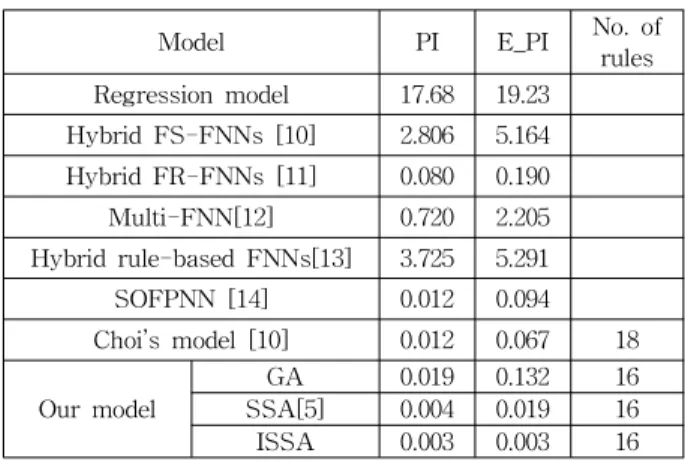
model is compared with the performance of some other models; refer to Table 1. It is clear that the proposed model outperforms several previous fuzzy models known in the literature.
Table 1. Comparative analysis of selected models (NOx)
Model PI E_PI No. of
rules Regression model 17.68 19.23
Hybrid FS-FNNs [10] 2.806 5.164 Hybrid FR-FNNs [11] 0.080 0.190 Multi-FNN[12] 0.720 2.205 Hybrid rule-based FNNs[13] 3.725 5.291 SOFPNN [14] 0.012 0.094 Choi’s model [10] 0.012 0.067 18
Our model GA 0.019 0.132 16
SSA[5] 0.004 0.019 16 ISSA 0.003 0.003 16 4.2 Automobile Miles Per Gallon (MPG) Data
The first dataset is an automobile MPG data (ftp://ics.uci.edu/pub/machine-learning-databased/auto- mpg) with the output being the automobile’s fuel consumption expressed in miles per gallon. The data set includes 392 input-output pairs (after removing incomplete instances) where the input space involves 8 input variables. To come up with a quantitative evaluation of the fuzzy model, we use the standard RMSE performance index.
The automobile MPG data is partitioned into two separate parts. The first 235 data pairs are used as the training data set for IG-based FIS while the remaining 157 pairs are the testing data set for assessing the predictive performance. The identification error of the proposed model is compared with the performance of some other model; refer to Table 7.
The selected values of the performance indexes of the IG-FIS are marked in Table 5 and Table 6, respectively. It is easy to see that the performance of the proposed model is better in the sense of its approximation and prediction abilities.
Table 2. Comparative analysis of selected models (MPG)
Model PI
(RMSE) E_PI
(RMSE) No. of rules
RBFNN [15] 3.24 3.62 36
Linguistic model
[16] 2.86 3.24 36
Functional
RBFNN[25] 2.41 2.82 33
Our model
GA 2.97 2.89 8
SSA[5] 2.74 2.88 8
ISSA 2.67 2.31 8
5. Conclusions
This paper introduced a hybrid identification of fuzzy models by means of an ISSA and IG.
Experimental results show that ISSA-based model lead to better performance than some other fuzzy models reported in the literature.
참 고 문 헌
[1] R.M. Tong, “The evaluation of fuzzy models derived from experimental data” J. Fuzzy Sets Syst.
Vol. 13, pp 1-12, 1980.
[2] C.W. Xu, Y. Zailu, “Fuzzy model identification self learning for dynamic system” J. IEEE Trans. on System, Man, and Cybernetics. Vol. 17(4), pp, 683-689, 1987.
[3] S.K. Oh., W. Pedrycz, “Identification of Fuzzy Systems by means of an Auto-Tuning Algorithm and Its Application to Nonlinear Systems” J. Fuzzy Sets and Syst. Vol 115(2), pp, 205-230, 2000.
[4] S.K. Oh, W. Pedrycz, K.J Park, “Identification of fuzzy systems by means of genetic optimization and data granulation”, Journal of Intelligent & Fuzzy Systems, Vol 18, pp. 31-41, 2007.
[5] W. Huang, L. Ding, S.K. Oh, C.W. Jeong, and S.C.
Joo. 2010. Identification of fuzzy inference system based on information granulation. KSII Trans.
Internet and Information systems. 4(4), 575-594.
[6] R. Hinterding. Gaussian mutation and self-adaption for numeric genetic algorithms. 1995. IEEE international conference on evolutionary computation.
384-389.
[7] W. Pedrycz, “An identification algorithm in fuzzy relational system”. J. Fuzzy Sets Syst. Vol 13, pp, 153-167, 1984.
[8] M. Sugeno, T. Yasukawa, “Linguistic modeling based on numerical data” In: IFSA’91 Brussels, Computer, Management & System Science. pp, 264-267. 1991.
[9] B. J. Park., W. Pedrycz., S. K. Oh, “Identification of Fuzzy Models with the Aid of Evolutionary Data Granulation”. IEE Proc.-Control Theory and Applications, Vol. 148, pp, 406-418, 2001.
[10] J.N. Choi, S.K. Oh, and W. Pedrycz, “Structural and parametric design of fuzzy inference systems using hierarchical fair competition-based parallel genetic algorithms and information granulation”, International Journal of Approximate Reasoning, Vol 49, pp, 631-648, 2008.
[11] Oh, S.K., Pedrycz, W., and Prak, H.S. 2003.
Hybrid identification in fuzzy-neural networks.
Fuzzy Set System. 138 ( Sep. 2003), 399-426.
[12] Park, H.S., and Oh, S.K. 2003. Fuzzy relation-based fuzzy neural-networks using a hybrid identification algorithm. Int. J. Cont., Autom., Syst.
1 (Sep. 2003), 289-300.
Park, H.S., and Oh, S.K. 2003. Multi-FNN
identification based on HCM clustering and evolutionary fuzzy granulation. Int. J. Cont., Autom., Syst. 1 (Jun. 2003), 194-202.
[13] Oh, S.K., Pedrycz, W., and Prak, H.S. 2002. Implicit rule-based fuzzy-neural networks using the identification algorithm of hybrid scheme based on information granulation. Adv. Eng.Inform.16(Oct.2002),247-263.
[14] Oh, S.K., and Pedrycz, W. 2004. A new approach to self-organizing multi-layer fuzzy polynomial neural networks based on genetic optimization. Adv.
Eng.Inform.18(Jan.2004),29-39.
[15] Pedrycz, W., and Kwak, K.C. “Linguistic models as a framework of user-centric system modeling,”
IEEE Trans. Syst., man cybern. –PART A:
Systems and humans, vol. 36, no. 4, pp. 727–745, 2006.
[16] Pedrycz, W., Park, H.S., and S.K. Oh, “A granular-oriented development of functional radial basis function neural networks,” Neurocomputing, vol. 72, pp. 420–435, 2008.
오 성 권(Oh, Sung-Kwun)
1981년 연세대학교 전기공학과 졸업, 동 대학원 석사(1983), 박사(1993). 1983-1989
년 금성산전연구소(선임연구원).
1996-1997년 캐나다 Manitoba 대학 전기 및 컴퓨터공학과 Post-Doc. 1993-2004년 원광대학교 전기전자 및 정보공학부 교 수. 2005~현재 수원대학교 전기공학과 교수, 2002~현재 대한전기학회, 제어로봇시스템학회, 퍼지및지능시스템학회 편집위원. 관심분야는 퍼지 시스
템, 퍼지-뉴럴 네트워크, 자동화 시스템, 고급
computational intelligence, 지능 제어등.
Tel : 031-229-8162 Fax : 031-220-2667 E-mail : [email protected]
김현기(Kim, Hyun-Ki)
1977년 연세대학교 전기공학과 졸업, 동 대학원 석사(1985), 박사(1991). 1997~
현 재 경기지역 산학연 기술지원단
단장, 1998~현재 산업기술정책연구
소 심의위 원, 2000~현재 사단법인
산학연 컨소시 엄 전국협의회 회장,
1989~현재 수원대학교 전기공학과 교수, 관심분야는 시스템 자동화 및 감시제어, 지능형 모델링 및 제어등.
Tel : 031-220-2666 Fax : 031-220-2667
E-mail : [email protected]