ⓒ 2019 The Korean Medicine Society For The Herbal Formula Study
This paper is available at http://www.formulastudy.com which permits unrestricted non-commercial use, distribution, and reproduction in any medium, provided the original work is properly cited.
Official Journal of The Korean Medicine Society For The Herbal Formula Study Available at http://www.formulastudy.com
HFS
Original Article / 원저
병원성 미생물에 대한 다빈도 51종 한약처방의 항균 활성 연구
이나리
1, 신현규
1, 하혜경
1*, 최순용
2**1
한국한의학연구원 한약연구부
2
한남대학교 생명나노과학대학 생명시스템과학과
Antimicrobial Activities of 51 Herbal Formulae on Pathogenic Microorganisms
Nari Lee
1, Hyeun-Kyoo Shin
1, Hyekyung Ha
1*, Soon Yong Choi
2**1
Herbal Medicine Research Division, Korea Institute of Oriental Medicine,
2
Department of Biological Sciences and Biotechnology, Hannam University
ABSTRACT
Objectives: The purpose of this study was to establish experimental evidence for the antimicrobial effects of 51 herbal formulae commonly used in traditional Korean medical institutions.
Methods: The antimicrobial activities of herbal formulae were screened using the disc diffusion method against 10 pathogenic microorganisms (Bacillus cereus, Staphylococcus aureus, Listeria monocytogenes, Vibrio parahaemolyticus, Escherichia coli DH5α, E. coli O157, Salmonella enteritidis, Yersinia enterocolitica, Shigella flexneri, and Helicobacter pylori). Of the 51 herbal formulae, 13 herbal formulae with antimicrobial activity were selected and their dose-dependency were confirmed.
Results: Nine herbal formulae, including Gyeji-tang, Dangguisu-san, Saengmaek-san, Samul-tang, Ssanghwa-tang, Socheongryong-tang, Yukmijihwang-tang, Jakyakgamcho-tang, and Paljung-san, presented antibacterial activity against B. cereus. The effects of Saengmaek-san and Paljung-san was sustained for 48 hr. On L.
monocytogenes, Dangguisu-san and Hyangsapyeongwi-san showed antimicrobial activity, but only Hyangsapyeongwi-san maintained the activity for 48 hr. Thirteen herbal formulae such as Galgeun-tang, Gyeji-tang, Dangguisu-san, Mahwang-tang, Banhasasim-tang, Saengmaek-san, Socheongryong-tang, Yukmijihwang-tang, Jakyakgamcho-tang,
Cheonwangbosim-dan, Palmijihwang-tang, Paljung-san, and Hwanglyeonhaedok-tang showed antimicrobial activity against V. parahaemolyticus, and the activity was maintained for 48 hr. The 51 herbal formulae did not show any antimicrobial activity against seven strains such as E. coli DH5α, E. coli O157, S. aureus, S.
enteritidis, Y. enterocolitica, S. flexneri, and H. pylori.
Conclusions: Nine, two, and thirteen herbal formulae showed antimicrobial activities against B. cereus, L.
monocytogenes, and V. parahaemolyticus in a dose-dependent manner, respectively. The results of antimicrobial activity of 51 herbal formulae against 10 microorganisms might be used as the basis for new application of herbal formulae.
Key words : Herbal formula, Pathogenic microorganisms, Antimicrobial activity, Disc diffusion method.
Ⅰ. 서론
1)병원성 미생물에 의한 식품 오염 및 다양한 감염성 질환의 발병은 심각한 공중보건 문제이며 전세계적으 로 엄청난 경제적 손실의 원인이 되고 있다. 세균의 증식을 억제하는 합성 항균제, 보존제, 방부제 등은 세균의 증식을 억제하여 감염성 질환의 확산을 막거 나 가공식품, 생활 물품들의 유통 및 보존 기간을 증 가시켜주지만 항생제 내성 구균 (methicillin-resistant
Staphylococcus aureus
; MRSA)과 같은 내성 균주 의 발현으로 병원 내 감염의 문제가 되기도 하고1), 환경호르몬으로 작용하여 내분비계 교란을 유발하는 등2.3)의 부작용이 있다.항생제가 개발되기 이전에는 전통적으로 한약을 비 롯한 천연물을 이용하여 감염성 질환을 치료해 왔으 나 합성 항생제 개발 이후로는 천연물을 이용한 감염 병 치료는 미미하였다. 합성 항생제의 장기간 및 고 농도 사용 시 항생제에 대한 내성균이 생기거나 독성 이 증가하는 등의 문제점이 발생하고 있으며, 이에 따라 한약을 비롯한 천연물을 이용한 항균 활성 제품 개발에 대한 관심도 2000년 이후 꾸준히 증가하고 있다4,5). 본 연구팀에서는 한약처방의 병원성 미생물 에 대한 억제 효능에 대한 실험적 근거를 제시하고자 한방의료기관에서 다빈도로 사용되는 한약처방6,7)을 중심으로 51종 한약처방을 활용하여 병원성 미생물
10종에 대한 항균 활성을 평가하였다.
Ⅱ. 재료 및 방법
1. 실험 재료 1) 사용 균주
실험에 사용한 균주 중
Escherichia coli
O157,Helicobacter pylori
,Staphylococcus aureus
,Shigella flexneri
,Salmonella enteritidis
,Bacillus cereus
,Yersinia enterocolitica
,Vibrio parahaemolyticus
,Listeria monocytogenes
등 9종의 균주는 한국미생물 보존센터 (KCCM)에서 구입하였으며,E. coli
DH5α 는 (주)엔지노믹스에서 구입하여 사용하였다.2) 한약처방 추출물 제조
본 실험에 사용된 처방의 구성은 동의보감, 방약합 편을 기준으로 다빈도 및 기본 처방 51종을 선정하였 으며, 처방의 구성 약재들은 ㈜광명당제약 (Ulsan, Korea)에서 의약품 수준의 규격품을 구입 후, 각각의 처방에 따라 약재를 배합한 후 이의 10배에 해당하는 증류수와 함께 100℃에서 2시간 동안 초고속진공저 온추출기 (COSMOS 660, Inchon, Korea)를 이용하 여 추출하였다. 이후 동결건조기를 이용해 완전히 건 조된 분말 형태의 추출물을 얻어 실험에 사용하였다.
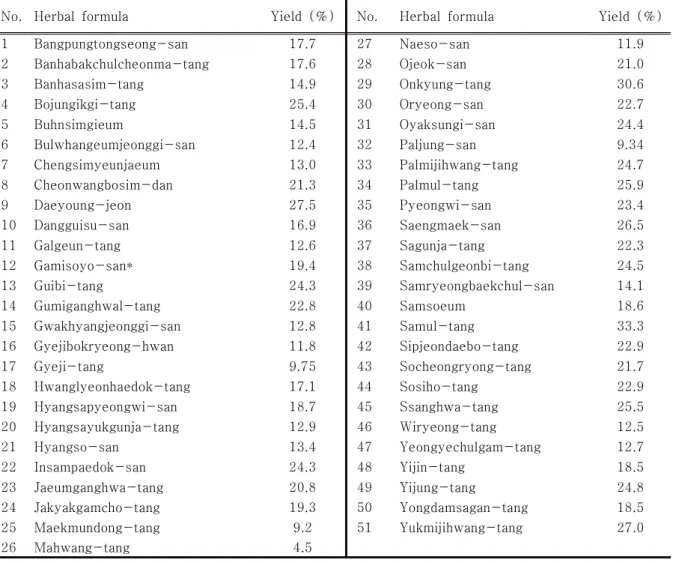
각 한약처방의 추출수율은 Table 1에 나타내었다8).
*Corresponding author : Hyekyung Ha. Herbal Medicine Research Division, Korea Institute of Oriental Medicine, 1672 Yuseong-daero, Yuseong-gu, Daejeon, 34054, Republic of Korea.
Tel : +82-42-868-9513, Fax : +82-42-864-2120, E-mail : [email protected]
**Corresponding author : Soon Yong Choi. Department of Biological Sciences and Biotechnology, Hannam University, 1646 Yuseong-daero, Yuseong-gu, Daejeon, 34430, Republic of Korea.
Tel : +82-42-629-8774, Fax : +82-42-629-8751, E-mail : [email protected]
∙Received : September 16, 2019 / Revised : November 11, 2019 / Accepted : November 19, 2019
2. 실험 방법
1) 미생물 균주 배양 배지 및 배양 조건
각 미생물을 배양하기 위한 배지와 배양 조건은 Table 2와 같다.
2) 항균 활성 측정 (디스크 확산법)
각 미생물을 해당 배지에 접종하여 30℃ 또는 3 7℃의 조건에서 16시간 배양한 후 새로운 배지에 10 배로 희석하였으며, 희석된 배양균주 100 μL를 각 균주별 해당 평판배지에 도말하였다. 해당 균주를 균 일하게 도말한 평판배지에 직경 10 mm 크기의 멸균 된 filter paper disc를 올려놓고 각 한약처방 추출물 희석액 100 μL를 disc에 흡착시켜 각 미생물별 배양 조건 (Table 2)에 맞는 배양기에서 24 시간 및 48 시간 배양하였다. 각 한약처방 추출물은 5 mg/disc 의 농도로 처리되었으며, 배양 후 미생물의 생장이 억제되어 형성된 억제환의 유무와 disc를 포함한 억 제환의 크기, 즉 균 생장 억제 영역의 직경인 clear zone의 크기 (mm)를 측정하여 항균 활성 여부를 판 단하였다.
각 미생물에 대해 48시간까지 항균 활성이 유지되 는 유효 한약처방을 선별하여 한약처방 추출물의 농 도별 항균 활성을 확인하였다. 위와 같은 방법으로 미생물을 도말하고 직경 10 mm 크기의 멸균된 filter paper disc에 유효 한약처방 추출물 희석액을 각 5, 10, 15 및 20 mg/disc의 농도로 흡착시켰다.
각 24 시간 및 48 시간 배양하여 clear zone의 크기 (mm)를 측정하였다.
Ⅲ. 결과
1. 51개 한약 처방의 항균 효과
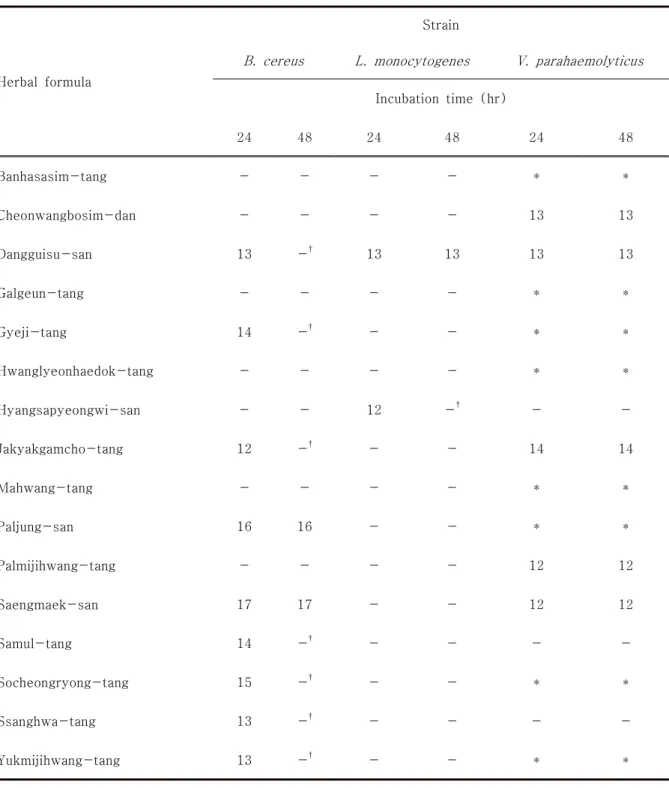
10종 병원성 미생물 균주에 대해 51개의 한약처방 추출물을 5 mg/disc로 동일하게 처리하여 clear zone 형성 여부를 확인한 결과 (Table 3),
B. cereus
에 대해서 생맥산과 팔정산의 clear zone이 24시간 에 각각 17, 16 mm로 나타났으며 48시간까지 지속 되었다. 계지탕 (14 mm), 당귀수산 (13 mm), 사물 탕 (14 mm), 소청룡탕 (15 mm), 쌍화탕 (13 mm), 육미지황탕 (13 mm) 및 작약감초탕 (12 mm)도 배양 24시간까지는 clear zone이 나타났으나 이후 48시간 에 모두 항균 활성이 소실되었다.L. monocytogenes
에 대해서 당귀수산의 clear zone의 크기는 24시간 및 48시간에 13 mm로 나타났고, 향사평위산은 24시 간에 12 mm로 항균활성을 나타냈으나 이후 48 시간 에 소실되었다.
V. parahaemolyticus
에 대해서 작약 감초탕 14 mm, 당귀수산과 천왕보심단 13 mm, 생 맥산과 팔미지황탕은 12 mm의 크기로 clear zone을 형성하여 항균 활성이 있는 것으로 나타났으며 모두 48시간까지 지속되었다. 갈근탕, 육미지황탕, 소청룡 탕, 황련해독탕, 반하사심탕, 계지탕, 마황탕 및 팔정 산은 모두 clear zone이 관찰되었으나 크기가 11 mm 미만이었고, 모두 48시간까지 지속되어 약한 항 균 활성을 나타냈다. 위 언급된 16개 한약처방 이외 의 35개 한약처방은B. cereus, L. monocytogenes
및V. parahaemolyticus
의 3종 균주에 대해서 항균 활성을 나타내지 않았다. 사용된 균주 중E. coli
DH5α,E. coli
O157,S. aureus
,S. enteritidis
,Y. enterocolitica, S. flexneri,
및H. pylori
등 7 종에 대해서는 51개의 한약처방이 모두 항균 활성을 나타내지 않았다.2. 유효 한약처방의 처리 농도별 항균효과
B. cereus, L. monocytogenes
또는V. parahaemolyticus
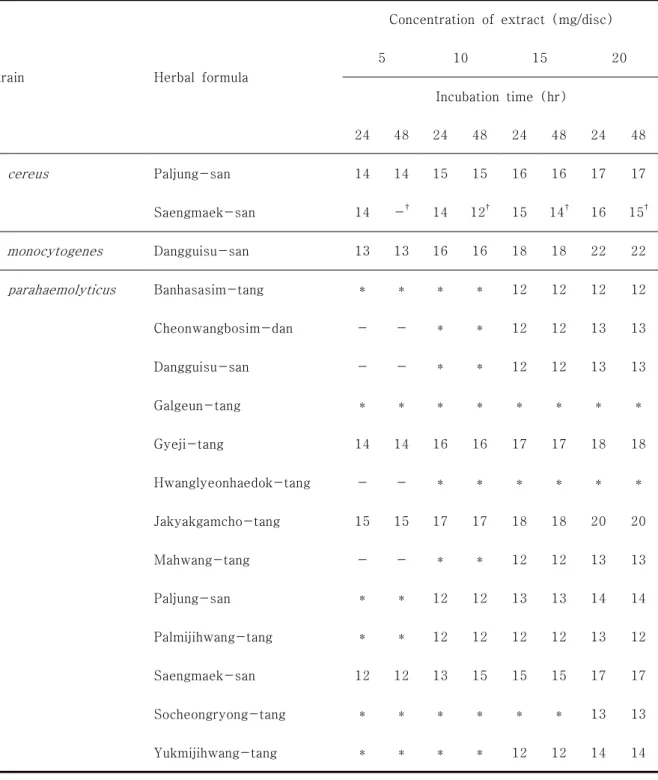
에 대하여 48시간까지 항균 활성을 나타내는 13개 유 효 한약처방을 선별하여 농도별 (5, 10, 15 및 20 mg/disc)로 처리한 후 48시간 동안 항균 활성을 평 가한 결과를 Table 4에 나타냈다.B. cereus
와V.
parahaemolyticus
에 대해서 생맥산과 팔정산의 농도 별 항균 활성을 평가한 결과,B. cereus
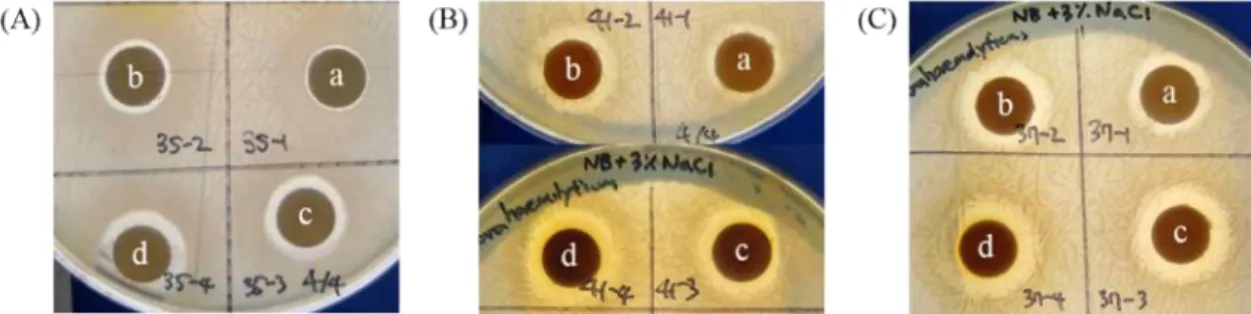
에서는 생맥 산의 농도가 증가할수록 clear zone의 직경이 24시 간 처리 시 14 mm에서 16 mm까지 증가하였고 48시 간에는 11 mm 미만에서 15 mm 까지 clear zone을 형성하였지만 24시간과 비교하여 항균 활성이 감소하 는 것으로 나타났다 (Fig. 1A).V. parahaemolyticus
에 서도 생맥산 처리 시 clear zone의 직경이 12 mm에 서 17 mm까지 농도의존적으로 증가하였고 48시간까 지 유지되었다 (Fig. 2A). 팔정산은B. cereus
에 대 해 clear zone의 직경이 14 mm에서 17 mm (Fig.1B),
V. parahaemolyticus
에서는 11 mm 미만에서 14 mm로 농도의존적으로 항균 활성이 증가되는 것으 로 나타났으며 이러한 활성이 48시간까지 지속되었다.L. monocytogenes
와V. parahaemolyticus
에 대 해서 당귀수산의 농도별 항균활성을 평가한 결과,L.
monocytogenes
에 대해 13 mm에서 22 mm의 clear zone을 형성하여 농도의존적 항균활성을 나타냈을 뿐만 아니라 48시간까지 그 효과가 지속되었고 (Fig.3),
V. parahaemolyticus
에 대해서는 11 mm 미만에 서 13 mm까지 농도의존적 항균 활성을 나타냈으며 이는 48시간까지 지속되었다.V. parahaemolyticus
에 대해서 계지탕과 작약감초탕은 농도의존적으로 항 균 활성이 증가했으며, 최고 농도 (20 mg/disc)에서 clear zone의 직경이 각각 18 mm와 20 mm로 다른 한약처방들과 비교하여V. parahaemolyticus
에 강한 항균력을 나타냈다 (Fig. 2B 및 2C). 반하사심탕, 마 황탕, 소청룡탕, 육미지황탕, 천왕보심단, 팔미지황탕 및 팔정산도V. parahaemolyticus
에 대해 농도의존 적으로 항균 활성이 증가하는 것으로 나타났으나 최 고농도인 20 mg/disc에서 clear zone의 직경이 12 mm에서 14 mm 정도로 약한 항균활성을 나타냈다.갈근탕과 황련해독탕은 20 mg/disc까지 농도를 증가 시켜도
V. parahaemolyticus
에 대한 clear zone의 직경이 11 mm 이하로 매우 약한 항균 활성을 나타냈 다. 이들 한약처방의 항균 활성은 모두 48시간까지 지속되었다.Ⅳ. 고찰
전통의학정보포털 OASIS (https://oasis.kiom.re.kr) 사이트의 논문 검색 시스템에서 현재까지 발표된 한 약의 항균 활성과 관련된 한의계 논문을 확인한 결과
8), 황금 등 단일 약재 (56편), 기존 처방이 아닌 한 약 복합 추출물 (5편), 한약처방의 가감방 (5편), 약 침 및 한약 성분 등의 기타 논문 (15편), 한약 처방에 대한 논문 (57편) 등 총 138편이 검색되었다. 한약처 방의 항균 활성 평가에 사용된 균주는 Staphylococcus 속 (
S. aureus, S. epidermidis
및 methicillin-resistantS. aureus
: MRSA 등)이 가장 사용 빈도가 높았고,E. coli, Bacillus subtilis, V. parahaemolyticus
의 순 이었다. 본 연구에서 사용된 51개 한약 처방에 대 한 국내·외 연구 결과를 정리해보면, 곽향정기산과 보중익기탕은 알레르기성 비염 환자에서 분리한Klebsiella pneumoniae
에 대해 항균활성을 나타냈으 며10), 보중익기탕은S. aureus, Salmonella, L.
monocytogenes, E. coli. H. pylori
등의 세균 감염 동물 모델에 투여 시 생존율을 증가시키거나 위내 세균수를 효과적으로 감소시키는 것으로 보고되었고
11-15), 내소산 (환혼산)은
S. aureus, B. subtilis, E.
coli 및 Pseudomonas aeruginosa
에 대해 항균 활성 을 나타내는 것으로 보고되었으나16), 본 연구에서는 사용한 10종 균주 모두에 대해 항균 활성을 나타내지 않았다. 반하사심탕은H. pylori
감염으로 유발된 위 염 감염균의 사멸뿐만 아니라 손상된 위 조직을 회복 시키는 것으로 알려져 있으나17), 본 연구에서는H.
pylori
에 대한 항균 활성은 관찰되지 않았으며,V.
parahaemolyticus
에 대해서 농도의존적인 항균 활성 을 확인할 수 있었다. 십전대보탕은E. coli
나Bacteroides fragilis
에 대해서는 직접적인 항균 작용 은 없으나 이들에 의한 감염으로 유발된 자궁농종 동 물모델에서는 자궁 내 세균수를 감소시키는 등의 개 선효과18) 및Porphyromonas gingivalis
에 대한 항균 작용과 이에 의해 유발되는 치조골 소실도 억제하는 것으로 알려져 있는데19), 본 연구에서도E. coli
에 대 한 항균 활성은 관찰되지 않았으며, 나머지 9개 균주 에 대해서도 항균 활성이 나타나지 않았다. 팔정산은 비뇨기 및 요로감염과 관련이 있는S. aureus, S.
epidermidis, S. pyogenes, Enterococcus faecalis, Neisseria gonorrhoeae
등 화농성 Gram 양성 구균 과 Gram 음성 쌍구균20),Diplococcus gonorrhoeae
에 대한 항균 작용이 알려져 있는데21), 본 연구에서 는S. aureus
에 대한 항균 활성은 나타나지 않은 반 면B. cereus
와V. parahaemolyticus
에 대해서는 농도의존적 항균 활성이 관찰되었다.황련해독탕은
S. aureus, S. epidermidis
에 대해 항균 활성이 전혀 나타나지 않았다는 보고와22) 고농 도에서S. aureus
에 대해 항균 활성을 나타냈다는 상반된 보고가 있는데23), 본 연구에서는S. aureus
에 대해 항균 활성이 없는 것으로 나타났다. 또한,V.
parahaemolyticus
에 대해서는 항균 활성이 있으나S. flexneri
,P. aeruginosa
,E. coli, S. pneumonia, S. typhi
에 대해서는 항균효과가 없다고 보고되었다24). 본 연구에서도 황련해독탕의
E. coli
에 대한 항균 활성은 관찰되지 않았으며V. parahaemolyticus
에 대해서는 약한 항균 활성을 나타내었다. 마지막으로V. parahaemolyticus
균주에서 소청룡탕이 가장 높 은 항균 활성을, 갈근탕, 곽향정기산, 삼령백출산, 이 진탕 및 평위산이 약한 항균 활성을 나타냈으며, 보 중익기탕 오령산, 이중탕, 사군자탕, 육군자탕, 오적산은 효과가 없는 것으로 발표되었는데25,26), 본 연구 에서도 보중익기탕 등은 항균 효과가 나타나지 않았 으며, 유효하다고 보고되었던 처방 중 소청룡탕과 갈 근탕만 농도의존적인 항균 활성이 나타났다. 이처럼 이전의 보고와 본 연구 결과에서 일치하거나 일치하 지 않는 결과들이 나타난 것에 대해서는 각 연구별로 한약 처방을 구성하는 약재, 추출법, 처리 농도 또는 사용하는 균주의 strain 차이에 의한 것으로 판단된 다. 본 연구에서는 각 한약처방의 구성, 추출방법, 이화학적 성분 함량에 대한 정보가 제공되고 있는 한 약처방8) 51종에 대해 일괄적으로 10종 미생물 균주에 대한 항균 활성 평가 결과를 제시함으로써 추후 유효 한약처방들의 구체적 활용에 대한 실험적 근거로 사 용될 수 있을 것으로 기대된다.
Ⅴ. 결론
한방의료기관에서 다빈도로 사용되거나 방제학 이 론상 기본 처방에 속하는 51종 한약처방을 소재로 10 종 미생물 균주에 대한 항균 활성을 연구한 결론은 다음과 같다.
1. 식중독 또는 심내막염, 폐혈증과 같은 화농성 질 환을 유발할 수 있는
B. cereus
에 대해서 계지 탕, 당귀수산, 사물탕, 생맥산, 쌍화탕, 소청룡탕, 육미지황탕, 작약감초탕, 팔정산 등 9종의 한약 처방이 유효했으나 팔정산과 생맥산 2종 처방만 48시간까지 항균 활성이 지속되었고, 최고 유효 한약처방은 팔정산이었다.2. 뇌수막염, 패혈증, 결막염 등을 유발할 수 있는
L. monocytogenes
에 대해서는 당귀수산과 향사 평위산이 유효했으나 당귀수산만 48시간까지 항 균 활성을 유지하였으며, 최고 유효 처방은 당귀 수산이었다.3. 어패류에 의한 식중독의 원인균인
V. parahaemolyticus
에 대해서는 갈근탕, 황련해독탕, 반하사심탕, 소 청룡탕, 천왕보심단, 당귀수산, 마황탕, 팔미지황 탕, 육미지황탕, 팔정산, 생맥산, 계지탕, 작약감 초탕의 순서로 높은 항균 활성을 나타냈으며, 이 들 13종 한약처방의 항균 활성은 48시간까지 유 지되었다.4.
E. coli
DH5α,E. coli
O157,S. aureus
,S.
enteritidis
,Y. enteocolitica, S. flexneri,
및H.
pylori
등 7종 균주에 대해서는 51종 한약처방 모두 항균 활성을 나타내지 않았다.감사의 말씀
본 연구는 한국한의학연구원의 ‘한약처방의 과학적 근거기반 구축사업 (K16251)’과 ‘한방의료기관 한약처 방 안전성·유효성 구축사업 (K18241)’ 지원으로 수 행되었습니다.
References
1. Prestinaci F, Pezzotti P, Pantosti A. Antimicrobial resistance: a global multifaceted phenomenon.
Pathog Glob Health. 2015;109(7):309-18.
2. Huang H, Du G, Zhang W, Hu J, Wu D, Song L, Xia Y, Wang X. The in vitro estrogenic activities of triclosan and triclocarban. J Appl Toxicol. 2014;34(9):1060-7.
3. Kassotis CD, Klemp KC, Vu DC, Lin CH, Meng CX, Besch-Williford CL, et al. Endocrine- disrupting activity of hydraulic fracturing chemicals and adverse health outcomes after prenatal exposure in male mice. Endocrinology.
2015;156(12):4458-73.
4. Kim E, Choi CH, Kim IH, Lee HI, Song YS.
Antibacterial effect of Huanggeumjakyak-tang against methicillin resistant
Staphylococcus aureus
. J Korean Med Rehabi. 2013;23(3):15-26.5. Kim JH, Do EJ, Lee G. Investigation of anti-microbial activity of herbal medicines used as natural preservatives based on the analysis of papers and patents. J Physiol & Pathol Korean Med. 2015;29(1):101-13.
6. 한약진흥재단. 2017년 한방의료이용 및 한약소비 실태조사 종합편. 2018. 서울. p. 204-21.
(available from: http://koms.or.kr/board/
researchReport/view.do?post_no=46&menu_no=2 1 (accessed 01 April 2019))
7. Lee JT. Research on intake of Chinese Medicine by Korean. Korea Food & Drug Administration.
2006. p. 80-94 - (available from: http://www.
ndsl.kr/ ndsl/commons/util/ ndslOriginalView.
do?dbt=TRKO&cn=TRKO200700007645&rn=&
url=&pageCode=PG18 (accessed 01 April 2019))
8. Shin HK, Ha H, Seo CS, Lee MY, Kim JH, Lee JK, et al. Standard herbal medicine formulary.
Daejeon:Korea Institute of Oriental Medicine.
2018:915.
9. Available from: https://oasis.kiom.re.kr/oasis/
search/search_total.jsp?srch_menu_nix=JI3a9m1 H&collection=article&query=항균 (accessed 01 April 2019).
10. Suh JY, Seo EH, Park SJ, Goo DM. The antimicrobial activity of Bojungikgi-tang, Gwakhyangjeonggi-san, and Gunggwihyangso- san to
Klebsiella pneumoniae
289 extracted from allergic rhinitis patients. J Sasang Constitut Med. 2004;16(3):85-95.11. Matsui K, Uechi Y, Horiguchi A, Yang G, Kitada Y, Ono Y, et al. Antibacterial effect of the Kampo herbal medicine, Hochu-ekki-to on methicillin-registant
Staphylococcus aureus
positive mice. Kampo Med. 1997;48(3):357-67.12. Shimizu S, Furuno H, Horiguchi A, Wang X, Ogata Y, Uechi Y, et al. Establishment of mouse model for
Salmonella
infection and trial of immunomodulating therapy using Hochu-ekki-to. Kampo Med. 1997;48(3):369-76.13. Yamaoka Y, Kawakita T, Kishihara K, Nomoto K. Effect of a traditional chinese medicine, Bu-Zhong-Yi-Qi-Tang on the protection against an oral infection with
Listeria monocytogenes
. Immunopharm. 1998; 39:215-23.14. Shimizu S, Komatsu Y, Wang X, Liu BX, Takeda M, Matsui K, et al. Immunomodulating activity of Hochu-ekki-to against mouse model for enterohemorrahgic
Escherichia coli
infection. Kampo Med. 1998;49(3):429-39.15. Yan X, Kita M, Minami M, Yamamoto T, Kuriyama H, Ohno T, et al. Antibacterial effect of Kampo herbal formulation, Hochu- ekki-to (Bu-Zhong-Yi-Qi-Tang) on
Helicobacter
pylori
infection in mice. Microbiol Immunol.2002;46(7):475-82.
16. Kim JH, Hwang CY, Lim KS. A study on the anti-inflammatory, analgesic and anti- bacterial activity of Hwanhonsan (HHS) water extract and 20% ethanol extract. J Wonkwang Oriental Med. 1994;4(1):361-78.
17. Yang GZ, Zheng YJ, Jiang X, Sun JX, Wang LX, Wang Y. Effect of Banxiaxiexin decoction on H. pylori gastritis by regulating the secretion of HSP70. Chin J Integr Trad West Med Dig.
2016;24(1):001.
18. Mikamo H, Kawazoe K, Izumi K, Sato Y, Tamaya T. Therapeutic effects of herbal medicines (Juzen-taiho-to and Ryutan-shakan- to) in a rat intrauterine infection (pyometra) model. Curr Therap Res. 1997;58(7):454-8.
19. Takeda O, Toyama T, Watanabe K, Sato T, Sasaguri K, Akimoto S, Sato S, Kawata T, Hamada N. Ameliorating effects of Juzentaihoto on restraint stress and
P. gingivalis
- induced alveolar bone loss. Arch Oral Biol.2014;59(11):1130-8.
20. Lee AG, Yoo DG, Lee UJ. Experimental study on the effect of Paljeongsan water extract on analgesic, anti-inflammatory and antimicrobial activity in experimental animals. Herb Formula Sci. 1990;1(1):209-26.
21. Lu H, Li Y, Chen Y. In vitro effects of ancient prescription Bazhengsan against
Diplococus gonorrhoeae
. J Chin Med Mater.1998;21(3):147-8.
22. Seo HS. The experimental study on anti- bacterial potency of Hwangryunhaedoktang herbal-acupuncture & extract on
Staphylococcus aureus
&Staphylococcus epidermidis
. J Korean pharmacopunct Inst. 2006;9(2):99-103.23. Kim IS, Oh HS, Shin MK, Lee YS.
Antimicrobial activity of
Hwangryunheadok-
tang
, and Scutellariae Radix extract, Phellodendri Cortex extract, Coptis Rhizoma extract, Gardenia Jasminoides extract againstStaphylococcus
aureus
. J Int Korean Med. 2014;35(4):455-71.24. Zeng X, Zhou G, Yang X, Liao J. Studies on antibacterial activities of Huanglian Jiedu decoction. Chin Med Herald. 2012;9(19):161-2.
25. Ma JY, Kim JS, Jung KY, Park KJ.
Antimicrobial Activity of Korean Traditional Prescription(Kumkue-Yoryak) and Herb Simplexes
Extracts to Vibrio Parahemolyticus. Korean J Orient Med. 2000;6(1):107-16.
26. Ma JY, Kim JS, Shin SS, Jung KY, Park KJ.
Antimicrobial Activity of Korea Traditional Prescription(Bangyak-Happyon) and Herb Simplexes Extracts to Vibrio parahemolyticus.
Korean J Orient Med. 2000;5(1):59-72.
Table 1. The Lists of Herbal Formulae and their Extraction Yields
No. Herbal formula Yield (%) No. Herbal formula Yield (%)
1 Bangpungtongseong-san 17.7 27 Naeso-san 11.9
2 Banhabakchulcheonma-tang 17.6 28 Ojeok-san 21.0
3 Banhasasim-tang 14.9 29 Onkyung-tang 30.6
4 Bojungikgi-tang 25.4 30 Oryeong-san 22.7
5 Buhnsimgieum 14.5 31 Oyaksungi-san 24.4
6 Bulwhangeumjeonggi-san 12.4 32 Paljung-san 9.34
7 Chengsimyeunjaeum 13.0 33 Palmijihwang-tang 24.7
8 Cheonwangbosim-dan 21.3 34 Palmul-tang 25.9
9 Daeyoung-jeon 27.5 35 Pyeongwi-san 23.4
10 Dangguisu-san 16.9 36 Saengmaek-san 26.5
11 Galgeun-tang 12.6 37 Sagunja-tang 22.3
12 Gamisoyo-san* 19.4 38 Samchulgeonbi-tang 24.5
13 Guibi-tang 24.3 39 Samryeongbaekchul-san 14.1
14 Gumiganghwal-tang 22.8 40 Samsoeum 18.6
15 Gwakhyangjeonggi-san 12.8 41 Samul-tang 33.3
16 Gyejibokryeong-hwan 11.8 42 Sipjeondaebo-tang 22.9
17 Gyeji-tang 9.75 43 Socheongryong-tang 21.7
18 Hwanglyeonhaedok-tang 17.1 44 Sosiho-tang 22.9
19 Hyangsapyeongwi-san 18.7 45 Ssanghwa-tang 25.5
20 Hyangsayukgunja-tang 12.9 46 Wiryeong-tang 12.5
21 Hyangso-san 13.4 47 Yeongyechulgam-tang 12.7
22 Insampaedok-san 24.3 48 Yijin-tang 18.5
23 Jaeumganghwa-tang 20.8 49 Yijung-tang 24.8
24 Jakyakgamcho-tang 19.3 50 Yongdamsagan-tang 18.5
25 Maekmundong-tang 9.2 51 Yukmijihwang-tang 27.0
26 Mahwang-tang 4.5
*The composition of herbs based on Dong-uibogam
Table 2. Culture Conditions of Microorganisms
Strain Culture media Culture condition
B. cereus
Nutrient Broth Aerobic, 30℃S. aureus
Tryptic Soy Broth Aerobic, 37℃L. monocytogenes
Brain Heart Infusion Broth Aerobic, 37℃V. parahaemolyticus
Nutrient Broth with 3% NaCl Aerobic, 37℃E. coli
DH5α Luria Bertani Broth Aerobic, 37℃E. coli
O157 Luria Bertani Broth Aerobic, 37℃S. enteritidis
Luria Bertani Broth Aerobic, 37℃Y. enteocolitica
Tryptose Broth Aerobic, 37℃S. flexneri
Luria Bertani Broth Aerobic, 37℃H. pylori
Luria Bertani Broth Anaerobic, 37℃Table 3. Antimicrobial Activities (the Size of Clear Zone, mm) of Herbal Formulae on the Microbes by using the Disc Diffusion Method.
Herbal formula
Strain
B. cereus L. monocytogenes V. parahaemolyticus
Incubation time (hr)24 48 24 48 24 48
Banhasasim-tang - - - - * *
Cheonwangbosim-dan - - - - 13 13
Dangguisu-san 13 -† 13 13 13 13
Galgeun-tang - - - - * *
Gyeji-tang 14 -† - - * *
Hwanglyeonhaedok-tang - - - - * *
Hyangsapyeongwi-san - - 12 -† - -
Jakyakgamcho-tang 12 -† - - 14 14
Mahwang-tang - - - - * *
Paljung-san 16 16 - - * *
Palmijihwang-tang - - - - 12 12
Saengmaek-san 17 17 - - 12 12
Samul-tang 14 -† - - - -
Socheongryong-tang 15 -† - - * *
Ssanghwa-tang 13 -† - - - -
Yukmijihwang-tang 13 -† - - * *
-; No clear zone (the size of disc: 10 mm)
*; The size of clear zone ≤ 11 mm
†: Reduction of clear zone at 48 hr compared with that at 24 hr
Table 4. Antimicrobial Activity of 13 Herbal Formulae for 24 and 48 hr on the Microbes by using the Disc Diffusion Method.
Strain Herbal formula
Concentration of extract (mg/disc)
5 10 15 20
Incubation time (hr)
24 48 24 48 24 48 24 48
B. cereus
Paljung-san 14 14 15 15 16 16 17 17Saengmaek-san 14 -† 14 12† 15 14† 16 15†
L. monocytogenes
Dangguisu-san 13 13 16 16 18 18 22 22V. parahaemolyticus
Banhasasim-tang * * * * 12 12 12 12Cheonwangbosim-dan - - * * 12 12 13 13
Dangguisu-san - - * * 12 12 13 13
Galgeun-tang * * * * * * * *
Gyeji-tang 14 14 16 16 17 17 18 18
Hwanglyeonhaedok-tang - - * * * * * *
Jakyakgamcho-tang 15 15 17 17 18 18 20 20
Mahwang-tang - - * * 12 12 13 13
Paljung-san * * 12 12 13 13 14 14
Palmijihwang-tang * * 12 12 12 12 13 12
Saengmaek-san 12 12 13 15 15 15 17 17
Socheongryong-tang * * * * * * 13 13
Yukmijihwang-tang * * * * 12 12 14 14
-; No clear zone (the size of disc: 10 mm)
*; The size of clear zone ≤ 11 mm
†: Reduction of clear zone at 48 hr compared to that at 24 hr
Figure legends
Figure 1. Antimicrobial activity of (A)
Saengmaek-san
and (B)Paljung-san
. Each herbal formula was treated with (a) 5 mg/disc, (b) 10 mg/disc, (c) 15 mg/disc, and (d) 20 mg/disc for 48 hr againstBacillus cereus.
Figure 2. Antimicrobial activity of (A)
Saengmaek-san
, (B)Gyeji-tang
, and (C)Jakyakgamcho-tang
. Each herbal formula was treated with (a) 5 mg/disc, (b) 10 mg/disc, (c) 15 mg/disc, and (d) 20 mg/disc for 48 hr againstVibrio parahaemolyticus.
Figure 3. Antimicrobial activity of