서 론
지구 온난화와 에너지가의 폭등으로 미국에서는 에탄올 생산이 증가되고 있으며, 매년 계속적으로 증가되는 추세이 다(Renewable Fuels Association, 2005). 에탄올은 주로 옥수수 를 효모로 발효시켜 생산된다. 이 과정에서 옥수수는 물과 합하여 슬러리가 되고, 이런 슬러리내 전분은 용해, 당화(가 수분해) 및 발효되어 에탄올이 된다. 에탄올을 생산한 후 생긴 부산물(옥수수배아, 섬유소, 단백질)을 바로 가축에 급여할 수 있도록 생산하거나(미건조 증류 곡물; WDG, wet distillers grains), 건조시켜 건조 증류 곡물(DDG, dried distillers grains) 로 만들 수 있다(USGC, 2006). WDG는 섬유소 함량이 높기 때문에 주로 반추가축에 사용되고, DDG는 전 축종에 급여 되고 있다(Singh 등, 2005; Hart와 Carriquiry, 2007). DDG에
시럽 형태의 액상 잔사물을 첨가하여 건조한 것을 DDGS(dis- tillers dried grains with solubles)라고 한다(USGC, 2006).
지난 수십 년 동안 미국내 에탄올 생산이 증가하면서 DDGS 의 사용도 계속적으로 증가되어 왔으며, 향후 10년 이상 지 속적 생산이 예측된다. 미국곡물협회(USGC, 2006)의 보고에 따르면, 2006년 DDGS 생산량은 850만 톤을 차지하였다.
DDGS의 영양적 가치는 다양한 요인에 의해 영향을 받는 다. 건조 과정 중, 고온 처리는 단백질을 변성시키며, 아미노 산 특히, lysine의 이용률 감소의 원인이 된다(Martinez Amez- cua와 Parsons, 2007). 이것은 주로 탄수화물, 특히 환원된 당 류와 lysine의 반작용 때문이다(Cromwell 등, 1993; Spiehs 등, 2002). 가금류에서 DDGS내 곡류와 액상 물질(solubles)의 비 율 또한 영양적 가치에 영향을 미친다(Martinez Amezcua 등, 2007). DDGS 생산을 위한 새로운 기술들도 영양적인 가치
육계에 있어서 옥수수 주정박의 진정 대사 에너지가 측정 및 사료내 첨가가 생산성과 영양소 이용률에 미치는 영향
홍의철1․정완태1․강근호1․박희두1․서옥석1․나재천1․김원2․노환국3․황보 종1,†
1농촌진흥청 국립축산과학원, 2한일사료, 3한국농업전문대학
Evaluation of True Metabolizable Energy and the Effect of Corn Distillers Dried Grains with Solubles in the Diets on Broiler Performance and Nutrient Availability
E. C. Hong1, W. T. Chung1, G. H. Kang1, H. D. Park1, O. S. Suh1, J. C. Na1, W. Kim2, W. G. Nho3 and J. Hwangbo1,†
1
National Institute of Animal Science
2
Hanilfeed, Co., LTD.
3
Korea National Agriculture College, RDA
ABSTRACT This study was conducted to investigate the effect of corn distillers dried grains with solubles (CDDGS) in broiler
diet on ileal amino acid digestibility and broiler performance. In experiment 1, TMEn of CGGDS ranged from 2,863 to 2,976 kcal/kg and averaged 2,904 kcal/kg on an 86% DM basis. In experiment 2, 192 male Ross broilers (one-day-old) were assigned randomly to 4 dietary treatment groups (12 birds/pen, 4 pens/treatment) as CDDGS levels (0, 6, 12 and 18%) and fed experimental diets for 6 weeks (starter (0~2wk); grower (2~4wk); finisher (4~6wk)). There was no difference in BWG of the chicks. However, feed intake and feed efficiency of chicks fed with non CDDGS groups were better than those of chicks fed with CDDGS fed groups (P<0.05).The amino acid digestibilities of diets containing CDDGS were high for phosphorus but low for lysine, threonine, aspartic acid, cystine and glycine (P<0.05) in the treatments compared to those of the control diet. This study showed that CDDGS has a high ME value and the treatments were low for the ileal amino acid digestibility, but there was no effect on the broiler performances.
(Key words : corn distillers dried grains with solubles, broiler, performance, nutrient availability)
†
To whom correspondence should be addressed : [email protected]
에 영향을 준다(Martinez Amezcua 등, 2007). 특히, DDGS 생 산 과정 중 발효는 phytic acid(피트산)을 감소시켜 인의 생체 이용성을 증가시킨다(Martinez Amezcua와 Parsons, 2007).
DDGS는 지난 수십 년 동안 사료 원료로서 이용되어 왔다 (Runnels, 1966; Scott, 1970; Waldroup 등, 1981). DDGS와 같 은 새로운 사료 원료를 사용하기 위해서는, 대사 에너지와 아미노산 조성을 고려하여야 한다. 과거, 사료내 DDGS의 사 용은 공급량이나 가격이 제한되어 있으며(Waldroup 등, 1981), 영양소의 함량이나 소화율도 일정하지 않아서(Noll 등, 2001), 대략 5%를 사료에 첨가하여 이용하였다(USGC, 2006). Day 등(1972)의 초기 연구에서는 CDDGS를 5%까지 급여 시 육 계의 증체량이 증가하였다. Waldroup 등(1981)은 육계 사료 내 에너지 수준이 유지된다면, CDDGS를 25%까지 첨가할 수 있으며, 최근 연구에서는 높은 품질의 CDDGS는 육계 초기, 육성기 및 비육기 사료의 12% 수준까지 첨가될 수 있다고 하 였다(Lumpskin 등, 2003, 2004). 따라서 본 연구는 미국에서 널리 이용되고 있는 옥수수 주정박(corn distiller's dried grains with solubles, CDDGS)의 진정 대사 에너지(TMEn)가를 측정 하고, CDDGS의 첨가 수준(0, 6, 12, 18%)에 따른 육계의 생 산성과 회장 아미노산 소화율을 조사하기 위해 실시하였다.
재료 및 방법 1. 공시 동물, 시험 설계 및 시험 사료
<시험 1>
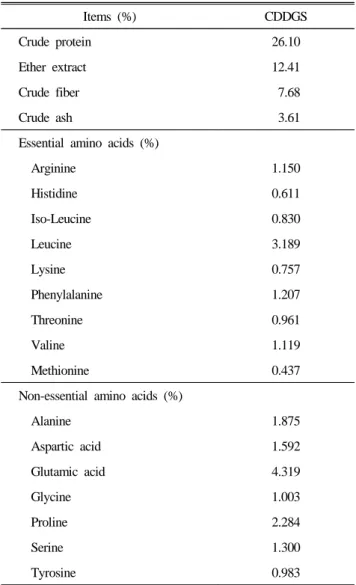
CDDGS의 TMEn가를 측정하기 위해 시판 Ross종 6주령 육계(2.1 ± 0.15 kg) 24수를 선별하여 실시하였다. 시험 사료 는 한국사양표준(가금, 2007)에서 제시한 기초 사료(육계 후 기 사료)와 미국산 CDDGS를 70 : 30으로 배합하였으며, 지 시물질로서 산화크롬(Cr2O3)을 0.2% 첨가하였다. Table 1은 본 시험에 사용된 CDDGS의 일반 성분과 아미노산 함량을 나 타낸 것이다.
<시험 2>
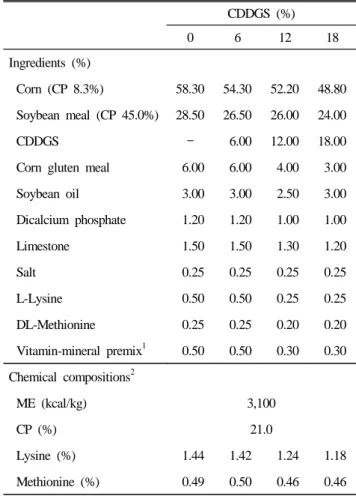
공시계로는 1일령 Ross종 육계 수컷 192수(44.5 ± 2.0 g)를 선별하여, 육계초기(0~2주), 전기(2~4주) 및 후기(4~6주)의 6주 동안 사양 시험을 실시하였다. 한국사양표준(가금, 2007) 에서 제시한 옥수수-대두박 위주의 기초 사료(육계 초기, 전 기와 후기)에 CDDGS를 0, 6, 12와 18%의 수준별로 첨가하 여 4개의 처리구로 나누고, 처리당 4반복, 반복당 12수씩 체 중별로 완전 임의 배치하였다. 처리구간 사료의 CP와 ME가
Table 1. Chemical compositions of CDDGS
1(86% DM Basis)
Items (%) CDDGS
Crude protein 26.10
Ether extract 12.41
Crude fiber 7.68
Crude ash 3.61
Essential amino acids (%)
Arginine 1.150
Histidine 0.611
Iso-Leucine 0.830
Leucine 3.189
Lysine 0.757
Phenylalanine 1.207
Threonine 0.961
Valine 1.119
Methionine 0.437
Non-essential amino acids (%)
Alanine 1.875
Aspartic acid 1.592
Glutamic acid 4.319
Glycine 1.003
Proline 2.284
Serine 1.300
Tyrosine 0.983
1
CDDGS, corn distillers dried grains with solubles.
는 <시험 1>에서 얻어진 CDDGS의 CP와 ME가를 사용하여 초기(CP 23%, ME 3,050 kcal/kg), 전기(CP 21%, ME 3,100 kcal/kg) 및 후기(CP 19%, ME 3,150 kcal/kg)로 나누어 동일 한 수준으로 급여하였다(Table 2, 3, 4).
사양 시험이 끝난 후 체중이 유사한 6주령 육계(2.0 ± 0.3 kg)를 각 처리구에서 12수씩 선별하여, 동일한 육계 후기 사 료를 이용하여 7일간 소화 시험을 실시하였다. 지시물질로 서 Cr2O3를 0.2% 첨가하였다.
2. 사양 관리
<시험 1>
모든 시험계는 총배설강에 자체 제작한 대사틀을 장착하
Table 2. Formula and chemical compositions of experimental
diets in starter period
*(0~2 weeks)
CDDGS (%)
0 6 12 18
Ingredients (%)
Corn (CP 8.3%) 52.65 48.05 41.05 32.95 Soybean meal (CP 45.0%) 30.00 28.65 28.50 30.80
CDDGS - 6.00 12.00 18.00
Corn gluten meal 9.30 8.60 11.50 11.50
Soybean oil 3.00 3.20 2.50 2.50
Dicalcium phosphate 1.50 1.70 1.00 1.20
Limestone 2.00 2.20 1.80 1.50
Salt 0.25 0.25 0.25 0.25
L-Lysine 0.50 0.50 0.50 0.50
DL-Methionine 0.25 0.30 0.35 0.25
Vitamin-mineral premix
10.50 0.50 0.50 0.50
Antibiotic 0.05 0.05 0.05 0.05
Chemical compositions
2ME (kcal/kg) 3,050
CP (%) 23.0
Lysine (%) 1.60 1.57 1.71 1.80
Methionine (%) 0.54 0.57 0.65 0.62
1
Provided following nutrients per kg of diet: vitamin A, 9,000,000 IU; vitamin D
3, 2,100,000 IU; vitamin E, 15,000 IU; vitamin K, 2,000 mg; vitamin B
1, 1,500 mg; vitamin B
2, 4,000 mg; vitamin B
6, 3,000 mg; vitamin B
12, 15 mg; Ca-pantothenate, 8,500 mg;
niacin, 20,000 mg; biotin, 110 mg; folic acid, 600 mg; Co, 300 mg;
Cu, 3,500 mg; Mn, 55,000 mg; Zn, 40,000 mg; I, 600 mg; Se, 130 mg.
2
Calculated values.
*
CDDGS, corn distiller's dried grains with solubles; ME, meta- bolizable energy; CP, crude protein; EE, ether extract; CF, crude fiber; P, phosphorus.
였으며, 36시간 절식시킨 후 48시간 배설물을 채취하였다.
이후 동일한 시험계에 기초 사료를 1주간 자유급이시키고, 다시 24시간을 절식시킨 다음, CDDGS가 30% 함유된 시험 사료 100 g을 4일 동안 오전과 오후로 나누어 2회 급여하고, 배설물을 채취하였다. 분뇨는 매일 아침, 저녁 2회 일정시간 에 채취하였으며, 대사틀에 0.1 N HCl을 넣어 미생물에 의한
Table 3. Formula and chemical compositions of experimental diets in starter period
*(2~4 weeks)
CDDGS (%)
0 6 12 18
Ingredients (%)
Corn (CP 8.3%) 58.30 54.30 52.20 48.80 Soybean meal (CP 45.0%) 28.50 26.50 26.00 24.00
CDDGS - 6.00 12.00 18.00
Corn gluten meal 6.00 6.00 4.00 3.00
Soybean oil 3.00 3.00 2.50 3.00
Dicalcium phosphate 1.20 1.20 1.00 1.00
Limestone 1.50 1.50 1.30 1.20
Salt 0.25 0.25 0.25 0.25
L-Lysine 0.50 0.50 0.25 0.25
DL-Methionine 0.25 0.25 0.20 0.20
Vitamin-mineral premix
10.50 0.50 0.30 0.30 Chemical compositions
2ME (kcal/kg) 3,100
CP (%) 21.0
Lysine (%) 1.44 1.42 1.24 1.18
Methionine (%) 0.49 0.50 0.46 0.46
1
Provided following nutrients per kg of diet: vitamin A, 9,000,000 IU; vitamin D
3, 2,100,000 IU; vitamin E, 15,000 IU; vitamin K, 2,000 mg; vitamin B
1, 1,500 mg; vitamin B
2, 4,000 mg; vitamin B
6, 3,000 mg; vitamin B
12, 15 mg; Ca-pantothenate, 8,500 mg; nia- cin, 20,000 mg; biotin, 110 mg; folic acid, 600 mg; Co, 300 mg;
Cu, 3,500 mg; Mn, 55,000 mg; Zn, 40,000 mg; I, 600 mg; Se, 130 mg.
2
Calculated values.
*
CDDGS, corn distiller's dried grains with solubles; ME, metabo- lizable energy; CP, crude protein; EE, ether extract; CF, crude fi- ber; P, phosphorus.
부패와 암모니아 가스 발생을 최소화 하였다.
<시험 2>
사료는 자유급이를 하였으며, 음수는 니플을 통하여 자유 롭게 마실 수 있게 하였다. 24시간 연속 점등으로 계사내 평 균온도는 입추시에는 34 ℃로 조절하였으며, 성장 단계에 따 라 온도를 점점 낮추어 4주령부터는 24 ℃로 조절하였다. 계
Table 4. Formula and chemical compositions of experimental diets in starter period
*(4~6 weeks)
CDDGS (%)
0 6 12 18
Ingredients (%)
Corn (CP 8.3%) 64.25 60.25 58.55 55.65 Soybean meal (CP 45.0%) 26.10 24.10 20.00 17.10
CDDGS - 6.00 12.00 18.00
Corn gluten meal 4.00 4.00 3.80 3.50
Soybean oil 2.00 2.00 2.00 2.50
Dicalcium phosphate 1.50 1.50 1.50 1.30
Limestone 1.20 1.20 1.20 1.00
Salt 0.25 0.25 0.25 0.25
L-Lysine 0.20 0.20 0.20 0.20
DL-Methionine 0.25 0.25 0.25 0.25
Vitamin-mineral premix
10.25 0.25 0.25 0.25 Chemical compositions
2ME (kcal/kg) 3,150
CP (%) 19.0
Lysine (%) 1.16 1.14 1.05 1.00
Methionine (%) 0.46 0.46 0.46 0.46
1
Provided following nutrients per kg of diet: vitamin A, 9,000,000 IU; vitamin D
3, 2,100,000 IU; vitamin E, 15,000 IU; vitamin K, 2,000 mg; vitamin B
1, 1,500 mg; vitamin B
2, 4,000 mg; vitamin B
6, 3,000 mg; vitamin B
12, 15 mg; Ca-pantothenate, 8,500 mg; nia- cin, 20,000 mg; biotin, 110 mg; folic acid, 600 mg; Co, 300 mg;
Cu, 3,500 mg; Mn, 55,000 mg; Zn, 40,000 mg; I, 600 mg; Se, 130 mg.
2
Calculated values.
*
CDDGS, corn distiller's dried grains with solubles; ME, metabo- lizable energy; CP, crude protein; EE, ether extract; CF, crude fiber; P, phosphorus.
Table 5. Prediction equations for TME
nof corn distillers dried grains with solubles based on 1, 2, 3, or 4 variables (86% DM basis)
Variable (n) Variable (%) Prediction equation
*R
21 Fat TME
n= 2439.4 + 43.2 (fat) 0.29
2 Fat, fiber TME
n= 2957.1 + 43.8 (fat) - 79.1 (fiber) 0.43
3 Fat, fiber, protein TME
n= 2582.3 + 36.7 (fat) - 72.4 (fiber) + 14.6 (protein) 0.44 4 Fat, fiber, protein, ash TME
n= 2732.7 + 36.4 (fat) - 76.3 (fiber) + 14.5 (protein) - 26.2 (ash) 0.45
*
Batal and Dale (2006).
사내 습도는 육계 초기와 전기에는 약 70%, 육계 후기에는 약 60%를 유지하였다. 기타 사양 관리는 농촌진흥청 국립축 산과학원의 사양 관행에 따라서 수행하였다.
3. 조사 항목
1) 아미노산, 에너지 및 일반 성분 분석
사료와 분의 일반 성분과 표시물로 혼합된 Cr2O3는 AOAC (1995)에 의해 분석하였다. 아미노산 함량은 6 N HCl로 110℃
에서 16시간 동안 가수분해시킨 후(Mason, 1984), 아미노산 분석기(HITACHI L-8500A, Japan)를 이용하여 분석하였다. 사 료와 분뇨의 총 에너지(gross energy, GE) 함량은 bone calori- meter(Parr 6200 Instrument, US)를 사용하여 측정하였다. TMEn
가는 절식과 사료급이 시험계에서 채취한 분뇨 배설물을 이 용하여 다음 공식에 의해 산출되었다(Hill과 Anderson, 1958).
TMEn (kcal/g) = {A - (B + C) × (D/E) - F}/30
A = 사료 총 에너지(GE) B = 사료급이 시험축의 배설 GE C = 절식 시험축의 배설 GE
D = 사료 급이 시험축의 배설 Cr2O3 함량 E = 절식 시험축의 배설 Cr2O3 함량 F = 8.22 ×질소 균형 (g)
산출된 값을 Batal과 Dale(2006)이 제시한 CDDGS의 TMEn
가 평가 공식(Table 5)과 비교하였다.
2) 사료 섭취량, 체중 및 사료 효율
사양 시험 기간 중 체중과 사료 섭취량을 매주 1회 오전 10시에 측정하였다. 사료 섭취량은 사료 잔량을 측정하여 사 료 급여량에서 제한 값을 계산하였다. 사료 효율은 섭취량에 서 증체량을 나누어 계산하였다.
3) 회장 소화율 측정
사양 시험이 끝난 육계는 처리구별로 12수씩을 선별하였 다. 선별된 개체들은 7일간의 소화 시험을 거친 후 diethyl ether 로 마취시키고, 회장 말단부위(회장 끝에서 2 cm 되는 부분) 부터 3등분하여 상부, 중부, 하부로 하고, 중부와 하부에서 소화 내용물을 즉시 채집하여 시료 용기에 담아 -20℃에서 냉동 보관하였다. 냉동된 소화 내용물은 동결 건조시킨 후, 1 mm 이하로 분쇄하여 소화율 측정에 사용하였다.
4. 화학 분석과 통계 처리
본 시험에서 얻어진 모든 자료는 SAS(1999)의 GLM을 이 용 Duncan's multiple range test(Duncan, 1955)로 처리하여 평 균 간의 유의성을 검정하였다.
결과 및 고찰
1. CDDGS의 진정 대사 에너지
본 시험에서 얻어진 CDDGS의 TMEn가를 Batal과 Dale (2006)의 평가 공식에 의해 산출된 값과 비교하여 Table 6에 나타내었다. 본 시험에서 일반적 생물학적 방법으로 측정한 CDDGS의 TMEn가는 2,937 ± 50.1 kcal/kg 이었고, Batal과 Dale (2006)의 TMEn평가 공식으로 구한 값은 2,863~2,976 kcal/kg, 평균 2,904 kcal/kg으로 크게 차이가 없었다. 이것은 CDDGS 를 86% 건물 기준으로 환산 시, NRC(1994)에서 제시한 TMEn
값(2,864 kcal/kg)보다 높게 나타났다. CDDGS의 AMEn 값에 대한 보고들은 산란계에서 2,770 kcal/kg, 칠면조 병아리 2,750 kcal/kg, 그리고 칠면조는 2,880 kcal/kg였다(Potter, 1966; Noll, 2004a,b). 본 시험에서 CDDGS의 AMEn값은 2,891 kcal/kg으 로, 다른 보고들에 비해 높게 나타났다.
가금류에 있어서 ME가는 사료의 상대적 가치를 알 수 있
Table 6. TME
nof distillers dried grains with solubles (CDDGS
3; 86% DM basis)
Index In vivo
1Prediction equations for TME
n21 2 3 4 Mean
--- kcal/kg ---
TME
n2,937 ± 50.1 2,976 2,893 2,863 2,882 2,904
1
Hille and Anderson (1958).
2
Batal and Dale (2006).
3
CDDGS, corn distillers dried grains with solubles.
는 중요한 요소이다. 따라서 ME가를 신속하게 알아낼 수 있 는 방법을 개발하기 위하여 많은 노력들이 있어 왔음에도 불구하고, 사료 원료의 다양성이나 품종과 성장 단계에 따른 변이들에 의하여 사료 가치를 측정하는데 어려움이 있다. ME 가를 측정함에 있어서 직접 실험 동물을 이용하는 생물학적 방법(in vivo)이 가장 이상적이기는 하지만, 많은 시간과 비용 이 드는 단점이 있다. 따라서, 원료의 몇 가지 성분(조지방, 조섬유, 단백질, 조회분)만을 가지고 사료의 ME가를 추정할 수 있는 Batal과 Dale(2006)의 평가 공식과 같은 산출식 등의 개발로 소요되는 시간과 비용을 단축시킬 수 있을 것으로 사료된다.
2. 증체량, 사료 섭취량 및 사료 효율
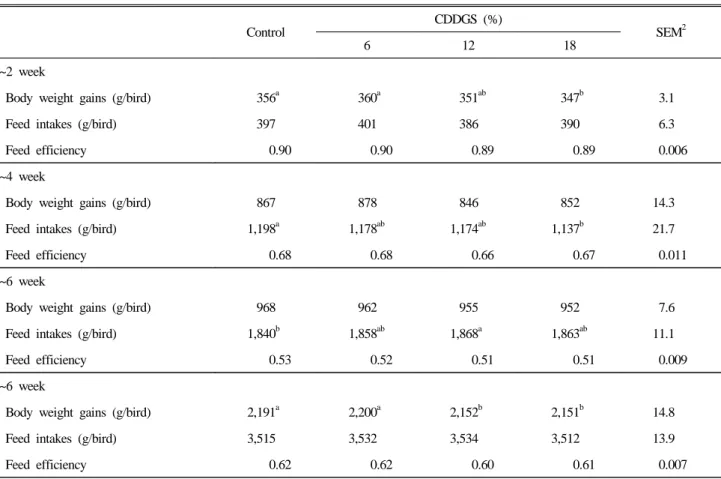
육계 초기(0~2주), 전기(2~4주), 후기(4~6주) 및 전 기간 (0~6주) 동안 증체량, 사료 섭취량 및 사료 효율을 Table 7에 나타내었다. 육계 초기에는 증체량이 CDDGS 18% 첨가구에 서 유의적으로 낮게 나타났으나(P<0.05), 사료 섭취량과 사 료 효율은 처리구간에 차이가 없었다. 육계 전기에서 증체량 은 처리구간에 차이가 없었으나, 사료 섭취량은 CDDGS의 첨가 수준이 높아짐에 따라 낮아지는 경향을 보였다(P<
0.05). 육계 후기에서도 전기와 마찬가지로 증체량은 처리구 사이에서 차이가 없었으나, 사료 섭취량은 CDDGS 12% 첨 가구에서 가장 높게 나타났다(P<0.05). 전 기간 동안 증체량 에서는 대조구와 CDDGS 6% 첨가구에서 12%와 18% 첨가 구에 비해 높게 나타났으며(P<0.05), 사료 효율은 처리구간 에 차이가 없었다. 시험 기간 중 사료 효율은 육계 초기, 전 기, 후기 및 전 기간 동안에 처리구 사이에서 차이가 없었다.
과거 수십 년간, CDDGS는 주로 성장을 촉진하는 미지 인 자의 공급원으로서 가금 사료에 10% 이하의 수준으로 사용 되었다. Couch 등(1957)은 CDDGS를 5% 첨가하는 것으로 칠 면조의 성장률이 17~32% 향상되고, Day 등(1972)은 CDDGS 를 5.0%까지 첨가하였을 때, 육계의 증체량이 증가한다고 보고하였다. 그러나 Cantor와 Johnson(1983)은 옥수수-대두박 위주 사료와 비교하여 CDDGS를 첨가한 사료의 성적이 낮 다고 보고하였다. 본 시험은 사료 내 5% 첨가 수준을 기초로 하여 6, 12, 18%까지 CDDGS를 공급하였다. 이것은 Lump- skin 등(2004)의 시험과 동일한 수준으로, 이들은 육계 초기 에서 18% CDDGS 수준을 급여한 병아리에서 증체량과 사료 효율이 감소하였다. 그러나, 본 시험에서 육계 초기에서는 CDDGS 18% 첨가구에서 증체량이 감소했으나(P<0.05), 사 료 효율에는 차이가 없었다. 사료 섭취량은 CDDGS 첨가구 에서 육계 전기에 감소하였으나, 육계 후기에는 섭취량의 증
Table 7. Body weight gain, feed intake, and feed efficiency on the additive levels of CDDGS in the diet of broiler chicks
1Control
CDDGS (%)
SEM
26 12 18
0~2 week
Body weight gains (g/bird) 356
a360
a351
ab347
b3.1
Feed intakes (g/bird) 397 401 386 390 6.3
Feed efficiency 0.90 0.90 0.89 0.89 0.006
2~4 week
Body weight gains (g/bird) 867 878 846 852 14.3
Feed intakes (g/bird) 1,198
a1,178
ab1,174
ab1,137
b21.7
Feed efficiency 0.68 0.68 0.66 0.67 0.011
4~6 week
Body weight gains (g/bird) 968 962 955 952 7.6
Feed intakes (g/bird) 1,840
b1,858
ab1,868
a1,863
ab11.1
Feed efficiency 0.53 0.52 0.51 0.51 0.009
0~6 week
Body weight gains (g/bird) 2,191
a2,200
a2,152
b2,151
b14.8
Feed intakes (g/bird) 3,515 3,532 3,534 3,512 13.9
Feed efficiency 0.62 0.62 0.60 0.61 0.007
1
CDDGS, corn distiller's dried with solubles.
2
Pooled standard error of the mean for 192 birds per treatment.
a,b
Means with different superscripts in the same row differ significantly (P<0.05).
가를 보였다. 따라서 육계의 성장 단계에 따른 CDDGS의 사 료 이용률에 관한 향후 연구가 요구된다.
3. 외관상 회장 소화율
CDDGS는 가금 사료에 대해 충분한 양의 에너지와 아미 노산 및 인을 공급할 수 있다. 그러나 CDDGS의 성분 함량 은 생산 공정, 방법 및 지역에 따라 달라지기 때문에, 가금 사료 배합 시에 영양소 수준을 고려하여야 한다. 본 시험에 사용된 CDDGS의 영양소 수준은 NRC(1994)에서 제시한 값 보다 높았다.
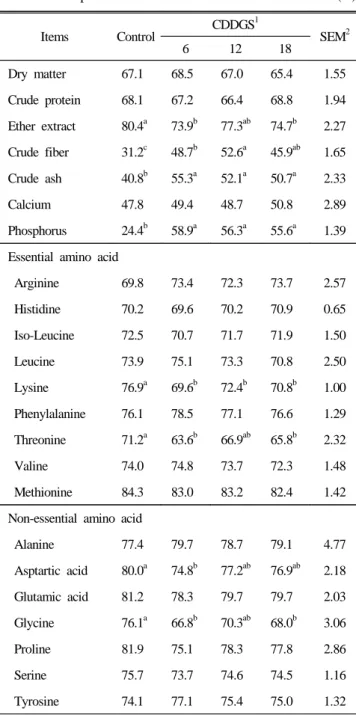
CDDGS의 회장내 일반 성분과 아미노산 소화율은 Table 8에 나타내었다. 조단백질의 소화율은 전체 처리구간에 차 이가 없었다. 조섬유, 조회분 및 인의 소화율은 CDDGS 처리 구가 대조구에 비해 높게 나타났다(P<0.05). CDDGS의 발효 과정에서 인의 소화율이 향상된다(Batal과 Dale, 2006). 특히 CDDGS내 총 인의 함량 중 50% 이상이 non-phytate-P(비피틴
태인)의 형태로 존재하며(NRC, 1994), 이것은 인의 생체 이 용률의 증가를 의미한다. 칼슘의 소화율은 처리구간 차이가 없었다. 아미노산의 소화율은 처리구간 차이가 없었으나, 필 수 아미노산 중 lysine과 threonine의 소화율이 CDDGS 첨가 구에서 감소하였다(P<0.05). CDDGS 생산 중 건조과정은 아 미노산, 특히 lysine의 소화율을 감소시킨다(Martinez Amez- cua와 Parsons, 2007). 본 시험에서도 lysine의 소화율이 감소 하였다. 비필수 아미노산에서는 aspartic acid와 glysine의 소 화율이 CDDGS 첨가구에서 감소하였으며(P<0.05), 다른 아 미노산들은 처리구간에 차이가 없었다. 이것은 아미노산 소 화율을 조사한 다른 연구들의 결과와 유사하였다(Parsons 등, 1983; Ergul 등, 2003; Lumpkins 등, 2005; Martinez Amezcua 와 Parsons, 2007).
과거의 연구들은 제한적 환경에서 실시되어, 결과적으로 CDDGS의 lysine 소화율이 옥수수의 lysine 소화율(81%)보다 낮으며(NRC, 1994), 이는 CDDGS 생산 과정 중 건조 과정에
Table 8. Apparent ileal digestibilities of nutrients and amino acids
of experimental diets (%)
Items Control CDDGS
1SEM
26 12 18
Dry matter 67.1 68.5 67.0 65.4 1.55
Crude protein 68.1 67.2 66.4 68.8 1.94
Ether extract 80.4
a73.9
b77.3
ab74.7
b2.27 Crude fiber 31.2
c48.7
b52.6
a45.9
ab1.65 Crude ash 40.8
b55.3
a52.1
a50.7
a2.33
Calcium 47.8 49.4 48.7 50.8 2.89
Phosphorus 24.4
b58.9
a56.3
a55.6
a1.39 Essential amino acid
Arginine 69.8 73.4 72.3 73.7 2.57
Histidine 70.2 69.6 70.2 70.9 0.65
Iso-Leucine 72.5 70.7 71.7 71.9 1.50
Leucine 73.9 75.1 73.3 70.8 2.50
Lysine 76.9
a69.6
b72.4
b70.8
b1.00 Phenylalanine 76.1 78.5 77.1 76.6 1.29 Threonine 71.2
a63.6
b66.9
ab65.8
b2.32
Valine 74.0 74.8 73.7 72.3 1.48
Methionine 84.3 83.0 83.2 82.4 1.42
Non-essential amino acid
Alanine 77.4 79.7 78.7 79.1 4.77
Asptartic acid 80.0
a74.8
b77.2
ab76.9
ab2.18 Glutamic acid 81.2 78.3 79.7 79.7 2.03 Glycine 76.1
a66.8
b70.3
ab68.0
b3.06
Proline 81.9 75.1 78.3 77.8 2.86
Serine 75.7 73.7 74.6 74.5 1.16
Tyrosine 74.1 77.1 75.4 75.0 1.32
1
CDDGS, corn distiller's dried with solubles.
2
Pooled standard error of the mean for 48 birds per treatment.
a,b,c
Means with different superscripts in the same row differ signi- ficantly (P<0.05).
서 소화율이 낮아졌기 때문이라 사료된다. 육성기 병아리를 이용한 CDDGS의 lysine 소화율은 66%(Parsons 등, 1983), 80%(Lumpkins 등, 2005) 및 71~93%(Combs와 Bossard, 1969) 인 반면에, White Leghorn 수컷을 이용한 lysine 소화율은
82%(Parsons 등, 1983)와 75%(Lumpkins 등, 2005)로 이전에 보고되었던 lysine 소화율(69.6%)보다 높았다. 이것은 과거에 비해 CDDGS의 가소화 영양소의 함량 증가에 따른 것으로 사료된다. 이 밖에 CDDGS의 색상 밝기도 소화율에 영향을 준다는 보고(Martinez Amezcua와 Parsons, 2007)도 있으나, 본 시험에서는 확인하지 못했다.
원산지별, 에탄올 가공 공장별, 및 생산 공정별에 따른 다 양한 CDDGS를 수집하여 사료학적 가치 등에 관한 더 많은 추가적인 연구가 필요하다.
적 요
본 연구는 아미노산 소화율과 육계의 생산성에 대하여 CDDGS의 효과를 평가하기 위해 실시하였다. <시험 1> CDDGS 의 TMEn가는 2,937 ± 50.1 kcal/kg 이었다. <시험 2> 공시계 는 1일령 Ross종 육계 192수를 CDDGS 첨가 수준에 따라 총 4처리구, 처리당 4반복, 반복당 12수씩 완전 임의 배치하였 다. 시험 사료는 육계 초기(0~2주), 전기(2~4주)와 후기(4~
6)의 기본 사료에 CDDGS를 0, 6, 12, 18% 첨가하였으며, ME 가와 CP는 일정하게 유지하였다. 증체량에는 큰 차이가 없 었으나, 섭취량은 CDDGS 비급여구가 급여구보다 증가하였 다(P<0.05). CDDGS 처리구에서 인의 소화율이 크게 증가하 였으며, 아미노산 소화율은 CDDGS 첨가구가 대조구에 비해 lysine, threonine, aspartic acid 및 glycine에서 낮게 나타났다 (P<0.05). 이상의 결과로부터, CDDGS는 높은 ME가를 가지고 있으며, CDDGS 첨가구는 대조구에 비해 아미노산 소화율 이 낮았으나, 육계 생산성에는 크게 영향을 미치지 않았다.
사 사
본 연구는 2007년 농촌진흥청 국립축산과학원의 연구비 지원에 의해 수행되었으며, 이에 감사드립니다.
인용문헌
AOAC 1995 Official method of analysis. 16th ed. Association of Official Analytical Chemists, Washington DC USA P1- 43.
Batal AB, Dale NM 2006 True metabolizable energy and amino
acid digestibility of distillers dried grains with solubles. J Appl Poult Res 15:89-93.
Cantor AH, Johnson TH 1983 Effects of unidentified growth factor sources on feed preference of chicks. Poultry Sci 62:1281-1286.
Combs GF, Bossard EH 1969 Further studies on available amino acid content of corn distillers dried grains with solu- bles. Proc Dist Feed Res Counc 24:53-58.
Couch JR, Kurnick AA, Svacha RL, Reid BL 1957 Corn dis- tillers dried solubles in turkey feed - summary and new de- velopments. In: Proceedings Distillers Feed Research Coun- cil Conference, pp. 71-81.
Cromwell GL, Herkelman KL, Stahly DC 1993 Physical, che- mical, and nutritional characteristics of distillers dried grains with solubles in adult cecectomized roosters. Poultry Sci 85:1212-1216.
Day EJ, Dilworth BC, McNaughton J 1972 Unidentified growth factor sources in poultry diets. In:Proceeding Distillers Feed Research Council Conference. pp. 40-45.
Duncan DB 1995 Multiple range and multiple F tests. Bio- metrics 11:1-42.
Ergul T, Martinez Amezuca C, Parsons CM, Walters B, Bran- non J, Noll SL 2003 Amino acid digestibility in corn dis- tillers dried grains with solubles. Poultry Sci 82(Suppl. 1):70 (Abstr.).
Hart C, Carriquiry M 2007 Ethanol-Livestock Integration Iowa Ag Review. Center for Agricultural and Rural Development, Iowa State University, Ames Iowa Winter p. 6-7.
Hill FW, Anderson DL 1958 Comparison of metabolizable energy and productive energy determinations with growing chicks.
J Nutr 8:587-603.
Lumpkins BS, Batal AB, Dale NM 2005 The bioavailability of lysine and phosphorus in distillers dried grains with solu- bles. Poultry Sci 84:581-586.
Lumpkins BS, Batal AB, Dale NM 2004 Evaluation of distillers dried grains with solubles as a feed ingredient for broilers.
Poultry Sci 83:1891-1896.
Lumpkins BS, Dale NM, Batal AB 2003 Phosphorus bio- availability of distiller's dried grains plus solubles. Presented at the Poultry Science Association Mtg., Madison, WI. July 6-9, 2003. ABSTR. #289.
Matinez Amezuca C, Parsons CM 2007 Effect of increased heat
processing and particle size on phosphorus bioavailability in corn distillers dried grains with solubles(DDGS). Poultry Sci 86:331-337.
Martinez Amezuca C, Parsons CM, Singh V, Srinivasan R, Murthy GS 2007 Nutritional characteristics of corn distillers dried grains with solubles as affected by the amounts of grains versus solubles and different processing techniques.
Poultry Sci 86:2624-2630.
Mason VC 1984 Metabolism of nitrogen compound in the large gut: Emphasis on recent findings in the sheep and pig. Proc Nutr Soc 43:45-53.
National Research Council 1994 Nutrient Requirements of Poultry.
9th rev. ed. National Academy Press, Washington DC.
Noll S 2004a DDGS in poultry diets-Does it make sense?
Midwest Poult. Fed., St. Paul, MN.
Noll S 2004b Feeding value of DDGS for poultry. Short course for Canadian animal nutritionists. US Grains Counc. Wa- shington DC.
Noll S, Stangeland V, Speers G, Brannon J 2001 Distillers grains in poultry diets. 62nd Minnesota Nutrition Conf. and Minnesota Corn Growers Association Technical Symposium, Bloomington, MN. Sep. 11-12, 2001.
Renewable Fuels Association 2005 Homegrown for the home- land: Ethanol industry outlook 2005. http://www.ethanolrfa.
org/objects/pdf/outlook/outlook_2005.pdf Accessed May 2005.
Runnels TD 1966 The biological nutrient availability of corn distiller's grains with solubles in broiler feeds. Proc Dist Feeds Res Counc 21:11-15.
Parsons CM, Baker DH, Harter JM 1983 Distillers dried grains with solubles as a protein source for the chick. Poultry Sci 62:2445-2451.
Potter LM 1966 Studies with distillers feeds in turkey rations.
Proc Dist Feed Res Counc 21:47-51.
SAS 1999 SAS suer guide. release 6.11 edition. SAS Inst Inc Cary NC USA.
Scott ML 1970 Twenty-five years of research on distiller's feeds for broilers. Proc Dist Feed Res Counc 25:19-24.
Singh V, Johnston DB, Naidu K, Raush KD, Belyea RL, Tumbleson ME 2005 Comparison of modified dry-grind corn processes for fermentation characteristics and DDGS composition. Cereal Chem 82:187-190.
Spiehs MJ, Whitney MH, Shurson GC 2002 Nutrient database
for distiller's dried grains with solubles produced from new ethanol plants in Minnesota and South Dakoda. J Anim Sci 80:2639-2645.
U.S. Grains Council 2006 Use of DDGS in Poultry Diets.
DDGS User Handbook p. 1-13.
Waldroup PW, Owen JA, Ramsey BE, Whelchel DL 1981 The use of high levels of distillers dried grains plus soluble in broiler diets. Poultry Sci 60:1479-1484.
한국가금사양표준 2007 농촌진흥청 축산과학원.
(접수: 2008. 12. 3, 수정: 2008. 12. 19, 채택: 2008. 12. 21)