Print ISSN: 2288-4637 / Online ISSN 2288-4645 doi:10.13106/jafeb.2021.vol8.no2.0809
Sectoral Banking Credit Facilities and Non-Oil Economic Growth in Saudi Arabia: Application of the Autoregressive Distributed Lag (ARDL) *
Jumah Ahmad ALZYADAT
1Received: November 05, 2020 Revised: January 05, 2021 Accepted: January 15, 2021
Abstract
The study aimed to investigate the impact of sectoral bank credit facilities provided by commercial banks on the non-oil economic growth in Saudi Arabia. Bank credit facilities are given for nine economic sectors: agriculture, manufacturing, mining, electricity and water, health services, construction, wholesale and retail trade, transportation and communications, services, and finance sector. The study employs annual data from 1970 to 2019. The study employs the Autoregressive Distributed Lag (ARDL) approach to identify the long-run and short-run dynamics relationships among the variables. The main results reveal that the overall impact of total bank credit has a significant and positive effect on non-oil economic growth in KSA. The results revealed that the effect of bank credit on the non-oil GDP growth in the short and long run was uneven. The study finds that all sectors have a positive and significant impact in the long run, except for the agricultural and mining sectors. Likewise, all sectors have a positive and significant impact in the short run, except for construction, finance, services, and transportation & communications. As a result, bank credit facilities in different sectors have played an important role in enhancing the non-oil economic growth in the KSA.
Keywords: Saudi Arabia, Bank Credit, Economic Growth, Financial Development, ARDL JEL Classification Code: G21, E51, O47, B26
development policy (Calderon & Liu, 2003). Causality is the influence by which one event, process, state, or object (a cause) contributes to the production of another event, process, state, or object (an effect) where the cause is partly responsible for the effect, and the effect is partly dependent on the cause. Financial development generally leads to economic growth; the causality from financial development to economic growth and the causality from economic growth to financial development coexist. Empirical results also indicate that there is no clear consensus on the direction of causation between financial development and economic growth and the results are country-specific (Deltuvaitėa &
Sinevicienėb, 2014). Many researchers around the world have confirmed the positive relationship between financial development and economic growth (Belinga et al., 2016).
Others have pointed out that economic growth interacts differently with financial development, where the relationship between financial development and economic growth takes a U-shape (Tariq et al., 2020). Therefore, the existence of the relationship between financial development and economic growth appears to be indisputable (Belinga et al., 2016).
The debate is the trend of causality between financial development and economic growth. A well-functioning
*Acknowledgments:
[1] The author extends the appreciation to the Deanship of Post Graduate and Scientific Research at Dar Al Uloom University for funding this research.
[2] The authors declare no conflict of interest.
1
First Author and Corresponding Author. Assistant Professor, Department of Finance and Banking, College of Business Administration, Dar Aluloom University, Riyadh, Kingdom of Saudi Arabia [Postal Address: Al Falah, Riyadh 13314, Saudi Arabia]
Email: [email protected]
© Copyright: The Author(s)
This is an Open Access article distributed under the terms of the Creative Commons Attribution Non-Commercial License (https://creativecommons.org/licenses/by-nc/4.0/) which permits unrestricted non-commercial use, distribution, and reproduction in any medium, provided the original work is properly cited.
1. Introduction
Financial development is associated with higher
rates of economic growth (Sahay et al., 2015). It is now
well recognized that financial development is crucial for
economic growth. Furthermore, the direction of causality
between financial development and economic growth is
crucial because it has significantly different implications for
financial sector is necessary to facilitate growth in the real sector which resultantly leads to economic growth. In other words, economic growth is reliant on how well the financial sector is deepened or developed. When the causality flows from financial development to economic growth, the financial sector deepens (activities of financial sector increases), there is an increase in the supply of financial services. The route through which financial deepening promotes economic growth is explained in the supply-leading hypothesis (Calderon & Liu, 2003). Likewise, when growth within the economy results in an increase in the demand for financial services, this subsequently stimulates financial development (Belinga et al., 2016), this is known as the demand-following hypothesis (Calderon & Liu, 2003).
Empirical literature used several indicators, to measure financial development; financial development refers to both the stock market development as well as the banking sector’s growth (Kumar & Paramanik, 2020). For the banking sector, they used the ratio of liquid liabilities to GDP, monetary aggregates M1 and M2 to GDP, size of deposits to GDP, and bank credit to the private sector to GDP (Barajas et al., 2013). Literature emphasized that bank credit to the private sector is the most appropriate measure of financial development (Beck et al., 2000; Masih et al., 2009; Hamdi et al., 2014). Banks are the largest and most important financial institutions that facilitate financial services. Bank credit is one of the important elements of financial development, which enhances economic growth. Given the importance of bank credit, many studies focused on the economic variables affecting bank credit, especially after the global financial crisis (Miyajima, 2020). In developing countries, the existence of economic links between financial development and economic growth is crucial (Aslanishvili, 2020).
Saudi Arabia is an oil-dominated economy and is currently trying to diversify itself away from excessive dependence on oil. Between 1970 and 2019, the contribution of the oil sector to GDP decreased from 43% to 31%; the average contribution of the oil sector to GDP during the period 1970–2019 was about 34%. The contribution of the non-oil (government and private) sector increased from 57% to 69%; the average contribution of the non-oil sector to GDP during the period 1970–2019 was about 57%. The contribution of the private sector to the non- oil sector increased from 66% to 67% with an average of 69%.
Whereas, the contribution of the government sector to non- oil decreased from 34% to 33%. Moreover, the ratio of bank credit facilities to the non-oil GDP increased from 11.9% to 76.6% between 1970 and 2019. Therefore, this study explores the impact of the commercial bank credits facilities provided to the private sector on the non-oil economic sectors growth in the Saudi Arabia economy over the period (1970–2019), using the Autoregressive Distributed Lag (ARDL) approach to examine the dynamics relationships in the short and long run empirically.
2. Literature Review
Empirical literature considered bank credit as one of the important elements of financial development, which enhances economic growth, bank credit contributes to economic growth in several ways (Timsina & Pradhan, 2016). Bank credit is an important link in transferring money;
finance production, consumption, and capital formation, which in turn boost economic activity. The monetary policy transmission mechanism can be strengthened and monetary policy objectives achieved, especially if the banking system is well functioning and managed under certain regulations.
Bank credit facilities to the private sector in an environment of banking discipline will be an effective factor in enhancing the productive potential and the bright development scenario of the economy. Thus, it leads to economic growth, job creation, and increased competitiveness of the economy.
More bank credit facilities will stimulate economic growth.
Empirical studies found that bank credit had a positive impact on economic growth (Cristea & Dracea, 2010; Murty et al., 2012; Barajas et al., 2013; Zaghdoudi et al., 2013; Oladapo &
Adefemi, 2015; Armeanu et al., 2015; Ismail & Masih, 2015; Singh et al., 2016; Abusharbeh, 2017; Hacievliyagil &
Eksi, 2019; Awad & Al Karaki, 2019; Zıdan, 2019). Bist (2018) investigated the long-run relationship between financial development and economic growth in 16 selected low-income countries for the period of 20 years from 1995 to 2014. The results revealed the positive impact of financial development on economic growth in the majority of the countries. Likewise, it was found that the flow of credit to the private sector is very low in this region of the world
Okafor et al. (2016) revealed a significant relationship between bank lending activities and economic growth in Nigeria. Adeola and Ikpesu (2016) indicated that commercial loans to the agriculture sector positively affect agricultural output in Nigeria but the effect is very low. Hasanov and Huseynov (2013) indicated that bank credit has a positive impact on non-oil tradable sector output in the long and short run in Azerbaijan. Ananzeh (2016) pointed out the importance of bank credit facilities in a major economic sector in the Jordanian economic growth. Timsina and Pradhan (2016) showed that bank lending has positive effects on the economic growth in Nepal. Banu (2013) showed that credits to households contribute largely to economic growth than credits offered to public administration.
On the other hand, some studies have found that bank credit has a negative effect on economic growth in some countries. Hasan and Barua (2015) found that the financial sector credit to the private sector has not yet played an influential role, and insignificantly promoting economic growth in developing countries in the South Asian region.
Krishnankutty (2011) found that bank credit in North-East
India does not have much impact on economic growth.
Petkovski and Kjosevski (2014) showed that credit to the private sector is negatively related to economic growth.
Dudian and Popa (2013) and Drozdowska et al. (2019) found evidence of a negative impact of bank credit on economic growth. Bui (2020) confirmed the inverted U-shaped nonlinear impact of domestic credit on economic growth.
The increase in domestic credit enhances the economy when the credit exceeds the optimal point and the impact becomes negative on economic growth. Amoo et al. (2017) showed that bank credit is growth-enhancing even when trade openness, monetary policy, investment climate, and infrastructure are low. Some empirical studies confirmed the causality between bank credit and GDP and approved that unidirectional causality runs from GDP to bank credit (Belinga et al., 2016; Ben & Harrathi, 2017; Awad & Al Karaki, 2019). While Camba Jr and Camba (2020) found that domestic credit has a significant short run causal relationship with economic growth in the Philippines. Alkhuzaim (2014) indicated that in the long-run, there is a bidirectional causal relationship between the broad money supply to the GDP ratio and the growth rate of real GDP as well as a unidirectional causality, which runs from domestic credit provided by the bank sector as a percentage of GDP to the growth rate of real GDP. However, a causality relationship does not exist between bank credits to the private sector ratio to GDP and economic growth. In the short-run, the findings showed a unidirectional causality running from the growth rate of real GDP to domestic credit provided by the banking sector. However, no causal relationship between the growth rate of real GDP and the other two financial development indicators was found.
Some studies dealt with sectoral bank credit and their mutual effects on economic growth as a whole or sector growth. Abubakar and Kassim (2016) investigated the sectoral impact of bank credit on economic output by analyzing the long- and short-run effects of bank credit on the output of five major economic sectors in Malaysia. The results revealed that bank credit has an uneven impact on the economic sectors, with significant effects, particularly in the short run on the mining and quarrying, and manufacturing sectors, but no effect on the agriculture sector. In contrast, bank credit is found to have a larger long-run impact on the output of the construction and services sectors compared to the short run.
Paul (2017) showed that credit to agriculture is bi- directionally related to economic growth while credit to the manufacturing sector granger causes economic growth without a feedback effect. On the other hand, Chisasa and Makina (2013) found that bank credit has a negative impact on agricultural output in South Africa. Ubesie et al. (2019) revealed that deposit money banks’ credit to agriculture, industries, building & construction, and wholesale & retail
trade has no significant effect on agricultural, industrial, building & construction and wholesale & retail trade contribution to real gross domestic product. While, Sipahutar (2018) found that banks credit for investment, agricultural, industrial, trade, and services, have a significant role on economic growth in Indonesia, Further, its role depends on the size of the credit portfolio of the total bank credit. Majeed et al. (2020) attempted to distinguish the role of banking sector credit to enterprise and household in the economic growth of Pakistan for the period from 1982 to 2017. Their results confirmed that enterprise credit has a positive and significant impact on the economic growth of Pakistan for the sample period. In contrast, the other component of private credit, i.e., household credit is not a positive driver of economic growth.
There are also some studies on the Saudi economy, regard to financial development, and the bank credit as an indicator of financial development. Mahran (2012) used the commercial bank credit to the private sector as a ratio to nominal GDP an indicator of financial intermediation in Saudi Arabia. The study found that financial intermediation has a significant negative impact on economic growth. On the other hand, Masih et al. (2009) found that the financial sector enhances economic growth in Saudi Arabia. Likewise, Ibrahim (2013) investigated the relationship between financial development and economic growth for Saudi Arabia for the period 1989–
2008. Financial market development has been represented by the effect of credit market development (bank credits to the private sector) and stock market development (The general stock market index). The results indicate that the domestic bank credit to the private sector has a significant and positive effect on economic growth in the long run, but an insignificant and negative effect in the short run. On the other hand, the stock market index has an expected positive but insignificant effect in the long run but an unexpected and insignificant effect in the short run. Finally, the growth of industrial production has an expected positive and significant effect on economic growth either in the short or long run.
Samargandi et al. (2014) found that financial development has a positive impact on the growth of the non-oil sector.
In contrast, its impact on oil-sector growth and total GDP
growth is either negative or insignificant. This suggested that
the relationship between financial development and growth
may be fundamentally different in resource-dominated
economies. Haque (2020) found private sector’s gross
domestic product has a negative relation with the supply
of money, positive relation with bank credit to the private
sector, and no significant relationship with share market
capitalization, as shown by the results of the study. Besides,
the private sector’s growth has a positive and significant
relationship with government expenditure, investment, and
trade openness. A 1% increase in bank credit to the private
sector increases the private sector’s GDP by 0.88%. Al Mahish (2016) showed that financing has a positive effect on economic growth in KSA. Hamdi et al. (2014) investigate the causal relationship between financial development and economic growth in Gulf Cooperation Council (GCC) countries, i.e. Bahrain, Oman, Kuwait, Qatar, United Arab Emirates, and Saudi Arabia, over the period 1980–2012. The results revealed that the financial sector development contributes significantly to economic growth in the GCC countries. Their results could be of great interest for policymakers since the financial sector could play a crucial role in lowering the dependency of the governments on oil revenues and could contribute significantly to spur economic growth.
3. Data and Methodology
The study aimed to investigate the impact of sectoral bank credit facilities provided by commercial banks on non-oil economic growth in Saudi Arabia. The period of this study spans from 1970 to 2019. The study was carried out by using the time series annual data taken from the annual statistical bulletin of the Saudi Arabian Monetary Agency (SAMA).
The data used in this study include; the non-oil Real Gross Domestic Product (NRGDP) at the current basic price which refers to the non-oil economic growth as the dependent variable. This study uses ten independent variables that represent bank credit provided by commercial banks for all private non-oil economic sectors. The total bank credit facilities provided by commercial banks for all sectors is (TBC). Bank credit facilities for the agriculture sector is (AG). Bank credit facilities for the manufacturing sector is (IND). Bank credit facilities for the mining sector is (MIN).
Bank credit facilities for electricity & water& health services sector is (EL). Bank credit facilities for the construction sector is (CONS). Bank credit facilities for the retail and wholesale trade sector is (COM). Bank credit facilities for transport & communications sector is (TRANS). Bank credit facilities for the finance sector is (FIN). Bank credit facilities for the services sector is (SER). All variables are converted to logarithm for analysis.
3.1. Model Specification
Empirical studies that examined and analyzed the relationship between bank credit and economic growth applied many statistical procedures. Some studies used Johansen Multivariate Co-Integration (JMC) test and Vector Error Correction Model (VECM) approaches (Masih et al., 2009; Belinga et al., 2016; Chisasa & Makina, 2015;
Ananzeh, 2016; Al Mahish, 2016; Paul, 2017; Sipahutar, 2018; Awad & Al Karaki, 2019). Other studies applied ordinary least square OLS techniques (Ibrahim, 2013;
Oladapo & Adefemi, 2015; Ubesie et al., 2019; Cristea &
Dracea, 2010; Abusharbeh, 2017). Some studies used VAR analysis (Mutlugun, 2014; Hamdi et al., 2014; Adeola and Ikpesu, 2016; Okafor, et al., 2016). The Generalized Method of Moments (GMM) estimation was applied to estimate the structural long run association amongst variables in a dynamic panel (Zaghdoudi et al., 2013; Petkovski &
Kjosevski, 2014; Bui, 2020).
This study applies the Autoregressive Distributed Lag (ARDL) approach following: (Mahran, 2012; Hasanov &
Huseynov, 2013; Samargandi et al., 2014; Osman, 2014;
Ismail & Masih, 2015; Abubakar & Kassim, 2016). ARDL approach used due to its several advantages over other alternatives. ARDL cointegration technique does not require pretests for unit roots, unlike other techniques. Consequently, the ARDL cointegration technique is preferable when dealing with variables that are integrated of a different order, I(0), I(1) or a combination of them both and, robust when there is a single long run relationship between the underlying variables in a small sample size (Nkoro & Uko, 2016).
The long run relationship of the underlying variables is detected through the F-statistic (Wald test). In this approach, long run relationship of the series is said to be established when the F-statistic exceeds the critical value band. The major advantage of this approach lies in its identification of the cointegrating vectors where there are multiple co- integrating vectors In ARDL each of the variables stands as a single equation, endogeneity is not an issue in ARDL as all variables are assumed to be endogenous. When there is a single long run relationship, the ARDL can distinguish between dependent and explanatory variables. That is, the ARDL assumes that only a single reduced form equation relationship exists between the dependent variable and the exogenous variables (Nkoro & Uko, 2016). Besides, ARDL is preferred to examine variables with a small sample of time series data (Mahran, 2012).
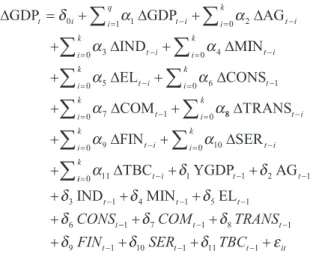
ARDL models are linear time series models in which both the dependent and independent variables are related not only contemporaneously but also across historical (lagged) values. In particular, the dependent variable and the explanatory variables, in a general ARDL model approach to cointegration, Pesaran and Shin (1998) give testing as follows:
D = + D + D + + +
= -
= - - -
å å
Y
t iy X Y X
i q
t i i
k
t i t i t i it
d
0a a d d e
1 1
1
2 1 2
Where Xs are the explanatory variables and Y is the
dependent variable, `q and k are the numbers of maximum
lag order in the form of (ARDL) mode - the maximum
lag lengths of q and k for the dependent and explanatory
variables respectively. In this study, the ARDL model can
be specified as:
D D D
D D
GDP GDP AG
IND M
t i t i
q
i t i k
i t i k
=
i+ +
+ +
= - = -
= -
å å
å
d a a
a a
0 1 1 0 2
0 3 4
IIN
EL CONS
COM
i t i k
i t i k
i t k
i t k
= -
= - = -
= -
å
å å
å
+ +
+ +
0
0 5 0 6 1
7 1
0
a a
a a
D D
D
0 880 9 0 10
11
D
D D
D
TRANS
FIN SER
TBC
i t i k
i t i k
i t i k
t i
= -
= - = -
-
å
å å
+ +
+
a a
ii
a
k
t t
t t t
CONS
t= - -
- - -
å + +
+ + +
+
0 1 1 2 1
3 1 4 1 5 1
6
d d
d d d
d
YGDP AG
IND MIN EL
-- - -
- - -
+ +
+ + + +
1 7 1 8 1
9 1 10 1 11 1
d d
d d d e
COM TRANS
FIN
tSER
t tTBC
t titWhere (δ
0– δ
11) represent the coefficients of the long-run relationships, while (α
1– α
11) represent the coefficients of short run dynamics relationships of the underlying variables in the model. And ε is the speed of short run adjustment of the model’s convergence to long run equilibrium. The error correction term (ECT) takes enough lags to capture the data generation process in general for the specified modeling framework (Nkoro & Uko, 2016). After regression of the above model, F- statistic (Wald test) is carried out irrespective of whether the underlying variables are purely I(0), purely I(1), or mutually cointegrated (Pesaran et al., 2001). Then, test the coefficients of the lagged to differentiate the long- run relationship between the underlying variables.
The null and alternative hypotheses are as follows:
H
0 2 3 4 5 6 7 8 910 11
1
0
: d d d d d d d d d
d d
= = = = = = = =
= = = no long run relaationship exists
Against the alternative hypothesis
H
A: d d d d d d d d d d
d
1 2 3 4 5 6 7 8 9 10
11