Print ISSN: 2288-4637 / Online ISSN 2288-4645 doi:10.13106/jafeb.2020.vol7.no9.801
1
First Author and Corresponding Author. Lecturer, Faculty of Economic and Business, University of Surabaya, Indonesia [Postal Address: No.56, Tenggilis Mejoyo Road, Kali Rungkut District, Surabaya City, East Java Province, 60294, Indonesia]
© Copyright: The Author(s)
This is an Open Access article distributed under the terms of the Creative Commons Attribution
Non-Commercial License (https://creativecommons.org/licenses/by-nc/4.0/) which permits
unrestricted non-commercial use, distribution, and reproduction in any medium, provided the
original work is properly cited.
Accounting Knowledge as a Contributing Intention on Improving Public Accounting Profession
Ria Sandra ALIMBUDIONO
1
Received: June 23, 2020 Revised: July 05, 2020 Accepted: August 10, 2020
Abstract
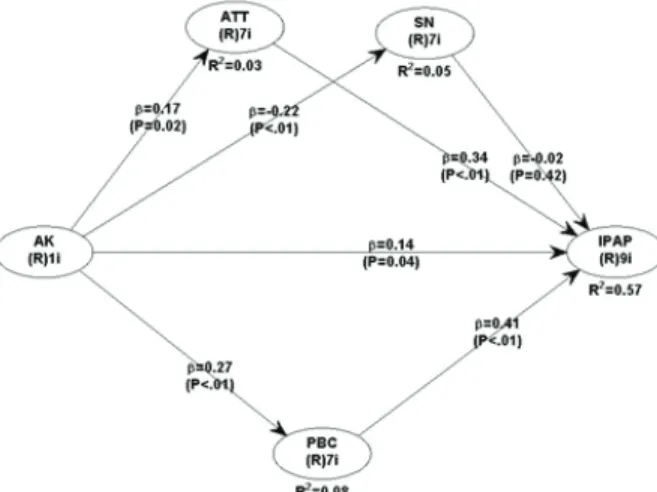
Public accountant profile dominated by over-50-year-old people appears to be alarming. The intention towards this profession had better be fostered immediately; therefore, the predictors to boost the intention need to be known. The study examines the influence of accounting knowledge toward the intention to work as public accountant using the Theory of Planned Behavior approach. A survey of 146 students revealed that there was a significantly positive influence of accounting knowledge toward the intention of becoming public accountant, both directly and indirectly, through the mediation of attitudes and perceived behavioral control. Subjective norms did not function as an appropriate mediation. The findings are expected to contribute to universities and professional accounting bodies. The study urges the accounting educators to redesign and reorganize the curriculum, including a more interesting teaching and learning methods. The professional accounting bodies are expected to cooperate with accounting educators in enhancing the internship program and providing real-case study to instill a positive attitude and assurance toward the students’ competence, which, in the end, might spark the intention to work as public accountant. That accounting knowledge positively influences the intention toward public accounting profession through the mediation of perceived behavioral control was statistically supported.
Keywords: Planned Behavior Theory, Accounting Knowledge, Public Accountant JEL Classification Code: I21, M40, M41, M51
Such situation bothered the professional sustainability of public accountant profession.
The scarcity of public accountants has raised an important question concerning why being a public accountant is less interesting for younger people. Previous studies have revealed various intentions of why people decided to be public accountant; for example, students are reluctant to become public accountant, since they have limited knowledge on what public accountant is (Sawarjuwono, 2013), the scope of work, job satisfaction, and great employee turnover (Suryani et al., 2018; Wen et al., 2018). However, the magnitude of intention in working as accountant depends on intrinsic motivation (Bagley et al., 2012), images (Jackling et al., 2012) and parental influences (Anis & Hanafi, 2015; Law
& Yuen, 2012). These earlier studies showed that there were great factors influencing the intention of becoming accountants.
In addition, this phenomenon of age gap can be perceived from the intentions of future students who enrolled in accounting department. Accounting departments at any universities accepted large numbers of new students, but only few of them were interested to consider public accountancy
1. Introduction
Recently, less and less people manifest an interest in
becoming public accountant, which causes the scarcity of
public accountant profession (Suryani et al., 2018). This
phenomenon can be seen through the number of accounting
firms in Indonesia, which were decreasing from 408 in 2011
to 388 in 2014 (PPPK-Ministry of Finance, 2015). The
condition worsened as viewed from the range of ages of
Indonesian public accountants. There are 57.55% of public
accountants above the age of 50, and under-30-year-olds
only account for 0,94% (PPPK-Ministry of Finance, 2015).