• 검색 결과가 없습니다.

Spatio-Temporal Variation of Cold Water Masses along the Eastern Coast of Korea in 2013 and 2014

N/A
N/A
Protected

Academic year: 2021

Share "Spatio-Temporal Variation of Cold Water Masses along the Eastern Coast of Korea in 2013 and 2014"

Copied!
10
0
0

로드 중.... (전체 텍스트 보기)

전체 글

(1)

Vol. 22, No. 3, pp. 286-295, May 31, 2016, ISSN 1229-3431(Print) / ISSN 2287-3341(Online) http://dx.doi.org/10.7837/kosomes.2016.22.3.286

Spatio-Temporal Variation of Cold Water Masses along the Eastern Coast of Korea in 2013 and 2014

In-Seong Han Myung-Hee Park Seung-Hwan Min Ju-Yeon Kim

*, ** Ocean Climate and Ecology Research Division, National Institute of Fisheries Science, 216 Gijanghaean-Ro, Gijang-Eup, Gijamg-Gun, Busan 46083, Korea

Abstract : With the results of observations in 2013 and 2014 including ocean buoys, in-situ investigations and wind data, we examined the spatio-temporal variation of cold water masses along the eastern coast of Korea. Usually, a cold water mass first appears along the northern part of the eastern coast from May to July, and then along the southern part of the eastern coast from late June to mid-August. Cold water masses appear 3~5 times a year and remain for 5~20 days in the southwestern part of the East Sea. A distinctive cold water mass appeared usually in mid-July in this area, the surface temperature of which was below 10in some cases. During the appearance of a cold water mass in the southwestern part of the East Sea, the horizontal temperature gradient was large at the surface and a significant low water temperature below 8appeared at the bottom level. This appearance of cold water masses clearly corresponded to southwesterly winds, which generated coastal upwelling.

Key Words : Eastern coast of Korea, In-situ investigation, Ocean buoys, Cold water mass, Southerly wind, Temperature gradient

1) 1. Introduction

A cold water mass caused by coastal upwelling frequently appears along the eastern coast of Korea between spring and summer. Usually, a cold water mass is described as the water mass below 5℃ compared with the surrounding ocean area (NIFS, 2013). Wind effect is a major reason for the generation of the coastal upwelling near the eastern coast of Korea. Especially, Lee et al. (1998) reported that 80 % of the cold water mass, which dropped more than 1℃, occurred with a strong south-westerly wind near the Gampo-Ulgi coast, located between Ulsan and Pohang, during the summers from 1987 to 1994. Byun (1989) suggested by analysis of hydrographic and meteorological data that the surface cold water masses near the south-eastern coast of Korea appear only when there is wind stronger than a minimum wind impulse, of the order of 10 m

2

/sec. Kim and Kim (2008) suggested that coastal upwelling near the south-eastern coast of Korea was generated with wind speed stronger than 5.0m/sec by numerical experiments. Lee et al. (2003) also reported that the period of upwelling events was about 10 days and the mean speed of along the shore wind was 4.0 m/sec. Kim et al. (2014) showed the relationship between sea surface temperature and wind

Corresponding Author : [email protected], 051-720-2231

speed magnitude, by information from several satellite.

The dynamic mechanism and structures of coastal upwelling along the eastern coast of Korea have been studied by several researchers. An (1974) explained that the cold water mass, which flows down from the northern part of the East Sea, ascends to the surface around the south-eastern coast of Korea and gives the surface its large temperature gradient. Lee et al. (2014) also reported that the extent of North Korean Cold Water when the strong coastal upwelling appeared around the south-western part of the East Sea is significantly dominant along the whole eastern coast of the East Sea. Lee and Na (1985) explained the regional differences in intensity of the wind-induced upwelling as represented by the combined influences of two factors; one is the baroclinic tilting of isotherms and the other is topographical effects. Kim and Kim (1983) maintained that the origin of these cold water masses along the eastern coast of Korea was the North Korean Cold Water. Seung (1984) carried out numerical experiments for the wind-induced coastal upwelling related to the coastline’s geometry.

Park and Kim (2010) explained that unprecedented coastal

upwelling along the eastern coast of Korea in summer 2007

occurred with the large scale air pressure distribution between the

tropical depression and the North Pacific High. From these results,

we can understand that the intensity and appearance of coastal

upwelling in the southwestern part of the East Sea should be

(2)

related to the wind pattern, air pressure distribution and oceanic structure.

The coastal upwelling area is well known as a high productivity ocean area due to the high concentration of nutrients from its lower layer. Chemical oceanographers have studied the chemical features of coastal upwelling around the south-western part of the East Sea (Yang et al., 1998; Kim and Kim, 2010). The effects on the distribution, size fraction and species composition of phyto- and zoo plankton of coastal upwelling around this region have also been studied recently (Lee et al., 2004; Park, 2006; Kim et al., 2014). Especially, Yoo and Park (2009) using ocean color satellite data proposed that the highest biological productivity in the south-western region of the East Sea is enhanced mainly by wind-driven upwelling along the Korean coast. They also showed that the upwelled water with high productivity is advected to the Ulleung basin through various pathways by current patterns. This coastal upwelling also affects to the fisheries, such as squid fishing grounds and set net fisheries around the south-western part of the East Sea (Park et al., 1998; Han et al., 2002). On the other hand, significant cold water masses caused by coastal upwelling often induce mass mortality of farming marine organisms in summer along the eastern coast of Korea (Lee et al., 2007).

Therefore, the spatial and temporal variation of coastal upwelling along the eastern coast of Korea is very important to fisheries, ocean dynamics and air-sea interactions. Usually, spatial and temporal variation of this coastal upwelling was studied using satellite temperature data (Suh et al., 2001; Suh and Hwang, 2005).

However, the satellite information of SST (Sea Surface Temperature) is usually very limited during the summer season due to the cloudy conditions. It is hard to establish the spatial and temporal variation in the short-term for the appearance of coastal upwelling from satellite information.

This study examined the spatial and temporal variation in the short-term with daily intervals of coastal upwelling, using a real-time ocean buoy array along the eastern coast of Korea.

Previous studies of the occurrence and intensity of coastal upwelling in this area usually employed just one of two moored systems or in-situ observations. It is possible to submit detailed temperature variations, which should be related to coastal upwelling, in summer and around the south-western part of the East Sea.

2. Data and Methods

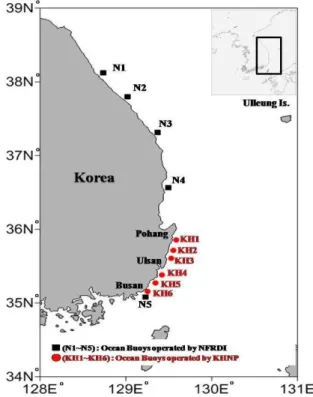
Eleven ocean buoys collecting real-time data operated along the eastern coast of Korea by the National Institute of Fisheries Science (NIFS) and Korea Hydro and Nuclear Power Co., Ltd (KHNP). NIFS operates five ocean buoys, to each of which are attached three temperature sensors at their surface, intermediate and lower levels. KHNP operates six real-time ocean buoys, which measure surface temperature, salinity and surface current. NIFS and KHNP ocean buoys measure this data at 30-minute and one minute intervals, respectively. NIFS and KHNP carry out monthly and bimonthly maintenance of the temperature sensors. The locations of the real-time ocean buoys are shown in Fig. 1. The detailed locations and operating organizations of each buoys are shown in Table 1.

We prepared the daily mean data to clarify the short-term change of temperature along the eastern coast of Korea. The NIFS real-time ocean buoys are especially convenient for understanding the spatial and temporal change of temperature along the whole eastern coast of Korea.

Fig. 1. Location of real-time ocean buoys.

(3)

Station name

Nearest

city Latitude Longitude Operating

organization N1 Yangyang 38˚04’58’’N 128˚41’54”E

National Institute of

Fisheries Science N2 Gangneung 37˚47’56’’N 128˚56’57”E

N3 Samcheok 37˚18’07’’N 129˚18’51”E N4 Yeongdeok 36˚34’26’’N 129˚26’13”E N5 Gijang 35˚11’13’’N 129˚13’39”E KH1 Yangpo 35˚51’57’’N 129˚32’50”E

Korea Hydro and Nuclear

Power Co., Ltd KH2 Wolsong 35˚43’04’’N 129˚29’42”E

KH3 Jeongja 35˚38’05’’N 129˚29’42”E

KH4 Jinha 35˚23’05’’N 129˚22’05”E

KH5 Gori 35˚19’07’’N 129˚18’53”E

KH6 Gijang 35˚10’57’’N 129˚14’07”E Table 1. Detailed description of ocean buoys

We used the KHNP real-time ocean buoys to understand the detailed spatio-temporal change around the south-western part of the East Sea, because they are concentrated along the coastal area from Busan to Pohang.

On the other hand, we also carried out five in-situ investigations of coastal upwelling around the south-western part of the East Sea each year (Fig. 2). During these investigations, we carried out CTD (Conductivity Temperature Depth Profiler) experiments, zoo- and phyto plankton sampling, water sample for analysis of nutrients, Chl.-a, suspended sediment and dissolved oxygen, etc, with four lines and 24 stations for each investigation. Detailed descriptions of the in-situ investigations are given in Table 2.

In this study, these hydrographic data are compared with real-time ocean buoy data to understand the oceanic water structure at the times when coastal upwelling appeared and disappeared.

To compare with the variation of sea surface temperature, we used the hourly wind direction and speed data at Ulgi as recorded the Automatic Weather Station (AWS) of Korea Meteorological Administration (KMA) from May to August in 2013 and 2014.

The Ulgi AWS is located around Station B1 (Fig. 2). This station is well known as the representative site to understand the wind pattern around the south-eastern coast of Korea.

Using the data obtained by the real-time ocean buoys and our in-situ investigations, we examined the spatio-temporal variation for the appearance of cold water masses and the features of horizontal and vertical distributions of temperature by the appearance of cold water masses along the eastern coast of Korea. By comparison with temporal variation of surface temperature and wind pattern, we also considered the relationship between both factors.

Fig. 2. Location of the stations of in-situ investigations. The ★ mark indicates the location of Ulgi AWS.

Cruise name Period Vessel

2013-Leg1 2013.5.20 ~ 5.22.

Tamgu-7 (79G/T) 2013-Leg2 2013.6.12 ~ 6.13.

2013-Leg3 2013.6.26 ~ 6.28.

2013-Leg4 2013.7.22 ~ 7.23.

2013-Leg5 2013.8.6. Tamgu-3 (369G/T)

2014-Leg1 2014.5.13 ~ 5.15.

Tamgu-7 (79G/T) 2014-Leg2 2014.6.17 ~ 6.19.

2014-Leg3 2014.7.1 ~ 7.3.

2014-Leg4 2014.7.28 ~ 7.30.

2014-Leg5 2014.8.6 Tamgu-3 (369G/T)

Table 2. Observation period of in-situ investigation in this study

3. Results

3.1 Temporal variation of surface temperature along the eastern coast of Korea

To examine the temporal variation of surface temperature from the southern part to the northern part of the eastern coast of Korea, we plotted the surface temperature variation observed by the NIFS real-time ocean buoys from May to August in 2013 and 2014.

Some data is missing because of bad weather conditions and a small boat colliding with one of the buoys.

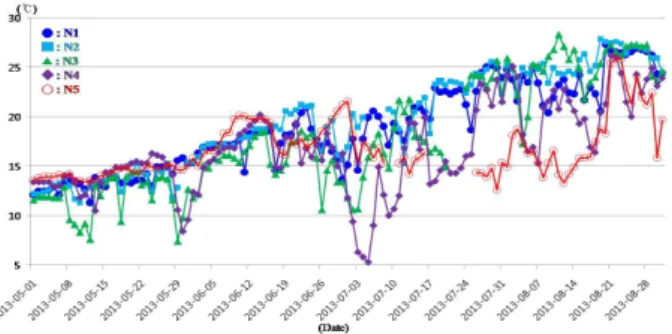
In the case of 2013, we discovered frequent appearances of a

significant cold water mass (Fig. 3). A relatively cold water mass

usually appears around the northern part from May to June each

year. Especially, this cold water mass was intense around N3. On

(4)

the other hand, the falls in surface temperature at N5 disappeared before mid-June. After mid-June, significant cold water masses usually appear along the southern part of the eastern coast of Korea; those were N4 and N5.

The most intense cold water mass appeared in early July at N4, where the surface temperature decreased by 5℃. The presence of significant cold water at N5 continued from early July to mid-August. This cold water was clearly present for longer than 45 days around the south-western part of the East Sea. After July, decreasing surface water temperatures at N1~N3 were not so distinctive, although short and local changes of surface temperature did occur.

Fig. 3. Temporal variation of surface temperature at N1~N5 from May to August 2013.

In the case of 2014, we also found out multiple evidence of the appearance of a cold water mass from May to August along the eastern coast of Korea, although some surface temperature data could not be obtained, especially at N5 (Fig. 4).

Cold water masses measuring around 10℃ appeared at N2~N3 in mid-May and at N1~N4 late in May, though they were not so significant. From late June to early August, relatively strong cold water masses appeared in several areas, centered around N3~N4.

Comparing the two years, it was stronger and longer in 2013 than in 2014.

Fig. 4. Temporal variation of surface temperature at N1~N5 from May to August 2014.

To understand the detailed variation of cold water masses around the south-western part of the East Sea, we examined the spatio-temporal variation of surface temperature observed by the KHNP real-time ocean buoys from May to August in 2013 and 2014. Before mid-June in 2013, no significant cold water mass was detected at any station, though some temperature change of about 2~3℃ appeared in mid-May and late May (Fig. 5).

These slight changes of surface temperature around the south-western part of the East Sea might be due to baroclinic instability by Tsushima Warm Current (Hase et al., 1999) or an effect of internal tides along the eastern coast of Korea (Han et al., 2008).

Several distinctive cold water masses appeared after mid-June of 2013. Especially, cold water masses from late June to mid-July continued for about 20 days and reached down to 10℃ at KH1 and KH2. This cold water mass was the most significant, reaching below 10℃, during our study periods in 2013 and 2014. After that, significant cold water masses also appeared two or three more times in this year.

Fig. 5. Temporal variation of surface temperature at KH1~KH6 from May to August 2013.

Fig. 6. Temporal variation of surface temperature at KH1~KH6

from May to August 2014.

(5)

In 2014, the strength and duration of cold water masses was weakened compared to 2013 (Fig. 6). During the whole study period in 2014, distinctive cold water masses appeared in late May, mid-July and early August, though we could not find out the significant cold water, lower than 10℃.

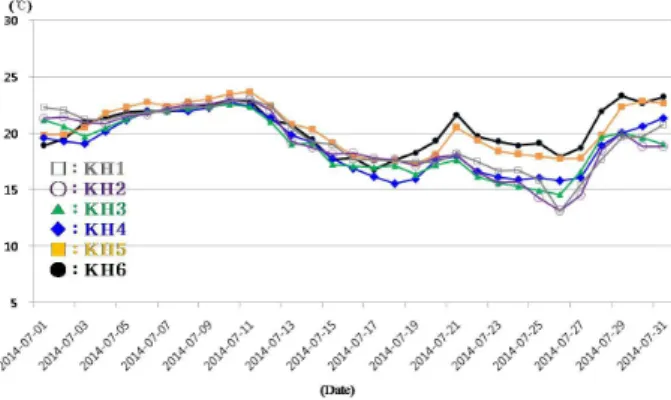
To examine the surface temperature change in detail, we plotted the temporal variation of surface temperature in July of both years at KH1~KH6. In the case of July 2013, surface temperature rapidly decreased at KH1~KH4, which were in the southern part of this mooring array (Fig. 7). Especially, surface temperatures at KH1~KH2 continuously decreased until 8~9 July, though significant decreasing of surface temperatures at KH3~KH6 stopped after just 2~3 days. Recovered surface temperature sharply decreased around 20 July, especially at KH1~KH2.

Fig. 7. Temporal variation of surface temperature at KH1~KH6 in July 2013.

This cold water mass showed a higher surface temperature than in early and mid-July. In the case of 2014, we could not find sharply decreasing surface temperatures at KH1~KH6 (Fig. 8). During July 2014, cold water masses appeared twice. One was centered at KH3 and KH4 and the other was centered at KH1 and KH2.

Fig. 8. Temporal variation of surface temperature at KH1~KH6 in July 2014.

From ocean buoys data obtained in both 2013 and 2014, it could be understood that a significant cold water mass appeared 3~5 times a year and was present for 5~20 days in the south-western part of the East Sea. Significant cold water masses appeared more often in 2013 than they did in 2014. The most significant cold water mass appeared in early and mid-July 2014, having a temperature decrease of about 13℃ compared to the normal condition. The centers of cold water masses were different in each case during the study period.

3.2 Horizontal and vertical temperature distribution by in-situ investigations

To understand the horizontal and vertical distribution of temperature related to the appearance of cold water masses, we examine the result of in-situ investigations by CTD experiments from May to August in 2013 and 2014. We carried out in-situ investigations five times each year around the south-western part of the East Sea.

Comparing the appearances of cold water masses by real-time ocean buoys with the observation period of in-situ investigations, we could understand that a cold water mass disappeared at 2013-Leg1 and 2013-Leg2 in 2013. On the other hand, significant cold water masses appeared at 2013-Leg4 and 2014-Leg5.

2013-Leg4 was carried out shortly before the disappearance of a cold water mass. In the case of 2014, significant cold water masses appeared at 2014-Leg4 and 2014-Leg5, though we could not find distinctive cold water masses during 2014-Leg1 to 2014-Leg3.

Horizontal distributions of surface temperature at each in-situ investigation in 2013 are shown in Fig. 9. We could not find distinctive horizontal gradient of surface temperature at 2013-Leg1 or 2013-Leg2. The center of the cold water mass was the northern part at 2013-Leg3, although its horizontal temperature gradient was not so significant. At 2013-Leg4 we found a significant cold water mass, lower than 17℃, and a dense horizontal temperature gradient, especially at Stations A1 and B1.

The horizontal temperature gradient was loose at 2013-Leg5

compared to 2013-Leg4, although a relatively significant cold water

mass (about 18℃) also appeared around Station C1. Vertical

distributions of temperature along the coast in 2013 also clearly

showed the location of the upwelling area at 2013-Leg3 to

2013-Leg5. At 2013-Leg3 and 2013-Leg4, we noted the bottom

low temperature water of below 8℃ around A1 (Fig. 10). We

should consider that this bottom low temperature water was raised

up to the surface at this period.

(6)

Fig. 9. Horizontal distribution of surface temperature from 2013-Leg1 to 2013-Leg5 by in-situ investigation in 2013.

Fig. 10. Vertical structure of temperature (A1~D1) from 2013-Leg1 to 2013-Leg5 by in-situ investigation in 2013.

Fig. 11. Horizontal distribution of surface temperature from 2014-Leg1 to 2014-Leg5 by in-situ investigation in 2014.

Fig. 12. Vertical structure of temperature (A1~D1) from 2014-Leg1

to 2014-Leg5 by in-situ investigation in 2014.

(7)

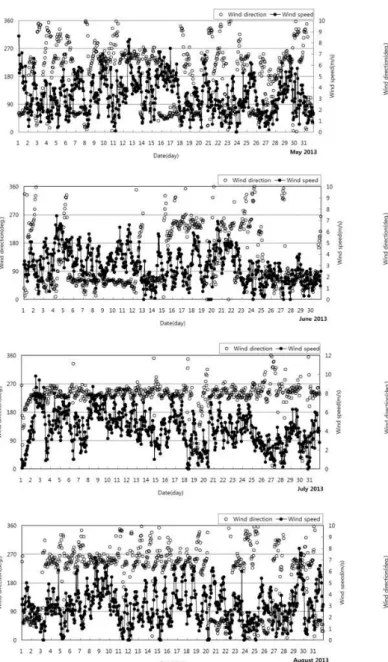
Fig. 13. Temporal variation of wind speed and direction from May to August 2013 at Ulgi AWS.

Fig. 14. Temporal variation of wind speed and direction from May to August 2014 at Ulgi AWS.

In the case of 2014, a large horizontal gradient of surface temperature appeared clearly at 2014-Leg4 and 2014-Leg5 (Fig.

11). The centers of the cold water mass, which was lower than 2 0℃, were around C1 at 2014-Leg4 and at 2014-Leg5, though the distinctive cold water mass was not detected at 2014-Leg1 to 2014-Leg3. The appearance of a large temperature gradient at 2014-Leg5, comparison to 2014-Leg4, might have been caused by the investigation at 2014-Leg4 being carried out shortly before the disappearance of the cold water mass. From the vertical temperature structure, we reconfirmed that the upwelled low temperature water from the bottom layer appeared around Station C1 (Fig. 12).

3.3 Change of wind pattern related to the variation of surface temperature

To compare the appearance of a cold water mass with the change of wind pattern, we examined the temporal variation of wind speed and direction at Ulgi AWS, located around Station B1 in the in-situ investigations, from May to August in 2013 and 2014.

In case of 2013, we could not find a significant wind pattern

and the appearance of distinctive cold water masses in the study

area before mid-June (Fig. 13). Before mid-June 2013, we could

not find a steady wind direction at this station. We already

(8)

examined the appearance of a relatively weak cold water mass for about 10 days in mid-June 2013. In this period, wind direction was almost constant southwesterly and at a speed of about 3~5 m/s.

During July, we detected the steady southwesterly wind as dominant, though it did change sometimes, such as on 19~20 and 26~28 July. From late July to mid-August, a southwestern wind temporally blew over this area and cold water masses temporally appeared. After mid-August, we could not find a significant wind direction in this area.

In 2014, a steady southwesterly wind appeared for 5 or 10 days until early July (Fig. 14). In accordance with the wind patterns, a relatively weak cold water mass appeared in this period.

Strong southwesterly winds continued from mid-July to early August in this area. A relatively strong cold water mass also appeared and clearly corresponded with the wind pattern. After 10 August, we could not find any significant wind pattern in this area.

From these results, the appearances of cold water masses clearly corresponded to southwesterly winds. It means that a cold water mass might be caused by coastal upwelling due to a south-western wind pattern. This result clearly coincided with the results by Lee (1983), which reported coastal upwelling occurring when strong southwesterly winds persisted for longer than three days in this area.

4. Summary and Discussion

In this study, we examined spatio-temporal variations of cold water masses along the eastern coast of Korea using ocean buoy data, in-situ investigation data and wind data, from May to August in both 2013 and 2014.

From the results, we could understand that cold water masses occurred in this area about 3~5 times each year. They usually appeared in the northern part of the eastern coast from May to July, and in the southern part of the eastern coast from mid-June to mid-August. It could be considered that the center of cold water mass generally moved south from spring to summer.

Around the southwestern part of the East Sea, a strong cold water mass usually appeared around early or mid-July. This distinctive cold water mass had the lowest surface temperature, below 10℃ in 2013, and remained for about 20 days. The cold water mass along the eastern coast of Korea was significant in 2013 compared with 2014, which should be related to the wind patterns in both years.

We also examined the horizontal and vertical distribution of

temperature by in-situ investigations along with the real-time ocean buoy data. Of our 10 in-situ investigations, four were carried out during the period of appearance of a cold water mass in the south-western part of the East Sea. During this appearance, a strong horizontal temperature gradient appeared at the surface and significant low water temperature also appeared at the bottom.

Comparing the variation of surface temperature with wind pattern, the appearance of cold water masses clearly corresponded with the southwesterly wind. Generally, southwesterly wind dominated from early July to mid-August. While a temporal southwesterly wind blew over this area in May and June, relatively weak cold water masses also appeared in this area. From these results, we can consider that coastal upwelling due to southwesterly winds along the eastern coast of Korea generated the cold water masses in this area.

Our result between the appearance of cold water masses and a south-western wind pattern corresponded with the results by Lee (1983), Lee et al. (1998) and Byun (1989). On the other hand, spatio-temporal variations of cold water masses are described in this study in more detail than in previous studies such as those by Suh et al. (2001) and Suh et al. (2005), which reported the spatial and temporal variation of cold water masses from satellite information only.

From this study, however, we could not describe the relationship between wind-generated coastal upwelling and wind pattern any more detail.

We will study that starting point of coastal upwelling due to the strengthening and duration of the southwesterly wind. Through future study, the upwelling index in this area will be computed so as to provide a prediction method for coastal upwelling. We will also examine in detail the slight change of surface temperature over the period of about 15~20 days, which might be caused by Tsushima Warm Current instability or vertical mixing generated by internal tide. As we know well, an upwelling area usually has a very high nutrient concentration, primary production, ecological efficiency and fish production. We will investigate these biological and fisheries effects which accompany coastal upwelling in this area in the near future.

Acknowledgement

We would like to thank to captains and crews of Tamgu-7 and Tamgu-3 for their helpful support during our in-situ investigations.

We also would like to express our special thanks to KHNP for

(9)

providing the real-time ocean buoys data. This study was funded by a grant from the National Institute of Fisheries Science (R2016052).

References

[1] An, H. S.(1974), On the cold water mass around the southeast coast of Korean Peninsula. J. Oceanol. Soc. Kor. Vol. 9, No.

1-2, pp. 10-18.

[2] Byun, S. K.(1989), Sea surface cold water near the southeastern coast of Korea: Wind effect. J. Oceanogr. Soc.

Kor. Vol. 24, No. 3, pp. 121-131.

[3] Han, I. S., J. Lee, L. H. Jang, Y. S. Suh and K. T.

Seong(2008), Evidence of vertical mixing caused by high frequency internal waves along the eastern coast of Korea. J.

Fish. Sci. Tech. Vol. 11, No. 1, pp. 41-49.

[4] Han, K. H., J. H. Kim and S. R. Baek(2002), Seasonal variation of species composition of fishes collected by set net in coastal waters of Ulsan, Korea. Kor. J. Ichthyol. Vol. 14, No. 1, pp. 61-69.

[5] Hase, H., J. H. Yoon and W. Koterayama(1999), The current structure of the Tsushima Warm Current along the Japanese coast. J Oceanogr 55, pp. 217-235.

[6] Kim, A. R., S. H. Youn, M. H. Chung, S. C. Yoon and C. H.

Moon(2014), The influence of coastal upwelling on phytoplankton community in the southern part of East Sea, Korea. J. Kor. Soc. Oceanogr. Vol. 19, No. 4, pp. 287-301.

[5] Kim, C. H. and K. Kim(1983), Characteristics and origin of the cold water mass along the east coast of Korea. J. Kor.

Soc. Oceanogr. Vol. 18, No. 1, pp. 73-83.

[6] Kim, D. S. and D. H. Kim(2008), Numerical simulation of upwelling appearance near the southeastern coast of Korea. J.

Kor. Soc. Mar. Env. Safety. Vol. 14, No. 1, pp. 1-7.

[7] Kim, T. H. and G. B. Kim(2010), Distribution of dissolved organic carbon (DOC) in the southwestern East Sea in summer. Ocean and Polar Res. Vol. 32, No. 3, pp. 291-297.

[8] Kim, T. S., K. A. Park, X. Li and S. W. Hong(2014), SAR-derived fields at the coastal region in the East/Japan Sea and relation to coastal upwelling. Int. J. Rem. Sens. Vol. 35, pp. 3497-3965.

[9] Lee, C. R., C. Park and C. H. Moon(2004), Appearance of cold water and distribution of zooplankton off Ulsan-Gampo area, eastern coastal area of Korea. J. Kor. Soc. Oceanogr.

Vol. 9, No. 2, pp. 51-63.

[10] Lee, D. K., J. I. Kwon and S. B. Hahn(1998), The wind effect on the cold water formation near Gampo-Ulgi coast. J.

Kor. Fish. Soc. Vol. 31, No. 3, pp. 359-371.

[11] Lee, J. C.(1983), Variations of sea level and sea surface temperature associated with wind-induced upwelling in the southeast coast of Korea in summer. J. Oceanol. Soc. Kor.

Vol. 18, No. 2, pp. 149-160.

[12] Lee, J. C. and J. Y. Na(1985), Structure of upwelling off the southeast coast of Korea. J. Oceanol. Soc. Kor. Vol. 20, No.

3, pp. 6-19.

[13] Lee, M. O., S. Otake and J. K. Kim(2014), Characteristic of cold water appeared in the southwestern East Sea. J. Kor.

Soc. Fish. Mar. Sci. Edu. Vol. 26, No. 3, pp. 455-473.

[14] Lee, Y. H., J. M. Shim, Y. S. Kim, J. D. Hwang, S. H.

Yoon, C. Lee and H. G. Jin(2007), The variation of water temperature and the mass mortalities of sea squirt, Halocynthia roretzi along Gyeongbuk coasts of the East Sea in summer, 2006. J. Kor. Soc. Mar. Env. Safety. Vol. 13, No.

4, pp. 15-19.

[15] NIFS(2013), National Institute of Fisheries Science, Ocean data newsflash #4317, NIFS Newsflash, pp. 1-2.

[16] Park, J. H., K. H. Choi and J. H. Lee(1998), The relationship between coastal cold water and catch condition of common squid (Todarodes pacificus STEENSTRUP) in the East Sea of Korea in summer. Bull. Kor. Soc. Fish. Tech. Vol. 34, No. 2, pp. 105-116.

[17] Park, K. A. and K. R. Kim(2010), Unprecedented coastal upwelling in the East/Japan Sea and linkage to long-term large-scale variations. Geophy. Res. Lett. Vol. 37, L09603, doi:10.1029/2009GL042231.

[18] Park, M. O.(2006), Composition and distribution of phytoplankton with size fraction results at southwester East/Japan Sea. Ocean Sci. Jour. Vol. 42, No. 4, pp. 301-313.

[19] Seung, Y. H.(1984), A numerical experiment of the effect of coastline geometry on the upwelling along the east coast of Korea. J. Oceanol. Soc. Kor. Vol. 19, No. 1, pp. 24-30.

[20] Suh, Y. S., L. H. Jang and J. D. Hwang(2001), Temporal and spatial variations of the cold waters occurring in the eastern coast of the Korean Peninsula in summer season. J. Kor.

Fish. Soc. Vol. 34, No. 5, pp. 435-444.

[21] Suh, Y. S. and J. D. Hwang(2005), Study on the cold mass occurrence in the eastern coast of the Korean Peninsula in summer. J. Env. Sci. Vol. 14, No. 10, pp. 945-953.

[22] Yang, H. S., S. J. Oh, H. P. Lee, C. H. Moon, M. S. Han

(10)

and B. K. Kim(1998), Distribution of particulate organic matter in the Gampo upwelling area of the southwestern East Sea. J. Kor. Soc. Oceanogr. Vol. 33, No. 4, pp. 157-167.

[23] Yoo, S. J. and J. S. Park(2009), Why is the southwest the most productive region of the East Sea/Sea of Japan?. J. Mar.

Sys. Vol. 78, pp. 301-315.

Received : 2016. 04. 22.

Revised : 2016. 05. 16. (1st)

: 2016. 05. 24. (2nd)

Accepted : 2016. 05. 27.

수치

Fig.  1.  Location  of  real-time  ocean  buoys.
Fig.  2.  Location  of  the  stations  of  in-situ  investigations.  The  ★  mark  indicates  the  location  of  Ulgi  AWS.
Fig.  3.  Temporal  variation  of  surface  temperature  at  N1~N5  from  May  to  August  2013.
Fig.  8.  Temporal  variation  of  surface  temperature  at  KH1~KH6  in  July  2014.
+3

참조

관련 문서

Current Tokyo is rich in green compared to other metro cities. In some parts, the greenery has been contributed by the many inherited gardens from the Edo era to today which

In a statement to Kuwait News Agency (KUNA) on the sidelines of a meeting of the Arab Parliament's Foreign Affairs Political and National Security

The meeting was attended by Assistant Foreign Minister for GCC Affairs, Ambassador, Nasser Al-Muzayyen, and Deputy Assistant Foreign Minister for the Office of the

“ Sheikh Nasser has a written message from HH the Amir, Sheikh Sabah Al-Ahmad Al-Jaber Al-Sabah to the Chinese President, Chi Gen Beng related to enhancing mutual

On his part, CEO of Express Roads Authority, Saud Al-Naqqi said that the heavy rains of the previous day led to clogging parts of the express

Kuwait will celebrate on Sunday the fourth anniversary of the UN honoring and proclamation of His Highness the Amir, Sheikh Sabah Al-Ahmad Al-Jaber Al-Sabah as

• 이명의 치료에 대한 매커니즘과 디지털 음향 기술에 대한 상업적으로의 급속한 발전으로 인해 치료 옵션은 증가했 지만, 선택 가이드 라인은 거의 없음.. •

In the current context, where the interconnectedness of the global economy has intensified greatly and the importance of a collective response to