Korean J. Environ. Biol. 37(1) : 68-71(2019)
68
ⓒ2019. Korean Society of Environmental Biology.konov (1950) was of great value as well, as they provided the baseline information on the surrounding regions of the Northern Pacific. In addition, Hayashi (1940) grouped 18 different Henricia species in Japan. Nine Henricia species have been reported in Korea, of which six species, name- ly, Henricia elachys, Henricia nipponica, Henricia ohshimai, Henricia pachyderma, Henricia pacifica, and Henricia regu- laris are distributed in Jeju Island in Korea.
MATE R IALS AND METHODS
The Henricia specimen was collected from the waters near Ongpo harbor, Jeju Island using fishing net on 24 Jan- uary 2017. The collected specimen was preserved in 95%
ethanol, and morphological characteristics, such as the size of the disk, upper and proximal portions of the arms, number of abactinal spines, shape of abactinal and actinal
https://doi.org/10.11626/KJEB.2019.37.1.068
INT R ODUCTION
The genus Henricia Gray, 1840 is composed of 91 spe- cies (Mah 2019), a number of which are taxonomically variable (Lambert 2000). Hybridization and a high degree of variations are the main reasons for difficulties in the identification and classification of Henricia species (Fish- er 1911; Clark and Downey 1992). The abactinal spines, shape of the abactinal and actinal skeleton, and number of adambulacral spines are the key characters that enable the morphological identification of Henricia species (Clark and Jewett 2010). Madsen (1987) contributed significant infor- mation for the study of Henricia species, as he re-evaluated the Henricia sanguinolenta complex from the Norwegian Sea and adjacent waters of the Northeast Atlantic Ocean.
He made many recommendations for the identification of the morphological characters of sea stars that were not used previously. The research of Fisher (1911) and D’ya-
Note
New record of a sea star of genus Henricia (Asteroidea: Spinulosida:
Echinasteridae) from Jeju Island, Korea
Michael Dadole Ubagan and Sook Shin*
Department of Chemistry Life Science, Marine Biological Resource Institute, Sahmyook University, Seoul 01795, Republic of Korea
Korean J. Environ. Biol.
37(1) : 68-71(2019) ISSN 1226-9999(print) ISSN 2287-7851(online)
Korean Journal of Environmental Biology
* Corresponding author Sook Shin
Tel. 02-3399-1717 E-mail. [email protected]
Received: 22 February 2019 Revised: 11 March 2019
Revision accepted: 12 March 2019
Abstract: An asteroid specimen that belongs to the genus Henricia was collected from the waters near Ongpo harbor, Jeju Island using fishing net on 24 January 2017. The specimen was identified as Henricia anomala Hayashi, 1973, which belongs to the family Echinasteridae and order Spinulosida. Henricia anomala was first described by Hayashi, 1973, who captured it from Sagami Bay at a depth of 110-116m. This species can be distinguished from other Henricia species by short arms (R/r=4), abactinal spines lining the abactinal plates and bearing about two to five spinelets, closely meshed abactinal skeleton, composed of small rod-like and subtriangular plates, a narrow papular area containing one or two papulae, and adambulacral armature composed of five to seven bluntly pointed spinelets. This is the first report of Henricia anomala in Korea.
Keywords: Henricia anomala, Echinasteridae, Spinulosida, Jeju Island, Korea
69
http://www.koseb.org
New record of genus Henricia from Jeju Island, Korea
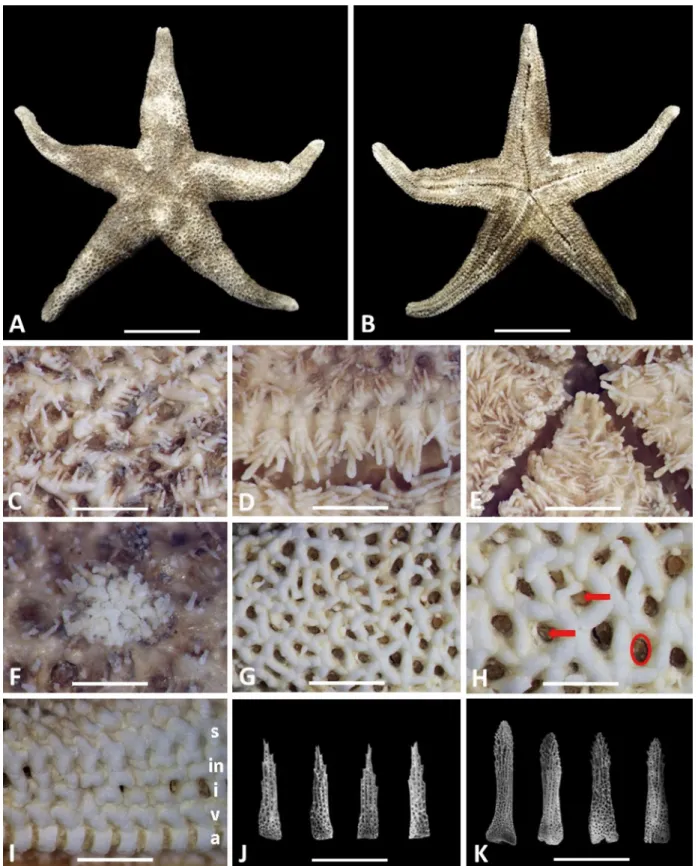
Fig. 1. Henricia anomala. A. abactinal side; B. actinal side; C. abactinal paxillae; D. adambulacral spines; E. oral part; F. madreporite; G.
abactinal skeleton; H. papula(arrow), papular area(circle); I. actinal skeleton: superomarginal plates(s), intermarginal plates (in), inferomar- ginal plates(i), ventrolateral plates(v), adambulacral plates(a); J. abactinal spines; K. adambulacral spines. Scale bars: A, B=1cm, C-I=
1mm, J=100μm, K=50μm.
Korean J. Environ. Biol. 37(1) : 68-71(2019)
70
ⓒ2019. Korean Society of Environmental Biology.skeleton, and number of adambulacral spines were exam- ined. The morphological features of the specimen were photographed using a scanning electron microscope (JSM- 6510; JEOL Ltd., Tokyo, Japan), stereomicroscope (Nikon SMZ1000; Nikon Co., Tokyo, Japan), and digital camera (Nikon D7000). Abbreviations for the measurements were those used by Shin and Ubagan (2015a, b).
SYSTEMATIC ACCOUNT Class Asteroidea de Blainville, 1830 Order Spinulosida Perrier, 1884 Family Echinasteridae Verrill, 1870 Genus Henricia Gray, 1840 Henricia anomala Hayashi, 1973
변칙애기불가사리(
신칭) (Fig. 1A-K)
Henricia anomala Hayashi, 1973, p. 63, pl. 13, figs. 5, 6;
Mah, 2019: 369097.
Material examined. One specimen, Ongpo harbor, Jeju Island, 24 January 2017.
Description. Arms five, thin, gradually tapering to tips (Fig. 1A, B). Abactinal paxillae scattered, containing two to five short, slender and delicate spinelets, not covered with integument. Papular areas narrow, containing one or rarely two papulae in an area (Fig. 1H). Abactinal skeleton closed meshed, imbricated, composed of subtriangular and small rod-like plates, and sub-skeleton present inside the papular areas (Fig. 1G). Madreporite small, situated near base of arm, delicate, circular in form, and bearing spines same as the abactinal spines (Fig. 1F). Actinal plate series distin- guishable, superomarginal plates relatively larger than the other plate series. Intermarginal and inferomarginal plates reaching one-half length of arm, ventrolateral plates reach- ing tip of arm (Fig. 1I). Adambulacral armature composed of five to seven bluntly pointed spinelets, the inner spine longer than the outer spines arranged in two transverse or zigzag rows (Fig. 1D). Oral plate bearing three slender spines (Fig. 1E). Furrow spine single.
Size. R
=32 mm, r
=8 mm, R/r
=4.
Habitat. Hard substrates (rocks).
Distribution. Korea (Jeju Island); Japan (Sagami Bay).
Deposition. The collected specimen was deposited in the Marine Echinoderm Resource Bank of Korea (MERBK), Sahmyook University, Seoul, Korea.
Remarks. Henricia anomala was first reported by Hayashi,
1973, from Sagami Bay in Japan. The Korean H. anomala specimen was collected from the waters near Ongpo har- bor of Jeju Island and is reported for the first time in Korea.
Based on the general appearance, our specimen (R/r
=4) has a superficial resemblance to H. elachys Clark and Jew- ett (2010) (R/r
=3.2-3.9). These Henricia species were distributed in Jeju Island, Korea. H. anomala can be easi- ly classified because it has (1) lesser number of abactinal spines (two to five) compared to H. elachys (three to 14);
(2) the shape of abactinal paxillae is scattered, clustered in H. elachys ; (3) lesser number of papulae (one or two) com- pared to H. elachys (two to five); (4) the abactinal skeleton composed of a small rod-like, and subtriangular plates, but those of H. elachys are rounded cross plates; and (5) lesser number of adambulacral spines (five to seven) compared to H. elachys (10-14).
We also compared H. anomala to another small size (R/
r
=3.1-3.6) Henricia nipponica Uchida (1928). As a result, three major differences in morphological characters of H.
nipponica was revealed such as (1) bearing more number of abactinal spines (seven to 15), (2) clustered abactinal pax- illae, and (3) roundish shape of abactinal plates.
ACKNOWLEDGEMENTS
This study was supported by a grant from the National Institute of Biological Resources (NIBR), funded by the Ministry of Environment (MOE) (NIBR201902107), and the Marine Biotechnology Program of the Korea Institute of Marine Science and Technology Promotion (KIMST) funded by the Ministry of Oceans and Fisheries (MOF) (No. 20170431), and it was a part of the project titled “De- velopment of the methods for controlling and managing marine ecological disturbance-causing and harmful organ- isms (MEDHO),” funded by the Ministry of Oceans and Fisheries, Korea.
R EFE R ENCES
Clark AM and ME Downey. 1992. Starfishes of the Atlantic.
Chapman & Hall Identification Guides 3. Chapman & Hall.
London. pp. 1-794.
D'yakonov AM. 1950. Keys to the Fauna of the USSR. Sea Stars (Asteroids) of the USSR Seas. Zoological Institute of the Academy of Sciences of the USSR(translated 1968 by Israel
71
http://www.koseb.org
New record of genus Henricia from Jeju Island, Korea
Program for Scientific Translations, Jerusalem). 34:1-183.
Fisher WK. 1911. Asteroidea of the North Pacific and adjacent waters: Part. 1. Phanerozonia and Spinulosa. Bull. U. S. Nat.
Mus. 76:1-420.
Hayashi R. 1940. Contributions to the classification of the sea- stars of Japan: I. Spinulosa. J. Fac. Sci. Hokkaido Univ. Ser. 6.
Zool. 7:107-204.
Hayashi R. 1973. The Sea-Stars of Sagami Bay. Biological Labo- ratory Imperial Household, Tokyo. pp. 1-114.
Lambert P. 2000. Sea Stars of British Columbia, Southeast Alas- ka, and Puget Sound. Royal British Columbia Museum. UBC press. pp. 1-186.
Madsen FJ. 1987. The Henricia sanguinolenta complex(Echino-
dermata, Asteroidea) of the Norwegian Sea and adjacent waters. A re -evaluation, with notes on related species.
Steenstrupia 13:201-268.
Mah C. 2019. Henricia anomala Hayashi, 1973. World Asteroidea Database. World Register of Marine Species at http://www.
marinespecies.org/aphia.php?p=tax details&id=369097. Ac- cessed 10 January 2019.
Shin S and MD Ubagan. 2015a. A newly recorded sea star of Ge- nus Henricia(Asteroidea: Spinulosida: Echi nasteridae) from the East Sea of Korea. Korean J. Environ. Biol. 33:197-200.
Shin S and MD Ubagan. 2015b. A newly recorded sea star of Ge- nus Henricia(Asteroidea: Spinulosida: Echin asteridae) from Jeju Island, Korea. Korean J. Environ. Biol. 33:390-393.