• 검색 결과가 없습니다.

Ixeris dentata (Thunb) Nakai Attenuates Cognitive Impairment in Scopolamine-induced Amnesic Mice

N/A
N/A
Protected

Academic year: 2021

Share "Ixeris dentata (Thunb) Nakai Attenuates Cognitive Impairment in Scopolamine-induced Amnesic Mice"

Copied!
5
0
0

로드 중.... (전체 텍스트 보기)

전체 글

(1)

Biomedical Science Letters 2017, 23(3): 281~285 https://doi.org/10.15616/BSL.2017.23.3.281 eISSN : 2288-7415

Ixeris dentata (Thunb) Nakai Attenuates Cognitive Impairment in Scopolamine-induced Amnesic Mice

Sung-Gyu Lee

1

, Ki-Whan Kim

2

and Hyun Kang

1,†

1

Department of Medical Laboratory Science, Dankook University, Cheonan-si, Chungnam 31116, Korea

2

Department of R&D Center, C.L.Pharm CO., Ltd., Seoul 04788, Korea

The purpose of the current study is to investigate the cognition-enhancing effects of Ixeris dentata (Thunb) Nakai in scopolamine-induced amnesic mice. Scopolamine (2 mg/kg, i.p.) was used to induce amnesia in mice. The cognitive- enhancing activity of the IDE (10, 20 and 40 μg/mL) was studied by passive avoidance response, elevated plus maze and Y-maze behavioral paradigm in normal and scopolamine-induced amnesic mice. Scopolamine-induced cognitive deficits were significantly reversed by IDE (P < 0.001 at 20 mg/kg) in a dose-dependent fashion in all the behavioral paradigms tested. IDE possesses cognitive-enhancing properties in amnesic mice due to its potent antioxidant action.

Key Words: Ixeris dentata, Cognition, Scopolamine, Antioxidant, Amnesia

Cognition in a broad sense means the ability of the brain to encode, store and retrieve information (Im et al., 2006).

The hippocampus contains the neural circuitry crucial for cognitive functions such as learning and memory, and in- tellectual aspects of mental functioning (Asuntha et al., 2010). Cognitive dysfunction, a major health problem in recent times can negatively affect learning and memory skills of individuals leading to the pathogenesis of various neuro- degenerative disorders (Derell, 1996). Ixeris dentata var. albi- flora Nakai, from the family Astaraceae, is a medicinal herbal plant used traditionally in Asian countries to treat stomach upsets, diabetes, tumors and liver diseases (Satyanarayana et al., 2004; Ahn et al., 2006). Pharmacologically, I. dentata has been reported to possess anti-mutagenic, anti-cancer, hypoglycemic, hypocholesterolemic and oxidative stress inhibiting properties (Hong et al., 2010; Kim et al., 2002;

Choi et al., 1990). However, the cognitive-enhancing effect of I. dentata in scopolamine-induced amnesic mice. In the present study, we evaluated cognitive-enhancing effects of I. dentata extract (IDE) in scopolamine-induced amnesic mice models.

All chemicals used were of analytical grade including scopolamine butyl bromide (SBB), 2 deoxy-D-ribose, thio- barbituric acid, nitro blue tetrazolium and riboflavin were purchased from Sigma Chemical Company, St. Louis, MO, USA. Plant material and preparation of I. dentata extract. We followed our previous work on use of plant material and preparation of I. dentata extract (Lee et al., 2016). Animals Male C57BL/6 mice (22~25 g, 8-week-old) were obtained from Orient Bio Co. (Seoul, Korea). They were housed in groups of five under standard conditions with food and water ad libitum. All experiments were performed under the guide-

Brief Communication

*Received: September 12, 2017 / Revised: September 26, 2017 / Accepted: September 26, 2017

Corresponding author: Hyun Kang. Department of Medical Laboratory Science, College of Health Science, Dankook University, Cheonan-si, Chungnam 31116, Korea.

Tel: +82-41-550-3015, Fax: +82-41-559-7934, e-mail: [email protected]

CThe Korean Society for Biomedical Laboratory Sciences. All rights reserved.

CCThis is an Open Access article distributed under the terms of the Creative Commons Attribution Non-Commercial License (http://creativecommons.org/licenses/by-nc/3.0/) which permits unrestricted non-commercial use, distribution, and reproduction in any medium, provided the original work is properly cited.
(2)

lines of Principles of Laboratory Animal Care (NIH publi- cation No.85-23, 1985) and Dankook University Institutional Animal Care and Use Committee.

The mice were divided into five groups (n = 15), i.e., vehicle, scopolamine (2 mg/kg), IDE (40 mg/kg), sopo- lamine + IDE 10 mg/kg, sopolamine + IDE 20 mg/kg and sopolamine + IDE 40 mg/kg. Different doses of IDE were prepared freshly by dissolving in distilled water and admin- istered for 15 days through oral gavage (p.o.). Scopolamine was prepared in normal saline. On the 15th day, after 60 min of administration of doses, acquisition trail for passive avoidance and the transfer latency for elevated plus maze was recorded. On the next day, 60 min after administration of IDE at various doses, amnesia was induced by admin- istration of scopolamine (2 mg/kg, i.p.) and animals were tested for their memory tests 30 min after scopolamine administration. For the passive avoidance test, s step through type passive avoidance test apparatus (GEMINI, Model PACS-30, San Diego instruments Int., USA) was used to evaluate the effects of extract on learning and memory as described previously (Moon et al., 2009).

For the Y-maze task Immediate working memory perfor- mance was assessed by recording spontaneous alternation behavior during a single session in a Y-maze. Each arm was 40 cm long, 12 cm wide and 30 cm high. The procedure was similar as described previously (Kumar et al., 2012).

The animal was allowed to explore the maze for 10 s and was then returned to its home cage. Memory retention was examined 24 h after the first day trial (Kasture et al., 2007).

All data are presented as mean ± SEM. Statistical analysis was performed with SAS statistical software (SAS Institute, Cray, NC, USA) using one-way analysis of variance, fol- lowed by Dunnett's tests. P < 0.05 was considered statistically significant.

IDE extract attenuated the cognitive and behavioral impairments in MPTP-induced mouse model in our group studies (unpublished data). The enhanced cognitive and behavioral function exhibited by IDE extract treatment was strongly supported by the reduced brain oxidative stress in MPTP-induced mice. In the present investigation IDE showed significant inhibition of cognitive deficits observed in scopolamine-induced amnesic mice. As shown in Fig. 1,

Transfer latency was significantly increased on the second trial (207.4 ± 11.7 s) when compared with first trial (13.9

± 1.2 s) in control-trained group, but in scopolamine- treated group there was no significant increase on second trial (16.75 ± 2.91 s) when compared with first trial (17.61

± 2.9 s). IDE treated alone group (40 mg/kg) did not influence the TLT and was similar to control group. Pre- treatment with different doses of IDE (10, 20 and 40 mg/

kg) for 15 days increased the TLT on second trial (101.02 ± 23.17 s for 10 mg/kg, 146.13 ± 15.62 s for 20 mg/kg and 175.36 ± 20.62 s for 40 mg/kg) when compared with first trial (20.81 ± 6.1 s, 20.3 ± 3.5 s and 22.81 ± 10.41 s), respectively in amnesic mice.

Cognitive impairment is one of the major health problems and a characteristic symptom of several neurodegenerative disorders including Alzheimer's disease (AD) and Parkinson's disease (PD) (Kim et al., 2002). Antioxidant supplements and phytochemical components might be helpful for preserving brain functions and forestalling neurodegeneration (Blum et al., 2001; Kang et al., 2014). Thus, agents that scavenge free radicals and regulate oxidative defense mechanisms may have potential in the mitigation of cognitive dysfunction Fig. 1. Effect of IDE on scopolamine-induced amnesia in passive avoidance test. Memory impairment was induced by scopolamine (2 mg/kg, i.p.) 5 min before acquisition (Trial I), and retention (Trial II) was carried out 24 h after scopolamine treatment. □:

Acquisition, ■: Retention. #P < 0.001 compared with control group. NS: Not significant. *P < 0.05, **P<0.01 and ***P < 0.001 compared with scopolamine group. Data is expressed as mean ± S.E.M. (n = 5) using one-way ANOVA followed by Tuckey's Mul- tiple comparison test in the Graph Pad Prism v 5.01 software.

SBB: Scopolamine butyl bromide; IDE: I. dentata aqueous extract

(3)

seen in neurodegenerative diseases. In our previous work we presented data on the. The suppression of NF-κB activation pathways (Lee et al., 2016). Further, the antioxidant actions of IDE might also be involved in delivering such potent anti-neuroinflammatory actions. Therefore, IDE can be de- veloped as a therapeutic agent in the treatment of neuro- degenerative disease.

It is well documented that scopolamine induction impairs retrieval of memory in experimental animals and such amnesia is associated with a significant increase in oxidative stress (El-Sherbiny et al., 2003). Therefore, scopolamine

induced amnesia could be used as a valid model to study the role of antioxidant defense mechanisms in cognitive dysfunctions. The data indicate a dose-dependent effect, with 40 mg/kg showing the highest activity. There was no signifi- cant difference in TLT in the first trial among various groups.

The findings from passive avoidance test suggest that IDE at various doses (10, 20 and 40 mg/kg) showed increase in TLT in retention trial of passive avoidance. As shown in Fig. 2A, there was no significant difference observed in total arm entry of any group. However, administration of scopol- amine (2 mg/kg, i.p) significantly (P < 0.001) decreased the percentage alternation (25.07 ± 2.16 s) when tested 30 min after the administration in mice Fig. 2B. Pre-treatment with IDE at indicated doses (10, 20 and 40 mg/kg, p.o.) ameliorated the scopolamine-induced decreased percentage alternation in mice significantly (P < 0.05 at 10 and 20 mg/

kg and P < 0.01 at 40 mg/kg). Results indicated that IDE exhibited a dose dependent activity with 40 mg/kg exhibiting the highest effect (48. 32 ± 0.75 s). Cognitive behavior evaluated through Y-maze test suggests an improvement in percentage alteration behavior in IDE treated groups against scopolamine-induced amnesia in a dose dependent manner.

The scopolamine treated group showed a significant increase Fig. 2. Effect of IDE on scopolamine-induced memory deficits in

the Y-maze test. Spatial working memory was assessed using Y- Maze. Memory impairment was induced by scopolamine treatment (2 mg/kg, i.p.), and the test was carried out 30 min later. Total Arm entry (A) and percentage alternation (B) was evaluated. #P < 0.001 compared with control group. NS: Not significant. *P < 0.05 and

**P < 0.01 compared with scopolamine group. Data is expressed as mean ± SEM (n = 5) using one-way ANOVA followed by Tuckey's Multiple comparison test in the Graph Pad Prism v5.01 software. SBB: Scopolamine butyl bromide; IDE: I. dentata aqueous extract

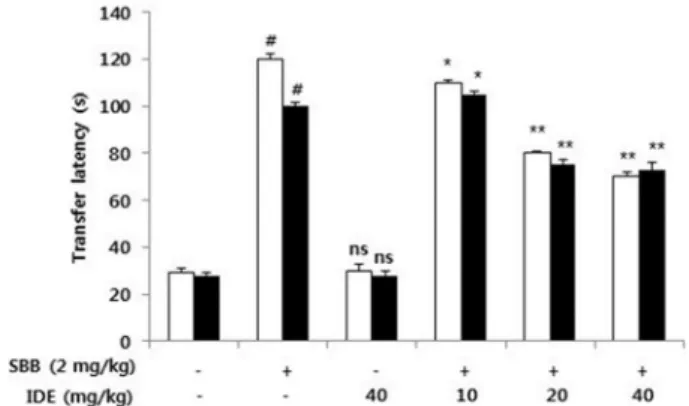
Fig. 3. Effect of IDE on scopolamine-induced memory impairment in mice using the elevated plus maze test. Transfer latency in seconds was measured in first trial second trial. □: Acquisition,

■ : Retention. #P < 0.001 compared with control group. NS: Not significant. *P < 0.05 and **P < 0.01 compared with scopolamine group. Data is expressed as mean ± S.E.M. (n = 5) using one-way ANOVA followed by Tuckey's Multiple comparison test in the Graph Pad Prism v5.01 software. SBB: Scopolamine butyl bromide;

IDE: I. dentata aqueous extract

(4)

(P < 0.05) in transfer latency (TL) values in the acquisition (141.72 ± 10.62 s) as well as the retention period (117.34

± 7.13 s) over those of the vehicle control mice, indicating impairment in learning and memory (Fig. 3).

Pretreatment with IDE at various doses (10, 20 and 40 mg/kg) for 15 days improved the memory in the elevated plus maze. IDE administration dose dependently (P < 0.5, P < 0.01 and P < 0.001 at 10, 20 and 40 mg/mL respec- tively), caused a significant reduction in the acquisition and retention latency in scopolamine-treated group with 40 mg/

mL showing the highest effect (acquisition, 73.52 ± 4.15 s and retention, 67.13±3.91 s). The elevated plus maze test revealed that IDE showed protective effect in TL against scopolamine-induced amnesia dose-dependently. Moreover, the decrease in TL during retention period indicate the positive response of IDE in attenuating learning and memory deficits induced by scopolamine. The major active con- stituents of I. dentata contained approximately 4 mg/g of caffeic acid (3,4-dihydroxy cinamic acid) (Kim et al., 2013).

Approximately 20 types of sesquiterpene and other com- pounds have been isolated from I. dentata. It has been reported that its main compounds are luteolin, luteolin 7- O-glucuronide, caffeic acid, chlorogenic acid, and guaiane sesquiterpene lactones (Cha et al., 2011). Among these main compounds, inhibitory effects of luteolin, chlorogenic acid, and tectroside on allergic inflammation had already been reported. The major active components of I. dentata are phenolic constituents (Kim et al., 2013). These compounds might act individually or in a synergistic manner in delivering neuroprotective effect.

ACKNOWLEDGEMENTS

This research was supported by the Ministry of Trade, Industry & Energy (MOTIE), Korea Institute for Advance- ment of Technology (KIAT) through the Encouragement Program for The Industries of Economic Cooperation Region).

CONFLICT OF INTEREST

No conflicts of interest, financial or otherwise, are declared by the authors.

REFERENCES

Ahn E, Bang M, Song M. Cytotoxic and ACAT inhibitory sesqui- terpene lactones fromthe root of Ixeris dentata forma albiflora.

Archives of Pharmacal Research. 2006. 29: 937-941.

Asuntha G, Prasannaraju Y, Prasad KVSRG. Effect of ethanol extract of Indigofera tinctoria Linn. (Fabaceae) on lithium/

pilocarpine-induced status epilepticus and oxidative stress in Wistar rats. Tropical Journal of Pharmaceutical Research. 2010.

9: 149-156.

Blum D, Torch S, Lambeng N. "Molecular pathways involved in the neurotoxicity of 6-OHDA, dopamine and MPTP: contri- bution to the apoptotic theory in Parkinson's disease", Progress in Neurobiology. 2001. 65: 135-172.

Cha MR, Choi YH, Choi CW, Yoo DS, Kim YS, Choi SU. New guaiane sesquiterpene lactones from Ixeris dentata. Planta Medica. 2011. 77: 380-382.

Choi JS, Chung HY, Young HS. A preliminary study on hypo- cholesterolemic and hypoglycemic activities of some medical plants. Korean Journal of Pharmacognosy. 1990. 21: 153-155.

Derrell C. Guide for the care and use of laboratory animals. In- stitute of laboratory animal resources. National Academy Press.

1996.

El-Sherbiny DA, Khalifa AE, Attia AS, Eldenshery ED. Hypericum perforatum extract demonstrates antioxidant properties against elevated rat brain oxidative status induced by amnestic dose of scopolamine. Pharmacology Biochemistry and Behavior.

2003. 76: 525-533.

Hong S, Jeong D, Kim K, Hwang E. The Composition of the root of Ixeris dentata var. albiflora Nakai. and cell viability and DPPH radical scavenging activities of its extract. Korean Journal of Nutrition. 2010. 43: 105-113.

Im HI, Lee ES, Hwang YJ, Kim YS. Baicalein protects 6-OHDA- induced neuronal damage by suppressing oxidative stress.

The Korean Journal of Physiology and Pharmacology. 2006.

10: 309-315.

Kang H. Anti-neuroinflammatory effects of Ixeris dentata Nakai against lipopolysaccharide-induced BV-2 microglial cells via suppressing NF-κB Signaling. Tropical Journal of Pharma- ceutical Research. 2014. 13: 1629-1635.

Kasture SB, Kasture VS, Joshua AJ. Damodaran A, Amit A.

Nootropic activity of BacoMind

TM

, an enriched phytoche-

mical composition from Bacopamonnieri. Journal of Natural

(5)

Remedies. 2007. 7: 166-173.

Kim DS, Ko JH, Jeon YD, Han YH, Kim HJ, Poudel A. Ixeris dentata NAKAI reduces clinical score and HIF-1 expression in experimental colitis in mice. Evidence-Based Complementary and Alternative Medicine. 2013. 67: 1281-1289.

Kim MJ, Kim JS, Jeong DM, Ham SS, Yu CY. Effect of anti- oxidant, antimutagenicity and anticancer of root extract from Ixeris dentata Nakai. Korean Journal of Medicinal Crop Science. 2002. 10: 222-229.

Kim SB, Kang OH, Joung DK, Mun SH, Seo YS, Cha MR. Anti- inflammatory effects of tectroside on UVB induced HaCaT cells. International Journal of Molecular Medicine. 2013. 31:

1471-1476.

Kumar H, Kim BW, Song SY, Kim JS, Kim IS, Kwon YS, Koppula S, Choi DK. Cognitive enhancing effects of alpha asarone in amnesic mice by influencing cholinergic and antioxidant defense mechanisms. Bioscience, Biotechnology, and Biochemistry. 2012. 76: 1518-1522.

Lee SK, Kang H. Ixeris dentata (Thunb) Nakai Ethylacetate extract attenuates sterol regulatory element-binding proteins-1c via

AMP-activated protein kinase activation. Tropical Journal of Pharmaceutical Research. 2016. 15: 453-459.

Moon M, Kim HG, Hwang L, Seo JH, Kim S, Hwang S, Kim S, Lee D, Chung H, Oh MS, Lee KT, Park. Neuroprotective effect of ghrelin in the 1-methyl-4-phenyl-1,2,3,6-tetrahydro- pyridine mouse model of Parkinson's disease by blocking microglial activation. Neurotoxicity Research. 2009. 15: 332 -347.

Satyanarayana S, Sushruta K, Sarma GS, Srinivas N, Subba Raju GV. Antioxidant activity of the aqueous extracts of spicy food additives--evaluation and comparison with ascorbic acid in in-vitro systems. Journal of Herbal Pharmacotherapy. 2004.

4: 1-10.

https://doi.org/10.15616/BSL.2017.23.3.281

Cite this article as: Lee SG, Kim KW, Kang H. Ixeris

dentata (Thunb) Nakai Attenuates Cognitive Impairment

in Scopolamine-induced Amnesic Mice. Biomedical

Science Letters. 2017. 23: 281-285.

수치

Fig. 3. Effect of IDE on scopolamine-induced memory impairment in  mice  using  the  elevated  plus  maze  test

참조

관련 문서

Second, what effect does the cognitive-behavioral group counseling have on reality testing problem, compulsive preoccupation problem, tolerance and loss of

In this study, we investigated how the Korean-Chinese cultural differences and cognitive emotion regulation influence the spirituality and stress coping

The program intervenes in self-efficacy, anxiety, and time-managing behavior, which respectively stands for cognitive, emotional, and behavioral variables verified to affect

• Theory can extent to molten polymers and concentrated solutions.. The single-molecule bead spring models.. a)

For this study—our third on global workforce trends, follow- ing studies in 2014 and 2018—Boston Consulting Group and The Network surveyed some 209,000 people in 190 countries

Basic aspects of AUTOSAR architecture and methodology Safety mechanisms supported by AUTOSAR.. Technical safety concepts supported by AUTOSAR Relationship to ISO

GDP impact of COVID-19 spread, public health response, and economic policies. Virus spread and public

Micro- and nano-sized pores were formed on the surface of the alloy using PEO and anodization methods, and the pore shape change according to the Zr