Introduction
Sixty percent to 80% of subjects with chronic stroke regain the ability to walk independently (Schmid et al, 2007). Despite the recovery of walking function, however, they generally walk at speeds less than .8 m/s, which lead to restriction in community mobility and reduced social participation (Schmid et al, 2007). A majority of stroke patients also identified a reduced capacity to walk farther as a limiting fac- tor in community participation (Combs et al, 2013).
Many studies have reported that treadmill walking
training (TWT) improves walking function, strength, balance, balance confidence, and gait symmetry in persons with chronic stroke, indicating that it may provide a greater amount and intensity of stepping practice than conventional walking training (Combs et al, 2010; Sullivan et al, 2002; Sullivan et al, 2007).
However, the effects of TWT for ambulatory post-stroke patients have still been inconclusive (Moseley et al, 2005). Moseley et al (2005) reported that dependent walking patients might benefit in terms of improving walking ability, implying that TWT provides adequate intensity and amount of prac- Corresponding author: Yeon-gyu Jeong [email protected]
The Effects of Treadmill Obstacle-Stepping on Physical Activity in Ambulatory Patients After Stroke
Jeong-soo Kim
1, PhD, PT, Yeon-gyu Jeong
2, PhD, PT
1Dept. of Physical Therapy, Seoul Rehabilitation Hospital
2Dept. of Physical Therapy, Dongguk University Ilsan Hospital
Abstract
Previous studies have investigated stepping over obstacles in treadmill walking training (TWT-OS) and treadmill walking training (TWT) alone for walking capacity not considering real physical activity. As such, we investigated the effects of TWT-OS on physical activity and changes in different levels of physical activity based on community ambulation in stroke patients. Thirty subjects were randomly assigned to either the experimental group or the control group, with 15 and 15 subjects, respectively.
However, one subject from the control group was excluded because of inadequate treatment sessions. All subjects underwent routine physical therapy in the form of treadmill walking. The subjects in the experimental group underwent simultaneous training in obstacle-stepping while walking on the treadmill for 30 min/day, five times/week, for four weeks. Subjects were given a three-axis accelerometer to wear at the hip on a belt for one-week pre- and post-training physical activity. Step counts for seven days, average daily step counts, and the average of minutes spent in sedentary, light, and above moderate activity were chosen as outcome measures of physical activity. No significant differences between the groups were found in terms of step counts for seven days, average daily activity, or daily activity spent at sedentary levels after four-week interventions. However, the average daily activity spent at light levels (-42.60 min vs. -6.71 min) was significantly lower in the experimental group than in the controls.
Conversely, average daily activity spent at above moderate levels was higher (19.86 min vs. 11.07 min) (p<.05) after adjusting for each baseline value. Significant pre- and post-training differences were found in all variables of the experimental group (p<.05). Thus, TWT-OS could improve physical levels above moderate activity as a community-oriented task more than simple repetitive waking on a treadmill, and it could provide an opportunity for patients ambulatory after stroke to participate in the community again.
Key Words: Obstacle-cross; Physical activity; Stroke; Treadmill walking.
tice in stroke patients with dependent walking, but not in terms of independent walking (Moseley et al, 2005).
A study reported that 10% of falls in stroke pa- tients occurred after discharge from the hospital and were related to an obstacle (Forster and Young, 1995). Such patients encounter a variety of obstacles of different widths and heights in the community, training in obstacle-crossing may be extremely im- portant as an element of community ambulation. A previous study reported that stepping over obstacles in treadmill walking training (TWT-OS) improved gait endurance, balance, and functional mobility more than only TWT in patients with chronic stroke (Jeong et al, 2013). However, that study measured only aspects of walking capacity and did not consid- er real physical activity based on community ambulation. Therefore, in this study, we investigated the effects of TWT-OS on physical activity, as well as changes in different levels of physical activity, as objectively as possible in hemiplegic stroke patients.
Methods
Participants
The inclusion criteria for the present study were as follows: (1) first cerebrovascular accident as veri- fied by computed tomography or magnetic resonance imaging (at least six months to less than one year);
(2) 40∼80 years of age; (3) hemiplegic stroke with gait disturbance; (4) independent ambulation with or without walking aids (cane or orthosis) over ten me- ters; and (5) sufficient cognition to participate in the training as assessed by the Mini-Mental State Examination-Korean (MMSE-K) score of 23 or higher (Folstein et al, 1975). The exclusion criteria were as follows: neurologic comorbidity other than stroke; cardiovascular, musculoskeletal, or other med- ical condition that could influence gait training; re- fusal to participate in the present study; recurrent stroke; and auditory or visual deficits. The time post-stroke was limited to at least six months to
less than one year in order to obtain a relatively ho- mogenous sample of individuals with chronic stroke readjusting to private treatment. The study was ap- proved by the Institutional Review Board of Catholic University (approval number: KCT0001080), and writ- ten informed consent was obtained from all patients prior to data collection.
Outcome measurements
Physical activity was assessed using a three-axis accelerometer, which is a valid and reliable test in older adults (Davis and Fox, 2007; Esliger et al, 2007; Strycker et al, 2007). The subjects were given an accelerometer (GT1M, ActiGraph, FL, USA) to wear on a belt at the hip all day (from the time of waking) for seven days during pre- and post-inter- vention, removing it only for bathing or swimming.
The subjects were asked to maintain their usual ac- tivities and record them in a log. Accelerometer traces were checked using the ActiGraph-provided ActiLife Monitoring System (Activity monitor, ActiGraph, FL, USA) alongside activity logs. Activity was recorded using ten-second epochs. Subjects with less than five days of data were excluded. Cut-points were used to distinguish between different levels of physical activity: sedentary <200 count/min, light 200
∼1999 count/min, above moderate ≥2000 count/min (Davis and Fox, 2007). Step counts for seven days, average daily step counts, and the average of mi- nutes spent in different levels of physical activity were chosen as the main objective outcomes, as walking is the predominant physical activity of post-stroke patients in the community.
Procedures
Thirty subjects were randomly assigned to either
the experimental (TWT-OS) group or the control
(TWT) group, with 15 subjects in each group. All
subjects underwent routine physical therapy in the
form of TWT. The subjects in the experimental
group underwent simultaneous training in TWT-OS
for 30 min/day, five times/week, for four weeks.
Treadmill walking training (TWT) The control group underwent 20 TWT sessions as reported in other studies (Sullivan et al, 2002; Sullivan et al, 2007). Considering that previous trials have demonstrated changes in walking performance fol- lowing 12 and 18 sessions over four to six weeks (DePaul et al, 2011; Sullivan et al, 2007), we ex- pected that a training frequency of five sessions per week for a total of 20 sessions would result in im- proved walking performance in our subjects. Walking on the treadmill (Biodex Systems 3, Biodex Co., NY, USA) was initiated for the ambulant chronic stroke patients at a speed as slow as 0∼.44 ㎧. The speed was increased in increments of .04 ㎧ until the max- imum speed the patient could tolerate was attained, while still requiring that the patient meet specific endurance and quality demands according to a standardized protocol for progression in inpatients with stroke (Combs et al, 2010). Each patient was checked for progression during every training ses- sion, and they were challenged to maximize their performance. Rest breaks were allowed if requested, but they were not included in the overall walking time. Verbal and manual assistance were provided during TWT by one or two therapists to facilitate an appropriate weight shift and/or control of the pa- retic limb, increase hip extension, or correct foot placement during the gait cycle. Whenever a patient showed fatigue, pain, abnormal breathing pattern, or facial color change, training was stopped immediately.
Stepping over obstacles in treadmill walking training (TWT-OS)
The experimental group performed the same tread- mill walking procedure as the control group, except for stepping over obstacles. To represent obstacles likely to be encountered in the home or community, acryl obstacles (1.5 ㎜ thick×60 ㎝ wide) separated on the treadmill floor were manufactured in three sizes-1 ㎝, 4 ㎝, and 8 ㎝ high-after reviewing the literature on both obstacle crossing and gait in the
stroke population (Said et al, 1999). These obstacles vary in height from less than 1 ㎝ to 8 ㎝, and are similar in dimension to the small obstacles. We de- cided that higher obstacles were inappropriate, as they could pose an unacceptable risk to patient safe- ty or they might elect to avoid them by walking around them. To conduct the TWT-OS, one thera- pist repeatedly placed the obstacles on approximately one-third of the treadmill belt with physical guidance provided by another therapist. The subjects were in- structed to step over the lowest obstacle (1 ㎝); after adapting to the same treadmill speed as the control group, the 3 ㎝ and 8 ㎝ obstacles were used if the participant had no contact with the obstacle and felt comfortable. The speed was then increased in incre- ments of .04 ㎧ following the same procedures as in the instructions. The patients were instructed to lift their legs high enough and far enough to clear each obstacle using the affected leg (lead limb), as the additional visual information available might compen- sate for any loss of kinesthetic information.
Statistical Analysis
For comparisons in demographic and clinical base- line characteristics between groups, independent t- or Chi-square tests were used for continuous and cate- gorical variables, respectively. Shapiro-Wilk tests (p
≥.05) were used to test for normal distribution of the outcomes and difference measures. Paired t-tests were used to compare differences within group means. For between-group comparison of outcomes, an analysis of covariance with the pre-test score as the covariate was used to determine differences in clinical outcomes. All statistical analyses were per- formed using the SPSS ver 18.0 (SPSS Inc., Chicago, IL, USA), with the risk of type Ι error set at p<.05.
Results
Although 30 subjects were enrolled in the study,
one patient (from the TWT group) was excluded be-
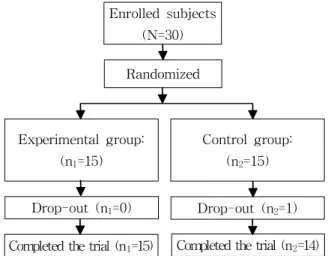
cause he did not participate regularly in the treat- ment sessions. Therefore, data for 29 patients were used for the analysis. Figure 1 shows a flowchart of the study. The demographic and clinical data of the subjects are summarized in Table 1. No statistically significant differences were observed between the two groups with respect to age (t=.36, p=.55), onset time after stroke (t=-1.44, p=.27), MMSE-K (t=1.17, p=.25), or rehabilitation time (t=1.19, p=.46).
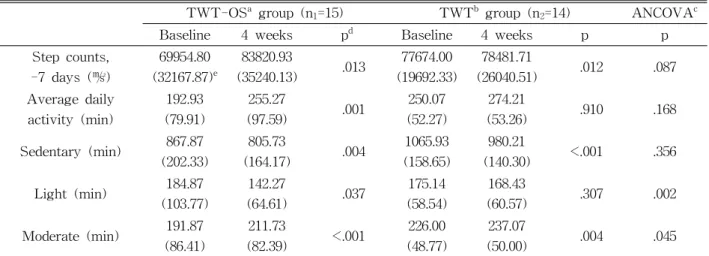
The values for seven-day step count (㎨), average daily activity (min), and average daily activity (min) spent at sedentary, light, and above moderate levels are summarized in Table 2. There were no sig-
nificant differences between the two groups in terms of seven-day step count, average daily activity, or daily activity spent at a sedentary level after the four-week interventions. However, average daily ac- tivity spent at light levels (-42.60 min vs. -6.71 min) was significantly lower in the experimental group than in the control group. Conversely, average daily activity spent at above moderate levels was higher (19.86 min vs. 11.07 min) (p<.05) after adjusting for each baseline value. Significant pre- and post-train- ing differences were found in all variables of the ex- perimental group (p<.05).
Discussion
While it has been shown that TWT is beneficial for patients with acute stroke (Moseley et al, 2005), it has not been clear whether these protocols have the same effect in chronic patients who are ambula- tory after stroke. When applied in patients with chronic stroke in the current study, TWT-OS was more beneficial than TWT at reducing activity at light levels, and in increasing moderate or vigorous levels after four weeks of training. The TWT-OS protocol we used was a short-term, typical inpatient schedule (one hour five times per week for four
TWT-OS
agroup (n
111=15)
TWT
bgroup
(n
2=14) p
Age (year) 73.7 (3.8)
c71.4 (4.1) .55
Sex (male/female) 10/5 6/8 .27
Months post-stroke (month) 9.2 (2.3) 10.0 (2.9) .77
Stroke type (infarction/hemorrhage) 7/8 6/8 1.00
Hemiparetic side (right/left) 6/9 8/6 .47
MMSE-K
d26.5 (1.5) 27.2 (1.7) .25
Duration of rehabilitation (hour) 21.5 (1.2) 22.1 (1.6) .46
Assistive devices (none/single cane) 7/8 10/4 .26
Ankle foot orthosis (yes/no) 7/8 8/6 .72
a
stepping obstacles on the treadmill walking training,
btreadmill walking training,
cmean (standard deviation),
d
mini-mental state examination-Korean.
Table 1. Demographic characteristics of the subjects (N=29) Completed the trial (n
1=15)
Drop-out (n
1=0) Drop-out (n
2=1) Experimental group:
(n
1=15)
Control group:
(n
2=15) Enrolled subjects
(N=30)
Randomized
Completed the trial (n
2=14)
Figure 1. Flowchart of study.
weeks) that was easily understood task-specific training. The findings of this study indicate that in- tegrating community-related tasks into treadmill walking is more advantageous for improving gait function than treadmill walking alone. These findings are in line with those of previous studies that re- ported that a community-based walking program comprising mobility and environmental options is a safe, practical, and effective alternative to routine re- habilitation therapy for stroke patients (Lord et al, 2008; Stuart et al, 2009).
Walking training for most stroke patients is typi- cally conducted indoors, which is a predictable and controlled environment. The skills required for walk- ing under these conditions do not carry over to walking functions in the outdoor environment. The elements of community ambulation include walking at an adequate speed to cross the street safely, walking the distance necessary to accomplish the activities of daily living independently, turning the head while walking and maintaining balance, maintaining stabil- ity despite unexpected perturbations, and demonstrat- ing anticipatory strategies to avoid or accommodate upcoming obstacles (Shumway-Cook et al, 2002).
Given this information, at the beginning of each ses- sion in this study, treadmill walking involved a rela- tively simply designed protocol in order to fulfill ba-
sic elements of community ambulation. The training then incorporated obstacle-crossing as an additional task along with the previous phases, which might pose difficulties with respect to risk of falls in stroke patients. As such, we predicted that TWT-OS would be an adequate training approach for all requirements required for community ambulation. To the best of our knowledge, this pilot study provides the first re- sults regarding the beneficial effects of TWT-OS on real community ambulation measured by three-axis accelerometer.
Both groups in the current study performed tread- mill walking, with obstacle-crossing being the only difference between the groups. Although both groups improved significantly in the seven-day step count, the TWT-OS group ultimately showed significantly better physical activity above moderate levels.
Neurorecovery and functional performance are en- hanced when training incorporates motor tasks of greater complexity and higher-intensity demands than training conditions that do not (Hornby et al, 2011).
Thus, the benefits of TWT-OS might be associated with training interventions that are task-specific and have a higher intensity demand than TWT only.
Gait endurance requires a certain degree of car- diovascular fitness, lower extremity strength, and other factors, such as balance (Pang et al, 2005).
TWT-OS
agroup (n
1=15) TWT
bgroup (n
2=14) ANCOVA
cBaseline 4 weeks p
dBaseline 4 weeks p p
Step counts, -7 days (㎨)
69954.80 (32167.87)
e83820.93
(35240.13) .013 77674.00 (19692.33)
78481.71
(26040.51) .012 .087
Average daily activity (min)
192.93 (79.91)
255.27
(97.59) .001 250.07
(52.27)
274.21
(53.26) .910 .168
Sedentary (min) 867.87 (202.33)
805.73
(164.17) .004 1065.93 (158.65)
980.21
(140.30) <.001 .356 Light (min) 184.87
(103.77)
142.27
(64.61) .037 175.14
(58.54)
168.43
(60.57) .307 .002
Moderate (min) 191.87 (86.41)
211.73
(82.39) <.001 226.00 (48.77)
237.07
(50.00) .004 .045
a