Biomedical Science Letters 2017, 23(2): 138~143 http://dx.doi.org/10.15616/BSL.2017.23.2.138 eISSN : 2288-7415
Hypocholesterolemic Effect of Ginkgo Biloba Seeds Extract from High Fat Diet Mice
Hyun Kang†
Department of Medical Laboratory Science, College of Health Science, Dankook University, Cheonan-si, Chungnam 31116, Korea
To investigate the efficacy of extract of Ginkgo Biloba seeds in high fat diet (HFD) in mice, the Ginkgo Biloba seeds extract (GSE) was orally administered to mice with a HFD at 300 mg/kg/day for 4 weeks. Our results show that GSE significantly inhibited fat accumulation. Moreover, GSE markedly reduced the final body weight with a decrease in epididymal adipose tissue mass and adipocyte size compared with the untreated HFD-induced group. Additionally, GSE ameliorated serum high-density lipoprotein cholesterol levels. The results show that Ginkgo Biloba seeds possesses hypocholesterolemic effect through down regulating lipid metabolism. Further studies are required in this area to strengthen the anti-obesity effects of GSE with active component, and it can be used a pro-drug instead of whole extract.
Key Words: Ginkgo Biloba seeds, Hypocholesterolemic, Lipid metabolism, High fat diet mice
Ginkgo biloba is the oldest gymnosperm species alive and has been used by the Chinese as a traditional cure for different ailments. Ginkgo biloba extract, from Ginkgo biloba leaves, has been widely used as a therapeutic agent for cardiovascular and neurological disorders (Ou et al., 2009).
Clinical studies showed that Ginkgo biloba extract can reduce atherosclerotic nanoplaque formation and size in cardio- vascular high-risk patients (Rodríguez et al., 2007). Ginkgo biloba seeds cause 4'-O-methylpyridoxine poisoning. It inter- feres with pyridoxine (vitamin B6) metabolism in the human body and may lead to a range of symptoms including stom- achache, nausea, vomiting, nervous irritability and convul- sions. The toxicity and symptoms, however, can be reversed by taking pyridoxine supplements. In general, children would tolerate up to five kernels per day and adults about ten per day. However, Owing to the presence of many bioactive
constituents, such as kaempferol, quercetin, and ginkgol, the extract from this plant has been put to modern uses as anti- diabetic, and cardio- and hepatoprotective. Important proteins with functional properties have been isolated from G. biloba seeds (Deng et al., 2011). The Chinese have used these seeds for thousands of years for the treatment and manage- ment of many ailments including ischemia, lung congestion and asthma. In modern day, this phytomedicine is put into use in the treatment of sexual dysfunction, premenstrual syndrome, dementia, and cognitive impairment in many parts of the world, especially, China, Germany and France (Evans et al., 2013). Bioactive constituents of G. biloba extract, i.e.
terpenoids and flavonoids, facilitate drug metabolism in liver by the selective activation of pregnane X receptor, con- stitutive adrostane receptor and aryl hydrocarbon receptor (Li et al., 2009). Following carbon tetrachloride-induced
Brief Communication
*Received: February 17, 2017 / Revised: April 17, 2017 / Accepted: April 28, 2017
†Corresponding author: Hyun Kang. Department of Medical Laboratory Science, College of Health Science, Dankook University, Cheonan-si, Chungnam 31116, Korea.
Tel: +82-41-550-3015, Fax: +82-41-559-7934, e-mail: [email protected]
○CThe Korean Society for Biomedical Laboratory Sciences. All rights reserved.
○CCThis is an Open Access article distributed under the terms of the Creative Commons Attribution Non-Commercial License (http://creativecommons.org/licenses/by-nc/3.0/) which permits unrestricted non-commercial use, distribution, and reproduction in any medium, provided the original work is properly cited.
levels of biochemical indicators of cell damage was observed in Sprague-Dawley rats as result of treatment with G. biloba extract (Yang et al., 2011). We investigated the protective effect of EGb761 on atherosclerosis in a rat model of obese type 2 diabetes. G. biloba extract has beneficial effects on blood circulation and hyperglycemia in patients with dia- betes, G. biloba seeds extract studies on its effects against hypocholesterolemic effect are limited. Therefore, the first time we examined the possible role of Ginkgo biloba seeds extract and its major subcomponents on the cholesterol lowering effects in vivo.
Ginkgo biloba seeds moisture content of <10% by weight, and were air-dried. Ginkgo biloba seeds extracted three times with 70% ethanol for 24 hours at room temperature. The supernatant was collected by filtration using 10 μm cartridge paper. The filtered extract was concentrated under reduced pressure to give a viscous ethanol extract. The concentrated extract was freeze-dried to obtain powder. Twenty-four male C57BL/6J mice (age 5~6 weeks old) were obtained from DBL Inc. (Eumseong-gun, Republic of Korea). This study was approved by the Institutional Review Board Deliber- ations Exemption of Dankook University (IRB No. DKU- 16-028). All the experimental animals were housed in a group (n = 6) and fed ad libitum water and food, under 12 h light and dark conditions. The Institutional Animal Ethics Committee guidelines were followed for handling animals
in this study. All mice had free access to food and water.
They were fed 10 kcal% low fat diet fat or 60 kcal% high fat diet (New Brunswick, NJ, USA) throughout the 8-week treatment period. The animals were subdivided into four groups: 10% low fat diet (LF), 60% high fat diet (HF), HF + GSE 300 mg/kg/day (GSE 300), and HF + green tea extract (GRE) 300 mg/kg/day (GRE 300) and fed for 4 weeks. The body weight of rats was recorded once a week, whereas food intake was recorded daily. The food efficiency ratio (FER) (body weight gain per g consumed food) was calculated throughout the experiment. At the end of the 4 week treatment period after an overnight fast, rats were sacrificed under ether anesthesia, and blood was collected in a heparinized tube. The collected blood was centrifuged at 3,000 rpm for 15 min, and the plasma was stored at -70℃
until processed. The liver, kidney, spleen, epididymis, epi- didymal fat, and abdominal fat were removed immediately, washed in ice-cold saline, and weighed. The concentration of plasma total cholesterol (TC), high density lipoprotein (HDL)-cholesterol, and low density lipoprotein (LDL)- cholesterol were determined using a Konelab 20XT auto- matic blood analyzer. The results were expressed as mean
± standard deviation (S.D.) and statistically analyzed by analysis of variance (ANOVA). Duncan's multiple range test was performed to determine significant differences among the groups, and differences at P < 0.05 were considered to
A B
Fig. 1. Effect of GSE on body weight and food efficiency ratio (FER) in high fat diet (HF)-fed mice. (A) Effect of GSE on body weight gain in HF-fed mice. (B) Effect of GSE on FER in HF-fed mice. Food efficiency ratio (FER) = increased body weight (g)/food intake. The values are mean ± S.D. (n=6). Values with a common superscript letter within the same column are not significantly different (P < 0.05).
LF: 10% low fat diet, HF: 60% high fat diet + vehicle, GSE 300: 60% high fat diet + GSE, 300 mg/kg, GRE 300: 60% high fat diet + GRE, 300 mg/kg.
be significant.
The seeds of Ginkgo biloba are widely used for foods and traditional medicines in China; they are rich in proteins, car- bohydrates, vitamin C, riboflavin, and many other nutrients (Yang et al., 2011). Research shows that Ginkgo biloba seeds have significant antioxidant activity, and this antioxidant
activity was mainly related to its protein compounds (Deng et al., 2011). At present, studies about purification and pre- paration of antioxidant proteins from Ginkgo biloba seeds are insufficient.
The present study was carried out study the hypochole- sterolemic effect of GSE in vivo, we fed a high fat diet to
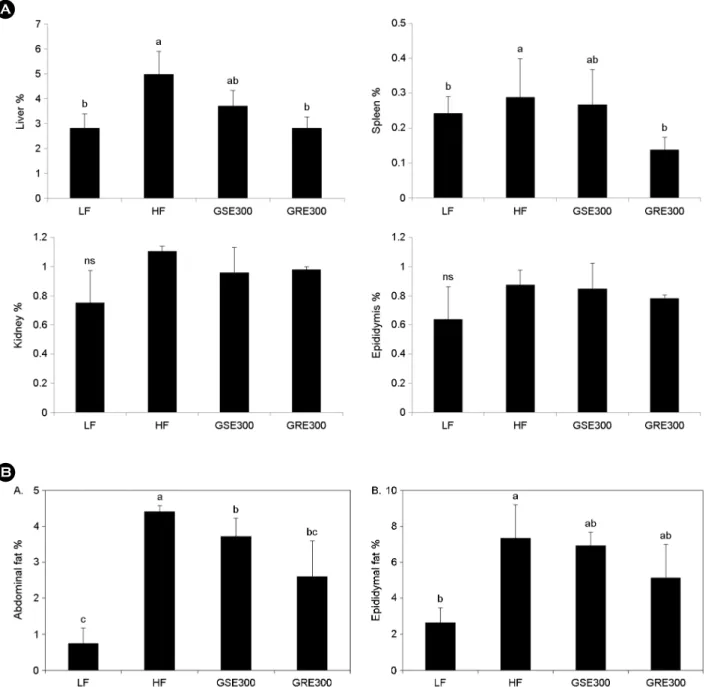
Fig. 2. Different adipose tissue weight in mice fed with experimental diet for 4 weeks. (A) Effect of GSE on abdominal fat weight in HF-fed mice. (B) Effect of GSE on epididymal fat weight in HF-fed mice. The values are mean ± S.D. (n=6). Values with a common superscript letter within the same column are not significantly different (P < 0.05). LF: 10% low fat diet, HF: 60% high fat diet + vehicle, GSE 300: 60% high fat diet + GSE, 300 mg/kg, GRE 300: 60% high fat diet + GRE, 300 mg/kg.
B A
mice for 4 weeks. According to the FER equation, a change in body weight is the most important factor affecting the FER, as there is no large change in the amount of ingested food. Thus, it is possible to apply the FER as an indicator; a small value for the FER can effectively predict the avoidance of obesity. Body weight gain in the HF group was higher than that of the LF, however, that of the GSE 300 group was lower compared to the HF group (P < 0.05) (Fig. 1A).
The food efficiency ratio (FER) of the HF group was signifi- cantly higher, however, that of the GSE 300 group was lower compared to the HF group (P < 0.05) (Fig. 1B). Mice that were orally administered GSE (300 mg/kg) with HF showed decreased body weight and food efficiency compared to HF-fed mice.
In our study, we speculated that the less body weight in GSE fed group might be due to the satiety effect that results reduction in fat tissue weight which is related to body weight
gain. The liver weight of the HF (4.99±0.91%) was signifi- cantly heavier than that of the LF (2.83±0.57%), GSE 300 (3.72±0.61), and GRE 300 (2.82±0.44%). No significant differences in the weights of the spleen, kidney, and epi- didymis among the groups were observed (Fig. 2A). How- ever, we could not measure the fat and lean mass parameters in all treatment groups. Mice that were orally administered GSE with HF had a lower amount of both abdominal and epididymal fat compared to the HF group (Fig. 2B). Abdom- inal fat weights of the HF group were significantly higher, compared to the LF group, and those of the GSE 300 group were significantly lower compared to the HF group (P <
0.05) (Fig. 2B). The effects of GSE on HFD-induced obesity were primarily responsible for inhibiting adipogenesis in adipose tissue and regulating lipid metabolism, such as through lipogenesis and fatty acid oxidation. Zheng et al., 2008 reported that the liver index in treated groups with
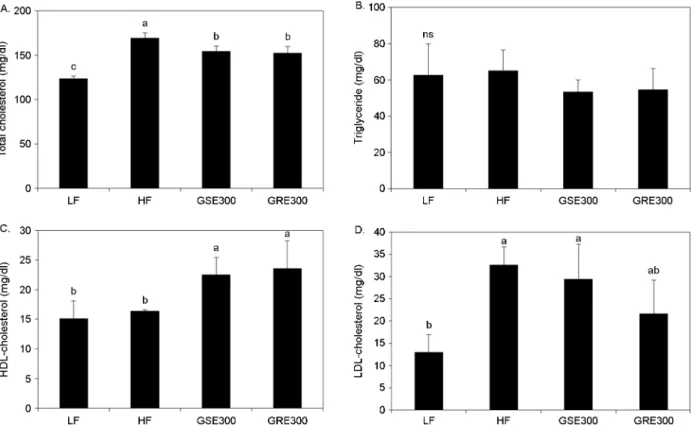
Fig. 3. Effects of GSE on total cholesterol, triglyceride, HDL-cholesterol, and LDL-cholesterol mice fed a high fat diet for 4 weeks.
The values are mean ± S.D. (n=6). Values with a common superscript letter within the same column are not significantly different (P < 0.05).
LF: 10% low fat diet, HF: 60% high fat diet + vehicle, GSE 300: 60% high fat diet + GSE, 300 mg/kg, GRE 300: 60% high fat diet + GRE, 300 mg/kg.
plant extracts shows decreasing when compared with the control group (HFD). As regard to the effect of high fat diet on mice kidney and groups treated with plant extracts, the results in Fig. 2A revealed that the high fat diet did not significantly change in kidney index, small reduction in kidney index observed in treated groups with plant extracts compared to the control group (HFD). No significant changes in color, texture and weight of the kidney in treated groups.
The same results were obtained in other previous studies (Park et al., 2006).
They found that plant extracts greatly reduced body weight in dose dependent manner in high fat fed mice. These results mean that the tested plant extracts possess effect in nor- malizing body weight in HFD mice (Burno et al., 2008).
Results for serum lipid levels are shown in Fig. 3. The HF group showed a significant (P < 0.05) increase in serum total cholesterol and LDL-cholesterol levels compared with the LF group. In contrast, GSE 300 and GRE 300 admin- istration caused a significant (P < 0.05) increase in serum HDL-cholesterol.
Many pharmaceutical candidates and theoretically cardio- protective drugs fall short in a clinical setting, because of their off-target effects and low efficacy at tolerated doses (Gotto, 2003). Statins, one of the cholesterol lowering drugs, are proven to decrease the mortality of coronary heart disease.
However, statins fail to rescue from acute ischemic events and prevent cellular uptake of oxidatively modified LDL (Gotto, 2003). However, trials have not shown efficacy in reducing clinical endpoints (Klingenberg et al., 2009). Ginkgo biloba extract EGb761 has antioxidant and antiplatelet aggre- gation effects indicating that it might protect against athero- sclerosis (Lim et al., 2011). GBE could exert its neuro- protective effects by improvement of Cx43 expression and gap junction intercellular communication (GJIC) induced by hypoxia/ischemia-reoxygenation/reperfusion injury (Li et al., 2005). The experimental results possibly indicate GSE effectively scavenges free radicals such as DPPH (unpub- lished data). It is presumed that GSE may well act as an electron donor and can react with free radicals to convert them to more stable products and terminate radical chain reactions or down regulation of low density lipoprotein (LDL) cholesterol protein.
In summary, this is first study to demonstrate that hypo- cholesterolemic effects of Ginkgo biloba seeds by lipid meta- bolism from High fat diet mice. Our results show that GSE effects on reduction in the body weight gain and food intake, reducing lipid in adipose tissue, and increasing HDL in mice.
This information presented in the current study suggests that GSE, including various flavonoids, might possibly have anti- obesity effects with hypocholesterolemic effects on mice.
CONFLICT OF INTEREST
The authors declare that there is no conflict of interests regarding the publication this articles.
REFERENCES
Bruno R, Dugan C, Smyth J, DiNatale D, Koo S. Green tea extract protects leptin-deficient, spontaneously obese mice from hep- atic steatosis and injury. American Society for Nutrition. 2008:
21: 323-331.
Deng Q, Wang L, Wei F, Xie B, Huang F-H, Huang W, Shi J, Huang Q, Tian B, Xue S. Functional properties of protein isolates, globulin and albumin extracted from Ginkgo biloba seeds.
Food Chemistry. 2011. 124: 1458-1465.
Gotto AM. Antioxidants, statins, and atherosclerosis. Journal of the American College of Cardiology. 2003. 41: 1205-1210.
Evans JR. Ginkgo biloba extract for age-related macular de- generation. Cochrane Database Systemic Review. 2013. 31:
CD001775.
Klingenberg R, Hansson GK. Treating inflammation in athero- sclerotic cardiovascular disease: emerging therapies. European Heart Journal. 2009. 30: 2838-2844.
Li L, Stanton JD, Tolson AH, Luo Y, Wang H. Bioactive terpenoids and flavonoids from Ginkgo biloba extract induce the expres- sion of hepatic drug-metabolizing enzymes through pregnane X receptor, constitutive androstane receptor, and aryl hydro- carbon receptor mediated pathways. Pharmaceutical Research.
2009. 26: 872-882.
Li Z, Lin XM, Gong PL, Zeng FD, Du GH. Effects of Gingko biloba extract on gap junction changes induced by reperfusion/
reoxygenation after ischemia/hypoxia in rat brain. The American Journal of Chinese Medicine. 2005. 33: 923.
Lim S, Yoon JW, Kang SM. EGb761, a Ginkgo biloba extract, is effective against atherosclerosis in vitro, and in a rat model of type 2 diabetes. PLoS One. 2011. 6: e20301.
Ou HC, Lee WJ, Lee IT. Ginkgo biloba extract attenuates oxLDL- induced oxidative functional damages in endothelial cells.
Journal of Applied Physiology. 2009. 106: 1674-1685.
Park SH, Ko SK, Chung SH. Euonymus alatus prevents the hyper- glycemic and hypokipidemic induced by high fat diet in ICR mice. Journal of Ethnopharmacology. 2005. 103: 326-335.
Rizzo M, Battista Rini G. Ezetimibe. Cardiovascular risk and athero- genic dyslipidaemia. Archives of Medical Science. 2011. 7:
5-7.
Rodríguez M, Ringstad L, Schäfer P. Reduction of atherosclerotic nanoplaque formation and size by Ginkgo biloba (EGb 761) in cardiovascular high-risk patients. Atherosclerosis. 2007.
192: 438-444.
Yang L, Wang C-Z, Ye J-Z, Li H-T. Hepatoprotective effects of polyprenols from Ginkgo biloba L. leaves on CCl4-induced
hepatotoxicity in rats. Fitoterapia. 2011. 82: 834-840.
Wei JM, Wang X, Gong H, Shi YJ, Zou Y. Ginkgo suppresses atherosclerosis through downregulating the expression of connexin 43 in rabbits. Archives of Medical Science. 2013.
20: 340-346.
Zheng S, Hoos L, Cook J, Tetzioff G, Davis H, Van Heek M, Hwa J. Ezetimibe improves high fat and cholesterol diet-induced nonalcoholic fatty liver disease in mice. European Journal of Pharmacology. 2008. 584: 118-124.
http://dx.doi.org/10.15616/BSL.2017.23.2.138
Cite this article as: Kang H. Hypocholesterolemic Effect of Ginkgo Biloba Seeds Extract from High Fat Diet Mice. Biomedical Science Letters. 2017. 23: 138-143.