Received: March 27, 2019 Revised: April 30, 2019 Accepted: May 21, 2019
Correspondence to: Nuri Lee, Department of Laboratory Me- dicine, Hallym University Hangang Sacred Heart Hospital, 12 Beodeunaru-ro 7-gil, Yeongdeungpo-gu, Seoul 07247, Korea Tel: 02-2639-5561, Fax: 02-2633-7571
E-mail: [email protected]
침습적 진균 감염 진단을 위한 화상환자에서의 (1,3)-β-D-Glucan 검사의 효용성
이누리1ㆍ김도헌2
한림대학교부속 한강성심병원 진단검사의학과1, 화상외과2
The Effectiveness of (1,3)-β-D-Glucan Assay for Diagnosis of Invasive Fungal Infections in Patients with Burn Injury
Nuri Lee1, Dohern Kim2
Departments of Laboratory Medicine1 and Burn Surgery2, Hallym University Hangang Sacred Heart Hospital, Seoul, Korea
Background: Fungal infections are emerging as a major cause of healthcare-associated infection, and invasive fungal infections (IFI) are associated with high mortality in burn patients. The (1,3)- β-D-glucan (BG) assay has been increasingly used for the diagnosis of IFI, but its effectiveness remains uncertain. As such, we evaluated the BG test in patients with severe burn injuries.
Methods: From July to December 2018, a total of 86 patients with major burn injuries were prospectively tested using a Fungitell assay (Cape Code, East Falmouth, MA). BG levels were measured within the first week of intensive care unit admission and compared with clinical symptoms of patients and results of a fungal culture.
Results: A total of 11 patients were identified as proven or possible IFI. Thirty seven patients (43.0%) were positive, 5 (5.8%) were intermediate, and 44 (51.2%) were negative based on a 60-80 pg/mL cutoff. The sensitivity, specificity, positive predictive value (PPV), and negative predictive value (NPV) were 81.8%, 56.0%, 24.3%, and 95.5%, respectively. A receiver operating characteristic (ROC) analysis showed an area under the curve of 0.725, an optimal cut-off of 124.2 pg/mL, a sensitivity of 81.8%, and a specificity of 74.7%.
Conclusion: The BG test in burn patients showed moderate accuracy and high negative predictive values but very low positive predictive values. We conclude that the BG test is not useful as a screening tool for IFI, but it is recommended as a follow-up in ruling out the discontinuation of treatment.
Keywords: Beta-1,3-D-glucan, Burns, Candidemia, Invasive fungal infections
Introduction
병원 내 진균감염은 점차 증가하는 추세로, 특
히 광범위 항생제의 빈번한 사용과 각종 침습적 시술에 노출되어 있는 중환자실 환자, 항암치료 나 이식 등에 의한 면역 저하 환자, 호중구감소 환자 등에서 호발하고 있다[1-3]. 침습적 진균감 염은 사망률과 예후에 영향을 끼치는 주요 원인 으로 꼽히고 있으며, 진균 이외의 혈류감염보다 높은 사망 위험도를 보이고 있다[4,5]. 하지만 현 재까지 이용되고 있는 배양 검사는 민감도와 특 이도가 낮고, 최종진단까지의 시간이 오래 걸려 적절한 시기에 진균 감염을 진단하기 쉽지 않다 [6,7]. 침습적 진균 감염의 적절한 치료를 위해서
는 조기에 감염균을 진단하고, 치료방향을 설정 하는 것이 중요하기 때문에 좀 더 민감하고, 빠 른 진단을 위한 검사의 필요성이 증가하였다. 이 러한 방안 중에 하나가 최근 개발된 (1,3)-β-D- glucan (BG) 측정 검사이다[8-12]. BG 은 진균 세 포벽의 주요 성분으로, 진균 검출에 있어 비교적 높은 민감도와 정확도를 보인다고 알려져 있다 [13,14]. 개정된 EORTC/MSG (European Organiza- tion for Research and Treatment of Cancer/Mycoses Study Group)의 침습성 진균감염 진단기준에 BG 검사가 포함되었으며, 개정된 ESCMID (European Society of Clinical Microbiology and Infectious Dis- eases)의 가이드라인에도 칸디다혈증 및 침습적 칸디다증의 진단기준에 BG 검사를 포함하고 있 어, 그 중요도가 더 커진 실정이다 [15,16]. 그럼 에도 불구하고, 국내에서는 아직까지 BG 검사가 적극적으로 이루어지고 있지 않으며, 질환별 환 자군에 따른 평가결과도 부족한 편이다. 또한 기 존의 여러 해외 연구 결과에 따르면, BG 검사의 효용성 및 참고범위에 대하여 질환과 환자군에 따라 서로 상이한 결과를 보인 바 있어, 국내 환 자를 대상으로 한 검사의 평가가 필요하다[17].
화상 환자는 면역력이 저하되어 있으며 여러 감염원에 직접적으로 노출되어 있어, 침습성 진 균감염의 주요 위험군으로 분류된다. 또한 화상 환자에서의 박테리아 감염 등은 전세계적으로 감소하고 있는 것에 비해, 진균 감염은 광범위 항생제로 인한 위장관내 정상군 집락 억제 및 위 장관 점막 손상으로 인해 점차적으로 증가하고 있는 추세이다[18-20]. 따라서, 화상 환자에서의 진균 조기 진단과 예방적 항생제 사용을 위한 진 균 감염의 정확한 검출은 예후와 사망률에 있어 그 중요성이 점차 강조되고 있다.
기존의 BG 수행능 평가 및 학술연구는 혈액종 양환자, 이식 환자 등에서는 간헐적으로 이루어 지고 있는 반면, 화상환자에서의 연구는 극히 드 물다. 화상환자을 대상으로 진행된 한 연구에서 는 BG 결과 중 위양성이 많아, 실제 임상에서 진 균감염으로 인한 진양성과의 감별이 어렵다고 보고한 바 있다[19]. 하지만 이 결과는 후향적이 며 소수의 코호트만으로 이루어졌기에 전향적으 로 검사의 효용성에 추가적인 정보를 제공하며,
적절한 참고범위를 설정할 수 있는 연구가 필요 한 실정이다. 따라서 이번 연구에서는 화상을 주 진단으로 내원한 중환자를 대상으로 침습적 진 균감염 진단에 있어서 BG 검사의 효용성에 대하 여 연구하고자 하였다.
Materials and Methods
1. 연구대상
연구대상병원인 한림대학교 한강성심병원 임 상시험심사위원회의 승인(IRB No. 2018-054)을 받은 후, 2018년 7월부터 12월까지 본원에 화상 을 주진단으로 중환자실에 내원한 성인 초진 화 상 환자 86명을 대상으로 연구를 진행하였다. 타 원에서 치료 진행 중 전원 온 환자로 화상 초기 치료 후 일주일 이상 지난 환자는 연구대상에서 제외하였다. 선정된 환자에 대하여 중환자실 입 원 첫 일주일 이내의 BG 값을 측정하였다.
2. 연구방법
1) 침습적 진균 감염의 진단 기준
EORTC/MSG의 개정된 진단기준에 따라 침습 적 진균감염 확진 환자군(IFI proven)과 침습적 진균감염 의심 환자군(IFI possible)을 구분하였다 [15]. 침습적 진균감염 확진 환자군의 경우, 임상 적으로 침습적 진균감염이 의심되며, 무균 검체 로 시행된 현미경적 검사 혹은 무균검체나 혈액 으로 시행된 배양 검사에서 진균이 자란 경우로 정의하였다. 침습적 진균감염 의심 환자군은 침 습적 진균감염의 개체 요인(Host factors)을 가지 고 있으며, 임상적으로 의심되는 소견을 보이나, 체내 무균 기관에서는 진균 배양 결과가 음성이 며, 침습적 진균감염 확진의 근거가 부족한 환자 를 포함하였다.
2) (1,3)-β-D-glucan의 측정
BG의 측정은 FungitellⓇ assay (Associates of Cape Cod, East Falmouth, MA)를 이용하여 제조 사의 지침에 따라 측정하였다.
3) 통계분석
침습적 진균감염 확진 및 의심 환자군(IFI pro-
Table 1. Demographics of patients at the time of admission
Variable All
(N=86)
Value by IFI category
IFI proven or possible (N=11) No IFI (N=75)
Age (IQR) 51 (45-62) 59 (48-66) 51 (45-62)
Male:Female 76:10 8:3 68:7
Race, no. (%)
Asian (Korean) 83 (96.5) 10 (90.9) 73 (97.3)
Others 3 (3.5) 1 (9.1) 2 (2.7)
Mode of Burn
Flame/Chemical/Electric/Scalding 65/1/15/5 9/0/1/1 56/1/14/4
TSBA (IQR) 32 (20-40) 50 (35-74)** 29 (20-39)
Inhalation burn, no. (%) 38 (44.2) 6 (54.5) 32 (42.7)
Full thickness burn, no. (%) 46 (53.5) 7 (63.6) 39 (52.0)
(1,3)- β-D-glucan (pg/mL)
Median (IQR) 55.5 (10.0-158.0) 157.2 (124.7-185.2)* 51.3 (10.0-125.0)
Positive/Intermediate/Negative 37/5/44 9/0/2** 28/5/24
Source of IFI, no. (%)
Candida albicans 5 5 Not applicable
Candida tropicalis 2 2
Candida parapsilosis 1 1
Candida glabrata 2 2
Candida species, not albicans 1 1
Data are medians (IQRs, interquartile ranges) or frequencies.
*P <0.05, **P<0.005.
Abbreviations: IFI, invasive fungal infections; IQR, interquartile ranges; TSBA, total body surface area.
ven and possible)군과 침습적 진균감염 음성군 간 의 차이를 비교하기 위해서는 Mann-Whitney 검 사를 이용하였다. BG 검사결과와 임상양상을 비 교하여, 검사의 민감도, 특이도, 양성예측률, 음 성예측률, 정확도를 평가하였으며, Receiver Oper- ating Characteristic (ROC) curve 분석을 통해 AUC (Area under ROC curve)를 측정하고 검사의 효용 성을 평가하였다. 또한 Youden index 분석을 통해 최적 절단값(cutoff value)을 구하였으며, 절단값 에 따른 민감도, 특이도, 양성예측률, 음성예측 률, 정확도를 제조사의 참고치와 비교 평가하였 다. 모든 통계분석은 SPSS ver. 16 (SPSS Inc., Chicago, IL)와 Medcalc ver. 12 (Medcalc software, Mariakerke, Belgium)을 이용하였다.
Results
1. 환자의 특성
연구기간 동안 모집된 총 86명의 환자를 대상 으로 분석을 시행하였다. 나이는 평균 51세였으
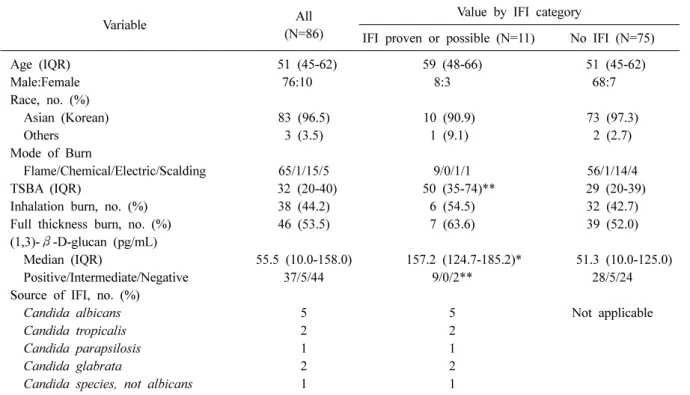
며 남성이 76명, 여성이 10명이었다. 전체 인종은 3명을 제외한 모든 환자가 한국인이었으며, 나머 지는 중국인, 미얀마, 베트남인이었다. 모든 환자 는 화상을 주진단으로 화상중환자실에 내원한 환자였으며, 화상체표면적(total body surface area, TBSA)의 중앙값은 32.0이었다. 화상종류는 화염 화상, 화학화상, 전기화상, 열탕화상이 각각 65명, 1명, 15명, 5명이었고, 흡인화상은 38명 (44.2%), 전층화상(full-thickness burn)은 46명 (53.5%)이었 다(Table 1). 전체 환자 중에서 총 5명이 침습적 진균감염 확진 환자군으로 판정이 되었고, 6명에 서 침습적 진균감염 의심 환자군의 양상을 보였 다. 침습적 진균감염의 원인 진균은 Candida albi- can이 가장 많은 수를 차지했고, 그밖에 C.tropicalis, C.parapsilosis, C.glabrata가 뒤를 이었다.
2. (1,3)-β-D-glucan값과 침습적 진균 감염 연구 기간 동안 측정된 BG 중앙값은 55.5 pg/mL (95% Confidential interval (CI) 10.0-158.0 pg/mL), 최소값 10 pg/mL, 최대값 1000 pg/mL이었다. 전
Table 2. Interval likelihood ratio of (1,3)-β-D-glucan tests
Interval (pg/mL) Positive* Negative
†Likelihood 95% CI
0-100 2 53 0.257 0.073 to 0.909
100-200 8 10 5.455 2.760 to 10.778
200-300 0 3 0.000 0.000 to 21.203
300-400 0 1 0.000 0.000 to 95.752
400-500 1 2 3.409 0.337 to 34.537
500-600 0 3 0.000 0.000 to 21.203
600-700 0 0 ∞ 0 to ∞
700-800 0 0 ∞ 0 to ∞
800-900 0 0 ∞ 0 to ∞
900-1000 0 3 0.000 0.000 to 21.203
Total 11 75
*Positive for invasive fungal infection proven or possible;
†Negative for invasive fungal infection proven or possible.
Fig. 1. Distribution of (1,3)-β-D-glucan levels divided by an interval of 100 pg/mL.
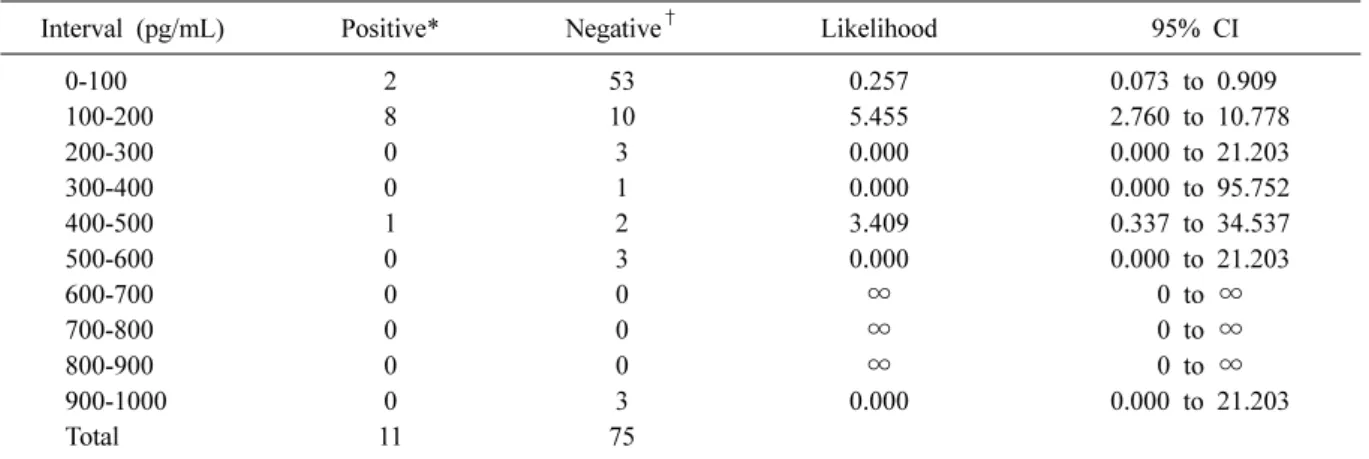
체 환자의 측정된 BG값을 100 pg/mL에 따라 나 눠 살펴본 분포도는 Fig. 1과 같다. 전체 환자 중 의 36.0%인 31명에서 10 pg/mL미만의 값을 보였 으며, 이 환자들을 포함하여 총 55명(64.0%)의 환 자들이 100 pg/mL미만의 값을 나타내었다. 100-200 pg/mL사이의 값에서 18명(20.9%), 200-600 pg/mL 사이의 값에서 10명(11.6%)의 분포를 보였으며, 600-1000 pg/mL사이의 값을 보이는 환자는 없었 고, 총 3명(3.5%)의 환자에서 1000 pg/mL을 초과 하는 값을 나타내었다. 간격우도비(interval likeli- hood ratio) 분석 결과 0-100 pg/mL사이의 결과값 에서는 침습적 진균감염 확진 및 의심 환자군과 침습적 진균감염 음성 환자군의 우도비(likelihood ratio)가 0.257 (95% CI: 0.073-0.909 pg/mL) 였으며, 100-200 pg/mL사이의 값에서는 5.455 (95% CI:
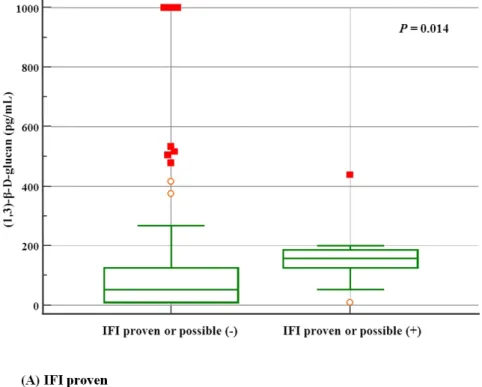
2.760-10.778) 이었다 (Table 2). 침습적 진균감염 여부에 따른 BG 값을 비교해보았을 때, 침습적 진균감염 확진 및 의심 환자군에서의 BG 값은 157.2 pg/mL (95% CI: 124.7-185.2 pg/mL), 침습적 진균감염 음성 환자군에서 51.3 pg/mL (95% CI:
10.0-125.0 pg/mL) 로 통계적으로 유의하게 침습적 진균감염 확진 및 의심 환자군에서 높은 양상을 보였다 (P=0.014, Table 1, Fig. 2).
3. 민감도, 특이도, 양성예측도, 음성예측도와 ROC curve 분석결과
제조사에서 제공하는 참고치(Positive >80 pg/mL, Intermediate 60-80 pg/mL, Negative <60 pg/mL)에 따라 검사결과를 분석해보았을 때, 37명(43.0%)의 환자에서 양성, 5명(5.8%)의 환자에서 중간값 (intermediate), 44명(51.2%)의 환자에서 음성의 결 과를 나타내었다. 이에 따른 결과값을 환자의 침 습적진균감염 임상 양상과 비교해보았다. 침습적 진균감염 확진 환자만을 침습적 진균감염으로 판단하였을 때 중간값(intermediate) 환자(N=5)를 제외하고, 진양성, 진음성, 위양성, 위음성 환자 의 수는 각각 4명, 43명, 33명, 1명이었으며 민감 도(sensitivity), 특이도(specificity), 양성예측도(po- sitive predictive value, PPV), 음성예측도(negative predictive value, NPV), 정확도(accuracy)는 각각 81.8%, 56.0%, 24.3%, 95.5%, 59.3%였다. 침습적 진균감염 확진 및 의심 환자군을 기준으로 분석 했을 때는 진양성, 진음성, 위양성, 위음성 환자 의 수는 각각 9명, 42명, 28명, 2명이었으며 민감
Fig. 2. Comparison of (1,3)- β-D-glucan levels in pa- tients with and without pro- ven or possible invasive fun- gal infections (IFI). Patients with proven or possible in- vasive fungal infection (IFI) (N=11) showed statistically significantly higher (1,3)- β- D-glucan levels (157.2 pg/
mL, 95% CI: 124.7-185.2 pg/
mL) compared to patients without proven or possible IFI (51.3 pg/mL, 95% CI:
10.0-125.0 pg/mL, N=75).
Fig. 3. Sensitivity, specificity, accuracy, positive predictive value (PPV), and negative predictive value (NPV) of (1,3)-β- D-glucan for (A) invasive fungal infection (IFI) proven (B) IFI proven or possible.
도, 특이도, 양성예측도, 음성예측도, 정확도가 각각 80.0%, 53.1%, 10.8%, 97.7%, 54.7% 였다(Fig. 3).
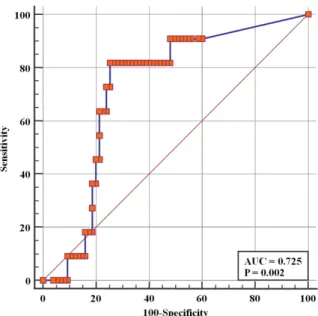
ROC curve 분석을 시행하였을 때 AUC는 0.725 였으며(P=0.002, Fig. 4), Youden index 분석에 따 라 적정한 절단값(cut-off)을 분석하여 보았을 때
침습적 진균감염 확진 및 의심군의 진단을 위한 가장 적정한 BG 절단값은 124.2 pg/mL였다. 적정 절단값인 124.2 pg/mL을 기준으로 재분석하였을 때 전체 환자 중 28명(32.6%)에서 양성, 58명 (67.4%)에서 음성을 보였다. 침습적 진균감염 확
Fig. 4. Receiver operator characteristic (ROC) curve of (1,3)- β-D-glucan cutoff values to define invasive fungal infection (IFI).
진 환자군에 대한 진양성, 진음성, 위양성, 위음 성 환자의 수는 각각 환자의 수는 각각 4명, 57 명, 24명, 1명이었으며, 민감도, 특이도, 양성예측 도와 음성예측도, 정확도는 각각 80.0%, 70.4%, 14.3%, 98.3%, 70.9%였다. 침습적 진균감염 확진 및 의심 환자군에 대한 진양성, 진음성, 위양성, 위음성 환자의 수는 각각 환자의 수는 각각 9명, 55명, 20명, 2명이었으며, 민감도, 특이도, 양성예 측도와 음성예측도, 정확도는 각각 81.8%, 73.3%, 31.0%, 96.5%, 74.4%였다.
Discussion
이번 연구에서는 중증 화상환자를 대상으로 BG 검사의 효용성에 대하여 분석하였다. BG 검 사는 화상환자의 침습적 진균 감염의 진단에 있 어서 중등도의 정확도[21]를 갖으나, 위양성률이 높아 선별검사로써 유용성은 떨어지는 것으로 판단된다. 각 병원의 환자 중증도가 높아지고, 이 식, 면역억제제 사용 등으로 면역력이 감소한 환 자가 많아짐에 따라 진균감염에 대한 검사실과 감염관리실에서의 관심이 더욱 요구된다. BG 검 사는 아직까지 국내의 환자를 대상으로 이루어 진 연구도 많지 않으며, 검사실에서 활발히 이용 되지 않는 실정이다. 또한 혈액종양 환자, 이식환
자, 간질환 환자군 등에서는 BG 검사의 침습적 진균감염의 유용성이 밝혀진 바 있으나, 아직까 지 화상환자 및 외상환자를 대상으로 이루어진 연구는 드물다. 화상환자는 지속적인 위험인자들 의 노출과 함께 전신적인 염증반응으로 인해 세 포 면역체계의 이상을 초래하거나, 창상 치료나 침습적 조작 등으로 인해 높은 진균증, 칸디다혈 증의 발생 빈도를 보이고, 이에 따른 사망률도 높은 것으로 알려져 있다[20,22,23]. 패혈증과 같 은 중증 박테리아 감염이 있는 환자에서도 2차적 인 침습적 진균감염 발생의 위험이 있다. 따라서 이러한 환자들의 면밀한 모니터링과 빠른 진단 및 치료가 필요하다.
화상환자를 대상으로는 이전에 이루어졌던 Blyth 등[19]의 연구에 따르면 BG 검사는 화상환자에서 위양성이 높고, 화상체표면적이 높거나, 거즈 사 용 등으로 인해 기본 결과값이 높아 검사의 이용 에 제한이 있다고 밝힌 바 있다. 이번 연구 결과 에서는 침습적 진균감염 확진 혹은 의심군(IFI proven or possible)은 침습적 진균감염 음성군에 비해 유의하게 BG 값이 높았으나, BG 검사의 특 이도와 양성예측도는 각각 53.1%, 10.8%로 선별 검사로써의 유용성을 떨어지는 것으로 나타났다.
반면 민감도와 음성예측도는 각각 80.0%, 97.7%로 우수한 편으로 평가되어, 추후 화상환자에서의 BG 검사는 침습적 진균감염으로 치료를 시작한 환자에 있어서 치료 반응을 보기 위한 지표로써 이용되거나 치료 중단을 고려할 수 있는 추적 검 사로써 유용하게 사용될 수 있을 것으로 판단된 다. 또한 이번 연구에서 적정 절단값을 재설정한 후 분석하였을 때, 제조사의 참고치를 적용하였 을 때보다 위양성 환자 수가 감소하였으며, 민감 도 및 특이도가 상승함을 확인할 수 있었다. 이 는 각 병원에서 BG 검사를 시행할 때 환자군에 따라 적정한 참고치를 재설정하여 이에 따라 결 과를 판단하여 제공한 필요성이 있는 것으로 사 료된다. 한편, 몇몇의 환자에서는 침습적 진균감 염군이 없이 BG 값이 1000 pg/mL을 초과하는 값 을 보이며 비상적으로 상승된 양상을 보였는데, 이 환자들의 원인 분석을 통해 위양성을 초래하 는 요소를 보정한다면 검사의 정확도 및 효용성 이 호전될 것으로 판단된다.
이 연구는 아직까지 국내에서 흔하게 적용되 고 있지 않은 BG 검사에 대해서 단일 질환군을 대상으로 전향적으로 BG 검사의 효용성 및 참고 범위를 분석했다는 점에서 의의가 있다. 각 병원 의 중증환자군의 증가와 함께 중환자실 환자의 사망률과 예후에 있어 진균감염의 중요성이 대 두됨에 따라, BG 검사는 빠른 시일 내에 상급병 원을 중심으로 적극적으로 활용될 것으로 예상 된다. 하지만 검사 결과의 해석 있어 각 질환별 로 임상의의 세심한 판단이 요구되며, 제조사의 참고범위 외의 각 병원의 검사실 차원에서의 질 환, 혹은 환자군별 적정 절단값의 설정이 필요할 것으로 사료된다.
Summary
배경: 진균감염은 원내감염의 주요 원인 중 하 나로, 특히 화상환자에 있어서 침습적 진균감염 은 환자의 사망률과 높은 관련성을 가지고 있다 고 알려져 있다. (1,3)-β-D-glucan (BG)검사는 침 습적 진균감염의 진단법으로 최근 국내에서도 이용되고 있으나, 아직까지 그 효용성에 있어 연 구된 바가 많지 않다. 따라서 저자들은 화상환자 를 대상으로 침습적 진균감염의 진단에 있어서 BG 검사의 효용성에 대하여 연구하고자 하였다.
방법: 2018년 7월부터 12월까지 화상을 주진단 으로 중환자실에 내원한 총 86명 환자의 BG 수 치를 전향적으로 측정하였다. Fungitell Assay (Cape Code, East Falmouth, MA)를 이용하여 중환자실 입원 첫 일주일 이내의 BG값을 측정하였고, 임 상양상, 진균 배양결과와 비교하여 검사의 효용 성을 평가하였다.
결과: 총 11명의 환자가 침습적 진균 감염으로 확진되거나, 의심 환자로 판명되었다. 60-80 pg/
mL 참고치를 기준으로, 총 37명(43.0%)에서 양성, 5명(5.8%)에서 중간값(intermediate), 44명(51.2%) 에서 음성의 결과를 보였으며, 민감도와 특이도, 양성예측도, 음성예측도는 각각 81.8%, 56.0%, 24.3%, 95.5%였다. ROC (receiver operating charac- teristic) 분석에서 AUC (area under the curve)는 0.725이었으며, 적정 절단값은 124.2 pg/mL로, 이 때 민감도와 특이도는 각각 81.8%와 74.7%였다.
결론: 화상환자에서의 BG 검사는 중등도의 정 확도와 높은 음성예측도를 보였지만, 양성예측도 가 매우 낮았다. BG 검사는 침습적 진균감염의 선별검사로써의 유용성은 떨어지나 치료 중단 등을 배제하기 위한 추적검사로의 이용을 권장 하는 바이다.
Acknowledgements
이 연구는 대한의료관련감염관리학회 연구비 지원으로 수행된 연구임.
This study was supported by Korean Society for Healthcare-associated Infection Control and Pre- vention.
References
1. Garcia-Vidal C, Upton A, Kirby KA, Marr KA.
Epidemiology of invasive mold infections in al- logeneic stem cell transplant recipients: biologi- cal risk factors for infection according to time after transplantation. Clin Infect Dis 2008;47:
1041-50.
2. Alexander BD, Smith PB, Davis RD, Perfect JR, Reller LB. The (1,3){beta}-D-glucan test as an aid to early diagnosis of invasive fungal in- fections following lung transplantation. J Clin Microbiol 2010;48:4083-8.
3. Racil Z, Kocmanova I, Lengerova M, Weinber- gerova B, Buresova L, Toskova M, et al. Diffi- culties in using 1,3-{beta}-D-glucan as the screening test for the early diagnosis of in- vasive fungal infections in patients with haema- tological malignancies--high frequency of false- positive results and their analysis. J Med Micro- biol 2010;59(Pt 9):1016-22.
4. Garey KW, Rege M, Pai MP, Mingo DE, Suda KJ, Turpin RS, et al. Time to initiation of flu- conazole therapy impacts mortality in patients with candidemia: a multi-institutional study.
Clin Infect Dis 2006;43:25-31.
5. Voss A, le Noble JL, Verduyn Lunel FM,
Foudraine NA, Meis JF. Candidemia in in- tensive care unit patients: risk factors for mortality. Infection 1997;25:8-11.
6. Pappas PG, Alexander BD, Andes DR, Hadley S, Kauffman CA, Freifeld A, et al. Invasive fungal infections among organ transplant recipi- ents: results of the Transplant-Associated Infect- ion Surveillance Network (TRANSNET). Clin Infect Dis 2010;50:1101-11.
7. Singh N, Avery RK, Munoz P, Pruett TL, Alexander B, Jacobs R, et al. Trends in risk profiles for and mortality associated with in- vasive aspergillosis among liver transplant reci- pients. Clin Infect Dis 2003;36:46-52.
8. Albert O, Toubas D, Strady C, Cousson J, Delmas C, Vernet V, et al. Reactivity of (1→3)- β-d-glucan assay in bacterial bloodstream in- fections. Eur J Clin Microbiol Infect Dis 2011;
30:1453-60.
9. Bellanger AP, Grenouillet F, Henon T, Skana F, Legrand F, Deconinck E, et al. Retrospective assessment of β-D-(1,3)-glucan for presumptive diagnosis of fungal infections. APMIS 2011;
119:280-6.
10. De Vlieger G, Lagrou K, Maertens J, Verbeken E, Meersseman W, Van Wijngaerden E. Beta-D- glucan detection as a diagnostic test for invasive aspergillosis in immunocompromised critically ill patients with symptoms of respiratory in- fection: an autopsy-based study. J Clin Microbi- ol 2011;49:3783-7.
11. Karageorgopoulos DE, Vouloumanou EK, Ntziora F, Michalopoulos A, Rafailidis PI, Falagas ME.
β-D-glucan assay for the diagnosis of invasive fungal infections: a meta-analysis. Clin Infect Dis 2011;52:750-70.
12. Theel ES, Doern CD. β-D-glucan testing is im- portant for diagnosis of invasive fungal infect- ions. J Clin Microbiol 2013;51:3478-83.
13. Fesel PH, Zuccaro A. β-glucan: crucial compo- nent of the fungal cell wall and elusive MAMP in plants. Fungal Genet Biol 2016;90:53-60.
14. Onishi A, Sugiyama D, Kogata Y, Saegusa J, Sugimoto T, Kawano S, et al. Diagnostic accu- racy of serum 1,3-β-D-glucan for pneumo- cystis jiroveci pneumonia, invasive candidiasis, and invasive aspergillosis: systematic review and meta-analysis. J Clin Microbiol 2012;50:7-15.
15. De Pauw B, Walsh TJ, Donnelly JP, Stevens DA, Edwards JE, Calandra T, et al.; European Orga- nization for Research and Treatment of Cancer/
Invasive Fungal Infections Cooperative Group;
National Institute of Allergy and Infectious Dis- eases Mycoses Study Group (EORTC/MSG) Con- sensus Group. Revised definitions of invasive fungal disease from the European Organization for Research and Treatment of Cancer/Invasive Fungal Infections Cooperative Group and the National Institute of Allergy and Infectious Dis- eases Mycoses Study Group (EORTC/MSG) Consensus Group. Clin Infect Dis 2008;46:
1813-21.
16. Cuenca-Estrella M, Verweij PE, Arendrup MC, Arikan-Akdagli S, Bille J, Donnelly JP, et al.;
ESCMID Fungal Infection Study Group.
ESCMID* guideline for the diagnosis and man- agement of Candida diseases 2012: diagnostic procedures. Clin Microbiol Infect 2012;18 Suppl 7:9-18.
17. He S, Hang JP, Zhang L, Wang F, Zhang DC, Gong FH. A systematic review and meta-analy- sis of diagnostic accuracy of serum 1,3-β-D- glucan for invasive fungal infection: focus on cutoff levels. J Microbiol Immunol Infect 2015;
48:351-61.
18. Santucci SG, Gobara S, Santos CR, Fontana C, Levin AS. Infections in a burn intensive care unit:
experience of seven years. J Hosp Infect 2003;
53:6-13.
19. Blyth DM, Chung KK, Cancio LC, King BT, Murray CK. Clinical utility of fungal screening assays in adults with severe burns. Burns 2013;
39:413-9.
20. Rafik A, Diouri M, Bahechar N, Chlihi A.
Epidemiology of nosocomial fungal infections in the National Center for Burns in Casablanca, Morocco. Ann Burns Fire Disasters 2016;29:90- 3.
21. Greiner M, Pfeiffer D, Smith RD. Principles and practical application of the receiver-operating characteristic analysis for diagnostic tests. Prev Vet Med 2000;45:23-41.
22. Fraser VJ, Jones M, Dunkel J, Storfer S, Medoff
G, Dunagan WC. Candidemia in a tertiary care hospital: epidemiology, risk factors, and pre- dictors of mortality. Clin Infect Dis 1992;15:
414-21.
23. Ekenna O, Sherertz RJ, Bingham H. Natural history of bloodstream infections in a burn pa- tient population: the importance of candidemia.
Am J Infect Control 1993;21:189-95.