CORROSION SCIENCE AND TECHNOLOGY, Vol.10, No.2(2011), pp.43~46
43
Minimizing Zinc Consumption In Hot-Dip Galvanizing Lines
Mark Bright†and Suzanne Ellis1
Pyrotek Inc., Metaullics Systems Division, 31935 Aurora Road, Solon, Ohio 44139 USA
1Pyrotek Engineering Materials Ltd., 55 Holloway Head, Birmingham, U.K. B1 1HP (Received August 11, 2009; Revised March 7, 2011; Accepted March 10, 2011)
Zinc consumption in a continuous galvanizing line is one of the highest operating cost items in the facility and minimizing zinc waste is a key economic objective for any operation. One of the primary sources of excessive loss of zinc is through the formation of top dross and skimmings in the coating pot. It has been reported that the top skimmings, manually removed from the bath, typically consist of more than 80% metallic zinc with the remainder being entrained dross particles (Fe2Al5) along with some oxides.
Depending on the drossing practices and bath management, the composition of the removed top skimmings may contain up to 2 wt% aluminum and 1 wt% iron.
On-going research efforts have been aimed at in-house recovery of the metallic zinc from the discarded top skimmings prior to selling to zinc recycling brokers. However, attempting to recover the zinc entrapped in the skimmings is difficult due to the complex nature of the intermetallic dross particles and the quality and volume of the recycled zinc is highly susceptible to fluctuations in processing parameters.
As such, an efficient method to extract metallic zinc from top skimmings has been optimized through the use of a specialized thermo-mechanical process enabling a continuous galvanizing facility to conserve zinc usage on-site. Also, through this work, it has been identified that filtration of discrete dross particles has been proven effective at maintaining the cleanliness of the zinc. Future efforts may progress towards expanded utilization of filters in continuous galvanizing.
Keywords : zinc, coating, galvanizing, CGL
†Corresponding author: [email protected]
1. Introduction
In a continuous galvanizing line (CGL), zinc is predom- inantly consumed by two sources: galvanized coating on the steel sheet and waste skimmings from the top of the zinc bath created by constant dross formation. Floating skimmings (typically called "top dross") consist primarily of Fe2Al5 while the dross on the bottom of the pot is FeZn10.1),2) During standard cleaning procedures to remove the accumulation of top skimmings, a tremendous amount of "clean" metallic zinc is also extracted from the galvaniz- ing pot and may contain 80 to 95% usable zinc.3) Thiounn, et al.4) defined top skimmings as a mixture of "scum" gen- erated by air knife wiping, discrete Fe2Al5 dross particles along with entrained liquid zinc bath. They also outlined data indicating that "galvanizing skimmings often contain more than 95 wt% zinc". Similarly, DuBois5) noted that CGL drosses contain minimal amounts of oxide particles (<1%) and the percentage of zinc entrained in the removed
dross volume is not only proportional to the steel pro- duction volumes, but also highly dependent on operator skimming practices. A recent investigation by the Interna- tional Lead Zinc Research Organization (ILZRO)6) found that at a specific CGL facility, top skimmings were ex- tracted from the bath at a rate of approximately 21 kg per each 20 tonne steel coil produced and was relatively consistent for a wide array of line operating parameters.
Analogously, Thiounn, et al.4) also presented data identify- ing their rate of skimmings formation at approximately 18-25 kg per coil. However, they further noted that the highest source of skimmings formation was due to cascad- ing zinc from air knife wiping.
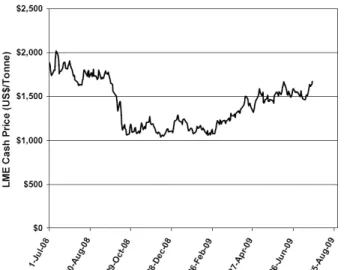
Once these skimmings ("Top dross") are extracted from the coating pot, they are typically sold to recycling or met- al trading companies at a significantly reduced rate from the original "prime" zinc ingot. However, as described, a large amount of "good" zinc is also lost with the waste material. In recent months the daily market price for pri- mary zinc (Fig. 1) has been climbing and is again begin- ning to impact the potential profitability of galvanized
MARK BRIGHT AND SUZANNE ELLIS
44 CORROSION SCIENCE AND TECHNOLOGY Vol.10, No.2, 2011
Fig. 1. LME Cash Price for Primary Zinc Ingot, July 2008-July 2009.7)
sheet, making it more imperative to minimize wasted zinc.
At the same time, continuously increasing logistics and transportation costs for storing and moving zinc skim- mings from each CGL facility and environmental con- straints for industrial waste materials (such as the RoHs directive in the European Union) are forcing steel compa- nies to re-evaluate the volume of zinc waste produced in their operations.
2. Minimizing zinc waste
An on-going research project has been investigating pro- cedures for in-house recovery of the "clean" metallic zinc from these top skimmings in order to minimize the amount shipped to outside processing centers. Starting in 2001, a thermo-mechanical device was developed for the General Hot Dip (Batch) Galvanizing industry8),9),10),11) to allow free, metallic zinc to be separated from drosses and in- dustrial wastes to be collected for re-use in the original coating process. The patented processing equipment de- signed to apply the technology of separation is known as the Metaullics Zinkoff Recovery (MZR) System (Fig. 2).
In the system, a skimmings mixture of zinc and zinc-oxide is subjected to indirect heat while being rotated and stirred.
Melting starts and is encouraged by the continuous tum- bling action under the sustained application of heat until the liquid metal and oxide segregate due to a density differential. The liquid metal collects at the base of the process barrel and can then be tapped into an ingot mould (Fig. 3). In the case of batch galvanizing skimmings, the residual zinc-oxide particles float on top of the metal dur- ing processing and can then be discarded per typical dross recycling procedures.
Fig. 2. MZR750 Zinc Recovery System.9)
Fig. 3. Pouring Recovered Zinc from a MZR750.10)
However, with regards to continuous galvanizing skim- mings, the Fe2Al5 dross particles are metastable and highly susceptible to fluctuations in temperature meaning the standard batch galvanizing zinc recovery process could not be utilized in the MZR System with CGL skimmings.
Initial trials with CGL skimmings in the MZR750 Furnace provided excellent zinc recovery (>80% yield). However, the compositional quality of this zinc was poor, possessing an iron concentration in excess of 0.15 wt%, as compared to the 0.02 wt% Fe in the actual coating bath. Since this recycled zinc could not be reintroduced into the coating operation, new procedures needed to be developed to ac- commodate the rigid CGL quality requirements.
Defining an experimental method and an array of labo- ratory trials, a new MZR process was developed that re- sulted in a lower heating temperature, a longer melting cycle time and also incorporated a Pyrotek Grade-20 SIVEXⓇ Ceramic Foam Filter (Fig. 4) to capture any ex- traneous particle carry-over during pouring. Furthermore, a graphite-based additive was utilized to maintain a partic- ulate residue in the barrel after melting for easy clean-up.
MINIMIZING ZINC CONSUMPTION IN HOT-DIP GALVANIZING LINES
CORROSION SCIENCE AND TECHNOLOGY Vol.10, No.2, 2011 45 Fig. 4. Pyrotek SIVEXⓇ Ceramic Foam Filters.
Table 1. MZR zinc recovery rates and metal quality from preliminary lab trials
Trial Recovery Fe% Al%
Raw Dross
Sample - 0.630 0.95 A 81% 0.058 0.14 B 85% 0.061 0.26 C 89% 0.071 0.23
Fig. 5. Recycled zinc ingot from MZR trials.
These new procedures resulted in recycled zinc with the following chemical composition (Samples A, B, C) after starting with raw top skimmings containing 0.630 wt% Fe.
Moreover, this performance was further validated by a series of trials with a MZR750 Furnace installed at an actual CGL facility. These trials produced the following data with repeatable consistency.
Hence, the updated processing parameters of the MZR Zinc Recovery System provided recycled zinc with the compositional quality nearly equivalent to the zinc in the production CGL coating pot. The recovered zinc ingots
Table 2. MZR zinc recovery rates and metal quality from field trials at CGL site
Trial Recovery Fe% Al%
Raw Dross
Sample - 1.01 1.46 1 86% 0.007 0.23 2 88% 0.0064 0.23 3 81% 0.022 0.17 4 84% 0.014 0.16 5 80% 0.039 0.18 6 75% 0.036 0.18 7 82% 0.036 0.18 8 79% 0.031 0.19 9 81% 0.033 0.17
could easily be remelted without detriment to the coating pot chemistry.
3. Analysis
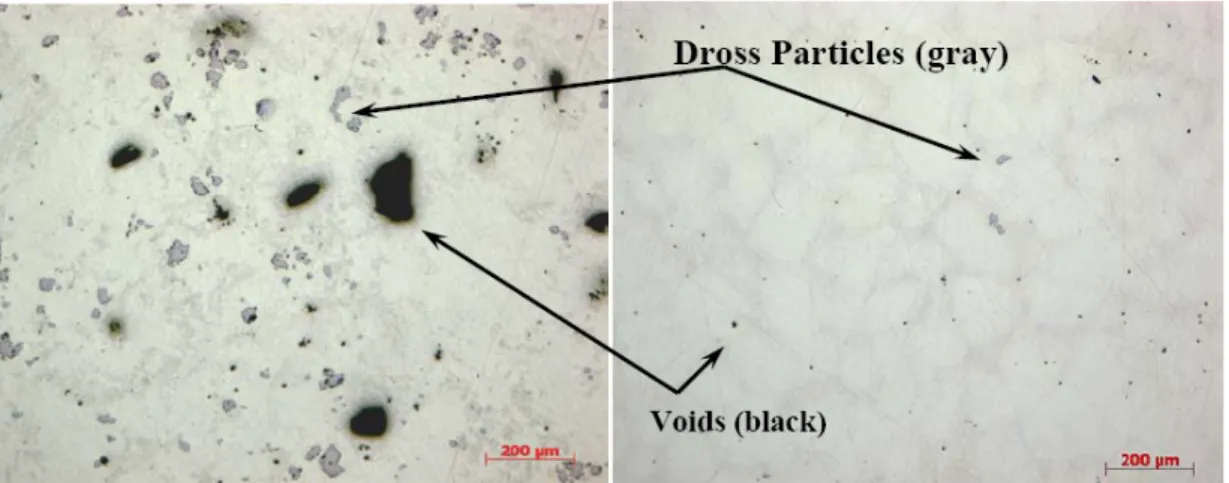
In addition to full hardware trials and general chemical composition testing, specimen samples were sent to the Pyrotek Metallurgical Services Laboratory in Birmingham, U.K. for detailed analysis. First, the particle volume of a raw top skimming sample was compared to the recycled zinc from the MZR Furnace. A cross-section of each speci- men identified that the dross particle concentration was reduced from 651 particles per 10 mm² in the raw dross (Fig. 6) down to only 10 particles per 10 mm² in the re- cycled zinc ingot (Fig. 7). In addition, the average size of the remaining particles in the recycled zinc was less than 10% of the original size, as shown in Fig. 8.
Next, the SIVEXⓇ Grade-20 Ceramic Foam Filter was sectioned and analyzed to better understand the dross par- ticle entrapment mechanisms. As evidenced in Fig. 9, the SIVEXⓇ Filter performed as expected and accumulated a large concentration of particles within the body of the filter. Based on these preliminary zinc filtration trials, new insight is being developed on the characteristics needed to capture metastable Fe2Al5 top dross particles with the anticipation of eventually being able to continuously filter a CGL zinc bath.
4. Conclusions
1) It is widely recognized that a tremendous amount of
"clean" metallic zinc is extracted from a continuous galva- nizing pot during standard dross skimming practices and this waste material may contain up to 95% usable zinc.
MARK BRIGHT AND SUZANNE ELLIS
46 CORROSION SCIENCE AND TECHNOLOGY Vol.10, No.2, 2011
Fig. 6. Raw CGL top dross sample Average 3.36 Area% particles Average 651 particles per 10 mm².
Fig. 7. Recycled zinc after MZR processing Average 0.02 Area%
particles Average 10 particles per 10 mm².
Fig. 8. Particles present before and after MZR processing (particle size distribution per each 10 mm²).
Fig. 9. SIVEXⓇ Grade-20 Ceramic Foam Filter showing massive numbers of Fe2Al5 captured particles.
2) Rising zinc prices, continuously increasing logistics and transportation costs and environmental constraints (such as the RoHs) are making it imperative for steel com- panies to reduce the amount of functional zinc that is dis- carded as waste material.
3) Metaullics Zinkoff Recovery (MZR) System has been optimized to minimize the content of valuable zinc con- tained within top dross skimmings by processing this mate- rial in-house prior to selling to outside recycling facilities.
4) Utilizing molten metal filtration and defined operat- ing parameters in the MZR System, recycled zinc may be easily produced that is near technical equivalence to the zinc in the CGL coating bath.
Ackowledgments
Special thanks to Paul Moberly at Pyrotek Inc., Spokane, WA for his detailed assistance in preparing this manuscript.
References
1. C. R. Shastry, J. J. Galka, Galvanizer's Association Annual Meeting, Indianapolis, Indiana (1998).
2. A. R. Marder, Progress in Materials Science, 45 (2000).
3. Unpublished research, Metaullics Systems (div. of Pyrotek Inc.), Solon, Ohio (2004-2006).
4. R. Thiounn, R. Zanfack, H. Saint-Raymond, P. Durighello, Galvanizer's Association Annual Meeting, Baltimore, Maryland (2008).
5. M. DuBois, Galvanizer's Association Annual Meeting, Monterrey, Mexico (2003).
6. ZCO-55 Project, International Lead Zinc Research Orga- nization, Progress Report (May 2009).
7. London Metals Exchange, http://www.lme.com 8. M. Bright, N. Deem, J. Fryatt, Light Metals 2007, TMS
Annual Meeting, (February 2007).
9. J. Fryatt, J. Vanska, 11th Int'l Galvanizing and Coil Coating Conference, Metal Bulletin, (September 2006).
10. N. Deem, AGA TechForum Conference, American Galvanizers Association, (October 2005).
11. J. Fryatt, N. Deem, M. Bright, GalvaTech'07 Conference, The Iron and Steel Institute of Japan, (November 2007).