Studies on the Inhibitory Effect of Eugenia aromaticum Extract
on Pancreatic Lipase
Seung-Kyum Kim, Yong-Mu Kim, Mi-Jeong Hong and Hae-Ik Rhee*
Division of Biotechnology, Kangwon National University, Chunchon 200-701, Korea
Received January 5, 2005; Accepted May 16, 2005
To develop functional food and anti-obesity drug through inhibition of dietary lipid absorption, inhibitory effects of herb extracts on pancreatic lipase were investigated. Due to high yield and simplicity of isolation, lipase inhibitor (ELI) was isolated from ethyl acetate extract of Eugenia aromaticum, which showed highest inhibitory activity, and characterized for development of novel functional material. Stability of ELI at high temperature and low pH was investigated. Results showed ELI is relatively stable under thermal and acidic conditions, reversible, and noncompetitive inhibitor of pancreatic lipase.
Key words: Lipase inhibitor, Eugenia aromaticum, Obesity, Pancreatic lipase
Obesity is presently one of the main social health problems in many developed countries due to the development of major chronic diseases, including cardiovascular disease, diabetes, and cancer.2,7) Increased intake of foods with high energy and dietary fat content leads to increased calorie intake, thereby promoting body fat storage and body weight gain in humans and animals.3,4) Globally, because dietary life style is changing to western style diet, which contains high fat level and calorie, obesity is increasing at an alarming rate. Therefore, numerous studies are undergoing to determine the therapeutics for this critical public problem of obesity. One of the therapeutic approaches for preventing obesity is to retard the absorption of fatty acid through the inhibition of lipase in the digestive organs.1,21) Pancreatic lipase (PL) is the most important enzyme for the digestion and absorption of dietary triglycerides.6) The application of a lipase inhibitor was reported as a treatment for obesity. Orlistat, a hydrogenated derivative of lipstatin derived from Streptomyces toxitricini, is a potent inhibitor of gastric, pancreatic, and carboxylester lipases, and has proved to be effective for the treatment of human obesity. The existence of lipase inhibitors in various foodstuffs,13) and natural materials such as phosphatidyl choline has been reported. Lipase inhibitor has also been sought in natural products including various herbs.18) In human clinical trials, lipase inhibitor effectively suppressed the bodyweight gain in obese patients by reducing the absorption of dietary fat.5,17,19,20)
In the present study, to develop functional food and anti- obesity drug through the inhibition of dietary lipid absorption, we investigated the inhibitory effects of extracts from more than 800 species of herbs in Korea on pancreatic lipase. Lipase inhibitor (ELI) was isolated and characterized from Eugenia
aromaticum, which showed the highest inhibitory activity among a number of herb extracts with inhibitory activity.
Materials and Methods
Materials. E. aromaticum was purchased from a local medicinal store in Chunchon, Korea. Porcine pancreatic lipase, 2, 4-dinitrophenol, sodium sulfate, butyl chloride, and triethylamine were purchased from Sigma Chemical Co. (St, Louis, MO, USA). 2, 4-Dinitrophenyl butyrate (DNPB) was synthesized using Mosmuller’s method.16) Dichloromethane was purchased from Junsei Chemical (Tokyo, Japan). Silica gel and TLC plate were purchased form Merck Co (Darmstadt, Germany).
Lipase assay. Lipase activity was measured using DNPB as a substrate.16) The reaction mixture was prepared with 0.1 ml of porcine pancreatic lipase (200 units/ml in 0.1 M potassium phosphate buffer, pH 6.8) and 0.1 ml of the inhibitor solution.
The reaction was then started by adding 0.5 ml of 25 mM DNPB to reach a final volume of 0.7 ml. During the assay, the reaction mixture was kept at 37oC in a thermostated cuvette holder. After incubation at 37oC for 1 min, the amount of 2, 4- dinitrophenol released by the lipase was measured at 360 nm using the U-3210 spectrophotometer (Hitachi, Japan). The inhibitory activity (%) was calculated as
(1-B/A) × 100
where A and B are the activities of the enzyme without and with sample, respectively.
Extraction and isolation of ELI. The lyophilized and powdered E. aromaticum (1 kg) was exhaustively extracted with ethyl acetate (5l×3) at room temperature. The extract was concentrated in vacuo (yield, 121 g), which was then dissolved in chloroform (300 ml) and partitioned successively with n-hexane (600 ml) to give an active residue (65 g) using
*Corresponding author
Phone: +82-33-250-6481, Fax: +82-33-241-6480 E-mail: [email protected]
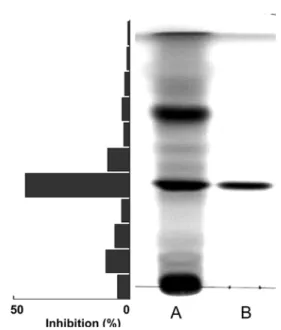
different solubilities. The active residue was applied to silica gel column (50×450 mm), eluted with ethyl acteate-n-hexane (40 : 7) to afford five fractions (A-H). Fraction D (800 mg) was subjected to prep RP-18 column, eluted with methanol- water (10 : 1) to give active fraction (ELI, 450 mg) through UV detection at 285 nm and TLC (ethyl acetate-hexane- formic acid = 2 : 2 : 0.1) (Fig. 1). The flow rate was 5 ml/min.
Stability at acidic condition and high temperature.
To investigate the stability of heat and acidic conditions, ELI was treated at various temperatures and pH, and was then used for the inhibition assay against lipase. The stability was measured based on the inhibitory activity of treated ELI under various conditions by comparing with that of the non-treated ELI.Kinetic of inhibition against lipase.
The inhibition mode of ELI at different concentrations against lipase activity with increasing concentration of DNPB as a substrate was measured.Based on the results, inhibition type was determined by Lineweaver-Burk plot analysis of the data calculated according to Michaelis-Menten kinetics.
Reversibility of ELI on lipase activity.
Two hundred units of lipase was incubated with 1 mg of ELI in 1.0 ml in 0.1 M potassium phosphate buffer, pH 6.8, for 1 h at 37oC and dialyzed against 20 mM potassium phosphate buffer, pH 6.8, for 24 h at 4oC, changing buffer every 8 h. A separate premixed-enzyme solution (1.0 ml) was kept at 4oC for 24 h without dialysis for the control experiments. Reversibility of ELI was determined by comparing the residual enzyme activity after dialysis with that of the control.Inhibitory activity of ELI on triolein digestion.
The inhibitory effect of ELI on the digestion of natural substrate was investigated using triolein instead of DNPB as anartificial substrate. A mixture of lipase and ELI was incubated with the emulsification substrate solution (40 mg triolein/ml in 0.1 M potassium phosphate buffer, pH 6.8) sonicated with a Soniprep 150 (MSE, UK) for 1 h at 37oC, and the reaction was stopped by adding equal amount of chloroform. The solvent phase was used to confirm the inhibitory effect of ELI on triolein digestion using TLC (benzene-diethyl ether-ethyl acetate-acetic acid = 80 : 10 : 10 : 0.2). The grade of triolein digestion was determined by comparing with trioein and the reaction mixture without the inhibitor.
Results
The effect of extraction solvent on the inhibitory activity against pancreatic lipase.
We investigated the yield and lipase inhibitory activity of ethyl acetate, ethanol (70 and 100%), and water extracts of E. aromaticum. Ethyl acetate, 70% ethanol, and cold and hot water extracts showed approximately 50% inhibitory activity against lipase, whereas the 100% ethanol extract showed lower inhibitory activity of 35% (Table 1). Yields of ethanol and water extracts were 15- 19%, slightly higher than that of ethyl acetate extract of 12%.Due to the high inhibitory activity compared to the extraction yield and the convenience of lipase inhibitor purification, ethyl acetate was selected as the extract solvent for the isolation and purification experiment of lipase inhibitor.
The stability of ELI at acidic condition and high temperature.
The stability of ELI in the digestive organ at high temperature and low pH was investigated for industrial use. The inhibitory activity on lipase was measured by ELI was treated at various temperatures (60, 80, 100) for 30 and 60 min, and its lipase inhibitory activity was compare to that of non-treated one. Results showed ELI exerted over 95%inhibitory activity against lipase at 60 for 1 h, whereas at 80 only 30% of the initial activity remained, and almost no activity was detected at 100 (Table 2); thus ELI is stable up to 60 but becomes unstable at over 60. To investigate the acidic stability, inhibitory activity of ELI was measured after treatment for 30 and 60 min at various pH values (2.0, 4.0, 7.0) and compared with that of non-treated ELI. All reaction mixtures were adjusted to pH 7.0 after treatment using 0.1 M K2HPO4. Results revealed 83% of the ELI inhibitory activity was maintained at pH 4.0 for 1 h. Moreover, over 75% of the Table 1. Effects of extraction solvents on extract yield and inhibitory activity against pancreatic lipase
Solvents Yield of extract
(%, w/w) Inhibition (%) Ethyl acetate (100%, v/v) 12.1 *48.4 ± 3.2a
Ethanol (100%, v/v) 15.4 34.2 ± 2.1
Ethanol (70%, v/v) 19.4 49.8 ± 2.8
Cold water 15.6 47.2 ± 1.9
Hot water 17.5 48.7 ± 3.0
aMean values ± standard deviation (three replicates).
Fig. 1. Thin layer chromatogram of Eugenia aromaticum extract and ELI. TLC plate was immersed in a solvent mix- ture (ethyl acetate-hexane-formic acid = 8 : 8 : 0.4), sprayed with 10% sulfuric acid, and heated. The inhibitory activity was measured after scratching from TLC plate. (A) Crude extract of E. aromaticum;(B) Purified inhibitor (ELI).
inhibitory activity was maintained at pH 2.0 for 1 h, which is the same condition as in the stomach (Table 3).
Inhibition kinetics and reversibility of ELI on pancreatic lipase. The inhibition modes of ELI against pancreatic lipase were measured with increasing concentration of the substrate in the absence and presence of ELI at different concentrations.
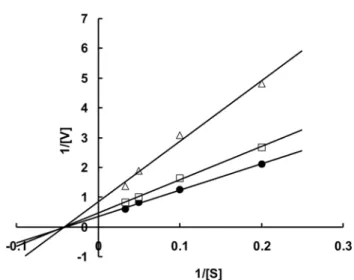
Inhibition type was determined by Lineweaver-Burk plot analysis of the data calculated from the results according to Michaelis-Menten kinetics. Pancreatic lipase inhibition by ELI was shown to be noncompetitive, which has same Km value at different inhibitor concentrations (Fig. 2). To determine the binding reversibility to pancreatic lipase, ELI was premixed with pancreatic lipase for 1 h and dialyzed against 20 mM potassium phosphate buffer, pH 6.8, for 24 h at 4oC, changing buffer every 8 h. The enzyme activity of pancreatic lipase itself was not significantly modified after dialysis. The enzyme activity was considerably inhibited by preincubation with ELI, but was recovered after dialysis, suggesting its reversible binding to the enzyme (Table 4).
Lipase inhibitory activity on triolein digestion. We investigated the inhibitory activity of ELI against lipase using natural substrate triolein instead of DNPB, artificial synthesized substrate. The Inhibitory activity of ELI was measured by determining product of reaction with emulsified triolein as substrate at 37oC for 1 h using TLC. The grade of triolein
digestion was determined by comparing with trioein and the reaction mixture without inhibitor (Fig. 3). Results showed ELI effectively suppressed the digestion of triolein into monoglyceride and free fatty acid as observed with Orlistat, a potent inhibitor of gastric, pancreatic, and carboxylester lipases, which indicates that ELI repressed pancreatic lipase activity on not only artificial substrate DNPB but also natural substrate triolein.
Table 2. Effect of temperature on inhibitory activity of ELI against pancreatic lipase
Temperature
(oC) Time
(min) Inhibition
(%) Relative activity (%)
Control - *54.3 ± 1.2a 100.0
6060 30 53.4 ± 1.4 98.3
60 52.3 ± 2.2 96.2
8080 30 16.2 ± 1.7 29.9
60 15.2 ± 2.0 28.0
100100 30 NIb 0.0
60 NI 0.0
aMean values ± standard deviation (three replicates).
bNI: no inhibition; Control: kept in the refrigerator before using Table 3. Effect of pH on inhibitory activity of ELI against pancreatic lipase
pH Time
(min) Inhibition
(%) Relative activity
Control - *55.3 ± 2.1a 100.0(%)
7.07.0 30 55.0 ± 2.0 99.4
60 54.8 ± 2.3 99.1
4.04.0 30 48.3 ± 1.7 87.3
60 46.0 ± 2.1 83.1
2.02.0 30 46.7 ± 2.8 84.4
60 43.2 ± 1.5 78.2
aMean values ± standard deviation (three replicates) Control: kept in the refrigerator before using
Fig. 2. Lineweaver-Burk plot of the reaction of lipase in the presence of ELI from E. aromaticum. ●: Control; □: ELI 0.5 mg; △: ELI 1.0 mg.
Table 4. Effects of ELI on pancreatic lipase activity before and after dialysis.
Inhibition (%) Relative activity Before dialysis After dialysis (%)
Orlistat *56.2 ± 2.7a 56.0 ± 1.7 99.6
ELI 54.9 ± 2.2 26.1 ± 1.9 47.5
aMean values ± standard deviation (three replicates).
Fig. 3. Thin layer chromatogram of lipase inhibitor reaction.
The TLC plate is immersed in a solvent mixture (benzene-diethyl ether-ethyl acetate-acetic acid = 80 : 10 : 10 : 0.2), sprayed with 10% sulfuric acid, and heated. (A) Triolein; (B) Reaction with Orlistat;(C) Reaction with ELI; (D) Reaction without inhibitor.
Discussion
We investigated the pancreatic lipase inhibitory effects of ethanol extracts from more than 800 species of herbs in Korea, among which E. aromaticum extract showed the highest inhibitory activity. Previous studies have established lipase inhibitors such as lipstatin derived from Streptomyces toxitricini and its hydrogenated derivative,1) and CT-II isolated from Nomame herba.18) In addition, some botanical foodstuffs such as the soybean proteins8,9,12) and AR25® from green tea extract13) have been reported as lipase inhibitors. Various plant species including Cassia mimosoides,11,20)Camelia sinensis,10) and Salacia reticulate22) have also been found to have lipase inhibitors. ELI was isolated from E. aromaticum using ethyl acetate as the extraction solvent, because the inhibitory activity is high relative to the extraction yield and the isolation of lipase inhibitor is convenient due to the solvent characteristic. ELI was isolated though the silica gel and reverse phase column chromatographies, and confirmed through TLC.
Under the thermal- and acid-conditions of this study, E.
aromaticum and ELI were shown to be comparatively thermal- and acid-stable, and thus would be resistant to the human digestive, making them useful industrially or as additions to health food. The Inhibition mode of ELI was non- competitive as observed with Orlistat, an established lipase inhibitor determined by Lineweaver-Burk plot analysis.
However, ELI was shown to be reversible to pancreatic lipase, in contrast with the result of Orlistat, which was shown to be irreversible to pancreatic lipase, suggesting that the inhibition mechanism of ELI against pancreatic lipase is totally different from that of Orlistat. As with Orlistat the production of oleic acid was significantly suppressed when triolein, a natural substrate, was used.
These results thus suggest ELI, as an effective inhibitor of pancreatic lipase isolated from E. aromaticum, is useful for the development of functional food against obesity and as a lead compound for the design of new anti-obesity drug. To understand the inhibitory mechanisms more clearly and investigate the effect of ELI through animal experiment, structural analysis of ELI is currently underway in our laboratory.
Acknowledgments
This study was supported by research fund in 2003 from Kangwon National University
References
1. Ballinger, A. and Peikin, S. I. R. (2002) Orlistat: its current status as an anti-obesity drug. Eur. J. Pharm.440, 109-117.
2. Bray, G. A. (2002) The underlying basis for obesity: rela- tionship to cancer. J. Nutr.132, 3451S-3455S.
3. Bray, G. A. and Popkin, B. M. (1998) Dietary fat intake
does affect obesity. Am. J. Clin. Nutr.68, 1157-1173.
4. Bray, G. A. and Popkin, B. M. (1999) Dietary fat affects obesity rate. Am. J. Clin. Nutr.70, 572-573.
5. Drent, M. L., Larsson, I., William-Olsson, T., Quaade, F., Czubayko, F., Bergmann, K., Strobel, W., Sjostrom, L. and van der Veen, E. A. (1995) Orlistat (Ro 18-0647), a lipase inhibitor, in the treatment of human obesity: a multiple dose study. Int. J. Obesity. 19,221-226.
6. Embleton, J. K. and Pouton, C. W. (1997) Structure and function of gastrointestinal lipases. Adv. Drug. Deliv. Rev.
25, 15-32.
7. Flegal, K. M., Carroll, M. D., Ogden, C. L. and Johnson, C. L. (2002) Prevalence and trends in obesity among US adults, 1999-2000. JAMA. 288, 1723-1727.
8. Garugouri, Y., Ransac, S. and Verger, R. (1997) Covalent inhibition of digestive lipases an in vitro study. Biochimica.
et Biophysica. Acta.1334, 6-37.
9. Garugouri, Y., Julien, R., Pieroni, G., Verger, R. and Sarda, L. (1984) Studies on the inhibition of pancreatic and micro- bial lipases by soybean proteins. J. Lipid Res. 25, 1214- 1221.
10. Han, L. K., Kimura, Y., Kawashima, M., Takaku, T., Taniyama, T., Hayashi, T., Zheng, Y. N. and Okuda, H.
(2001) Anti-obesity effects in rodents of dietary teasaponin, a lipase inhibitor. Int. J. Obes. Rel. Metab. Dis. 25, 1459- 1464.
11. Hatano, T., Yamashita, A., Hashimoto, T., Ito, H., Kubo, N., Yoshiyama, M., Shimura, S., Itoh, Y., Okuda, T. and Yoshida, T. (1997) Flavin dimers with lipase inhibitory activity from Cassia nomame. Phytochemistry.46, 893-900.
12. Higaki, S. (2003) Lipase inhibitor for the treatment of acne.
J. Molecular Catalysis B : Enzymatic.22, 377-384.
13. Juhel, C., Armand, M., Pafumi, Y., Rosier, C., Vanderman- der, J. and Lairon, D. (2000) Green tea extract (AR25®) inhibits lipolysis of triglycerides in gastric and duodenal medium in vitro. J. Nutr. Biochem.11,45-51.
14. Meyer, J. H., Elashoff, J. D., Domeck, M., Levy, A., Jehn, D., Hlinka, M., Lake, R., Graham, L. S. and Gu, Y. G.
(1994) Control of canine gastric emptying of fat by lipoly- tic products. Am. J. Physiol.266, 1017-1035.
15. Meyer, J. H., Hlinka, M., Khatibi, A., Raybould, H. E. and Tso, P. (1998) Role of small intestine in caloric compensa- tions to oil premeals in rats. Am. J. Physiol. 275, R1320- R1333.
16. Mosmuller, E. W. J., Van Heemst, J. D. H., Van Delden, C.
J., Franssen, M. C. R. and Engbersen, J. F. J. (1992) A new spectrophotometric method for the detection of lipase activ- ity using 2, 4-dinitrophenyl butyrate as a substrate. Bioca- talysis, 5,279-287.
17. Reaven, G., Segal, K., Hauptman, J., Boldrin, M. and Lucas, C. (2001) Effect of Orlistat-Assisted Weight Loss in Decreasing Coronary Heart Disease Risk in Patients with Syndrome X. Am. J. Cardiol.87, 827-831.
18. Shimura, S., Tsuzuki, W., Kobayashi, S. and Suzuki, T.
(1992) Inhibitor Effect on Lipase Activity of Extracts from Medicinal Herbs. Biosci. Biotech. Biochem.56, 1478-1479.
10. Sternby, B., Hartmann, D., Borgsrom, B. and Nilsson, A.
(2002) Degree of in vivo inhibition of human gastric and pancreatic lipases by Orlistat (Tetrahydrolipstatin, THL) in the stomach and small intestine. Clin. Nutr.21, 395-402.
20. Yamamoto, M., Shimura, S., Itoh, Y., Ohsaka, T., Egawa, M. and Inoue, S. (2000) Anti-obesity effects of lipase inhib- itor CT-II, an extract from edible herbs, Nomame herba, on rats fed a high-fat diet. Int. J. Obes. 24, 758-764.
21. Yanovski, S. Z. and Yanovski, J. A. (2002) Obesity. N.
Engl. J. Med.346, 591-602.
22. Yoshikawa, M., Shimoda, H., Nishida, N., Takada, M. and Matsuda, H. (2002) Salacia reticulata and its polyphenolic constituents with lipase inhibitory and lipolytic activities have mild antiobesity effects in rats. J. Nutr. 132, 1819- 1824.