Received: February 14, 2021 Revised: April 23, 2021 Accepted: July 7, 2021
Address for Correspondence: Zahra Bostani Khalesi, Social Determinants of Health Research Center, Guilan University of Medical Sciences, Hamidyan Shahrak, Shahid Dr. Beheshti Ave., Rasht 41469-39841, Iran
Tel: 98-9112370860, E-mail: [email protected], ORCID: https://orcid.org/0000-0001-5531-0506
ORIGINAL ARTICLE
INTRODUCTION
The goal of achieving optimal health outcomes for all in the 21st century is improving quality of life (QOL).
QOL is a mental aspect of welfare and one of the indi- cators of health measurement [1]. Currently, well-being and health-related QOL are major concerns for health providers in public health [2] and one of the most im- portant components of the general concept of health [3].
The issue of QOL is important across different classes of the society, especially those suffering special physi- cal or psychological conditions and facing the stresses resulting from these conditions [4].
One of the vulnerable classes of society is the group of women reaching the menopausal age [5]. In spite of in- creasing life expectancy, the age of menopause is fixed.
Thus, women in more developed countries pass almost one-third or 30 years of their lives in the menopausal period [6,7]. According to the statistics predicted by the Iranian management and planning organization, until 2021 in Iran the number of menopausal women would be 5 million [8]. Menopausal women usually suffer vaginal atrophy and dryness, diminished sexual desire or sexual arousal, and problems in achieving orgasm [9,10]. Thus, one of the common and principal health-related concerns in menopausal women is im-
The Association between Sexual Self-Efficacy and the Quality of Life among Menopausal Women
Tahereh Jalali1, Zahra Bostani Khalesi2, Fatemeh Jafarzadeh-Kenarsari2
1Student Research Committee, Guilan University of Medical Sciences, Rasht, Iran, 2Social Determinants of Health Research Center, Guilan University of Medical Sciences, Rasht, Iran
Objectives: The present study aimed to determine the association between sexual self-efficacy (SSE) and quality of life (QOL) among menopausal women.
Methods: In this analytical cross-sectional study, 558 menopausal women were enrolled. Consecutive and available sampling was performed for the sample collection. The instruments used for data collection included a three-part questionnaire consisting of demographic information, Menopausal-Specific Quality of Life Questionnaire (MENQOL), and SSE questionnaire.
Results: Overall, the maximum and minimum scores of SSE were related to sexual desire (2.88 ± 0.60) and orgasm (0.85 ± 0.17). The highest and lowest scores of QOL were related to psychosocial (4.14 ± 1.24) and sexual activity (3.03 ± 1.74) domains. A significant correlation was observed between the QOL and the domains of SSE (P < 0.001). The maximum and minimum correlation of QOL were related to sexual desire (P < 0.001, r = 0.030) and orgasm (P < 0.001, r = 0.108), respectively. Furthermore, a significant correlation was observed between the SSE score and all domains of QOL except for the vasomotor domain. With regard to the SSE score, the maximum association was found with the sexual activity score (P < 0.001, r = 0.466).
Conclusions: Based on the findings of this study, a significant direct correlation was observed between the QOL and SSE of menopausal women. Thus, further research and developing education and consultation as intervention programs for enhancing SSE can promote the QOL among women.
Key Words: Menopause, Quality of life, Sexual health, Self-efficacy, Women
paired sexual functioning and its negative impacts on their marital satisfaction and QOL [6,11]. Based on the results of studies performed in Iran, the prevalence rate of female sexual disorders during menopause is 72.5%
[12]. Hence, the prevalence of this disorder is high among menopausal women [10], and significantly af- fects their confidence, mood, relations with the spouse, and naturally their QOL [13]. Meanwhile, the low confidence of the person in sexual affairs or low sexual self-efficacy (SSE) plays a determining role in develop- ing sexual function disorders [14]. The concept of SSE which is adapted from Bandura’s self-efficacy theory is a multidimensional construction composed of the per- son’s belief about their ability in performing effective sexual activity [15].
Researchers believe that in order to have a proper and desirable sexual functioning, SSE is essential, and those with a higher SSE have greater sexual perception and pleasure plus better psychosocial functioning [16].
They also believe that low SSE can have negative effects on the person’s sexual function and behavior, resulting in avoidance of sexual activity [17]. Sex therapists also consider SSE as a predictive factor for sexual function- ing [15,17] and boosting the SSE as a proper solution to prevent sexual problems, to improve sexual activity, and to ameliorate sexual adaptation [18].
Thus, the question arises here, whether by enhancing SSE among women, the QOL of menopausal women could be heightened through improving the sexual functioning. Hence, the aim of the current study was to determine the association between SSE and QOL of menopausal women referring to Alzahra education, re- search, and remedial center in Rasht, Iran.
MATERIALS AND METHODS
This study was carried out at Guilan University of Medical Sciences from April 2019 to February 2020.
A cross-sectional comparative study was conducted which 558 menopausal women 40–60 years of age meeting the inclusion criteria participated. The inclu- sion criteria were as follows: natural menopause (no incidence of menopause following surgery), consent to participating in the study, at least one year past their menopause, having a spouse and sexual activity, no special disease (cardiovascular disease, epilepsy, diabe- tes, hypertension), not consuming drugs affecting the nervous system, no heavy psychological stress such as accidents or loss of first-degree family members over
the last three months. On the other hand, not respond- ing to the questionnaire items completely was the ex- clusion criterion. The sampling method was consecu- tive and available. The data collection questionnaire in this research was an instrument consisting of three parts: 1) demographic information (age, age of meno- pause, level of education, occupation, spouse age, level of the spouse education, spouse’s occupation, economic status, place of residence, number of family members, number of children); 2) Menopausal-Specific Quality of Life Questionnaire (MENQOL) developed by Hilditch et al. [19] with 29 items in four domains including va- somotor (3 items), psychosocial (7 items), physical (16 items), and sexual activity (3 items); 3) standard SSE questionnaire developed by Bailes et al. [20], composed of eight dimensions (interpersonal desire and interest, sensuality, personal arousal, interpersonal orgasm, af- fection, communication, physical acceptance, and re- fusal), whose psychometrics have been tested by Rajabi and Jelodari [21] in Iran.
The scores of the MENQOL questionnaire span from 0 to 174 as a 6-point rating scale (not at all: 6, very rarely: 5, rarely: 4, below average: 3, average: 2, much: 1, extremely: 0). In each item, the person is asked whether she has had this problem over the past month or not.
In case she did not have this problem, she would mark that option, while in case of positive experience, its se- verity would be responded from 0–6 according to the description above. The negative response to one item indicates a score of six in that item. The more severe that symptom, the lower the score assigned to that item. After calculation, the mean scores are determined in each of the domains of the questionnaire (vasomotor, psychosocial, physical, and sexual activity). The mean sum of the scores related to the questionnaire items represents the total score of QOL [19].
The reliability of the questionnaire measured by test- retest method was 98%. The internal consistency of the questionnaire measured by Cronbach’s alpha was 0.81. Otherwise, she would leave the opposite columns blank, in which case the score would be zero. The scor- ing of questionnaire obtains of adding scores across all dimensions of SSE. The scoring of each dimension is also based on the mean value of scores of that dimen- sion. The higher scores (the maximum score is 100) indicate greater SSE.
The internal consistency of the questionnaire mea- sured by Cronbach’s alpha was 0.88 [21]. The indepen- dent-samples t test, ANOVA, and Pearson correlation
coefficient is used to determine SSE based on socio- demographic variables of participants. Multiple regres- sion analysis also be used to assess factors associated to SSE. Statistical analysis was performed using SPSS for Windows (ver. 16.0; SPSS, Chicago, IL, USA). P value was considered with P < 0.05.
RESULTS
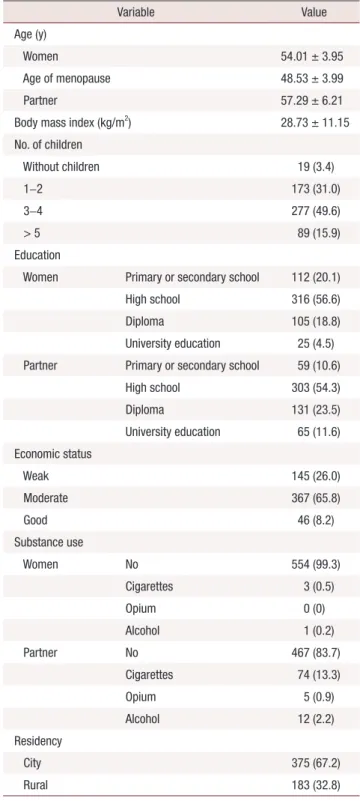
The mean and standard deviation (SD) age (54.01 ± 3.95 years) of participants was with the range 41–60 years. The mean and SD age of menopause was 48.53
± 3.99 years. Most participants (76.7%) had below di- ploma level and were housewives (81.5%) with average economic status (65.8%) and were city dwellers (67.2%) (Table 1).
Table 2 displays the SSE of our participants. The mean of SSE was 2.50 ± 0.53 with a 95% confidence inter- val (2.46–2.54). The lowest and highest total scores of SSE were 1.18 and 4.18, respectively. A Friedman test showed strong significant differences between the four subscales of SSE (P < 0.001). The lowest and highest scores of SSE subscales were related to orgasm 0.85 ± 0.17 and sexual desire 2.88 ± 0.60, respectively.
The mean score of MENQOL among participants was 3.77 ± 0.95, with the minimum and maximum being 0.79 and 5.79 respectively. The participants acquired the minimum score in the domain of sexual activity (3.03 ± 1.74), while the maximum was found in the psychosocial domain (4.14 ± 1.24) (Table 3).
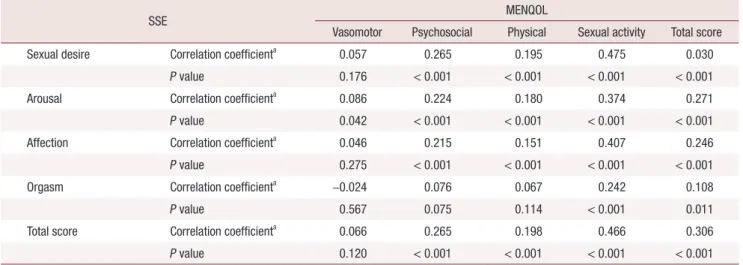
The QOL of participants had a significant positive correlation with the total score in all domains of SSE (P < 0.001, r = 0.306). The maximum correlation of QOL was found with sexual desire (P < 0.001, r = 0.030), while the minimum was observed for orgasm (P < 0.001, r = 0.108). Also, the score of SSE had a sig- nificant correlation with all domains of MENQOL ex- cept for vasomotor domain. The maximum correlation of SSE was found with sexual activity (P < 0.001, r = 0.466) (Table 4).
SSE had a significant association with the level of edu- cation (P < 0.001), spouse’s occupation (P = 0.01), and economic status (P < 0.001). Specifically, the partici- pants with academic degrees (mean, 2.75; SD, 0.43; me- dian, 2.68), with employed spouse and better economic status (mean, 2.76; SD, 0.57; median, 2.73) had a great score of SSE.
There is a significant linear relationship between the score of MENQOL and the level of education of
menopausal women (P = 0.015), spouse’s occupation (P < 0.001), and economic status (P < 0.001). The par- ticipants with academic degrees (mean, 4.24; SD, 1.00;
median, 4.34), with employed spouses and better eco-
Table 1. Sociodemographic characteristics of participants (n = 558)
Variable Value
Age (y)
Women 54.01 ± 3.95
Age of menopause 48.53 ± 3.99
Partner 57.29 ± 6.21
Body mass index (kg/m2) 28.73 ± 11.15
No. of children
Without children 19 (3.4)
1–2 173 (31.0)
3–4 277 (49.6)
> 5 89 (15.9)
Education
Women Primary or secondary school 112 (20.1)
High school 316 (56.6)
Diploma 105 (18.8)
University education 25 (4.5) Partner Primary or secondary school 59 (10.6)
High school 303 (54.3)
Diploma 131 (23.5)
University education 65 (11.6) Economic status
Weak 145 (26.0)
Moderate 367 (65.8)
Good 46 (8.2)
Substance use
Women No 554 (99.3)
Cigarettes 3 (0.5)
Opium 0 (0)
Alcohol 1 (0.2)
Partner No 467 (83.7)
Cigarettes 74 (13.3)
Opium 5 (0.9)
Alcohol 12 (2.2)
Residency
City 375 (67.2)
Rural 183 (32.8)
Data are presented as mean ± standard deviation or number (%).
nomic status, had a higher MENQOL score.
The regression coefficients predicting the factors asso- ciated with QOL of menopausal women based on mul- tiple linear regression models on the unmatched model indicated that from among the four domains of SSE, only sexual desire (P < 0.001, β = 0.483) predicts the QOL of menopausal women. In this regard, with one score increase in the sexual desire domain, the QOL score of menopausal women will grow by (β ± standard error = 0.483 ± 0.06) on average.
The multiple linear regression model in the matched model showed that age (P = 0.031, β = 0.021) and economic status of the family (P = 0.045, β = 0.143) predicted the MENQOL, while the unemployment of the spouse has an adverse effect on the QOL of meno- pausal women (P = 0.006, β = –0.596).
In the current study, control for confounding factors done with multiple linear regression. Multiple regres- sion analysis is also used to assess whether confounding exists. Since multiple linear regression analysis allows us to estimate the association between a given inde- pendent variable and the outcome holding all other variables constant, it provides a way of adjusting for (or
accounting for) potentially confounding variables that have been included in the model.
Table 5 shows the regression coefficients predicting factors related to the QOL of postmenopausal women based on the multiple linear regression model in the matched model. In this model, in order to match and eliminate the effect of the intervening variable on the relationship between the main variables, all individual, social and intervening variables were entered in the initial model with P < 0.1. Based on the information in Table 5, in the final model, the score of sexual orienta- tion (P < 0.001, β = 0.455) was still significant, as well as age (β = 0.021, P = 0.031) and family economic sta- tus (β = 0.143, P = 0.045) is considered as a predictor related to increasing the QOL score. But the unemploy- ment of the husband had a negative effect on the QOL of postmenopausal women (β = –0.596, P = 0.006).
DISCUSSION
The minimum and maximum scores of SSE were re- lated to orgasm and sexual desire respectively. These results did not concur with Zare et al. [22] findings. In Table 2. The sexual self-efficacy levels and their subscales among participants
SSE Mean SD Median Min. Max.
95% CI
P value Lower
limit Upper
limit
Sexual desire 2.88 0.60 2.85 1.38 4.62 2.83 2.93
< 0.001a
Arousal 2.62 0.66 2.67 1.00 4.50 2.56 2.67
Affection 2.37 0.79 2.40 1.00 4.80 2.30 2.43
Orgasm 0.85 0.17 0.83 0.67 2.33 0.83 0.86
Total score 2.50 0.53 2.50 1.18 4.18 2.46 2.54
SSE: sexual self-efficacy, SD: standard deviation, Min.: minimum, Max.: maximum, CI: confidence interval.
aFriedman test.
Table 3. The menopausal specific quality of life levels and their subscales among participants
MENQOL Mean SD Median Min. Max. 95% CI
P value Lower limit Upper limit
Vasomotor 3.14 1.88 3.67 < 0.001 6.00 3.26 3.57
< 0.001a
Psychosocial 4.14 1.24 4.29 0.43 6.00 4.03 4.24
Physical 3.81 1.04 3.88 0.88 5.88 3.73 3.90
Sexual activity 3.03 1.74 3.00 < 0.001 6.00 2.89 3.18
Total score 3.77 0.95 3.83 0.79 5.79 3.69 3.85
MENQOL: Menopausal-Specific Quality of Life Questionnaire, SD: standard deviation, Min.: minimum, Max.: maximum, CI: confidence interval.
aFriedman test.
their study, the minimum mean score was related to sexual refusal, while the maximum was associated with physical acceptance. The difference might be attributed to the studied population. SSE had a significant associa- tion with the level of education of participants, spouse’s occupation, and economic status. The participants with academic degrees employed spouse, and better economic status showed a higher SSE score. These re- sults concurred with Kafaei et al. [16] findings. In their study, women with younger spouses, higher levels of education, employed status, and higher-income en- joyed greater SSE scores.
SSE had an inverse association with the age of partici- pants. This finding was in line with the results of Assar- zadeh et al. [23].
The domain of sexual desire predicted the QOL of menopausal women. These results have been in accor- dance with the study by Madankan and Riyazi [24]. In their study, there was a positive and direct correlation between SSE and the QOL of menopausal women.
The participants acquired the minimum QOL score in sexual activity, while the maximum in the psychosocial domain. These results were not in line with the study by Nazarpour et al. [25]. In their study, the maximum and minimum scores were associated with physical health and psychological health respectively. This difference might be assigned to the sample size, menopause age of the studied women, and type of questionnaire.
Also, in the present study, most participants had an undesired QOL in the sexual domain, which concurs with the findings of Sheikhan et al. [26] and Abedza- deh Kalarhoudi et al. [27]. In their study, again, most women had an undesired QOL in this domain. Nev- ertheless, this finding does not match the results of Li et al. [28] as well as Sharifniya et al. [29]. In the Li et al.’s study [28], most participants had the desired QOL in the sexual domain, while in the study by Sharifniya et al. [29], most of them had an average QOL. In the researcher’s opinion, this discrepancy in the findings can be due to social-cultural differences across various Table 4. Correlations between SSE scores and MENQOL scores
SSE MENQOL
Vasomotor Psychosocial Physical Sexual activity Total score
Sexual desire Correlation coefficienta 0.057 0.265 0.195 0.475 0.030
P value 0.176 < 0.001 < 0.001 < 0.001 < 0.001
Arousal Correlation coefficienta 0.086 0.224 0.180 0.374 0.271
P value 0.042 < 0.001 < 0.001 < 0.001 < 0.001
Affection Correlation coefficienta 0.046 0.215 0.151 0.407 0.246
P value 0.275 < 0.001 < 0.001 < 0.001 < 0.001
Orgasm Correlation coefficienta –0.024 0.076 0.067 0.242 0.108
P value 0.567 0.075 0.114 < 0.001 0.011
Total score Correlation coefficienta 0.066 0.265 0.198 0.466 0.306
P value 0.120 < 0.001 < 0.001 < 0.001 < 0.001
aSpearman correlation coefficient.
Table 5. Multiple regression analysis to predict MENQOL score based on SSE
Variable Beta SE P CE
Lower Upper
Constant 1.081 0.577 0.062 –0.053 2.214
Sexual desire 0.455 0.066 > 0.001 0.326 0.584
Unemployment of spouse –0.596 0.218 0.006 –1.024 –0.169
Age 0.021 0.010 0.031 0.040 0.002
Economic family 0.143 0.071 0.045 0.282 0.003
MENQOL: Menopausal-Specific Quality of Life Questionnaire, SSE: sexual self-efficacy, SE: standard error, CE: coefficient of error.
societies regarding sexual issues. The QOL of the par- ticipants had a positive significant correlation with all domains of QOL except vasomotor. Also, the score SSE had a significant correlation with the score of sexual activity domain. The results of the present study have been in accordance with Zare et al. [22] and Gozuyesil et al. [30] findings.
The MENQOL had a significant correlation with the level of education, spouse’s occupation, and economic status of participants. The participants with academic degrees employed spouses, and better economic status indicated the higher MENQOL scores. These results are in line with the findings of Fallahzade et al. [31].
Based on the results of the present study, the MENQOL of participants with lower levels of education, unem- ployed spouses, and the poor economic situation was low. In the study by Mohammadi Zeidi et al. [32], there was a significant association between the level of litera- cy and QOL, which does concur with the present study findings. The level of education can enhance women’s awareness and better manage the changes of this pe- riod. Also, higher levels of education are mostly syn- onymous with higher income and greater opportunities in social life. Indeed, these women have greater access to health care services and possess greater awareness, and benefit from more medical consultation. Also, those who were satisfied with their economic status also showed a greater QOL possible because of proper nutrition and timely referral to physicians. Meanwhile, unemployed spouse had a negative impact on the QOL of menopausal women. In the study by Abdi and Solhi [33], there was a significant association between QOL and demographic variables including occupation and income.
In conclusion, the research findings indicated that the QOL of the menopausal period has a positive sig- nificant correlation with the total score and score of all domains of SSE. The maximum correlation was found between QOL and sexual desire, while the minimum was observed with orgasm. Also, the SSE score had a significant correlation with all domains of MENQOL except for the vasomotor domain. The maximum correlation for SSE was observed in the sexual activ- ity domain of QOL. Thus, attention should be paid to awareness-raising and developing the grounds for fa- miliarization with the provision of health care services with new concepts such as SSE and its association with the QOL of menopausal women.
ACKNOWLEDGMENTS
The current paper was extracted from a master’s the- sis in midwifery. Ethical approval was granted by the Guilan University of Medical Sciences (IR.GUMS.REC.
1398.270). We thanks to all participants that shared their experiences.
CONFLICT OF INTEREST
No potential conflict of interest relevant to this article was reported.
REFERENCES
1. Norozi E, Mostafavi F, Hasanzadeh A, Moodi M, Sharifirad G.
Factors affecting quality of life in postmenopausal women, Isfa- han, 2011. J Educ Health Promot 2013; 2: 58.
2. Ehsanpour S, Salehi K, Zolfaghari B, Bakhtiari S. The effects of red clover on quality of life in post-menopausal women. Iran J Nurs Midwifery Res 2012; 17: 34-40.
3. Mohammed S, Shabana K, Mansour S, Emam M. Evaluation of post-menopausal symptoms: it’s effect on female's quality of life.
IJND 2016; 6: 1-10.
4. Ahmadi M, Noudehi M, Esmaeili M, Sadrollahi A. Comparing the quality of life between active and non-active elderly women with an emphasis on physical activity. Iran J Ageing 2017; 12: 262-75.
5. Nazari M, Farmani S, Kaveh MH, Ghaem H. The effectiveness of lifestyle educational program in health promoting behaviors and menopausal symptoms in 45-60-year-old women in Marvdasht, Iran. Glob J Health Sci 2016; 8: 55414.
6. Berek J. Berek & Novak’s gynecology essentials. Philadelphia: Lip- pincott Williams & Wilkins; 2020.
7. Taebi M, Abdolahian S, Ozgoli G, Ebadi A, Kariman N. Strategies to improve menopausal quality of life: a systematic review. J Educ Health Promot 2018; 7: 93.
8. Bahri N, Latifnejad Roudsari R, Tohidinik H, Sadeghi R. Attitudes towards menopause among Iranian women: a systematic review and meta-analysis. Iran Red Crescent Med J 2016; 18: e31012.
9. Thornton K, Chervenak J, Neal-Perry G. Menopause and sexual- ity. Endocrinol Metab Clin North Am 2015; 44: 649-61.
10. Ambler DR, Bieber EJ, Diamond MP. Sexual function in elderly women: a review of current literature. Rev Obstet Gynecol 2012; 5:
16-27.
11. Jafarbegloo E, Momenyan S, Khaki I. The relationship between sexual function and marital satisfaction in postmenopausal wom- en. Mod Care J 2019; 16: e83687.
12. Safaei M, Rajabzadeh S. A review of sexual functioning disorders amongst postmenopausal women referring to health centers of
Torbat Heydariyeh in 2016. J Health Chimes 2017; 4: 23-8.
13. Tabaghdehi M, Keramat A, Khosravi A. Prevalence of female sex- ual dysfunction in Iran: a meta-analysis Study. IJHS 2017; 2: 10-3.
14. Nazarpour S, Simbar M, Tehrani FR. Factors affecting sexual function in menopause: a review article. Taiwan J Obstet Gynecol 2016; 55: 480-7.
15. Dastaran F, Maasoumi R. Development and psychometric proper- ties of a questionnaire to assess the Iranian women’s sexual self- efficacy. 2019; 6: 176-89.
16. Kafaei Atrian M, Mohebbi Dehnavi Z, Kamali Z. The relation- ship between sexual self-efficacy and sexual function in married women. JMRH 2019; 7: 1683-90.
17. Hsu HY, Yu HY, Lou JH, Eng CJ. Relationships among sexual self- concept and sexual risk cognition toward sexual self-efficacy in adolescents: cause-and-effect model testing. Jpn J Nurs Sci 2015;
12: 124-34.
18. Vaziri S, Kelvani S. Prediction of sexual functioning and sexual self-efficacy in women based on signs and symptoms of behavioral problems. J Res Behav Sci 2018; 16: 101-7.
19. Hilditch JR, Lewis J, Peter A, van Maris B, Ross A, Franssen E, et al. A menopause-specific quality of life questionnaire: develop- ment and psychometric properties. Maturitas 1996; 24: 161-75.
20. Bailes S, Creti L, Fichten C, Libman E, Brender W, Amsel R. Sex- ual self-efficacy scale for female functioning. In: Fisher TD, Davis CM, Yarber WL, Davis SL, editors. Handbook of sexuality-related measures. Taylor & Francis Group; 2011. p. 551-4.
21. Rajabi G, Jelodari A. Validity and reliability of the Persian sexual self-efficacy scale functioning in female. JPCP 2015; 3: 267-72.
22. Zare Z, Golmakani N, SHareh H, SHakeri M. Survey of associa- tion between sexual self-efficacy and sexual life quality with mari- tal satisfaction in primiparous women after childbirth. JSUMS 2016; 21: 1-10.
23. Assarzadeh R, Bostani Khalesi Z, Jafarzadeh-Kenarsari F. Sexual self-efficacy and associated factors: a review. Shiraz E Med J 2019;
20: e87537.
24. Madankan F, Riyazi H. The correlation and comparison of sexual self-efficacy with quality of sexual life in menopausal and non- menopausal women referred to health centers in Abyek city 2016 [MSc thesis]. Tehran: Shahid Beheshti University; 2016.
25. Nazarpour S, Simbar M, Ramezani Tehrani F, Alavi Majd H.
Association between sexual function and quality of life in post- menopausal women. J Mazandaran Univ Med Sci 2016; 26: 90-8.
26. Sheikhan Z, Pazandeh F, Azar M, Ziaei T, Alavi Majd H. Survey on sexual satisfaction situation and some of affecting agents in postmenopausal women. J Adv Med Biomed Res 2010; 18: 81-9.
27. Abedzadeh Kalarhoudi M, Taebi M, Sadat Z, Saberi F. Assessment of quality of life in menopausal periods: a population study in Kashan, Iran. Iran Red Crescent Med J 2011; 13: 811-7.
28. Li S, Holm K, Gulanick M, Lanuza D. Perimenopause and the quality of life. Clin Nurs Res 2000; 9: 6-23; discussion 24-6.
29. Sharifniya H, Bahrami N, Saatsaz S, Soleimani M, Nazari R, Mo- hamad Tabar R. Assessment of life quality of menopausal women and its relative factors. IJOGI 2012; 15: 7-12.
30. Gozuyesil E, Gokyildiz Surucu S, Alan S. Sexual function and quality-of-life-related problems during the menopausal period. J Health Psychol 2018; 23: 1769-80.
31. Fallahzade H, Dehghani Tafti A, Dehghani Tafti M, Hosseini F, Hosseini H. Factors affecting quality of life after menopause in women, Yazd, 2008. J Shaheed Sadoughi Univ Med Sci 2011; 18:
552-8.
32. Mohammadi Zeidi E, Pakpour A, Mohammadi Zeidi B. The im- pact of educational interventions based on individual empower- ment model on knowledge, attitude, self-efficacy, self esteem and quality of life of postmenopausal women. Iran J Nurs Res 2013; 26:
21-31.
33. Abdi N, Solhi M. Quality of life in postmenopausal women in Tehran. Iran J Health Educ Health Promot 2014; 2: 87-96.