Received: December 1, 2019 Revised: March 2, 2020 Accepted: March 3, 2020
Address for Correspondence: Salman Khazaei, Research Center for Health Sciences, Hamadan University of Medical Sciences, Hamedan, Hamadan Province 65178, Iran
Tel: +98-38380496, E-mail: [email protected], ORCID: https://orcid.org/0000-0001-5918-2310
ORIGINAL ARTICLE
INTRODUCTION
Menopause is resulting from the permanent cessation of menstruation, which occurs around the age of 51 in women [1]. Due to increase in the human life expec- tancy in recent years, nearly one third of women’s life is located after menopause [2]. In Iran like other develop- ing countries the number of middle aged women has raised dramatically in recent years. Several factors con- tribute to the quality of life (QOL) in postmenopausal women. Physiological changes during menopause, vari- ous mental problems such as depression and memory loss, as well as sexual dysfunctions, reduced physical activity and engage in underlying diseases such as hy- pertension, diabetes type 2, osteoporosis, and muscu-
loskeletal diseases can reduce dramatically their QOL [1,3].
The QOL is an important end point in medicine and researches on disease outcomes [4]. QOL indicated that how individuals intuitively evaluate their health as well as their ability to perform physical, psychological, and social functions [5-7]. Currently, QOL is measured for judge about outcome as a comprehensive health indica- tor in medical interventions and health surveys [8].
The health of human societies is affected by many fac- tors such as economic development, social and cultural factors. One of them is health literacy, which is a term introduced by the American Medical Association in 1970 [8,9]. Health literacy is defines as “a constellation of skills, including the ability to perform basic reading
Correlation between Health Literacy and Quality of Life in Iranian Menopausal Women
Ensiyeh Jenabi1, Behzad Gholamaliee2, Salman Khazaei3
1Autism Spectrum Disorders Research Center, Hamadan University of Medical Sciences, Hamadan, Iran, 2School of Public Health, Hamadan University of Medical Sciences, Hamadan, Iran, 3Research Center for Health Sciences, Hamadan University of Medical Sciences, Hamadan, Iran
Objectives: Understanding the factors that promote quality of life (QOL) in menopausal women is essential for establishing educational strategies and health policies. Studies on the relationship between health literacy and QOL in menopausal women in Iran are rare.
Therefore, we aimed to determine health literacy in menopausal women and its relationship with QOL.
Methods: The present cross-sectional study was performed on 177 menopausal women referred to comprehensive health services in Hamadan City, Iran. Health Literacy for Iranian Adults and Menopause-Specific QOL questionnaires were used to collect information.
Pearson correlation coefficient was used to assess the correlation between health literacy and QOL.
Results: The majority of menopausal women included in this study were married housewives, and 44.6% of them were 50–55 years old; furthermore, only 6.2% had adequate or good health literacy. Health literacy was significantly correlated with total QOL score and vasomotor, psychology, and physical domains (P < 0.05).
Conclusions: Health literacy was associated with various domains of QOL. Therefore, health providers should pay more attention on improving health literacy by holding educational promotional programs for menopausal women to enhance their QOL.
Key Words: Health literacy, Iran, Menopause, Quality of life
and numerical tasks required to function in the health care environment” [8].
In modern societies, literacy and health literacy are considered as essential components of health and poor health literacy has adverse effects on people’s health [10].
Evidence shows that some vulnerable groups such as elderly people, immigrants, low level of education, so- cieties with low level of socio-economic status, people with mental health problem, and people with chronic diseases have low levels of health literacy [11].
Knowing the factors relating promoting of QOL in menopausal women is essential for educational strate- gies and health policy making. Evidence regarding the evaluation of the health literacy and its relationship with QOL in menopausal women in Iran is rare [12], therefore in this study we aimed to determine health literacy in menopausal women and its relationship with QOL.
MATERIALS AND METHODS
The present study was a cross-sectional study per- formed on 177 menopausal women referred to com- prehensive health services of Hamadan City, Iran. This study was conducted for duration of 3 consecutive months in 2019. Sampling method was quota random selection in comprehensive health services of Hamadan City. According to study of Abdolmalaki et al. [13], sample size was estimated 190 menopausal woman based on power 80% and α = 5% with a 10% dropout rate.
Inclusion criteria was menopausal women aged be- tween 40–60 years referred to comprehensive health services of Hamadan City, not having history of physi- cal and mental disorders and not receiving hormone replacement therapy. Exclusion criteria were failure to fulfill the questionnaire correctly and completely. The study protocol was reviewed and approved by Ethical Committee of Hamadan University of Medical Sciences (ethical code: IR.UMSHA.REC.1398.416). All partici- pants filled out and signed informed consent form.
In total, three questionnaires were used in this study.
The first questionnaire was including demographic characteristics, such as age, education level, marital sta- tus, and job.
Health Literacy for Iranian Adults (HELIA) was the second questionnaire with alpha coefficient correlation score ranging from 0.72–0.89 which included 33 ques- tions (in the dimensions of availability, reading, under-
standing, assessment and decision-making and use of health information). The validity and reliability of this questionnaire been confirmed by Montazeri et al. [14].
Each question has a 5-point scale including “it is quite easy”, “it is easy”, “it is hard”, “it is quite hard”, and “not easy not hard”, respectively. According to the question- naire, menopausal women were divided into four dif- ferent categories: well (84.1–100), adequate (66.1–84), partially adequate (50.1–66), and inadequate (less than 50).
The third questionnaire was Menopause-Specific QOL (MENQOL) questionnaire. This questionnaire measure QOL in postmenopausal women includes of 29 items in vasomotor (3 questions), psychosocial (7 questions), physical (16 questions), and sexual (3 ques- tions) dimensions [15]. The validity and reliability for this questionnaire were conducted in Iran [16]. This questionnaire has seven-point Likert scale with ranges between 0–7. Score zero is equivalent to a woman re- sponding “no”, reporting women has not experienced this symptom in the past month. Score “one” reports that she experienced the symptom, but it was not both- ersome at all. Scores “two” until “seven” report increas- ing levels of bother experienced from the symptom and correspond to “1” through “6” check boxes on the
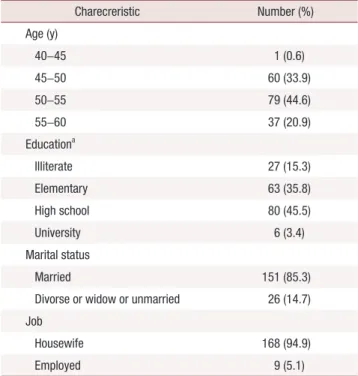
Table 1. Basic charecreristics of included women
Charecreristic Number (%)
Age (y)
40–45 1 (0.6)
45–50 60 (33.9)
50–55 79 (44.6)
55–60 37 (20.9)
Educationa
Illiterate 27 (15.3)
Elementary 63 (35.8)
High school 80 (45.5)
University 6 (3.4)
Marital status
Married 151 (85.3)
Divorse or widow or unmarried 26 (14.7) Job
Housewife 168 (94.9)
Employed 9 (5.1)
aData of 1 person was missed.
MENQOL. Each item was manually calculated into a 0–7 score. Hence, the average for each domain was cal- culated between 0 and 7. The high scores in MENQOL dimensions indicate low QOL.
We used IBM SPSS ver. 20 (IBM Corp., Armonk, NY, USA) was in order to analyzing the data. The Pearson correlation coefficient was used. The statistically sig- nificant was considered with P values lower than 0.05 and two-tailed hypotheses.
RESULTS
Rate of the response to questions was 93%. A total of 13 women did not fully complete the questionnaires and were deleted from the present study. Therefore, 177 menopausal women contributed in this study.
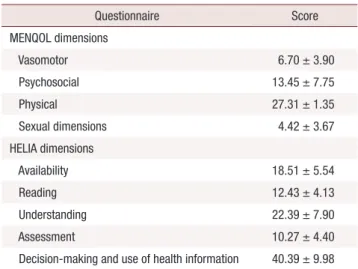
The mean age of menopausal women was 51.30 ± 3.65 years. Most of menopausal women were housewife (94.9%) and married (85.3%). Also, 45.5% had educa- tion level of high school. The mean of menarche age was 12.28 years and temporal relationship between marriage and childbirth was 1.43 years. Table 1 presents the characteristics of the menopausal women in present study. The mean scores of QOL for vasomotor, psycho- social, physical and sexual dimensions were 6.70 ± 3.90, 13.45 ± 7.75, 27.31 ± 1.35, and 4.42 ± 3.67, respectively.
Also, the mean scores of HELIA for availability, read- ing, understanding, assessment, and decision-making and use of health information dimensions were 18.51 ± 5.54, 12.43 ± 4.13, 22.39± 7.90, 10.27± 4.40, and 40.39 ± 9.98, respectively (Table 2).
The results of Table 3 showed that 46.3% had health literacy of inadequate, 47.5% had health literacy of par- tially adequate, 5.6% had health literacy of adequate, and 0.6% had health literacy of well.
The results of the Table 4 showed that the score mean of availability dimension of HELIA questionnaire was significantly correlated with the mean scores of vaso- motor, psychosocial, physical, sexual, and mean score of MENQOL in postmenopausal women (P < 0.05).
There was a significant relationship between assess- ment dimension of HELIA and mean score of vasomo- tor, psychosocial, sexual, and total mean score of MEN- Table 2. Results of MENQOL and HELIA
Questionnaire Score
MENQOL dimensions
Vasomotor 6.70 ± 3.90
Psychosocial 13.45 ± 7.75
Physical 27.31 ± 1.35
Sexual dimensions 4.42 ± 3.67
HELIA dimensions
Availability 18.51 ± 5.54
Reading 12.43 ± 4.13
Understanding 22.39 ± 7.90
Assessment 10.27 ± 4.40
Decision-making and use of health information 40.39 ± 9.98 Values are presented as mean ± standard deviation.
MENQOL: Menopause-Specific quality of life, HELIA: Health Literacy for Iranian Adults.
Table 3. Frequency distribution of health literacy in the participants
Health literacy Number (%)
Inadequate 82 (46.3)
Partially adequate 84 (47.5)
Adequate 10 (5.6)
Well 1 (0.6)
Table 4. The correlation between health literacy with quality of life in menopausal women
HELIA dimension MENQOL dimension Total of scores
MENQOL
Vasomotor Psychology Physical Sexual
Availability –0.292a –0.324a –0.181a –0.081 –0.261a
Reading 0.061 0.139 0.04 0.301 0.108
Understanding 0.142 0.107 0.009 0.102 0.066
Assessment –0.214a –0.209a –0.073 –0.165a –0.165a
Decision-making and use of health information –0.277a –0.322a –0.132 –0.045 –0.225a
Total of scores health literacy –0.326a –0.373a –0.209a 0.001 –0.285a
HELIA: Health Literacy for Iranian Adults, MENQOL: Menopause-Specific quality of life.
aSignificant at 5% level.
QOL in postmenopausal women (P < 0.05). There was a significant relationship between decision-making, and the use of health information dimension of HELIA questionnaire with mean score of vasomotor, psycho- social, and total mean score of MENQOL. There was a significant relationship between total mean score of HELIA questionnaire in postmenopausal women with mean score of vasomotor, psychosocial, physical, and total mean score of MENQOL (P < 0.05).
DISCUSSION
The results showed that only 6.2% of menopause women had adequate or well health literacy. Health lit- eracy was significantly in correlation with total score of QOL, vasomotor, psychology, and physical domains. It means that QOL decreases as health literacy decreases and vice versa.
The positive relation between adequate level of health literacy with the QOL has been approved previously in research subjects in Iran [12] and other countries [17,18]. Although, Zhang et al. [18], in their study reached a contradict result. This difference can be due to the different applied questionnaires to measure of health literacy and QOL in their study populations.
Also differences in culture, ethnicity and social impacts of the subjects are among the factors affecting the QOL and health literacy of subjects and confounded this as- sociation [19].
Abdolmalaki et al. [13] in 2018 showed that 47.8%
menopausal women had inadequate health literacy. In our study, 46.3% menopausal women had inadequate health literacy. Therefore, this study was in line with our findings.
Improving health literacy is associated with behavioral changes and playing active role in decision making in- adequate health literacy is associated with non-compli- ance to the physician orders, inappropriate drugs con- sumption, poor control of weight, blood glucose, blood lipid and blood pressure, low health knowledge, poor communication between physician and patient and consequently decreased QAL [20]. Yadollahi et al. [21], showed that improving health literacy is associated with behavioral changes and playing active role in deci- sion making. Therefore not wonder that World Health Organization considered health literacy a major deter- mining factor for health [20]. Despite the importance of health literacy in promoting health in present study, less than 10% of participations had adequate, although
this situation in exist in other parts of Iran and even in developed countries [22,23].
In current study, there were some limitations: First, socioeconomic status is an important factor which can effect on QOL of postmenopausal women, while we studied a group with only 3.4% had academic degree and majority were housewife, therefore assessing health literacy and QOL may be encountered with under- estimation. Second, information about QOL of the par- ticipants during their premenopausal period was based on self-reporting and therefore prone to information bias. Further studies with stronger design like cohort or case-control and larger sample size is recommended to better understanding the association.
In conclusion, we found that postmenopausal women in Hamadan province had low level of health literacy and given that health literacy has an impact on the various domains of their QOL, therefore health provid- ers should focus more attention on improving people’s health literacy by holding educational promotion pro- grams for menopausal women.
ACKNOWLEDGMENTS
The authors would like to appreciate the Vice-chan- cellor of Research and Technology, Hamadan Univer- sity of Medical Sciences, Iran for financial support of the study (research ID: 9805223860).
CONFLICT OF INTEREST
No potential conflict of interest relevant to this article was reported.
REFERENCES
1. Greendale GA, Lee NP, Arriola ER. The menopause. Lancet 1999;
353: 571-80.
2. Nisar N, Sohoo NA. Severity of menopausal symptoms and the quality of life at different status of menopause: a community based survey from rural Sindh, Pakistan. Int J Collab Res Intern Med Public Health 2010; 2: 118-30.
3. de Souza Santos CA, Dantas EE, Moreira MH. Correlation of physical aptitude; functional capacity, corporal balance and quality of life (QoL) among elderly women submitted to a post-meno- pausal physical activities program. Arch Gerontol Geriatr 2011;
53: 344-9.
4. Welton AJ, Vickers MR, Kim J, Ford D, Lawton BA, MacLennan AH, et al. Health related quality of life after combined hormone
replacement therapy: randomised controlled trial. BMJ 2008; 337:
a1190.
5. Wang HM, Beyer M, Gensichen J, Gerlach FM. Health-related quality of life among general practice patients with differing chronic diseases in Germany: cross sectional survey. BMC Public Health 2008; 8: 246.
6. Shobeiri F, Jenabi E, Hazavehei SM, Roshanaei G. Quality of life in postmenopausal women in Iran: a population-based study. J Menopausal Med 2016; 22: 31-8.
7. Jenabi E, Shobeiri F, Hazavehei SM, Roshanaei G. Assessment of questionnaire measuring quality of life in menopausal women: a systematic review. Oman Med J 2015; 30: 151-6.
8. Miguel RS, López-González AM, Sanchez-Iriso E, Mar J, Cabasés JM. Measuring health-related quality of life in drug clinical trials:
is it given due importance? Pharm World Sci 2008; 30: 154-60.
9. Sørensen K, Van den Broucke S, Fullam J, Doyle G, Pelikan J, Slon- ska Z, et al. Health literacy and public health: a systematic review and integration of definitions and models. BMC Public Health 2012; 12: 80.
10. Kickbusch I, Pelikan JM, Apfe F, Tsouros AD. Health literacy: the solid facts. Copenhagen: World Health Organization Regional Of- fice for Europe; 2013.
11. Jabalameli S, Doost HTN, Moulavi H. Efficacy of cognitive- behavioral stress management intervention on quality of life and blood pressure in female patients with hypertension. Sci J Kurd Univ Med Sci 2010; 15: 88-97.
12. Mosallanezhad Z, Poornowrooz N, Javadpour S, Haghbeen M, Jamali S. Health literacy and its relationship with quality of life in postmenopausal women. J Clin Diagn Res 2019; 13: VC01-04.
13. Abdolmalaki B, Peyman N, Esmaeili H. Evaluation of health lit- eracy rate of postmenopausal women covered by Mashhad health centers in 2018. J Health Lit 2018; 3: 182-90.
14. Montazeri A, Tavousi M, Rakhshani F, Azin SA, Jahangiri K, Ebadi M, et al. Health literacy for Iranian adults (HELIA): development and psychometric properties. Payesh 2014; 13: 589-99.
15. Lewis JE, Hilditch JR, Wong CJ. Further psychometric property development of the menopause-specific quality of life question- naire and development of a modified version, MENQOL-inter- vention questionnaire. Maturitas 2005; 50: 209-21.
16. Fallahzadeh H. Quality of life after the menopause in Iran: a popu- lation study. Qual Life Res 2010; 19: 813-9.
17. Shin KM, Chu SH, Jang YS, Kang SM. Relationships between health literacy, knowledge and self-care behaviors in elderly pa- tients with heart failure. J Korean Clin Nurs Res 2016; 22: 28-37.
18. Zhang XH, Li SC, Fong KY, Thumboo J. The impact of health lit- eracy on health-related quality of life (HRQoL) and utility assess- ment among patients with rheumatic diseases. Value Health 2009;
12 Suppl 3: S106-9.
19. Chew LD, Bradley KA, Boyko EJ. Brief questions to identify pa- tients with inadequate health literacy. Fam Med 2004; 36: 588-94.
20. Javadzade SH, Sharifirad G, Radjati F, Mostafavi F, Reisi M, Hasanzade A. Relationship between health literacy, health status, and healthy behaviors among older adults in Isfahan, Iran. J Educ Health Promot 2012; 1: 31.
21. Yadollahi M, Siavashi E, Mostaghim S. The relationship between health literacy and patient participation in medical decision mak- ing among breast cancer patients. Arch Breast Cancer 2018; 5:
183-8.
22. Yee LM, Simon MA. The role of health literacy and numeracy in contraceptive decision-making for urban Chicago women. J Com- munity Health 2014; 39: 394-9.
23. Tavousi M, Haeri MA, Rafiefar S, Solimanian A, Sarbandi F, Ar- destani M, et al. Health literacy in Iran: findings from a national study. Payesh 2016; 15: 95-102.