
Infection &
Chemotherapy
https://doi.org/10.3947/ic.2018.50.1.51 Infect Chemother 2018;50(1):51-54
ISSN 2093-2340 (Print) · ISSN 2092-6448 (Online)
Received: October 19, 2016 Accepted: December 25, 2016 Published online: July 27, 2017 Corresponding Author : Chang-Seop Lee, MD, PhD
Department of Internal Medicine, Chonbuk National University Medical School, 567 Baekje-daero, Deokjin-gu, Jeonju 54896, Korea
Tel: +82-63-250-2391, Fax: +82-63-254-1609 E-mail: [email protected]
This is an Open Access article distributed under the terms of the Creative Commons Attribution Non-Commercial License (http://creativecommons.org/licenses/by-nc/3.0) which permits unrestricted non-commercial use, distribution, and repro- duction in any medium, provided the original work is properly cited.
Copyrights © 2018 by The Korean Society of Infectious Diseases | Korean Society for Chemotherapy
www.icjournal.org
A Case of Jejunal Intussusception caused by Burkitt Lymphoma in an Acquired Immunodeficiency
Syndrome Patient
Dae-Youb Baek
1, Dae-Hyuk Heo
1, Sang-Min Oh
1, Joo-Hee Hwang
1, Jeong-Hwan Hwang
1,3, Ho Sung Park
2, and Chang-Seop Lee
1,31Department of Internal Medicine, and 2Department of Pathology, Chonbuk National University, 3Research Institute of Clinical Medicine of Chonbuk National University-Chonbuk National University Hospital, Jeonju, Korea
Non-Hodgkin’s lymphoma of B-cell type is the second most common neoplasm after Kaposi’s sarcoma among patients with human immunodeficiency virus infection. Most non- Hodgkin’s lymphoma cases that are associated with acquired immunodeficiency syn- drome (AIDS) involve extranodal sites, especially the digestive tract and the central nervous system. We report a case of multiple jejunal intussusception caused by Burkitt lymphoma in a 42- year-old AIDS patient. Upper gastrointestinal endoscopy and surgical biopsy were performed and a complete diagnostic study including histological and immunohistochemical analyses showed Burkitt lymphoma.
Key Words: Burkitt lymphoma; AIDS; Intussusception
Introduction
Burkitt lymphoma is a cancer of the lymphatic system that is a highly malignant, aggressive and rapidly growing B-cell neo- plasm. Burkitt lymphoma can be divided into three main clin- ical variants: endemic, sporadic, and immunodeficiency-asso- ciated [1].
The endemic variant usually involves the facial bones, partic- ularly the jaw, maxilla, and orbit, and, especially in young chil- dren, it is associated with Epstein-Barr virus (EBV) infection [2].
In comparison, the sporadic form tends to present in the lym-
phoid tissues of the gut, often presenting as masses in the Wald- eyer ring or the terminal ileum, or even with involvement of ab- dominal organs with the most involvement of the distal ileum, cecum or mesentery [3, 4] Cases of intestinal intussusception caused by Burkitt lymphoma are rarely reported [5].
Intussusception, the invagination of one portion of the intes- tine into another, rarely occurs after the first 5 years of life and is classically associated 25 with intense intermittent abdomi- nal pain, vomiting, bloody mucoid diarrhea, and a palpable abdominal mass [6-8].
Intussusception may become an emergent medical concern
Case Report
Baek DY, et al. • Jejunal Intussusception in AIDS www.icjournal.org
52
if not treated early, as it eventually causes death if not reduced.
Urgent diagnosis and reduction is required. In Korea, intussus- ception caused by Burkitt lymphoma in AIDS patients has not yet been reported. We report a case of multiple jejunal intus- susception caused by Burkitt lymphoma in an AIDS patient.
Case Report
A 42-year-old man was brought into our emergency depart- ment because of severe abdominal pain. His body temperature was 36.4ºC, heart rate was 84 beats per minute, respiratory rate was 16 breaths per minute, and blood pressure was 130/90 mmHg. On physical examination, the abdomen was rigid and whole abdomen tenderness was observed.
Complete blood cell count revealed a white blood cell of 7,220/mm3 (neutrophil 57.5%), hemoglobin of 9.7 g/dL, and platelet count of 299,000/mm3. Chemistry analysis showed 25 IU/L aspartate aminotransferase, 21 IU/L alanine aminotrans- ferase, 0.81 mg/dL total bilirubin, 6.4 g/dL total protein, 3.5 g/
dL albumin, 8 mg/dL blood urea nitrogen, 0.65 mg/dL Cr, 97 mg/dL glucose, and 580 IU/L lactate dehydrogenase. The eryth- rocyte sedimentation rate and C-reactive protein level were 41 mm/hr and 6.84 mg/L, respectively. The patient had been diag- nosed with HIV infection in 2010. In November, 2014, the pa- tient’s CD4 (+) T-cell count was 355 cell/mm3 (CDC classifica- tion system: Stage 2), and HIV viral load was 156,000 copies/
mL. Highly active antiretroviral therapy (HAART) was initiated in April 2015 with abacavir/lamivudine/darunavir/ritonavir.
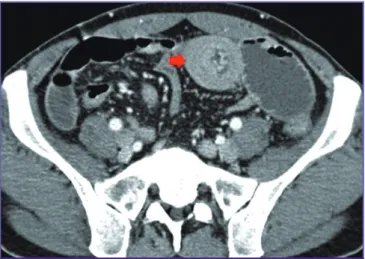
One week before visiting emergency room the patient com- plained of mild abdominal pain and an upper gastrointestinal endoscopy revealed acute gastric ulcer so a biopsy was per- formed. One week later, abdominal pain had still not subsided and he visited the emergency department. Plain abdomen X-ray and abdominopelvic computerized tomography (CT) scan were done to evaluate abdominal pain. Abdomen plain X-ray showed multiple air-fluid levels in the dilated loops in a typical configuration of a small bowel obstruction. The CT scan showed a bowel-within bowel configuration at multiple jejunal sites (Fig. 1). Gastrointestinal endoscopic biopsy was performed and the patient was diagnosed with Burkitt lymphoma. Intus- susception was thought to be caused by Burkitt lymphoma.
Therefore, the patient underwent an emergency operation, during which five intussusception points were found and small bowel segment resection was performed at three sites (Fig. 2).
On the surgically resected specimen, the tumor mass involved the submucosa to the subserosa. A typical starry sky pattern
was found. Tumor cells were immunoreactive for CD10, CD20, BCL6 and EBER. Ki67 was positive in more than 95% of tumor cells (Fig. 3). However, CD3, CD5, BCL2, Mum-1, ALK and TdT were negative. The patient was in good condition following the surgery.
Discussion
Intussusceptions caused by gastrointestinal (GI) tract non-Hod- gkin lymphoma are occasionally reported [5, 9].
Intussusception is believed to initiate from any pathologic le- sion of the bowel wall or irritant within the lumen that alters nor- mal peristaltic activity and serves as a lead point that is able to initiate invagination of one segment of the bowel into another Figure 1. Abdomen computed tomography scan showed target appearance in the jejunum with severe upstream dilatation of the small bowel (red arrow).
Figure 2. During operation, the intussusception point looked like a mass.
Bowel movement and color were intact. Five intussusception points (black arrow) were found and small bowel segment resection was performed at three sites.
https://doi.org/10.3947/ic.2018.50.1.51 • Infect Chemother 2018;50(1):51-54
www.icjournal.org 53
[10, 11]. GI tract non-Hodgkin lymphoma is a rare pathological lead point that can lead to intussusception in older children and in adults.
Non-Hodgkin lymphoma is an important AIDS-defining dis- ease [12]. It is already known that non-Hodgkin lymphoma of- ten occurs in the GI tract of AIDS patients [13]. However, intus- susception caused by GI tract non-Hodgkin lymphoma in an AIDS patient has rarely been reported [14-16]. Common points of previously reported casess were that AIDS patient com- plained severe abdominal pain with intestinal intussusception, subsequent emergency operation was performed. And biopsy finding was non-Hodgkin lymphoma. However, no such case has been reported in Korea.
Many diseases can cause abdominal pain in an AIDS patient.
Opportunistic infections (Cytomegalovirus, Mycobacterium avium Complex) in severe immunodeficiency can cause ab- dominal pain. Pain may also be due to other more common eti- ologies seen in the general population (e.g., appendicitis, diver- ticulitis). The widespread adoption of ART has been associated with a number of drug-induced side effects, including pancre- atitis and the lactic acidosis syndrome, both of which are asso- ciated with abdominal pain [17, 18]. Therefore, acute abdomi-
nal pain in an AIDS patient is not easy to diagnose. As in this case, intussusception caused by non-Hodgkin lymphoma can cause abdominal pain in an AIDS patient.
In conclusion, physicians should consider the possibility of intussusception caused by non- Hodgkin lymphoma when ex- amining AIDS patients with acute abdominal pain.
Intussusception may become a medical emergency if not treated early, as it eventually causes death if not reduced. There- fore early diagnosis and differential diagnosis are important in AIDS patients with acute abdominal pain.
Acknowledgement
This research was supported by the Basic Science Research Program through the National Research Foundation of Korea (NRF) funded by the Ministry of Education, Science and Tech- nology (1501002405) and by research funds from Chonbuk National University in 2016 and by Fund of Biomedical Re- search Institute, Chonbuk National University Hospital, Jeonju, Korea.
Figure 3. Low power view revealed a bluish mass involving the intestinal wall (Hematoxylin and eosin stain [H&E stain], ×40). Scattered benign histiocytes were present in the diffuse tumor cells, giving a “starry sky” pattern (H-E, ×100). The tumor cells were medium-sized with similar nuclear size to that of his- tiocytes. The nuclei were round with finely clumped and dispersed chromatin (H-E, ×400). The tumor cells showed strong expression of CD20 and CD10. In situ hybridization revealed nuclear Epstein-Barr virus-encoded small RNA (EBER). The tumor cells were negative for bcl-2. Because the tumor had an ex- tremely high proliferation fraction, nearly all of the cells were positive for Ki67.
Baek DY, et al. • Jejunal Intussusception in AIDS www.icjournal.org
54
Conflicts of interest
No conflicts of interest.
ORCID
Dae-Youb Baek https://orcid.org/0000-0002-7539-6893 Dae-Hyuk Heo https://orcid.org/0000-0002-7306-0149 Sang-Min Oh https://orcid.org/0000-0003-3021-5021 Joo-Hee Hwang https://orcid.org/0000-0002-8616-3411 Jeong-Hwan Hwang https://orcid.org/0000-0003-2114-1374 Ho Sung Park https://orcid.org/0000-0002-4879-874X Chang-Seop Lee https://orcid.org/0000-0002-2897-2202
References
1. Molyneux E, Rochford R, Griffin B, Newton R, Jackson G, Menon G, Harrison CJ, Israels T, Bailey S. Burkitt’s lympho- ma. Lancet 2012;379:1234-44.
2. McNally RJ, Parker L. Environmental factors and child- hood acute leukemias and lymphomas. Leuk Lymphoma 2006;47:583-98.
3. Yustein JT, Dang CV. Biology and treatment of Burkitt’s lym- phoma. Curr Opin Hematol 2007;14:375-81.
4. Musallam KM, Taher AT, Shamseddine AI. Burkitt’s lym- phoma of the colon and bronchi: three case reports. Cases J 2008;1:15.
5. Hoxha FT, Hashani SI, Krasniqi AS, Kurshumliu FI, Komoni DS, Hasimja SM, Maxhuni M. Intussusceptions as acute ab- domen caused by Burkitt lymphoma: a case report. Cases J 2009;2:9322.
6. Stringer MD, Pablot SM, Brereton RJ. Paediatric intussus- ception. Br J Surg 1992;79:867- 76.
7. Pollack CV Jr, Pender ES. Unusual cases of intussusception.
J Emerg Med 1991;9:347-55.
8. DiFiore JW. Intussusception. Semin Pediatr Sur 1999;8:214-20.
9. Xu XQ, Hong T, Li BL, Liu W. Ileo-ileal intussusception caused by diffuse large B-cell lymphoma of the ileum. World J Gas- troenterol 2013;19:8449-52.
10. Begos DG, Sandor A, Modlin IM. The diagnosis and man- agement of adult intussusception. Am J Surg 1997;173:88- 94.
11. Takeuchi K, Tsuzuki Y, Ando T, Sekihara M, Hara T, Kori T, Kuwano H. The diagnosis and treatment of adult intussus- ception. J Clin Gastroenterol 2003;36:18-21.
12. World Health Organization (WHO). Guidance on provid- er-initiated HIV testing and counselling in health facilities.
Geneva: WHO; 2007.
13. Besson C, Goubar A, Gabarre J, Rozenbaum W, Pialoux G, Châtelet FP, Katlama C, Charlotte F, Dupont B, Brousse N, Huerre M, Mikol J, Camparo P, Mokhtari K, Tulliez M, Salm- on-Céron D, Boué F, Costagliola D, Raphaël M. Changes in AIDS-related lymphoma since the era of highly active an- tiretroviral therapy. Blood 2001;98:2339-44.
14. Farrier J, Dinerman C, Hoyt DB, Coimbra R. Intestinal lym- phoma causing intussusception in HIV (+) patient: a rare presentation. Curr Surg 2004;61:386-9.
15. Kehagias I, Karamanakos SN, Panagiotopoulos S, Giali S, Gogos CA, Kalfarentzos F. A rare case of intussusception leading to the diagnosis of acquired immune deficiency syndrome: a case report. J Med Case Rep 2009;3:61.
16. Yagmur Y, Gumus S. Burkitt's lymphoma causing intussus- ception in adults: report of two cases and review of the lit- erature. J Gastroenterol Hepatol Res 2015;4:1702-6.
17. Louie JK, Hsu LC, Osmond DH, Katz MH, Schwarcz SK.
Trends in causes of death among persons with acquired immunodeficiency syndrome in the era of highly active an- tiretroviral therapy, San Francisco, 1994-1998. J Infect Dis 2002;186:1023-7.
18. Reisler RB, Murphy RL, Redfield RR, Parker RA. Incidence of pancreatitis in HIV-1- infected individuals enrolled in 20 adult AIDS clinical trials group studies: lessons learned.
J Acquir Immune Defic Syndr 2005;39:159-66.
![Figure 3. Low power view revealed a bluish mass involving the intestinal wall (Hematoxylin and eosin stain [H&E stain], ×40)](https://thumb-ap.123doks.com/thumbv2/123dokinfo/5237594.129375/3.892.194.702.127.549/figure-power-revealed-bluish-involving-intestinal-hematoxylin-stain.webp)
