Chemotherapy
Infect Chemother 2016;48(2):91-98
ISSN 2093-2340 (Print) · ISSN 2092-6448 (Online)
Received: February 19, 2016, Revised: April 12, 2016, Accepted: April 15, 2016 Corresponding Author : Kyungwon Lee, MD, PhD
Department of Laboratory Medicine and Research Institute of Bacterial Resistance, Yonsei University College of Medicine, 50-1 Yonsei-ro, Seodaemun-gu, Seoul 03722, Korea
Tel: +82-2-2228-2446, Fax: +82-2-313-0956 E-mail: [email protected]
This is an Open Access article distributed under the terms of the Creative Commons Attribution Non-Commercial License (http://creativecommons.org/licenses/by-nc/3.0) which permits unrestricted non-commercial use, distribution, and repro- duction in any medium, provided the original work is properly cited.
Copyrights © 2016 by The Korean Society of Infectious Diseases | Korean Society for Chemotherapy
www.icjournal.org
Anaerobic Bacteremia: Impact of Inappropriate Therapy on Mortality
Jieun Kim
1, Yangsoon Lee
2, Yongjung Park
3, Myungsook Kim
1, Jun Yong Choi
4, Dongeun Yong
1, Seok Hoon Jeong
1, and Kyungwon Lee
11Department of Laboratory Medicine and Research Institute of Bacterial Resistance, Yonsei University College of Medicine; 2Department of Laboratory Medicine, Hanyang University College of Medicine, Seoul; 3Department of Laboratory Medicine, National Health Insurance Corporation, Ilsan Hospital, Goyang; 4Department of Internal Medicine and AIDS Research Institute, Yonsei University College of Medi- cine, Seoul, Korea
Background: Investigation on incidence and mortality of anaerobic bacteremia (AB) is clinically relevant in spite of its infre- quent occurrence and not often explored, which report varies according to period and institutions. Therefore, it is necessary to analyze the incidence and risk factors related to mortality and assess clinical outcomes of AB in current aspect.
Materials and Methods: Characteristics of AB patients and anaerobic bacteria from blood culture at a university hospital in 2012 were reviewed retrospectively. The correlation between risk factors and 28-day patient mortality was analyzed.
Results: A total of 70 non-duplicated anaerobic bacteria were isolated from blood of 70 bacteremia patients in 2012. The histo- ry of cardiovascular disease as host’s risk factor was statistically significant (P = 0.0344) in univariate and multivariate analysis.
Although the inappropriate therapy was not statistically significant in univariate and multivariate analysis, the survival rate of bacteremia was significantly worse in patients who had inappropriate therapy compared with those underwent appropriate therapy (hazard ratio, 5.4; 95% confidence interval, 1.7–16.9; P = 0.004). The most frequently isolated organism was Bacteroi- des fragilis (32 isolates, 46%), followed by Bacteroides thetaiotaomicron (10, 14 %), and non-perfringens Clostridium (7, 10%).
Conclusion: The incidence of AB in 2012 was 2.3% (number of AB patients per 100 positive blood culture patients) and the mor- tality rate in patients with clinically significant AB was 21.4%. In addition, AB was frequently noted in patients having malignancy and the survival rate of AB was significantly worse in patients who received inappropriate therapy compared with those underwent appropriate therapy.
Key Words: Anaerobic bacteremia; Mortality; Survival rate; Inappropriate therapy
Introduction
Anaerobic bacteremia (AB) is occasionally encountered in 0.5-11.8% of all positive blood cultures [1, 2] depending on the institution. In spite of its infrequent occurrence, the fatal rate remains high from 25% to 44% [3, 4]. Due to such significant mortality, characterizing the risk factors associated with mor- tality in patients with AB was previously attempted from the 1970s. Generally, increasing age, polymicrobial infection, and underlying diseases were considered as factors contributing the mortality [5]. The significance of inappropriate antimicro- bial treatment in mortality of AB patients was discussed in number of studies [6, 7], however, the association was not conclusive. Given the changes in antimicrobial therapy, clini- cal characteristic of patients, and antimicrobial susceptibili- ties, it is difficult to apply former studies to current circum- stances. Moreover, to our knowledge, there have been limited studies defining factors associated with mortality of AB and whether the appropriate therapy contributed the survival of AB patients, based on bacterial susceptibilities. To these lim- itations, the aims of the present study were to determine the clinical significance of anaerobes isolated from blood and as- sess the risk factors related to mortality of patients with AB at a tertiary-care hospital in Korea.
Materials and Methods
1. Patients
Seventy patients who experienced clinically relevant bacte- remia between January and December of 2012 and hospital- ized at Severance Hospital (a 2,000-bed university tertiary re- ferral hospital in Seoul, Korea) were analyzed retrospectively by reviewing laboratory records and electronic medical re- cords.
2. Microbiology
Blood cultures were obtained by general venipuncture guidelines to draw no less than 10 ml of blood when possible.
Blood was injected to BacT/ALERT FA and BacT/ALERT FN (bioMérieux, Marcy-l'Etoile, France) bottles. The positive blood cultures were inoculated on Brucella agar and phenyl- ethyl alcohol blood agar, and then incubated in an anaero- bic chamber (Forma Scientific, Marietta, OH, USA) at 35°C for 48 hours. All isolates were identified by either conventional methods [8], the Vitek Anaerobe and Corynebacterium (ANC) identification card (bioMérieux), or the VITEK MS
(bioMérieux) matrix-assisted laser desorption ionisation-time of flight mass spectrometry (MALDI-TOF MS) system. An epi- sode with positive culture of Propionibacterium acnes was ex- cluded, which was considered as a common skin commensal.
The antimicrobial susceptibility testing was performed for 44 isolates of the Bacteroides fragilis group following the CLSI agar dilution method [9].
3. Definitions
Bacteremia was considered clinically relevant when a pa- tient had one or more positive blood cultures for anaerobes and met one of the following SIRS (Systemic inflammatory re- sponse syndrome) critera for documented or suspected infec- tion: leukocyte count greater than 12,000/mm3 or less than 4,000/mm3, body temperature higher than 38.3°C or lower than 36°C, pulse rate faster than 90/min, elevated C-reactive protein (CRP), hypotension or clinical evidence consistent with infection such as symptoms and signs of organ dysfunc- tion [10].
The presence of an underlying disease was based on the de- scription made by the physician. A patient was said to have cardiovascular disease when one or more of the following terms was used: chronic heart disase, coronary artery disease, hypertension, or cerebrovascular disease.
The source of the infection was assessed using imaging stud- ies, clinical symptoms and signs. Each episode was classified as community acquired (CA), hospital acquired (HA) and healthcare-associated (HCA) community onset infection by reviewing the patient's medical records according to guide- lines suggested by Lenz et al. [11]. The infection was deemed to be HA if a positive culture was drawn after more than 48 hours following admission or within 48 hours of discharge from hospital. A HCA was defined as first culture obtained less than 48 hours of admission and at least of: 1) visit to a hospital clinic or emergency department within the prior 5-30 days before onset of bloodstream infection; 2) receipt of dialy- sis; or 3) active cancer. CA are those with first positive culture obtained less than 48 hours of admission and not fulfilling cri- teria for HCA.
A delay in starting antimicrobials even after objective data confirmed an infection or the use of an antimicrobial agent to which the pathogen is resistant (by known susceptibility re- sults) was considered inappopriate therapy [12, 13]. However, some treatments could not be classified in those patients dis- charged without any prescriptions. The patients’ outcome was considered as either alive or dead within 28 days of the onset of bacteremia.
4. Statistics
Statistical analyses were performed using the SPSS software (version 23.0; SPSS Inc., Chicago, IL, USA). Means of non-nor- mally distributed quantitative values were compared using the Mann-Whitney U test and correlation between nonpara- metric characteristics and mortality was determined by Pear- son Chi-square and Fisher's exact test. A two-tailed value of P
< 0.05 was considered statistically significant. Multivariate lo- gistic regression analysis was used to determine associations between characteristics which were significant in univariate analysis with the value of P < 0.2 and mortality. Survival data were collected for 28 days following the onset of bacteremia, using Cox proportional-hazards regression model.
Results
1. Demographics and underlying diseases
A total of 70 non-duplicated subjects were included in the analysis, which incidence was 2.3% (Number of AB patients per 100 positive blood culture patients) of 3,050 positive blood culture patients in 2012. Thirty-eight (54.3%) patients were male. The median age of the patients was 61 (first quartile 50 yrs; third quartile 69 yrs) years.
Thirty-five patients were > 60 years old, accounting for half of total patients. Fifty-six patients (70.0%) had malignancy as an underlying disease, 27 patients (38.6%) had histoty of sur- gical procedure, 14 patients had liver disease (20.0%) and 11 patients had cardiovascular disease (15.7%). The presence of cardiovascular disease was statistically significant (P = 0.049)
Table 1. Host or microbial characteristics associated with 28-day mortality in 70 patients of anaerobic bacteremia Characteristics/factors
No. (%) of patients P-value
All (No=70)
Alive (No =55)
Dead
(No =15) Univariatea Multivariateb Age (median, interquartile range, years) 61 (50-69) 61 (48-69) 60 (50-77) 0.897
Age > 60 years 35 (50.0) 28 (50.9) 7 (46.7) 0.771
Male/Female (male, %) 38/32 (54.3) 33/22 (60.0) 5/10 (33.3) 0.066 0.050
Underlying diseases, n (%)
Hematologic malignancy 6 (8.6) 4 (7.3) 2 (13.3) 1.000
Non-hematologic malignancy 50 (71.4) 39 (70.9) 11 (73.3) 0.749
Cardiovascular disease 11 (15.7) 6 (10.9) 5 (33.3) 0.049 0.045
Previous surgery 27 (38.6) 21 (38.2) 6 (40.0) 0.898
Diabetes mellitus 9 (12.9) 7 (12.7) 2 (13.3) 1.000
Liver disease 14 (20.0) 10 (18.2) 4 (26.7) 0.480
Source of infection, n (%)
Intra-abdominal 42 (60.0) 34 (61.8) 8 (53.3) 1.000
Skin barrier penetration 5 (7.1) 5 (9.1) 0 (0.0) 0.577
Respiratory 2 (2.9) 1 (1.8) 1 (6.7) 1.000
Origin of infection, n (%)
Hospital-acquired infection 44 (62.9) 32 (58.2) 12 (80.0) 0.1210 1.000
Community-acquired infection 2 (2.9) 2 (3.6) 0 (0.0) 1.000
Healthcare-associated
community onset infection 24 (34.3) 21 (38.2) 3 (20.0) 0.189 1.000
Polymicrobial infection 9 (12.9) 3 (5.5) 6 (40.0) 0.392
Bacteroides spp. infection 50 (71.4) 37 (67.3) 13 (86.7) 0.202
Inappropriate therapy 16 (22.9) 10 (18.2) 6 (40.0) 0.139 0.168
aThe Pearson χ2 test was used for categorical variables and the Mann-Whitney U test was used for continuous variables.
bThe multivariate logistic regression analysis was used to determine which variables were acting independently.
in 28-day mortality, whereas other underlying diseases were not statistically significant in univariate analysis. The five sig- nificant factors (P < 0.2) were examined using multivariate lo- gistic regression analysis to determine which variables were acting independently. Cardiovascular disease was statistically significant in the multivariate analysis.
2. Source and onset of infection
The most common sources of bacteremia among those were available to be determined were the intra-abdominal area (42 patients, 60.0%), skin barrier penetration (5 patients, 7.1%) and the respiratory tract (2 patients, 2.9%). Forty-four patients (62.9%) were HA, 24 patients (34.3%) were HCA, while two patients (2.9%) were CA. Neither the source of infection nor where the infection was acquired was statistically related to 28-day mortality (Table 1).
3. Microbiology
The most frequently isolated organisms were B. fragilis (32 isolates, 46%), Bacteroides thetaiotaomicron (10, 14%), and non-perfringens Clostridium (7, 10%) (Table 2). In 61 patients (87.1%), bacteremia was caused by a single organism. Nine patients (12.9%) had a polymicrobial infection, most com- monly with coagulase-negative staphylococci, Escherichia coli, and Klebsiella pneumoniae (in order of frequency), how- ever, the mortality was not significantly associated with mixed infections. Among the 70 patients, 50 patients had bacteremia due to Bacteroides spp., although the mortality was not statis-
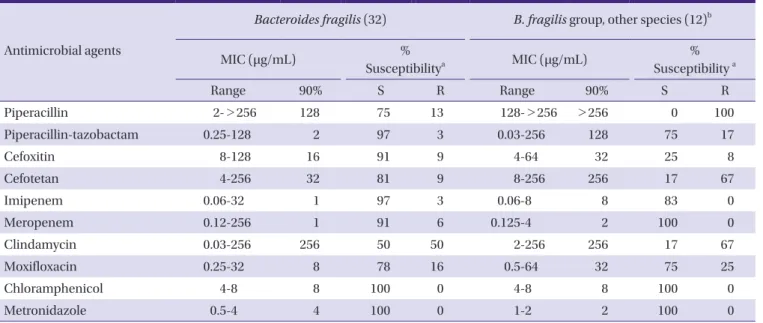
tically significant. On an antibiogram (Table 3) for B. fragilis, the susceptibility rate to clindamycin, piperacillin and moxi- floxacin were 50%, 75% and 78%, respectively, whereas the susceptibility rate to cefoxitin, piperacillin-tazobactam, imipe- nem, meropenem, chloramphenicol, and metronidazole were 91% to 100%. However, for other species of the B. fragilis group, the susceptibility rate to clindamycin, piperacillin, ce- foxitin, and piperacillin-tazobactam, were 17%, 0%, 25%, and 75%, respectively.
Table 2. Anaerobic organisms isolated from blood culture
Organisms No.(%) of patients
Bacteroides fragilis 32 (45.7)
Bacteroides thetaiotaomicron 10 (14.3)
Bacteroides ovatus 4 (5.7)
Bacteroides caccae 2 (2.9)
Bacteroides vulgatus 2 (2.9)
Fusobacterium nucleatum 1 (1.4)
Prevotella buccae 1 (1.4)
Clostiridium spp. 9 (12.9)
Bifidobacterium sp. 1 (1.4)
Eubacterium lentum 1 (1.4)
Veillonella parvula 3 (4.3)
Parvimonas micra 4 (5.7)
Total 70 (100.0)
Table 3. Antimicrobial activities against 44 Bacteroides fragilis group isolates in 2012
Antimicrobial agents
Bacteroides fragilis (32) B. fragilis group, other species (12)b
MIC (μg/mL) %
Susceptibilitya MIC (μg/mL) %
Susceptibility a
Range 90% S R Range 90% S R
Piperacillin 2->256 128 75 13 128->256 >256 0 100
Piperacillin-tazobactam 0.25-128 2 97 3 0.03-256 128 75 17
Cefoxitin 8-128 16 91 9 4-64 32 25 8
Cefotetan 4-256 32 81 9 8-256 256 17 67
Imipenem 0.06-32 1 97 3 0.06-8 8 83 0
Meropenem 0.12-256 1 91 6 0.125-4 2 100 0
Clindamycin 0.03-256 256 50 50 2-256 256 17 67
Moxifloxacin 0.25-32 8 78 16 0.5-64 32 75 25
Chloramphenicol 4-8 8 100 0 4-8 8 100 0
Metronidazole 0.5-4 4 100 0 1-2 2 100 0
aS, susceptible; R, resistant.
bBacteroides thetaiotaomicron (n=6), B. caccae (n=2), B. ovatus (n=2), B. vulgatus (n=2).
4. Therapy and outcome
During the study period, patients were hospitalized for (13.5 [4, 36]) days (median, [first quartile ,third quartile], range 1-166 days) and 15 patients (21.4%) died within 28 days of the onset of bacteremia. Fifty-one patients (72.9%) received appropriate antimicrobial therapy: piperacillin-tazobactam in 24 patients, carbapenem in 20 patients, and metronidazole in six patients.
Sixteen patients received inappropriate therapy with either in- effective antimicrobials or an inadequate time of initiation (Fig. 1A). Six of the 16 patients who received inappropriate therapy died, and 4 of these 6 patients underwent therapy that included third-generation cephalosporin and other agents known to be ineffective against AB. Five of the 6 patients were
deemed to be expired due to bacteremia within 1 to 5 days af- ter the blood culture were drawn. Among the ten live patients of the 16 patients who received inappropriate therapy, six pa- tients were treated with third-generation cephalosporins and other agents known to be ineffective against AB, three patients did not receive any antimicrobial therapy, and one patient un- derwent delayed therapy with carbapenem. The appropriate- ness of therapy was not significant in mortality by univariate and multivariate analysis, however, survival rate of bacteremia was significantly worse in patients who received inappropriate therapy compared with those underwent appropriate therapy by Cox proportional-hazards regression analysis (hazard ratio, 5.4; 95% confidence interval, 1.7–16.9; P = 0.004) (Fig. 1B).
Figure 1. Clinical outcome and survival rate of 70 patients with anaerobic bacteremia according to appropriateness of treatment(A, B).
A
B
Discussion
Clinical decision making is more difficult in anaerobic infec- tions than aerobic infections, because of its limitations in iso- lating and susceptibility testing, such as slow growth of organ- isms, complexity of testing method and predictable susceptibility patterns among the anaerobes [14]. However, AB has reemerged as a significant clinical problem, owing to multiple reasons, such as change of medical practices and in- creasing number of patients with complex underlying diseas- es [15]. Similarly, from the trends in AB that we have followed since 1974, the incidence of AB has gradually increased in the last four decades, from 1.39% in 1974-1983 to 1.96% in 2007- 2008 [16-18]. There were technological advances in blood cul- ture detection systems in our institution, blood culture sys- tems from conventional anaerobic broth blood systems to BACTEC 9240 systems (Becton Dickinson Diagnostic Instru- ment Systems, Sparks, MA, USA) in 1997 and to BacT/Alert 3D systems (bioMérieux) in 2005, however, the steady rather than sudden increase was noted during the decades. Accord- ing to an annual report from the Korean Ministry of Health and Welfare [19], the number of elderly patients and patients with underlying malignancies is increasing and we assume that the change in patient population attributed to this trend we observed. Indeed, patients admitted to the Severance Hos- pital, a tertiary care referral center, often present with comor- bidities and advanced disease.
To our knowledge, this is the first study in Korea to demon- strate a correlation between risk factors and mortality, using χ2 test and Cox proportional-hazards regression model for sta- tistical analysis. In this study of AB, there were three findings:
1) mortality of patients with AB is associated with cardiovas- cular disease as an underlying disease; and 2) more than half of AB is derived from HA infection; and 3) the survival was significantly worse in patients who received inappropriate therapy compared with those underwent appropriate therapy.
The cardiovascular disease as an underlying condition was significantly associated with mortality, which is a novel find- ing in this study. Yang et al. [20] reported this comorbidity as not being a significant risk factor for 30-day mortality, howev- er, the limitation in scope to a single species such as Clostridi- um perfringens, and different assessment of patient demo- graphics may have contributed to discordant results. The relationship between cardiovascular disease and mortality in AB patients has not been demonstrated, so further investiga- tion is needed.
The nosocomial acquisition of AB was commonly estimated
in previous studies, from 25% to 64% of AB cases [20, 21]. The nosocomial bacteremia was defined as a positive blood cul- ture obtained more than 48 h after admission in previous studies. However, due to a complexity in the delivery of healthcare services, the category and definition of blood stream infection has changed. Based on the proposed defini- tion of CA, HA, and HCA infection, 62.9% of cases were HA in- fection in this study.
Inappropriate therapy has been regarded as a prognostic factor in patient outcomes [6, 22], and was also found to be statistically significant for the survival rate in this study. In the period of this study, 54 patients (77.1%) received initial thera- py that was appropriately effective against AB, which is not much different from some studies that have reported values of 72-80% [6]. Among six expired cases of 16 patients who un- derwent inappropriate therapy, four patients had active can- cer with multiple metastasis, one had acute pulmonary edema due to heart failure and one had traumatic subdural hemor- rhage with coma metal status. Five of six patients had therapy using third-generation cephalosporin or colistin and one pa- tient had no antimicrobials given. Generally, in our hospital, monotherapy of third-generation cephalosporin or piperacil- lin-tazobactam is recommended as the intial therapy when systemic infection is suspected, and carbapenam or vancomy- cin is considered in severe infections. AB is not empirically treated at the initial time of infection, but metronidazole is ad- ministered in clinically suspicious circumstances or when pri- or antimicrobial therapy has failed.
Several factors have been suggested to have an association with a greater likelihood of inappropriate antimicrobial thera- py, such as presence of multiple infecting organisms, antibiot- ic-resistant bacteria, and prolonged length of stay [23]. In this study, however, there was no case of polymicrobial infection or use of antimicrobial agents that the isolate showed resis- tance in the inappropriately treated groups, and length of hos- pital stay was longer in the appropriately treated group com- pared with the inappropriately treated group (30 vs. 17.6 days). We assume that impression of patients with risk of AB is important in the clinical outcome as observed in our study that inappropriately treated groups showed worse survival. In addition, our findings regarding patient characteristics may guide physicians with clinical clues.
The limitations of the present study are that it was a restro- spective review and was done with a small sample size. De- spite these limitations, in conclusion, AB was frequently noted in patients having maliganancy and the mortality rate in pa- tients with clinically significant AB was 21%. B. fragilis was the
most frequently recovered organism with predictable suscep- tibility patterns. The survival rate of AB was significantly worse in patients who received inappropriate therapy compared with those underwent appropriate therapy and choice of proper initial antimicrobial is fundamental in clinical out- come of AB.
Acknowledgments
This research was supported by a CMB-Yuhan research grant of Yonsei University College of Medicine for 2012 (6- 2012-0048).
Conflicts of Interest
No conflicts of interest.
ORCID
Kyungwon Lee http://orcid.org/0000-0003-3788-2134 Jieun Kim http://orcid.org/0000-0002-6498-5801
References
1. Washington JA 2nd. Comparison of two commercially available media for detection of bacteremia. Appl Micro- biol 1971;22:604-7.
2. Arzese A, Trevisan R, Menozzi MG. Anaerobe-induced bacteremia in Italy: a nationwide survey. The Italian An- aerobe Study Group. Clin Infect Dis 1995;20 (Suppl 2):S230-2.
3. Peraino VA, Cross SA, Goldstein EJ. Incidence and clinical significance of anaerobic bacteremia in a community hos- pital. Clin Infect Dis 1993;16 (Suppl 4):S288-91.
4. Vazquez F, Mendez FJ, Perez F, Mendoza MC. Anaerobic bacteremia in a general hospital: retrospective five-year analysis. Rev Infect Dis 1987;9:1038-43.
5. Wilson JR, Limaye AP. Risk factors for mortality in patients with anaerobic bacteremia. Eur J Clin Microbiol Infect Dis 2004;23:310-6.
6. Salonen JH, Eerola E, Meurman O. Clinical significance and outcome of anaerobic bacteremia. Clin Infect Dis 1998;26:1413-7.
7. Cheng CW, Lin HS, Ye JJ, Yang CC, Chiang PC, Wu TS, Lee MH. Clinical significance of and outcomes for Bacteroides fragilis bacteremia. J Microbiol Immunol Infect 2009;42:243-
50.
8. Summanen P, Baron EJ, Citron DM, Strong CA, Wexler HM, Finegold SM. Wadsworth anaerobic bacteriology manual. 5th ed. Belmont, CA: Star Publishing Co.; 1993.
9. Clinical and Laboratory Standards Institute (CLSI). Meth- ods for antimicrobial susceptibility testing of anaerobic bacteria : approved standard. 8th ed. Wayne, PA: CLSI;
2012.
10. Levy MM, Fink MP, Marshall JC, Abraham E, Angus D, Cook D, Cohen J, Opal SM, Vincent JL, Ramsay G; SCCM/
ESICM/ACCP/ATS/SIS. 2001 SCCM/ESICM/ACCP/ATS/
SIS International sepsis definitions conference. Crit Care Med 2003;31:1250-6.
11. Lenz R, Leal JR, Church DL, Gregson DB, Ross T, Laup- land KB. The distinct category of healthcare associated bloodstream infections. BMC Infect Dis 2012;12:85.
12. Weinstein MP, Towns ML, Quartey SM, Mirrett S, Reimer LG, Parmigiani G, Reller LB. The clinical significance of positive blood cultures in the 1990s: a prospective com- prehensive evaluation of the microbiology, epidemiology, and outcome of bacteremia and fungemia in adults. Clin Infect Dis 1997;24:584-602.
13. Brook I. Treatment of anaerobic infection. Expert Rev Anti Infect Ther 2007;5:991-1006.
14. Nguyen MH, Yu VL, Morris AJ, McDermott L, Wagener MW, Harrell L, Snydman DR. Antimicrobial resistance and clinical outcome of Bacteroides bacteremia: findings of a multicenter prospective observational trial. Clin Infect Dis 2000;30:870-6.
15. Lassmann B, Gustafson DR, Wood CM, Rosenblatt JE. Re- emergence of anaerobic bacteremia. Clin Infect Dis 2007;44:895-900.
16. Kim HO, Kang CG, Chong Y, Lee SY. Organisms isolated from blood at the Yonsei medical center, 1974-1983. Kore- an J Infect Dis 1985;17:15-32.
17. Koh EM, Lee SG, Kim CK, Kim M, Yong D, Lee K, Kim JM, Kim DS, Chong Y. Microorganisms isolated from blood cultures and their antimicrobial susceptibility patterns at a university hospital during 1994-2003. Korean J Lab Med 2007;27:265-75.
18. Park Y, Lee Y, Kim M, Choi JY, Yong D, Jeong SH, Kim JM, Lee K, Chong Y. Recent trends of anaerobic bacteria iso- lated from clinical specimens and clinical characteristics of anaerobic bacteremia. Infect Chemother 2009;41:216- 23.
19. Do SR. Changing trends in Korean patients' use of health facilities. Available at: https://www.kihasa.re.kr/web/pub-
lication/periodical/issue_view.do?menuId=50&
tid=38&bid=21&searchForm=Y&keyField=myear&search- Stat=2009&key=&aid=8&ano=1. Accessed 12 February 2016.
20. Yang CC, Hsu PC, Chang HJ, Cheng CW, Lee MH. Clinical significance and outcomes of Clostridium perfringens bac- teremia--a 10-year experience at a tertiary care hospital.
Int J Infect Dis 2013;17:e955-60.
21. Kornowski R, Schwartz D, Averbuch M, Levo Y, Berger S, Giladi M. Anaerobic bacteremia: a retrospective four-year
analysis in general medicine and cancer-patients. Infec- tion 1993;21:241-4.
22. Robert R, Deraignac A, Le Moal G, Ragot S, Grollier G.
Prognostic factors and impact of antibiotherapy in 117 cases of anaerobic bacteraemia. Eur J Clin Microbiol In- fect Dis 2008;27:671-8.
23. Kollef MH. Inadequate antimicrobial treatment: an im- portant determinant of outcome for hospitalized patients.
Clin Infect Dis 2000;31 (Suppl 4):S131-8.