D I A B E T E S & M E T A B O L I S M J O U R N A L D I A B E T E S & M E T A B O L I S M J O U R N A L
This is an Open Access article distributed under the terms of the Creative Commons Attribution Non-Commercial License (http://creativecommons.org/licenses/by-nc/4.0/) which permits unrestricted non-commercial use, distribution, and reproduction in any medium, provided the original work is properly cited.
Effects of Lobeglitazone, a Novel Thiazolidinedione, on Bone Mineral Density in Patients with Type 2 Diabetes Mellitus over 52 Weeks
Soo Lim1,*, Kyoung Min Kim1,*, Sin Gon Kim2, Doo Man Kim3, Jeong-Taek Woo4, Choon Hee Chung5, Kyung Soo Ko6, Jeong Hyun Park7, Yongsoo Park8,9, Sang Jin Kim10, Hak Chul Jang1, Dong Seop Choi2
1Department of Internal Medicine, Seoul National University Bundang Hospital, Seoul National University College of Medicine, Seongnam,
2Department of Internal Medicine, Korea University Anam Hospital, Korea University College of Medicine, Seoul,
3Department of Internal Medicine, Hallym University Kangdong Sacred Heart Hospital, Hallym University College of Medicine, Seoul,
4Department of Internal Medicine, Kyung Hee University Hospital, Kyung Hee University School of Medicine, Seoul,
5Department of Internal Medicine, Wonju Severance Christian Hospital, Yonsei University Wonju College of Medicine, Wonju,
6Department of Internal Medicine, Cardiovascular and Metabolic Disease Center, Inje University Sanggye Paik Hospital, Inje University College of Medicine, Seoul,
7Department of Internal Medicine, Inje University Busan Paik Hospital, Inje University College of Medicine, Busan, Korea,
8Kosair Children’s Hospital Research Institute, University of Louisville, Louisville, KY, USA,
9Department of Internal Medicine, Hanyang University Guri Hospital, Hanyang University College of Medicine, Guri,
10Department of Internal Medicine, Soon Chun Hyang University Cheonan Hospital, Soon Chun Hyang University College of Medicine, Cheonan, Korea
Background: The aim of this multicenter, randomized, double-blind study was to examine the effect of lobeglitazone, a novel thi- azolidinedione, on the changes in bone mineral density (BMD) in patients with type 2 diabetes mellitus.
Methods: A 24-week, double-blinded phase was followed by a 28-week, open-label phase, in which the placebo group also started to receive lobeglitazone. A total of 170 patients aged 34 to 76 years were randomly assigned in a 2:1 ratio to receive lobeglitazone 0.5 mg or a matching placebo orally, once daily. BMD was assessed using dual-energy X-ray absorptiometry at week 24 and at the end of the study (week 52).
Results: During the double-blinded phase, the femur neck BMD showed decreasing patterns in both groups, without statistical significance (‒0.85%±0.36% and ‒0.78%±0.46% in the lobeglitazone and placebo groups, respectively). The treatment difference between the groups was 0.07%, which was also not statistically significant. Further, minimal, nonsignificant decreases were ob- served in both groups in the total hip BMD compared to values at baseline, and these differences also did not significantly differ between the groups. During the open-label phase, the BMD was further decreased, but not significantly, by ‒0.32% at the femur neck and by ‒0.60% at the total hip in the lobeglitazone group, and these changes did not significantly differ compared with the original placebo group switched to lobeglitazone.
Conclusion: Our results indicate that treatment with lobeglitazone 0.5 mg over 52 weeks showed no detrimental effect on the BMD compared to the placebo.
Keywords: Bone density; Diabetes mellitus, type 2; Lobeglitazone; Thiazolidinediones
Corresponding author: Dong Seop Choi https://orcid.org/0000-0002-8272-1180 Department of Internal Medicine, Korea University Anam Hospital, Korea University College of Medicine, 73 Inchon-ro, Seongbuk-gu, Seoul 02841, Korea
E-mail: [email protected]
* Soo Lim and Kyoung Min Kim contributed equally to this study as first
INTRODUCTION
The bone mineral density (BMD) tends to be increased in pa-
tients with type 2 diabetes mellitus (T2DM) because they are commonly overweight or obese [1]. However, the risk of osteo- porotic fracture is significantly increased in patients with https://doi.org/10.4093/dmj.2017.41.5.377
pISSN 2233-6079 · eISSN 2233-6087
T2DM, with approximately a two-fold relative risk compared to those without diabetes [2,3]. The impaired bone quality and increased risk of falls might attenuate or offset the positive ef- fect of the relatively large body weight on bone strength in sub- jects with T2DM [4,5]. Moreover, the mortality related to os- teoporotic fracture is much higher in diabetic patients com- pared to their nondiabetic counterparts [2]. Given the deterio- ration of bone strength and higher mortality and morbidity in diabetic patients with fracture, the skeletal effects of antidia- betic drugs represent a major issue [6].
Thiazolidinediones (TZDs) are a class of antidiabetic drugs that work by increasing insulin sensitivity by activating peroxi- some proliferator-activated receptor γ (PPARγ) [7,8]. TZDs are known to inhibit differentiation of osteoblasts by overweighing adipogenesis from mesenchymal stem cells, which are the common progenitors of both adipocytes and osteoblasts [9].
Furthermore, some data suggest that TZDs may also partially promote osteoclastogenesis [10]. In many clinical trials, the BMD was found to decrease and the risk of fractures was found to increase in diabetic patients treated with rosiglitazone [11,12]. Accordingly, there are many concerns about whether long-term administration of TZDs is associated with de- creased BMD and increased osteoporotic fractures [12,13].
These negative effects of TZDs on bone strength have become a major limitation in prescribing TZDs to diabetic patients, particularly those at high risk of fractures.
Several TZDs have demonstrated similar glucose-lowering efficacies and are currently being used as antidiabetic drugs.
However, these drugs have shown distinguishable properties in terms of their effects on diverse organs, systems, and pro- cesses, including energy metabolism, skeletal biology, the vas- culature, and lipid profiles [14,15]. Especially pioglitazone has been reported to show fewer negative effects on bone metabo- lism compared to rosiglitazone [16,17]. Based on these find- ings, it is conceivable that the effects on bone metabolism might differ between different TZDs, independently of their glucose-lowering potency.
Lobeglitazone is a novel PPARγ agonist with proven glucose- lowering potency in previous clinical trials and has been used to treat diabetic patients in several Asian countries [18,19]. In the present study, we evaluated the effects of 52 weeks of treat- ment with lobeglitazone on BMD as a means to determine whether lobeglitazone treatment shows negative effects on BMD compared to a placebo.
METHODS
Study design and patients
This was a 52-week, multicenter, randomized, controlled trial to investigate the effect of lobeglitazone on BMD. This study consisted of two phases: a 24-week, double-blinded study fol- lowed by a 28-week open-label extension study in which the placebo group also started to receive lobeglitazone. This study was conducted at nine centers in South Korea between 2009 and 2011. In the first double-blinded phase, the patients were randomized into two groups in a 2:1 ratio: one group treated with lobeglitazone 0.5 mg and one group administered a pla- cebo drug for 24 weeks. After completing the first phase of the study, a 28-week, open-label extension phase was conducted, with the patients receiving lobeglitazone continuing on the same drug, whereas the patients in the placebo group were switched to lobeglitazone and continued on this drug for 28 weeks. In our previous studies using the same cohort, the glu- cose-lowering efficacy and safety of lobeglitazone were dem- onstrated [18,19]. In the present study, the main inclusion cri- teria were as follows: age 18 to 80 years; T2DM diagnosed at least 3 months prior to the study enrollment; glycosylated he- moglobin (HbA1c) 6.5% to 9.0% at the screening test if medi- cation with oral hypoglycemic agents had been stopped less than 3 months ago, or HbA1c 7.0% to 10.0% at the screening test if patients were drug-naïve or had ceased medication with antidiabetic drugs more than 3 months previously; body mass index between 21 and 40 kg/m2; fasting serum C-peptide level
>1.0 ng/mL. The exclusion criteria were as follows: fasting plasma glucose (FPG) level >250 mg/dL; triglyceride level
>500 mg/dL; treatment with insulin or TZDs within 60 days;
uncontrolled hypertension; history of cardiovascular diseases, including myocardial infarction, uncompensated heart failure, cerebral infarction, cerebral hemorrhage, or unstable angina within 6 months; severe hepatic or renal dysfunction; anemia for any reason; uncontrolled other disease or diabetic compli- cations; and a history of cancer within 5 years. Subjects who used drugs affecting bone metabolism, including bisphospho- nates, raloxifene, sex hormone-replacement therapy, or teripa- ratide, were also excluded. Subjects who were using lipid-low- ering agents were allowed to maintain those drugs. This study was approved by each study center’s Institutional Review Board (B-0704-044-009) and was carried out in accordance with the Code of Ethics of the World Medical Association (Declaration of Helsinki). All patients provided informed con-
sent to participate.
The primary outcome was the changes in the femur neck BMD from baseline to the end of treatment. The secondary endpoints were the changes in total hip BMD during the study period and the percent of patients who showed changes of BMD more than ‒3.5% at the femur neck or total hip in each study phase.
Dual-energy X-ray absorptiometry
The BMDs at the femur neck and total hip area were measured by dual-energy X-ray absorptiometry (DXA) (Hologic Inc., Bedford, MA, USA; or GE Healthcare Lunar, Madison, WI, USA) in each center. DXA scans were performed at baseline and at week 24 and at the end of the study. BMD values from both systems were converted to standardized BMD values us- ing a conversion formula, which is previously defined [20].
Changes in the BMD were calculated as the percentage of changes of the absolute BMD during the study period. The co- efficient variations of BMD measurements in each center ranged from 0.8% to 1.8% for both the femur neck and total hip.
Biochemical parameters
After overnight fasting for at least 12 hours, serum was collect- ed. The serum concentrations of total cholesterol, triglycerides, high density lipoprotein cholesterol, low density lipoprotein cholesterol, blood urea nitrogen, creatinine, HbA1c, and FPG were measured by standard biochemical methods.
Statistical analysis
Data are expressed as mean±standard deviation for continu- ous variables or as the number and the percentage of patients for categorical variables. The mean percent changes of BMD were calculated using the BMD values at baseline and at weeks 24 and 52. The comparisons of the changes from before and af- ter the treatment within the groups were analyzed by the paired t-test, and differences between the study groups were assessed by repeated measures analysis of variance at the end of the study. Significant BMD loss was defined as a reduction of >3.5% in each study phase than 3.5% loss in each study phase, which was assumed as the least significant change cal- culated with precision multiplied by 2.77. All statistical analy- ses were performed using SPSS version 18 (SPSS Inc., Chicago, IL, USA). Values of P<0.05 were considered significant.
RESULTS
Demographics and baseline characteristics
The detailed information about the subject enrollment and randomization has been previously described [18,19]. A total of 173 patients were randomly assigned to the lobeglitazone or control group in a 2:1 ratio. The BMD values in three patients in the lobeglitazone group from the original study were not provided, and those patients were thus excluded from the pres- ent analysis. The baseline characteristics of the 170 patients who were finally included in the analyses are provided in Table 1. There were no differences in any of the demographic, an- thropometric, or clinical characteristics at baseline between the two groups. Further, the BMD values were comparable be- tween the groups for all patients and for men and women when analyzed separately (Table 2).
Table 1. Baseline characteristics of the study participants Characteristic Lobeglitazone
(n=112) Placebo (n=58)
Age, yr 56.36±9.29 54.72±9.7
Male, sex 65 (58) 32 (55.2)
Height, cm 161.9±8.2 161.8±9.0
Weight, kg 66.5±9.9 65.9±8.8
Body mass index, kg/m2 25.3±2.8 25.1±2.2
SBP, mm Hg 124.1±13.5 123.3±12.2
DBP, mm Hg 77.2±9.1 76.2±8.4
Fasting plasma glucose, mg/dL 140.2±32.0 151.0±60.5
HbA1c, % 7.68±0.76 7.86±0.86
Total cholesterol, mg/dL 181.6±37.4 189.8±41.7 Triglycerides, mg/dL 148.1±106.8 168.6±100.4
LDL-C, mg/dL 111.7±32.3 116.8±34.3
HDL-C, mg/dL 48.4±12.4 48.1±11.4
Duration of diabetes, yr 4.3±3.9 4.9±4.6 Antidiabetic medications
Drug-naïve 45 (40.2) 24 (41.4)
Sulfonylurea 28 (25) 14 (24.1)
Metformin 49 (43.8) 23 (39.7)
DPP4 inhibitor 5 (5.4) 2 (3.4)
α-Glucosidase inhibitor 2 (1.8) 1 (1.7) Values are presented as mean±standard deviation or number (%).
SBP, systolic blood pressure; DBP, diastolic blood pressure; HbA1c, glycosylated hemoglobin; LDL-C, low density lipoprotein cholesterol;
HDL-C, high density lipoprotein cholesterol; DPP4, dipeptidyl pepti- dase-4.
Changes in bone mineral density
Changes in BMD at the femur neck and total hip in the total subjects and in men and women are presented in Figs. 1 and 2.
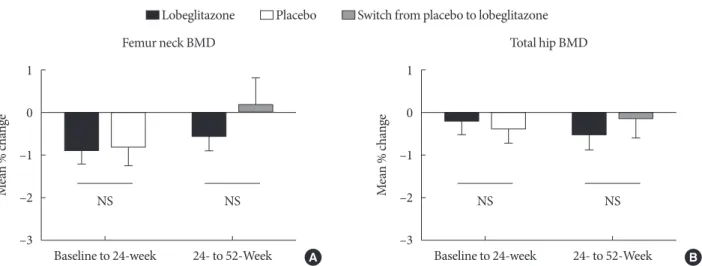
During the placebo, controlled, blinded phase, the femur neck BMD at 24 weeks had decreased by ‒0.85%±0.36% in the lobeglitazone group and by ‒0.78%±0.46% in the placebo group compared to values at baseline; however, these changes were not statistically significant. The difference between the groups was 0.07%, and this was also statistically insignificant (Figs. 1A and 2A). Minimal nonsignificant decreases were ob- served in both groups in total hip BMD, with no treatment dif- ference noted between the groups (‒0.17%±0.30% in the lobe- glitazone group vs. –0.35%±0.34% in the placebo group; treat- ment difference, 0.17%; P>0.05 for all) (Figs. 1B and 2B). Dur- ing the open-label phase, in which the placebo was switched to lobeglitazone, the BMD was further decreased by ‒0.32% in the femur neck and by ‒0.60% in the total hip, without statisti- cal significances, in the lobeglitazone group (Figs. 1A, B and 2).
In the group that switched to lobeglitazone during the open- label phase, there was a slight increase in the femur neck BMD and a decrease in the total hip BMD; however, these changes similarly did not reach statistical significance, and there were no significant differences compared to the lobeglitazone-main- tained group (Figs. 1A, B and 2). Similar trends were observed in both men and women when analyzed separately (Fig. 1C and F).
We also compared the BMD changes in women and men older than 50 years or younger. Consequently, the BMD changes were not different between the treatment groups re-
gardless of their ages, indicating that lobeglitazone administra- tion did not show any significant effects on BMD changes in subgroups that have higher risk of rapid bone loss (data not shown).
The ratios of patients showing significant bone loss during the double-blinded or open-label phase did not differ between the groups at either the femur neck (25.5% in the lobeglitazone group vs. 25.2% in the placebo group during the double-blind- ed phase; 26.2% in the lobeglitazone group vs. 18.5% in the group switched from placebo to lobeglitazone during the open- label phase) or total hip (15.0% vs. 10.9% and 20.0% vs. 14.8%, respectively; P>0.05 for all) (Fig. 3).
DISCUSSION
In this study, we investigated the effects of a novel TZD, lobegl- itazone, on BMD in subjects with T2DM after 52 weeks of treatment. The results from the present study revealed neutral effects of lobeglitazone on BMD changes in this study popula- tion. No statistically significant differences were observed be- tween the lobeglitazone and placebo groups in the changes in BMD at the femur neck and total hip compared to baseline during both the double-blinded and open-labeled periods.
TZDs are insulin-sensitizing agents [21,22] and are consid- ered one of the major therapeutic drug classes for the manage- ment of diabetes [7]. TZDs increase insulin sensitivity by acti- vating PPARγ, mainly in the adipose tissue and muscle, and show beneficial effects in preventing vascular complications in patients with insulin resistance [23,24]. However, despite these Table 2. Baseline bone mineral density in total, men, and women according to the treatment groups
Variable
Total Men Women
Lobeglitazone
(n=112) Placebo
(n=58) P value Lobeglitazone
(n=65) Placebo
(n=32) P value Lobeglitazone
(n=47) Placebo
(n=26) P value Femur neck
BMDa 0.860±0.171 0.851±0.179 0.74 0.911±0.175 0.924±0.177 0.72 0.790±0.139 0.760±0.136 0.38
T-score –0.3±1.1 –0.4±1.4 0.78 –0.1±1.0 0.1±1.4 0.44 –0.63±1.13 –1.0±1.1 0.19
Z-score 0.6±1.0 0.6±1.2 0.81 0.7±1.0 0.8±1.3 0.58 0.52±0.92 0.3±1.0 0.26
Total hip
BMDa 0.902±0.150 0.779±0.177 0.63 0.944±0.146 0.962±0.182 0.61 0.845±0.135 0.800±0.125 0.17
T-score 0.2±1.1 –0.1±1.7 0.40 0.4±1.1 0.5±1.4 0.68 –0.2±1.1 –0.7±1.8 0.15
Z-score 0.7±1.0 0.6±1.2 0.68 0.8±1.1 0.9±1.4 0.81 0.5±0.9 0.3±0.8 0.25
Values are presented as mean±standard deviation.
BMD, bone mineral density.
aBMD values from both systems were converted into standardized BMD values by using a conversion formula.
benefits, severe clinical issues are related to TZDs, especially the predisposition to fractures [12]. Both adipocytes and os- teoblasts differentiate from the same mesenchymal stem cells [25,26], and TZDs are known to induce adipocyte differentia- tion [8] and suppress osteoblastogenesis [27]. Therefore, TZDs might have potentially negative effects on bone metabolism.
Accordingly, rapid bone loss and increased risk of fractures have been reported in several clinical studies on TZDs [11,28].
Thus, given the increased fragility of diabetes patients, the neg- ative influence on bone has become a significant limitation in TZD prescription.
Interestingly, rosiglitazone and pioglitazone show somewhat Fig. 1. Mean percentage of changes in bone mineral density (BMD) during the study period for the femur neck and total hip in (A, B) all subjects, (C, D) men, and (E, F) women.
2 1 0 –1 –2 –3 –4
2 1 0 –1 –2 –3 –4
2 1 0 –1 –2 –3 –4
2 1 0 –1 –2 –3 –4
2 1 0 –1 –2 –3 –4
2 1 0 –1 –2 –3 –4
% change% change% change % change% change% change
Baseline
Baseline
Baseline
Baseline
Baseline
Baseline 24-Week
24-Week
24-Week
24-Week
24-Week
24-Week 52-Week
52-Week
52-Week
52-Week
52-Week
52-Week
Femur neck BMD Total hip BMD
Total
Men
Women
Total
Men
Women A
C
E
B
D
F Lobeglitazone
Placebo
Switch from placebo to lobeglitazone
different profiles in their effects on diverse organs. Rosigli- tazone, which was once withdrawn from the market because of an increased risk of cardiovascular events [29], has been re- ported to decrease BMD and increase fracture risks [11]. On the other hand, basic and clinical studies with pioglitazone re- vealed cardiovascular benefits [30,31], although its effect on the skeletal system remains inconclusive, with several studies finding no meaningful influences on bone [16,32]. In addition, these two drugs also exert distinct effects on lipid profiles and skeletal muscle biology [14,15].
Lobeglitazone, a novel PPARγ agonist, has proven glucose- lowering efficacy [18,19,33] and a higher affinity with PPARγ compared to rosiglitazone or pioglitazone [33,34]. This profile enables lower dosage as an antidiabetic therapeutic drug;
thereby, decreasing the risks of dose-related side-effects. More- over, the detrimental effects of rosiglitazone on bone are known to result partially from stimulated osteoclastogenesis [35]. However, this phenomenon has not been demonstrated with other TZDs [36]. In the present study, treatment with lobeglitazone 0.5 mg did not affect bone metabolism. The low- Fig. 2. Mean percentage changes in bone mineral density (BMD) for the (A) femur neck and (B) total hip during the double- blinded and open-labeled phases. NS, not significant.
1 0 –1 –2 –3
1 0 –1 –2 –3
Mean % change Mean % change
Baseline to 24-week Baseline to 24-week
NS NS NS NS
24- to 52-Week 24- to 52-Week
Femur neck BMD Total hip BMD
A B
Lobeglitazone Placebo Switch from placebo to lobeglitazone
Fig. 3. Ratios of subjects who showed significant bone loss at the (A) femur neck and (B) total hip during the double-blinded and open-labeled phases. BMD, bone mineral density; NS, not significant.
100 80 60 40 20 0
100 80 60 40 20 0
(%) (%)
Lobeglitazo ne
Lobeglitazo ne Lobeglitazo
ne
Lobeglitazo ne Place
bo
Place bo Place
bo
Place bo
NS NS
24 Weeks 24 Weeks
NS NS
52 Weeks 52 Weeks
Femur neck Total hip
A B
Percentage changes of BMD ≤–3.5% Percentage changes of BMD >–3.5%
er dosage of lobeglitazone and its differential effects on bone cells might contribute to the current study findings. However, mechanistic studies to elucidate its effects of bone biology are required to confirm this speculation.
There are several strengths to this study. First, this was a multicenter, placebo-controlled, randomized clinical study.
Second, BMD was measured in 98% of the participants. Third, diabetic patients taking other medications such as glucagon- like peptide-1 agonists or sodium-glucose cotransporter in- hibitors were excluded because these agents might affect bone metabolism.
However, several limitations should be noted. First, the pri- mary outcome of the original study was changes in the HbA1c level. Therefore, the sample size was calculated based on the determination of the glucose-lowering efficacy, and not pow- ered to investigate BMD changes. Second, approximately half of the study subjects were treatment-naïve patients whose bone quality is thus not expected to be greatly affected by long- term hyperglycemia. Therefore, we cannot extend the current study findings to diabetic populations with a long duration of disease. Third, bone formation and resorption markers were not assessed in the present study, which made it impossible to assess the effect of lobeglitazone on the bone turnover rate per se. Fourth, BMDs were measured only at the femur neck and total hip areas, not at the lumbar spine. Fifth, the study sample size was too small to evaluate the lobeglitazone effects on frac- ture risks, even though any new fractures had not happened during the study periods in both groups. Last, the study dura- tion was only 52 weeks, which is not enough time to conclude the long-term cumulative effects of lobeglitazone on bone health.
The prevalence of diabetes is increasing substantially world- wide, mainly due to increasing rates of obesity and insulin re- sistance [37-40], as well as in the increasing number of elderly people, in whom fracture is a critical factor affecting quality of life and mortality [2]. Under these circumstances, TZDs will continue to play a crucial role in diabetes management, and awareness of both the beneficial and side effects of these drugs is important in daily clinical practice [41]. In this study, treat- ment of lobeglitazone 0.5 mg once a day for 52 weeks showed no detrimental effect on BMD at the femur neck and total hip area compared to placebo. Longer-term and mechanistic stud- ies are needed to confirm this finding.
CONFLICTS OF INTEREST
The original study was funded by CKD Pharmaceutical Cor- poration. The funders had no role in study design, data collec- tion and analysis, decision to publish, or preparation of the manuscript.
ACKNOWLEDGMENTS
The original investigators were responsible for the study design and protocol. The current investigators were responsible for analysis plans, statistical analysis, and reporting of the results.
The decision to submit the manuscript for publication was made jointly by all authors.
REFERENCES
1. Strotmeyer ES, Cauley JA, Schwartz AV, Nevitt MC, Resnick HE, Zmuda JM, Bauer DC, Tylavsky FA, de Rekeneire N, Har- ris TB, Newman AB; Health ABC Study. Diabetes is associated independently of body composition with BMD and bone vol- ume in older white and black men and women: The Health, Aging, and Body Composition Study. J Bone Miner Res 2004;
19:1084-91.
2. Liao CC, Lin CS, Shih CC, Yeh CC, Chang YC, Lee YW, Chen TL. Increased risk of fracture and postfracture adverse events in patients with diabetes: two nationwide population-based retrospective cohort studies. Diabetes Care 2014;37:2246-52.
3. Hofbauer LC, Brueck CC, Singh SK, Dobnig H. Osteoporosis in patients with diabetes mellitus. J Bone Miner Res 2007;22:
1317-28.
4. Starup-Linde J, Frost M, Vestergaard P, Abrahamsen B. Epide- miology of fractures in diabetes. Calcif Tissue Int 2017;100:
109-21.
5. Choi YJ, Chung YS. Type 2 diabetes mellitus and bone fragility:
special focus on bone imaging. Osteoporos Sarcopenia 2016;
2:20-4.
6. Palermo A, D’Onofrio L, Eastell R, Schwartz AV, Pozzilli P, Na- poli N. Oral anti-diabetic drugs and fracture risk, cut to the bone: safe or dangerous? A narrative review. Osteoporos Int 2015;26:2073-89.
7. Yki-Jarvinen H. Thiazolidinediones. N Engl J Med 2004;351:
1106-18.
8. Cariou B, Charbonnel B, Staels B. Thiazolidinediones and PPARγ agonists: time for a reassessment. Trends Endocrinol
Metab 2012;23:205-15.
9. Rzonca SO, Suva LJ, Gaddy D, Montague DC, Lecka-Czernik B. Bone is a target for the antidiabetic compound rosiglitazone.
Endocrinology 2004;145:401-6.
10. Wei W, Wang X, Yang M, Smith LC, Dechow PC, Sonoda J, Ev- ans RM, Wan Y. PGC1beta mediates PPARgamma activation of osteoclastogenesis and rosiglitazone-induced bone loss. Cell Metab 2010;11:503-16.
11. Bilezikian JP, Josse RG, Eastell R, Lewiecki EM, Miller CG, Wooddell M, Northcutt AR, Kravitz BG, Paul G, Cobitz AR, Nino AJ, Fitzpatrick LA. Rosiglitazone decreases bone mineral density and increases bone turnover in postmenopausal wom- en with type 2 diabetes mellitus. J Clin Endocrinol Metab 2013;
98:1519-28.
12. Zhu ZN, Jiang YF, Ding T. Risk of fracture with thiazolidine- diones: an updated meta-analysis of randomized clinical trials.
Bone 2014;68:115-23.
13. Billington EO, Grey A, Bolland MJ. The effect of thiazolidine- diones on bone mineral density and bone turnover: systematic review and meta-analysis. Diabetologia 2015;58:2238-46.
14. Goldberg RB, Kendall DM, Deeg MA, Buse JB, Zagar AJ, Pinaire JA, Tan MH, Khan MA, Perez AT, Jacober SJ; GLAI Study Investigators. A comparison of lipid and glycemic effects of pioglitazone and rosiglitazone in patients with type 2 diabe- tes and dyslipidemia. Diabetes Care 2005;28:1547-54.
15. Rabol R, Boushel R, Almdal T, Hansen CN, Ploug T, Haugaard SB, Prats C, Madsbad S, Dela F. Opposite effects of pioglitazone and rosiglitazone on mitochondrial respiration in skeletal muscle of patients with type 2 diabetes. Diabetes Obes Metab 2010;12:806-14.
16. Bone HG, Lindsay R, McClung MR, Perez AT, Raanan MG, Spanheimer RG. Effects of pioglitazone on bone in postmeno- pausal women with impaired fasting glucose or impaired glu- cose tolerance: a randomized, double-blind, placebo-con- trolled study. J Clin Endocrinol Metab 2013;98:4691-701.
17. Li R, Xu W, Luo S, Xu H, Tong G, Zeng L, Zhu D, Weng J. Ef- fect of exenatide, insulin and pioglitazone on bone metabolism in patients with newly diagnosed type 2 diabetes. Acta Diabetol 2015;52:1083-91.
18. Kim SG, Kim DM, Woo JT, Jang HC, Chung CH, Ko KS, Park JH, Park YS, Kim SJ, Choi DS. Efficacy and safety of lobegli- tazone monotherapy in patients with type 2 diabetes mellitus over 24-weeks: a multicenter, randomized, double-blind, par- allel-group, placebo controlled trial. PLoS One 2014;9:e92843.
19. Kim SH, Kim SG, Kim DM, Woo JT, Jang HC, Chung CH, Ko
KS, Park JH, Park YS, Kim SJ, Choi DS. Safety and efficacy of lobeglitazone monotherapy in patients with type 2 diabetes mellitus over 52 weeks: an open-label extension study. Diabetes Res Clin Pract 2015;110:e27-30.
20. Fan B, Lu Y, Genant H, Fuerst T, Shepherd J. Does standardized BMD still remove differences between Hologic and GE-Lunar state-of-the-art DXA systems? Osteoporos Int 2010;21:1227- 36.
21. Kahn BB, McGraw TE. Rosiglitazone, PPARγ, and type 2 dia- betes. N Engl J Med 2010;363:2667-9.
22. Home PD, Jones NP, Pocock SJ, Beck-Nielsen H, Gomis R, Hanefeld M, Komajda M, Curtis P; RECORD Study Group.
Rosiglitazone RECORD study: glucose control outcomes at 18 months. Diabet Med 2007;24:626-34.
23. Kernan WN, Viscoli CM, Furie KL, Young LH, Inzucchi SE, Gorman M, Guarino PD, Lovejoy AM, Peduzzi PN, Conwit R, Brass LM, Schwartz GG, Adams HP Jr, Berger L, Carolei A, Clark W, Coull B, Ford GA, Kleindorfer D, O’Leary JR, Parsons MW, Ringleb P, Sen S, Spence JD, Tanne D, Wang D, Winder TR; IRIS Trial Investigators. Pioglitazone after ischemic stroke or transient ischemic attack. N Engl J Med 2016;374:1321-31.
24. Liu J, Wang LN. Peroxisome proliferator-activated receptor gamma agonists for preventing recurrent stroke and other vas- cular events in patients with stroke or transient ischaemic at- tack. Cochrane Database Syst Rev 2015;(10):CD010693.
25. Bianco P, Riminucci M, Gronthos S, Robey PG. Bone marrow stromal stem cells: nature, biology, and potential applications.
Stem Cells 2001;19:180-92.
26. Moerman EJ, Teng K, Lipschitz DA, Lecka-Czernik B. Aging activates adipogenic and suppresses osteogenic programs in mesenchymal marrow stroma/stem cells: the role of PPAR- gamma2 transcription factor and TGF-beta/BMP signaling pathways. Aging Cell 2004;3:379-89.
27. Patel JJ, Butters OR, Arnett TR. PPAR agonists stimulate adi- pogenesis at the expense of osteoblast differentiation while in- hibiting osteoclast formation and activity. Cell Biochem Funct 2014;32:368-77.
28. Aubert RE, Herrera V, Chen W, Haffner SM, Pendergrass M.
Rosiglitazone and pioglitazone increase fracture risk in women and men with type 2 diabetes. Diabetes Obes Metab 2010;12:
716-21.
29. Nissen SE, Wolski K. Effect of rosiglitazone on the risk of myo- cardial infarction and death from cardiovascular causes. N Engl J Med 2007;356:2457-71.
30. Erdmann E, Dormandy JA, Charbonnel B, Massi-Benedetti M,
Moules IK, Skene AM; PROactive Investigators. The effect of pioglitazone on recurrent myocardial infarction in 2,445 pa- tients with type 2 diabetes and previous myocardial infarction:
results from the PROactive (PROactive 05) Study. J Am Coll Cardiol 2007;49:1772-80.
31. Osman I, Segar L. Pioglitazone, a PPARγ agonist, attenuates PDGF-induced vascular smooth muscle cell proliferation through AMPK-dependent and AMPK-independent inhibi- tion of mTOR/p70S6K and ERK signaling. Biochem Pharma- col 2016;101:54-70.
32. Grey A, Bolland M, Fenwick S, Horne A, Gamble G, Drury PL, Reid IR. The skeletal effects of pioglitazone in type 2 diabetes or impaired glucose tolerance: a randomized controlled trial.
Eur J Endocrinol 2013;170:255-62.
33. Lee HW, Kim BY, Ahn JB, Kang SK, Lee JH, Shin JS, Ahn SK, Lee SJ, Yoon SS. Molecular design, synthesis, and hypoglyce- mic and hypolipidemic activities of novel pyrimidine deriva- tives having thiazolidinedione. Eur J Med Chem 2005;40:862- 74.
34. Kim BY, Ahn JB, Lee HW, Kang SK, Lee JH, Shin JS, Ahn SK, Hong CI, Yoon SS. Synthesis and biological activity of novel substituted pyridines and purines containing 2,4-thiazolidine- dione. Eur J Med Chem 2004;39:433-47.
35. Wu H, Li L, Ma Y, Chen Y, Zhao J, Lu Y, Shen P. Regulation of selective PPARγ modulators in the differentiation of osteo- clasts. J Cell Biochem 2013;114:1969-77.
36. Okazaki R, Toriumi M, Fukumoto S, Miyamoto M, Fujita T, Tanaka K, Takeuchi Y. Thiazolidinediones inhibit osteoclast-
like cell formation and bone resorption in vitro. Endocrinology 1999;140:5060-5.
37. Weng J, Bi Y. Diabetes in China: the challenge now. J Diabetes Investig 2010;1:170-1.
38. Song SO, Lee YH, Kim DW, Song YD, Nam JY, Park KH, Kim DJ, Park SW, Lee HC, Lee BW. Trends in diabetes incidence in the last decade based on Korean National Health Insurance Claims Data. Endocrinol Metab (Seoul) 2016;31:292-9.
39. Jeon JY, Ko SH, Kwon HS, Kim NH, Kim JH, Kim CS, Song KH, Won JC, Lim S, Choi SH, Jang MJ, Kim Y, Oh K, Kim DJ, Cha BY; Taskforce Team of Diabetes Fact Sheet of the Korean Diabetes Association. Prevalence of diabetes and prediabetes according to fasting plasma glucose and HbA1c. Diabetes Metab J 2013;37:349-57.
40. Danaei G, Finucane MM, Lu Y, Singh GM, Cowan MJ, Pacio- rek CJ, Lin JK, Farzadfar F, Khang YH, Stevens GA, Rao M, Ali MK, Riley LM, Robinson CA, Ezzati M; Global Burden of Metabolic Risk Factors of Chronic Diseases Collaborating Group (Blood Glucose). National, regional, and global trends in fasting plasma glucose and diabetes prevalence since 1980:
systematic analysis of health examination surveys and epide- miological studies with 370 country-years and 2·7 million par- ticipants. Lancet 2011;378:31-40.
41. Bae KH, Seo JB, Jung YA, Seo HY, Kang SH, Jeon HJ, Lee JM, Lee S, Kim JG, Lee IK, Jung GS, Park KG. Lobeglitazone, a novel peroxisome proliferator-activated receptor γ agonist, at- tenuates renal fibrosis caused by unilateral ureteral obstruction in mice. Endocrinol Metab (Seoul) 2017;32:115-23.