D I A B E T E S & M E T A B O L I S M J O U R N A L
This is an Open Access article distributed under the terms of the Creative Commons Attribution Non-Commercial License (http://creativecommons.org/licenses/by-nc/4.0/) which permits unrestricted non-commercial use, distribution, and reproduction in any medium, provided the original work is properly cited.
Discrepancies between Glycosylated Hemoglobin and Fasting Plasma Glucose for Diagnosing Impaired
Fasting Glucose and Diabetes Mellitus in Korean Youth and Young Adults
Jieun Lee1, Young Ah Lee2, Jae Hyun Kim3, Seong Yong Lee4, Choong Ho Shin2, Sei Won Yang2
1Department of Pediatrics, Inje University Ilsan Paik Hospital, Inje University College of Medicine, Goyang,
2Department of Pediatrics, Seoul National University Children’s Hospital, Seoul National University College of Medicine, Seoul,
3Department of Pediatrics, Seoul National University Bundang Hospital, Seoul National University College of Medicine, Seongnam,
4 Department of Pediatrics, Seoul Metropolitan Government Seoul National University Boramae Medical Center, Seoul National University College of Medicine, Seoul, Korea
Background: Glycosylated hemoglobin (HbA1c) has been recommended as a diagnostic test for prediabetes and diabetes. Here, we evaluated the level of agreement between diagnoses based on fasting plasma glucose (FPG) versus HbA1c levels and deter- mined optimal HbA1c cutoff values for these diseases in youth and young adults.
Methods: The study included 7,332 subjects (n=4,129, aged 10 to 19 years in youth group; and n=3,203 aged 20 to 29 years in young adult group) from the 2011 to 2016 Korea National Health and Nutrition Examination Survey. Prediabetes and diabetes were defined as 100 to 125 mg/dL (impaired fasting glucose [IFG]) and ≥126 mg/dL for FPG (diabetes mellitus [DM] by FPG [DMFPG]), and 5.7% to 6.4% and ≥6.5% for HbA1c, respectively.
Results: In the youth group, 32.5% with IFG had an HbA1c level of 5.7% to 6.4%, and 72.2% with DMFPG had an HbA1c ≥6.5%.
In the young adult group, 27.5% with IFG had an HbA1c level of 5.7% to 6.4%, and 66.6% with DMFPG had an HbA1c ≥6.5%.
Kappa coefficients for agreement between the FPG and HbA1c results were 0.12 for the youth group and 0.19 for the young adult group. In receiver operating characteristic curve analysis, the optimal HbA1c cutoff for IFG and DMFPG were 5.6% and 5.9% in youths and 5.5% and 5.8% in young adults, respectively.
Conclusion: Usefulness of HbA1c for diagnosis of IFG and DMFPG in Koreans aged <30 years remains to be determined due to discrepancies between the results of glucose- and HbA1c-based tests. Additional testing might be warranted at lower HbA1c lev- els to detect IFG and DMFPG in this age group.
Keywords: Adolescent; Blood glucose; Diabetes mellitus; Diagnosis; Glycated hemoglobin A; Prediabetic state; Young adult
Corresponding author: Jae Hyun Kim https://orcid.org/0000-0002-0203-7443 Department of Pediatrics, Seoul National University Bundang Hospital, Seoul National University College of Medicine, 82 Gumi-ro 173beon-gil, Bundang-gu, Seongnam 13620, Korea
E-mail: [email protected]
INTRODUCTION
The prevalence of obesity and type 2 diabetes mellitus (DM) is increasing worldwide among adolescents and young adults [1].
Impaired fasting glucose (IFG) and impaired glucose tolerance (collectively known as prediabetes) precede diabetes [2,3], and
prediabetes is more prevalent in these age groups than is dia- betes [4]. Children and adolescents with elevated fasting plas- ma glucose (FPG) have been predicted to have type 2 DM in young adulthood [5].
The diagnosis of diabetes and prediabetes has been tradi- tionally based on the FPG and 2-hour plasma glucose levels in https://doi.org/10.4093/dmj.2018.0046
pISSN 2233-6079 · eISSN 2233-6087
oral glucose tolerance tests (OGTTs). However, an Interna- tional Expert Committee has recommended measurement of glycosylated hemoglobin (HbA1c) levels as the diagnostic method, with cutoff values of ≥6.5% for diabetes and ≥6.0%
for high risk for diabetes [6]. The value for prediabetes recom- mended by the American Diabetes Association (ADA) is
≥5.7% [7]. The Korean Diabetes Association (KDA) has in- cluded HbA1c as a diagnostic test since 2011 [8].
HbA1c is a non-enzymatic glycosylated product of hemo- globin, and its level reflects the mean glucose concentration in the blood for the preceding 3 to 4 months. A high level of HbA1c is a risk factor for diabetes and diabetes-related com- plications according to epidemiologic studies [9-11]. Measure- ment of HbA1c levels has several advantages over measure- ment of FPG or 2-hour plasma glucose levels, which include no need for fasting, less inter-individual variability, and better biologic stability after sampling [6,12]. Although HbA1c has been used as a tool for detecting diabetes and prediabetes, di- agnoses based on HbA1c levels are not always the same as those based on glucose levels [13-15]. Studies performed in obese Korean children and adolescents showed discordance between OGTT- and HbA1c-based results in predicting dia- betes and prediabetes [16,17]. Several studies have revealed the differences in normative HbA1c values with respect to age, sex, and ethnicity [18,19]. Whether the HbA1c cutoff values for di- abetes and prediabetes should be the same in adults versus ad- olescents is controversial [20-22]. Moreover, studies for the usefulness of HbA1c in detecting prediabetes and diabetes based on FPG in both general pediatric and young adult popu- lations are lacking.
The aims of the present study were to assess the extent of agreement between diagnoses based on FPG versus HbA1c levels, to evaluate the diagnostic performance of HbA1c, and to determine the optimal HbA1c cutoff values for diabetes and prediabetes in youths and young adults by using nationally representative data of Korea.
METHODS
Study participants
The data for the study were obtained from the Korea National Health and Nutrition Examination Survey (KNHANES) per- formed between 2011 and 2016. The KNHANES was a nation- ally representative cross-sectional examination of non-institu- tionalized Korean citizens with a multi-stage clustered proba-
bility design conducted by the Korea Centers for Disease Con- trol and Prevention [23]. This survey aimed to assess the health and nutrition of Koreans, to monitor risk factors for major chronic diseases, and to provide reliable data for health policies [23]. The detailed methods for data collection by the KNHANES are described elsewhere [24].
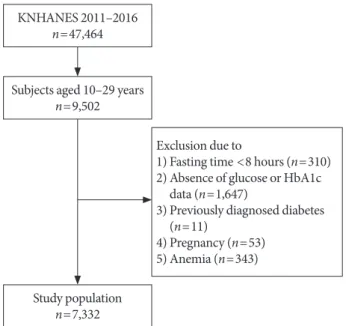
A total of 47,464 individuals were enrolled in the KNHANES from 2011 to 2016. For this study, 9,502 subjects aged 10 to 29 years were considered as potential participants. Among them, 7,332 were included in the study after exclusion of participants who had fasted <8 hours before sample collection (n=310), had no glucose or HbA1c data (n=1,647), were previously di- agnosed with DM (n=11), were pregnant at the time of the sur- vey (n=53), or had anemia with a hemoglobin level <11.5 g/dL in children aged 10 to 11 years, <12 g/dL in children aged 12 to 14 years and females aged ≥15 years, or <13 g/dL for males aged ≥15 years (n=343) (Fig. 1) [25]. Subjects with hemoglo- binopathy were not considered for the present study, because the condition is extremely rare in the Korean population [26].
Among the 7,332 participants in the 2011 to 2016 KNHANES who met the inclusion criteria, 4,129 (45.1%) were in the youth group (10 to 19 years of age) and 3,203 (54.9%) were in the young adult group (20 to 29 years of age).
Subjects were divided into two groups according to age: the youth group (10 to 19 years of age) and the young adult group
KNHANES 2011–2016 n=47,464
Subjects aged 10–29 years n=9,502
Study population n=7,332
Exclusion due to
1) Fasting time <8 hours (n=310) 2) Absence of glucose or HbA1c
data (n=1,647)
3) Previously diagnosed diabetes (n=11)
4) Pregnancy (n=53) 5) Anemia (n=343)
Fig. 1. Flow chart for the selection of study participants.
KNHANES, Korea National Health and Nutrition Examina- tion Survey; HbA1c, glycosylated hemoglobin.
(20 to 29 years of age). In this study, DM by FPG (DMFPG) was defined as an FPG level ≥126 mg/dL, and IFG was defined as an FPG level between 100 and 125 mg/dL. We used the HbA1c cutoff criteria recommended by the ADA and KDA, namely,
≥6.5% for DM by HbA1c (DMA1C) and 5.7% to 6.4% for predi- abetes by HbA1c (PreDMA1C) [7,8].
All subjects participated in the KNHANES voluntarily and provided informed consent. The protocol of the KNHANES was approved by the Institutional Review Board of the Korea Centers for Disease Control and Prevention (IRB No. 2011- 02CON-06-C, 2012-01EXP-01-2C, 2013-07CON-03-4C, 2013- 12EXP-03-5C) [23,24]. The present study was approved by the Institutional Review Board of Seoul National University Bun- dang Hospital (IRB No. X-1703-388-912). All procedures were performed in accordance with the Declaration of Helsinki.
Laboratory tests
Blood samples were drawn after overnight fasting by trained medical personnel. The samples were transported daily to the central laboratory and analyzed within 24 hours. FPG levels were measured by using the hexokinase method with a Hitachi Automatic Analyzer 7600 (Hitachi, Tokyo, Japan). HbA1c levels were measured via high performance liquid chromatography (HLC-723G7; Tosoh, Tokyo, Japan), which is the method certi- fied by the National Glycohemoglobin Standardization Pro- gram [27]. The laboratory tests performed in the KNHANES underwent both internal and external quality controls three times a year. The detailed methods for anthropometric mea- surements and laboratory tests are described elsewhere [24].
Statistical analysis
Statistical analyses were performed by using Stata version 14.2 software (StataCorp LP, College Station, TX, USA). Appropri- ate sample weights were used to adjust for the multi-stage clus- tered probability sample design. Taylor series linearization was used for variance estimation.
Results were expressed as weighted mean±standard error or number (weighted percent). Kappa coefficients were calculated to assess agreement between FPG and HbA1c results for the diagnosis of prediabetes and diabetes [28]. The diagnostic per- formance of HbA1c was evaluated in terms of sensitivity, spec- ificity, positive predictive value (PPV), and negative predictive value at thresholds of 5.7% and 6.5%. Receiver operating char- acteristic (ROC) curves were generated to assess the ability of HbA1c to predict IFG and DMFPG [29]. The equality of area
under the curve (AUC) with a 95% confidence interval (CI) was evaluated. The optimal cutoff values were the points at which the ROC curve was closest to the point at which sensi- tivity and specificity were equal to 1. A P value <0.05 was con- sidered statistically significant.
RESULTS
Characteristics of the study participants
There was no sex difference found between the groups (males 54.6% for the youth group and 55.8% for the young adult group) (Supplementary Table 1). FPG and HbA1c levels were signifi- cantly higher in the youth group than in the young adults group (FPG 90.3±0.2 and 89.1±0.2 mg/dL; HbA1c 5.41%±
0.01% and 5.32%±0.01%, respectively). The values of all vari- ables except for FPG and HbA1c levels were significantly high- er in the young adult group than in the youth group (Supple- mentary Table 1).
Distribution of prediabetes and diabetes by FPG and HbA1c values
In the youth group, HbA1c levels were as follows: 5.7% to 6.4%
in 110 (32.5%) of the participants with IFG; and ≥6.5% in five (72.2%) of the participants with DMFPG (Table 1). In the young adult group, the HbA1c levels were as follows: 5.7% to 6.4% in 54 (27.5%) of the participants with IFG and ≥6.5% in 12 (66.6%) of the participants with DMFPG. The kappa coefficients for agreement between the FPG and HbA1c results were 0.12 in the youth group and 0.19 in the young adult group, which indicated poor agreement [28].
When an HbA1c cutoff of 5.7% was used to detect IFG, the sensitivity and specificity were 35.0% and 83.9% in the youth group and 33.2% and 90.9% in the young adult group, respec- tively (Table 2). When an HbA1c cutoff of 6.5% was used to detect DMFPG, the sensitivity and specificity were 72.2% and 99.9% in the youth group and 66.6% and 99.9% in the young adult group, respectively.
ROC curve analysis of the diagnostic performance of HbA1c
In the ROC curve analysis, the AUC (95% CI) for detecting IFG based on HbA1c level was 0.649 (95% CI, 0.648 to 0.650) for the youth group and 0.700 (95% CI, 0.699 to 0.701) for the young adult group (P<0.001) (Fig. 2A). The optimal HbA1c cutoff point for diagnosing IFG was 5.6% (sensitivity 49.9%,
specificity 73.3%) in the youth group and 5.5% (sensitivity 54.3%, specificity 72.9%) in the young adult group (Table 2).
The AUC (95% CI) for detecting DMFPG based on HbA1c level was 0.996 (95% CI, 0.996 to 0.996) for the youth group and 0.962 (95% CI, 0.962 to 0.963) for the young adult group (P<0.001) (Fig. 2B). The optimal HbA1c cutoff point for diag- nosing DMFPG was 5.9% (sensitivity 100%, specificity 95.8%) in the youth group and 5.8% (sensitivity 87.9%, specificity 94.6%) in the young adult group (Table 2).
DISCUSSION
By using nationally representative survey data, we assessed the diagnostic performance of HbA1c cutoff values recommended for the diagnosis of IFG and DMFPG. Use of an HbA1c cutoff of
≥6.5% for DMFPG resulted in a sensitivity of 72.2% and a speci- ficity of 99.9% in the youth group and a sensitivity of 66.6% and a specificity of 99.9% in the young adult group. However, the HbA1c cutoff of ≥5.7% for IFG had a lower sensitivity and Table 1. Fasting plasma glucose level according to HbA1c category and age group
Age group FPG, mg/dL HbA1c category
Total
<5.7% 5.7%−6.4% ≥6.5%
10–19 yr <100 3,135 (83.9)
(93.6) 658 (16.1)
(85.1) 1 (0.02)
(9.3) 3,794 (100)
(91.9)
100–125 214 (66.9)
(6.4) 110 (32.5)
(14.7) 3 (0.6)
(18.5) 327 (100)
(7.9)
≥126 0 (0)
(0) 3 (27.8)
(0.4) 5 (72.2)
(72.2) 8 (100)
(0.2)
Total 3,349 (82.4)
(100) 771 (17.4)
(100) 9 (0.2)
(100) 4,129 (100)
(100)
20–29 yr <100 2,702 (90.9)
(94.5) 276 (9.1)
(80.8) 0 (0)
(0) 2,978 (100)
(92.6)
100–125 149 (71.5)
(5.5) 54 (27.5)
(18.0) 2 (1.0)
(15.1) 205 (100)
(6.8)
≥126 2 (12.1)
(0.1) 5 (21.3)
(1.2) 12 (66.6)
(84.9) 20 (100)
(0.6)
Total 2,853 (89.1)
(100) 335 (10.4)
(100) 15 (0.5)
(100) 3,203 (100)
(100) Values are presented as number (weighted % of rows) (weighted % of columns). The kappa coefficient was 0.12 for 10 to 19 years and 0.19 for 20 to 29 years.
HbA1c, glycosylated hemoglobin; FPG, fasting plasma glucose.
Table 2. Diagnostic performance of HbA1c according to cutoff values by the present study and ADA/KDA
Criteria Age group No.
(weighted %) HbA1c cutoff, % Sensitivity, % Specificity, % PPV, % NPV, %
FPG ≥100 mg/dL 10−19 yr 335 (8.1) 5.6 (present study) 49.9 73.3 14.2 94.3
5.7 (ADA/KDA) 35.0 83.9 16.1 93.6
20−29 yr 225 (7.4) 5.5 (present study) 54.3 72.9 13.8 95.2
5.7 (ADA/KDA) 33.2 90.9 22.6 94.5
FPG ≥126 mg/dL 10−19 yr 8 (0.2) 5.9 (present study) 100 95.8 5.34 100
6.5 (ADA/KDA) 72.2 99.9 72.2 99.9
20−29 yr 20 (0.6) 5.8 (present study) 87.9 94.6 8.8 99.9
6.5 (ADA/KDA) 66.6 99.9 85.0 99.8
HbA1c, glycosylated hemoglobin; ADA, American Diabetes Association; KDA, Korean Diabetes Association; PPV, positive predictive value;
NPV, negative predictive value; FPG, fasting plasma glucose.
specificity than did the HbA1c cutoff of 6.5% for diabetes in both groups. In the present study, the HbA1c cutoff values that best coincided with the DMFPG were 5.9% in the youth group and 5.8% in the young adult group by using ROC curve analy- sis. The optimal HbA1c cutoff levels for detecting IFG in the youth and young adult groups were 5.6% and 5.5%, respectively.
Collectively, the data presented above support the use of dif- ferent HbA1c thresholds for identifying IFG and DMFPG in pe- diatric and young adult populations. The cutoff values of HbA1c predicting IFG and DMFPG were lower than those rec- ommended by the ADA in the adult population.
In this study population, when HbA1c alone was used as a tool for detecting DMFPG, only three youths (0.07%) and five young adults (0.12%) with DMFPG were misdiagnosed with PreDMA1C. However, for the diagnosis of IFG using HbA1c, 214 youths (5.3%) and 149 young adults (4.9%) with IFG were misclassified as being normoglycemic (Table 1). According to the present study, an HbA1c of 6.5% might play a role in con- firming the diagnosis of diabetes in the pediatric population because of high specificity and PPV (Table 2). This suggests that HbA1c alone might be insufficient to diagnose IFG in youths and young adults.
When applying the HbA1c cutoff value of 5.6% for IFG in the youth group, the misclassification rate decreased to 4.1%
(163 subjects). In the young adult group, applying the HbA1c cutoff of 5.5% to detect IFG decreased misclassification rate to 3.4% (103 subjects). Therefore, in these age groups, lower HbA1c
cutoff might be used to detect subjects at risk for development of diabetes.
After adopting HbA1c as a diagnostic test for DM, valida- tion studies were performed in adult and pediatric populations (Table 3) [16,17,22,30-33]. The cutoff values of HbA1c for de- tecting prediabetes and diabetes were found not to be the same as the values recommended by the ADA.
Table 3. Cutoff values of glycosylated hemoglobin for predia- betes and diabetes
Country Age, yr Degree of
obesity Cutoff value, % Reference
Korea 50±13 NA Prediabetes 5.7
Diabetes 6.1 [30]
China 52.4±13.3 NA Prediabetes 5.6
Diabetes 6.1 [31]
Asia &
Europe NA NA Diabetes 6.1 [32]
USA 13.2±2.8 Obese IGT 5.5
T2DM 5.8 [22]
UK 5–15 NA IFG 5.4 [33]
Korea 9.9±3.0 Overweight
and obese IGT 5.8 [16]
Korea 13.0±2.5 Overweight
and obese Prediabetes 5.8
Diabetes 6.2 [17]
Values are presented as mean±standard deviation or range.
NA, not available; IGT, impaired glucose tolerance; T2DM, type 2 dia- betes mellitus; IFG, impaired fasting glucose.
Fig. 2. Receiver operator characteristic curves for detection of (A) impaired fasting glucose (fasting plasma glucose ≥100 mg/dL) and (B) diabetes mellitus (fasting plasma glucose ≥126 mg/dL) according to glycosylated hemoglobin levels. (A) The area under the curve (AUC) (95% confidence interval [CI]) for impaired fasting glucose was 0.649 (95% CI, 0.648 to 0.650) in the youth group (10 to 19 years of age) and 0.700 (95% CI, 0.699 to 0.701) in the young adult group (20 to 29 years of age) (P<0.001). (B) The AUC (95% CI) for diabetes mellitus was 0.996 (95% CI, 0.996 to 0.996) in the youth group and 0.962 (95% CI, 0.962 to 0.963) in the young adult group (P<0.001).
1
0.75
0.50
0.25
0
1
0.75
0.50
0.25
0
Sensitivity Sensitivity
0 0.25 0.50 0.75 1 0 0.25 0.50 0.75 1
1-Specificity 1-Specificity
5.5%Sensitivity 54.3%
Specificity 72.9% 5.8%
Sensitivity 87.9%
Specificity 94.6%
5.6%Sensitivity 49.9%
Specificity 73.3%
20–29 years 10–19 years Reference
20–29 years 10–19 years Reference
A B
5.9%Sensitivity 100%
Specificity 95.8%
The HbA1c threshold for prediabetes and diabetes might be associated with the HbA1c levels of a certain population. Pop- ulations with higher mean HbA1c levels seemed to show high- er HbA1c cutoff values for prediabetes and diabetes. In the present study, young adults aged 20 to 29 years had lower HbA1c cutoff points for IFG and DMFPG than did youths aged 10 to 19 years. Generally, HbA1c levels increase with age [34].
HbA1c thresholds for prediabetes and diabetes also increase with age [30]. However, several studies have revealed that teen- agers have higher HbA1c levels than adults in their twenties [18,19]. In the general Korean population, mean HbA1c levels were 5.42% for youths aged 10 to 19 years and 5.32% for young adults aged 20 to 29 years [18]. Moreover, Korean youths and young adults showed higher HbA1c levels than did their coun- terparts in the United States (5.37% from Korea versus 4.99%
from the United States) [18,19]. HbA1c cutoff points of predia- betes and diabetes in the United States pediatric population was 5.5% and 5.8%, respectively, which was lower than those in Korean youths [22].
In the adult population aged >30 years, FPG usage, as com- pared with HbA1c usage, has been found to underestimate di- abetes and prediabetes in Korean and Chinese studies [15,35, 36]. However, studies of primarily Caucasians and African Americans in the United States have reported to opposite re- sults [11,21]. Ethnic variations in HbA1c levels might be the reason for these results; e.g., Asians have higher HbA1c levels than African Americans and Caucasians [18,19]. In the pres- ent study, HbA1c alone underestimated IFG and DMFPG in subjects aged <30 years (Table 1). This suggests that additional evaluation by using FPG to detect diabetes and prediabetes might be warranted in those aged <30 years with lower HbA1c values.
Interestingly, cutoff points for prediabetes and diabetes in the present study corresponded to the 75th and 95th percen- tiles for both age groups according to recently published Kore- an reference values for HbA1c (5.6% for the 75th percentile and 5.9% for the 95th percentile in the youth group; 5.5% for the 75th percentile and 5.8% for the 95th percentile in the young adult group) [18]. This implies that an HbA1c value of the 75th percentile among those aged <30 years might be an appropriate cutoff, rather than the uniform value provided by the ADA. An HbA1c of 6.5%, which was the diagnostic criteria for diabetes, far exceeded over the 99th percentile in the Kore- an population aged <30 years.
HbA1c is useful for predicting DM and cardiovascular com-
plications [11]. However, there are discrepancies in the diag- noses of diabetes and prediabetes based on HbA1c versus FPG levels. In the present study, the kappa coefficients indicated poor agreement between HbA1c and FPG results in both groups (0.12 for the youth group and 0.19 for the young adult group). Similar to our findings, others have reported a kappa coefficient of 0.17 for agreement between HbA1c results and 2-hour plasma glucose results of OGTTs for diagnosis of DM in obese children and adolescents [22]. Therefore, HbA1c cri- teria for the diagnosis of prediabetes and diabetes might be dif- ferent in children and adults. Glucose- and HbA1c-based test might be complementary in detecting prediabetes and diabe- tes. Moreover, this approach might help to detect early changes in abnormal glucose metabolism.
In the present study, IFG and DMFPG was defined by FPG levels due to the lack of 2-hour plasma glucose after OGTT.
However, FPG elevation within the normal glycemic range in childhood was found to be a reliable marker for future devel- opment of diabetes in young adulthood [5]. This result sug- gests the importance of FPG levels in the pediatric population.
Several factors may influence the variance of HbA1c levels, including the hemoglobin glycosylation rate and the rate of turnover of red blood cells [37-39]. Although we did not evalu- ate these parameters in this study, we excluded participants with anemia, because iron deficiency has been shown to ele- vate HbA1c levels.
This study had several limitations. First, only a single fasting sample was examined, which might have caused misclassifica- tion bias. Second, OGTT were not performed. Diabetes could be diagnosed based on either FPG or 2-hour plasma glucose.
Moreover, variance in HbA1c is affected by both fasting and postprandial glucose. However, in a large-scale survey such as the KNHANES, OGTT could be difficult to apply. Third, be- cause of the cross-sectional study design, whether a current HbA1c value could predict diabetes and its related complica- tions is unclear. In addition, HbA1c could not indicate acute glucose fluctuation or variation. Fourth, the low number of pa- tients with diabetes in the youth group might have affected the statistical significance (DMFPG 0.23%, DMA1C 0.23% in the youth group; DMFPG 0.58%, DMA1C 0.46% in the young adult group). The strength of the present study is the comparison between the diagnostic performance of HbA1c in youth and young adult groups by using nationally representative data.
In summary, although HbA1c has been recommended as a diagnostic marker for diabetes and prediabetes in adults, its
usefulness in children and adolescents remains unclear owing to the disparity between the results of glucose- and HbA1c- based tests. Lower optimal HbA1c cutoff values for the diag- nosis of IFG and DMFPG were observed in youths and young adults as compared with those recommended for adults. There- fore, a lower HbA1c level for the detection of prediabetes and diabetes, as compared to that recommended by the ADA, might be more appropriately applied to the Korean population aged <30 years. Prospective studies that include OGTTs are needed to clarify the diagnostic role of HbA1c in both diabetes and prediabetes in pediatric and young adult populations.
CONFLICTS OF INTEREST
No potential conflict of interest relevant to this article was re- ported.
REFERENCES
1. Cali AM, Caprio S. Prediabetes and type 2 diabetes in youth:
an emerging epidemic disease? Curr Opin Endocrinol Diabe- tes Obes 2008;15:123-7.
2. Unwin N, Shaw J, Zimmet P, Alberti KG. Impaired glucose tol- erance and impaired fasting glycaemia: the current status on definition and intervention. Diabet Med 2002;19:708-23.
3. Gerstein HC, Santaguida P, Raina P, Morrison KM, Balion C, Hunt D, Yazdi H, Booker L. Annual incidence and relative risk of diabetes in people with various categories of dysglycemia: a systematic overview and meta-analysis of prospective studies.
Diabetes Res Clin Pract 2007;78:305-12.
4. Ek AE, Rossner SM, Hagman E, Marcus C. High prevalence of prediabetes in a Swedish cohort of severely obese children. Pe- diatr Diabetes 2015;16:117-28.
5. Nguyen QM, Srinivasan SR, Xu JH, Chen W, Berenson GS.
Fasting plasma glucose levels within the normoglycemic range in childhood as a predictor of prediabetes and type 2 diabetes in adulthood: the Bogalusa Heart Study. Arch Pediatr Adolesc Med 2010;164:124-8.
6. International Expert Committee. International Expert Com- mittee report on the role of the A1C assay in the diagnosis of diabetes. Diabetes Care 2009;32:1327-34.
7. American Diabetes Association. Standards of medical care in diabetes: 2010. Diabetes Care 2010;33 Suppl 1:S11-61.
8. Ko SH, Kim SR, Kim DJ, Oh SJ, Lee HJ, Shim KH, Woo MH, Kim JY, Kim NH, Kim JT, Kim CH, Kim HJ, Jeong IK, Hong
EK, Cho JH, Mok JO, Yoon KH; Committee of Clinical Prac- tice Guidelines, Korean Diabetes Association. 2011 Clinical practice guidelines for type 2 diabetes in Korea. Diabetes Metab J 2011;35:431-6.
9. Edelman D, Olsen MK, Dudley TK, Harris AC, Oddone EZ.
Utility of hemoglobin A1c in predicting diabetes risk. J Gen In- tern Med 2004;19:1175-80.
10. Pradhan AD, Rifai N, Buring JE, Ridker PM. Hemoglobin A1c predicts diabetes but not cardiovascular disease in nondiabetic women. Am J Med 2007;120:720-7.
11. Selvin E, Steffes MW, Zhu H, Matsushita K, Wagenknecht L, Pankow J, Coresh J, Brancati FL. Glycated hemoglobin, diabe- tes, and cardiovascular risk in nondiabetic adults. N Engl J Med 2010;362:800-11.
12. Bloomgarden ZT. A1C: recommendations, debates, and ques- tions. Diabetes Care 2009;32:e141-7.
13. Cowie CC, Rust KF, Byrd-Holt DD, Gregg EW, Ford ES, Geiss LS, Bainbridge KE, Fradkin JE. Prevalence of diabetes and high risk for diabetes using A1C criteria in the U.S. population in 1988-2006. Diabetes Care 2010;33:562-8.
14. Mann DM, Carson AP, Shimbo D, Fonseca V, Fox CS, Munt- ner P. Impact of A1C screening criterion on the diagnosis of pre-diabetes among U.S. adults. Diabetes Care 2010;33:2190-5.
15. Jeon JY, Ko SH, Kwon HS, Kim NH, Kim JH, Kim CS, Song KH, Won JC, Lim S, Choi SH, Jang MJ, Kim Y, Oh K, Kim DJ, Cha BY; Taskforce Team of Diabetes Fact Sheet of the Korean Diabetes Association. Prevalence of diabetes and prediabetes according to fasting plasma glucose and HbA1c. Diabetes Metab J 2013;37:349-57.
16. Lee HS, Park HK, Hwang JS. HbA1c and glucose intolerance in obese children and adolescents. Diabet Med 2012;29:e102-5.
17. Nam HK, Cho WK, Kim JH, Rhie YJ, Chung S, Lee KH, Suh BK. HbA1c cutoff for prediabetes and diabetes based on oral glucose tolerance test in obese children and adolescents. J Ko- rean Med Sci 2018;33:e93.
18. Seo JY, Hwang SS, Kim JH, Lee YA, Lee SY, Shin CH, Yang SW.
Distribution of glycated haemoglobin and its determinants in Korean youth and young adults: a nationwide population- based study. Sci Rep 2018;8:1962.
19. Saaddine JB, Fagot-Campagna A, Rolka D, Narayan KM, Geiss L, Eberhardt M, Flegal KM. Distribution of HbA(1c) levels for children and young adults in the U.S.: Third National Health and Nutrition Examination Survey. Diabetes Care 2002;25:
1326-30.
20. Shah S, Kublaoui BM, Oden JD, White PC. Screening for type
2 diabetes in obese youth. Pediatrics 2009;124:573-9.
21. Lee JM, Wu EL, Tarini B, Herman WH, Yoon E. Diagnosis of diabetes using hemoglobin A1c: should recommendations in adults be extrapolated to adolescents? J Pediatr 2011;158:947- 52.
22. Nowicka P, Santoro N, Liu H, Lartaud D, Shaw MM, Goldberg R, Guandalini C, Savoye M, Rose P, Caprio S. Utility of hemo- globin A(1c) for diagnosing prediabetes and diabetes in obese children and adolescents. Diabetes Care 2011;34:1306-11.
23. Kweon S, Kim Y, Jang MJ, Kim Y, Kim K, Choi S, Chun C, Khang YH, Oh K. Data resource profile: the Korea National Health and Nutrition Examination Survey (KNHANES). Int J Epidemiol 2014;43:69-77.
24. Ministry of Health and Welfare: The Korea National Health and Nutritional Examination Survey. Available from: https://
knhanes.cdc.go.kr/knhanes/main.do (cited 2018 Oct 23).
25. World Health Organization: Haemoglobin concentrations for the diagnosis of anaemia and assessment of severity 2011 (WHO/NMH/NHD/MNM/11.1). Available from: http://www.
who.int/vmnis/indicators/haemoglobin.pdf (cited 2018 Oct 23).
26. Yang SE, Park CJ, Nah J, Min WK, Chi HS. Hematologic char- acteristics and hemoglobin fraction analysis by high perfor- mance liquid chromatogaphy in patients with hypochromic microcytosis: trials for detection of beta-thalassemia. Korean J Lab Med 2005;25:145-51.
27. The National Glycohemoglobin Standardization Program: List of NGSP certified methods. Available from: http://www.ngsp.
org/docs/methods.pdf (cited 2018 Oct 23).
28. Landis JR, Koch GG. The measurement of observer agreement for categorical data. Biometrics 1977;33:159-74.
29. Akobeng AK. Understanding diagnostic tests 3: receiver oper- ating characteristic curves. Acta Paediatr 2007;96:644-7.
30. Lee H, Oh JY, Sung YA, Kim DJ, Kim SH, Kim SG, Moon S, Park IeB, Rhee EJ, Chung CH, Kim BJ, Ku BJ. Optimal hemo- globin A1C cutoff value for diagnosing type 2 diabetes mellitus in Korean adults. Diabetes Res Clin Pract 2013;99:231-6.
31. Hu Y, Liu W, Chen Y, Zhang M, Wang L, Zhou H, Wu P, Teng X, Dong Y, Zhou Jw, Xu H, Zheng J, Li S, Tao T, Hu Y, Jia Y. Com- bined use of fasting plasma glucose and glycated hemoglobin
A1c in the screening of diabetes and impaired glucose toler- ance. Acta Diabetol 2010;47:231-6.
32. Bennett CM, Guo M, Dharmage SC. HbA(1c) as a screening tool for detection of type 2 diabetes: a systematic review. Diabet Med 2007;24:333-43.
33. Hosking J, Metcalf BS, Jeffery AN, Streeter AJ, Voss LD, Wilkin TJ. Divergence between HbA1c and fasting glucose through childhood: implications for diagnosis of impaired fasting glu- cose (Early Bird 52). Pediatr Diabetes 2014;15:214-9.
34. Pani LN, Korenda L, Meigs JB, Driver C, Chamany S, Fox CS, Sullivan L, D’Agostino RB, Nathan DM. Effect of aging on A1C levels in individuals without diabetes: evidence from the Fram- ingham Offspring Study and the National Health and Nutri- tion Examination Survey 2001-2004. Diabetes Care 2008;31:
1991-6.
35. Kim CH, Kim HK, Bae SJ, Park JY, Lee KU. Discordance be- tween fasting glucose-based and hemoglobin A1c-based diag- nosis of diabetes mellitus in Koreans. Diabetes Res Clin Pract 2011;91:e8-10.
36. Li J, Ma H, Na L, Jiang S, Lv L, Li G, Zhang W, Na G, Li Y, Sun C.
Increased hemoglobin A1c threshold for prediabetes remark- ably improving the agreement between A1c and oral glucose tolerance test criteria in obese population. J Clin Endocrinol Metab 2015;100:1997-2005.
37. Herman WH, Ma Y, Uwaifo G, Haffner S, Kahn SE, Horton ES, Lachin JM, Montez MG, Brenneman T, Barrett-Connor E;
Diabetes Prevention Program Research Group. Differences in A1C by race and ethnicity among patients with impaired glu- cose tolerance in the Diabetes Prevention Program. Diabetes Care 2007;30:2453-7.
38. Ziemer DC, Kolm P, Weintraub WS, Vaccarino V, Rhee MK, Twombly JG, Narayan KM, Koch DD, Phillips LS. Glucose-in- dependent, black-white differences in hemoglobin A1c levels:
a cross-sectional analysis of 2 studies. Ann Intern Med 2010;
152:770-7.
39. Cohen RM, LeCaire TJ, Lindsell CJ, Smith EP, D’Alessio DJ. Re- lationship of prospective GHb to glycated serum proteins in in- cident diabetic retinopathy: implications of the glycation gap for mechanism of risk prediction. Diabetes Care 2008;31:151-3.