https://doi.org/10.4174/astr.2016.91.6.288 Annals of Surgical Treatment and Research
The safety and risk factors of major hepatobiliary pancreatic surgery in patients older than 80 years
Jong Hun Kim, Seog Ki Min, Huisong Lee, Geun Hong, Hyeon Kook Lee
Department of Surgery, Ewha Womans University Mokdong Hospital, Ewha Womans University School of Medicine, Seoul, Korea
INTRODUCTION
The elderly population has increased worldwide. In 2000, the percentage of the population aged 65 years and older in the United States was 12.4%. In 2010, the percentage of the population aged 65 years and older in the United States was 13.0% [1]. In South Korea, the percentage of the population aged 65 years and older was 12.7% in 2014. In 2020, the percentage of the population aged 65 and older in South Korea is projected to exceed 20% [2]. The proportion of the population aged 80 years and over was 2.52% as of January 1, 2015 in South Korea [3].
As the population ages, more octogenarians will be
diagnosed with major hepatobiliary pancreatic (HBP) diseases such as intrahepatic duct or extrahepatic duct stone, cholangitis and benign or malignant tumor, etc. For treatment, major HBP surgery should be performed. However, the risk of postoperative complication increases with advanced age because of the high comorbidity in elderly patients [411]. Therefore, it is difficult to make the decision to perform major HBP surgery in elderly patients.
On the other hand, recent reports have found acceptable morbidity and mortality in specific HBP surgeries with patients older than 80 years [4,1216]. In these recent reports, the type of surgery was limited to a specific major surgery such Purpose: Recently, the number of elderly patients has increased due to a longer life expectancy. Among these elderly patients, more octogenarians will be diagnosed with major hepatobiliary pancreatic (HBP) diseases. Therefore, we need to evaluate the safety and risk factors of major HBP surgery in patients older than 80 years.
Methods: From January 2000 to April 2015, patients who underwent major HBP surgery were identified. The patients were divided into 2 groups according to their age at the time of surgery: Group O (≥80 years) and group Y (<80 years). The patient characteristics and intra- and postoperative outcomes were retrospectively investigated in the 2 groups.
Results: The median age was 84 years (range, 80–95 years) in group O and 61 years (range, 27–79 years) in group Y.
group O had worse American Society of Anesthesiologists (ASA) physical status (ASA ≥ III: 23% vs. 7%, P = 0.002) and was associated with a higher rate of hypertension and heart problems as comorbidities. There were significant differences in albumin and BUN, favoring group Y. The length of intensive care unit stay was longer in group O, whereas the overall complication and mortality rates did not show statistical difference. But, there was a significant difference in systemic complication of both Clavien-Dindo classification grade ≥II and ≥III as complications were divided into surgical site complication and systemic complication.
Conclusion: Major HBP surgery can be performed safely in patients older than 80 years if postoperative management is appropriately provided.
[Ann Surg Treat Res 2016;91(6):288-294]
Key Words: Aged, Safety, Postoperative complications, Mortality
Reviewed January February March April May June July August September October November December
Received June 20, 2016, Revised July 19, 2016, Accepted August 3, 2016 Corresponding Author: Seog Ki Min
Department of Surgery, Ewha Womans University Mokdong Hospital, Ewha Womans University School of Medicine, 1071 Anyangcheon-ro, Yangcheon-gu, Seoul 07985, Korea
Tel: +82-2-2650-5599, Fax: +82-2-2644-7984 E-mail: [email protected]
Copyright ⓒ 2016, the Korean Surgical Society
cc Annals of Surgical Treatment and Research is an Open Access Journal. All articles are distributed under the terms of the Creative Commons Attribution Non- Commercial License (http://creativecommons.org/licenses/by-nc/4.0/) which permits unrestricted non-commercial use, distribution, and reproduction in any medium, provided the original work is properly cited.
as pancreaticoduodenectomy and/or distal pancreatectomy.
Therefore, we included various types of major HBP surgery in our study.
The hypothesis of this study is that major HBP surgery can also be performed safely in patients older than 80 years. Thus, we conducted this study to evaluate the safety and risk factors of major HBP surgery in patients older than 80 years.
METHODS
From January 2000 to April 2015, the patients who underwent major HBP surgery were identified in Ewha Womans University Mokdong Hospital. We found a variety of major HBP surgeries. As a concept of major HBP surgery, we included laparoscopic common bile duct exploration with cholecystectomy, or laparoscopic common bile duct exploration, or open common bile duct exploration, distal pancreatectomy, subtotal pancreatectomy and extended cholecystectomy as well as pancreaticoduodenectomy (PD), hepatic segmentectomy, hemihepatectomy or greater, extrahepatic bile duct resection with hepaticojejucostomy or choledochojejunostomy and hepatopancreaticoduodenectomy [17]. We excluded minor HBP surgeries such as laparoscopic cholecystectomy, open cholecystectomy, internal drainage of pancreatic pseudocyst and fenestration of hepatic cyst as well as liver transplantation, traumarelated surgery and pediatric surgery.
We analyzed 100 patients who underwent major HBP surgery in patients older than 80 years at the time of surgery. These 100 patients were classified into three types according to the performed operation: lowercase hepatectomy included hepatic segmentectomy or hemihepatectomy or greater (10 patients);
lowercase pancreatectomy included pyloruspreserving pancreatoduodenectomy or Whipple operation or a distal pancreatectomy or subtotal pancreatectomy (18 patients); lower
case other major operation included laparoscopic common bile duct exploration with cholecystectomy or laparoscopic common bile duct exploration or open common bile duct exploration or hepaticojejucostomy or choledochojejunostomy or extended cholecystectomy (72 patients). A total of 100 patients aged
≥80 years (group O) were matched with 100 patients aged
<80 years (group Y) who were randomly selected as a control group for comparison. The number of patient group of each type of surgery was the same with the number of randomly selected control group of each type of surgery. Then, the patient characteristics and intra and postoperative outcomes were retrospectively investigated in the 2 groups.
Patient characteristics included age, sex, American Society of Anesthesiologists (ASA) physical status, disease malignancy, performed operation type, comorbidities, preoperative laboratory findings, and previous laparotomy history.
Comorbidities included diabetes mellitus (DM), hypertension,
obstructive lung disease (OLD), heart problem, chronic kidney disease (CKD), cerebrovascular accident (CVA) history, sepsis at the time of surgery, and previous cancer history. OLD included chronic obstructive pulmonary disease, asthma, and pulmonary emphysema. Heart problem included coronary artery disease, congestive heart failure, atrial fibrillation, aortic stenosis, unstable angina, myocardial infarction, severe heart wall hypokinesia, and sick sinus syndrome. Prostate cancer, thyroid cancer, and skin cancer except for melanoma were not included in the category of previous cancer history. Open or laparoscopic appendectomy was not included in the category of previous laparotomy history, but gynecological surgeries such as cesarean section, uterine myomectomy, and total hysterectomy were included.
Intraoperative (IO) outcomes included operation time, portal vein or superior mesenteric vein (SMV) resection, IO organ injury, IO packed red blood cells (pRBC) transfused, and estimated blood loss (EBL).
The primary endpoint of the study was overall complication and mortality rates. The second endpoint was the postoperative recovery course such as length of postoperative stay, length of intensive care unit (ICU) stay, postoperative diet starting day, and severity of complication.
Postoperative outcomes included length of postoperative stay, length of ICU stay, postoperative diet starting day, mortality, and overall complication. Severity of complication was classified by ClavienDindo grade [18]. ClavienDindo grade II or more was considered significant. Complications were also investigated by dividing them into surgical site complication and systemic complication. Postoperative complications were investigated for 30 days after surgery. Mortality was defined as death within 90 days of surgery.
Categorical variables are presented as number (percentage).
Continuous variables are presented as median (range).
Differences between groups were evaluated by univariate analyses using the chisquare and independent samples ttest for categorical and continuous variables, respectively. All statistical significances were determined at P < 0.05.
RESULTS
Patient characteristics and comorbidities
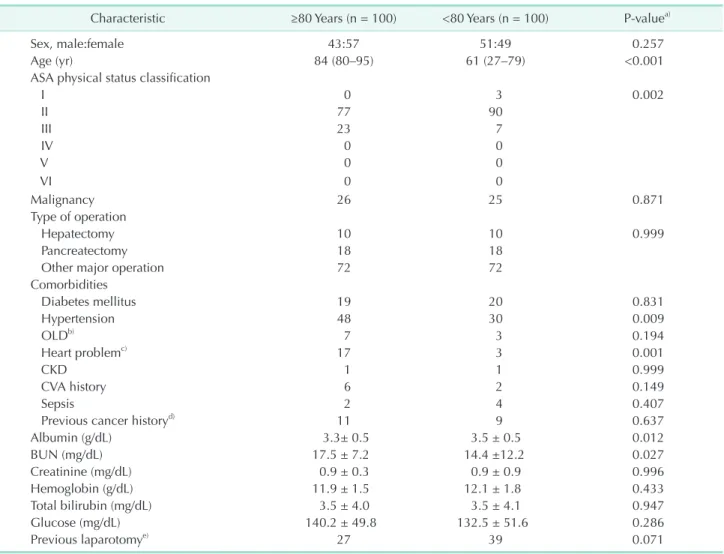
The median age was 84 years (range, 80–95 years) in group O and 61 years (range, 27–79 years) in group Y. There was no difference in terms of gender composition and disease malignancy. However, ASA physical status was worse in group O (ASA ≥ III: 23% vs. 7%, P = 0.002).
Patient comorbidities were compared between the 2 groups at the time of surgery. There were no significant differences between the groups in terms of DM, OLD, CKD, CVA history, sepsis at the time of surgery and previous cancer history.
However, group O was associated with a higher rate of hypertension (48% vs. 30%, P = 0.009) and heart problem (17%
vs. 3%, P = 0.001).
Preoperative laboratory findings were compared between the 2 groups. There were no significant differences in terms of creatinine levels, hemoglobin levels, total bilirubin, and glucose levels. However, there were significant differences in terms of albumin (3.3 ± 0.5 vs. 3.5 ± 0.5, P = 0.012) and BUN (17.5 ± 7.2 vs. 14.4 ± 12.2, P = 0.027), favoring the younger group (Table 1).
IO outcomes
There were no differences in operation time, rate of portal vein resection or SMV resection, IO organ injury, IO pRBC
transfused, and EBL (Table 2).
Postoperative outcomes
There were no differences in terms of length of postoperative stay, postoperative diet starting day, and mortality rate (lower
case length of postoperative stay: 15.8 ± 11.5 days vs. 14.8 ± 11.0 days, P = 0.527; postoperative diet starting day: 5.0 ± 4.9 days vs. 4.4 ± 2.6 days, P = 0.366). Ninetyday mortality was the same, as the number of dead patients was three in both groups (P = 0.999). However, the length of ICU stay was longer in group O (2.9 ± 5.2 days vs. 1.6 ± 2.1 days, P = 0.019) (Table 3).
There was no significant difference in overall complication rate by Clavien-Dindo grade ≥ II (28% vs. 17%, P = 0.063) as
Table 1. Baseline characteristics of study patients
Characteristic ≥80 Years (n = 100) <80 Years (n = 100) Pvaluea)
Sex, male:female 43:57 51:49 0.257
Age (yr) 84 (80–95) 61 (27–79) <0.001
ASA physical status classification
I 0 3 0.002
II 77 90
III 23 7
IV 0 0
V 0 0
VI 0 0
Malignancy 26 25 0.871
Type of operation
Hepatectomy 10 10 0.999
Pancreatectomy 18 18
Other major operation 72 72
Comorbidities
Diabetes mellitus 19 20 0.831
Hypertension 48 30 0.009
OLDb) 7 3 0.194
Heart problemc) 17 3 0.001
CKD 1 1 0.999
CVA history 6 2 0.149
Sepsis 2 4 0.407
Previous cancer historyd) 11 9 0.637
Albumin (g/dL) 3.3± 0.5 3.5 ± 0.5 0.012
BUN (mg/dL) 17.5 ± 7.2 14.4 ±12.2 0.027
Creatinine (mg/dL) 0.9 ± 0.3 0.9 ± 0.9 0.996
Hemoglobin (g/dL) 11.9 ± 1.5 12.1 ± 1.8 0.433
Total bilirubin (mg/dL) 3.5 ± 4.0 3.5 ± 4.1 0.947
Glucose (mg/dL) 140.2 ± 49.8 132.5 ± 51.6 0.286
Previous laparotomye) 27 39 0.071
Values are presented as number, median (range), or mean±standard deviation.
ASA, American Society of Anesthesiologists; OLD, obstructive lung disease; CKD, chronic kidney disease; CVA, cerebrovascular accident.
a)Fisher exact test or chisquare test for discrete variable and MannWhitney Utest for continuous variable. b)OLD included a chronic obstructive lung disease, asthma and pulmonary emphysema. c)Heart problem included a coronary artery disease, congestive heart failure, atrial fibrillation, aortic stenosis, unstable angina, myocardial infarction, severe heart wall hypokinesia and sick sinus syndrome. d)Prostate cancer, thyroid cancer and skin cancer except for melanoma were not included in the category of previous cancer history. e)Open or laparoscopic appendectomy was not included in the category of previous laparotomy history, but gynecological surgeries such as cesarean section, uterine myomectomy and total hysterectomy were included.
well as Clavien-Dindo grade ≥ III (19% vs. 12%, P = 0.171).
Although the difference in overall complication rate was not statistically significant, the overall complication rate by Clavien
Dindo grade ≥ II and Clavien-Dindo grade ≥ III showed high tendency in group O.
As the complication was divided into surgical site complication and systemic complication, systemic complication rates of both Clavien-Dindo grade ≥ II and grade ≥ III was higher in group O (Clavien-Dindo grade ≥ II: 19% vs. 7%, P = 0.012; Clavien
Dindo grade ≥ III: 12% vs. 3%, P = 0.016) while surgical site complication rates showed no difference between the 2 groups.
Three patients in group O died: the first case was due to acute respiratory distress syndrome, the second case was due to hospital acquired pneumonia and acute renal failure, and the third case was due to septic shock. Also, 3 patients in group Y died: the first case was due to intraabdominal surgical site bleeding, the second case was due to septic shock, and the third case was due to atrial fibrillation (Table 4).
DISCUSSION
In this study, there was a significant difference in terms of ASA physical status, the worse being in group O. Furthermore, group O was associated with a higher rate of hypertension and heart problem as comorbidities. For preoperative laboratory findings, there were significant differences in terms of albumin and BUN, favoring group Y. There were no differences in the IO outcomes such as operation time, rate of portal vein or SMV resection, IO organ injury, IO pRBC transfused, and EBL. For postoperative outcomes, the length of ICU stay was longer in group O, whereas overall complication and mortality rates did not show statistical difference. However, when the complications were divided into surgical site complication and systemic complication, there was a significant difference in the rate of systemic complication of both Clavien-Dindo grade ≥ II and grade ≥ III.
The elderly population has increased worldwide. With this increase, surgeons are increasingly faced with the prospect of performing major HBP surgery in patients older than 80 years.
In this study, we attempted to determine the safety and risk Table 2. Intraoperative outcomes
Outcome ≥80 Years (n = 100) <80 Years (n = 100) Pvaluea)
Operation time (min) 258 ± 128.6 285.7 ± 138.8 0.157
PV or SMV resection 0 4 0.121
IO organ injury 0 0 0.999
IO pRBC transfused (unit) 0.3 ± 0.9 0.5 ± 1.6 0.467
Estimated blood loss (mL) 275.1 ± 285.0 427.4 ± 912.9 0.114
Values are presented as mean ± standard deviation or number.
PV, portal vein; SMV, superior mesenteric vein; IO, intraoperative; pRBC, packed red blood cells.
a)Fisher exact test or chisquare test for discrete variable and MannWhitney Utest for continuous variable.
Table 3. Postoperative outcomes and complication
Outcome ≥80 Years (n = 100) <80 Years (n = 100) Pvaluea)
Length of postoperative stay (POD) 15.8 ± 11.5 14.8 ± 11.0 0.527
Length of ICU stay (day) 2.9 ± 5.2 1.6 ± 2.1 0.019
Diet start (POD) 5.0 ± 4.9 4.4 ± 2.6 0.366
Mortality 3 3 0.999
Complication
CD grade ≥ IIb) 28 17 0.063
Surgical site complication 13 11 0.663
Systemic complication 19 7 0.012
CD grade ≥ IIIc) 19 12 0.171
Surgical site complication 11 10 0.818
Systemic complication 12 3 0.016
Values are presented as mean ± standard deviation or number.
POD, postoperative day; ICU, Intensive care unit; CD grade, ClavienDindo classification grade.
a)Fisher exact test or chisquare test for discrete variable and MannWhitney Utest for continuous variable. b)CD grade ≥ II means grade II, III, IV, and V. c)CD grade ≥ III means grade III, IV, and V.
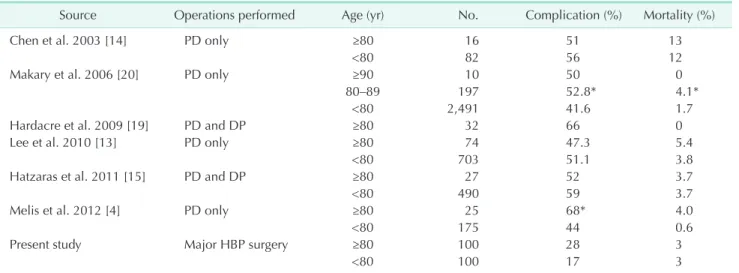
factors of major HBP surgery and demonstrate herein that major HBP surgery can be performed safely in patients older than 80 years. We used the age of 80 years as a cutoff in our study to allow comparisons with other studies and have found acceptable outcomes in morbidity and mortality after major HBP surgery in patients older than 80 years [4,1216,19]. As summarized in Table 5, rates of postoperative mortality and overall complication rates in patients over the age of 80 years appeared similar to younger patients [1315,19]. Contrary to the results of our study, the study by Makary et al. [20] showed significantly higher overall complication as well as mortality rate in the older group (52.8% vs. 41.6% and 4.1% vs. 1.7%, respectively, both P < 0.05). In the study by Melis et al. [4], the overall complication was higher in octogenarians than younger patients (68% vs. 44%, P = 0.03), whereas mortality did not show statistical difference (P = 0.23).
In our study, there were no significant differences in overall complication and postoperative mortality rates. Dividing the complications into surgical site complication and systemic complication, there was also no significant difference in terms of surgical site complication of both Clavien-Dindo grade ≥ II and grade ≥ III. However, systemic complication of both Clavien-Dindo grade ≥ II and grade ≥ III showed significant difference in the 2 groups (Clavien-Dindo grade ≥ II: 19% vs.
7%, P = 0.012; Clavien-Dindo grade ≥ III: 12% vs. 3%, P = 0.016).
In other words, systemic complication was higher in group O. The reason that systemic complication was higher in the old age group seems to be that physical tolerance that fights against surgical trauma becomes weaker due to aging. Also, the result may be associated with the longer stay in ICU. However, there was no significant difference in the length of hospital stay after the operation; the reason for this result may be that recent medical improvements made it possible for systemic complications to be overcome with postoperative care. This is also shown by the same mortality rate in the 2 groups.
In the future, it seems necessary to actively perform preoperative physical examination, carefully select the cases, and cautiously administer premedication to reduce the rate of complication in elderly patients, especially in that of systemic complication. Also, even if systemic complication occurs, postoperative management should be appropriately provided.
Furthermore, we need to actively use the National Surgical Quality Improvement Program (NSQIP) in order to reduce overall complication and mortality rate [2125]. Lowercase, careful preoperative selection and appropriate postoperative management can be possible if based on the predictive value of NSQIP, which will eventually lead to reduction in overall complication as well as mortality rate.
Performance status is a good preoperative assessment tool for determining surgical risk in elderly patients [26]. Therefore, the limitation of our study is that preoperative Eastern Cooperative Table 4. Comparison of mortality cases between the 2 groups CaseAge/sex
Type of oper
ationComorbidityPreoperative historyICU stay (day)Complication ≥80 Years Case 180/femaleLCBDE
Hypertension RA
No14ARDS, pneumonia, atrial fibrillation Case 284/malePPPD
Hypertension CNo8Ventricular tachycardia, hospital acquired pneumonia, ARF, VA pulmonary edema ent, hemic evAKI due to isck due to biliary sepsis, Septic shoc36Stereotactic aspiration of ICHaumatic Previous trCBDE81/male Case 3 ICH intraabdominal fluid collection, splenic infarction, CBD stricture <80 Years Case 163/femaleCBDE
DM Biliary sepsis
Partial hepatectomy d/t IHD stone 3Intraabdominal surgical site bleeding Case 269/femalePPPD
Hypertension RA
No6Surgical site bleeding, septic shock, renal failure, pulmonary edema, wound infectioncandida albicans, VRE Case 356/malePPPD
Hypertension RCC Hypoth
yroidism
No11Atrial fibrillation ICU, intensive care unit; LCBDE, laparoscopic common bile duct exploration; RA, rheumatoid arthritis; ARDS, acute respiratory distress syndrome; PPPD, pyloruspreserving pancreatoduodenectomy; CVA, cerebrovascular accident; ARF, acute renal failure; CBDE, common bile duct exploration; ICH, intracranial hemorrhage; AKI, acute kidney insufficiency; CBD, common bile duct; DM, diabetes mellitus; IHD, intrahepatic duct; VRE, vancomycin resistant enterococcus; RCC, renal cell carcinoma.
Oncology Group (ECOG) scale performance status was not used to evaluate the difference between the 2 groups, since there was no data in the patient records. Instead, we used ASA physical status, which is as standard as ECOG score, to evaluate the performance status in this study. Also, the main limitations of our study are its retrospective nature and selection bias.
In conclusion, major HBP surgery can be performed safely in
patients older than 80 years if postoperative management is appropriately provided.
CONFLICTS OF INTEREST
No potential conflict of interest relevant to this article was reported.
Table 5. Literature review
Source Operations performed Age (yr) No. Complication (%) Mortality (%)
Chen et al. 2003 [14] PD only ≥80 16 51 13
<80 82 56 12
Makary et al. 2006 [20] PD only ≥90 10 50 0
80–89 197 52.8* 4.1*
<80 2,491 41.6 1.7
Hardacre et al. 2009 [19] PD and DP ≥80 32 66 0
Lee et al. 2010 [13] PD only ≥80 74 47.3 5.4
<80 703 51.1 3.8
Hatzaras et al. 2011 [15] PD and DP ≥80 27 52 3.7
<80 490 59 3.7
Melis et al. 2012 [4] PD only ≥80 25 68* 4.0
<80 175 44 0.6
Present study Major HBP surgery ≥80 100 28 3
<80 100 17 3
PD, pancreaticoduodenectomy; DP, distal pancreatectomy; HBP, hepatobiliary pancreatic.
*P < 0.05 compared with patients < 80 years.
1. U.S. Census Bureau [Internet]. Washington, DC: U.S. Census Bureau; 2016 [cited 2016 May 3]. Available from: http://factfinder.
census.gov.
2. Age and sex [Internet]. Washington, DC:
U.S. Census Bureau; 2016 [cited 2008 Dec 2]. Available from: http://www.census.gov/
population/age/.
3. Korea Statistical Information Services [Internet]. Daejeon: Statistics Korea; 2016 [cited 2016 May 3]. Available from: http://
kosis.kr/.
4. Melis M, Marcon F, Masi A, Pinna A, Sarpel U, Miller G, et al. The safety of a pancreaticoduodenectomy in patients older than 80 years: risk vs. benefits. HPB (Oxford) 2012;14:5838.
5. Oguro S, Shimada K, Kishi Y, Nara S, Esaki M, Kosuge T. Perioperative and longterm
outcomes after pancreaticoduodenectomy in elderly patients 80 years of age and older. Langenbecks Arch Surg 2013;398:531
8.
6. Kow AW, Sadayan NA, Ernest A, Wang B, Chan CY, Ho CK, et al. Is pancreati co
duodenectomy justified in elderly pa
tients? Surgeon 2012;10:12836.
7. Adam R, Frilling A, Elias D, Laurent C, Ramos E, Capussotti L, et al. Liver resec
tion of colorectal metastases in elderly patients. Br J Surg 2010;97:36676.
8. Nagano Y, Nojiri K, Matsuo K, Tanaka K, Togo S, Ike H, et al. The impact of ad vanced age on hepatic resection of colorec tal liver metastases. J Am Coll Surg 2005;201:5116.
9. Shin JW, Ahn KS, Kim YH, Kang KJ, Lim TJ. The impact of old age on surgical out
comes after pancreaticoduodenectomy for distal bile duct cancer. Korean J Hepa
tobiliary Pancreat Surg 2011;15:24853.
10. Yeh CC, Jeng YM, Ho CM, Hu RH, Chang HP, Tien YW. Survival after pancreatic
oduodenectomy for ampullary cancer is not affected by age. World J Surg 2010;34:
294552.
11. Bathe OF, Caldera H, Hamilton KL, Franceschi D, Sleeman D, Livingstone AS, et al. Diminished benefit from resection of cancer of the head of the pancreas in patients of advanced age. J Surg Oncol 2001;77:11522.
12. Tani M, Kawai M, Hirono S, Ina S, Miyazawa M, Nishioka R, et al. A pan
crea ticoduodenectomy is acceptable for pe ri ampullary tumors in the elderly, even in patients over 80 years of age. J Hepa
REFERENCES
tobiliary Pancreat Surg 2009;16:67580.
13. Lee MK, Dinorcia J, Reavey PL, Holden MM, Genkinger JM, Lee JA, et al. Pan
creaticoduodenectomy can be performed safely in patients aged 80 years and older.
J Gastrointest Surg 2010;14:183846.
14. Chen JW, Shyr YM, Su CH, Wu CW, Lui WY. Is pancreaticoduodenectomy justified for septuagenarians and octogenarians?
Hepatogastroenterology 2003;50:16614.
15. Hatzaras I, Schmidt C, Klemanski D, Muscarella P, Melvin WS, Ellison EC, et al.
Pancreatic resection in the octogenarian:
a safe option for pancreatic malignancy. J Am Coll Surg 2011;212:3737.
16. Hentati H, Arfa N, Haouas N, Landolsi S, Gharbi W, Miloudi N, et al. Pancreaticoduo
denectomy in the elderly over 80 years: a case report. Hepatobiliary Pancreat Dis Int 2007;6:1047.
17. Hayashi H, Morikawa T, Yoshida H, Motoi F, Okada T, Nakagawa K, et al. Safety of postoperative thromboprophylaxis after major hepatobiliarypancreatic surgery
in Japanese patients. Surg Today 2014;44:
16608.
18. Dindo D, Demartines N, Clavien PA.
Classi fication of surgical complications: a new proposal with evaluation in a cohort of 6336 patients and results of a survey.
Ann Surg 2004;240:20513.
19. Hardacre JM, Simo K, McGee MF, Stellato TA, Schulak JA. Pancreatic resection in octogenarians. J Surg Res 2009;156:12932.
20. Makary MA, Winter JM, Cameron JL, Campbell KA, Chang D, Cunningham SC, et al. Pancreaticoduodenectomy in the very elderly. J Gastrointest Surg 2006;10:
34756.
21. Cohen ME, Liu Y, Ko CY, Hall BL. Improved surgical outcomes for ACS NSQIP hospitals over time: evaluation of hospital cohorts with up to 8 years of participation. Ann Surg 2016;263:26773.
22. Ortega G, Rhee DS, Papandria DJ, Yang J, Ibrahim AM, Shore AD, et al. An evalua
tion of surgical site infections by wound classi fication system using the ACS
NSQIP. J Surg Res 2012;174:338.
23. Lucas DJ, Pawlik TM. Quality improvement in gastrointestinal surgical oncology with American College of Surgeons National Surgical Quality Improvement Program.
Surgery 2014;155:593601.
24. Hall BL, Hamilton BH, Richards K, Bilimoria KY, Cohen ME, Ko CY. Does surgical quality improve in the American College of Surgeons National Surgical Quality Improvement Program: an evalua
tion of all participating hospitals. Ann Surg 2009;250:36376.
25. Rowell KS, Turrentine FE, Hutter MM, Khuri SF, Henderson WG. Use of national surgical quality improvement program data as a catalyst for quality improvement.
J Am Coll Surg 2007;204:1293300.
26. Covinsky KE, Martin GE, Beyth RJ, Justice AC, Sehgal AR, Landefeld CS. The rela tion
ship between clinical assessments of nu
tri tional status and adverse outcomes in older hospitalized medical patients. J Am Geriatr Soc 1999;47:5328.