INTRODUCTION
Disasters result in physical and psychosocial injuries and symptoms. A disaster management system focused primar- ily on medical needs was developed in the United States fol- lowing the 9/11 terror attacks and Hurricane Katrina.1) Di- sasters in particular lead to chronic mental health problems and have a profound impact on physical and mental health, ranging from mild injury to death.2) In addition, disasters ex- perienced by psychologically vulnerable children and adoles- cents lead to destructive behaviors and externalizing, which may result in numerous psychological, emotional, and behav- ioral disorders.3,4) Therefore, mental health professionals should conduct appropriate mental health assessments in children and adolescents exposed to disasters. These assess- ments should be followed by effective high-risk interventions.
In the event of a disaster, rapid and efficient mental health
assessments are needed to address emergencies. Effective di- saster management is one of the main concerns of the World Health Organization (WHO)5) in its efforts to reduce and pre- vent post-traumatic stress disorder (PTSD). Nevertheless, re- search into the psychological responses of children and ado- lescents to disasters is still in the early stages.4)
The National Child Traumatic Stress Network (NCTSN) in the United States recommends the assessment of two criti- cal elements when screening traumatized children: 1) expo- sure to potentially traumatic events/experiences, including traumatic loss, and 2) traumatic stress symptoms/reactions.
Trauma screening is used to assess a wide range of experienc- es and to identify common reactions and symptoms of trau- ma (PTSD or dissociation) and other commonly reported difficulties (anger, behavior problems, depression, and anxi- ety).6) Nevertheless, studies have shown the inadequacy of standard guidelines and reliable measures used to assess the mental health of children and adolescents after a disaster.7) Clinicians who conduct mental health assessments face many obstacles, as disaster environments are unpredictable and
This is an Open Access article distributed under the terms of the Creative Commons Attribution Non-Commercial License (http://creativecommons.org/licenses/by-nc/4.0) which permits unrestricted non-commercial use, distribution, and reproduction in any medium, provided the original work is properly cited.
Assessment Tools for the Mental Health of School-Aged Children and Adolescents Exposed to Disaster:
A Systematic Review (1988–2015)
Mi-Sun Lee1 and Soo-Young Bhang2
1Department of Psychiatry, Eulji University Hospital, Seoul, Korea
2Department of Psychiatry, Eulji University School of Medicine, Eulji University Hospital, Seoul, Korea
Objectives: In this study, we aimed to conduct a systematic review of studies investigating psychosocial factors affecting children ex- posed to disasters.
Methods: In total, 140 studies were retrieved. The studies were published from 1988 to 2015. A systematic review was performed us- ing the PRISMA guidelines. MEDLINE, EMBASE, Cochrane Central, Web of Science, PsycINFO, PubMed, and Google Scholar were searched. Each database was searched using the following terms: ‘Child,’ ‘Adolescent,’ ‘Youth,’ ‘Disaster,’ ‘Posttraumatic,’ ‘Psychosocial,’
‘Assessment,’ ‘Evaluation,’ and ‘Screening.’ The identified studies were subjected to data extraction and appraisal.
Results: The database search identified 713 articles. Based on the titles and abstracts, the full texts of 118 articles were obtained. The findings of this review can be used as a basis for the design of a psychosocial evaluation tool for disaster preparedness.
Conclusion: Given the paramount importance of post-disaster evaluation and the weaknesses of current disaster evaluation tools, the need to develop valid and reliable tools and psychometric evaluations cannot be overstated. Our findings provide current evidence supporting various assessments in children, who are very vulnerable psychologically following disasters.
Key Words: Disaster; Mental health tool; Assessment; Children; Systematic review.
Received: January 12, 2018 / Revision: April 3, 2018 / Accepted: April 24, 2018
Address for correspondence: Soo-Young Bhang, Department of Psychiatry, Eulji University School of Medicine, Eulji University Hospital, 68 Hangeulbis- eok-ro, Nowon-gu, Seoul 01830, Korea
Tel: +82-2-970-8303, Fax: +82-2-970-8429, E-mail: [email protected] J Korean Acad Child Adolesc Psychiatry 2018;29(3):88-100 https://doi.org/10.5765/jkacap.180002
confusing in practice. Additionally, the post-disaster situation and diversity of research subjects complicate the selection of assessment tools.8) Therefore, a comprehensive approach is needed.
We systematically reviewed the literature and here propose an appropriate set of directions for mental health evaluation in an emergency. The goal of this study was to provide meth- odological consistency and to perform a systematic litera- ture review of mental health assessment tools for children and adolescents. The systematic literature review highlight- ed the need for a fair degree of accuracy and the development of standardized measures. Systematic reviews of research studies investigating mental health assessment following disasters represent major sources of psychological support for individuals and the society.3) We sought to conduct an analysis of the standardized scales in order to develop evalu- ation resources for use in future large-scale disasters.
METhODs
We conducted a comprehensive search of online databas- es (Google Scholar, MEDLINE, Web of Science, ProQuest, Science Direct, Ovid, Scopus, Cochrane, and CINAHL) un- til 2015. We analyzed studies of disasters from 1988 to 2015 and reviewed research assessing the mental health of chil- dren and adolescents after disasters. We selected studies in English that included assessments related to disasters. We also selected reports of human medical research data. The Medical Subject Headings (MeSH) used in the search in- cluded the keywords ‘Child,’ ‘Adolescent,’ ‘Youth,’ ‘Disaster,’
‘Posttraumatic,’ ‘Psychosocial,’ ‘Assessment,’ ‘Evaluation,’
and ‘Screening.’
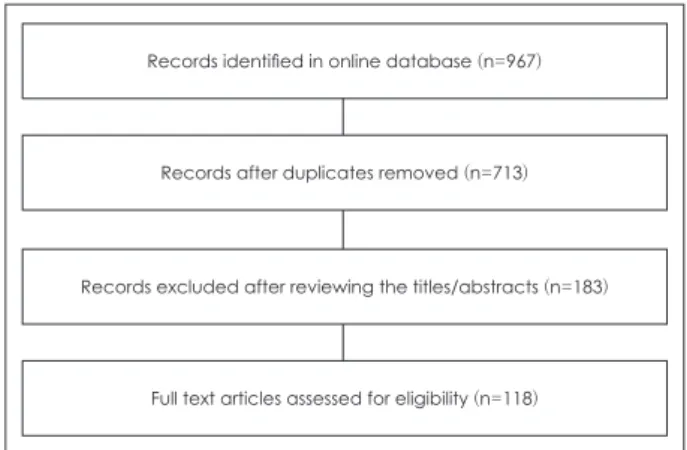
After removal of duplicate articles, we selected 713 stud- ies. Following a review of the titles and abstracts of the pa- pers, 530 documents were excluded. We reviewed the entire contents of approximately 183 full articles and included stud-
ies based on the agreement of both authors. Finally, 118 pa- pers were included in the final review (Fig. 1).
The systematic literature review was conducted according to the Preferred Reporting Items for Systematic reviews and Meta-Analyses (PRISMA) guideline. PRISMA is an evidence- based minimum set of items for reporting systematic reviews, and is used as the basis for appraisal of published systematic reviews of different types of research.9) In this study, we used the PRISMA flow diagram, which depicts the flow of infor- mation through the different phases of a systematic review.
This information include the numbers of articles identified, included, and excluded, and the reasons for exclusion.
REsULTs
A systematic review was conducted by searching mental health and medical databases. The results of the review are presented below.
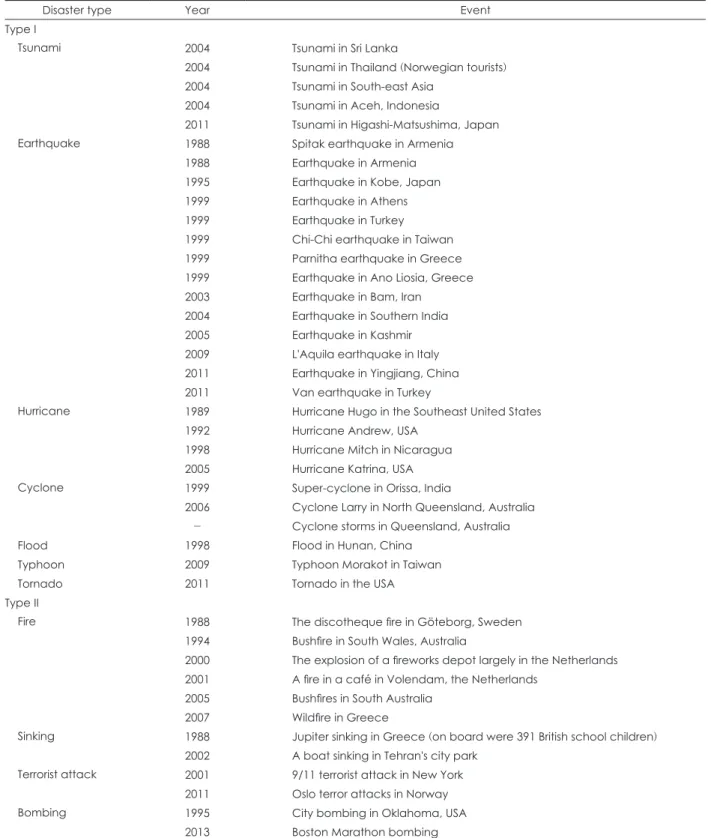
In this study, we divided articles into Type I and Type II cat- egories based on a previous study.10) The articles in each cat- egory are presented in Table 1. Type I articles included those discussing natural disasters such as earthquakes, tsunamis, hurricanes, cyclones, floods, typhoons, and tornadoes. Type II articles discussed man-made disasters such as fires, sink- ings, terrorist attacks, and explosions.
A total of 118 studies assessed the symptoms of PTSD, anxi- ety, depression, behavior, coping, and daily life in children and adolescents exposed to disaster. Thirty-one scales were used to assess the symptoms associated with PTSD, and 10 or more of the various scales assessed the following domains:
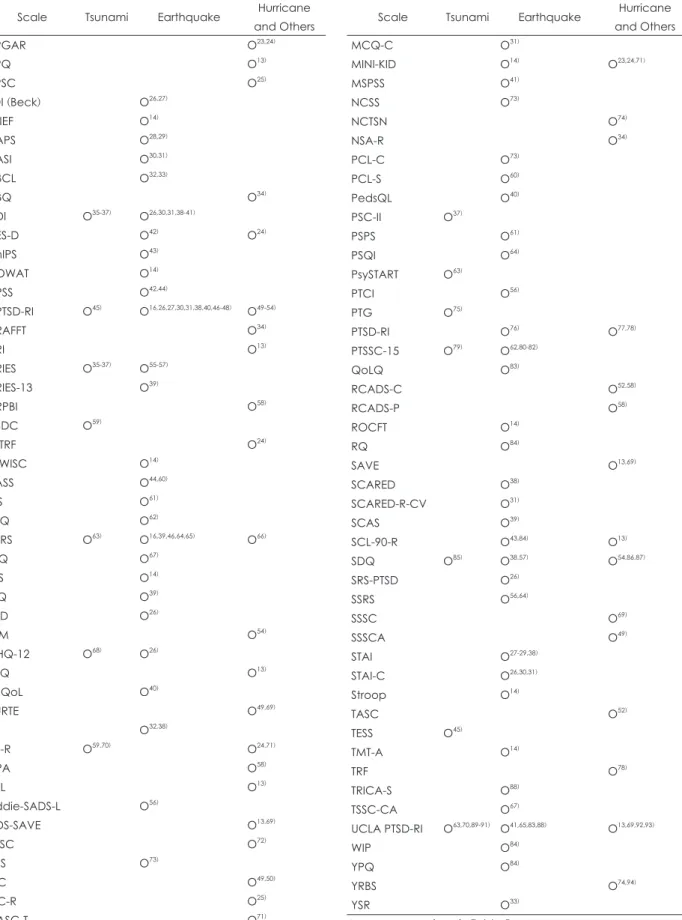
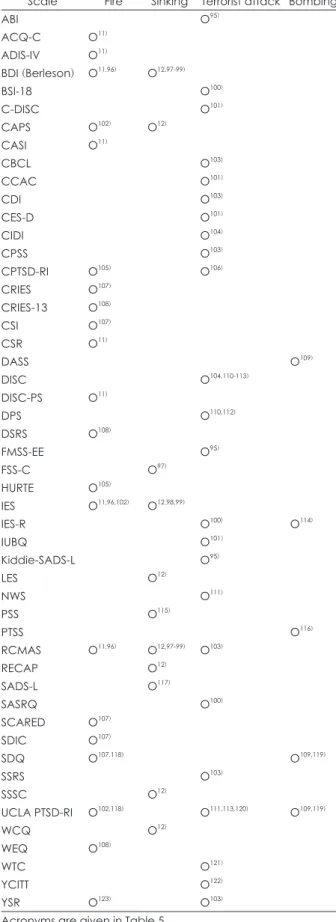
anxiety, depression, structured clinical interview, and gener- al psychopathology. In addition, one or more of the measures used assessed social support, coping, family relationships, attention, stress, routines, quality of life, cognitive function, somatization, health, emotion, attachment, control, behavior, and substance abuse. The mental health assessment tools in children according to the rater characteristics (Table 2) or Type of Disaster (Table 3 and 4) and the full names for the abbreviations of the scales after a disaster reviewed in this article (Table 5) are described in Table 2 through Table 5.
The assessment tools for the children’s mental health used in the well-known type I and type II disaster, Hurricane Ka- trina (2005) and 9/11 terrorist attack (2001), respectively, were presented in Supplementary Table 1 and 2 (in the online-on- ly Data Supplement). In addition, the mental health assess- ment tools used for each disaster event presented in Supple- mentary Table 3-15 (in the online-only Data Supplement) (type I disaster) and Supplementary Table 16-22 (in the on- line-only Data Supplement) (type II disaster).
Fig. 1. Flowchart outlining the selection of studies.
Records identified in online database (n=967)
Full text articles assessed for eligibility (n=118) Records excluded after reviewing the titles/abstracts (n=183)
Records after duplicates removed (n=713)
DIsCUssION
Our review of the 118 selected studies revealed that 35 (29.67%) of the studies used single scales. All other studies used up to 8 scales to assess mental health.11-14)
Depressive disorders are some of the most common psy- chological responses to trauma and stress. Depressive disor- ders in children and adolescents cause interpersonal prob- lems and may affect developmental functions. Depressive symptoms should be monitored in children and adolescents
Table 1. Type I and Type II disasters reviewed in this article
Disaster type Year Event
Type I
Tsunami 2004 Tsunami in Sri Lanka
2004 Tsunami in Thailand (Norwegian tourists) 2004 Tsunami in South-east Asia
2004 Tsunami in Aceh, Indonesia
2011 Tsunami in Higashi-Matsushima, Japan
Earthquake 1988 Spitak earthquake in Armenia
1988 Earthquake in Armenia 1995 Earthquake in Kobe, Japan 1999 Earthquake in Athens 1999 Earthquake in Turkey 1999 Chi-Chi earthquake in Taiwan 1999 Parnitha earthquake in Greece 1999 Earthquake in Ano Liosia, Greece 2003 Earthquake in Bam, Iran
2004 Earthquake in Southern India 2005 Earthquake in Kashmir 2009 L'Aquila earthquake in Italy 2011 Earthquake in Yingjiang, China 2011 Van earthquake in Turkey
Hurricane 1989 Hurricane Hugo in the Southeast United States 1992 Hurricane Andrew, USA
1998 Hurricane Mitch in Nicaragua 2005 Hurricane Katrina, USA
Cyclone 1999 Super-cyclone in Orissa, India
2006 Cyclone Larry in North Queensland, Australia - Cyclone storms in Queensland, Australia
Flood 1998 Flood in Hunan, China
Typhoon 2009 Typhoon Morakot in Taiwan
Tornado 2011 Tornado in the USA
Type II
Fire 1988 The discotheque fire in Göteborg, Sweden
1994 Bushfire in South Wales, Australia
2000 The explosion of a fireworks depot largely in the Netherlands 2001 A fire in a café in Volendam, the Netherlands
2005 Bushfires in South Australia 2007 Wildfire in Greece
Sinking 1988 Jupiter sinking in Greece (on board were 391 British school children) 2002 A boat sinking in Tehran's city park
Terrorist attack 2001 9/11 terrorist attack in New York 2011 Oslo terror attacks in Norway
Bombing 1995 City bombing in Oklahoma, USA
2013 Boston Marathon bombing
exposed to disaster.4) None of the studies reviewed used a sin- gle scale to assess depression or anxiety. This is consistent with the findings of Wang et al.15) A long-term follow-up study16) investigated PTSD and depressive symptoms in children and adolescents over a period of about six and a half years after a disaster. Several studies have shown that mental health in- terventions during the early follow-up stages effectively re- duce the prevalence of psychopathological problems in pedi- atric survivors.15)
Earthquakes were analyzed in a study16) that used the Chil- dren’s Post-Traumatic Stress Disorder-Reaction Index (CPTSD- RI), the Depression Self-Rating Scale (DSRS), and other sim-
ilar scales for follow-up. Of these scales, the University of California at Los Angeles PTSD Reaction Index (UCLA PTSD-RI) scale represents an appropriate tool for the assess- ment of children and adolescents in various disasters. Trans- lated versions of this scale, which are available in many dif- ferent languages, were shown to be cost-effective and user- friendly, and to facilitate effective management and rapid evaluation.4)
A comparison of the 9/11 terror attacks and Hurricane Ka- trina revealed that only the CPTSD-RI and UCLA PTSD-RI were used as common evaluation tools. Until now, there has been no gold standard assessment used after a disaster. At
Table 2. Mental health assessment tools after the disaster in children according to the rater (self report, parent, teacher, and clinician)
Symptoms/rater Self-report scale Parents’
report scale
Teacher’s
report scale Clinician’s report scale PTSD AVE, CPSS, CPTSD-RI, CRIES, CRIES-13,
CSDC, DIS, KID-SAVE, LEC, LES, LSC-R, NSA-R, NWS, PCL-C, PCL-S, PSPS, PSS, PTCI, PTG, PTSD-RI, PTSS, SAVE, SRS-PTSD, TESS, TSSC-CA, UCLA PTSD-RI, YPQ
IES, IES-R, WIP CAPS
Diagnosis C-DISC, ChIPS, CIDI, CSR,
DISC, DISC-PS, Kiddie-SADS- L, MINI-KID, RECAP, SADS-L Anxiety ACQ-C, CASI, DASS, FSS-C, MASC-T,
RCADS-C, RCMAS, SCARED, SCARED-R- CV, SCAS, STAI-C, TASC
RCADS-P, STAI ADIS-IV
Depression BDI, CDI, DASS, DPS, DSRS, NCTSN, RCADS-C, SDIC
CES-D, RCADS-P
DISC
General
psychopathology
APSC, BSI-18, CBQ, LASC, SCL-90-R, SDQ, YSR
CBCL C-TRF PSC-II
Social support ISEL, MSPSS, SSRS, SSSC, SSSCA, TRICA-S Type specific EEQ, EES, ETQ, HURTE, PsySTART, WEQ Coping CCAC, NCSS, SSRS, WCQ, YCITT
Family APGAR, CRPBI, FAD, FRM
Cognitive function MCQ-C
Attention COWAT BRIEF
ADHD BRIEF
Emotion FMSS-EE
Stress DASS, SASRQ
Routines CRI, DLQ
Sleep PSQI, SQ
Somatization CSI
Health GHQ-12
Attachment IPPA
Control LCS
Behavior YRBS
Quality of life PedsQL, QoLQ
Substance CRAFFT
Miscellaneous ABI, IUBQ, WTC RQ TRF
Acronyms are given in Table 5
Table 3. Mental health assessment tools used after the Type I di- saster in children
Scale Tsunami Earthquake Hurricane and Others
APGAR O23,24)
APQ O13)
APSC O25)
BDI (Beck) O26,27)
BRIEF O14)
CAPS O28,29)
CASI O30,31)
CBCL O32,33)
CBQ O34)
CDI O35-37) O26,30,31,38-41)
CES-D O42) O24)
ChIPS O43)
COWAT O14)
CPSS O42,44)
CPTSD-RI O45) O16,26,27,30,31,38,40,46-48) O49-54)
CRAFFT O34)
CRI O13)
CRIES O35-37) O55-57)
CRIES-13 O39)
CRPBI O58)
CSDC O59)
C-TRF O24)
C-WISC O14)
DASS O44,60)
DIS O61)
DLQ O62)
DSRS O63) O16,39,46,64,65) O66)
EEQ O67)
EES O14)
ETQ O39)
FAD O26)
FRM O54)
GHQ-12 O68) O26)
HEQ O13)
HRQoL O40)
HURTE O49,69)
IES O32,38)
IES-R O59,70) O24,71)
IPPA O58)
ISEL O13)
Kiddie-SADS-L O56)
KIDS-SAVE O13,69)
LASC O72)
LCS O73)
LEC O49,50)
LSC-R O25)
MASC-T O71)
Table 3. Mental health assessment tools used after the Type I di- saster in children (continued)
Scale Tsunami Earthquake Hurricane and Others
MCQ-C O31)
MINI-KID O14) O23,24,71)
MSPSS O41)
NCSS O73)
NCTSN O74)
NSA-R O34)
PCL-C O73)
PCL-S O60)
PedsQL O40)
PSC-II O37)
PSPS O61)
PSQI O64)
PsySTART O63)
PTCI O56)
PTG O75)
PTSD-RI O76) O77,78)
PTSSC-15 O79) O62,80-82)
QoLQ O83)
RCADS-C O52,58)
RCADS-P O58)
ROCFT O14)
RQ O84)
SAVE O13,69)
SCARED O38)
SCARED-R-CV O31)
SCAS O39)
SCL-90-R O43,84) O13)
SDQ O85) O38,57) O54,86,87)
SRS-PTSD O26)
SSRS O56,64)
SSSC O69)
SSSCA O49)
STAI O27-29,38)
STAI-C O26,30,31)
Stroop O14)
TASC O52)
TESS O45)
TMT-A O14)
TRF O78)
TRICA-S O88)
TSSC-CA O67)
UCLA PTSD-RI O63,70,89-91) O41,65,83,88) O13,69,92,93)
WIP O84)
YPQ O84)
YRBS O74,94)
YSR O33)
Acronyms are given in Table 5
this time, it is necessary to create a consensus among special- ists regarding the use of different approaches for specific di- saster types or the use of domain scales in the event of a disas- ter in South Korea.7) Specific disaster types and symptoms, as well as variables such as sleep, concentration, cognitive function, daily life, and quality of life, should be initially eval- uated.
The sources of information can be categorized as self-re- port, caregiver’s report, teacher’s report, and direct evalua- tion by a mental health professional. A self-report form is a type of questionnaire that is read by the respondents, who se- lect their own responses.17) Effective assessments should re- quire the consideration of children’s developmental issues and changes in cognitive capacity.18) The Fear Survey Sched- ule for Children (FSS-C), the Hurricane-Related Traumatic Experience Questionnaire (HURTE), the Screen for Child Anxiety Related Emotional Disorders (SCARED), the Screen for Adolescent Violence Exposure (SAVE), and the State and Trait Anxiety Inventory for Children (STAI-C) are usually used in self-report questionnaires, which children and ado- lescents respond to by themselves. However, self-report ques- tionnaires to which school-aged children respond themselves have the disadvantage of allowing the respondent to reduce his or her externalizing symptoms. In addition, cases where- in school-aged children or adolescents are not well aware of their psychiatric symptoms should be noted by clinicians, who should then conduct the evaluation.
Parent-reported questionnaires may be categorized as fol- lows: those that assess the parents’ psychological symptoms, and those that allow parents to respond by observing their child’s behavior. Examples of questionnaires assessing the parents’ symptoms are the Impact of Event Scale-Revised (IES- R), the Watson Interview for PTSD of adults (WIP), and the Center for Epidemiological Studies Depression Scale (CES-D).
Parents and teachers are considered reliable observers for the evaluation of the behavior of children and adolescents.19) In our review, many parents reported such observations us- ing the Children’s Report of Parent Behavior Inventory (CRPBI); the Revised Child Anxiety and Depression Scales, Parent Version(RCADS-P); Rutter’s Questionnaire, parent’s version (RQ); and the Inventory of Parent and Peer Attach- ment (IPPA).
In the present study, we found that Achenbach’s Teacher’s Report Form (TRF) and the Chinese version of the TRF (C- TRF) were used only as measures reported by the teacher.
However, as reported previously,20) they might underestimate internalizing symptoms, pain, and anger in children and ad- olescents. This suggests the need for careful interpretation of such reports.
Direct evaluation by mental health professionals is highly
Table 4. Mental health assessment tools used after the Type II di- saster in children
Scale Fire Sinking Terrorist attack Bombing
ABI O95)
ACQ-C O11)
ADIS-IV O11)
BDI (Berleson) O11,96) O12,97-99)
BSI-18 O100)
C-DISC O101)
CAPS O102) O12)
CASI O11)
CBCL O103)
CCAC O101)
CDI O103)
CES-D O101)
CIDI O104)
CPSS O103)
CPTSD-RI O105) O106)
CRIES O107)
CRIES-13 O108)
CSI O107)
CSR O11)
DASS O109)
DISC O104,110-113)
DISC-PS O11)
DPS O110,112)
DSRS O108)
FMSS-EE O95)
FSS-C O97)
HURTE O105)
IES O11,96,102) O12,98,99)
IES-R O100) O114)
IUBQ O101)
Kiddie-SADS-L O95)
LES O12)
NWS O111)
PSS O115)
PTSS O116)
RCMAS O11,96) O12,97-99) O103)
RECAP O12)
SADS-L O117)
SASRQ O100)
SCARED O107)
SDIC O107)
SDQ O107,118) O109,119)
SSRS O103)
SSSC O12)
UCLA PTSD-RI O102,118) O111,113,120) O109,119)
WCQ O12)
WEQ O108)
WTC O121)
YCITT O122)
YSR O123) O103)
Acronyms are given in Table 5
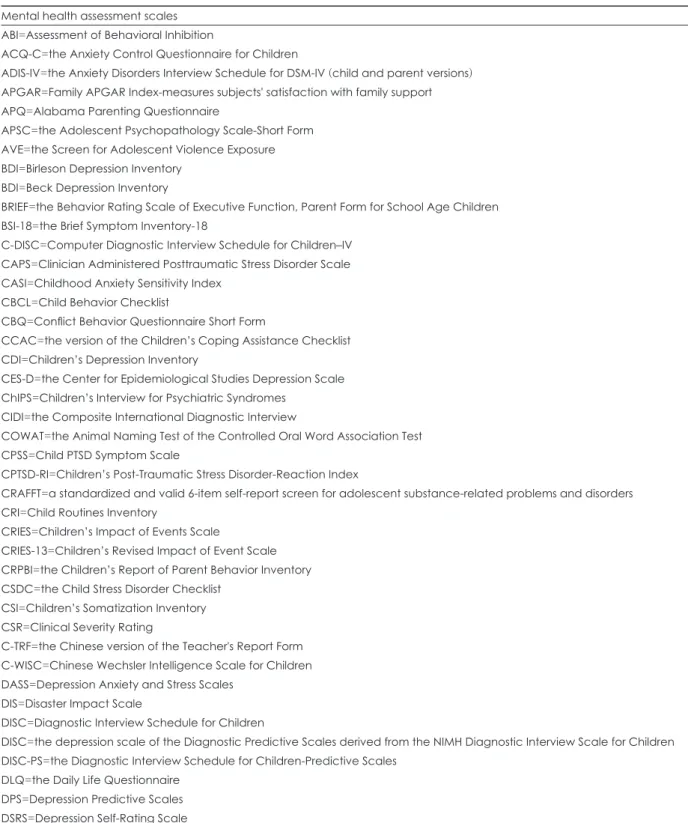
Table 5. Mental health assessment scales after a disaster reviewed in this article Mental health assessment scales
ABI=Assessment of Behavioral Inhibition
ACQ-C=the Anxiety Control Questionnaire for Children
ADIS-IV=the Anxiety Disorders Interview Schedule for DSM-IV (child and parent versions) APGAR=Family APGAR Index-measures subjects' satisfaction with family support APQ=Alabama Parenting Questionnaire
APSC=the Adolescent Psychopathology Scale-Short Form AVE=the Screen for Adolescent Violence Exposure BDI=Birleson Depression Inventory
BDI=Beck Depression Inventory
BRIEF=the Behavior Rating Scale of Executive Function, Parent Form for School Age Children BSI-18=the Brief Symptom Inventory-18
C-DISC=Computer Diagnostic Interview Schedule for Children–IV CAPS=Clinician Administered Posttraumatic Stress Disorder Scale CASI=Childhood Anxiety Sensitivity Index
CBCL=Child Behavior Checklist
CBQ=Conflict Behavior Questionnaire Short Form
CCAC=the version of the Children’s Coping Assistance Checklist CDI=Children’s Depression Inventory
CES-D=the Center for Epidemiological Studies Depression Scale ChIPS=Children’s Interview for Psychiatric Syndromes
CIDI=the Composite International Diagnostic Interview
COWAT=the Animal Naming Test of the Controlled Oral Word Association Test CPSS=Child PTSD Symptom Scale
CPTSD-RI=Children’s Post-Traumatic Stress Disorder-Reaction Index
CRAFFT=a standardized and valid 6-item self-report screen for adolescent substance-related problems and disorders CRI=Child Routines Inventory
CRIES=Children’s Impact of Events Scale
CRIES-13=Children’s Revised Impact of Event Scale CRPBI=the Children’s Report of Parent Behavior Inventory CSDC=the Child Stress Disorder Checklist
CSI=Children’s Somatization Inventory CSR=Clinical Severity Rating
C-TRF=the Chinese version of the Teacher's Report Form C-WISC=Chinese Wechsler Intelligence Scale for Children DASS=Depression Anxiety and Stress Scales
DIS=Disaster Impact Scale
DISC=Diagnostic Interview Schedule for Children
DISC=the depression scale of the Diagnostic Predictive Scales derived from the NIMH Diagnostic Interview Scale for Children DISC-PS=the Diagnostic Interview Schedule for Children-Predictive Scales
DLQ=the Daily Life Questionnaire DPS=Depression Predictive Scales DSRS=Depression Self-Rating Scale
EEQ=the Earthquake Experience questionnaire EES=Earthquake-related Experience Scale ETQ=Earthquake Trauma Questionnaire FAD=McMaster Family Assessment Device
FMSS-EE=Five-Minute-Speech Sample Measure of Expressed Emotion FRM=the Family Resilience Measure
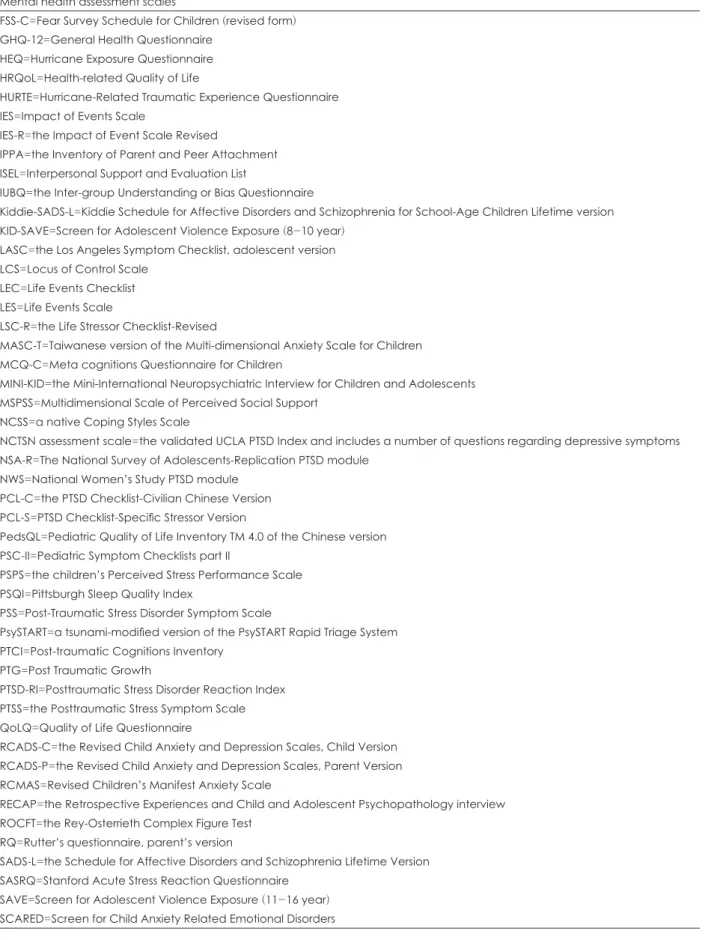
Table 5. Mental health assessment scales after a disaster reviewed in this article (continued) Mental health assessment scales
FSS-C=Fear Survey Schedule for Children (revised form) GHQ-12=General Health Questionnaire
HEQ=Hurricane Exposure Questionnaire HRQoL=Health-related Quality of Life
HURTE=Hurricane-Related Traumatic Experience Questionnaire IES=Impact of Events Scale
IES-R=the Impact of Event Scale Revised
IPPA=the Inventory of Parent and Peer Attachment ISEL=Interpersonal Support and Evaluation List
IUBQ=the Inter-group Understanding or Bias Questionnaire
Kiddie-SADS-L=Kiddie Schedule for Affective Disorders and Schizophrenia for School-Age Children Lifetime version KID-SAVE=Screen for Adolescent Violence Exposure (8-10 year)
LASC=the Los Angeles Symptom Checklist, adolescent version LCS=Locus of Control Scale
LEC=Life Events Checklist LES=Life Events Scale
LSC-R=the Life Stressor Checklist-Revised
MASC-T=Taiwanese version of the Multi-dimensional Anxiety Scale for Children MCQ-C=Meta cognitions Questionnaire for Children
MINI-KID=the Mini-International Neuropsychiatric Interview for Children and Adolescents MSPSS=Multidimensional Scale of Perceived Social Support
NCSS=a native Coping Styles Scale
NCTSN assessment scale=the validated UCLA PTSD Index and includes a number of questions regarding depressive symptoms NSA-R=The National Survey of Adolescents-Replication PTSD module
NWS=National Women’s Study PTSD module PCL-C=the PTSD Checklist-Civilian Chinese Version PCL-S=PTSD Checklist-Specific Stressor Version
PedsQL=Pediatric Quality of Life Inventory TM 4.0 of the Chinese version PSC-II=Pediatric Symptom Checklists part II
PSPS=the children’s Perceived Stress Performance Scale PSQI=Pittsburgh Sleep Quality Index
PSS=Post-Traumatic Stress Disorder Symptom Scale
PsySTART=a tsunami-modified version of the PsySTART Rapid Triage System PTCI=Post-traumatic Cognitions Inventory
PTG=Post Traumatic Growth
PTSD-RI=Posttraumatic Stress Disorder Reaction Index PTSS=the Posttraumatic Stress Symptom Scale QoLQ=Quality of Life Questionnaire
RCADS-C=the Revised Child Anxiety and Depression Scales, Child Version RCADS-P=the Revised Child Anxiety and Depression Scales, Parent Version RCMAS=Revised Children’s Manifest Anxiety Scale
RECAP=the Retrospective Experiences and Child and Adolescent Psychopathology interview ROCFT=the Rey-Osterrieth Complex Figure Test
RQ=Rutter’s questionnaire, parent’s version
SADS-L=the Schedule for Affective Disorders and Schizophrenia Lifetime Version SASRQ=Stanford Acute Stress Reaction Questionnaire
SAVE=Screen for Adolescent Violence Exposure (11-16 year) SCARED=Screen for Child Anxiety Related Emotional Disorders
reliable. For instance, the Clinician-Administered Posttrau- matic Stress Disorder Scale (CAPS), the Kiddie Schedule for Affective Disorders and Schizophrenia for School-Age Chil- dren Lifetime version (Kiddie-SADS-L), the Mini-Interna- tional Neuropsychiatric Interview for Children and Adoles- cents (MINI-KID), and the Retrospective Experiences and Child and Adolescent Psychopathology interview (RECAP) are used as assessment scales by clinicians. Nevertheless, di- rect evaluations by mental health professionals were avail- able in only a few studies.
For children and adolescents exposed to disasters, moni- toring is based on the evaluation used, and subsequent inter- vention promotes recovery. Effective provision of mental health services and an integrated system facilitate the man- agement of psychosocial challenges in children and adoles- cents.21) Appropriate and timely interventions in communi- ties may result in positive developmental impacts in young patients. Therefore, it is important to use an evaluation tool
with high reliability and validity. A brief screening test fol- lowed by an in-depth assessment to select high-risk groups should be systematized. In addition, the cost of intervention following an emergency should be reduced. Mental health- related assessments are affected by the numbers of research designs and subjects. The scale that is used should be select- ed carefully to provide appropriate and critical feedback re- garding the functional status and diagnosis of the subject.8)
The limitations of this study are as follows. The systemat- ic literature review included an extensive search only for ar- ticles written in English. This means that some important research results may have been omitted. In addition, analysis of the scales used for different types of disasters may have been restricted due to the limited number of relevant stud- ies. Furthermore, the final selection of articles included only those pertaining to school-aged children and adolescents.
As such, evaluation items and tools used to assess individu- als in early childhood were not analyzed. Therefore, a system-
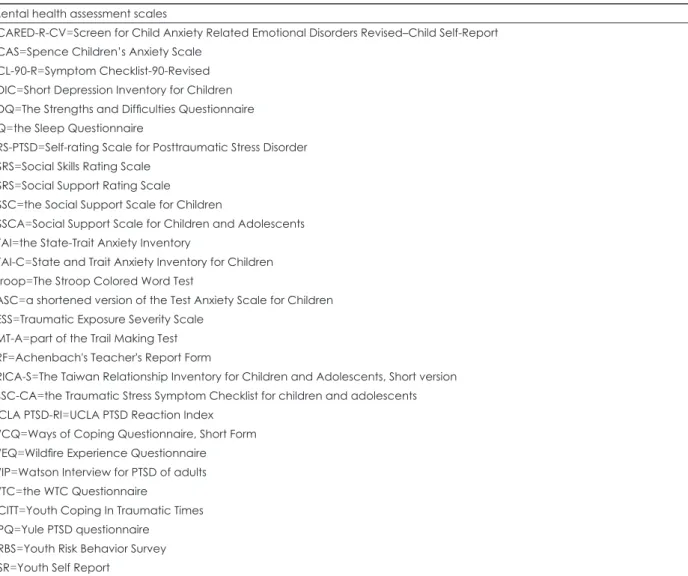
Table 5. Mental health assessment scales after a disaster reviewed in this article (continued) Mental health assessment scales
SCARED-R-CV=Screen for Child Anxiety Related Emotional Disorders Revised–Child Self-Report SCAS=Spence Children’s Anxiety Scale
SCL-90-R=Symptom Checklist-90-Revised SDIC=Short Depression Inventory for Children SDQ=The Strengths and Difficulties Questionnaire SQ=the Sleep Questionnaire
SRS-PTSD=Self-rating Scale for Posttraumatic Stress Disorder SSRS=Social Skills Rating Scale
SSRS=Social Support Rating Scale SSSC=the Social Support Scale for Children
SSSCA=Social Support Scale for Children and Adolescents STAI=the State-Trait Anxiety Inventory
STAI-C=State and Trait Anxiety Inventory for Children Stroop=The Stroop Colored Word Test
TASC=a shortened version of the Test Anxiety Scale for Children TESS=Traumatic Exposure Severity Scale
TMT-A=part of the Trail Making Test TRF=Achenbach's Teacher's Report Form
TRICA-S=The Taiwan Relationship Inventory for Children and Adolescents, Short version TSSC-CA=the Traumatic Stress Symptom Checklist for children and adolescents UCLA PTSD-RI=UCLA PTSD Reaction Index
WCQ=Ways of Coping Questionnaire, Short Form WEQ=Wildfire Experience Questionnaire WIP=Watson Interview for PTSD of adults WTC=the WTC Questionnaire
YCITT=Youth Coping In Traumatic Times YPQ=Yule PTSD questionnaire
YRBS=Youth Risk Behavior Survey YSR=Youth Self Report
atic review of the literature on infants and preschoolers should be conducted in a subsequent study. Nevertheless, our study discusses mental health assessment tools for potential appli- cation following disasters and suggests recommendations for clinical settings.22)
CONCLUsION
Studies involving disaster evaluation highlight the behav- ioral and mental health impacts of the disaster. The results of this study have major implications for systematic mental health assessments and interventions administered to chil- dren and adolescents, as well as survivors of disasters in the future. It may thus serve as a basis for subsequent studies and for responses to policy measures.
Supplementary Materials
The online-only Data Supplement is available with this arti- cle at https://doi.org/10.5765/jkacap.180002.
Acknowledgments
This study was supported by a grant from the Korean Mental Health Technology R&D Project, Ministry of Health & Welfare, Republic of Korea (HM15C1058).
Conflicts of Interest
The authors have no financial conflicts of interest.
REFERENCEs
1) Gold JI, Montano Z, Shields S, Mahrer NE, Vibhakar V, Ybarra T, et al. Pediatric disaster preparedness in the medical setting: in- tegrating mental health. Am J Disaster Med 2009;4:137-146.
2) Garbern SC, Ebbeling LG, Bartels SA. A systematic review of health outcomes among disaster and humanitarian responders. Prehosp Disaster Med 2016;31:635-642.
3) Castaño García T, Vega Díaz C, Cernuda Martínez JA. Emotion- al disorders in children victims of natural disasters. Rev Enferm 2016;39:18-29.
4) Balaban V. Psychological assessment of children in disasters and emergencies. Disasters 2006;30:178-198.
5) Ardalan A, Kandi M, Talebian MT, Khankeh H, Masoumi G, Mo- hammadi R, et al. Hospitals safety from disasters in I.R.iran: the results from assessment of 224 hospitals. PLoS Curr 2014;6.
6) National Child Traumatic Stress Network. Empirically support- ed treatments and promising practices. 2005. Los Angeles/Dur- ham: Author. [cited 2014 March 10]. Available from URL: https://
www.nctsn.org/resources/topics/treatments-that-work/promising- practices.
7) Heidaranlu E, Ebadi A, Khankeh HR, Ardalan A. Hospital Disas- ter Preparedness Tools: a systematic review. PLoS Curr 2015;7.
8) Pfefferbaum B, Noffsinger MA, Sherrieb K, Norris FH. Framework for research on children’s reactions to disasters and terrorist events.
Prehosp Disaster Med 2012;27:567-576.
9) Moher D, Liberati A, Tetzlaff J, Altman DG; PRISMA Group. Pre- ferred reporting items for systematic reviews and meta-analyses:
the PRISMA statement. J Clin Epidemiol 2009;62:1006-1012.
10) Hoven CW, Duarte CS, Turner B, Mandell DJ. Child mental health in the aftermath of disaster: a review of PTSD studies. In: Neria Y, Galea S, Norris FH, editors. Mental health and disasters. Cam-
bridge: Cambridge University Press;2009. p.218-232.
11) McDermott BM, Palmer LJ. Post-disaster service provision fol- lowing proactive identification of children with emotional distress and depression. Aust N Z J Psychiatry 1999;33:855-863.
12) Udwin O, Boyle S, Yule W, Bolton D, O’Ryan D. Risk factors for long-term psychological effects of a disaster experienced in ado- lescence: predictors of post traumatic stress disorder. J Child Psy- chol Psychiatry 2000;41:969-979.
13) Kelley ML, Self-Brown S, Le B, Bosson JV, Hernandez BC, Gor- don AT. Predicting posttraumatic stress symptoms in children fol- lowing Hurricane Katrina: a prospective analysis of the effect of parental distress and parenting practices. J Trauma Stress 2010;23:
582-590.
14) Ma X, Liu X, Hu X, Qiu C, Wang Y, Huang Y, et al. Risk indicators for post-traumatic stress disorder in adolescents exposed to the 5.12 Wenchuan earthquake in China. Psychiatry Res 2011;189:385- 15) Wang CW, Chan CL, Ho RT. Prevalence and trajectory of psy-391.
chopathology among child and adolescent survivors of disasters:
a systematic review of epidemiological studies across 1987-2011.
Soc Psychiatry Psychiatr Epidemiol 2013;48:1697-1720.
16) Goenjian AK, Walling D, Steinberg AM, Roussos A, Goenjian HA, Pynoos RS. Depression and PTSD symptoms among bereaved ad- olescents 6(1/2) years after the 1988 Spitak earthquake. J Affect Disord 2009;112:81-84.
17) Victor J. The SAGE dictionary of social research methods. Lon- don: SAGE Publications;2006.
18) Liu H, Hays RD, Marcus M, Coulter I, Maida C, Ramos-Gomez F, et al. Patient-reported oral health outcome measurement for children and adolescents. BMC Oral Health 2016;16:95.
19) Irwin DE, Gross HE, Stucky BD, Thissen D, DeWitt EM, Lai JS, et al. Development of six PROMIS pediatrics proxy-report item banks. Health Qual Life Outcomes 2012;10:22.
20) Jensen PS, Rubio-Stipec M, Canino G, Bird HR, Dulcan MK, Schwab-Stone ME, et al. Parent and child contributions to diagno- sis of mental disorder: are both informants always necessary? J Am Acad Child Adolesc Psychiatry 1999;38:1569-1579.
21) Somasundaram DJ, van de Put WA. Management of trauma in special populations after a disaster. J Clin Psychiatry 2006;67 Sup- pl 2:64-73.
22) Lai BS, Esnard AM, Lowe SR, Peek L. Schools and disasters: safe- ty and mental health assessment and interventions for children.
Curr Psychiatry Rep 2016;18:109.
23) Tang TC, Yen CF, Cheng CP, Yang P, Chen CS, Yang RC, et al. Sui- cide risk and its correlate in adolescents who experienced typhoon- induced mudslides: a structural equation model. Depress Anxiety 2010;27:1143-1148.
24) Yang P, Yen CF, Tang TC, Chen CS, Yang RC, Huang MS, et al.
Posttraumatic stress disorder in adolescents after Typhoon Mor- akot-associated mudslides. J Anxiety Disord 2011;25:362-368.
25) Robertson AA, Morse DT, Baird-Thomas C. Hurricane Katrina’s impact on the mental health of adolescent female offenders. Anx- iety Stress Coping 2009;22:433-448.
26) Kiliç EZ, Ozgüven HD, Sayil I. The psychological effects of pa- rental mental health on children experiencing disaster: the expe- rience of Bolu earthquake in Turkey. Fam Process 2003;42:485- 27) Karakaya I, Ağaoğlu B, Coşkun A, Sişmanlar SG, Yildiz Oc O. The 495.
symptoms of PTSD, depression and anxiety in adolescent students three and a half years after the Marmara earthquake. Turk Psiki- yatri Derg 2004;15:257-263.
28) Ekşi A, Braun KL, Ertem-Vehid H, Peykerli G, Saydam R, Topar- lak D, et al. Risk factors for the development of PTSD and depres- sion among child and adolescent victims following a 7.4 magni- tude earthquake. Int J Psychiatry Clin Pract 2007;11:190-199.
29) Eksi A, Braun KL. Over-time changes in PTSD and depression among children surviving the 1999 Istanbul earthquake. Eur Child Adolesc Psychiatry 2009;18:384-391.
30) Kiliç EZ, Kiliç C, Yilmaz S. Is anxiety sensitivity a predictor of PTSD in children and adolescents? J Psychosom Res 2008;65:81- 31) Kadak MT, Nasıroğlu S, Boysan M, Aydın A. Risk factors predict-86.
ing posttraumatic stress reactions in adolescents after 2011 Van earth- quake. Compr Psychiatry 2013;54:982-990.
32) John PB, Russell S, Russell PS. The prevalence of posttraumatic stress disorder among children and adolescents affected by tsuna- mi disaster in Tamil Nadu. Disaster Manag Response 2007;5:3-7.
33) Feo P, Di Gioia S, Carloni E, Vitiello B, Tozzi AE, Vicari S. Preva- lence of psychiatric symptoms in children and adolescents one year after the 2009 L’Aquila earthquake. BMC Psychiatry 2014;14:
34) Sumner JA, Pietrzak RH, Danielson CK, Adams ZW, Ruggiero 270.
KJ. Elucidating dimensions of posttraumatic stress symptoms and their functional correlates in disaster-exposed adolescents. J Psy- chiatr Res 2014;59:85-92.
35) Piyasil V, Ketuman P, Plubrukarn R, Jotipanut V, Tanprasert S, Aowjinda S, et al. Post traumatic stress disorder in children after tsunami disaster in Thailand: 2 years follow-up. J Med Assoc Thai 2007;90:2370-2376.
36) Piyasil V, Ketumarn P, Prubrukarn R, Pacharakaew S, Dumrong- phol H, Rungsri S, et al. Psychiatric disorders in children at one year after the tsunami disaster in Thailand. J Med Assoc Thai 2008;91 Suppl 3:S15-S20.
37) Piyasil V, Ketumarn P, Prubrukarn R, Ularntinon S, Sitdhiraksa N, Pithayaratsathien N, et al. Post-traumatic stress disorder in children after the tsunami disaster in Thailand: a 5-year follow-up.
J Med Assoc Thai 2011;94 Suppl 3:S138-S144.
38) Kolaitis G, Kotsopoulos J, Tsiantis J, Haritaki S, Rigizou F, Zach- araki L, et al. Posttraumatic stress reactions among children fol- lowing the Athens earthquake of September 1999. Eur Child Ad- olesc Psychiatry 2003;12:273-280.
39) Giannopoulou I, Strouthos M, Smith P, Dikaiakou A, Galanopou- lou V, Yule W. Post-traumatic stress reactions of children and ad- olescents exposed to the Athens 1999 earthquake. Eur Psychiatry 2006;21:160-166.
40) Zhang N, Zhang Y, Wu K, Zhu Z, Dyregrov A. Factor structure of the Children’s Revised Impact of Event Scale among children and adolescents who survived the 2008 Sichuan earthquake in China.
Scand J Psychol 2011;52:236-241.
41) Geng F, Fan F, Mo L, Simandl I, Liu X. Sleep problems among ad- olescent survivors following the 2008 Wenchuan earthquake in China: a cohort study. J Clin Psychiatry 2013;74:67-74.
42) Jia Z, Shi L, Duan G, Liu W, Pan X, Chen Y, et al. Traumatic expe- riences and mental health consequences among child survivors of the 2008 Sichuan earthquake: a community-based follow-up study.
BMC Public Health 2013;13:104.
43) Hsu CC, Chong MY, Yang P, Yen CF. Posttraumatic stress disorder among adolescent earthquake victims in Taiwan. J Am Acad Child Adolesc Psychiatry 2002;41:875-881.
44) Wang R, Wang L, Li Z, Cao C, Shi Z, Zhang J. Latent structure of posttraumatic stress disorder symptoms in an adolescent sample one month after an earthquake. J Adolesc 2013;36:717-725.
45) Agustini EN, Asniar I, Matsuo H. The prevalence of long-term post- traumatic stress symptoms among adolescents after the tsunami in Aceh. J Psychiatr Ment Health Nurs 2011;18:543-549.
46) Goenjian AK, Walling D, Steinberg AM, Karayan I, Najarian LM, Pynoos R. A prospective study of posttraumatic stress and depres- sive reactions among treated and untreated adolescents 5 years af- ter a catastrophic disaster. Am J Psychiatry 2005;162:2302-2308.
47) Bal A, Jensen B. Post-traumatic stress disorder symptom clusters
in Turkish child and adolescent trauma survivors. Eur Child Ado- lesc Psychiatry 2007;16:449-457.
48) Pynoos RS, Goenjian A, Tashjian M, Karakashian M, Manjikian R, Manoukian G, et al. Post-traumatic stress reactions in children after the 1988 Armenian earthquake. Br J Psychiatry 1993;163:239- 49) Moore KW, Varela RE. Correlates of long-term posttraumatic 247.
stress symptoms in children following Hurricane Katrina. Child Psychiatry Hum Dev 2010;41:239-250.
50) Weems CF, Taylor LK, Cannon MF, Marino RC, Romano DM, Scott BG, et al. Post traumatic stress, context, and the lingering ef- fects of the Hurricane Katrina disaster among ethnic minority youth. J Abnorm Child Psychol 2010;38:49-56.
51) Taylor LK, Weems CF. Cognitive-behavior therapy for disaster-ex- posed youth with posttraumatic stress: results from a multiple- baseline examination. Behav Ther 2011;42:349-363.
52) Weems CF, Scott BG, Taylor LK, Cannon MF, Romano DM, Per- ry AM. A theoretical model of continuity in anxiety and links to academic achievement in disaster-exposed school children. Dev Psychopathol 2013;25:729-737.
53) Weems CF, Graham RA. Resilience and trajectories of posttrau- matic stress among youth exposed to disaster. J Child Adolesc Psy- chopharmacol 2014;24:2-8.
54) McDermott BM, Cobham VE, Berry H, Stallman HM. Vulnera- bility factors for disaster-induced child post-traumatic stress disor- der: the case for low family resilience and previous mental illness.
Aust N Z J Psychiatry 2010;44:384-389.
55) Tian W, Jia Z, Duan G, Liu W, Pan X, Guo Q, et al. Longitudinal study on health-related quality of life among child and adolescent survivors of the 2008 Sichuan earthquake. Qual Life Res 2013;22:
745-752.
56) Ying LH, Wu XC, Lin CD, Chen C. Prevalence and predictors of posttraumatic stress disorder and depressive symptoms among child survivors 1 year following the Wenchuan earthquake in China. Eur Child Adolesc Psychiatry 2013;22:567-575.
57) Ayub M, Poongan I, Masood K, Gul H, Ali M, Farrukh A, et al.
Psychological morbidity in children 18 months after Kashmir Earthquake of 2005. Child Psychiatry Hum Dev 2012;43:323-336.
58) Costa NM, Weems CF, Pina AA. Hurricane Katrina and youth anxiety: the role of perceived attachment beliefs and parenting behaviors. J Anxiety Disord 2009;23:935-941.
59) Dyb G, Jensen TK, Nygaard E. Children’s and parents’ posttrau- matic stress reactions after the 2004 tsunami. Clin Child Psychol Psychiatry 2011;16:621-634.
60) Wang L, Long D, Li Z, Armour C. Posttraumatic stress disorder symptom structure in Chinese adolescents exposed to a deadly earthquake. J Abnorm Child Psychol 2011;39:749-758.
61) Sahin NH, Batigün AD, Yilmaz B. Psychological symptoms of Turkish children and adolescents after the 1999 earthquake: expo- sure, gender, location, and time duration. J Trauma Stress 2007;20:
335-345.
62) Usami M, Iwadare Y, Watanabe K, Kodaira M, Ushijima H, Tana- ka T, et al. Analysis of changes in traumatic symptoms and daily life activity of children affected by the 2011 Japan earthquake and tsunami over time. PLoS One 2014;9:e88885.
63) Thienkrua W, Cardozo BL, Chakkraband ML, Guadamuz TE, Pengjuntr W, Tantipiwatanaskul P, et al. Symptoms of posttrau- matic stress disorder and depression among children in tsunami- affected areas in southern Thailand. JAMA 2006;296:549-559.
64) Yang R, Xiang YT, Shuai L, Qian Y, Lai KY, Ungvari GS, et al. Ex- ecutive function in children and adolescents with posttraumatic stress disorder 4 and 12 months after the Sichuan earthquake in China. J Child Psychol Psychiatry 2014;55:31-38.
65) Roussos A, Goenjian AK, Steinberg AM, Sotiropoulou C, Kakaki M, Kabakos C, et al. Posttraumatic stress and depressive reactions
among children and adolescents after the 1999 earthquake in Ano Liosia, Greece. Am J Psychiatry 2005;162:530-537.
66) Goenjian AK, Molina L, Steinberg AM, Fairbanks LA, Alvarez ML, Goenjian HA, et al. Posttraumatic stress and depressive reactions among Nicaraguan adolescents after hurricane Mitch. Am J Psy- chiatry 2001;158:788-794.
67) Kiliç C, Kiliç EZ, Aydin IO. Effect of relocation and parental psy- chopathology on earthquake survivor-children’s mental health. J Nerv Ment Dis 2011;199:335-341.
68) Uttervall M, Hultman CM, Ekerwald H, Lindam A, Lundin T.
After the flood: resilience among tsunami-afflicted adolescents.
Nord J Psychiatry 2014;68:38-43.
69) Self-Brown S, Lai BS, Thompson JE, McGill T, Kelley ML. Post- traumatic stress disorder symptom trajectories in Hurricane Ka- trina affected youth. J Affect Disord 2013;147:198-204.
70) Jensen TK, Dyb G, Nygaard E. A longitudinal study of posttrau- matic stress reactions in Norwegian children and adolescents ex- posed to the 2004 tsunami. Arch Pediatr Adolesc Med 2009;163:
856-861.
71) Yen CF, Tang TC, Yang P, Chen CS, Cheng CP, Yang RC, et al. A multidimensional anxiety assessment of adolescents after Typhoon Morakot-associated mudslides. J Anxiety Disord 2011;25:106-111.
72) Overstreet S, Salloum A, Badour C. A school-based assessment of secondary stressors and adolescent mental health 18 months post-Katrina. J Sch Psychol 2010;48:413-431.
73) Zhang W, Liu H, Jiang X, Wu D, Tian Y. A longitudinal study of posttraumatic stress disorder symptoms and its relationship with coping skill and locus of control in adolescents after an earth- quake in China. PLoS One 2014;9:e88263.
74) Kronenberg ME, Hansel TC, Brennan AM, Osofsky HJ, Osofsky JD, Lawrason B. Children of Katrina: lessons learned about post- disaster symptoms and recovery patterns. Child Dev 2010;81:1241- 1259.
75) Hafstad GS, Gil-Rivas V, Kilmer RP, Raeder S. Parental adjust- ment, family functioning, and posttraumatic growth among Nor- wegian children and adolescents following a natural disaster.
Am J Orthopsychiatry 2010;80:248-257.
76) Uemoto M, Asakawa A, Takamiya S, Asakawa K, Inui A. Kobe earthquake and post-traumatic stress in school-aged children. Int J Behav Med 2012;19:243-251.
77) Lonigan CJ, Shannon MP, Taylor CM, Finch AJ Jr, Sallee FR. Chil- dren exposed to disaster: II. risk factors for the development of post-traumatic symptomatology. J Am Acad Child Adolesc Psychi- atry 1994;33:94-105.
78) Shaw JA, Applegate B, Schorr C. Twenty-one-month follow-up study of school-age children exposed to Hurricane Andrew. J Am Acad Child Adolesc Psychiatry 1996;35:359-364.
79) Kuwabara H, Araki T, Yamasaki S, Ando S, Kano Y, Kasai K. Re- gional differences in post-traumatic stress symptoms among chil- dren after the 2011 tsunami in Higashi-Matsushima, Japan. Brain Dev 2015;37:130-136.
80) Usami M, Iwadare Y, Kodaira M, Watanabe K, Aoki M, Katsumi C, et al. Relationships between traumatic symptoms and envi- ronmental damage conditions among children 8 months after the 2011 Japan earthquake and tsunami. PLoS One 2012;7:e50721.
81) Usami M, Iwadare Y, Kodaira M, Watanabe K, Aoki M, Katsumi C, et al. Sleep duration among children 8 months after the 2011 Japan earthquake and tsunami. PLoS One 2013;8:e65398.
82) Usami M, Iwadare Y, Watanabe K, Kodaira M, Ushijima H, Tana- ka T, et al. Decrease in the traumatic symptoms observed in child survivors within three years of the 2011 Japan earthquake and tsu- nami. PLoS One 2014;9:e110898.
83) Goenjian AK, Roussos A, Steinberg AM, Sotiropoulou C, Walling D, Kakaki M, et al. Longitudinal study of PTSD, depression, and quality of life among adolescents after the Parnitha earthquake. J Affect Disord 2011;133:509-515.
84) Parvaresh N, Bahramnezhad A. Post-traumatic stress disorder in bam-survived students who immigrated to Kerman, four months after the earthquake. Arch Iran Med 2009;12:244-249.
85) Siriwardhana C, Pannala G, Siribaddana S, Sumathipala A, Stew- art R. Impact of exposure to conflict, tsunami and mental disor- ders on school absenteeism: findings from a national sample of Sri Lankan children aged 12-17 years. BMC Public Health 2013;13:
86) McLaughlin KA, Fairbank JA, Gruber MJ, Jones RT, Lakoma MD, 560.
Pfefferbaum B, et al. Serious emotional disturbance among youths exposed to Hurricane Katrina 2 years postdisaster. J Am Acad Child Adolesc Psychiatry 2009;48:1069-1078.
87) McLaughlin KA, Fairbank JA, Gruber MJ, Jones RT, Osofsky JD, Pfefferbaum B, et al. Trends in serious emotional disturbance among youths exposed to Hurricane Katrina. J Am Acad Child Adolesc Psychiatry 2010;49:990-1000.
88) Wu CH, Chen SH, Weng LJ, Wu YC. Social relations and PTSD symptoms: a prospective study on earthquake-impacted adoles- cents in Taiwan. J Trauma Stress 2009;22:451-459.
89) Neuner F, Schauer E, Catani C, Ruf M, Elbert T. Post-tsunami stress: a study of posttraumatic stress disorder in children living in three severely affected regions in Sri Lanka. J Trauma Stress 2006;
19:339-347.
90) Nygaard E, Jensen TK, Dyb G. Stability of posttraumatic stress reaction factors and their relation to general mental health prob- lems in children: a longitudinal study. J Clin Child Adolesc Psy- chol 2012;41:15-26.
91) Nygaard E, Jensen TK, Dyb G. Posttraumatic stress reactions in siblings after mutual disaster: relevance of family factors. J Trau- ma Stress 2010;23:278-281.
92) Hansel TC, Osofsky JD, Osofsky HJ, Friedrich P. The effect of long-term relocation on child and adolescent survivors of Hurri- cane Katrina. J Trauma Stress 2013;26:613-620.
93) McDermott B, Cobham V, Berry H, Kim B. Correlates of persist- ing posttraumatic symptoms in children and adolescents 18 months after a cyclone disaster. Aust N Z J Psychiatry 2014;48:80-86.
94) Madkour AS, Johnson CC, Clum GA, Brown L. Disaster and youth violence: the experience of school-attending youth in New Orleans. J Adolesc Health 2011;49:213-215.
95) Otto MW, Henin A, Hirshfeld-Becker DR, Pollack MH, Bieder- man J, Rosenbaum JF. Posttraumatic stress disorder symptoms following media exposure to tragic events: impact of 9/11 on chil- dren at risk for anxiety disorders. J Anxiety Disord 2007;21:888- 96) McDermott BM, Palmer LJ. Postdisaster emotional distress, de-902.
pression and event-related variables: findings across child and ad- olescent developmental stages. Aust N Z J Psychiatry 2002;36:
754-761.
97) Yule W, Udwin O, Murdoch K. The ‘Jupiter’ sinking: effects on children’s fears, depression and anxiety. J Child Psychol Psychi- atry 1990;31:1051-1061.
98) Yule W. Children in shipping disasters. J R Soc Med 1991;84:12-15.
99) Yule W, Udwin O. Screening child survivors for post-traumatic stress disorders: experiences from the ‘Jupiter’ sinking. Br J Clin Psychol 1991;30:131-138.
100) Gil-Rivas V, Silver RC, Holman EA, McIntosh DN, Poulin M. Pa- rental response and adolescent adjustment to the September 11, 2001 terrorist attacks. J Trauma Stress 2007;20:1063-1068.
101) Gershoff ET, Aber JL, Ware A, Kotler JA. Exposure to 9/11 among youth and their mothers in New York City: enduring associations with mental health and sociopolitical attitudes. Child Dev 2010;
81:1142-1160.
102) Broberg AG, Dyregrov A, Lilled L. The Göteborg discotheque fire:
posttraumatic stress, and school adjustment as reported by the pri- mary victims 18 months later. J Child Psychol Psychiatry 2005;