고산도 생성 초산균의 분리 및 발효특성
백창호, 백성열, 이세희, 강지은, 최한석, 김재현, 여수환*
농촌진흥청국립농업과학원농식품자원부발효식품과
Received: May 15, 2015 / Revised: May 21, 2015 / Accepted: May 21, 2015
서 론
식초는술과함께가장오랜역사를가진발효식품중의 하나로서음식을조리할때첨가되는조미성분으로주로사 용되어왔으나최근에는다이어트등의건강을위한기능성
음료생산을위한원료사용되고있다[6]. 식초는식품의맛
을상승시키는조미료로서발효과정에서독특한방향과신 맛을주는대표적인알칼리성발효식품이며[23], 당이알코 올발효를거쳐초산발효로생산된초산을주성분으로발효 기질에따라다양한유기산과아미노산, 당류및에스테르 등을함유하고있다[7, 34].
국내에서생산되는식초는주정을희석하고무기염류를첨 가한양조식초, 과즙함량 30% 이상을함유하는과실식초, 곡 물함량 4% 이상을함유하는곡물식초가대부분이었으나[8], 최근, 식품의기능성을중요하게여기는소비자인식에따라
단순조미료에서기능성이부여된건강음료로소비패턴이 변화되면서원료로서과즙이나곡물의함량이높고유기산 뿐만아니라아미노산이풍부한흑초와같은고품질곡물발 효식초가등장하는등생산과소비가증가되는추세이다[8, 18]. 일반적인초산발효의산도는약 6−7%인데이는사용균
주의초산생성능과발효방법에따라다르게나타난다[20].
그러나, 윤등[37]의보고에의하면, 발효방법보다는발효에 관여하는종균의초산생산특성이산도증감에상대적으로 더큰영향을미치는것으로알려져있으며, 기질로이용되 는알코올및생성물인초산농도의내성에따라최종산도 가결정된다고보고되고있다.
초산균은그종류에따라생산되는초산과유기산함량이 다르며총산함량을좌우하는품질지표로이용되므로우수 한초산균을발굴하고개량하는것이무엇보다도중요하다. 초산균은초산과젖산을과산화시킬수있는 Acetobacter 속 과알코올보다당을더선호하며초산을과산화시킬수없 는 Gluconobacter 속두종류로분류되어왔으나 Yamada와 Kondo 등에의해새로운아속인 Gluconacetobacter 속이보
고된 바 있다[36]. 지금까지 알려진 대표적인 초산균은
Characterization of Acetobacter sp. Strain CV1 Isolated from a Fermented Vinegar
Chang-ho Baek, Seong-yeol Baek, Se Hee Lee, Ji-Eun Kang, Han-Seok Choi, Jae-Hyun Kim, and Soo-Hwan Yeo*
Fermented Food Science Division, Department of Agrofood Resources, NAAS, RDA, Wanju 565-850, Republic of Korea Ten types of farm-made brewing vinegars were collected and four high acetic acid-producing strains (CV1, CV3, CV5, and CV6) were isolated. Among them strain CV1, exhibiting highly alcohol-resistant and acetic acid-producing properties, was selected and its taxonomic properties were investigated by phenotypic (particularly chemotaxonomic) characterization and phy- logenetic inference based on 16S rRNA gene sequence analysis. On SM broth agar, cells of strain CV1 were gram-staining- negative and formed pale white colonies with smooth to rough surfaces. Strain CV1 produced acetate from ethanol and was resistant to up to 8% (v/v) ethanol in LM broth. Strain CV1 had a G+C content of 61.0 mol%, contained meso-DAP as the cell wall amino acid, and possessed Q-10 as the major ubiquinone. A comparison of 16S rRNA gene sequences showed that strain CV1 was most closely related to Gluconacetobacter saccharivorans (≥99.0% identity). In liquid media, the optimum growth conditions for acetic acid production were 30oC and pH >3.0 and strain CV1 produced 9.3% and 8.4% acetic acids from 10%
and 9% alcohol concentrations, respectively.
Keywords: Gluconacetobacter saccharivorans, 16S rDNA gene sequence analysis, vinegar, acetic acid
*Corresponding author
Tel: +82-63-238-3610, Fax: +82-63-238-3843 E-mail: [email protected]
© 2015, The Korean Society for Microbiology and Biotechnology
Acetobacter aceti, A. pasteurianus, A. xylinum [1], A.
methanolicus [33], Gluconacetobacter entanii [27], Glu. xylinus [3], Glu. oboediens [35], Glu. hansenii [21], Gluconobacter cerevisiae [30] 및 Glu. nephelii [14] 등이있다.
국내에서고산도식초제조용균주로는 Acetobacter 속의
초산균을사용하여약 6−7% 초산을생산한후, 일정량의식 초를분취한다음, 알코올을첨가하여생산하는유가배양 (Fed-batch) 방식으로고산도식초(12−14%)를생산하고있
다[19]. 그러나농가에서는종균을사용하지않고자연발효
방식으로식초를제조하기에장시간의발효기간에의한품
질균일성을유지하기쉽지않을뿐만아니라[17], 초산함
량이낮은저산도식초(약 2.4−4%)가대부분이며살균공정 없이산성에의한저장성만으로침전물생성, 갈변등의품
질저하가발생하는문제점에노출되어있다[11]. 이에농가
형천연발효식초의품질향상을위해, 고산도생성유용발 효종균의확보와보급이필요한상황이다. 뿐만아니라국내 천연발효식초에서식하는초산균의체계적인분류·동정, 균 주개량및산업화에대한연구가미흡한상황이며, 초산발 효에대한연구는주로저산도초산균에국한되어있어[9,
22], 8% 이상의고농도초산을생성하는종균에대한연구
는미흡한실정이다.
본연구에서는농가에서사용하는정치배양법으로고산도 초산을생성할수있는알코올내성이우수한초산균의발 효특성을구명하고자하였다.
재료 및 방법
시료 및 배지
본실험에사용한식초는전국에서소규모로제조·시판된 농가형발효식초 10점을수집하여 4oC 냉장보관하면서시 료로사용하였다. 초산생성균분리용평판배지는 SM 배지 (yeast extract 0.5%, glucose 3.0%, CaCO3 1.0%, agar 2.0%, ethanol 5.0%, w/v) [18]를사용하였으며, 초산균배양 용액체배지는 LM 배지 (yeast extract 0.5%, glucose 0.5%, glycerol 1.0%, MgSO4· 7H2O 0.02%, ethanol 5.0%, acetic acid 1.0%, w/v) [12]를사용하였다.
초산균 분리 및 선정
농가형발효식초에서분리한초산균중산생성능이가장 우수한 균주를 사용하였다. 적정배수로 희석된 발효식초 100µl를 SM 배지에도말하고 30oC에서 3일동안배양하여
생성된초산균의단일집락(colony)을동일한배지에계대배
양하여순수분리한뒤, 고체배지에점적하고 30oC에서 7일 간배양한후생성된투명환의크기를비교하여우수초산 균을선별하여실험에사용하였다[21].
균주 동정
분리초산균의균학적동정은형태학적및생화학적특성 등을조사하였다. 균주의형태관찰을위해 SM 배지에 48시간 배양한균체를 60, 70, 80, 90, 95 및 100% 에탄올로단계적 으로 수분을 제거한 후, 위상차 현미경(Axio Imager A2, Carl Zeiss Microimaging GmbH, Gottingen, Germany)으 로 관찰하였다. 그람 염색은 Kit (Becton, Dickinson and Co., Maryland, USA)를사용하였고, 균주동정을위하여분 리균을 API 20NE Kit (BioMerieux, France)에 100 µl 접 종하고 30oC에서 24시간반응시켰다. 형태학적및생화학적 특성결과를토대로초산균을동정하였다[4].
세포 지방산 분석
균주의세포지방산분석을위해, SM 배지에서 72시간동
안배양된 균체로부터 지방산을 추출한후[25] fatty acid methyl esters (FAMEs)를분석하였다. FAMEs는 capillary column (HP-19091B-102, Ultra 2, 25 m×0.20 mm, 0.33 µm) 과 MIDI Hewlett-packard microbial identification system (MIDI; Microbial ID, Inc., Newark, Delaware, USA) software 가 장착된 gas chromatograph (HP6890, Palo alto, USA) 로분석하였다. 오븐온도는 170oC에서 260oC까지 5oC/mim 의속도로승온하였고, 이후 310oC까지 40oC/min의속도로 승온후 1분간유지하였으며, 이동상은 H2 (0.5 ml/min)를사 용하였다.
염색체 DNA GC 함량 및 퀴논 화합물 분석
초산균의염색체 DNA는 Saito와 Miura [23] 방법으로추 출및정제하여사용하였다. GC 함량은 Tamaoka와 Komagata [32] 방법을사용하여측정하였다. 퀴논화합물은 Komagata 와 Suzuki [12]의방법으로분리및추출하여 HPLC로분석 하였다. 분석칼럼은cosmosil-pack 5C18-AR (4.6×150 mm, Nacalai tesque Co., Japan)을 사용하였으며 이동상으로 methanol/isopropyl ether (3:1)를 1.0 ml/min의 유속으로 사용하였고, 검출기는 UV detector (Waters Co, Milford, Connecticut, USA)를사용하여 270 nm에서분석하였다. 분리 초산균의 계통 분석
분리초산균의계통도를작성하기위하여 16S rDNA 염
기서열을분석하였다. 염색체 DNA (chromosomal DNA) 를 주형(template)으로 universal primer인 27F (5'- AGAGTTTGATCCTGGCTCAG-3')와 1492R (5'-GGTTACCTT GTTACGACTT-3') [10, 16]를 이용하여 polymerase chain reaction (PCR)을수행하였으며, 반응생성물의염기서열분 석은 (주)제노셀(Genocell Co., Ltd, Yongin, Korea)에의뢰 하였으며, DNAstar Lasergene 7 (DNAstar Inc, Madison,
WI, USA) 프로그램을이용하여분석하였다. 결정된염기서 열의 상동성 검사는 National Center for Biotechnology Information (NCBI; www.ncib.nlm.nih/gov/)에서제공하는 BLAST search를통하여수행하였고, 염기서열간의상동성 은 Clustal W 프로그램[30]을사용하여확보된염기서열들 간의 다중서열정렬(Multiple sequence alignment) 검색을 수행하였으며[2], 계통도는 Molecular Evolutionary Genetics Analysis (MEGA 4) 프로그램[15]을 사용하여 neighbor- joining [25]법과 Kimura-nei 방법으로작성하였고계통도의 안정성검사를위해 1,000번의 bootstrapping [5]을수행하 여계통도의견고성을확인하였다. 동정된균주의 16S rDNA 염기서열은 GenBank에등록하였다(AB759966).
분리 균주의 생육 특성
분리균의탄소원이용능은각각 2% ethanol과 acetic acid
를 첨가한 LM 배지에 glucose 대신에 다양한 탄소원
(fructose, maltose, sucrose, mannitol, sorbitol, glycerol, lactate)을첨가하여 30oC에서 14일동안배양하면서분리균 의생육특성을조사하였고온도에따른생육특성은 15, 20, 25, 30, 35 및 37oC에서 20일간배양하였다. 또한, 초기 pH 조건(2.0, 2.4, 2.7, 3.0, 3.4)을달리하고 30oC에서 20일간배 양한후, 660 nm에서흡광도로생육정도를측정하였고, 초 산생성능을 확인하기위해 ethanol 농도를 5, 6, 7, 8, 9, 10%로조정한 LM 배지에서 20일동안배양하였다.
적정산도
발효에의하여생성된초산의함량(%, v/v)은중화적정법
을이용하여측정하였다[9].
미생물 생육도
초산균의생육정도는배양액을적정배수로희석하여, 분 광 광도계(UV Spectrophotometer 1601, Shimadzu Co, Kyoto, Japan)를이용해 660 nm에서흡광도를측정하여결 정하였다.
결과 및 고찰
초산균 선정 및 형태학적 특성
전국에서수집한발효식초로부터초산균을분리하고자 SM 배지에도말하여균주의생육유무를확인하였다. 그결과, 유기산을생성하며생육이왕성한초산균 4주를 1차선발하 였고, 선발된초산균을같은배지에다시도말하여생성된
투명환의 크기를 비교한 결과, CV1로 명명된 균주가
18.7±0.6 mm로가장크게나타났다(Table 1). 균주보존센 터에등록된표준균주(Type strain)를대조구로하여분리된
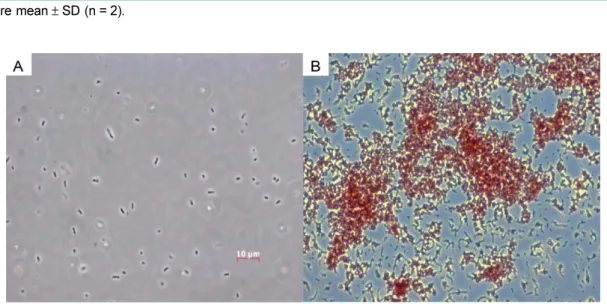
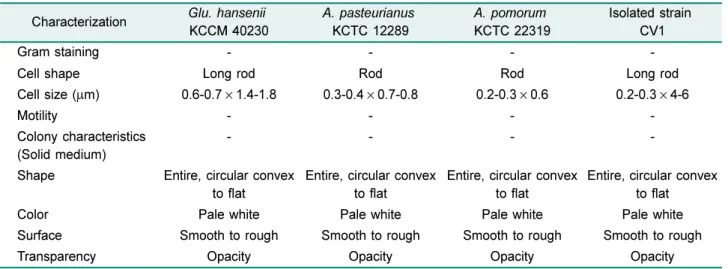
초산균과형태학적특징을비교한결과, CV1 균주는그람
음성균으로크기는 0.2−0.3×4−6 µm였으며운동성이없는 단일균형태의간균으로판단되었다(Fig. 1, Table 2).
분리된 CV1 균주의생화학적특성은 Table 3에나타내었
Table 1. Comparison of acid production by isolated Acetobacter strains.
Acetobacter sp. CV1 CV3 CV5 CV6
Clear zone size (mm) 18.7± 0.61) 17.2± 0.7 16.2± 0.4 16.8± 0.3
1)Values are mean± SD (n = 2).
Fig. 1. Phase contrast micrograph (×1,000) (A) and gram staining (B) of isolated strain CV1 grown on LM agar plate for 2 days and 30oC.
으며, 생화학적및탄소원이용특성을근거로 CV1 균주는 Gluconacetobacter 속(genus) 보다 Acetobacter 속에유사한 것으로판단되었다.
분리 균주의 chemotaxonomy 특성
CV1 균주의 diaminopimelic acid (DAP)는 meso-DAP이 고세포벽 아미노산은 alanine, glutamic acid, glycine 및 Table 2. Morphological characteristics of strain CV1 and type strain of Acetobacter species.
Characterization Glu. hansenii KCCM 40230
A. pasteurianus KCTC 12289
A. pomorum KCTC 22319
Isolated strain CV1
Gram staining - - - -
Cell shape Long rod Rod Rod Long rod
Cell size (μm) 0.6-0.7× 1.4-1.8 0.3-0.4× 0.7-0.8 0.2-0.3× 0.6 0.2-0.3× 4-6
Motility - - - -
Colony characteristics (Solid medium)
- - - -
Shape Entire, circular convex
to flat
Entire, circular convex to flat
Entire, circular convex to flat
Entire, circular convex to flat
Color Pale white Pale white Pale white Pale white
Surface Smooth to rough Smooth to rough Smooth to rough Smooth to rough
Transparency Opacity Opacity Opacity Opacity
Table 3. Biochemical characteristics of strain CV1 and type strain of Acetobacter species.
Characterization Glu. hansenii KCCM 40230
A. pasteurianus KCTC 12289
A. pomorum KCTC 22319
Isolated strain CV1
Catalase (+) (+) (+) (+)
Nitrate reduction - - - -
Indole production - (+) (+) (+)
Glucose fermentaion - - - -
Arginine dihydrolase - - - -
Urease - - - -
Escullin hydrolysis (+) (+) (+) -
Gelatin hydrolysis - - - -
β-glucosidase - - - -
Assimilation
D-glucose - - - -
D-arabinose - - - -
D-mannose - - - -
D-mannitol - - - -
N-acetyl-D-glucosamine - - - -
D-maltose - - - -
Potassium gluconate - - - -
Capric acid - - - -
Adipic acid - - - -
Malic acid - - - -
Trisodium citrate - - - -
Phenylacetic acid - - - -
(+) : positive, - : negative
lysine으로구성되어있는것으로나타났다. CV1 균주의세 포벽지방산조성은불포화지방산과관련지방산(C18:1 w7c/18:1 w6c)이대표적인지방산으로약 65%가존재하고있고, C10:0, C12:0, C18:0 3OH, C16:1 iso I/C14:0 3OH & C16:1 w7c/C16:1
w6c가미량으로존재하는것으로확인되었다. 주된 quinone 은 Q10 (55.8%)과 Q9 (44.2%)으로 확인되었고, Lisdiyanti 등[21]이보고한 Gluconacetobacter 속이갖는대표적인 Q10
이 90% 이상검출된결과와다소상이하였지만, G+C 함량
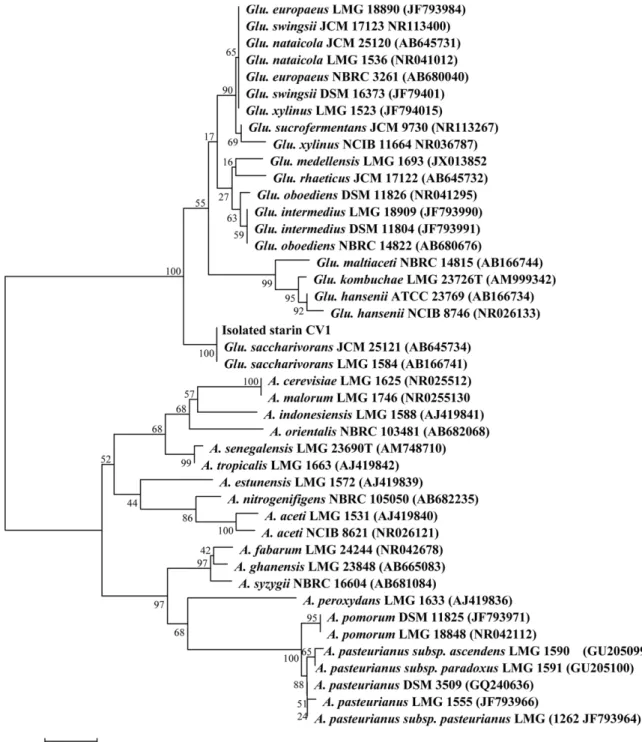
Fig. 2. Phylogenetic tree based on 16S rDNA sequences showing the positions of isolated strain CV1 and the representatives of other related taxa. The tree was constructed from an alignment of the full-length sequence of 16S rRNA from various species using the neighbor-joining method. The number on the nodes corresponds to the bootstrap percentages based on 1,000 pseudoreplicates. The bar denotes the relative branch length. The 16S rRNA sequences are identified by their GenBank accession numbers in parentheses.
은 61.0 mol%로서 Yamada 등[36]이보고한 Gluconacetobacter 속의 G+C 함량 55−66 mol%, quinone의형태는 Q10이주요 quinone이고 Q9도같이존재하며, 주요지방산은 C18:1로본 연구에서분리된균주 CV1은 Gluconacetobacter 속의특징 을가지는것으로판단하였다.
분리 균주의 동정
CV1 균주의 16S rDNA 유전자의염기서열을분석한결
과는 Fig. 2와같다. CV1 균주는 Gluconacetobacter 속균주 들과높은상동성을나타내었으며특히, Glu. saccharivorans LMG 1582와 16S rDNA 유전자의염기서열이 99.97% 이상 일치하였다(Fig. 2). 따라서 선발된 CV1 균주는 Glu.
saccharivorans로판단되어 Glu. saccharivorans CV1으로 동정하였고 16S rDNA 유전자의염기서열은 GenBank에등 록하였다(AB759966). 또한 초산균 CV1은 Glu. hansenii ATCC 23769 (98.23%), Glu. intermedius LMG 18909 (98.89%), Glu. xylinus NCIB 11664 (98.97%), Glu.
sucrofermentans JCM 9730 (99.04%) 종과는유전학적으로 차이가많았다.
탄소원 이용 특성 분석
CV1 균주의탄소원이용능을조사한결과, 모든탄소원에
서생육이확인되었고, 이당류인 sucrose, fructose, 단당류 인 mannose, 지방족 3가알코올인 glycerol 및당알코올인
mannitol에서 CV1 균주의생육이우수한것으로나타났고
대조균주인 Glu. hansenii는 fructose, mannitol, gluconate 를이용하였으나, A. pasteurianus와 A. pomorum은 mannitol
과 lactate 이외의다른탄소원을거의이용하지못하는것
으로 나타났다(Table 4). 대부분의 탄소원을 이용하고
biocellulose를생성하지않는 Glu. europaeus의탄소이용능 을보고한 Park 등[23]의결과와분리균인 CV1의탄소원이 용특성은유사하였지만 Acetobacter 속의이용특성과는다 르게나타내었다.
분리균주의 배양특성 및 초산 생성능 분석
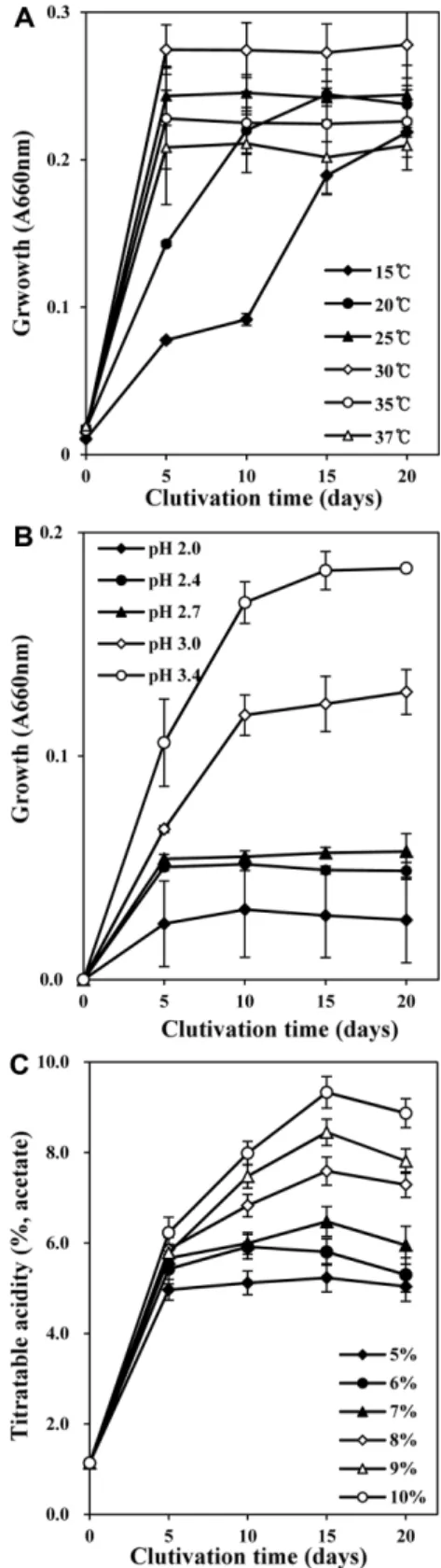
분리균 CV1은 15oC부터 37oC까지생육이가능하였으며 (Fig. 3A), 초기 pH는 pH 3.0과 3.4에서생육이왕성한반면 pH 2.0에서는전혀생육하지못하였다. 따라서분리균 CV1 의최적배양조건은 30oC, pH 3.0 이상으로추정되었다(Fig.
3B). 에탄올농도에따른초산생성능을조사한결과, 초기
에탄올농도 10%에서배양 15일후에약 9.3%의적정산도 를나타냈으며, 9% 에탄올농도에서는 8.4% 적정산도를나 타내어 9% 이상의높은에탄올농도에서적정산도 8% 이상 의높은산생성능을나타내는것으로판단되었다(Fig. 3C).
이러한결과는초산균은발효온도가 30oC일때생육이가장
Fig. 3. Effects of temperature (A), initial pH (B), and ethanol concentration (C) on acetic acid production and growth of Glu. saccharivorans CV1. Cells were grown at 30°C for 3 days in LM medium supplemented with 6% ethanol (A and B), or with the indicated concentration of ethanol (C).
우수하며 15oC에서 34oC까지생육이가능하다는박등[2]의 보고와유사하였고, 초기총산 1.0%에서가장높은수율 62%
로초산을생성한다는 Shin 등[29]의결과와비교하였을때, 분리균주 CV1의초산생산수율은 63%로서유사한수준을 나타내었다.
요 약
본연구에서는정치배양법으로고농도의초산을생산할 수있고에탄올내성이우수한균주를확보하고자농가형발 효식초에서초산균을분리및선발하였고, 이들초산균의형 태적특징을조사한바, 분리균 CV1은그람음성으로운동 성이없는간균으로나타났다. 분리균의 chemotaxonomy를 분석한 결과, meso-DAP이며, 대표 퀴논은 Q10이고, G+C mol 함량은 61.0 mol %로나타났으며 16S rDNA 유전자의 염기서열을분석한결과, Gluconacetobacter saccharivorans 로동정되어 Glu. saccharivorans CV1로명명하였다. CV1 초산균의최적성장조건은 30oC, pH 3.0 이상으로판단되었
고에탄올농도에따른초산생성능은 10% 에탄올농도에서
9.3%, 9% 에탄올농도에서는 8.4% 적정산도를나타내어고 농도에탄올조건에서도높은산생성능을나타내는우수한 균주로판단되었다.
Acknowledgments
This work was carried out with the support of “Cooperative Research Program for Agriculture Science & Technology Develop- ment (Project No. PJ00943901)” Rural Development Administra- tion, Republic of Korea.
References
1. Cha YJ, Park KJ, Kim DK, Chun HS, Lee BK, Kim KH, et al.
1994. Isolation and characterization of cellulose producing Acetobacter xylinum KI strain. Korean J. Appl. Microbiol. Bio- technol. 22: 571-576.
2. Chenna R, Sugawara H, Koike T, Lopez R, Gibson TJ, Hig- gins DG, et al. 2003. Multiple sequence alignment with the clustal series of programs. Nucleic. Acids Res. 31: 3497-3500.
3. Cleenwerck I, De Vos P, De Vuyst L. 2010. Phylogeny and dif- ferentiation of species of the genus Gluconacetobacter and related taxa based on multilocus sequence analyses of housekeeping genes and reclassification of Acetobacter xyli- nus subsp. sucrofermentans as Gluconacetobacter sucrofer- mentans (Toyosaki et al. 1996) sp. nov., comb. nov. Int. J.
Syst. Evol. Microbiol. 60: 3087-3103.
4. De Ley J, Swings J, Gossele F. 1984. Genus I. Acetobacter Beijerinck 1898, 215AL. In Bergey’s Manual of Systematic Table 4. Characteristics of carbon source utilization for strain CV1 and type strain of Acetobacter species.
Carbon sources LM broth – Glucose replaced by
Strain CV1
Glu. hansenii KCCM 40230
A. pasteurianus KCTC 12289
A. pomorum KCTC 22319
Sucrose +++ + + +
Lactose ++ + - -
Mannose +++ - - -
Rhamnose ++ - - -
Galactose ++ - - -
Fructose +++ ++ - -
Maltose ++ - - -
Glycerol +++ + - +
Melibiose ++ - - -
Xylose ++ - - -
Inositol ++ - - -
Mannitol +++ ++ +++ ++
Sorbitol ++ - - -
Arabinose + - - -
Amygdalin ++ - - -
Lactate + - +++ ++
Gluconate + ++ - -
+++: very good, ++: good, +: growth, -: no growth
Bacteriology, 1, pp. 268-274. Edited by NR Krieg, JG Holt.
Baltimore: Williams & Wilkins.
5. Felsenstein J. 1985. Confidence limits on phylogenies: An approach using the bootstrap. Evolution. 39: 783-791.
6. Ha YD, Kim KS. 2000. Civilization history of vinegar. Food Indust. Nutr. 5: 1-6.
7. Jeong YJ, Lee MH. 2000. A view and prospect of vinegar industry. Food Ind. Nutr. 5: 7-12.
8. Jeong YJ. 2009. Current trends and future prospects in the Korean vinegar industry. Food Sci. Ind. 42: 52-59.
9. Kang SK, Jang MJ, Kim YD. 2006. Isolation and culture condi- tions of acetobacter sp. for the production of citron (citrus junos) vinegar. Koran J. Food Preserv. 13: 357-362.
10. Kim BY, Zucchi TD, Fiedler HP, Goodfellow M. 2012. Strepto- myces cocklensis sp. nov., a dioxamycinproducing actinomy- cete. Int. J. Syst. Evol. Microbiol. 62: 279-283.
11. Kim SS, Kang HA, Chang KS. 2000. Effect of membrane sep- aration on persimmon vinegar quality. Food Eng. Prog. 4: 167- 172.
12. Kim SW, Park JH, Jun HK. 2008. Analysis of optimum condi- tion for production of an onionic vinegar by tow-step fermenta- tion. J. Life Sci. 18: 1410-1414.
13. Komagata K, Suzuki K. 1987. Lipid and cell wall analysis in bacterial systematics. Methods Microbiol. 19: 161-206.
14. Kommanee J, Tanasupawat S, Yukphan P, Malimas T, Mura- matsu Y, Nakagawa Y, et al. 2011. Gluconobacter nephelii sp.
now., an acetic acid bacterium in the class Alphaproteobacte- ria. Int. J. Syst. Evol. Microbiol. 61: 2177-2122.
15. Kumar S, Tamura K, Nei M. 2004. MEGA3: Integrated soft- ware for molecular evolutionary genetics analysis and sequence alignment. Brief. Bioinformatics. 5: 150-163.
16. Lane DJ. 1991. 16S/23S rRNA sequencing. In Nucleic Acid Techniques in Bacterial Systematics, pp. 115-175. Edited by E Stackebrandt and M Goodfellow. Chichester: Wiley.
17. Lee SH, Kim JC. 2009. A comparative analysis for main com- ponents change during natural fermentation of persimmon vinegar. J. Korean Soc. Food Sci. Nutr. 38: 372-376.
18. Lee SW, Kwon JH, Yoon SR, Woo SM, Jang SY, Yeo SH, et al. 2010. Quality characteristics of brown rice vinegar by differ- ent yeasts and fermentation condition. J. Korean Soc. Food Sci. Nutr. 39: 1366-1372.
19. Lee YC, Lee JH. 2000. A manufacturing process of high- strength vinegar. Food Ind. Nutr. 5: 13-17.
20. Lim YS, Sul IW. 2004. Isolation of a bacterial strain for fer- mentation of Omija vinegar. J. East Asian Soc. Dietary Life 14:
508-512.
21. Lisdiyanti P, Navarro RR, Uchimura T, Komagata K. 2006.
Reclassification of Gluconacetobacter hansenii strains and proposals of Gluconacetobacter saccharivorans sp. nov. and Gluconacetobacter nataicola sp. nov. Int. J. Syst. Evol. Micro- biol. 56: 2101-2111.
22. Park MH, Lee JO, Lee JY, Yu SJ, Ko YJ, Kim YH, et al. 2005.
Isolation and characteristics of acetic acid bacteria for persim-
mon vinegar fermentation. J. Korean Soc. Food Sci. Nutr. 34:
1251-1257.
23. Park MH, Lyu DK, Ryu CH. 2002. Characteristics of high acid- ity producing acetic acid bacteria isolated from Industrial vine- gar fermentation J. Korean Soc. Food Sci. Nutr. 31: 394-398.
24. Saito H, Miura K. 1963. Preparation of transforming deoxyri- bonucleic acid by phenol treatment. Biochim. Biophys Acta 72: 619-629.
25. Saitou N, Nei M. 1987. The neighbor-joining method: A new method for reconstructing phylogenetic trees. Mol. Biol. Evol.
4: 406-425.
26. Sasser MJ. 1990. Identification of bacteria by gas chromatog- raphy of cellular fatty acids. Technical note 101. Newark, DE:
Microbial ID Inc.
27. Schüller G, Hertel C, Hammes WP. 2000. Gluconacetobacter entanii sp. nov., isolated from submerged high-acid industrial vinegar fermentations. Int. J. Syst. Evol. Microbiol. 50: 2013- 2020.
28. Shin JA, Oh NS. 2010. Optimization of fermentation process for acetic acid production. Food Eng. Progr. 14: 217-221.
29. Shin JS, Jeong YJ. 2003. Changes in the component of acetic acid fermentation of brown rice using raw starch digesting enzyme, J. Korean Soc. Food Sci. Nutr. 32: 381-387.
30. Spitaels F, Wieme A, Balzarini T, Cleenwerck I, Van land- schoot A, De vuyst L, et al. 2014. Gluconobacter cerevisiae sp. nov., isolated from the brewery environment. Int. J. Syst.
Evol. Microbiol. 64: 1134-1141.
31. Thompson JD, Gibson TJ, Plewniak F, Jeanmougin F, Higgins DG. 1997. The clustal X windows interface: flexible strategies for multiple sequence alignment aided by quality analysis tools. Nucleic Acids Res. 25: 4876-4882.
32. Tamaoka K, Komagata K. 1984. Determination of DNA base composition by reversed-phase high-performance liquid chro- matography. FEMS Microbiol. Lett. 25: 125-128.
33. Uhlig H, Karbaum K, Steudel A. 1986. Acetobacter methanoli- cus sp. nov., an acidophilic facultatively methylotrophic bacte- rium. Int. J. Syst. Evol. Microbiol. 36: 317-322.
34. Woo KS, Ko JY, Song SB, Lee JS, Kang JR, Oh BG, et al.
2010. Physicochemical characteristics of vinegars fermented from cereal crops with incalgyun. J. Korean Soc. Food Sci.
Nutr. 39: 1171-1178.
35. Yamada Y. 2000. Transfer of Acetobacter oboediens Sokollek et al. 1998 and Acetobacter intermedius Boesch et al. 1998 to the genus Gluconacetobacter as Gluconacetobacter oboedi- ens comb. nov. and Gluconacetobacter intermedius comb.
nov. Int. J. Syst. Evol. Microbiol. 50: 2225-2227.
36. Yamada Y, Kondo K. 1984. Gluconoacetobacter, a new sub- genus comprising the acetate-oxidizing acetic acid bacteria with ubiquinone-10 in the genus Acetobacter. J. Gen. Appl.
Microbiol. 30: 297-303.
37. Yoon HN. 1998. Simultaneous gas chromatographic analysis of ethanol and acetic acid in vinegar. Korean J. Food. Sci.
Technol. 30: 1247-1251.