†These authors contributed equally to this work.
S.-C. Park†・S. H. Kim ・ J. C. Jeong ・ H.-S. Lee ・ S.-S. Kwak () 한국생명공학연구원 식물시스템공학연구센터
(Plant Systems Engineering Research Center, Korea Research Institute of Bioscience and Biotechnology (KRIBB), Daejeon 305-806, Korea)
e-mail: [email protected] M. D. Kim†
국립한경대학교 유전공학연구소
(Institute of Genetic Engineering, Hankyong National University (HNU), Anseong 456-749, Korea)
Y.-H. Kim
국립경상대학교 사범대학 생물교육과
(Department of Biology Education, College of Education, Gyeongsang National University, Jinju 660-701, Korea)
CodA 고발현 형질전환 고구마의 산화 및 건조 스트레스 내성 증가
박성철 ・ 김명덕 ・ 김선하 ・ 김윤희 ・ 정재철 ・ 이행순 ・ 곽상수
Enhanced drought and oxidative stress tolerance in transgenic sweetpotato expressing a codA gene
Sung-Chul Park・ Myoung Duck Kim・ Sun Ha Kim・ Yun-Hee Kim・ Jae Cheol Jeong・ Haeng-Soon Lee・ Sang-Soo Kwak
Received: 9 March 2015 / Revised: 20 March 2015 / Accepted: 20 March 2015
ⓒKorean Society for Plant Biotechnology
Abstract Glycine betaine (GB) is one of the compatible solutes that accumulate in the chloroplasts of certain halotolerant plants under salt or cold stress. The codA gene for choline oxidase, the enzyme that converts choline into GB, has been cloned from a soil bacterium Arthrobacter globiformis. We generated transgenic sweetpotato plants [Ipomoea batatas (L.) Lam] expressing codA gene in chloroplasts under the control of the SWPA2 promoter (referred to as SC plants) and evaluated SC plants under oxidative and drought stresses.
SC plants showed enhanced tolerance to methyl viologen (MV)-mediated oxidative stress and drought stress due to induced expression of codA. At 5 μM of MV treatment, all SC plants showed enhanced tolerance to MV-mediated oxidative stress through maintaining low ion leakage and increased GB levels compared to wild type plants. When plants were subjected to drought conditions, SC plants showed enhanced tolerance to drought stress through maintaining high relative water contents and increased codA expression compared to
wild type plants. These results suggest that the SC plants generated in this study will be useful for enhanced biomass production on global marginal lands.
Keywords Sweetpotato, Glycine betaine, codA gene, Oxidative stress, Drought stress
서 론
가뭄, 고 염분, 저온, 고온과 같은 환경스트레스는 식물 의 생장과 발달을 저해하여 생산성 저하에 큰 영향을 미 친다(Bray 1997; Wang et al. 2003). 특히 사막화 면적은 지 나친 방목, 삼림훼손, 부적절한 물과 토양관리 등이 원인 으로 전 세계에 매년 약 1200만 ha씩 확산되고 있다. 현 재 100개국 이상의 15억 인구가 사막화의 직접적인 영향 을 받고 있으며 지표면적의 41% 정도가 사막화의 피해 를 받고 있다(Reynolds et al. 2007). 또한, 농약과 화학비 료의 과다한 사용과 잘못된 경작관리 등으로 세계적으 로 토양의 염류화가 급속하게 진전되고 있다. 국제연합 식량농업기구(FAO)의 집계에 의하면 전 세계의 염류화 토양 면적은 매년 100 ~ 150만 ha씩 증가하고 있고 현재 염류화 된 토지의 전체 면적은 9.55억 ha로 집계되고 있 다(Sun et al. 2014). FAO는 2050년 세계 인구가 91억 명이 될 것이며 지금 추세로 동물성 단백질을 소비하면 2050 년에는 지금의 1.7배의 식량이 필요할 것으로 전망했다.
따라서 사막화 지역, 염류화 지역 등 글로벌 조건 불리지 역에 적합한 농작물 개발이 시급하다. 이러한 요구에 의 해 형질전환기술과 유전체정보를 이용하여 다양한 환경 스트레스 조건에서도 생장이 가능한 형질전환 재해내성 작물이 개발되고 있다.
DOI:http://dx.doi.org/10.5010/JPB.2015.42.1.19 Research Article
ISSN 1598-6365
식물이 과도한 스트레스를 받게 되면 생체 내 산소가 superoxide anion radical, hydrogen peroxide, hydroxyl radical 등의 반응성이 높은 독성의 활성산소종(reactive oxygen species, ROS)으로 변하게 되고(Allen 1995), ROS의 과다 발생은 식물의 생산성을 감소시키는 주요 요인이 되고 있다(Inze and Van Montagu 1995). 그러나 이러한 ROS는 superoxide dismutase (SOD), peroxidase (POD) 등의 항산화 효소와 ascorbic acid, glutathione 등의 저분자 항산화물질 등에 의해 효율적으로 제거된다(Allen 1995). 또한 건조 와 고염분과 같은 환경조건에 대해 저항성을 가지는 식 물은 세포질 내 용질의 농도를 증가시키는 삼투조절 기 작이 잘 발달되어 있다. 잘 알려진 세포질성 삼투조절 물 질로는 proline, trehalose, soluble sugar, glycine betaine (GB) 등이 있다(Sakamoto and Murata 2002). 이들 중 GB는 아미 노산 glycine의 유도체이며, 양쪽성 이온으로 choline의 산 화에 의하여 합성된다. GB합성은 일반적인 식물과 대장 균에서는 choline monooxygenase (CMO)에 의해 choline이 betaine aldehyde로 전환된 이후 betaine aldehyde dehydrogenase (BADH)에 의해 GB가 생성된다(Ahmad et al. 2013). 하지 만 박테리아 Arthrobacter globiformis, A. pascens의 경우 choline oxidase (COD/COX)라는 하나의 효소에 의해 choline으로 부터 GB가 합성된다(Hayashi et al. 1997; Ahmad et al. 2013).
BADH 혹은 cod/cox 유전자의 고발현은 많은 식물체에서 GB함량을 증가시켰으며, 이로 인해 GB가 증가된 식물체 는 건조, 고염, 저온 등의 환경스트레스에 저항성을 획득 한 것으로 보고되어 있다(Ashraf and Foolad 2007). 일반적 으로 GB는 밀, 사탕무, 시금치 등의 소수 작물에서는 합 성되는 반면, 벼, 감자, 토마토 등의 작물들에서는 합성 되지 않아 분자육종을 통하여 GB함량을 증가시켜 여러 환경스트레스에 저항성을 가지는 작물을 만드는 연구가 필요하다. GB함량이 높은 형질전환식물체가 산화스트레 스에 대한 내성이 증가됨이 저자들의 선행연구에서 규 명된바 있다(Ahmad et al. 2008; Li et al. 2014).
고구마 [Ipomoea batatas (L.) Lam]는 메꽃과(Convol- vulaceae)의 식량작물로 전 세계 약 100여 개의 나라에서 재배되며 밀, 벼, 옥수수, 감자, 보리, 카사바에 이어 세계 7번째 주식작물로서 매년 1억 톤 이상 생산되고 있다. 고 구마는 재배가 비교적 용이하며 넓은 범위의 기후에 적 응이 가능하고 생산량이 높은 작물로 조건불리지역에 적합한 작물로 평가된다. 2008년 미국 농무부(USDA)는 대표적인 전분작물인 옥수수, 카사바, 고구마, 감자 등을 미국 북부지역과 남부지역에 재배한 결과 고구마가 단 위면적당 가장 많은 탄수화물을 생산하며 특히 조건불 리지역에 가장 적합한 바이오에탄올 작물로 평가하였다 (Ziska et al. 2009). 그러나 건조, 고염분, 저온, 해충 및 바 이러스 등과 같은 스트레스들은 고구마의 생산량을 저 해하는 요인으로 알려져 있다. 그러므로 여러 환경스트
레스 에서 내성을 가지는 새로운 고구마 품종의 개발이 필요하다.
본 연구에서는 건조, 고염 등 스트레스에 내성이 증가된 고구마를 개발하기 위하여 산화스트레스 유도성 SWPA2 프로모터 조절 하에 박테리아(A. globiformis) 유래의 choline oxidase (codA) 유전자를 엽록체에 고발현시킨 형질전환 고구마를 제작하고 형질전환식물체의 GB함량 변화와 환경 스트레스에 대한 반응을 분자생화학적 방법을 통 하여 분석하였다.
재료 및 방법 식물재료
실험에 사용한 고구마 [Ipomoea batatas (L.) Lam.]는 국립 식량과학원 바이오에너지작물연구소에서 분양 받은 품 종인 율미(cv. Yulmi)를 사용하였다. 형질전환을 위한 배 발생 캘러스를 유도하기 위하여 어린식물체의 정아 및 측아 부분을 70% 에탄올에서 1분간 세척 후 2% NaClO 용액에서 5분간 소독하였다. 소독이 끝난 정아와 측아는 멸균된 증류수를 이용하여 5회 반복 세척하였다. 세척된 정아와 측아에서 생장점을 분리하여 1 mg/L의 2,4-dich- lorophenoxyacetic acid (2,4-D)와 3 g/L의 gelite가 포함된 MS배지(Murashige and Skoog 1962)에 3달간 배양하여 얻 어진 배발생 캘러스를 형질전환 실험에 사용하였다.
발현벡터 및 형질전환
본 실험에 사용된 유전자 발현벡터는 산화스트레스 유 도성 SWPA2 프로모터 조절 하에 고구마 엽록체에 박테 리아 유래 codA 유전자가 발현되도록 제작된 것을 사용 하였다(Hayashi et al. 1997; Kim et al. 2003; Ahmad et al.
2008; Li et al 20014). 고구마 형질전환실험은 Lim 등 (2004)의 실험방법을 참고하여 진행하였다. 배발생 캘러 스와 배양된 아그로박테리움(EHA 105)을 3일간 공동배 양한 후, MS 기본배지로 세척하여 선발배지(MS salt, 1 mg/L 2,4-D, 400 mg/L cefotaxime, 100 mg/L kanamycin)에 서 배양하고 3주 간격으로 새로운 선발배지로 계대배양 하였다. 선발배지에서 살아남은 배발생 캘러스는 400 mg/L cefotaxime과 100 mg/L kanamycin을 포함한 MS배지로 옮겨 지상부와 뿌리를 유도하여 소식물체로 재분화 시켰다.
Genomic DNA 분석 및 유전자 발현분석
Genomic DNA는 CTAB 추출 방법을 이용하여 고구마 잎 에서 분리하였다(Kim and Hamada 2008). 분리된 genomic
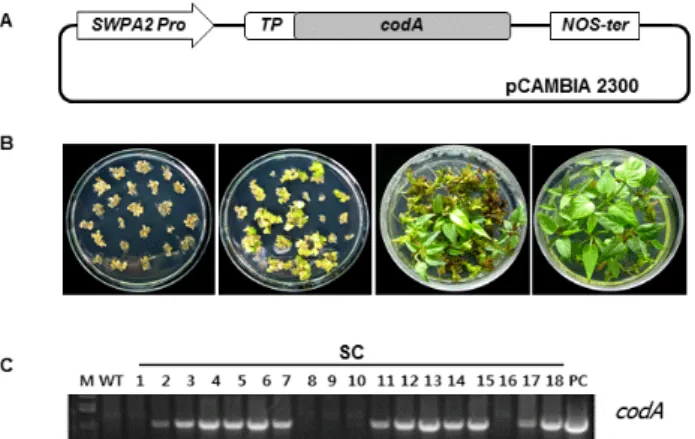
Fig. 1 Development of transgenic sweetpotato plants expressing the codA gene. (A) Schematic representation of the T-DNA regions of vector used for sweetpotato transformation. SWPA2 Pro, sweetpotato peroxidase anionic 2 promoter; TP, transit peptide from the sequence of the small subunit of Rubisco (tobacco);
codA, choline oxidase cDNA; NOS-ter, termination sequence from the nopaline synthase gene. (B) Agrobacterium-mediated transformation of embryogenic calli of sweetpotato. (C) Genomic DNA PCR analysis of the codA gene from transgenic plants. M, size markers; WT, wild-type plant; PC, positive control; Numbers (1-18), independent putative transgenic lines
DNA를 codA 유전자 특이적 프라이머(Forward: GCTGC- TGGAATCGGGCTA, Reverse: TGGGCTTATCGCGGAAGT) 를 사용하여 genomic PCR을 수행하였다. 유전자 발현분 석을 위해 total RNA는 TRIzol reagent (Invitrogen, USA)를 이용하여 분리하였고, cDNA 합성은 TOPscript RT DryMIX (Enzynomics, Korea)를 사용하여 합성하였다. 합성된 cDNA 를 주형으로 codA 유전자 특이적 프라이머(Forward: CACA- ACTCCTGCATCGCCTT, Reverse: GTTGGTTTCCAGCCG- CTTGTA)를 제작하여 real-time PCR을 수행 하였다. 시료 의 cDNA양을 보정하기 위한 내부 대조유전자로 고구마 의 ADP-ribosylation factor (Forward: CTTTGCCAGAAG- GAGATGC, Reverse: TCTTGTCCTGACCACCAACA)를 사 용하였다(Park et al. 2012). Real-time PCR 실험과 분석은 CFX real-time PCR system과 software를 사용하였다(Bio-Rad, USA).
Methyl viologen 처리 및 이온전도도 분석
Methyl viologen (MV) 처리를 위해 상토에 삽식하여 5주 된 고구마의 3번째 잎을 사용하였다. 8개의 잎 절편(직 경: 8 mm)을 5 μM MV가 포함된 0.4% (w/v)의 sorbitol 용 액에 띄워 12시간 동안 25°C 암 상태로 배양한 후 25°C 광조건(150 μmol m-2s-1)에서 지속적으로 배양시켰다. 세 포의 이온소실은 ion conductivity meter를 이용하여 0 ~ 48 시간 동안 12시간 단위로 측정하고 48시간 이후 시료를 80°C에서 2시간 동안 처리하여 세포를 완전 파괴시킨 이 온의 소실 값을 100%로 하여 환산 하였다.
Glycine betaine 함량 측정
Glycine betaine (GB)의 함량을 측정하기 위하여 5 μM 농 도의 MV를 분무 처리한 잎 0.1 g에 0.5 ml의 methanol:
chloroform: water (60:25:15)을 이용하여 추출한 후 AG-1-X8 anion exchange resin (Bio-Rad, USA)을 이용하여 GB를 정 제하였다(Park et al. 2004). 정제한 GB는 spectrophotometer 를 이용하여 Li 등(2014)의 방법을 사용하여 측정하였다.
건조스트레스 처리
상토에 삽주하여 5주 된 고구마 식물체에 건조처리를 하 였다. 배양실 조건(25°C, 100 μmol photons m-2s-1, 30% 습 도)에서 14일간 관수 하지 않고 식물을 배양하였다. 상대 수분함량(RWC)과 malondialdehyde (MDA) 분석을 통하여 건조스트레스의 정도를 측정하였다. 상대수분함량(relative water content, RWC)은 [RWC (%) = (생중량 - 건조중량) / (팽압 - 건조중량) x100] 수식으로 구하였다. 여기서 팽 압무게는 신선한 잎을 4°C 암상태에서 12시간 배양한 후
무게를 말한다. MDA의 측정은 spectrophotometer를 이용 하여 Li 등(2014)의 방법을 사용하여 측정하였다.
통계 분석
실험의 모든 결과는 Statistical Package for the Social Sciences (SPSS12)를 이용한 일원분산분석 방법을 사용하여 통계 분석을 시행하였다. 데이터 비교는 least significant difference (LSD)를 이용하였으며 통계적 유의성은 *P <0.05 및 **P
<0.01로 설정하였다.
결과 및 고찰
CodA 유전자 도입 형질전환 고구마 제작
환경 스트레스에 저항성을 가지는 고구마 식물체를 만 들기 위하여 A. globiformis에서 분리한 choline oxidase를 암호화하는 codA 유전자를 고구마 유래의 산화스트레스 유도성 SWPA2 프로모터의 조절 하에 율미 품종에 도입 한 형질전환 식물체(SC식물체)를 개발하였다(Fig. 1A, B).
SC 식물체에 사용한 벡터는 kanamycin 선발마커가 있는 pCAMBIA 2300을 사용하였으며, codA 단백질을 엽록체 로 위치하게 하는 transit peptide (TP)를 codA 유전자 앞부 분에 삽입하였다. Kanamycin 함유배지에서 선발된 총 70 개의 소식물체 중 생장이 빠른 18개의 소식물체를 선발 하여 genomic PCR을 수행하여 codA 유전자가 안정적으
Fig. 2 Characterization of SC sweetpotato plants expressing the codA gene. (A) Phenotype of SC Plants. WT, wild-type plant;
SC2~SC18, transgenic SC plant lines. (B) Quantitative real-time RT-PCR analysis of 12 lines expressing stable codA gene integration in transgenic plants following MV treatment
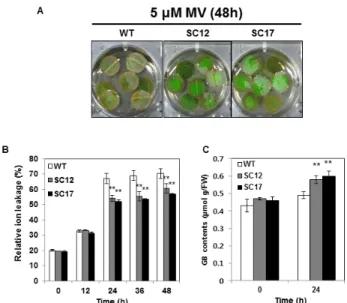
Fig. 3 Effect of methyl viologen (MV)-mediated oxidative stress on the ion leakage of wild-type (WT) and transgenic (SC) plants at 0 to 48 h after 5 μM MV treatment. (A) Differential visible damage of leaf discs. (B) Relative ion leakage. (C) Glycine betaine (GB) contents of WT and SC plants before and after MV treatment. Data are expressed as the mean ± SD of three replicates. Asterisks indicate a significant difference between WT and SC plants at **p < 0.01 by LSD test
로 도입된 13개 라인을 선발하였다(Fig. 1C). 선발된 재분 화 식물체는 2주간의 순화과정을 거쳐 상토로 옮겨 이후 실험을 수행하였다.
SC 식물체의 표현형
CodA 유전자의 발현 및 GB함량의 증가가 식물의 표현형 에 미치는 영향을 관찰하기 위해, 정상생육조건에서 형 질전환 식물체의 표현형을 관찰하였다. 형질전환식물체 잎의 모양을 비교했을 때, SC6 식물체는 비형질전환 식 물체(대조구)와 비슷한 잎의 모양을 보였으며, SC2, SC7, SC11 식물체는 잎의 크기가 작으면서 길쭉한 모양을 나 타내었다. 그리고 나머지 9개의 SC식물체들은 거치가 발 달된 잎의 모양을 나타내었다(Fig. 2A). 5 μM MV를 식물 체에 처리한 후 real-time PCR을 이용하여 codA 유전자의 발현을 확인하였을 때, 13개의 선별된 형질전환체 중 SC12, SC17 식물체 유전자의 발현이 가장 높았으며 두 형질전환체는 대조구에 비하여 잎의 거치가 발달되어 있었다(Fig. 2B).
최근 Li 등(2014)에 따르면 SWPA2 프로모터의 조절하 에 codA 유전자가 과발현시 auxin 관련 유전자의 과발현 이 유도되어 형질전환 알팔파의 성장이 대조구 보다 증 가되었다. 본 연구의 SC 식물체의 경우 식물의 성장 증 가는 관찰되지 않았지만 잎의 거치가 증가하는 표현형 이 많이 관찰되었다. 잎의 거치 발달은 auxin 호르몬이 아닌 cytokinin과 gibberellin 호르몬의 상호 조절에 의해서 결정되는 것으로 알려져 있다(Blein et al. 2013). 이후 연
구에서 codA 유전자 혹은 GB의 함량이 식물호르몬을 조 절하는지에 대한 연구가 더 필요할 것으로 사료된다.
SC 식물체의 산화스트레스 내성
Choline oxidase를 암호화하는 codA 유전자는 식물에 과 발현 시 GB를 고축적하여 염분, 건조, 저온 스트레스 등 과 같은 다양한 비생물학적 스트레스에 대한 저항성을 부여하는 것으로 알려져 있다. 산화스트레스 조건에서 형질전환 식물체의 반응을 보기 위하여 잎 절편에 5 μM 농도의 MV를 처리하였다(Fig. 3A). 이온전도도 분석결과 MV 처리 후 24시간 이후부터 대조구가 SC12, SC17번 식 물체보다 세포내 이온의 소실이 약 10% 더 증가하였다 (Fig. 3B). SC 식물체의 산화스트레스 내성이 GB함량과 관련이 있는 것을 확인하기 위하여 GB 함량을 측정하였 다. MV 처리시 대조구의 GB 함량은 0.48 µmol g/FW 이 었고, SC12, SC17 식물체는 각각 0.58, 0.60 µmol g/FW로 대조구보다 더 많은 GB를 합성하였다(Fig. 3C). 따라서 증가된 GB 함량으로 인해 SC 식물체들이 산화 스트레스 에 대한 내성을 획득한 것으로 판단된다.
SC 식물체의 건조내성
GB 함량의 증가가 건조스트레스에 미치는 영향을 평가 하기 위하여, SC 식물체의 건조내성 실험을 진행하였다.
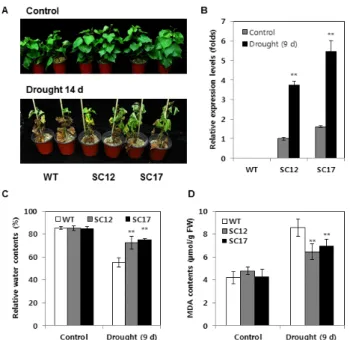
Fig. 4 Drought stress analysis of WT and SC plants. (A) Plant growth before drought stress (upper panel) and after water withholding for 14 days (lower panel). (B) Quantitative real-time RT-PCR analysis of codA expression before drought stress and after water withholding for 9 days. (C) Relative water content of WT and SC plants before drought stress and after water withholding for 9 days. (D) Malondialdehyde (MDA) contents in leaves before drought stress and after water withholding for 9 days treatment.
Data are expressed as the mean ± SD of three replicates. Asterisks indicate a significant difference between WT and SC plants at
**p < 0.01 by LSD test
상토에 삽주한 대조구와 SC식물체를 건조처리하여 대조 구의 잎이 위조(wilting)되는 9일째 잎의 codA 유전자의 발현과 상대수분함량(RWC)을 조사하였다. 건조 처리 14 일 이후 SC 식물체는 대조구에 비해 잎의 고사의 정도가 확연하게 드러났다(Fig. 4A). 대조구에서는 codA 유전자 가 발현하지 않았으며 SC12 및 SC17 식물체에서는 건조 처리 전에 비해 건조 9일 처리 후 codA 유전자의 발현이 3배 이상 증가하였다(Fig. 2B). RWC는 SC식물체가 대조 구에 비해 약 15% 높아 건조에 저항성을 가지는 것을 확 인하였다(Fig. 4C). 또한, 9일째 식물체의 세포 지질의 과 산화도를 MDA함량 분석으로 측정하였을 때, 대조구가 SC식물체보다 높은 MDA 활성을 가지고 있어 세포내 지 질의 과산화가 더 많이 진행되었음을 알 수 있었다(Fig.
4D). 따라서 codA 유전자의 과발현이 GB함량을 증가시 켜 SC 식물체가 대조구 식물체에 비해 건조 저항성을 획 득한 것으로 간주된다.
최근 동일한 codA 과발현 벡터를 도입한 감자 및 알팔 파의 경우 공통적으로 GB 함량의 증가에 따라 산화, 건 조, 고염 등의 환경 스트레스에서 저항성을 보였으며 알 팔파의 경우 또 다른 삼투조절 물질인 proline의 함량 역 시 증가하였다(Ahmad et al. 2008; Li et al. 2014). 시금치
의 BADH를 CaMV 35S 프로모터의 조절하에 과발현한 형 질전환 고구마의 논문에 의하면 GB의 증가는 proline의 증가뿐 아니라 SOD, APX 등의 항산화효소 유전자 발현 을 증가시킨다고 보고되어 있다(Fan et al. 2012). 따라서 본 연구의 SC식물체의 MV에 의해 유도된 산화스트레스 및 건조스트레스에 대한 내성 증가는 GB, proline 그리고 항산화효소의 상호작용에 의한 결과로 예측된다. 이들의 보다 정확한 상호기작을 규명하기 위해 SC식물체의 전 사체 분석 등을 수행할 필요가 있다.
GB 함량을 증가시킨 형질전환 목화, 벼, 토마토 등에 서도 건조 및 염 스트레스 조건에서 생산량 증가가 보고 되었다(Ahmad et al. 2013). 특히 밀의 경우 고염 스트레 스에서 형질전환체의 생산량이 대조구에 비해 51 ~ 90%
까지 상승하였다(He et al. 2010). Fan 등(2012)의 연구에 따르면 고염 조건에서 GB 함량이 증가된 고구마의 괴근 형성이 대조구에 비해 증가하여 고염을 포함한 환경스 트레스 조건에서 고구마의 저장뿌리 생산량 증가의 가 능성을 시사하였다. 본 연구의 SC 식물체는 산화 및 건 조스트레스에서 저항성을 보임으로 환경스트레스 조건 및 일반 재배조건에서 고구마 괴근 생산량 증가가 기대 된다.
적 요
식물은 여러 환경스트레스에 적응하기 위해 스트레스 내성 유전자의 발현 혹은 proline, trehalose, glycine betaine (GB) 등과 같이 삼투압을 조절하는 compatible solute를 생 성하면서 진화해 왔다. GB는 고염, 저온 등 환경스트레 스 조건에서 식물의 엽록체에서 축적되는 물질 중 하나 이다. 토양 박테리아 Arthrobacter globiformis에서 분리한 choline oxidase (codA) 유전자는 choline을 GB로 전환하는 기능을 한다. 본 연구에서는 산화스트레스 유도성 SWPA2 프로모터의 발현조절 하에 codA 유전자를 엽록체에 과 발현시킨 형질전환 고구마 식물체(SC식물체)를 제작하 여 다양한 환경스트레스 조건에서의 특성을 분석하였다.
SC 식물체는 methyl viologen (MV)에 의한 산화스트레스 와 건조 처리 조건에서 내성 증가를 보였다. 5 μM MV 처리시 형질전환 식물체는 GB의 함량이 증가하였고 낮 은 수준의 이온 전도도를 보였다. 건조 스트레스 조건에 서 형질전환 식물체는 codA 유전자의 발현이 증가하였 으며, 대조구 보다 높은 상대수분함량을 유지하였다. 따 라서 본 연구결과의 SC식물체는 고염, 건조토양 등 조건 불리지역에 재배하면 바이오매스를 증가시킬 수 있을 것으로 예상된다.
사 사
본 연구는 2015년도 한국생명공학연구원 주요사업(KRIBB Initiative Program)과 농촌진흥청 차세대 바이오그린21사 업(시스템합성농생명공학사업단 과제번호: PJ01106401) 의 지원으로 수행되었다.
Reference
Ahmad R, Kim M, Back KH, Kim HS, Lee HS, Kwon SY, Murata N, Chung WI, Kwak SS (2008) Stress-induced expression of choline oxidase in potato plant chloroplasts confers enhanced tolerance to oxidative, salt, and drought stresses. Plant Cell Rep 27:687-698
Ahmad R, Lim C, Kwon SY (2013) Glycine betaine: a versatile compound with great potential for gene pyramiding to improve crop plant performance against environmental stresses. Plant Biotechnol Rep 7:49-57
Allen RD (1995) Dissection of oxidative stress tolerance using transgneic plants. Plant Physiol 107:1049-1054
Ashraf M, Foolad M. R (2007) Roles of glycine betaine and proline in improving plant abiotic stress resistance. Environ Exp Bot 59:206-216
Blein T, Pautot V, Laufs P (2013) Combinations of mutations sufficient to alter Arabidopsis leaf dissection. Plants 2:
230-247
Bray E A (1997) Plant responses to water deficit. Trends Plant Sci 2:48-54
Fan W, Zhang M, Zhang H, Zhang P (2012) Improved tolerance to various abiotic stresses in transgenic sweet potato (Ipomoea batatas) expressing spinach betaine aldehyde dehydrogenase.
PLoS One 7:e37344
Hayashi H, Alia, Mustardy L, Deshnium P, Ida M, Murata N (1997) Transformation of Arabidopsis thaliana with the codA gene for choline oxidase; accumulation of glycinebetaine and enhanced tolerance to salt and cold stress. Plant J 12:133-142 He C, Yang A, Zhang W, Gao Q, Zhang J (2010) Improved salt
tolerance of transgenic wheat by introducing betA gene for glycine betaine synthesis. Plant Cell Tiss Org 101:65-78 Inze D, Van Montagu (1995) Oxidative stress in plants. Curr Opin
Biotechnol 6:166-172
Kim KY, Kwon SY, Lee HS, Hur Y, Bang JW, Kwak SS (2003) A
novel oxidative stress-inducible peroxidase promoter from sweetpotato: molecular cloning and characterization in transgenic tobacco plants and cultured cells. Plant Mol Biol 51:831-838 Kim SH, Hamada T (2005) Rapid and reliable method of extracting
DNA and RNA from sweetpotato, Ipomoea batatas (L). Lam.
Biotechnol Lett 27:1841-1845
Li H, Wang Z, Ke Q, Ji CY, Jeong JC, Lee HS, Lim YP, Xu B, Deng XP, Kwak SS (2014) Overexpression of codA gene confers enhanced tolerance to abiotic stresses in alfalfa. Plant Physiol Biochem 85:31-40
Lim S, Yang KS, Kwon SY, Paek KH, Kwak SS, Lee HS (2004) Agrobacterium-mediated genetic transformation and plant regeneration of sweetpotato (Ipomoea batatas). J Plant Biotechnol 31:267-271
Murashige T, Skoog F (1962) A revised medium for rapid growth and bioassays with tobacco tissue culture. Physiol Plant 15:
473-497
Park EJ, Jeknić Z, Sakamoto A, DeNoma J, Yuwansiri R, Murata N, Chen THH (2004) Genetic engineering of glycinebetaine synthesis in tomato protects seeds, plants, and flowers from chilling damage. Plant J 40:474-487
Park SC, Kim YH, Ji CY, Park S, Jeong JC, Lee HS, Kwak SS (2012) Stable internal reference genes for the normalization of real-time PCR in different sweetpotato cultivars subjected to abiotic stress conditions. PLoS One 7:e51502
Reynolds JF, Smith DM, Lambin EF, Turner BL, Mortimore M, Batterbury SP, Downing TE, Dowlatabadi H, Fernández RJ, Herrick JE, Huber-Sannwald E, Jiang H, Leemans R, Lynam T, Maestre FT, Ayarza M, Walker B (2007) Global Deser- tification: Building a Science for Dryland Development.
Science 316:847-851
Sakamoto A, Murata N (2002) The role of glycine betaine in the protection of plants from stress: clues from transgenic plants.
Plant Cell Environ 25:163-171
Sun YF, Niu LC, Song FQ (2014) Progress on salinization soil restoration method. Int J Ecol 3:30-36
Wang W, Vinocur B, Altman A (2003) Plant responses to drought, salinity and extreme temperatures: towards genetic engineering for stress tolerance. Planta 218:1-14
Ziska LH, Runion GB, Tomecek M, Prior SA, Torbet HA, Sicher R (2009) An evaluation of cassava, sweet potato and field corn as potential carbohydrate sources for bioethanol production in Alabama and Maryland. Biomass Bioenergy 33:1503-1508