• 검색 결과가 없습니다.

Penile Mass Caused by Seung Hoon Ryang, Minseob Eom

N/A
N/A
Protected

Academic year: 2021

Share "Penile Mass Caused by Seung Hoon Ryang, Minseob Eom"

Copied!
4
0
0

로드 중.... (전체 텍스트 보기)

전체 글

(1)

126

Case Report

ISSN 2465-8243(Print) / ISSN 2465-8510(Online) http://dx.doi.org/10.14777/uti.2015.10.2.126 Urogenit Tract Infect 2015;10(2):126-129

Penile Mass Caused by Mycobacterium tuberculosis

Seung Hoon Ryang, Minseob Eom

1

, Tae Wook Kang, Chang Min Lee, Hyun Chul Chung, Jae Mann Song, Kwang Jin Kim, Jae Hung Jung

Departments of Urology and

1

Pathology, Yonsei University Wonju College of Medicine, Wonju, Korea

Tuberculosis of the penis is rare. The clinical features of penile tuberculosis are usually manifested as ulceration or scars. However, the authors encountered a case of penile tuberculosis that presented as a mass. A painless nodule at the base of the penis was noted in a 63-year-old male patient. Surgical excision was recommended, and pathologic finding revealed granulomatous inflammation in the mass. Acid fast bacilli stain and culture were negative, but a positive result was found in urine polymerase chain reaction for detection of Mycobacterium tuberculosis. He was diagnosed with tuberculosis of the penis and underwent anti-tuberculosis chemotherapy.

Keywords: Penis; Tuberculosis; Male genital tuberculosis

Copyright 2015, Korean Association of Urogenital Tract Infection and Inflammation. All rights reserved.

This is an open access article distributed under the terms of the Creative Commons Attribution Non-Commercial License (http://creativecommons.org/licenses/by-nc/4.0) which permits unrestricted non-commercial use, distribution, and reproduction in any medium, provided the original work is properly cited.

Received: 15 March, 2015 Revised: 4 June, 2015 Accepted: 6 July, 2015

Correspondence to: Jae Hung Jung

http://orcid.org/0000-0002-4990-7098 Department of Urology, Yonsei University Wonju College of Medicine, 20 Ilsan-ro, Wonju 26426, Korea

Tel: +82-33-741-0652, Fax: +82-33-748-3804 E-mail: [email protected]

Tuberculosis (TB) is a disease caused by Mycobacterium tuberculosis [1]. Recent involvement of the genitourinary system has been reported in 5.8% of all cases of extra- pulmonary TB (EPTB), and the proportion is 1.5% for all patients with pulmonary TB [2]. Penile TB is a rare form of urogenital TB, but it remains important because it is difficult to differentiate from a cancer [3]. Few penile TB cases have been reported, and ulceration or scar was the most prominent presentation. Penile TB is clinically indis- tinguishable from a malignant condition although it can also progress to a tubercular cavernositis with involvement of urethra [1]. Here, we report on a rare case of penile TB that appeared to be a tuberculid.

CASE REPORT

A painless nodule at the base of the penis was noted in a 63-year-old male, and he was referred to our institution for further evaluation. His past medical history included

hypertension and diabetes, but no previous history of genitourinary infection or malignancy or surgical history.

No penile deformity was associated with the mass, and he did not complain of any voiding dysfunctions or symp- toms such as hematuria.

The patient noticed the mass about 1 month ago before making a visit to his local practitioner for the condition.

The non-tender mass located at the dorsal aspect of the base of the penis was firm, mobile, and well-circumscribed.

Routine chest radiography finding was insignificant. Leuko-

cytosis was found on urine analysis, but bacteria were not

evident on urine bacterial culture. High venereal disease

research laboratory and human immunodeficiency virus

(HIV) antigen tests were all negative. Imaging studies were

recommended for further evaluation. Abdomen-pelvic

computed tomography (APCT) and penile ultrasonography

(US) showed a 15×15×17 mm sized non-enhancing cystic

mass with enhancement of the wall on the dorsal aspect

of the penile base (Fig. 1, 2). No lymphadenopathy was

(2)

Seung Hoon Ryang, et al. Penile Tuberculosis 127

Urogenit Tract Infect Vol. 10, No. 2, October 2015 Fig. 4. Histologically, well circumscribed nodules contain chronic granulomatous inflammation with caseous necrosis (arrows) (H&E stain, ×400).

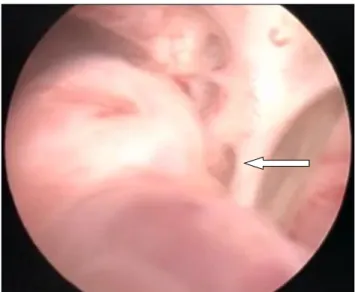
Fig. 3. Multiple diverticulums in the vicinity of the ejaculatory duct (arrow) were observed on verumontanum intraoperative cystoscopy.

Fig. 1. Abdomino-pelvic computed tomography showed a 15×15×17 mm sized non-enhancing cystic mass with wall enhancement on the dorsal aspect of the penis base (arrow).

Fig. 2. Penile ultrasonography showed a 15×8×17 mm sized hetero- geneous hypoechoic mass with irregular wall thickening in the penile base.

found in the pelvic cavity and both inguinal areas. We recommended surgical excision to the patient for a pathologic diagnosis, and he underwent an excision procedure.

Intraoperatively, a single discrete mass was discovered, which was round in shape with a well demarcated wall that was adherent to the corpus spongiosum. Excision of the mass was performed without complication, and the wound was closed with primary repair. Cystoscopy was performed to determine its relation to surrounding structures.

There were multiple diverticulum in the vicinity of the ejaculatory duct on verumontanum, but no other compli- cations such as urinary fistula were observed on cystoscopy (Fig. 3).

Pathologically, the mass was a well-circumscribed nodule including chronic granulomatous inflammation and caseous necrosis (Fig. 4). Stains for fungi and acid fast bacilli (AFB)

were negative. A rapid detection screening for M. tuber- culosis using DNA polymerase chain reaction (PCR) was positive in urinary bladder washing, but negative in the specimen. Urine AFB yielded no mycobacterial organism.

The case was discussed with the patient and he agreed to start anti-TB treatment but refused to undergo a trans- rectal biopsy of the prostate.

He is currently on TB medication. Isoniazid (300 mg/day), rifampicin (600 mg/day) were maintained for 6 months and pyrazinamide (1,500 mg/day), ethambutol (900 mg/day) were added for the first 2 months.

No postoperative complication has been reported during

a 6-month follow-up period.

(3)

128 Seung Hoon Ryang, et al. Penile Tuberculosis

Urogenit Tract Infect Vol. 10, No. 2, October 2015

DISCUSSION

TB, which is caused by an organism, M. tuberculosis , has affected mankind for over 5,000 years. The disease has been and continues to be a major cause of morbidity and mortality [1]. In the last two decades, the number of TB cases has been on the rise again in both developed and developing nations. This resurgence of TB cases is related to the spread of HIV. Since then, more incidences of EPTB as well as disseminated TB have been observed.

Immune compromised status, immunosuppressive therapy, prolonged steroid use and diseases with poor immune mechanism are predisposing factors causing the develop- ment of EPTB [4]. EPTB cases include TB lymphadenitis, pleural TB, TB meningitis, osteoarticular TB, genitourinary TB, abdominal TB, cutaneous TB, ocular TB, TB pericarditis and breast TB, and it is reported that any organ can be open to infection [5].

Recent involvement of the genitourinary system has been reported in 5.8% of all EPTB cases, and the proportion is 1.5% for all patients with pulmonary TB [2]. Isolated genital involvement has been reported in 28% among these patients [6]. Nonspecific clinical presentations and variable radiographic presentations mimic other pathologic lesions [7], and male genital TB may present as a testicular mass that can be difficult to differentiate from malignant condition [2]. Penile TB is an even rarer entity, and the usual clinical manifestation is superficial ulceration of the glans penis.

Both primary and secondary infections have been described.

Primary cases generally include those who were previously uninfected and had direct inoculation such as sexual contact [2], and secondary infection is commonly found with other genitourinary foci [8]. In this case report, no specific finds were observed on the chest radiogram or APCT, but intraoperatively we found multiple diverticula on the site of the ejaculatory duct, and urine TB-PCR was positive on urinary washing specimen. Thus, we made a conclusion of possible secondary TB infection.

Genital TB in male is predominantly associated with TB of kidney, prostate, seminal vesicle, epididymis, testis, and scrotum [9]. Since multiple diverticula were evident sur- rounding the ejaculatory duct, we suspect that the penile TB in this case originated from the prostate.

Urine culture and/or biopsy are necessary to make the diagnosis of TB. Urine culture has been used traditionally

to make the diagnosis because AFB smears are often negative. However, due to its slow growing nature, it takes between 6 to 8 weeks to grow M. tuberculosis with a doubling time of 15 to 20 hours [1], and it is intermittently excreted through urination.

Thus, at least three consecutive samples, but preferably five samples, of early morning urine must be collected for culture evaluation. Difficulty in making the diagnosis of EPTB stems from atypical presentation clinically. The infection has features similar to those of other inflammatory and malignant conditions that may result in improper or postponed treatment. However, in our patient, urine TB-PCR was positive so that the proper treatment could be admini- stered, although we were unable to distinguish what organism of the Mycobacterium.

Anti-TB chemotherapy and surgical excision are recom- mended for treatment of mycobacterial infection in the penis [2]. Our patient also underwent both chemotherapy and surgical excision. The causes of penile mass were epidermal cyst, abscess, sarcoma, carcinoma, etc. Because differential diagnosis for penile TB includes malignant condition, ex- cisional biopsy is a must step to confirm the infection from other serious conditions. In addition, before undergoing surgical excision, US and APCT are further recommended when TB infection is not excluded and a malignant condition is suspected.

CONFLICT OF INTEREST

No potential conflict of interest relevant to this article was reported.

REFERENCES

1. Daher Ede F, da Silva GB Jr, Barros EJ. Renal tuberculosis in the modern era. Am J Trop Med Hyg 2013;88:54-64.

2. Jacob JT, Nguyen TM, Ray SM. Male genital tuberculosis. Lancet Infect Dis 2008;8:335-42.

3. Narayanaswamy S, Krishnappa P, Bandaru T. Unproved tuber- culous lesion of penis: a rare cause of saxophone penis treated by a therapeutic trial of anti-tubercular therapy. Indian J Med Sci 2011;65:112-5.

4. Mylarappa P, Srikantaiah HC. Acute retention of urine, tubercular prostatitis: a rare case. J Clin Diagn Res 2013;7:

2992-3.

5. Dahl DM, Klein D, Morgentaler A. Penile mass caused by the

newly described organism Mycobacterium celatum. Urology

(4)

Seung Hoon Ryang, et al. Penile Tuberculosis 129

Urogenit Tract Infect Vol. 10, No. 2, October 2015 1996;47:266-8.

6. Wolf JS Jr, McAninch JW. Tuberculous epididymo-orchitis:

diagnosis by fine needle aspiration. J Urol 1991;145:836-8.

7. Wise GJ, Marella VK. Genitourinary manifestations of tuber- culosis. Urol Clin North Am 2003;30:111-21.

8. Baveja CP, Vidyanidhi G, Jain M, Kumari T, Sharma VK. Drug-

resistant genital tuberculosis of the penis in a human immu- nodeficiency virus non-reactive individual. J Med Microbiol 2007;56:694-5.

9. Zajaczkowski T. Genitourinary tuberculosis: historical and

basic science review: past and present. Cent European J Urol

2012; 65:182-7.

수치

Fig. 3. Multiple diverticulums in the vicinity of the ejaculatory duct  (arrow) were observed on verumontanum intraoperative cystoscopy.

참조

관련 문서

Firstly, it was discovered that hierarchical culture of sports organizational cultures had a negative influence on occupational and organizational immersion while

2) In between-group comparison before and after elastic band exercise, a significant difference was found in the percentage of body fat, fat-free

• Chemical reaction; attraction between positive and negative or partial charges. negative,

As a result of this study, it was confirmed that the possibility of valuable resources recovery was positive when a combined process of froth

‘continuous compulsory and professional education’, there was a negative difference in ‘offering incentive for overtime’ and ‘uniform caddy fee in all

Among the sub-factors of self-esteem, positive, male was higher than female, and on the contrary, negative In this study, females were higher than males,

As a result of pyrG N-PCR sequence analysis, the positive rate of Borrelia in 27 wild mice captured in October and November was 29.63% (8 positive / 27 total) and only

For reaction above (fast pyrolysis in fluidized bed) a product distribution, instead of a “typical” kinetic equation, was defined by Gonza´lez-Saiz, in his PhD Thesis