한국임상약학회지 제25권 제3호
Korean J Clin Pharm, Vol. 25, No. 3, 2015
131 Original Article
Korean Journal of Clinical Pharmacy Official Journal of
Korean College of Clinical Pharmacy Available online at http://www.kccp.or.kr pISSN: 1226-6051
제 2형 당뇨병 환자의 유방암 발생 위험 및 사망률에 대한 메트포민의 영향:
체계적 문헌고찰 및 메타분석
천부순*
인제대학교약학대학
(2015년 3월 31일접수·2015년 8월 7일수정·2015년 8월 12일승인)
Effects of Metformin on Breast Cancer Risk and Mortality in Type 2 Diabetes Mellitus:
A Systematic Review and Meta-analysis
Pusoon Chun*
College of Pharmacy, Inje University, Gimhae 621-749, South Korea
(Received March 31, 2015·Revised August 7, 2015·Accepted August 12, 2015)
Introduction
Diabetes is a disease in which the body either has a shortage of insulin, a decreased ability to use insulin, or both. Type 2 diabetes accounts for 90-95% of all diabetes cases and is usually associated with older age, obesity and physical inactivity, family history of type 2 diabetes, or a personal history of gestational diabetes. Chronic hyperglycemia in patients with type 2 diabetes develops insulin resistance in fat and muscle tissues and leads to an inadequate, compensatory increased production of insulin.1)
Breast cancer is the most frequently diagnosed cancer and the leading cause of cancer death among females, accounting for
23% of the total cancer cases and 14% of the cancer deaths.2) The risk of breast cancer is strongly related to age and menopausal status.3,4) Other factors that increase a risk of developing breast cancer include obesity, having dense breasts, and inherited changes in certain genes.5-7)
Type 2 diabetes and breast cancer share several risk factors such as old age and obesity.8,9) There is an evidence for increased risk of breast cancer incidence and mortality in diabetic individuals compared with individuals who do not have diabetes.10,11) The exact mechanisms are yet to be explored, but insulin resistance with secondary hyperinsulinemia is the most frequently proposed hypothesis. Firstly, insulin resistance may ABSTRACT
Background: The protective effect of metformin against breast cancer is inconclusive. Objective: To evaluate the effect of metformin on breast cancer risk and mortality in patients with type 2 diabetes. Method: A comprehensive literature search was performed for pertinent articles published prior to June 30, 2014, using PubMed and EMBASE. Study heterogeneity was estimated with I2 statistic.
The data from the included studies were pooled and weighted by random-effects model. The quality of each included study was assessed on the basis of the 9-star Newcastle-Ottawa Scale and publication bias was evaluated by visual inspection of a funnel plot. Results: Ten studies were included in the meta-analysis of the association of metformin and breast cancer risk. By synthesizing the data from the studies, the pooled odds ratio (OR) was 0.72 (95% CI: 0.59, 0.87) (p = 0.0005). Three cohort studies were included for meta-analysis of the association between metformin and breast cancer-related mortality. Metformin was associated with a significant decrease in mortality (Risk ratio: 0.68; 95% CI: 0.51, 0.90, p = 0.007). Conclusion: The present meta- analysis suggests that metformin appears to be associated with a lower risk of breast cancer incidence and mortality in patients with type 2 diabetes.
KEY WORDS: breast cancer, breast neoplasm, metformin, biguanide, diabetes mellitus
*Correspondence to: Pusoon Chun, College of Pharmacy, Inje University, 197 Inje-ro, Gimhae, Gyeongnam 621-749, South Korea Tel: +82-55-320-3886, Fax: +82-55-320-3940
E-mail: [email protected]
enhance the bioactivity of insulin-like growth factor 1 (IGF-1), which may contribute to the carcinogenesis in hyperinsulinemic patients. Secondly, IGF-1 might increase the risk of cancer through its anti-apoptotic activity. Finally, insulin activity may affect the mitogenic pathways that include an overactivation of the mammalian target of rapamycin (mTOR) enzyme, an important positive regulator of translation initiation and cell proliferation. Therefore, the drugs that decrease insulin re- sistance and act as growth inhibitors by reducing mTOR activity, including metformin, are thought to lower the risk of developing cancer.12,13)
Metformin is an antihyperglycemic agent which improves glucose tolerance in patients with type 2 diabetes, lowering both basal and postprandial plasma glucose. Two effects, suppression of hepatic gluconeogenesis and improvement of insulin sen- sitivity in skeletal muscle and adipose tissue, have been implicated as major contributors to glucose-lowering efficacy.14) In addition to the antidiabetic effect, importantly, metformin has been shown to exert protective effects against cancer.15) The potential anticancer activity of metformin is believed to be mediated mainly by adenosine monophosphate-activated protein kinase (AMPK). AMPK is a major metabolic sensor involved in regulating cellular energy homeostasis. By activating AMPK, metformin inhibits mTOR and protein synthesis and induces cell cycle arrest in cancer cells. The activation of AMPK is mediated by other proteins including Liver Kinase B1 (LKB1), a tumor suppressor protein kinase which mediates the action of metformin on AMPK activity. The absence or decreased expression of LKB1 in human breast carcinomas is associated with poor prognosis. Additionally, metformin decreases circulating insulin levels, inhibits angiogenesis, and exerts a toxic effect on cancer stem cells.16)
Although, a growing volume of evidence has been reported to show a potential protective action of metformin against cancer, the beneficial effects of metformin on the risk of breast cancer and mortality are controversial.17,18)
A systematic review was conducted to examine relationship between metformin and breast cancer incidence and mortality in patients with type 2 diabetes.
Methods
Data sources and searchesA systematic literature search was conducted to identify publications addressing the association between metformin and
breast cancer incidence and/or mortality in patients with type 2 diabetes. The published studies from inception to June 30, 2014, were searched using PubMed and EMBASE by two independent investigators (MSK and JHP). The following keywords were used: (“breast cancer” OR “breast neoplasm”) AND (“metformin”
OR “biguanide” OR “glucose-lowering drug” OR “diabetes mellitus.”). The reference lists of the identified studies, reviews, and meta-analyses on metformin and breast cancer risk/mortality were also scrutinized to find additional pertinent studies.
Study selection
Two investigators (MSK and JHP) independently identified potential studies and extracted detailed information from each included article. Discrepancies were resolved through a con- sensus discussion with a third investigator (PC).
Any study that met all of the following criteria was included:
(1) evaluated the impact of metformin compared with non- metformin on breast cancer incidence or mortality; (2) involved treatment of patients with type 2 diabetes; (3) utilized appropriate methods of data collection.
Studies were excluded in accordance with the following criteria: (1) animal or cell model studies; (2) reviews, comment, editorial, conference abstract or paper, letter, and note; (3) studies without the number of cases and controls or clear grouping number; (4) cases of unclear diagnostic criteria; (5) analysis of individual cases
Data extraction and quality assessment
From each identified article, two researchers (MSK and JHP) independently extracted the data using predefined data extraction forms: the first author’s name, study’s year, country in which the study population lived, study design, comparator, age of participants, treatment or follow-up duration, numbers of events and total participants in each group, and the covariate-adjusted hazard ratio (HR)/ odds ratio (OR) estimates for breast cancer risk corresponding 95% confidence intervals (CIs). The quality of each included study was assessed on the basis of the 9-star Newcastle-Ottawa Scale (NOS).19) The NOS assigns up to a maximum of 9 points for the least risk of bias: 4 for selection, 2 for comparability, and 3 for assessment of outcomes (for cohort study) or exposures (for case-control study). Studies with points of 0-3, 4-6, 7-9 were considered as low, moderate and high quality, respectively.20) Two raters (MSK and JHP) independently assessed the quality of the studies. Any disagreements were resolved by discussion and consensus with a third rater (PC).
제 2형당뇨병환자의유방암발생위험및사망률에대한메트포민의영향: 체계적문헌고찰및메타분석 / 133
Data synthesis and analysis
The present meta-analysis was performed using the Review Manager software (RevMan Version 5.2). The data from the included studies were pooled and weighted by random-effects model. Pooled OR and 95% CIs were used to measure the association between metformin and breast cancer incidence or mortality. Study heterogeneity was estimated with I² statistic, with values of 25%, 50%, and 75% representing low, moderate, and high degrees of heterogeneity. Two-sided P values less than 0.05 were considered statistically significant. Publication bias was evaluated by visual inspection of a funnel plot.
Results
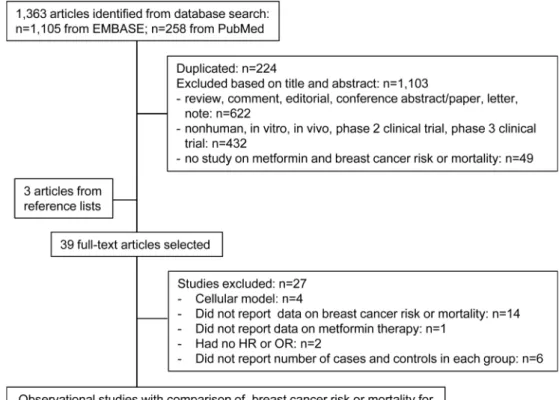
The process of identifying reports for inclusion is outlined in Fig. 1. The initial search yielded 1,363 articles. After review of the titles and abstracts, a total of 36 articles were chosen for further review. Three articles were identified through the re- ference lists and included in this study. Among the 39 articles, 4 articles were excluded because they were cellular model. Fifteen of these articles were excluded because they did not study the impact of metformin on breast cancer risk or mortality. Two articles were excluded because of lack of reported HR or OR,
and 6 were excluded because they did not report the number of the patients, breast cancer events, or breast cancer-related deaths in each group. After these exclusions, 12 retrospectively designed studies were included: 9 retrospective cohort, 1 case-control, and 2 nested case-control studies. When assessing quality of the studies, all the included studies received between 7 and 9 stars and met the criteria of high quality based on NOS (Fig. 2).
The effect of metformin therapy on breast cancer risk Ten studies with a total of 14,715 cases of breast cancer were
Fig. 1. Literature search and study selection process.
Fig. 2. Newcastle-Ottawa-Scale. The number of studies based on the number of the “stars” assigned in the retrospective cohort and case-control studies.
rean J Clin Pharm, Vol. 25, No. 3, 2015 Study Country Study design Control
metformin Control metformin Control events total events total
Libby et al.,
2009 Scotland Retrospective cohort
Metformin
nonuser ≥ 35 ≥ 35 3.5
(median)
2.6
(median) 24 4085 41 4085
Bodmer et al.,
2010 UK Nested
case-control
Other
antidiabetics 30-79 30-79 > 5 > 5 17 62 120 260
Bosco et al.,
2011 Denmark Nested
case-control
Other
antidiabetics ≥ 50 ≥ 50 ≥ 1 ≥ 1 96 1154 297 2776
Ruiter et al.,
2012 Netherland case-control Sulfonylurea 61.8± 13.4 (mean)
65.6± 13.8
(mean) 2.3 2.9 207 32714 217 32591
Bayraktar
et al., 2012 USA Retrospective cohort
Metformin
nonuser 30-67 35-80 0.08-14.7
5.16 (median)
0.08-14.7
5.16 (median) 24 63 29 67
Hsieh et al.,
2012 Taiwan Retrospective cohort
Metformin nonuser
61.4± 13.2 (mean)
61.4± 13.2
(mean) 8 8 19 2048 53 3142
Qiu et al.,
2012 UK Retrospective
cohort Sulfonylurea 60.5± 10.7 (mean)
64.2± 10.4 (mean)
3.35± 2.5 (mean)
5.02± 3.02
(mean) 616 39070 517 16904
Redaniel
et al. 2012 UK Retrospective
cohort Sulfonylurea ≥ 35 ≥ 35 ≥ 0.5 ≥ 0.5 151 7523 93 4815
Tsilidis et al.,
2014 UK Retrospective
cohort Sulfonylurea 35-90 35-90 2.9-8.1
5.1 (mean)
2.9-8.1
5.1 (mean) 307 51484 153 26428
Tseng et al.,
2014 USA Retrospective
cohort
Metformin never-user
54.93 (mean)
56.54 (mean)
7 (cumulative)
7
(cumulative) 2412 191195
(cases) 9322 443847
(cases)
Table 2. Events of all-cause and breast cancer-specific deaths among patients with type 2 diabetes and breast cancer after exposure to metformin compared with non- metformin.
Study Country Study design Age (year)
Control Follow-up (year) Metformin group (n) Control group (n)
metformin control events total events total
Bayraktar et al.,
2012 USA Retrospective
cohort 30-67 35-80 Metformin
nonuser
0.08-14.7
5.16 (median) 20 63 23 67
Lega et al.,
2013 Canada Retrospective
cohort
≥ 66 77.4± 6.3
(mean)
≥ 66 77.4± 6.3
(mean)
Metformin
nonuser 3.7± 2.8 126 1094 260 1267
Peeters et al.,
2013 Netherlands Retrospective cohort
68 (median)
76 (median)
Metformin
nonuser 1 51 508 75 550
제 2형당뇨병환자의유방암발생위험및사망률에대한메트포민의영향: 체계적문헌고찰및메타분석 / 135
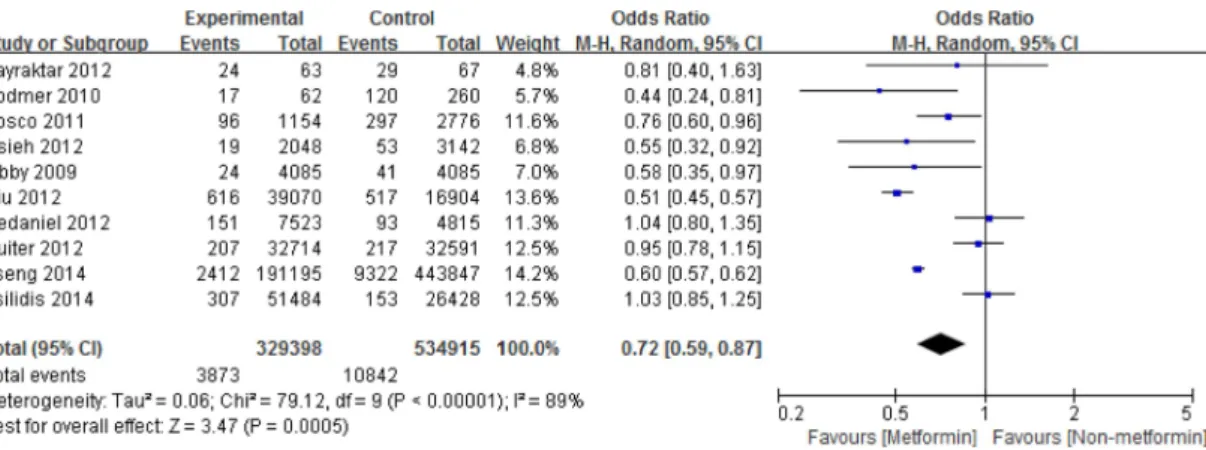
included in the present meta-analysis reviewing the association between metformin and breast cancer risk in patients with type 2 diabetes (Table 1). Of the studies, 5 studies showed the adjusted HR for comorbid conditions, such as age, sex, smoking, BMI, and HbA1C, and adjusted HR for breast cancer risk for metformin compared with non-metformin.21,24,28-30) By synthesizing the data from the 10 studies, the pooled OR was 0.72 (95% CI: 0.59, 0.87) (p = 0.0005) (Fig. 3). Visual inspection of a funnel plot suggested possible publication bias (Fig. 4).
The effect of metformin use on breast cancer-related mortality
The association between metformin and breast cancer-related mortality was reported in 3 cohort studies recruiting 555 breast cancer-related deaths(Table 2). Of the studies, 2 studies showed the adjusted HR for all potential confounders, such as other antidiabetic agents, age at breast cancer diagnosis, and duration of diabetes before breast cancer.31,32) With random-effects model analysis, metformin treatment was associated with a significant Fig. 3. Random-effects meta-analysis of breast cancer risk in type 2 diabetic patients exposed to metformin compared with non- metformin. Squares represent study-specific relative risk estimates; horizontal lines represent 95% CIs; diamond represents a summary relative risk estimate with corresponding 95% CI (0.62, 0.88).
Fig. 4. Funnel plot for publication bias of the included studies in the meta-analysis of the effect of metformin on breast cancer risk.
Fig. 5. Random-effects meta-analysis of breast cancer-related mortality in patients with type 2 diabetes and breast cancer after exposure to metformin compared with non-metformin. Squares represent study-specific relative risk estimates; horizontal lines repre- sent 95% CIs; diamond represents a summary relative risk estimate with corresponding 95% CI (0.51, 0.90).
Fig. 6. Funnel plot for publication bias of the included studies in the meta-analysis of the effect of metformin on breast cancer risk.
reduction in the risk of breast cancer-related mortality in patients with type 2 diabetes (RR: 0.68; 95% CI: 0.51, 0.90, p = 0.007) (Fig. 5). Visual inspection of a funnel plot suggested possible publication bias (Fig. 6).
Discussion
In this meta-analysis, metformin therapy was associated with a significantly decreased risk of breast cancer compared with non- metformin treatment in patients with type 2 diabetes. This supports the hypothesis that metformin may have an anticancer effect.33,34) In this study, metformin was associated with a 26%
decrease in the incidence of breast cancer. This result is con- sistent with the finding of a previous study by Col et al. that reviewed seven studies21-24,36-38) (OR: 0.83; 95% CI: 0.71, 0.97).35) Although the three studies36-38) were excluded from the present study due to unfulfilled inclusion criteria, no substantial difference in the overall effect of metformin on breast cancer risk was found between the previous study and the present meta- analysis. In addition, the study by DeCensi et al., which analyzed three observational studies,21,22,36) found a 30% decrease in overall summary RR (95% CI: 0.28, 1.77) in the metformin users compared with other antidiabetic drug users.39) On the contrary, in the previous meta-analysis of 9 randomized con- trolled trials (RCTs), no beneficial effect of metformin was observed (RR: 0.99; 95% CI: 0.80, 1.24) in trials comparing metformin to other antidiabetic drugs.40) This discordance may be partly explained by the fact that the previous meta-analysis of RCTs has fewer patients of follow-up and fewer cancer cases than those of the present study (398 vs. 14,715 for cancer cases).
In this meta-analysis, metformin use was associated with a significant risk reduction of breast cancer-related mortality com- pared to non-metformin use in patients with type 2 diabetes (OR:
0.72; 95% CI: 0.59, 0.87, p = 0.007). This finding is consistent with the result from the meta-analysis by Noto et al. that analyzed three observational studies21,42,43) and two RCTs.44,45) In that study, a significant reduction in mortality was observed in metformin users compared with other medication users (RR:
0.66; 95% CI: 0.49, 0.88; p = 0.005).41)
There are some limitations in this meta-analysis. The findings from this study are based on the results derived from obser- vational studies, which are inherently more susceptible to bias.
In addition, most of the included studies did not analyze data on pathological type of breast cancer. In this study, the presence of publication bias cannot be ruled out. This publication bias may
be related to the exclusion of “grey literature” and of studies which do not report precise data on cases and controls in each group. Lastly, a high degree of heterogeneity was found in the analysis of breast cancer risk while the heterogeneity observed in the analysis of breast cancer related-mortality was moderate:
I2= 89% for the analysis of breast cancer risk (p < 0.00001), I2= 56% for the analysis of breast cancer related-mortality. This can be partly explained by the differences in the treatment duration and age of the subjects among the included studies.
Despite of these limitations, this study has two strengths. First of all, this meta-analysis is mainly based on large population- based data originating from multiple nations. In addition, all the populations included in the present study were people with type 2 diabetes while non-diabetic populations were excluded because diabetes is emerging risk factor for breast cancer.
Conclusion
The present meta-analysis suggests that metformin appears to be associated with a lower risk of breast cancer incidence and mortality in patients with type 2 diabetes.
Acknowledgement
I am grateful to Myoung Sung Kim and Jee Hye Park, who identified potential studies, extracted detailed information from each included article, and assessed the quality of the included studies.
References
1. American Diabetes Association. Diagnosis and Classification of Dia- betes Mellitus. Diabetes Care 2008;31(Suppl 1):S55-60.
2. Jemal A, Bray F, Center MM, et al. Global cancer statistics. CA Cancer J Clin 2011;61:69.
3. Moolgavkar SH, Day NE, Stevens RG. Two-stage model for carcino- genesis: Epidemiology of breast cancer in females. J Natl Cancer Inst 1980;65:559-69.
4. Colditz GA, Rosner B. Cumulative risk of breast cancer to age 70 years according to risk factor status: data from the Nurses' Health Study. Am J Epidemiol 2000;152:950-64.
5. Eliassen AH, Colditz GA, Rosner B, et al. Adult weight change and risk of postmenopausal breast cancer. JAMA 2006;296:193-201.
6. Boyd NF, Guo H, Martin LJ, et al. Mammographic density and the risk and detection of breast cancer. N Engl J Med 2007;356:227-36.
7. Chen S, Parmigiani G. Meta-analysis of BRCA1 and BRCA2 pene- trance. J Clin Oncol 2007;25:1329-33.
8. Resta F, Triggiani V, Sabbà C, et al. The impact of body mass index and type 2 diabetes on breast cancer: current therapeutic measures of pre-
제 2형당뇨병환자의유방암발생위험및사망률에대한메트포민의영향: 체계적문헌고찰및메타분석 / 137
vention. Curr Drug Targets Immune Endocr Metabol Disord 2004;4:
327-33.
9. Key TJ, Verkasalo PK, Banks E. Epidemiology of breast cancer. Lancet Oncol 2001;2:133-40.
10. Baron JA, Weiderpass E, Newcomb PA, et al. Metabolic disorders and breast cancer risk (United States). Cancer Causes Control 2001;12:875- 80.
11. Lipscombe LL, Goodwin PJ, Zinman B, et al. Increased prevalence of prior breast cancer in women with newly diagnosed diabetes. Breast Cancer Res Treat 2006;98:303-9.
12. Arcidiacono B, Iiritano S, Nocera A, et al. Insulin resistance and cancer risk: an overview of the pathogenetic mechanisms. Exp Diabetes Res 2012;2012:789174.
13. Zakikhani M, Dowling R, Fantus IG, et al. Metformin is an AMP kinase-dependent growth inhibitor for breast cancer cells. Cancer Res 2006;66:10269-73.
14. Hundal RS, Krssak M, Dufour S, et al. Mechanism by which met- formin reduces glucose production in type 2 diabetes. Diabetes 2000;49:2063-9.
15. Lee JH, Kim TI, Jeon SM, et al. The effects of metformin on the sur- vival of colorectal cancer patients with diabetes mellitus. Int J Cancer 2012;131:752-9.
16. Kourelis TV, Siegel RD. Metformin and cancer: new applications for an old drug. Med Oncol 2012;29:1314-27.
17. Bodmer M, Becker C, Meier C, et al. Use of metformin is not associ- ated with a decreased risk of colorectal cancer: a case-control analysis.
Cancer Epidemiol Biomarkers Prev 2012;21:280-6.
18. Ladson G, Dodson WC, Sweet SD, et al. The effects of metformin with lifestyle therapy in polycystic ovary syndrome: a randomized double- blind study. Fertil Steril 2011;95:1059-66.
19. Wells GA, Shea B, O’Connell D, et al. The Newcastle-Ottawa scale (NOS) for assessing the quality of nonrandomised studies in meta-anal- ysis. Ottawa Health Research Institute. http://www.ohri.ca/programs/
clinical_epidemiology/oxford.htm (Accessed on Aug 25, 2014).
20. Zheng JS, Hu XJ, Zhao YM, et al. Intake of fish and marine n-3 polyun- saturated fatty acids and risk of breast cancer: meta-analysis of data from 21 independent prospective cohort studies. BMJ 2013;346:f3706.
21. Libby G, Donnelly LA, Donnan PT, et al. New users of metformin are at low risk of incident cancer: a cohort study among people with type 2 diabetes. Diabetes Care 2009;32:1620-5.
22. Bodmer M, Meier C, Krähenbühl S, Jick SS, et al. Long-term met- formin use is associated with decreased risk of breast cancer. Diabetes Care 2010;33:1304-8.
23. Bosco JL, Antonsen S, Sørensen HT, et al. Metformin and incident breast cancer among diabetic women: a population-based case-control study in Denmark. Cancer Epidemiol Biomarkers Prev 2011;20:101-11.
24. Ruiter R, Visser LE, van Herk-Sukel MP, et al. Lower risk of cancer in patients on metformin in comparison with those on sulfonylurea deriv- atives: results from a large population-based follow-up study. Diabetes Care 2012;35:119-24.
25. Bayraktar S, Hernadez-Aya LF, Lei X, et al. Effect of metformin on sur- vival outcomes in diabetic patients with triple receptor-negative breast cancer. Cancer 2012;118:1202-11.
26. Hsieh MC, Lee TC, Cheng SM, et al. The influence of type 2 diabetes and glucose-lowering therapies on cancer risk in the Taiwanese. Exp Diabetes Res 2012;2012:413782.
27. Qiu H, Rhoads GG, Berlin JA, et al. Initial metformin or sulphonylurea exposure and cancer occurrence among patients with type 2 diabetes mellitus. Diabetes Obes Metab 2013;15:349-57.
28. Redaniel MT, Jeffreys M, May MT, et al. Associations of type 2 diabe- tes and diabetes treatment with breast cancer risk and mortality: a pop- ulation-based cohort study among British women. Cancer Causes Control 2012;23:1785-95.
29. Tsilidis KK, Capothanassi D, Allen NE, et al. Metformin Does Not Affect Cancer Risk: A Cohort Study in the U.K. Clinical Practice Research Datalink Analyzed Like an Intention-to-Treat Trial. Diabetes Care 2014;37:2522-32.
30. Tseng CH. Metformin may reduce breast cancer risk in Taiwanese women with type 2 diabetes. Breast Cancer Res Treat 2014;145:785- 90.
31. Lega IC, Austin PC, Gruneir A, et al. Association between metformin therapy and mortality after breast cancer: a population-based study.
Diabetes Care 2013;36:3018-26.
32. Hou G, Zhang S, Zhang X, et al. Use of metformin and survival of dia- betic women with breast cancer. Curr Drug Saf 2013;8:357-63.
33. Green AS, Chapuis N, Lacombe C, et al. LKB1/AMPK/mTOR signal- ing pathway in hematological malignancies: from metabolism to can- cer cell biology. Cell Cycle 2011;10(13):2115-20.
34. Goodwin PJ, Stambolic V. Obesity and insulin resistance in breast can- cer--chemoprevention strategies with a focus on metformin. Breast 2011;20(Suppl 3):S31-5.
35. Col NF, Ochs L, Springmann V, et al. Metformin and breast cancer risk:
a meta-analysis and critical literature review. Breast Cancer Res Treat 2012;135(3):639-46.
36. Currie CJ, Poole CD, Gale EA. The influence of glucose-lowering ther- apies on cancer risk in type 2 diabetes. Diabetologia 2009;52(9):1766- 77.
37. Col NF, Ochs L, Springmann V, et al. Glucose lowering agents and the patterns of risk for cancer: a study with the General Practice Research Database and secondary care data. Diabetologia 2012;55(3):654-65.
38. Staa Van, Patel D, Gallagher AM, de Bruin ML. Diabetes, metformin, and breast cancer in postmenopausal women. J Clin Oncol 2012;
30:2844-52.
39. DeCensi A, Puntoni M, Goodwin P, et al. Metformin and cancer risk in diabetic patients: a systematic review and meta-analysis. Cancer Prev Res (Phila) 2010;3(11):1451-61.
40. Stevens RJ, Ali R, Bankhead CR, et al. Cancer outcomes and all-cause mortality in adults allocated to metformin: systematic review and col- laborative meta-analysis of randomised clinical trials. Diabetologia 2012;55(10):2593-603.
41. Noto H, Goto A, Tsujimoto T, Noda M. Cancer risk in diabetic patients treated with metformin: a systematic review and meta-analysis. PLoS One 2012;7(3):e33411.
42. Bowker SL, Majumdar SR, Veugelers P, et al. Increased cancer-related mortality for patients with type 2 diabetes who use sulfonylureas or insulin. Diabetes Care 2006;29(2):254-8.
43. Landman GW, Kleefstra N, van Hateren KJ, et al. Metformin associ- ated with lower cancer mortality in type 2 diabetes: ZODIAC-16. Dia- betes Care 2010;33(2):322-6.
44. UK Prospective Diabetes Study (UKPDS) Group. Effect of intensive blood-glucose control with metformin on complications in overweight patients with type 2 diabetes (UKPDS 34). Lancet 1998;352(9131):
854-65.
45. Mellbin LG, Malmberg K, Norhammar A, et al. Prognostic implica- tions of glucose-lowering treatment in patients with acute myocardial infarction and diabetes: experiences from an extended follow-up of the Diabetes Mellitus Insulin-Glucose Infusion in Acute Myocardial Inf- arction (DIGAMI) 2 Study. Diabetologia 2011;54(6):1308-17.