• 검색 결과가 없습니다.

KMJOriginal Article

N/A
N/A
Protected

Academic year: 2021

Share "KMJOriginal Article"

Copied!
11
0
0

로드 중.... (전체 텍스트 보기)

전체 글

(1)

Heart rate variability (HRV) is widely used as a method of evaluating the effects of sympathetic and parasympathetic nerves in the sinoatrial node.

Analyzing the information according to heart rate change helps determine the cardiovascular mor- bidity and prognosis in heart failure, myocardial infarction, diabetes cardiovascular diseases, as well as normal conditions. 1 Through frequency do-

main and time domain analysis, factors such as high frequency (HF), low frequency (LF), RMSSD (root mean square of successive differences of RR intervals), and pNN50 (proportion of successive RR intervals > 50 ms in relation to total RR intervals) can be obtained. 1-3 The clinical significance of each factor is as follows.

Original Article

Relation of Various Parameters Used to Estimate Cardiac Vagal Activity and Validity of pNN50 in Anesthetized Humans

Jae Ho Lee, In Young Huh, Jae Min Lee, Hyung Kwan Lee, Il Sang Han, Ho Jun Kang

Department of Anesthesiology and Pain Medicine, Ulsan University Hospital, College of Medicine, Ulsan University, Ulsan, Korea

Objectives: Analysis of heart rate variability (HRV) has been used as a measure of cardiac autonomic function.

According to the pNN50 statistic, the percentage of differences between successive normal RR intervals (RRI) that exceed 50 ms, has been known to reflect cardiac vagal modulation. Relatively little is known about the validity of pNN50 during general anesthesia (GA). Therefore, we evaluated the correlation of pNN50 with other variables such as HF, RMSSD, SD1 of HRV reflecting the vagal tone, and examined the validity of pNN50 in anesthetized patients. Methods: We assessed changes in RRI, pNN50, root mean square of successive differences of RRI (RMSSD), high frequency (HF) and standard deviation 1 (SD1) of Poincaré plots after GA using sevoflurane anesthesia. We also calculated the probability distributions for the family of pNNx statistics (x: 2-50 ms).

Results: All HRV variables were significantly decreased during GA. HF power was not correlated with pNN50 during GA (r = 0.096, P = 0.392). Less than pNN47 was shown to have a correlation with other variables.

Conclusions: These data suggest that pNN50 can not reflect the level of vagal tone during GA.

Key Words: General anesthesia, Heart rate variability, pNN50, Vagal tone

Corresponding Author: In Young Huh, Department of Anesthesiology and Pain Medicine, Ulsan University Hospital, 877, Bangeojin sunhwan do-ro, Dong-gu, Ulsan 44033, Korea

Tel: +82-52-250-7248 Fax: +82-52-250-7249 E-mail: [email protected]

Received:

Revised:

Accepted:

Nov. 21, 2017 Feb. 02, 2018 Feb. 05, 2018

Articles published in Kosin Medical Journal are open-access, distributed under the terms of the Creative Commons Attribution

Non-Commercial License (http://creativecommons.org/licenses/by-nc/4.0/) which permits unrestricted non-commercial use, distribution,

and reproduction in any medium, provided the original work is properly cited. 

(2)

(1) High-frequency band (HF)

The high-frequency band is a frequency band between 0.15 ~ 0.4 Hz. It is also referred to as respiratory arrhythmia associated with heart rate variability connected with the respiratory cycle.

This is controlled by the activity of the para- sympathetic nervous system. 33

(2) Low frequency (LF)

The low-frequency band is the frequency band between 0.04 Hz ~ 0.15 Hz and is controlled by both the sympathetic and parasympathetic nerv- ous systems. 33

(3) RMSSD (Root mean square of successive dif- ferences of RR intervals)

This variable is a good indicator of short-term heart rate variability and indicates the degree of parasympathetic activity. 31,32 Investigation of the actual correlation between each of these factors was conducted to a limited extent, and a correla- tion study under anesthesia is rare.

The time domain, pNN50, is the % of the total RRI in which the difference between two consec- utive RR intervals (RRI) is greater than 50 ms, which reflects the activity of the vagus nerve and is also known to be correlated with HF in the fre- quency domain HF. 1,4 Ewing et al. reported that

5 pNN50 was the most sensitive among the various tests that could initially diagnose parasympathetic nerve damage in the heart.

However, some studies reported using thresh- olds other than 50 ms. 6-8 Mietus et al. 9 found that pNN50 is one of several factors that represent HRV and introduced the concept of pNNx (x <

50 ms) with consecutive RRI differences of less than 50 ms, which makes it possible to clarify the difference between normal or pathologic con- ditions more clearly than pNN50.

General anesthesia using inhalation anesthetics is known to suppress the autonomic nerves and reduce HRV in a dose-dependent manner. 10,11 These HRVs are affected by anesthetic depth, medication administered, the operation of the surgical site, and body temperature of the patient.

The HRV may also be used as an indicator of anes- thesia depth. 12,13 Therefore, the frequency of HRV analytical method use is gradually increasing as an aid for determining the function of the auto- nomic nervous system during the administration of general or regional anesthesia to the anesthesia site. Parasympathetic dysfunction, in particular, is considered to be the cause of death or ven- tricular arrhythmia independently in patients with heart failure. 14,15 Therefore, it is important to evaluate the parasympathetic nervous dysfunc- tion by inhalation anesthesia during anesthesia.

However, unlike other factors of HRV, few stud-

ies have examined whether pNN50 or pNNx re-

flect cardiac vagal activity during anesthesia and

what changes are reported during general anes-

thesia by inhalation anesthesia.

(3)

In previous studies, HF, RMSSD, SD1, and pNN50 were found to be significantly reduced in patients compared to those who were awake dur- ing general anesthesia under isoflurane and sevo- flurane 1 minimum alveolar concentration (MAC).

pNN50, in particular, measured zero in both groups. 16 Thus, it was considered necessary to study the usefulness of pNN50 during general anesthesia.

Therefore, studies on whether the correlation between pNN50 and other HRV measurements known to reflect cardiac vagal activity during gen- eral anesthesia were maintained. If this correla- tion was not maintained, further investigation was conducted to determine whether the introduction of the pNNx concept by Mietus et al. was neces- sary during anesthesia.

MATERIALS AND METHODS

Eighty patients with American Society of Anesthesiologists physical status classification ASA 1 and 2 were selected as target patients. Those with diseases that could cause abnormalities in the autonomic nervous system such as car- diovascular, diabetes, and nervous system were excluded from the study. The study was conducted after approval from the Hospital Ethics Committee. All patients fasted prior to surgery and were forbidden from consuming alcohol and caffeinated beverages for more than 24 hours. As

a preoperative treatment, 7.5 mg of midazolam was administered orally 90 minutes before induc- ing anesthesia.

After the patient entered the operating room and lay down in the supine position, the electro- cardiogram was taken and connected to the monitor. A stable electrocardiogram was recorded for 5 minutes in the patient’s spontaneous breath- ing state after 20 minutes to adapt to the operating room environment. Anesthesia was induced with 5 mg/kg thiopental, 1 ㎍/kg fentanyl, and 0.1 mg/kg vecuronium for muscle relaxation. After endotracheal intubation, the mechanical ven- tilation changed the breathing frequency to 15 times/minute (0.25 Hz) and the ventilation was adapted to maintain the end-tidal CO2 concen- tration to 35-40 mmHg. Maintenance anesthesia was performed with a sevoflurane and 50% oxy- gen-nitrous oxide mixture and muscle relaxation was performed with vecuronium. Prior to the op- eration, the end-tidal sevoflurane concentration was 1 MAC for a stabilization period of 10 minutes.

Subsequently, an electrocardiogram of 5 minutes was obtained. Each beat of the electrocardiogram was digitized through an analog-to-digital con- verter (DI-720U, DATAQ Instruments, USA) and stored at 500 Hz using a computer-programmed signal conversion program (CODAS, DATAQ Instruments; DADiSP, DSP Development, USA).

RRI was determined as the difference between

the peak R of each beat. The RRI obtained was

(4)

analyzed using an HRV analysis software (version 1.1, Biomedical signal analysis group, Finland).

The method of obtaining each measurement value was initiated with the calculation of the time domain HRV analysis, pNN50 (%), and RMSSD (root mean square of successive difference of RRI, millisecond, ms). NNx is defined as the difference between consecutive RRIs of x ms (x: 2 - 50 ms) or more, and pNNx is defined as the % of NNx for the total RRI. In the case of consciousness, pNN50 and RMSSD are known to be highly corre- lated with HF of HRV. 17

Frequency-domain HRV analysis was con- ducted by using a power spectral analysis method using the Welch periodogram averaging algorithm.

To summarize, a 300-second RRI is interpolated at 5 Hz to obtain equidistant time intervals, fol- lowed by obtaining 5 segments of 100 seconds overlapping every 50 seconds. Then detrended, Hanning filtered and fast Fourier transform are implemented to convert the frequency domain of HRV, which has a resolution of 0.01 Hz. The spec- trum was obtained by averaging 5 periodograms.

The spectrum was defined as low frequency (0.04-0.15 Hz) and high frequency (0.15-0.5 Hz) and its value was obtained. In addition, amongst the overall spectrum, the following were calcu- lated: the LF fraction of nuLF (normalized unit of LF, LF/[LF + HF]), the HF fraction of nuHF (normalized unit of HF, HF/[LF + HF]), and the LF/HF ratio.

The Poincaré plot can measure the activity of the autonomic nerves of the heart by viewing the distribution of adjacent RRI. This facilitates the diagnosis of abnormal heartbeats and enables the quantitative analysis of HRV. 18,19 Three measure- ments of the standard deviation (SD) of the in- stantaneous beat-to-beat RRI variability (SD1), the SD of the long-term RRI variability (SD2), and the axis ratio (SD1/SD2) 19 can be obtained. As SD1, in particular, is known to reflect the cardiac vagal activity, 20 it was calculated in this study.

All values were a mean ± standard deviation.

To evaluate the effect of the HRV inhalation anes- thesia, RMSSD, SD1, and LF HF, which did not follow the normal distribution except pNN50, were subjected to a paired test for changes before and after anesthesia after using natural loga- rithmic transformation. A correlation analysis was conducted using the Pearson method of each vari- able and P < 0.05 was considered statistically significant. Statistical analysis was performed us- ing Sigma stat version 3.10 (Systat Software, USA).

RESULTS

Demographic data of patients who participated

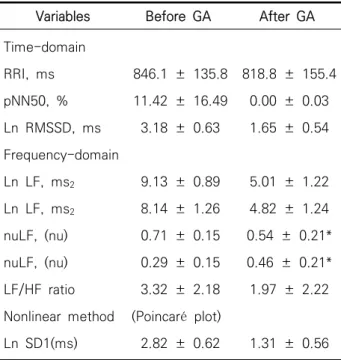
in the study are shown in Table 1. Table 2 shows

changes in HRV variables due to general anes-

thesia and shows a significant decrease ( P < 0.001)

in pNN50, RMSSD, HF, and SD1 except nuHF by

anesthesia, and RRI itself does not show any sig-

(5)

nificant change.

pNNx was significantly reduced by anesthesia (Fig. 1). Prior to anesthesia, NN50 was observed in 77% of patients and NN34 was observed in 90%

of patients. By general anesthesia, however, NN50 was 0 in all patients except for one case, whose results were 26.8% in NN30, 41.8% in NN20 and 47.8% in NN15, respectively.

Ln HF (Ln: natural logarithmic), Ln RMSSD, and Ln SD1 showed a significant correlation before and after anesthesia (before anesthesia: LnHF-Ln RMSSD; r = 0.958, P < 0.001, Ln HF-Ln SD1; r = 0.966, P < 0.001, after anesthesia: Ln HF-Ln RMSSD; r = 0.945 P < 0.001, Ln HF-Ln SD1, r = 0.944, P < 0.001). However, pNN50 was correlated with Ln HF before anesthesia (r = 0.825, P < 0.001), but the correlation disappeared when general an- esthesia was administered (Fig. 2). The correlation between pNN50 and Ln RMSSD was r = 0.861, P

ASA score (1/2) Age (yr)

Sex (M/F) Body weight (kg) Height (cm)

80 (48/32) 45.7 ± 11.9

80 (50/30) 74.2 ± 30.5 158.9 ± 28.9 Values are mean ± SD or number of patients.

Table 1. Demographic Data

Variables Before GA After GA Time-domain

RRI, ms pNN50, % Ln RMSSD, ms Frequency-domain Ln LF, ms

2

Ln LF, ms

2

nuLF, (nu) nuLF, (nu) LF/HF ratio Nonlinear method Ln SD1(ms)

846.1 ± 135.8 11.42 ± 16.49

3.18 ± 0.63

9.13 ± 0.89 8.14 ± 1.26 0.71 ± 0.15 0.29 ± 0.15 3.32 ± 2.18 (Poincaré plot) 2.82 ± 0.62

818.8 ± 155.4 0.00 ± 0.03 1.65 ± 0.54

5.01 ± 1.22 4.82 ± 1.24 0.54 ± 0.21*

0.46 ± 0.21*

1.97 ± 2.22

1.31 ± 0.56 Values are mean ± SD. GA: general anesthesia, RRI:

RR intervals, pNN50: proportion of successive RRI differences > 50 ms in relation to the total RRI, Ln RMSSD: natural logarithmic-transformed of root mean square of successive differences of RRI, Ln LF: natural logarithmic-transformed of low frequency, Ln HF:

natural logarithmic-transformed of high frequency, nuLF: normalized unit of low frequency, nuHF:

normalized unit of high frequency, LF/HF ratio: ratio between low frequency and high frequency, Ln SD1:

natural logarithmic-transformed of standard deviation 1 from the Poincaré plots analysis. * P < 0.05, † P < 0.001 versus before state.

Table 2. Descriptive Statistics of Indices Derived from Heart Rate Variability

Fig. 1. Mean pNNx distributions. During general anesthesia, pNNx is significantly lower than before general anesthesia state and nearly zero at greater than 30 ms.

pNNx; proportion of successive RR intervals differences

> 2 - 50 ms in relation to total RR intervals (x = 2

- 50 ms).

(6)

< 0.001 before anesthesia, but the correlation dis- appeared during anesthesia and similar results were obtained with Ln SD1 (r = 0.861, P < 0.001 before anesthesia, r = 0.134, P = 0.229 after anes- thesia). There was no correlation between pNNx and each factor in NN 47-50 under general anes- thesia and the correlation coefficient was over 0.4 in NN less than 30 ms (pNN30 - Ln HF r2 = 0.35, pNN30 - RMSSD and SD1 r2 = 0.41) (Fig. 3).

DISCUSSION

The purpose of this study was to investigate the correlation of various factors reflecting cardiac vagal activity by general anesthesia and to eval- uate the usefulness of pNN50 to reflect vagal activity. As a result, pNN50 is rarely observed in general anesthesia, unlike other factors that show parasympathetic activity. Moreover, the correla- tion between HF, RMSSD, and SD1 and pNN50 of frequency variation is lost post-anesthesia, un- like pre-anesthesia. That is, from pNN50 to pNN47 there was no correlation with each factor, suggesting that pNN50 does not exhibit vagal ac- tivity during anesthesia.

HRV is used as a basis for evaluating car- diovascular morbidity not only in healthy adults but also in patients with diabetes and heart failure. HRV is known to be closely related to the renin-angiotensin system, body temperature, and respiration in addition to the autonomic nervous Fig. 2. Correlations between RMSSD, pNN50, SD1 and

LnHF. The effect of general anesthesia. Ln RMSSD and Ln SD1 are significantly correlated with Ln HF at before and after general anesthesia state. Note that pNN50 is not correlated with Ln HF during general anesthesia. Ln HF (ms2): natural logarithmic transformed of high frequency power of heart rate variability, Ln RMSSD (ms):

natural logarithmic transformed of root mean square of successive differences of RR intervals, pNN50 (%):

proportion of successive RR intervals differences > 50 ms in relation to the total RR intervals, Ln SD1 (ms):

natural logarithmic transformed of standard deviation 1

from the Poincaré analysis.

(7)

system. 1,21

The parasympathetic nervous system is the re- action of a fast sinus nodule in a short period of time and has been associated with respiratory sinus arrhythmia (RSA). The sympathetic nerve

has a 10-second cycle of Mayer waves and the renin-angiotensin system has a slower and longer cycle time affecting the heart rate. 22 As previously mentioned, the evaluation method of HRV uses methods such as time and frequency domain and analysis of the Poincaré plot through the dis- tributed shape of the non-linear consecutive RRI. 1,19

Autonomic insufficiency of the sinus nodule can cause sudden death in patients with heart failure.

Parasympathetic dysfunction, in particular, in- creases the incidence of death or life-threatening ventricular arrhythmia in patients with heart failure. It has also been reported that the activa- tion of vagal nerves in these patients stops ven- tricular tachycardia. 14,15,23 Because the autonomic nervous system hypofunction, including para- sympathetic nerves, is present during anesthesia, an accurate assessment of HRV can be used as an indicator of the balance or failure of the auto- nomic nervous system during anesthesia. 24

In this study, general anesthesia showed a sig- nificant decrease in HRV factors such as HF, RMSSD, pNN50, and SD1 except for nuHF, which can be explained by a decline in autonomic nerv- ous system functionality. All inhaled anesthetics have a dose-dependent decrease in HRV. They are also known to affect the autonomic nervous system in addition to anesthetics during general anesthesia, as well as the operation itself and the body temperature. 12,13,25 All of the HRV factors ex- Fig. 3. Correlations of Ln RMSSD (A), LnHF (B), and

Ln SD1 (C) for pNNx. pNN values greater than 47 ms are not correlated with other three parameters. Ln RMSSD (ms): natural logarithmic transformed of root mean square of successive differences of RR intervals, LnHF (ms2): natural logarithmic transformed high frequency power of heart rate variability, Ln SD1 (ms);

natural logarithmic transformed of standard deviation

1 from the Poincaré analysis, NNx (ms): successive RR

intervals differences > x ms (x = 2 - 50 ms).

(8)

cept nuHF were significantly decreased during isoflurane and sevoflurane anesthesia. The pNN50 value was not measured in both groups except for 1 patient, 16 which was consistent with the study results. The increase of nuHF during general anesthesia seems to be less than that of LF due to mechanical ventilation rather than an increase of vagal nerve activity. Considering the effect of the administered drugs on HRV, the use of thiopental resulted in a decrease in all fre- quency domain values of HRV. This was especially apparent in HF rather than LF, which is due to the vagal suppression effect of barbiturate, 13 Though related to the parasympathomimetic ef- fect, primarily on the parasympathetic nerves, fentanyl does not change the balance of the auto- nomic nervous system. 26,27 Midazolam 0.3 mg/kg reduced all spectra of HRV and dose-dependently had great resistance from sympathetic nerves at lower doses and from parasympathetic nerves at higher doses. 28 In this study, pNN50 appeared in only 62 patients before the anesthesia, which is thought to be the effect of midazolam prior to operation. 13 In this study, concurrent use of mid- azolam and sevoflurane seemed to deliver a syner- gistic effect of autonomic nervous suppression.

However, because the same anesthetic agent was used in the same environment, there was no dif- ference in HRV value due to the anesthetic agent.

The HRV measurements reflecting the para- sympathetic nervous system are known as HF in the frequency domain, RMSSD in the time domain,

pNN50, and SD1 in Poincaré plot, 1,19 These factors are useful for evaluating cardiac vagal activity by HRV in normal conditions and are known to show a significant correlation with each other. In addi- tion, Bigger et al. 21 reported that pNN50, RMSSD, and HF of HRV were correlated with each other by 0.9 or higher after acute myocardial infarction.

However, no studies have investigated whether there is any correlation between the factors that reflect these vagal activities during anesthesia.

pNN50 is known to reflect the activity of car- diac-vagal nerves as the HRV factor in the time domain as calculated from the differences in suc- cessive RRI. 17 This was first cited by Ewing et al. 5 , and is reported facilitate in the diagnosis and prognosis of patients with various clinical conditions. 1,21 However, Mietus et al. 9 reported that by using the RRI difference of less than 950 ms, information on the heart rhythm dynamics in the pathological state, as well as in normal con- ditions, can be obtained, which is closely related to the control of parasympathetic nerves.

However, Hutchinson 29 reported no significant

difference in the ability to distinguish between

pNN20 and pNN50. Further, there was no evi-

dence that pNN20 was more beneficial. With re-

spect to the controversial result of the present

study, pNN50 did not appear in most patients and

the correlation with HF was lost in general anes-

thesia using inhalation anesthetics. Moreover, us-

ing a threshold value of less than 47 ms showed

a significant correlation with HF, RMSSD, and

SD1, and Ln HF and r2 were 0.35 at 30 ms, and

(9)

0.41 for RMSSD and SD1, respectively. The values were measured in 20% or more patients, and the correlation coefficients were 0.58 and 0.69 for 20 ms, respectively. The values were measured in 46% of patients. Thus, during general anesthesia, pNN50 appears to be insignificant in reflecting cardiac vagal activity. However, further studies are needed to determine whether the clinical sig- nificance of using intervals other than that of 50 ms or other specified values is most useful.

Unlike other studies, one limitation of this study was that an electrocardiogram of 5 minutes was analyzed. Although a 24-hour electrocardiogram analysis is used to compare HRV parameters, sim- ilar information is often presented in short-term records, and short-term records are used in most studies. 4,21 Perkiomaki et al. 30 reported that short-term records reflect the results of long-term records even in non-linear HRV analysis, such as Poincaré plot analysis. Therefore, an electro- cardiogram of 5 minutes also provides important information in HRV analysis. It is also necessary to increase the vagal activity during anesthesia by administering a drug such as pyridostigmine, which suppresses cholinesterase and stimulates cholinergic. This method enables the observance of the correlation between the changes of each factor reflecting the vagal activity including pNN50 in the future. It is possible to inhibit ven- tricular tachycardia induced by electrical stim- ulation through cholinergic stimulation. For pa-

tients with heart failure, administration of 30 mg pyridostigmine 3 times daily for 2 days reduces the heart rate and the frequency of ventricular tachycardia in a short period of time and in- creases pNN50 of HRV and RMSSD. The results, however, did not differ from the placebo effects in the function on echocardiography. In con- clusion, pNN50 is not observed in most patients during anesthesia and it is difficult to determine whether pNN50 reflects the activity of cardiac parasympathetic nerves under general anesthesia because the correlation between HRV and HF is lost. According to the results of this study, using a value of less than 47 ms improves the correlation with other HRV variables. However, it is still nec- essary to investigate the clinical significance of the numerical use of less than 47 ms.

REFERENCES

1. Heart rate variability: standards of measurement, physiological interpretation and clinical use. Task Force of the European Society of Cardiology and the North American Society of Pacing and Electrophysiology. Circulation 1996;93:1043-65.

2. Akselrod S, Gordon D, Ubel FA, Shannon DC, Berger AC, Cohen RJ. Power spectrum analysis of heart rate fluctuation: a quantitative probe of beat-to-beat cardiovascular control. Science 1981;213:220-2.

3. Fleisher LA. Heart rate variability as an assessment

of cardiovascular status. J Cardiothorac Vasc

(10)

Anesth 1996;10:659-71.

4. Vongpatanasin W, Taylor JA, Victor RG. Effects of cocaine on heart rate variability in healthy subjects. Am J Cardiol 2004;93:385-8.

5. Ewing DJ, Neilson JM, Travis P. New method for assessing cardiac parasympathetic activity using 24 hour electrocardiograms. Br Heart J 1984;52:396-402.

6. Voss A, Kurths J, Kleiner HJ, Witt A, Wessel N, Saparin P, et al. The application of methods of non-linear dynamics for the improved and predictive recognition of patients threatened by sudden cardiac death. Cardiovasc Res 1996;31:419-33.

7. Silipo R, Deco G, Vergassola R, Gremigni C. A characterization of HRV's nonlinear hidden dynamics by means of Markov models. IEEE Trans Biomed Eng 1999;46:978-86.

8. Busjahn A, Voss A, Knoblauch H, Knoblauch M, Jeschke E, Wessel N, et al. Angiotensin- converting enzyme and angiotensinogen gene polymorphisms and heart rate variability in twins.

Am J Cardiol 1998;81:755-60.

9. Mietus JE, Peng CK, Henry I, Goldsmith RL, Goldberger AL. The pNNx files: reexamining a widely used heart rate variability measure. Heart 2002;88:378-80.

10. Donchin Y, Feld JM, Porges SW. Respiratory sinus arrhythmia during recovery from isoflurane-nitrous oxide anesthesia. Anesth Analg 1985;64:811-5.

11. Bäcklund M, Toivonen L, Tuominen M, Pere P, Lindgren L. Changes in heart rate variability in elderly patients undergoing major noncardiac

surgery under spinal or general anesthesia. Reg Anesth Pain Med 1999;24:386-92.

12. Kato M, Komatsu T, Kimura T, Sugiyama F, Nakashima K, Shimada Y. Spectral analysis of heart rate variability during isoflurane anesthesia.

Anesthesiology 1992;77:669-74.

13. Latson TW, McCarroll SM, Mirhej MA, Hyndman VA, Whitten CW, Lipton JM. Effects of three anesthetic induction techniques on heart rate variability. J Clin Anesth 1992;4:265-76.

14. Nolan J, Batin PD, Andrews R, Lindsay SJ, Brooksby P, Mullen M, et al. Prospective study of heart rate variability and mortality in chronic heart failure: results of the United Kingdom heart failure evaluation and assessment of risk trial (UK-heart). Circulation 1998;98:1510-6.

15. La Rovere MT, Pinna GD, Hohnloser SH, Marcus FI, Mortara A, Nohara R, et al. Baroreflex sensitivity and heart rate variability in the identification of patients at risk for life-threatening arrhythmias:

implications for clinical trials. Circulation 2001;

103:2072-7.

16. Huh IY, Kim YK, Hwang GS. Change of heart rate variability before and after general anesthesia. Korean J Anesthesiol 2005;49:447-54.

17. Kleiger RE, Bigger JT, Bosner MS, Chung MK, Cook JR, Rolnitzky LM, et al. Stability over time of variables measuring heart rate variability in normal subjects. Am J Cardiol 1991;68:626-30.

18. Anan T, Sunagawa K, Araki H, Nakamura M.

Arrhythmia analysis by successive RR plotting.

J Electrocardiol 1990;23:243-8.

19. Tulppo MP, Mäkikallio TH, Takala TE, Seppänen

(11)

T, Huikuri HV. Quantitative beat-to-beat analysis of heart rate dynamics during exercise. Am J Physiol 1996;271:H244-52.

20. Berger RD, Saul JP, Cohen RJ. Transfer function analysis of autonomic regulation. I. Canine atrial rate response. Am J Physiol 1989;256:H142-52.

21. Bigger JT Jr, Fleiss JL, Steinman RC, Rolnitzky LM, Kleiger RE, Rottman JN. Correlations among time and frequency domain measures of heart period variability two weeks after acute myocardial infarction. Am J Cardiol 1992;69:891-8.

22. Cohen MA, Taylor JA. Short-term cardiovascular oscillations in man: measuring and modelling the physiologies. J Physiol 2002;542:669-83.

23. Waxman MB, Wald RW. Termination of ventricular tachycardia by an increase in cardiac vagal drive.

Circulation 1977;56:385-91.

24. Baumert JH, Frey AW, Adt M. [Analysis of heart rate variability. Background, method, and possible use in anesthesia]. Anaesthesist 1995;44:677-86.

25. Latson TW, O'Flaherty D. Effects of surgical stimulation on autonomic reflex function:assessment by changes in heart rate variability. Br J Anaesth 1993;70:301-5.

26. Galletly DC, Westenberg AM, Robinson BJ, Corfiatis T. Effect of halothane, isoflurane and fentanyl on spectral components of heart rate variability. Br J Anaesth 1994;72:177-80.

27. Gravlee GP, Ramsey FM, Roy RC, Angert KC, Rogers AT, Pauca AL. Rapid administration of a narcotic

and neuromuscular blocker: a hemodynamic comparison of fentanyl, sufentanil, pancuronium, and vecuronium. Anesth Analg 1988;67:39-47.

28. Komatsu T, Singh PK, Kimura T, Nishiwaki K, Bando K, Shimada Y. Differential effects of ketamine and midazolam on heart rate variability.

Can J Anaesth 1995;42:1003-9.

29. Hutchinson TP. Statistics and graphs for heart rate variability: pNN50 or pNN20? Physiol Meas 2003;24:N9-14.

30. Perkiömäki JS, Zareba W, Kalaria VG, Couderc J, Huikuri HV, Moss AJ. Comparability of nonlinear measures of heart rate variability between long- and short-term electrocardiographic recordings. Am J Cardiol 2001;87:905-8.

31. Heart rate variability. Standards of measurement, physiological interpretation, and clinical use.

Task Force of the European Society of Cardiology and the North American Society of Pacing and Electrophysiology. Éúŕ H́éárt́ ́ J ́1996;17:354-381.

32. Nolan J, Batin PD, Andrews R, Lindsay SJ, Brooksby P, Mullen M, et al. Prospective study of heart rate variability and mortality in chronic heart failure: results of the United King- dom heart failure evaluation and assessment of risk trial (UK-heart). Circulation 1998;98:1510- 1516.

33. Rajendra Acharya U, Paul Joseph K, Kannathal N, Lim CM, Suri JS. Heart rate variability: a review.

Med Biol Eng Comput 2006;44:1031-51.

수치

Fig.  1.  Mean  pNNx  distributions.  During  general  anesthesia, pNNx is significantly lower than before general  anesthesia state and nearly zero at greater than 30 ms

참조

관련 문서

Sixth, the analysis of differences in living satisfaction according to the frequency of exercise of participants through living sports showed that there

First, the general characteristics of the two groups were analyzed by frequency analysis and correlation analysis, which is technical statistics, and the

– Water-filling solution in the frequency-time domain is derived – Theoretical limit of data rate in single user OFDM. • Transmit power allocation

Record Fault Tree Analysis Event Tree Analysis Frequency or Probability.. Common-cause analysis

load and differential output have a superior p p high frequency response over differential amplifiers with current mirror load and. amplifiers with current mirror load

Second, a frequency analysis and keyword network centrality of the words in the main texts of the units dealing with “sustainable” core concept was

As the frequency of participation and the period of participation increased, the score for leisure satisfaction was high, and as the external motivation

Second, the analysis of the differences in sports participation time showed statistically significant differences in the operation of the competition and