• 검색 결과가 없습니다.

The Effects of Water-based Exercise on Respiratory Function in Children with Spastic Diplegic Cerebral Palsy J K S P T

N/A
N/A
Protected

Academic year: 2021

Share "The Effects of Water-based Exercise on Respiratory Function in Children with Spastic Diplegic Cerebral Palsy J K S P T"

Copied!
4
0
0

로드 중.... (전체 텍스트 보기)

전체 글

(1)

www.kptjournal.org 198 J Korean Soc Phys Ther 2012:24(3):198-201

The Effects of Water-based Exercise on Respiratory Function in Children with Spastic Diplegic Cerebral Palsy

Hwa-Kyung Shin, PT, PhD

Department of Physical Therapy, College of Medical Science, Catholic University of Daegu

Purpose: We investigated to evaluate the effectiveness of water-based exercise (WE) program on respiratory functions for children with spastic diplegic cerebral palsy (CP).

Methods: Fourteen children with spastic diplegic CP were randomly assigned, to either the experimental group (EG, n=7), or the control group (CG, n=7). Respiratory function was measured by a spirometer, a CardioTouch 3000S ( Bionet, Seoul, Korea) at a chair-sitting posture. Forced vital capacity (FVC), forced expiratory volume at one second (FEV1), peak expiratory flow (PEF) were measured. The intervention program will last 8 weeks, with three 40 minutes sessions per week (24 training session). The usual care and the addition of a WE program, were compared in the CG and EG, respectively.

Results: The EG showed a significant increase in the FVC, FEV1, PEF after training (p<0.05), whereas there was no significant difference in the CP after training. In the EG, FVC increased significantly, compared to the control group (p<0.05), but not FEV and PEF.

Conclusion: These findings suggest that WE program have an effect on the respiratory function in children with spastic diplegic CP.

Keywords: Cerebral palsy, Respiratory function tests, Water based exercise

I. Introduction

Swimming and aquatic exercise programs can provide vigorous physical activity in a fun and a motivating environment.

1,2

As a form of therapy, the potential benefits of an adapted aquatics program include increased cardio- respiratory endurance, gross motor skill performance, strength, and coordination, at the same time, improved swimming and water safety skills.

3,4

The properties of water, including buoyancy and hydrostatic pressure makes it easier for children to participate in aquatic program.

5

The buoyancy of water decreases the

influence of gravity and provides increased postural support.

These characteristics may allow children with cerebral palsy (CP) to exercise in water with more freedom than on land.

6

The resistive forces of buoyancy and viscous drag permit a variety of aerobic and strengthening activities that can be easily modified to accommodate the wide ranges of motor abilities of children with CP.

7

The water-based exercise (WE), due to its non-weight bearing nature, is considered to be a safe and an effective alternative to land-based exercise to increase the respiratory fitness and strength.

5-8

The use of weight bearing exercise may not be efficacious in improving the cardiopulmonary function in children with CP. Therefore, non-weight bearing exercise has been suggested as an alternative approach for those individuals who might find weight-bearing exercise difficult. Despite the theoretical respiratory benefit of WE, few studies have evaluated the effects of AE for children with CP.

The purposes of this study were to evaluate the effectiveness Received May 18, 2012 Revised June 2, 2012

Accepted June 12, 2012

Corresponding author Hwa-Kyung Shin, [email protected]

Copyright © 2012 by The Korean Society of Physical Therapy

This is an Open Access article distributed under the terms of the Creative Commons Attribution Non-Commercial License (http://creativecommons.org/licenses/by-nc/3.0/) which permits unrestricted non-commercial use, distribution, and reproduction in any medium, provided the original work is properly cited.

J Korean Soc Phys Ther Vol. 24, No. 3, June, 2012 pISSN 1229-0475 • eISSN 2287-156X

The J ournal of K orean S ociety of P hysical T herapy Original Article

(2)

www.kptjournal.org

Hwa-Kyung Shin: The Effects of Water-based Exercise on Respiratory Function in Children with Spastic Diplegic Cerebral Palsy

J Korean Soc Phys Ther 2012:24(3):198-201 199

Original Article

of WE on the respiratory function in children with spastic diplegic CP.

II. Materials and Methods

1. Subjects

Fourteen children with spastic diplegic CP who met the inclusion criteria, participated in this study. The Inclusion criteria were the following. (a) ages 6~10 years, (b) the ability to walk independently with or without and assistive device, (c) children were medically able to participate, (d) children did not require constant individualized attention for monitoring medical and behavior status, (e) children were able to following direction and attend during a 45-minute session, (f) children had any level swimming ability as long as they were not fearful of being a pool. They were randomly assigned to either the exercise group (EG, n=7), or control group (CG, n=7). Their mean ages was 8.7±1.1 years, and mean height was 122.0±7.5 cm, mean weight was 27.0±4.0 kg. All participants voluntarily signed a consent form prior to the experiment.

2. Experimental methods 1) Measurement

Respiratory function were measured by a spirometer, a CardioTouch 3000S (Bionet, Seoul, Korea) at chair-sitting posture. The sufficient explanations and demonstrations were provided before the measurement. The plastic mouse piece was used to cover the mouth completely and the nose was pinched to prevent the in-flux or out-flux of air. If needed, a physical therapist helped children maintain a proper posture.

Forced vital capacity (FVC), forced expiratory volume at one second (FEV1), and peak expiratory flow (PEF) were measured.

9,10

The children were coached through a standard forced expiratory maneuvers.

11

The best value of the three repeated measurements was recorded.

2) Intervention

The WE program will last 8 weeks, with three 40 minutes sessions per week (24 training session). The usual care and the addition of a WE program, were compared in the CG and

EG, respectively. The usual care included a standard physical therapy in the public system (hospital and rehabilitation clinic). The intervention added an exercise program in a waist-high pool of warm water (33

o

C). A qualified exercise leader instructed and trained the EG over a period of 8 weeks. The training program adheres to the principle of exercise prescription-specificity, progressive overload, and individualization.

The WE program is performed on six levels. Each session consists of 2~5 minutes of warming up exercises including stretching, breathing control, walking, jumping, and cycling, 20~25 minutes of WE program, including sagittal rotational, transverse rotational, longitudinal rotational, and combined rotational control, about 5 minutes of gait training, including straight gait and turning gait, and 2~5 minutes of cool down exercise with low intensity exercises.

During 8-weeks period, the CG continued their daily activities, which did not include any form of physical exercise similar to that in the program. This program was based on the Halliwick theory and modified as programmatic intervention that could be easily organized to improve trunk control in children with a spastic diplegic CP.

3) Statistical analysis

The average and standard deviation of the data and statistics of this study were calculated and analyzed using SPSS ver.

14.0 (SPSS Inc., Chicago, IL, USA). A Wilcoxon signed rank test was used to determine the statistical significance of the difference (p<0.05) before and after training within group.

A Mann-Whitney U test was employed to determine the statistical significance of the difference between the EG and CG. The statistical significance was set to p<0.05.

III. Results

We studied the effects of AE on the respiratory function in

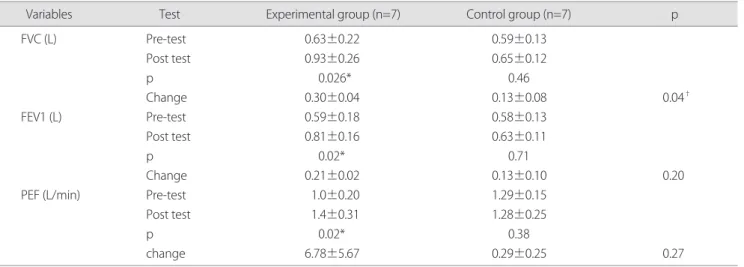
the children with spastic diplegic CP. The EG showed a

significant increase in the FVC, FEV1, and PEF after training

(p<0.05), whereas there was no significant difference in

the CG after training. In the EG, FVC increased significantly,

compared to the CG (p<0.05), but not FEV and PEF (Table 1).

(3)

Hwa-Kyung Shin: The Effects of Water-based Exercise on Respiratory Function in Children with Spastic Diplegic Cerebral Palsy

www.kptjournal.org 200 J Korean Soc Phys Ther 2012:24(3):198-201

IV. Discussion

CP patients suffer from a high incidence of respiratory dysfunction, such as recurrent pneumonia, atelectasis, bronchiectasis, sleep apnea, chronic obstructive lung disease, and restrictive lung disease.

12

Clinical symptoms, such as poor coughing and airway clearance, respiratory muscle weakness and kyphoscoliosis are thought to be related to respiratory dysfunction in these individuals.

12

WE is an attractive form of exercise for children with CP because of the unique properties of water that may reduce risks associated with joint loading, and may allow a child to engage more easily in strength and/or aerobic activity than land-based exercise.

6-8

WE may be of particular benefit to children with significant movement limitations for whom the participation in land- based exercise may be limited. Theoretically, we can evaluate respiratory function in two ways; first, the lung needs more power for breathing through a measurement of airway resistance, and second, the lung needs more time for breathing by measuring the expiratory flow volume.

Among the spirometry variables, the most frequently used measurement in children is the FEV1. It is also known that when compared to normal children, asthmatic children show reduced FEV1 and FVC, even in the absence of an asthmatic attack.

13,14

In this study, the EG showed a significant increase

in the FVC, FEV1, and PEF after training, whereas, there was no significant difference in the CG after training. In the EG, FVC increased significantly, compared to that of the CG, but not FEV and PEF.

Studies involving typically developing children and children with asthma report a significant improvement in aerobic capacity for children engaging in aquatic exercise two or more times a week. Hutzler et al.

15

studied the effects of a movement and swimming program and described the significant increase in the vital capacity of the children with CP. Lee et al.

16

compared the effect of aquatic task training and land task exercise on gait and balance ability in the stroke patients. Both group showed significant improvement. But the aquatic EG showed slightly more improvement in the in static balance, Berg balance, and upright walking tests.

We admit some limitations of the study. The primary limi- tation was that the subjects were not screened for metabolic problems, such as metabolic acidosis and alkalosis, which could also influence the respiratory system. Also, the sample size was much less which also would have an effect on the result of the study. In conclusion, these findings suggest that an aquatic AE program was effective for children with spastic diplegic CP. Furthermore, we support the need for additional research about the effect of AE on gait analysis or activity of daily living performance.

Table 1. Changes in dependent variables for CP children over 8-week intervention for both groups

Variables Test Experimental group (n=7) Control group (n=7) p

FVC (L)

FEV1 (L)

PEF (L/min)

Pre-test Post test p Change Pre-test Post test p Change Pre-test Post test p change

0.63±0.22 0.93±0.26 0.026*

0.30±0.04 0.59±0.18 0.81±0.16

0.02*

0.21±0.02 1.0±0.20 1.4±0.31

0.02*

6.78±5.67

0.59±0.13 0.65±0.12

0.46 0.13±0.08 0.58±0.13 0.63±0.11

0.71 0.13±0.10 1.29±0.15 1.28±0.25

0.38 0.29±0.25

0.04

0.20

0.27 Values are number or mean±standard deviation.

FVC: forced vital capacity, FEV1: forced expiratory volume at one second, FEF: peak expiratory flow.

Wilcoxon signed-rank test for within-group comparison (*p<0.05), Mann-Whitney U test for between-group comparison of improvements (

p<0.05).

(4)

www.kptjournal.org

Hwa-Kyung Shin: The Effects of Water-based Exercise on Respiratory Function in Children with Spastic Diplegic Cerebral Palsy

J Korean Soc Phys Ther 2012:24(3):198-201 201

Author Contributions

Research design: Shin HK Acquisition of data: Shin HK

Analysis and interpretation of data: Shin HK Drafting of the manuscript: Shin HK

Administrative, technical, and material support: Shin HK Research supervision: Shin HK

Acknowledgements

This work was supported by research grants from the Catholic University of Daegu in 2010.

References

1. Rogers A, Furler BL, Brinks S et al. A systematic review of the effectiveness of aerobic exercise interventions for children with cerebral palsy: an AACPDM evidence report. Dev Med Child Neurol. 2008;50(11):808-14.

2. Takeshima N, Rogers ME, Watanabe E et al. Water-based exercise improves health-related aspects of fitness in older women. Med Sci Sports Exerc. 2002;34(3):544-51.

3. Wang TJ, Belza B, Elaine Thompson F et al. Effects of aquatic exercise on flexibility, strength and aerobic fitness in adults with osteoarthritis of the hip or knee. J Adv Nurs. 2007;57(2):141-52.

4. Pechter U, Ots M, Mesikepp S et al. Beneficial effects of water- based exercise in patients with chronic kidney disease. Int J Rehabil Res. 2003;26(2):153-6.

5. Melzer I, Elbar O, Tsedek I et al. A water-based training program that include perturbation exercises to improve stepping responses in older adults: study protocol for a randomized controlled cross-

over trial. BMC Geriatr. 2008;8:19.

6. Kelly M, Darrah J. Aquatic exercise for children with cerebral palsy.

Dev Med Child Neurol. 2005;47(12):838-42.

7. Retarekar R, Fragala-Pinkham MA, Townsend EL. Effects of aquatic aerobic exercise for a child with cerebral palsy: single-subject design. Pediatr Phys Ther. 2009 ;21(4):336-44.

8. Ballaz L, Plamondon S, Lemay M. Group aquatic training improves gait efficiency in adolescents with cerebral palsy. Disabil Rehabil.

2011;33(17-18):1616-24.

9. Mohan V, Henry LJ, Das S et al. Effect of unsupported arm exercise on spirometry values and functional exercise tolerance of subjects with chronic obstructive pulmonary disease. Int Med J. 2010;

17(2):113-6.

10. Fattah MA, Hamdy B. Pulmonary functions of children with asthma improve following massage therapy. J Altern Complement Med.

2011;17(11):1065-8.

11. Song TW, Kim KW, Kim ES et al. Correlation between spirometry and impulse oscillometry in children with asthma. Acta Paediatr.

2008;97(1):51-4.

12. Park ES, Park JH, Rha DW et al. Comparison of the ratio of upper to lower chest wall in children with spastic quadriplegic cerebral palsy and normally developed children. Yonsei Med J. 2006;

47(2):237-42.

13. Shin HK, Kim HS, Lee OB. The effect of seat surface inclination on respiratory function and speech production in sitting. J Korean Soc Phys Ther. 2012; 24(1):29-34.

14. Song JY. The changes of respiratory functions following postures in cerebral palsy: spastic diplegia. J Korean Soc Phys Ther 2004;16(4):699-709.

15. Hutzler Y, Chacham A, Bergman U et al. Effects of a movement and swimming program on vital capacity and water orientation skills of children with cerebral palsy. Dev Med Child Neurol. 1998;

40(3):176-81.

16. Lee JY, Park JS, Kim K. The effect of aquatic task training on the gait and balance ability in stroke patients. J Korean Soc Phys Ther.

2011;23(3):29-35.

수치

Table 1. Changes in dependent variables for CP children over 8-week intervention for both groups

참조

관련 문서

Injury is a burden on athletes, but the rehabilitation exercise of this study suggests that the improvement of knee muscle function and knee function

The purpose of this study was to investigate the effects of a disability awareness program on improving the attitudes of regular elementary school

The effect of Combined Exercise program on Body composition, Physical fitness and thickness of subcutaneous fat in. Obese

The objective of this study is to understand the effects of walking activity using fairy tales on the peer competence and emotional intelligence of

This study investigates the effect of complex exercise program activities using Motion-based games on high school students with developmental disabilities on

Wrestler anaerobic exercise on body composition and function by analyzing the impact of physical man wrestler necessary for the efficient exercise

Transformed –log 10 p of SNPs from the logistic regression model of association with dementia based on the additive model in male subjects.. P-value on the left Y-axis is

Through an empirical analysis of employability of persons with cerebral palsy this study aims to examine the factors affecting their employability and