• 검색 결과가 없습니다.

Effects of Low-intensity Scapular Stabilization Exercise in Arthroscopic Shoulder Surgery Patients J K S P T

N/A
N/A
Protected

Academic year: 2021

Share "Effects of Low-intensity Scapular Stabilization Exercise in Arthroscopic Shoulder Surgery Patients J K S P T"

Copied!
6
0
0

로드 중.... (전체 텍스트 보기)

전체 글

(1)

Effects of Low-intensity Scapular Stabilization Exercise in Arthroscopic Shoulder Surgery Patients

Hee-Yeon Yoon, PT, BHSc.

1

, Jong-Duk Choi, PT, PhD

2

1

Department of Physical Therapy, Daejeon Sewoori Hospital, College of Health Science, Daejeon University,

2

Department of Physical Therapy, College of Natural Science, Daejeon University

Purpose: The purpose of this study was to compare a control group and an experimental group, consisting of arthroscopic shoulder surgery patients who had received acute rehabilitation treatment and who were to perform scapular stabilization exercise.

Methods: Sixteen subjects were studied. The control group, n=8, received instruction for basic physical therapy intervention.

An experimental group, n=8, received instruction for doing scapular stabilization exercise (protraction, retraction, elevation, depression) 10 times, 6 times per week. To evaluate the effects of exercise, subjects were evaluated using a joint position sense of shoulder (JPS), disability of the arm, shoulder index (DASH), shoulder pain and disability index (SPADI).

Results: Participants showed after the intervention, both groups saw their JPS errors at 30

o

, 60

o

, and 90

o

significantly decrease relative to before the intervention (p<0.05). Both groups saw their JPS rates at 90

o

significantly decrease (p<0.05), with no significant changes in JPS at 30

o

and 60

o

(p>0.05). SPADI and DASH significantly decrease after the intervention (p<0.05), with no significant decreases before the intervention (p>0.05). The change rates of SPADI and DASH significantly reduced (p<0.05).

Conclusion: Low-intensity scapular stabilization exercise is considered effective as a clinical treatment for arthroscopic shoulder surgery patients who receive acute rehabilitation treatment.

Keywords: Arthroscopy, Shoulder pain, Stabilization exercise

I. Introduction

Stiffness in the shoulder joint capsule, which can occur in a variety of situations, greatly restricts passive range of motion.

1

Problems arising from shoulder stiffness include adhesive capsule,

2

frozen shoulder,

3-7

and capsulitis.

8-10

Adhesive or fusion capsule limits movement or leads to failure in movement, and capsule injuries may trigger operational issues and problems with subacromial bursae, tendons, or muscles outside the capsule.

1

Rotator cuff injuries experienced by 4%

to 32% of the population and with growing prevalence in

increasing age trigger shoulder pain and weakness together with kinematic movement deformity of the glenohumeral joint. This condition may also occur when the shoulder joint is unstable. The rotator cuff consists of four structurally combined muscles: the supraspinatus, infraspinatus, subscapularis, and teres minor, which harmoniously function for shoulder movement. Weak injury of the partially ruptured area or overall rupture is the operational standard for surgical treatment of rotator cuff injuries. Symptoms that do not respond to traditional treatment methods impair a patient’s normal function.

11,12

Superior labrum anterior to posterior (SLAP) is a rupture starting from the biceps brachii tendon and its origin, and extending to the posterior upper subglenoid fossa, to an area before the glenoid cavity notch. This condition exhibits a variety of symptoms, including snapping, pain, and instability.

13-15

However, there are no symptoms specific to Received May 31, 2012 Revised June 10, 2012

Accepted June 18, 2012

Corresponding author Jong-Duk Choi, [email protected]

Copyright © 2012 by The Korean Society of Physical Therapy

This is an Open Access article distributed under the terms of the Creative Commons Attribution Non-Commercial License (http://creativecommons.org/licenses/by-nc/3.0/) which permits unrestricted non-commercial use, distribution, and reproduction in any medium, provided the original work is properly cited.

The J ournal of K orean S ociety of P hysical T herapy Original Article

(2)

the disease and physical examination results in no unique observations. This condition is also accompanied by other diseases, such as anterior instability and rotator cuff disease, and therefore, is difficult to diagnose.

16,17

Good rehabilitation programs provide the potential for good post-operative results, the return of the patient to functional activities, and an enhanced quality of life.

18

Stabilization is defined as the ability to regulate a particular movement of a joint. Among all of the joints in the human body, the shoulder joint has the widest range of movement and has a tendency toward instability; therefore, muscles play an important role in the dynamic stability of the joint.

The normal movement pattern of the shoulder joint is accompanied by scapular rhythmic stabilization.

The proprioceptive sense is composed of mechanical load information, which is input to special sensory receptors located in the muscles, around the skin, or in the joints, and is delivered to the central nervous system (CNS), where it is integrated.

19

It is used as basic information for conscious or unconscious balance caused by stimuli resulting from postural change. The proprioceptive sense is the body’s positioning sense (the ability to determine exactly where a particular body part is in space) and plays an important role in maintaining dynamic movement.

20,21

The sensibility of this sense is weakened by aging, illness, high intensity exercise, or physical injury and may be upgraded by light, low-intensity pre-exercise.

22,23

Previous studies applied exercise for between 6 and 8 weeks post-operatively in order to treat the shoulder joint and restore active movement. The subjects under study were patients who had been diagnosed with rotator cuff rupture and SLAP in the shoulder joint, had undergone arthroscopy, and to whom exercise restriction was made six weeks prior to the performance of the experiment.

Appropriate post-operative rehabilitation time had been discussed before the study. Active exercise was applied four weeks post-operatively. At two-year follow-up the results were still positive.

24

However, there have been no studies regarding low-intensity, scapular stabilization exercise applied to arthroscopic shoulder surgery patients 5 to 10 days postoperatively.

The purpose of the present study was to compare a control group and an experimental group, consisting of arthroscopic shoulder surgery patients who had received acute rehabilitation treatment and who were to perform scapular stabilization exercise (retraction, protraction, elevation, and depression) between 5 and 10 days postoperatively, in order to examine the effects of such exercise on pain, function and sensibility.

II. Materials and Methods

1. Subjects

The participants of this study were 16 patients (10 female and 6 male) who were diagnosed with SLAP and rotator cuff rupture by orthopedic doctors at S hospital located in Daejeon. These patients had undergone arthroscopic shoulder surgery between March and April 2012. The purpose of this study was sufficiently explained to the subjects and signed consent was obtained. Those who had neurological problems resulting from cervical disc disorder, complained of vascular problems, an internal disease, or psychological problems were excluded.

2. Experimental methods 1) Measurement

⑴ Performance of exercise

After subject selection, their dominant hands were deter-

mined. All subjects were right-handed. Three subjects

had undergone surgery on the left-hand side and 13 on

the right-hand side. They were randomly assigned to an

experimental group (8 patients) and a control group (8

patients). Basic physical therapy intervention was applied

to all subjects twice per day, six times a week. An ice pack

for 10 minutes, ultrasound for 5 minutes, and interferential

current therapy for 15 minutes was applied to the surgical

area. Passive exercise physical therapy was also applied

by therapists once per day for 10 minutes, six times per

week. Two skillful therapists, each with 5 years of passive

physical therapy experience, conducted the sessions. The

experimental group engaged in the scapular stabilization

exercise intervention.

(3)

(2) Evaluation tools and methods

The two groups recorded their disability of the arm, shoulder index (DASH) and shoulder pain and disability index (SPADI) symptoms and their joint position senses of shoulder (JPS) were measured prior to their participation in the experiment.

After the application of the intervention for one week, their DASH, SPADI, and JPS scores were reassessed.

① Shoulder JPS

This test was conducted before and after the intervention.

Post-operative flexion proprioceptive position was measured using an assessment plate of 180 degrees with 30 degree intervals (30

o

, 60

o

, 90

o

, 120

o

, 150

o

). The 30 degree interval was the minimum interval used to divide proprioceptive injuries and differentiate different levels of position sensitivity.

25

Measurements at each angle (30

o

, 60

o

, 90

o

, 120

o

, 150

o

) were aimed at preventing assessment errors resulting from a single measurement. In order to control position perception enhancement caused by repeated movement and measurement, measurement at each angle was randomly made twice.

26

Test-retest reliability of the passive reposition test under the above method was Cronbach’s α=0.86.

Given that the standard Cronbach’s α to judge assessment tool reliability is 0.75 or higher,

27

the evaluation method in this study, using the shoulder JPS assessment plate, was acceptable.

Because the experimental group was composed of arthroscopic shoulder surgery patients receiving acute rehabilitation treatment, measurements were made only between 30

o

and 90

o

. The subjects in the experimental group were fixed in alignment with the shoulder joint axis of the affected side, with the shoulder joint flexion angle of 0

o

as a starting position. They were passively held at each angle of 30

o

, 60

o

, and 90

o

by the therapist twice, five seconds each time, and returned to the starting position. They were explained to express “stop” when they perceived a target angle during the shoulder joint passive flexion. After a rest for 10 seconds, a perception test was conducted on targeted angles of the shoulder joint flexion. The points where subjects expressed “stop” were marked on the assessment plate and error ranges from the targeted angles were measured. The error range angles measured were calculated into absolute

values and recorded.

② DASH

DASH is a self-report questionnaire aimed at evaluating functional physical disabilities or symptoms of the upper extremities (shoulder, elbow, wrist, and hand).

28

It consists of 30 items-21 on upper extremity functions to measure physical activities; 5 on pain, activity-related pain, tingling, weakness, and stiffness; and 4 on emotional matters and social activities, such as the disability to engage in social activities due to pain, repeated problems, and sleep and psychological problems. A score from zero (no disability) to 100 points (the most severe disability) is obtained. In the present study, the DASH measurements were made twice- once before and once after the intervention.

③ SPADI

SPADI is a self-report questionnaire to evaluate pain and function in those with pathological problems of the shoulder, musculoskeletal pain, and neurological problems.

29

It is composed of 13 items-5 on the severity of pain and 8 on physical function problems. Scores granted on this questionnaire are the same as those of a Visual Analog Scale.

Zero points refers to no pain/no difficulties and 10 points means the worst pain imaginable, and movement so difficult that the subject requires help. All the point scores were added for a total percentage ranging from 0 to 100, with 0 indicating the best and 100 indicating the worst. In the present study, SPADI measurements were made twice-once before and once after the intervention.

④ Scapular stabilization exercise

Scapular stabilization exercise of low-intensity was applied

to the subjects in the experimental group 5 to 10 days after

arthroscopic shoulder surgery. Each motion of protraction,

retraction, elevation, and depression was applied at a set of

10 times per a day for 5 minutes six times per week. An ice

pack was applied to each of the subjects after the scapular

stabilization exercise for 10 minutes. The intensity of the

exercise varied among the patients, according to their state. A

3-minute rest time was given after each movement. A skilled

physical therapist with over 2 years of experience guided the

subjects in the exercises.

(4)

3. Statistical analysis

All data obtained in this study were analyzed using SPSS ver.

18 for Windows (SPSS Inc., Chicago, IL, USA). Description analysis (mean±SD) of the general characteristics of the two groups was made. The Wilcoxon signed-rank test was conducted in order to examine differences in the results from each group before and after the intervention and the Mann- Whitney U test was used to look at differences between the groups. The level for statistical significance was set at 0.05.

III. Results

1. General characteristics of the participants

The participants consisted of 16 adults-6 males and 2

females in the control group and 5 males and 3 females in the experimental group. The general characteristics of the participants are shown in Table 1.

2. Variations in the results of JPS at 30 o , 60 o , and 90 o in the control and experimental groups

After the intervention, both groups saw their JPS errors at 30

o

, 60

o

, and 90

o

significantly decrease relative to before the intervention (p<0.05). Both groups saw their JPS rates at 90

o

significantly decrease (p<0.05), with no significant changes in JPS at 30

o

and 60

o

(p>0.05). Data is shown in Table 2.

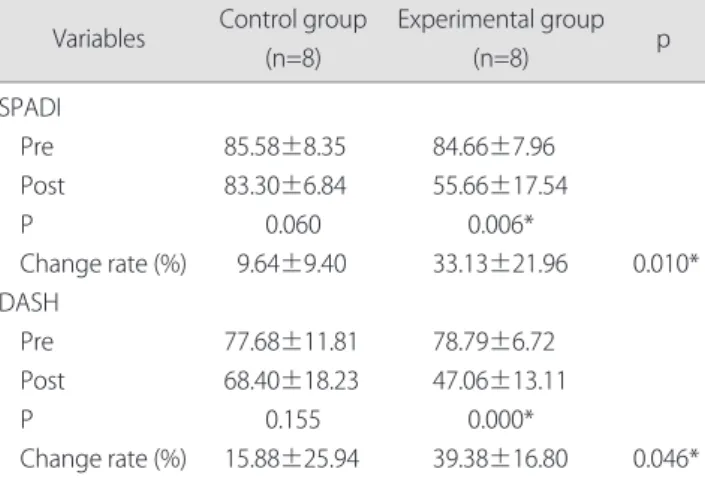
3. Variations in the results of SPADI and DASH in the control and experimental groups

Both groups saw their SPADI and DASH significantly decrease after the intervention (p<0.05), with no significant decreases before the intervention (p>0.05). The change rates of SPADI and DASH significantly reduced (p<0.05). Data is shown in Table 3.

IV. Discussion

This study examined the effects of low-intensity scapular stabilization exercise on JPS, DASH, and SPADI in patients

Table 1. General characteristics of the test subjects (n=16)

Variables Control group (n=8) Experimental group (n=8) Age (yr)

Height (cm) Weight (kg)

56.8±6.6 160.1±4.5 59.8±7.9

56.3±7.8 166±10.1

62±12.9 Values are mean±standard deviation.

Table 2. A comparison of JPS30, JPS60 and JPS90 between the pre control and experimental groups and the post control and experi- mental groups (n=16)

Variables Control group (n=8)

Experimental group

(n=8) p

JPS 30 Pre Post P

Change rate (%) JPS 60

Pre Post P

Change rate (%) JPS 90

Pre Post P

Change rate (%)

15.75±6.02 10.50±5.98 0.000*

37.14±20.92

9±4.57 6.13±4.12 0.034*

28.25±29.21

12.75±6.58 7.88±4.01 0.010*

27.75±36.79

14.75±6.58 7±4.14 0.002*

53.38±23.38

13.73±6.94 6.88±4.52 0.003*

49.25±18.55

13.13±5.94 5.13±2.1

0.001*

59.38±9.43

0.224

0.181

0.014*

Values are mean±standard deviation.

JPS: joint position sense of shoulder.

*p<0.05.

Table 3. A comparison of SPADI and DASH between the pre control and experimental groups and the post control and experimental groups (n=16)

Variables Control group (n=8)

Experimental group

(n=8) p

SPADI Pre Post P

Change rate (%) DASH

Pre Post P

Change rate (%)

85.58±8.35 83.30±6.84 0.060 9.64±9.40

77.68±11.81 68.40±18.23

0.155 15.88±25.94

84.66±7.96 55.66±17.54

0.006*

33.13±21.96

78.79±6.72 47.06±13.11

0.000*

39.38±16.80

0.010*

0.046*

Values are mean±standard deviation.

SPADI: shoulder pain and disability index, DASH: disability of the arm, shoulder index.

*p<0.05.

(5)

who had undergone arthroscopic shoulder surgery. After the intervention, the experimental group saw overall increases in their JPS while the control group’s increase was confined to a JPS of 30

o

.

The shoulder joint, the human joint with the widest range of motion, has an anatomically thin glenoid fossa, which enables the performance of a wide range of exercise.

Additionally, this is where many muscles and ligaments cross the joint, generating joint stability. Therefore, pain in the shoulder joint, causing limitations to movement, creates difficulties in the activities of daily living.

30

The proprioceptive sense receives information regarding the position and movement of the musculoskeletal system and joints. Mechanoreceptors perceive movement and tension of the muscles and ligaments and the positions and movements of the joints. According to their positions, sensitive receptors are classified into skin, internal, muscle, and joint receptors.

Muscle and joint receptors are categorized as proprioceptive sense receptors.

31

According to the shoulder JPS test results, the control group saw their errors regarding JPS significantly decrease only at 30

o

, whereas the experimental group’s errors regarding JPS significantly decreased at all angles: 30

o

, 60

o

, and 90

o

. This result suggests that scapular stabilization exercise, which is an active repetitive exercise, is effective in recovering JPS compared to general physical therapy, which leads to only a slight increase in JPS function. Mottram

32

noted that scapular stabilization exercise is used to improve movement dysfunction related to abnormal scapular position and abnormal dynamic coordination and primarily offers stability to the overall scapular area. Scapular stabilization exercise influences rearrangement of protein fibers and reduces muscle stiffness in the process of delivering information to the CNS regarding tension and pressure on different joints and the length of muscles related to a variety of joint positions. Bartlett and Warren

33

reported that repeated exercise increases body temperature, lowers the mechanoreceptor threshold, induces vascular expansion, and increases nerve root reflexes, heightening exercise senses. In DASH and SPADI, tools to assess the effects of low-intensity scapular stabilization exercise on pain and function, the control group did not see any significant differences between

prior to the intervention and after the intervention. On the other hand, the experimental group’s DASH and SPADI significantly decreased after the intervention. Both assessment tools are widely known and commonly used methods.

In current reports, rehabilitation periods were shorter in patients who had received acute rehabilitation treatment after arthroscopic shoulder surgery. In a study of active range of motion exercise applied to patients 10 days postoperatively, Habernek et al.

24

observed that a survey after two years showed normal function, movement, and force. Other reports showed that resurvey after five years demonstrated no difference. Düzgün et al.

18

observed that pain decreased both in a group that performed active exercise three weeks postoperatively and in a group that performed active exercise six weeks postoperatively. Prior studies reported that acute rehabilitation treatment did not bring about negative results in pain and function. Similarly, in the present study, there was no pain increase or functional decrease when scapular stabilization exercise was applied to patients who had received arthroscopic shoulder surgery.

As the first limitation of this study, scapular stabilization exercise was conducted by the subjects themselves and there were probably individual differences in exercise intensity.

In other words, accurate intensity of the exercise was not expressed, which is unsatisfying. Second, the intervention period was too short. Third, the number of study subjects was small, lowering the reliability of the results.

Author Contributions

Research design: Yoon HY, Choi JD Acquisition of data: Yoon HY

Analysis and interpretation of data: Yoon HY Drafting of the manuscript: Yoon HY, Choi JD

Administrative, technical, and material support: Choi JD Research supervision: Choi JD

References

1. Beaufils P, Prévot N, Boyer T et al. Arthroscopic release of the

glenohumeral joint in shoulder stiffness: a review of 26 cases.

(6)

French Society for Arthroscopy. Arthroscopy. 1999;15(1):49-55.

2. Duplay S. La Périarthrite scapulo-humérale. Rev Prat Med.

1896;53:226-7.

3. Codman A. The shoulder. Boston, Todd, 1934.

4. DePalma AF. Loss of Scapulohumeral Motion (Frozen Shoulder) Clin Orthop Relat Res. 2008;466(3):552-60.

5. De Palma F. Surgery of the shoulder. 3rd ed. Philadelphia, JB Lippincott, 1983;193-204.

6. Ozaki J, Nakagawa Y, Sakurai G et al. Recalcitrant chronic adhesive capsulitis of the shoulder. Role of contracture of the coracohumeral ligament and rotator interval in pathogenesis and treatment. J Bone Joint Surg Am. 1989;71(10):1511-5.

7. Zuckermann JD, Cuomo F, Rokito S. Definition and classification of frozen shoulder: a consensus approach. J Shoulder Elbow Surg.

1994;27:S72(part 2).

8. Neviaser S. Adhesive capsulitis of the shoulder. A study of the pathological findings in periarthritis of the shoulder. J Bone Joint Surg. 1945;27:211-22.

9. Murnaghan JP. Adhesive capsulitis of the shoulder: current concepts and treatment. Orthopedics. 1988;11(1):153-8.

10. Hannafin JA, E.F. D, Wickiewicz TL, Warren RF. Adhesive capsulitis:

capsular fibroplasia of the glenohumeral joint. J Shoulder Elbow Surg 1994;3(Suppl):5.

11. Boykin E, Heuer J, Vaishnav S, et al. Rotator Cuff Disease: basics of diagnosis and treatment. Rheuma Rep. 2010;2(1):1-12.

12. Bin S, Jung S. Diagnosis of lesions of the rotator cuff tear; a comparison of ultrasonography, magnetic resonance imaging and operative findings. J Kor Sports Surg. 1995;13(2)102-7.

13. Higgins LD, Warner JJ. Superior labral lesions: anatomy, pathology, and treatment. Clin Orthop Relat Res. 2001;(390):73-82.

14. Mileski RA, Snyder SJ. Superior labral lesions in the shoulder:

pathoanatomy and surgical management. J Am Acad Orthop Surg.

1998;6(2):121-31.

15. Snyder SJ, Banas MP, Karzel RP. An analysis of 140 injuries to the superior glenoid labrum. J Shoulder Elbow Surg. 1995;4(4):243-8.

16. Gartsman GM, Hammerman SM. Superior labrum, anterior and posterior lesions. When and how to treat them. Clin Sports Med.

2000;19(1):115-24.

17. Maffet MW, Gartsman GM, Moseley B. Superior labrum-biceps tendon complex lesions of the shoulder. Am J Sports Med.

1995;23(1):93-8.

18. Düzgün I, Baltacı G, Atay OA. Comparison of slow and accele-

rated rehabilitation protocol after arthroscopic rotator cuff repair: pain and functional activity. Acta Orthop Traumatol Turc.

2011;45(1):23-33.

19. Carpenter JE, Blasier RB, Pellizzon GG. The effects of muscle fatigue on shoulder joint position sense. Am J Sports Med. 1998;26(2):262- 5.

20. Miura K, Ishibashi Y, Tsuda E et al. The effect of local and general fatigue on knee proprioception. Arthroscopy. 2004;20(4):414-8.

21. Tsuda E, Okamura Y, Otsuka H et al. Direct evidence of the anterior cruciate ligament-hamstring reflex arc in humans. Am J Sports Med. 2001;29(1):83-7.

22. Friemert B, Bach C, Schwarz W et al. Benefits of active motion for joint position sense. Knee Surg Sports Traumatol Arthrosc.

2006;14(6):564-70.

23. Uchio Y, Ochi M, Fujihara A et al. Cryotherapy influences joint laxity and position sense of the healthy knee joint. Arch Phys Med Rehabil. 2003;84(1):131-5.

24. Habernek H, Schmid L, Frauenschuh E. Five year results of rotator cuff repair. Br J Sports Med. 1999;33(6):430-3.

25. Jun AY, Jung KI, Choi EH. The effect of visual feedback training on proprioception of the wrist joint in stroke patients. Korean J Stroke. 2003;5(1):78-82.

26. Baek JH, Kim JW, Kim SY et al. Acute effect of repeated passive motion exercise on shoulder position sense in patients with hemiplegia: a pilot study. NeuroRehabilitation. 2009;25(2):101-6.

27. Portney G, atkins P. Foundations of clinical research: Applications to practice. 2nd ed. New Jearsy, Prentice-hall, 2000.

28. Hudak PL, Amadio PC, Bombardier C. Development of an upper extremity outcome measure: the DASH (disabilities of the arm, shoulder and hand) [corrected]. Am J Ind Med. 1996;29(6):602-8.

29. Roach KE, Budiman-Mak E, Songsiridej N et al. Development of a shoulder pain and disability index. Arthritis Care Res.

1991;4(4):143-9.

30. Jae L, Yong H. Clinical study of physical therapy on the frozen shoulder. J of Health Scie & Med Tech. 1985;14(1):1-8.

31. Tae K. The effects of proprioceptive position sense by exercise-induced muscle fatigue of shoulder joint. J coll health scie.2006;26:47-56.

32. Mottram SL. Dynamic stability of the scapula. Man Ther. 1997;2(3):

123-31.

33. Bartlett MJ, Warren PJ. Effect of warming up on knee proprio-

ception before sporting activity. Br J Sports Med. 2002;36(2):132-4.

수치

Table 3. A comparison of SPADI and DASH between the pre control  and experimental groups and the post control and experimental  groups (n=16)

참조

관련 문서

This showed that the surgical outcome was successfulin 269 patients (98.89%),butthe revision surgery due to surgicalrelapse was performed in three patients.Of 152 patients

In the region of Auerbach’s plexus (AP) of small intestine, the staining intensity of the ICC-IR cells was reduced in the HFD group compared to the control group.. The numbers

In contrast, Chiropractic has shown better result than sports massage in the range of motion of the shoulder joint, Thoracic Scapular rhythm test, and the

This study prepares an educational program which helps the patients reduce anxiety on surgery which is considered as one of the biggest emotional crises

Using this leap motion, a surgeon can perform the virtual shoulder arthroscopic surgery skillfully and reduce mistakes in surgery.. The simulation using leap motion shows

Purpose: The purpose of this study is to report the safety and effectiveness of arthroscopic-assisted implantation of Cartistem®, an articular cartilage

Then humeral head prosthetic design of a Bigliani-Flatow (BF) shoulder system was used to do simulation humeral arthroplasty surgery and the humeral head size

Results: In this research, in the group with fibromyalgia patients group, systemic lupus erythematosus patients group and without systemic autoimmune