| Abstract |
1)PURPOSE: This study examined the efficacy of an interferential current (IFC) treatment on the improvement of pain, disability, and quality of life in stroke patients with lumbago.
METHODS: A double-blind, randomized clinical trial was conducted on 40 stroke patients with lumbago. The patients were allocated randomly into two groups: the IFC treatment group (n= 20) and the placebo treatment group (n= 20). The IFC group received 30 minutes of IFC treatment on the lumbar region, while the placebo group received IFC treatment but without real electrical stimulation. The intervention was administered five days a week for four weeks. The primary outcomes of pain intensity were measured using a visual analogue scale. The secondary measurements included the Barthel Index, Oswestry Disability Index (ODI), and
†Corresponding Author : Tae-Sung In
[email protected], https://orcid.org/0000-0002-7672-5150 This is an Open Access article distributed under the terms of the Creative Commons Attribution Non-Commercial License (http://creativecommons.org/licenses/by-nc/3.0) which permits unrestricted non-commercial use, distribution, and reproduction in any medium, provided the original work is properly cited.
health-related quality of life (HRQoL).
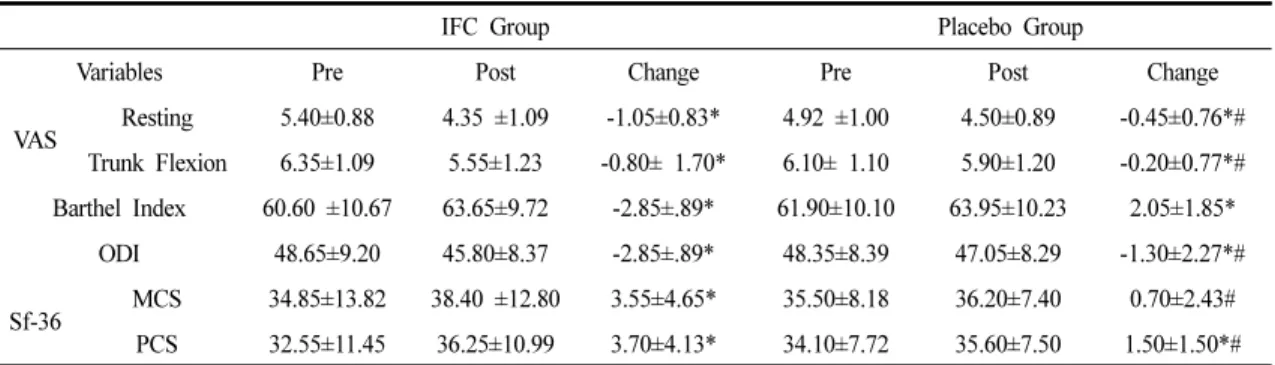
RESULTS: The measurements were conducted before and after the two-week intervention period. Compared to the placebo treatment group, the IFC treatment group showed significantly greater improvement in the pain intensity (p<.05), ODI (p<.05), and SF-36 (p<.05) at the end of the intervention. No significant differences in the Barthel Index were found between the two groups.
CONCLUSION: These findings show that an IFC treatment can improve pain, functional ability, and quality of life, highlighting the benefits of somatosensory stimulation from IFC in stroke patients with lumbago.
Key Words: Electric stimulation therapy, Pain, Activities of daily living, Quality of life, Stroke
Ⅰ. Introduction
Stroke can cause severe and long-term functional disabilities in the elderly [1,2], of which pain is quite common (prevalence, 11%-53%) [3-6]. In addition to shoulder pain, back and lower extremity pain are also observed in stroke patients. In some cases, patients have more than one type of post-stroke pain. [4,7,8].
Research Article Open Access
Effects of Interferential Current Treatment on Pain, Functional Ability, and Health-Related Quality of Life in Chronic Stroke Patients with Lumbago; A
Randomized Controlled Study
Kyoung-Sim Jung, PT⋅Tae-Sung In, PT
†Department of Physical Therapy, Gimcheon University
Received: November 18, 2019 / Revised: November 19, 2019 / Accepted: December 17, 2019
ⓒ 2020 J Korean Soc Phys Med
Regardless of the patient’s age, disease severity, and functional ability, pain adversely affects the rehabilitation outcome in stroke patients [9]. Lumbago has been shown to reduce the health-related quality of life (HRQoL) and the balance and gait of affected individuals [10]. In a recent study, Köseoğlu et al. [11] reported that appropriate and early interventions for pain management are critical in minimizing the functional disability. Although patients with stroke may experience pain in various parts of the body, including the shoulder, wrist, back, and lower extremities, most studies on pain in these patients focused on the shoulder [3,4,7,8]. Electrotherapy, which is a non-invasive and non-pharmaceutical intervention for pain reduction, involves mainly the use of transcutaneous electrical nerve stimulation and interferential current (IFC) [12]. IFC utilizes a low frequency (0-250Hz) current, which is generated from different cross-interfering mid-frequency (around 4000Hz) electrical currents [13]. This method can reduce the skin resistance, thereby enabling the current to penetrate deeper into the tissues without causing discomfort [13, 14]. IFC not only stimulates the sensory nerve fibers to reduce pain but also relaxes the muscles and facilitates blood circulation [15,16]. This method can improve both pain and functionality significantly in patients with musculoskeletal conditions of the knee, shoulder, and back. Suriya-amarit et al. [17] reported significant improvements in stroke patients with shoulder pain and ROM after IFC use. On the other hand, to the best of the authors’ knowledge, the effectiveness of this method in stroke patients with back pain has not been studied.
This study examined the effects of IFC on pain, functional ability, and HRQoL in stroke patients with lumbago.
Ⅱ. Materials and Methods
1. Participants
Forty stroke patients with LBP aged between 19 and 65 years were recruited for this study from J Hospital in
Gyeonggi-do. The subjects had experienced low back pain for three months or longer, had a visual analogue scale score of four or higher, could maintain their standing posture independently for 30 seconds or longer and could understand and follow the instructions given by the researcher (MMSE> 24 points) [18]. The following patients were excluded: patients with radiculopathy; those with contraindications to electrotherapy, lumbar fracture, or surgery; those taking medications that can affect the posture control, gait, or pain; and those who received any physical therapy eight weeks before recruitment in this study [19].
Table 1 lists the common characteristics of the participants in this study. Informed consent was obtained voluntarily from all patients before participation in this study, which was approved by the Institutional Review Board of Gachon University (1044396-201801-HR-009-01). This study used G-power 3.1.7 to calculate the sample size, which was determined based on the ability to detect clinically significant improvement in the outcome measures from a pilot study (17 patients with IFC and 17 patients with placebo IFC), and the effect size and alpha error were set to 0.8 and 0.05, respectively. According to the analysis, at least 20 subjects for each group were necessary to make an acceptable group size.
2. Experimental procedure
This study was designed as a double-blinded,
randomized controlled trial (RCT). The participants were
evaluated before and one day after training for four weeks
by three well-trained physical therapists, who were blinded
to the subjects and the purpose of this study. Forty subjects
were assigned randomly to either the experimental group
(n = 20) or the control group (n = 20) using a selection
envelope. A person who was not involved in the study
picked out a number (either 1 or 2) from a sealed envelope
for unbiased randomization. The treatment lasted for 30
minutes a day, five times a week for four weeks. The sub
jects in the IFC treatment group received electrical
stimulation for 30 minutes, while those in the placebo treatment group received non-electrically stimulated IFC for the same amount of time. All the subjects received conventional therapy for one hour a day, five times a week, for four weeks. Conventional therapy consisted of a range of motion exercises, mat exercises, and gait training for one hour per day. All subjects were evaluated for their pain, functional ability, and health-related quality of life after the four-week training period
3. Intervention
The subjects were asked to expose their waist while lying on their side, and they were electrically stimulated for 30 minutes using an IFC treatment device (IF-7P; ITO CO., Japan). Four electrodes were attached so that they crossed at the lumbar 1 and 5 height. The carrier frequency was set to 4000Hz, and the amplitude-modulated frequency was 80Hz. The current electricity intensity was adjusted to an individual tolerable level of pins-and-needles sensation at a level of invisible muscle contraction.
Furthermore, the mediator was asked to observe whether motion due to muscle contraction had occurred in the
Variable IFC group (n=20) Placebo group (n=20) p-valuea
Sex
Male 6 9 .327
aFemale 14 11
Age 48.05±10.65
a52.40±10.83 .208
bWeight (kg) 61.95±13.94 63.90±12.86 .648
bHeight (cm) 164.63±16.01 167.10±14.73 .528
bDuration of Pain (month) 14.95±7.04 16.80±5.94 .375
bDuration of Dtroke(month) 30.16±14.45 36.27±16.91 .272
bMMSE 25.95±7.043 26.56±7.04 .119
bMMSE, mini-mental status examination; VAS, visual analogue Scale; ODI, Oswestry disability index for low back pain Values are expressed as mean±standard deviation (SD).
a
Chi-square test Independent t-test.
b