• 검색 결과가 없습니다.

Balance Exercise Program Using Training Mats Improves the Postural Balance of Elderly Individuals: A Randomized Controlled Trial J K S P T

N/A
N/A
Protected

Academic year: 2021

Share "Balance Exercise Program Using Training Mats Improves the Postural Balance of Elderly Individuals: A Randomized Controlled Trial J K S P T"

Copied!
6
0
0

로드 중.... (전체 텍스트 보기)

전체 글

(1)

Balance Exercise Program Using Training Mats Improves the Postural Balance of Elderly Individuals: A Randomized Controlled Trial

Kyoung-Jin Lee, PT, MS, Soon-Hyun Kim, PT, MS, Chang-Ho Song, PT, PhD

Department of Physical Therapy, College of Health and Welfare, Sahmyook University

Purpose: The purpose of this study was to investigate the effect of balance training using a training mat on the postural balance of the elderly individuals.

Methods: Thirty-five participants were selected from a falling prevention class and were randomly allocated to two groups;

17 in an exercise group (EG, 72.7±5.1 years) and 18 in the control group (74.9±4.0 years). The EG underwent balance training using training mats for 60 minutes a day, 2 days a week, for 4 weeks. Postural balance parameter (timed up and go test, functional reach test, and one leg standing) were measured pre- and post- training.

Results: The EG showed significant improvements in all variables that were analyzed.

Conclusion: This study confirmed that balance training using a training mat effectively improves the postural balance in elderly people at risk for falling.

Keywords: Postural balance, Aged, Falling, Exercise

I. Introduction

For older adults, falling is a major public health concern that contributes to a cycle of disengagement from occupations, dependence, and increased risk of serious injury.

1

More than one-third of adults aged 65 years or older sustain at least one fall each year.

2

Serious injuries result from about 10% of all falls; 1% consists of hip fractures and another 5% includes other type of fractures.

3

Injuries resulting from falls are one of the leading causes of death among the elderly population.

4

In 2000, direct medical costs associated with fall-related injuries were approximately $19 billion and are projected to rise as the population ages.

5

Balance is dependent on sensory input, central processing, and muscle strength and power.

6

Biological aging is a multi-

factorial phenomenon which is associated with profound changes in the activity of cells, tissues and organs, as well as the reduction of effectiveness through a range of physio- logical processes.

7

Postural control is altered by aging and deterioration of various physiological systems, thereby causing gait abnormalities and postural instability.

A recent Cochrane Review showed that exercise intervention reduces the risk and rate of falls.

8

There are several ways of reducing falls among elderly people. Common interventions include aerobic exercises

9

, muscle strengthening exercises

10

, balance training

8

, and complex gait training.

11

Programs focused on balance training have been found to be effective for preventing falls in the elderly.

12-15

A training mat is a soft, supple, springy piece of equipment.

Balance training using training mats has also been reported to be an effective intervention on performance in bowler.

16

However, few studies have been performed on the effects of balance training using a training mat on the risk of falling in elderly populations. The benefits of such training programs are thus unclear.

Therefore, the objective of the present study was to Received May 31, 2012 Revised June 10, 2012

Accepted June 14, 2012

Corresponding author Chang-Ho Song, [email protected]

Copyright © 2012 by The Korean Society of Physical Therapy

This is an Open Access article distributed under the terms of the Creative Commons Attribution Non-Commercial License (http://creativecommons.org/licenses/by-nc/3.0/) which permits unrestricted non-commercial use, distribution, and reproduction in any medium, provided the original work is properly cited.

The J ournal of K orean S ociety of P hysical T herapy Original Article

(2)

examine the effectiveness of balance training using training mats on the postural balance of elderly people at risk for falling.

II. Materials and Methods

1. Subjects

The study subjects included 52 community-dwelling elderly individuals who attended a fall prevention program provided by a physical therapist at a Senior Welfare Center in Seoul, South Korea.

The inclusion criteria were as follows: age of 65 years or older, no previous participation in a regular balance improvement program during the past 6 months, a Mini- Mental State Examination score of over 24, ability to stand for 2 minutes without any aid, and capability of walking 100 m with or without an aid.

Individuals were excluded from this study if they had: an orthopedic condition (e.g., a fracture, a deformity, or severe osteoarthritis), visual-perceptual impairment, neurological damage, postural hypotension, or a mental deficiency.

When a participant expressed willingness to take part in the study, we obtained their informed consent in accordance with the requirements of the Institutional Review Board of Sahmyook University (Seoul, Korea).

Thirty-eight subjects who met the inclusion criteria were randomly assigned to an exercise group (EG, n=19) or a control group (CG, n=19) using Random Allocation Software ver. 1.0 (Isfahan University, Isfahan, Iran).

17

Two members of the EG were excluded because their program participation rate was less than 80%, and one in the CG was excluded due to a fracture which required hospitalization. Ultimately, the study cohort consists of 35 subjects: 17 in the EG, and 18 in

the CG. The baseline characteristics of the study subjects are shown in Table 1.

2. Experimental methods 1) Intervention

The balance exercise program was conducted for 4 weeks.

The participants were assessed 1 week before and after the program. Before initiating the exercise program, the demographics and balance of the participants were assessed by four different examiners. Participants in the EG performed balance exercises for 60 minutes twice a week and the CG received fall prevention education without the balance exercise. The balance exercise program used training mats that were designed based on previous studies of exercise programs shown to improve balance.

18-20

The exercise intervention performed on a high elasticity balance training mats (StimUp, Alfoots, Seoul, Korea) included the following steps:

(1) A warm-up included gentle stretching forward, backward, and sideways, and massage with a sensory ball. This step was performed with light soothing music to increase muscle flexibility.

(2) Static exercise on training mats involved heel and toe raises, performing a one-leg stance on each limb; shifting the weight forward, backward, sideways, and diagonally;

and turning the head to the left and then to the right while keeping the feet together. This step was performed in two sets of 7 minutes each, once with the eyes opened and then with the eyes closed. While performing the second set, each subject was paired with another for safety reasons and performed the exercises in turn.

(3) Dynamic exercise on training mats included walking, step-ups, and bipedal jumps. The participants performed

Table 1. Subject characteristics

Exercise group Control group t/x

2

p

Gender (male/female) Age (yr)

Height (cm) Weight (kg)

17 (3/14) 72.71±5.10 156.32±6.61 58.84±8.64

18 (5/13) 74.89±3.97 157.64±8.84 60.83±9.56

0.509 1.084 -0.533 -0.688

ns ns ns ns Values are expressed as the mean±standard deviation.

ns: not significant.

(3)

these exercises for 10 minutes per session.

(4) Progressive balance exercise on training mats involved walking forward in a straight line, walking backward, walking sideways, stepping over obstacles, stepping on obstacles, passing balls while standing on a training mat in a circle, and throwing and catching a ball on the training mat. Subjects performed these exercises for 10 minutes per session.

(5) Finally, a cool-down was performed to prevent muscle fatigue, sudden hypoglycemia, and muscle tension, and to help return the heart and respiratory rates back to normal. The cool-down included deep breathing, abdominal breathing, and performing static back extensor exercises while in a reclined position.

21

The exercises were performed in a group so that when one person was exercising, another was supervising the subjects who could not perform the exercises correctly. After every exercise session, the subjects were allowed to rest for 2 minutes at which time they performed upper limb exercises with an elastic band sitting on a ball.

22

A high elasticity balance training mat measuring 46×496

×6 cm, and small polyurethane ball (EDUFOM, Incheon, Korea) 170 mm in diameter were used. The red PVC Ball (Thera-Band, Hygenic corporation, Akron, USA) was 55 cm in diameter and was used for adequate bouncing in an effective and safe manner. The yellow elastic band (Thera-band, Hygenic corporation, Akron, USA) was 40 cm in length and provided 1 kg of resistance.

The fall prevention education was given twice and pre- and post-tests were carried out in the CG as in the EG.

Education was given regarding fear of falling, use of assistive devices, risk factor of falling, medication, and the home assessment.

2) Measurement

For the timed up and go test (TUG), the subjects were asked to sit in an arm chair with a seat height of 46 cm, stand up, walk 3 m at a normal pace, turn, walk back to the chair, and sit down again. The subjects wore their regular footwear and used their customary walking aid (e.g., a cane or walker). No physical assistance was provided. The period for completing this task was measured in seconds starting at the word “go”

and ending when the subject’s back touched the backrest of the chair. Shorter periods were thought to indicate better balancing abilities.

23

This test as a measure of physical mobility has good intrarater and interrater reliability (r=0.99 and 0.98, respectively).

23,24

The functional reach test (FRT) assessed dynamic balance by measuring the maximum distance the subjects could reach forward beyond their own arm length while maintaining a fixed base of support while standing. A yardstick was mounted on the wall at shoulder height. The participants are asked to reach as far forward as possible in a plane parallel to the measuring device without taking a step forward. The better measurement (in cm) of two trials was recorded. The FRT is a precise (coefficient of variation=2.5%) and stable (intra-class correlation=0.92) measurement technique known to be sensitive to change (responsiveness index=0.97).

25

For the one leg standing (OLS) test, the subjects were instructed to start in a position with a comfortable base of support with their eyes open and arms at the side of their trunk. The participants were then asked to stand unassisted on their dominant leg. The time that the subjects were able to stand on one leg was measured (in seconds) from the time one foot was lifted from the floor to when it touched the ground or the standing leg. Longer times were indicative of better balancing abilities.

26

This test as a measure of balance performance has good intrarater (r=0.79 to 0.95).

27

3) Statistical analysis

Statistical analyses were performed using IBM SPSS ver. 19.0 (SPSS Inc., Chicago, IL, USA). Data were analyzed with a Shapiro-Wilk test for normality. Descriptive statistics were used for demographics. An independent t-test and chi-square test were used to maintain homogeneity between the two groups. Pre and post-intervention data were examined with the paired t-test within each groups and the independent t-test to compare between groups. p-values ≤0.05 were considered statistically significant.

III. Results

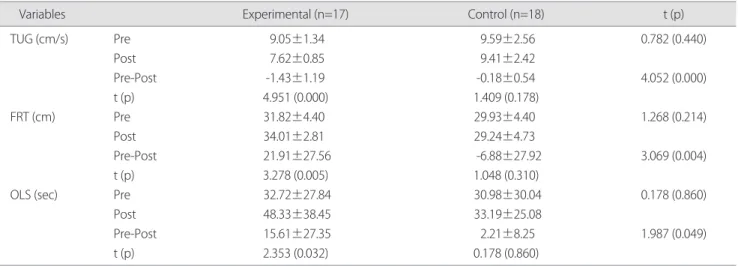
Table 2 shows the effects of the 4-week balance exercise

(4)

program on TUG, FRT, and OLS scores. Significant differences (p<0.05) between the pre- and post-intervention values for all parameters were observed in the EG. In contrast, no significant differences between the pre- and post- intervention values for any parameter were observed in the CG.

IV. Discussion

A number of studies have recently reported the positive effects of balance training in the elderly.

14,15

In the present study, similar results were obtained suggesting that main- tenance of sufficient postural balance was achieved with balance training. In particular, all measurements of postural balance for the EG were greatly improved.

The TUG test is a predictor of fall risk although it assesses few aspects of balance (standing, sitting, and turning).

23

This test is performed to assess functional mobility and balance of the elderly. Shorter TUG times represent increases in these parameters. Mobility is essential for day-to-day activities like grocery shopping and visiting the hospital. Improved balance is considered fundamental for enhancing mobility as well as preventing falls.

28

Shumway-Cook et al.

29

showed that older adults with TUG scores greater than 13.5 seconds have a 90% probability of falling. This study did not specifically target individuals prone

to falling. Rather, community-dwelling older adults with moderate balance impairment were evaluated. In the EG, a mean pre-training TUG score of 9.05 seconds corresponded to a fall risk of approximately 29%. After strength training, the mean TUG score in the EG was 7.62 seconds, corresponding to a fall risk of approximately 12%. Our results show that balance training decreased the risk of falling among the EG participants by approximately 17% according to TUG scores.

The FRT test is designed to examine the limits of stability.

A test result less than 15.24 cm is indicative of a significant increase in the risk of falling. On the other hand, test results ranging from 15.24 to 25.40 cm corresponds to an intermediate risk of falling. FRT pre- and post- test results of the EG improved (+6.9%). Compared to the change observed in the CG, these improvements were significant. Our results indicate that the balance exercise program using training mats helped improve postural balance as previously reported by Nitz and Choy.

15

Nelson et al.

30

found that OLS times significantly increased by 84% in elderly individuals after undergoing strength, balance, and general physical activity intervention programs.

Binder et al.

31

also reported that exercise programs can improve OLS times by 88% and stated that this positive result is attributed to enhanced physical function. In the present study, OSL test results improved significantly (23%) in the EG while no significant change was observed in the CG.

Table 2. Comparison of postural balance within groups and between groups

Variables Experimental (n=17) Control (n=18) t (p)

TUG (cm/s)

FRT (cm)

OLS (sec)

Pre Post Pre-Post t (p) Pre Post Pre-Post t (p) Pre Post Pre-Post t (p)

9.05±1.34 7.62±0.85 -1.43±1.19 4.951 (0.000) 31.82±4.40 34.01±2.81 21.91±27.56 3.278 (0.005) 32.72±27.84 48.33±38.45 15.61±27.35 2.353 (0.032)

9.59±2.56 9.41±2.42 -0.18±0.54 1.409 (0.178) 29.93±4.40 29.24±4.73 -6.88±27.92 1.048 (0.310) 30.98±30.04 33.19±25.08 2.21±8.25 0.178 (0.860)

0.782 (0.440) 4.052 (0.000) 1.268 (0.214) 3.069 (0.004) 0.178 (0.860) 1.987 (0.049) Values are expressed as the mean±standard deviation.

TUG: timed up and go test, FRT: functional reach test, OLS: one leg standing.

(5)

Two limitations of this study need to be mentioned.

First, the small sample size of our study limited the ability to measure statistical significance. There is the possibility that type I-II error was introduced, and further investigation is therefore warranted to determine the overall effectiveness of the intervention. Second, it is unclear whether the improvements we observed after administering our balance exercise program would translate into decreased risk of falling.

In summary, our study demonstrated that a balance exercise program using training mats has a positive effect on postural balance in elderly individuals. Different kinds of balance exercises need to be developed and their effects on not only balance but also muscle strength and gait should be evaluated. Therefore, further research should be conducted to help improve the quality of life and prevent falls among the elderly by enhancing physical function and gait.

Author Contributions

Research design: Song CH Acquisition of data: Kim SH

Analysis and interpretation of data: Lee KJ Drafting of the manuscript: Song CH, Lee KJ Research supervision: Song CH

References

1. Lee YW, Choi SJ, Song CH. The effect of a balance training program to improve the balance of aged patients with diabetes mellitus. J Korean Soc Phys Ther. 2010;22(3):23-30.

2. Hausdorff JM, Rios DA, Edelberg HK. Gait variability and fall risk in community-living older adults: a 1-year prospective study. Arch Phys Med Rehabil. 2001;82(8):1050-6.

3. Tinetti ME, Speechley M, Ginter SF. Risk factors for falls among elderly persons living in the community. N Engl J Med. 1988;

319(26):1701-7.

4. Murphy SL. Deaths: final data for 1998. Natl Vital Stat Rep.

2000;48(11):1-105.

5. Stevens JA, Corso PS, Finkelstein EA et al. The costs of fatal and non-fatal falls among older adults. Inj Prev. 2006;12(5):290-5.

6. Alexander NB. Postural control in older adults. J Am Geriatr Soc.

1994;42(1):93-108.

7. Kjaer M, Jespersen JG. The battle to keep or lose skeletal muscle with ageing. J Physiol. 2009;587(Pt 1):1-2.

8. Gillespie LD, Robertson MC, Gillespie WJ et al. Interventions for preventing falls in older people living in the community. Cochrane Database Syst Rev. 2009;(2):CD007146.

9. Delbaere K, Bourgois J, Van Den Noortgate N et al. A home-based multidimensional exercise program reduced physical impairment and fear of falling. Acta Clin Belg. 2006;61(6):340-50.

10. Persch LN, Ugrinowitsch C, Pereira G et al. Strength training improves fall-related gait kinematics in the elderly: a randomized controlled trial. Clin Biomech (Bristol, Avon). 2009;24(10):819-25.

11. Shimada H, Obuchi S, Furuna T et al. New intervention program for preventing falls among frail elderly people: the effects of perturbed walking exercise using a bilateral separated treadmill.

Am J Phys Med Rehabil. 2004;83(7):493-9.

12. Rogers ME, Fernandez JE, Bohlken RM. Training to reduce postural sway and increase functional reach in the elderly. J Occup Rehabil.

2001;11(4):291-8.

13. Kim JJ, Gu S, Lee JJ et al. The effects of virtual reality-based continuous slow exercise on factors for falls in the elderly. J Korean Soc Phys Ther. 2012;24(2):90-7.

14. Hiyamizu M, Morioka S, Shomoto K et al. Effects of dual task balance training on dual task performance in elderly people: a randomized controlled trial. Clin Rehabil. 2012;26(1):58-67.

15. Nitz JC, Choy NL. The efficacy of a specific balance-strategy training programme for preventing falls among older people: a pilot randomised controlled trial. Age Ageing. 2004;33(1):52-8.

16. Lee SH, Han SC, Kim WJ et al. The effects of balance training using kybounder on collegeate bowler’s performance. Korea J Sports Sci.

2010;19(3):1327-37.

17. Saghaei M. Random allocation software for parallel group randomized trials. BMC Med Res Methodol. 2004;4:26.

18. Verhagen E, Bobbert M, Inklaar M et al. The effect of a balance training programme on centre of pressure excursion in one-leg stance. Clin Biomech (Bristol, Avon). 2005;20(10):1094-100.

19. Song CH, Petrofsky JS, Lee SW et al. Effects of an exercise program on balance and trunk proprioception in older adults with diabetic neuropathies. Diabetes Technol Ther. 2011;13(8):803-11.

20. Richardson JK, Sandman D, Vela S. A focused exercise regimen improves clinical measures of balance in patients with peripheral neuropathy. Arch Phys Med Rehabil. 2001;82(2):205-9.

21. Dorey G, Glazener C, Buckley B et al. Developing a pelvic floor muscle training regimen for use in a trial intervention.

Physiotherapy. 2009;95(3):199-209.

22. Brouwer BJ, Walker C, Rydahl SJ et al. Reducing fear of falling in seniors through education and activity programs: a randomized trial. J Am Geriatr Soc. 2003;51(6):829-34.

23. Podsiadlo D, Richardson S. The timed “Up & Go”: a test of basic functional mobility for frail elderly persons. J Am Geriatr Soc.

1991;39(2):142-8.

24. Hughes C, Osman C, Woods AK. Relationship among perfromance on stair ambulation, functional reach, and Timed Up and go tests in older adults. Issues on Aging. 1998;21:18-22

25. Duncan PW, Weiner DK, Chandler J et al. Functional reach: a new clinical measure of balance. J Gerontol. 1990;45(6):M192-7.

26. Resnick HE, Vinik AI, Schwartz AV et al. Independent effects of

(6)

peripheral nerve dysfunction on lower-extremity physical function in old age: the Women’s Health and Aging Study. Diabetes Care.

2000;23(11):1642-7.

27. Ageberg E, Roberts D, Holmström E et al. Balance in single-limb stance in healthy subjects--reliability of testing procedure and the effect of short-duration sub-maximal cycling. BMC Musculoskelet Disord. 2003;4:14.

28. Howe TE, Rochester L, Jackson A et al. Exercise for improving balance in older people. Cochrane Database Syst Rev. 2007;(4):

CD004963.

29. Shumway-Cook A, Brauer S, Woollacott M. Predicting the probability for falls in community-dwelling older adults using the Timed Up & Go Test. Phys Ther. 2000;80(9):896-903.

30. Nelson ME, Layne JE, Bernstein MJ et al. The effects of multidi- mensional home-based exercise on functional performance in elderly people. J Gerontol A Biol Sci Med Sci. 2004;59(2):154-60.

31. Binder EF, Schechtman KB, Ehsani AA et al. Effects of exercise

training on frailty in community-dwelling older adults: results of a

randomized, controlled trial. J Am Geriatr Soc. 2002;50(12):1921-

8.

수치

Table 1. Subject characteristics
Table 2. Comparison of postural balance within groups and between groups

참조

관련 문서

The purpose of this study was to investigate how the Da Vinci body board exercise program affects the body balance and physical stress of women with body imbalance.. For

Third, for the change in balance ability according to core training and plyometric training, the core group showed a significant difference in travel area

The purpose of this study is a comprehensive analysis for curriculum training excellent teachers, by comparing and analyzing the training program for

In conclusion, it was confirmed that the winter training program is an effective exercise program by inducing positive changes in the physical fitness and

Vector/tensor

straight cylinder (no problems with toroidal force balance) - The 1-D radial pressure balance relation is valid for.. tokamaks, stellarators, RFP’s,

radial pressure balance, toroidal force balance, β limits, q-profiles, etc.. - The stream function ψ is closely related to the poloidal flux

In the lower extremity balance, the change in left unilateral clerk showed a statistically significant difference as the exercise group increased post-test