A Study on Changes in Knee Joint Loading during Stair Gait with Unstable Shoes
계단 보행 시 불안정성 신발 착용에 따른 슬관절 부하에 대한 연구
Purpose: The purpose of this study is to compare kinematics and kinetics on the knee joint between stair gait with unstable shoes and barefoot in healthy adult women.
Methods: Seventeen healthy adult women were recruited for this study. The subjects performed stair ascent and descent with unstable shoes and barefoot. The experiment was repeated three times for each stair gait with unstable shoes and barefoot.
Measurement and analysis of the movements of the knee joint were performed using a three-dimensional analysis system.
Results: Statistically significant differences in the knee muscle force of semimembranosus, biceps femoris-long head, biceps femoris-short head and sartorius, patellar ligament, medial gastrocnemius, and lateral gastrocnemius were observed between unstable shoes and barefoot gait during stair ascent. Statistically significant differences in the knee muscle force of sartorius, rectus femoris, medial gastrocnemius, and lateral gastrocnemius were observed between unstable shoes and barefoot gait during stair descent. Statistically significant differences in the knee flexor moment of semitendinosus, biceps femoris-long head, biceps femoris-short head, sartorius, rectus femoris, vastus intermedialis, medial gastrocnemius, and lateral gastrocnemius were observed between unstable shoes and barefoot gait during stair ascent.
Conclusion: Therefore, wearing unstable shoes during stair gait in daily life is considered to influence knee joint kinematics and kinetics due to the unstable shoes, and thus suggest the possibility that reducing the risks of pain, and knee osteoarthritis, stabilizing the knee joint caused by changes in the loading of the knee joint.
Key Words:Stair ascent, Stair descent, Unstable shoes, knee joint Ji-Won Park1, Yun-jin Kim2
1Department of Physical Therapy, College of Medical Science, Catholic University of Daegu, 2Department of Physical Therapy, General Graduate School, Catholic University of Daegu
박지원1, 김윤진2
1대구가톨릭대학교 물리치료학과, 2대구가톨릭대학교 대학원 물리치료학과
The Journal of Korean Society of Physical Therapy Original articles
Ⅰ. 서론
신발은 외부환경으로부터 발을 보호해주고 보행하는 동안
Copylight ⓒ 2013 The Korea Society of Physical Therapy
This is an Open Access article distribute under the terms of the Creative Commons Attribution Non-commercial License (Http:// creativecommons.org/license/by-nc/3.0.) which permits unrestricted non-commercial use, distribution,and reproduction in any medium, provided the original work is properly cited.
Received Mar 22, 2014 Revised Apr 10, 2014 Accepted Apr 15, 2014
Corresponding author Yun-jin Kim, [email protected]
지지하는 역할을 하는데,1 그 종류로는 하지 관절의 부하에 도움을 주어 보행의 효율성을 높여주는 기능성 신발에서부터 훈련이나 치료를 목적으로 제작된 불안정성 신발(unstable shoe) 까지 다양한 형태로 개발되고 있다.2-4 특히, 불안정성 신발은 전-후 방향으로 둥근 밑창을 부착하여 불안정성 지 지면을 제공함으로써,5 균형과 자세를 개선시키는 목적으로 사 용되고 있다.3
불안정성 신발은 보행하는 동안 발뒤꿈치 닿기에서 발 끝 떼기까지 발을 잡아주어 관절의 움직임을 줄여주고 앞쪽으로
덜 기울어지게 함으로써 최적화된 신체정렬을 가능하게 하며, 하지의 모멘트 감소로 관절에 가해지는 부하를 감소시켜준 다.6,7 불안정성 신발은 해부학적으로 회전축에 가까운 근육 들을 강화시켜줌으로써, 관절에 부하를 감소시키며,5 스포츠 선수와 여성들이 다리 근육의 강화를 목적으로 일상생활동작 을 하는 동안 불안정성 신발을 많이 착용하고 있다.4
계단 보행(stair gait)은 일상생활동작에서 평지 보행 다 음으로 빈번하게 일어나는 움직임으로,8 재활치료 과정 중 의 하나로 사용되기도 한다.9 계단 보행은 입각기와 유각기 로 구분되는 것이 평지 보행과 유사하지만 계단의 높이와 기울기에 따라 하지에서 발생하는 힘의 특성이 달라지는 점이 다르다.8 계단 오르기 동작(stair ascent)은 신체가 전방으로 이동하여 단하지 지지기동안 몸의 균형을 유지해야 하며,10 수평이동과 수직상승을 하기 때문에 평지에서의 보행에 비해 더 큰 하지 관절에서의 가동 범위와 모멘트, 근력 및 조절 능력을 요구한다.11-14 특히, 운동학 및 운동역학적인 관점으로 평지보행과 비교한 선행 연구에서는 계단 오르기 동작을 수행하는 동안 더 큰 슬관절 굽힘 각도와 모멘트가 필 요하다고 보고했고,11,15 최대 슬관절 굽힘 모멘트는 일반 보 행 수준보다 3배 이상 크게 나타났다.11
계단 내리기 동작(stair descent)은 평지보행보다 슬관절 굽힘의 움직임이 더 크며,15 계단 오르기 동작보다 슬관절 굽힘 모멘트가 2.7배 큰 것으로 나타나 손상의 위험에 노출 될 가능성이 높다고 할 수 있다.11,16 이와 같이 계단 오르기 와 내리기 동작은 슬관절염(knee osteoarthritis)으로 고통 받는 고령자나 슬개대퇴통증(patellofemoral pain)이 있는 환자들에게는 어려운 과제이다.17,18 따라서, 관절의 통증은 관절 부하와 관련이 있으며, 관절 부하의 감소는 관절의 통 증을 줄일 수 있는데,5 Nigg 등19은 불안정성 신발이 슬관 절과 고관절의 부하를 감소시켜 슬관절염 증상을 개선시킬 수 있다고 하였다. 또한 불안정성 신발은 슬관절과 요통을 감소시킨다는 연구도 보고되었다.19,20
하지만 불안정성 신발 착용에 관한 선행 연구들을 살펴보면 주로 서 있는 자세21와 평지 보행에서 시행되었으며,3-5 계단 보행과 관련한 연구는 많지 않은 실정이다. 일상생활에서는 계단 보행 시에도 불안정성 신발의 착용이 늘어나고 있으므 로 3차원적인 분석을 통해 계단 보행을 하는 동안 하지 관 절의 생체 역학을 이해하는 것이 중요하다.22,23 따라서 본 연구에서는 불안정성 신발 착용 후 계단 보행 시 슬관절의 운 동학 및 운동역학적인 변화를 3차원 동작 분석 시스템을 통 해 측정 및 분석하여 임상 검사와 중재에 관한 기초자료를
제공하고자 하였다.
II. 연구방법
1. 연구대상 및 기간
본 연구는 20대 정상 성인 여성 17명을 대상으로 하였으며, 최근 1년간 정형외과적인 문제, 신경학적 질환, 현기증, 또는 시각 결핍이 있는 자는 제외하였고,24 우성 발은 오른발로 하였다. 오른발잡이의 선별기준은 차기 동작(kicking)을 수행할 때 사용하는 다리로 오른쪽 다리를 선호하는 자이다.25 대상자들은 실험하기 전, 실험과정에 대해 충분한 설명을 듣고 실험 참여에 자발적으로 동의를 하였다.
2. 실험방법 1) 측정도구
(1) 하지 관절의 운동학 측정
3차원 동작 분석기(Motion analysis corp, santarosa, CA, US)는 8개의 적외선카메라로 구성되었으며, 대상자의 양쪽 하지 관절에 부착한 표식자(marker)의 삼차원 궤적 데이터를 캡쳐하기 위하여 사용하였다. Cortex motion capture software를 이용하여 카메라 프레임 비율 120 Hz에서 계단 보행을 수행하는 동안 대상자의 골반, 고관절, 슬관절, 발목관절의 움직임을 측정하였다. 3차원 동작 분석기의 표식 자는 Helen-hayes market set 방법으로 부착하였으며, 천 골을 제외한 나머지 부위는 양쪽으로 부착하여 총 21개의 표식자를 이용하였다. 부착부위는 전상장골근(ASIS), 후상장 골근(PSIS), 천골(sacral), 허벅지(thigh), 안쪽 슬관절(medial knee), 바깥쪽 슬관절(lateral knee), 정강이(shank), 안쪽 복사뼈(medial malleolus), 바깥쪽 복사뼈(lateral malleolus), 발뒤꿈치(heel), 두 번째와 세 번째 발가락 사이(toe)로 설정 하였다. 발뒤꿈치와 두 번째와 세 번째 발가락 사이는 신발 표면 위에 부착하였다.24
(2) 실험용 신발
본 연구에 사용한 불안정성 신발(unstable shoes, US)은 전·후 방향으로 둥근 밑창의 형태를 가지며, 서 있는 자세를 취할 때 발 뒷굽의 높이가 후방으로 좀 더 낮은 특성으로 불안 정성 지면을 형성한다. 모든 조건은 대상자 모두 동일하게 적용하였다.
(3) 동작 별 제어 도구
본 연구에 사용한 동작 별 제어 도구는 계단(stair)으로 높이 22 cm의 나무계단을 제작하여 사용하였다.
2) 실험절차
대상자들은 실험을 수행하기 전 충분한 설명을 들은 후 나이, 신장, 체중, 발 길이, 발 너비 등의 측정을 하였다. 대상자는 계단 오르기와 계단 내리기 동작으로 사전 연습을 실시한 후, 맨발과 불안정성 신발 착용에 따라 계단 오르기와 계단 내리기 동작을 3회씩 반복 수행하였다. 수행한 동작들 사이에 3분 또는 피로를 느끼지 않는 만큼의 휴식시간이 주어졌다.
3) 계단 보행(stair gait task)
대상자의 팔은 몸통에 교차하였고, 계단의 위치는 동일하게 적용하였다. 계단 보행 시 각각의 발을 교차하여 계단 오르기 동작 시 오른발로 계단을 오르고, 계단 내리기 동작은 왼발로 내려오도록 하였다. 대상자는 동작 수행 전과 후에 몇 걸음을 더 걷도록 하였다.26
4) 자료수집과 분석
본 연구에서 하지 관절의 운동학 자료는 보행주기 중 다음에 해당하는 시점(event)에서 수집하였다. 계단 오르기 동작은 보행주기 중 오른발 발바닥 닿기(foot flat)와 왼발 발가락 떼기(toe off)에서 수집하였고, 계단 내리기 동작은 보행주기 중 왼발 발바닥 닿기와 오른발 발가락 떼기에 해당하는 시점에서 얻었다. 하지 관절의 운동학 및 운동역학 자료는 동작분석기를 통해 측정한 움직임을 SIMM biomechanics software 6.0.2 프로그램으로 해당시점에서의 관절 각도와 각각의 근육 힘 및 모멘트 값을 분석하였고, 반복 수행 3회의 평균값을 산출하였다.
3. 통계 분석
통계처리는 PASW 18.0 프로그램을 이용하였고, 연구 대상자 의 일반적인 특성은 기술통계량의 빈도분석으로 분석하였다.
계단 보행 동작 시 불안정성 신발의 착용 전과 후에 따른 하지 관절의 운동학 및 운동역학을 비교하기 위해 대응표본 t-검정(paired t-test)을 사용하였으며, 통계학적 유의수준 α는 0.05로 설정하였다.
III. 결과
1. 연구 대상자의 일반적인 특성
본 연구에 참여한 대상자는 여성 17명이며, 평균 나이 22.6 세, 키 159.5 cm, 체중 49.9 kg, 발 길이 23.4 cm, 발 너비 8.9 cm이었다.
2. 계단 보행 동작 시 슬관절 운동학(kinematics) 1) 슬관절 굽힘 각도(knee flexion angle (°))
계단 오르기 동작 시 맨발과 US (unstable shoe, 불안정성 신 발) 착용에 따라 유의한 차이는 없었으며, 계단 내리기 동작 시에도 맨발과 불안정성 신발 착용에 따른 차이는 없었다 (Table 1).
3. 계단 오르기 동작 시 슬관절 운동역학(kinetics) 1) 슬관절 근육 힘(force, N)
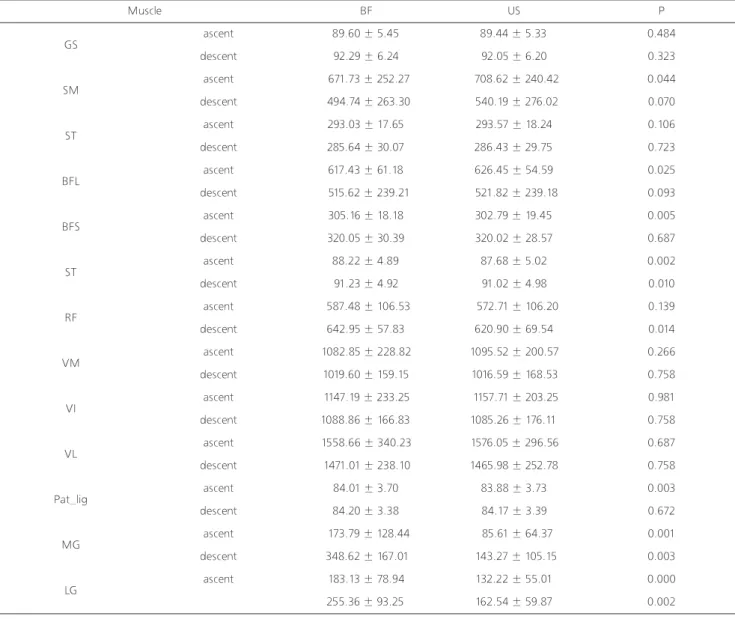
계단 오르기 동작 시 맨발과 불안정성 신발 착용에 따른 반막 근의 힘은 증가하면서 유의한 차이를 보였지만(p<0.05), 두덩정강근과 반힘줄근의 힘은 유의한 차이가 없었다. 넙다 리두갈래근 장두의 힘은 증가, 넙다리두갈래근 단두와 넙다 리빗근의 힘은 감소하면서 맨발과 불안정성 신발 착용에 따라 통계학적으로 유의한 차이를 보였다(p<0.05). 넙다리 네갈래근에서 넙다리곧은근, 안쪽넓은근, 중간넓은근, 가쪽 넓은근의 힘은 유의한 차이를 보이지 않았으며, 슬관절 인대 와 안쪽장딴지근, 가쪽장딴지근의 힘은 감소하면서 통계학적 으로 유의한 차이를 보였다(p<0.05)(Table 2).
2) 슬관절 굽힘 모멘트(moment, N-m)
Stair gait BF US P
Stair ascent (stepping limb) 67.18 ± 5.24 69.05 ± 4.33 0.050
Stair descent (landing limb) 26.37 ± 6.99 25.80 ± 10.20 0.806
Table 1. Stair gait of knee flexion angle (°)
Values are mean ± SD.
*p<0.05 BF: Barefoot group US: Unstable shoes group
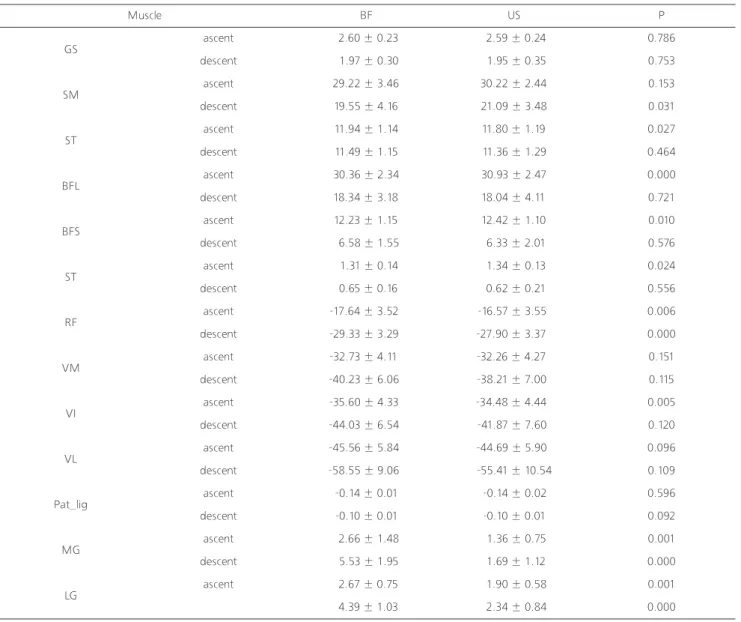
계단 오르기 동작 시 두덩정강근과 반막근의 굽힘 모멘트에 서는 맨발과불안정성 신발 착용에 따른 유의한 차이가 없 었지만, 반힘줄근의 굽힘 모멘트는 감소, 넓다리두갈래근의 장두와 단두, 넙다리빗근의 굽힘 모멘트는 증가하면서 유의한 차이가 있었다(p<0.05). 넙다리네갈래근에서 넙다리곧은근과 중간넓은근의 굽힘 모멘트는 증가하면서 유의한 차이가 있었지만(p<0.05), 안쪽넓은근과 가쪽넓은근의 굽힘 모멘 트는 유의한 차이가 없었다. 슬관절 인대의 굽힘 모멘트는 유의한 차이가 없었지만 안쪽장딴지근과 가쪽장딴지근의
굽힘 모멘트는 감소하면서 유의한 차이를 보였다(p<0.05) (Table 3).
4. 계단 내리기 동작 시 슬관절 운동역학 1) 슬관절 근육 힘
계단 내리기 동작 시 맨발과 불안정성 신발 착용에 따른 두 덩정강근의 힘은 유의한 차이가 없었다. 반막근, 반힘줄근, 넙다리두갈래근의 장두와 단두의 힘은 유의한 차이가 없 었지만, 넙다리빗근의 힘은 감소하면서 유의한 차이가 있었
Muscle BF US P
GS ascent 89.60 ± 5.45 89.44 ± 5.33 0.484
descent 92.29 ± 6.24 92.05 ± 6.20 0.323
SM ascent 671.73 ± 252.27 708.62 ± 240.42 0.044
descent 494.74 ± 263.30 540.19 ± 276.02 0.070
ST ascent 293.03 ± 17.65 293.57 ± 18.24 0.106
descent 285.64 ± 30.07 286.43 ± 29.75 0.723
BFL ascent 617.43 ± 61.18 626.45 ± 54.59 0.025
descent 515.62 ± 239.21 521.82 ± 239.18 0.093
BFS ascent 305.16 ± 18.18 302.79 ± 19.45 0.005
descent 320.05 ± 30.39 320.02 ± 28.57 0.687
ST ascent 88.22 ± 4.89 87.68 ± 5.02 0.002
descent 91.23 ± 4.92 91.02 ± 4.98 0.010
RF ascent 587.48 ± 106.53 572.71 ± 106.20 0.139
descent 642.95 ± 57.83 620.90 ± 69.54 0.014
VM ascent 1082.85 ± 228.82 1095.52 ± 200.57 0.266
descent 1019.60 ± 159.15 1016.59 ± 168.53 0.758
VI ascent 1147.19 ± 233.25 1157.71 ± 203.25 0.981
descent 1088.86 ± 166.83 1085.26 ± 176.11 0.758
VL ascent 1558.66 ± 340.23 1576.05 ± 296.56 0.687
descent 1471.01 ± 238.10 1465.98 ± 252.78 0.758
Pat_lig ascent 84.01 ± 3.70 83.88 ± 3.73 0.003
descent 84.20 ± 3.38 84.17 ± 3.39 0.672
MG ascent 173.79 ± 128.44 85.61 ± 64.37 0.001
descent 348.62 ± 167.01 143.27 ± 105.15 0.003
LG ascent 183.13 ± 78.94 132.22 ± 55.01 0.000
255.36 ± 93.25 162.54 ± 59.87 0.002
Table 2. Stair gait of lower limb joints (muscle force (N))
Values are mean ± SD.
*p<0.05 BF: Barefoot group US: Unstable shoes group
GR: gracilis, SM: semimembranosus, ST: semitendinosus, BFL: biceps femoris-long head, BFS: biceps femoris-short head, SR: sartorius), RF: rectus femoris, VM: vastus medialis, VI: vastus intermedialis, VL: vastus lateralis, Pat_lig: patellar ligament, MG: medial gastrocnemius, LG: lateral gastrocnemius
다(p<0.05). 넙다리네갈래근에서 넙다리곧은근의 힘은 감소 하면서 유의한 차이를 보였지만 (p<0.05), 안쪽넓은근, 중 간넓은근, 가쪽넓은근의 힘은 유의한 차이가 없었다. 슬관절 인대의 힘은 유의한 차이가 없었지만, 안쪽장딴지근과 가쪽 장딴지근의 힘은 감소하면서 유의한 차이가 있었다(p<0.05) (Table 2).
2) 슬관절 굽힘 모멘트
계단 내리기 동작 시 두덩정강근의 굽힘 모멘트는 맨발과
불안정성 신발 착용에 따른 유의한 차이가 없었지만, 반막 근의 굽힘 모멘트는 증가하면서 유의한 차이가 있었다 (p<0.05). 반힘줄근, 넙다리두갈래근의 장두와 단두, 넙다리 빗근의 굽힘 모멘트는 통계학적으로 유의한 차이가 없었다.
넙다리네갈래근에서 넙다리곧은근의 굽힘 모멘트는 증가 하면서 유의한 차이가 있었지만(p<0.05), 안쪽넓은근, 중간 넓은근, 가쪽넓은근의 굽힘 모멘트는 통계학적으로 유의한 차이가 없었다. 슬관절 인대의 굽힘 모멘트는 유의한 차이가 없었지만, 안쪽장딴지근, 가쪽장딴지근의 굽힘 모멘트는 감소
Muscle BF US P
GS ascent 2.60 ± 0.23 2.59 ± 0.24 0.786
descent 1.97 ± 0.30 1.95 ± 0.35 0.753
SM ascent 29.22 ± 3.46 30.22 ± 2.44 0.153
descent 19.55 ± 4.16 21.09 ± 3.48 0.031
ST ascent 11.94 ± 1.14 11.80 ± 1.19 0.027
descent 11.49 ± 1.15 11.36 ± 1.29 0.464
BFL ascent 30.36 ± 2.34 30.93 ± 2.47 0.000
descent 18.34 ± 3.18 18.04 ± 4.11 0.721
BFS ascent 12.23 ± 1.15 12.42 ± 1.10 0.010
descent 6.58 ± 1.55 6.33 ± 2.01 0.576
ST ascent 1.31 ± 0.14 1.34 ± 0.13 0.024
descent 0.65 ± 0.16 0.62 ± 0.21 0.556
RF ascent -17.64 ± 3.52 -16.57 ± 3.55 0.006
descent -29.33 ± 3.29 -27.90 ± 3.37 0.000
VM ascent -32.73 ± 4.11 -32.26 ± 4.27 0.151
descent -40.23 ± 6.06 -38.21 ± 7.00 0.115
VI ascent -35.60 ± 4.33 -34.48 ± 4.44 0.005
descent -44.03 ± 6.54 -41.87 ± 7.60 0.120
VL ascent -45.56 ± 5.84 -44.69 ± 5.90 0.096
descent -58.55 ± 9.06 -55.41 ± 10.54 0.109
Pat_lig ascent -0.14 ± 0.01 -0.14 ± 0.02 0.596
descent -0.10 ± 0.01 -0.10 ± 0.01 0.092
MG ascent 2.66 ± 1.48 1.36 ± 0.75 0.001
descent 5.53 ± 1.95 1.69 ± 1.12 0.000
LG ascent 2.67 ± 0.75 1.90 ± 0.58 0.001
4.39 ± 1.03 2.34 ± 0.84 0.000
Table 3. Stair gait lower limb joints (knee flexion moment (N-m))
Values are mean ± SD.
*p<0.05 BF: Barefoot group US: Unstable shoes group
GR: gracilis, SM: semimembranosus, ST: semitendinosus, BFL: biceps femoris-long head, BFS: biceps femoris-short head, SR: sartorius), RF: rectus femoris, VM: vastus medialis, VI: vastus intermedialis, VL: vastus lateralis, Pat_lig: patellar ligament, MG: medial gastrocnemius, LG: lateral gastrocnemius
하면서 유의한 차이가 있었다(p<0.05)(Table 3).
IV. 고찰
계단 보행은 일상생활동작에서 평지 보행 다음으로 빈번하게 일어나는 움직임으로, 계단의 높이와 기울기에 따라 하지에서 발생되는 힘의 특성이 다르며,8 평지에서의 보행에 비해 더 큰 하지 관절에서의 가동 범위와 모멘트, 근력 및 조절 능력을 요구한다.11-14 특히, 슬관절은 평지보행, 계단보행 등과 같은 다양한 일상생활동작을 하는 동안 지면 반발력, 질량 및 발과 정강이 뼈의 가속력과 같은 외부의 힘에 의해 부하를 받는데, 슬관절 부하는 평지 보행보다 계단 오르기와 내리기 동작 시 높게 나타났고,27 슬관절 굽힘 각도와 모멘트도 계단 보행 시 크게 나탔났다.11,15
보행 시 발목 관절의 운동 변화는 하지 관절이 닫힌 운동 사슬로 연결되어 있기 때문에 슬관절의 움직임에 영향을 주게 된다.28 최근에 기능성 혹은 치료적인 도구로 다양한 형 태로 개발되고 있는 불안정성 신발은 전·후 방향이 둥근 밑 창으로 발목의 움직임에 변화를 유발한다.4 특히, 앞쪽으로 덜 기울어지게 함으로써 최적화된 신체정렬을 가능하게 하며, 하지의 모멘트 감소로 관절에 가해지는 부하를 감소 시켜준다.7 이에 본 연구는 불안정성 신발 계단 보행 시 동작 수행 시점에서의 슬관절 움직임을 운동학, 운동역학적인 관 점으로 알아보고자 하였다.
Demura와 Demura는 보행 시 3가지 형태의 둥근 밑창 신 발 착용이 하지 관절각도와 근 수행력에 미치는 영향에 대 한 연구를 하여, 슬관절 최대 굽힘 각은 stretch walker 신 발보다 Flat-bottomed 신발이나, 마사이 신발 착용 시 증가 한다고 보고하였다.29 본 연구 결과에서도 계단 오르기 동작 시 불안정성 신발 착용이 맨발에 비해 슬관절 굽힘 각이 더 높게 나타났으며, 이는 신발의 둥근 밑창이 움직임에 영향을 미친 것으로 생각된다.
슬관절염 환자의 슬괵근군(hanmstring group) 활성도 증 가는 압축력을 증가시킴으로써 지지기 동안 슬관절 안정화, 부하의 원심성 조절, 인대의 보호를 향상시킨다.30-32 본 연구 결과에서는 계단 오르기 동작 시 슬관절 굽힘 작용을 하는 슬괵근군 중 반막근, 넙다리두갈래근의 장두와 단두, 넙다리빗근의 힘은 불안정성 신발 착용 시 높게 나타났다.
계단 내리기 동작 시 반막근, 반힘줄근, 넙다리두갈래근의 장두는 유의한 차이는 없었지만, 불안정성 신발 착용 시 모두 증가하는 결과를 보였다. 또한 슬관절 굽힘 모멘트에서 계단
오르기 동작 시 슬괵근군 중 반힘줄근, 넙다리두갈래근의 장 두와 단두, 넙다리빗근의 굽힘 모멘트가 증가하였다. 계단 내리기 동작 시 슬괵근군 중 반막근의 굽힘 모멘트가 불안정 성 신발 착용 시 증가하였다. 이러한 결과는 불안정성 신발 착용이 계단 보행 동안 슬괵근군의 힘을 증가시켜 슬관절 안 정화에 도움을 주는 것으로 생각할 수 있다.
슬개대퇴관절 반력 (넙다리네갈래근과 슬개인대 힘의 합 력)은 넙다리네갈래근의 힘과 슬관절 굽힘 각에 따라 증가
하는데,33-35 본 연구 결과에서는 계단 오르기 동작 시 슬관절
인대, 계단 내리기 동작 시 넙다리곧은근의 힘이 불안정성 신발 착용에 따라 감소하는 결과를 보였다. 이는 불안정성 신발 착용이 슬개대퇴관절 반력을 부분적으로 감소시켜 슬개 대퇴관절의 부하와 관련된 통증을 줄여줄 수 있을 것으로 생각된다.
발목 근육이 약한 경우 안정성을 증가시키기 위한 보상 작용으로 계단 내리기 동작 시 슬관절 폄 모멘트 (extensor moments)가 증가한다.36,37 본 연구 결과에서는 슬관절 폄근 중 계단 보행 시 넙다리곧은근, 계단 오르기 동작 시 중간 넓 은근의 굽힘 모멘트가 불안정성 신발 착용 시 증가하는 것 으로 나타났다. 이는 불안정성 신발 착용이 발목근육의 안 정성을 증가시켜, 슬관절의 보상작용을 줄여준 것으로 생각 된다.4
평지 보행 시 불안정성 신발 착용이 앞정강근과 장딴지근의 작용을 활성화시킨다는 선행연구와는 달리,4 본 연구의 결과에서는 계단 보행 시 안쪽장딴지근, 가쪽장딴지근의 힘과 모멘트가 불안정성 신발 착용에 따라 감소하는 것으로 나타났다. 이는 선행연구와 상반된 결과를 나타내는데 그 이유는 계단 보행은 평지 보행과는 달리 하지 힘의 특성이 변하기 때문이다.8 또한 불안정성 신발 착용은 보행과 계단 보행과 같은 기능적인 동작에 따라 하지의 힘 특성에 미치는 영향이 달라질 수 있다고 생각된다.
이처럼 본 연구결과에서는 슬관절 굽힘근과 폄근의 힘, 모멘트의 변화가 나타났음을 알 수 있었고, 이는 계단 오르기 와 내리기 동작 시 슬관절에서 굽힘근과 폄근의 상호작용이 일어난다는 선행연구와 일치한다.23 또한, 계단 보행 동안 불안정성 신발의 착용은 슬관절의 움직임에 변화를 가져와 슬관절에서 굽힘근과 폄근의 상호작용을 유도하고,23 각 근육의 힘과 모멘트 변화를 통해 슬관절 안정화 및 슬관절의 보상작용을 개선시킬 수 있음을 알 수 있었다. 또한 선행연 구와 같이 불안정성 신발 착용이 슬관절염 환자들에게 통증을 줄여줄 수 있다는 가능성을 제시할 수 있다고 생각된다.19
본 연구는 일상생활에서의 계단 보행 및 재활치료 과 정에서의 계단 보행 훈련 시 발목관절의 자세변화와 슬관절 부하의 관련성에 대한 운동학 및 운동역학적 기초자료를 제공하는데 의의를 두고자 하였다. 향후 연구에서는 더 다양 하고 특별한 굽 형태의 신발 중재를 적용하여 일상생활 및 기능적인 활동을 수행하는 동안 하지의 운동학 및 운동역학에 어떠한 영향을 미치는 지를 제시할 수 있을 것이다.
Acknowledgements
이 논문은 2013년도 대구가톨릭대학교 교내연구비 지원에 의한 것임.
참고문헌
1. McPoil TG. Footwear. Physical therapy. 1988;68(12):1857-65.
2. Kutzner, Stephan D, Dymke J et al. The influence of footwear on knee joint loading during walking - in vivo load measurements with instrumented knee implants. J Biomech.
2013;46(4):796-800.
3. Nigg BM, G KE, Federolf P et al. Gender differences in lower extremity gait biomechanics during walking using an unstable shoe. Clin Biomech (Bristol, Avon). 2010;25(10):1047-52.
4. Romkes J, Rudmann C, Brunner R. Changes in gait and EMG when walking with the Masai Barefoot Technique. Clin Biomech (Bristol, Avon). 2006;21(1):75-81.
5. Nigg B, Hintzen S, Ferer R. Effect of an unstable shoe construction on lower extremity gait characteristics. Clin Biomech (Bristol, Avon). 2006;21(1):82-8.
6. Janisse DJ, Janisse E. Shoe modification and the use of orthoses in the treatment of foot and ankle pathology. Journal of the American Academy of Orthopaedic Surgeons 2008;16:152-8.
7. Vernon T, Wheat J, Naik R et al. Change in gait characteristics of a normal, healthy population due to an unstable shoe construction. Sheffiled Hallam U. UK. 2004.
8. Christina KA, Cavanagh PR. Ground reaction forces and frictional demands during stair descent: effects of age and illumination. Gait Posture. 2002;15(2):153-8.
9. Kim DK. Change of walking and stair up in hemiplegia by proprioceptive neuromuscular facilitation techniques. J Korean Soc Phys Ther. 1999;11(3):57-64.
10. Bradford J, Mc Fadyenm BJ, Winter DA. An integrated biomechanical analysis of normal stair ascent and descent. J Biomech. 1988;21(9):733-44.
11. Andriacchi TP, Andersson GB, Fermier RW et al. A study of lower-limb mechanics during stair-climbing. J Bone Joint Surg
Am. 1980;62(5):749-57.
12. Andriacchi TP, Galante JO, Fermier RW. The influence of total knee-replacement design on walking and stair-climbing.
Journal of bone and joint surgery. 1982;64(9):1328-35.
13. Andriacchi TP, Mikoz RP. Musculoskeletal dynamics, locomotion and clinical applications. Basic orthopaedic biomechanics, New York, Raven Press. 1991;51-92.
14. Han JT, Hwang BG. Kinematic analysis of lower extremities during stairs and ramp climbing witholder adults. Korean society of sport biomechanics. 2009;19(3):435-48.
15. Jevsevar DS, Riley PO, Hodge WA et al. Knee kinematics and kinetics during locomotor activities of daily living in subjects with knee arthroplasty and in healthy control subjects. Phys Ther. 1993 Apr;73(4):229-39.
16. Salsich GB, Brechter JH, Powers CM. Lower extremity kinetics during stair ambulation in patients with and without patellofemoral pain. Clin Biomech 2001;16:906.
17. Costigan PA, Wyss UP, Li J et al. Forces and moments at the knee during stair climbing. J Biomech. 1994;27(6):796.
18. Brechter JH, Powers CM. Patellofemoral joint stress during stair ascent and descent in persons with and without patellofemoral pain. Gait Posture. 2002;16(2):115-23.
19. Nigg BM, Emery C, Hiemstra LA. Unstable shoe construction and reduction of pain in osteoarthritis patients. Med Sci Sports Exerc 2006;38(10):1701-8.
20. Nigg BM, Davis E, Lindsay D et al. The effectiveness of an unstable sandal on low back pain and golf performance. Clin J Sport Med 2009;19:464-70.
21. Landry SC, Nigg BM, Tecante KE. Standing in an unstable shoe increases postural sway and muscle activity of selected smaller extrinsic foot muscles. Gait Posture. 2010;32(2):215-9.
22. Han JT, Lee JD, Bae SS. The 3-D motion analysis of kinematic variety on lower extremities during ramp ascent at different inclinations. J Korean Phys Ther. 2005;17(4):633-50.
23. Protopapadaki A, Drechsler WI, Cramp MC et al. Hip, knee, ankle kinematics and kinetics during stair ascent and descent in healthy young individuals. Clin Biomech (Bristol, Avon).
2007;22(2):203-10.
24. Hsue BJ, Su FC. Kinematics and kinetics of the lower extremities of young and elder women during stairs ascent while wearing low and high-heeled shoes. J Electromyogr Kinesiol.
2009;19(6):1071-8.
25. Palluel E, Ceyte H, Oliver et al. Anticipatory postural adjustments associated with a forward leg raising in children:
effects of age, segmental acceleration and sensory context. Clin Neurophysiol. 2008;119(11):2546-54.
26. Rudolph KS, Mackler LS. Effect of dynamic stability on a step task in ACL deficient individuals. Journal of Electromyography and Kinesiology. 2004;14(5):565-75.
27. Kutzner , Heinlein B, Graichen F et al. Loading of the knee joint during activities of daily living measured in vivo in five subjects.
J Biomech. 2010 Aug 10;43(11):2164-73.
28. Perry J. Gait analysis: Normal and pathological function. New Jersey: SLACK. 1992.
29. Demura T, Demura S. The effects of shoes with a rounded soft sole in the anterior-posterior direction on leg joint angle and muscle activity. Foot (Edinb). 2012;22(3):150-5.
30. Bernardi M, Solomonow M, Baratta RV. Motor unit recruitment strategy of antagonist muscle pair during linearly increasing contraction. Electromyogr Clin Neurophysiol. 1997;37(1):3-12.
31. Ebenbichler GR, Kollmitzer J, Glöckler L et al. The role of the biarticular agonist and cocontracting antagonist pair in isometric muscle fatigue., Muscle Nerve. 1998;21(12):1706-13.
32. Hagood S, Solomonow M, Baratta R et al. The effect of joint velocity on the contribution of the antagonist musculature to
knee stiffness and laxity. Am J Sports Med. 1990;18(2):182-7.
33. Reilly DT, Martens M. Experimental analysis of the quadriceps muscle force and patella-femoral joint reaction force for various activities. Acta Orthop Scand. 1972;43:126-37.
34. Huberti HH, Hayes WC. Patellofemoral contact pressures. The influence of Q-angle and tendofemoral contact. J Bone Joint Surg Am.1984;66:715-24.
35. Buff HU, Jones LC, Hungerford DS. Experimental determination of forces transmitted through the patella-femoral joint. J Biomech. 1988;21:17-23.
36. Startzel JK, Owens DA, Mulfinger LM et al. Stair negotiation in older people: a review. J Am Geriatr Soc. 2000;48(5):567-80.
37. Novak AC, Li Q, Yang S et al. Mechanical energy transfers across lower limb segments during stair ascent and descent in young and healthy older adults. Gait Posture. 2011;34(3):384- 90.