• 검색 결과가 없습니다.

Primary Bronchial Granular Cell Tumor in an Adult MaleHo Jin Kim, M.D.

N/A
N/A
Protected

Academic year: 2021

Share "Primary Bronchial Granular Cell Tumor in an Adult MaleHo Jin Kim, M.D."

Copied!
4
0
0

로드 중.... (전체 텍스트 보기)

전체 글

(1)

Korean J Thorac Cardiovasc Surg 2014;47:193-196 □ Case Report □ http://dx.doi.org/10.5090/kjtcs.2014.47.2.193 ISSN: 2233-601X (Print) ISSN: 2093-6516 (Online)

− 193 −

Departments of

1

Thoracic and Cardiovascular Surgery and

2

Pathology, Asan Medical Center, University of Ulsan College of Medicine Received: July 15, 2013, Revised: September 5, 2013, Accepted: September 17, 2013

Corresponding author: Hyeong Ryul Kim, Department of Thoracic and Cardiovascular Surgery, Asan Medical Center, University of Ulsan College of Medicine, 88 Olympic-ro 43-gil, Songpa-gu, Seoul 138-736, Korea

(Tel) 82-2-3010-3580 (Fax) 82-2-3010-6966 (E-mail) [email protected]

C

The Korean Society for Thoracic and Cardiovascular Surgery. 2014. All right reserved.

CC
This is an open access article distributed under the terms of the Creative Commons Attribution Non-Commercial License (http://creative- commons.org/licenses/by-nc/3.0) which permits unrestricted non-commercial use, distribution, and reproduction in any medium, provided the original work is properly cited.

Primary Bronchial Granular Cell Tumor in an Adult Male

Ho Jin Kim, M.D.

1

, Soyeon An, M.D.

2

, Hyeong Ryul Kim, M.D.

1

We report a rare case of granular cell tumor arising in the left lower lobe (LLL) bronchus with secondary ob- structive change in a 60-year-old male. The patient was found to have a nodule in the LLL on a computed to- mography scan, three months prior to his presentation to the Asan Medical Center. Bronchoscopic biopsies re- vealed a granular cell tumor. After undergoing LLL lobectomy with bronchoplasty, the patient has not experienced any tumor recurrence.

Key words: 1. Granular cell tumor 2. Bronchial tumor

CASE REPORT

A 60-year-old male was referred to the Asan Medical Center for a nodule in the left lower lobe (LLL). The nodule was incidentally detected during the preoperative evaluation of gallstone, for which he underwent laparoscopic chol- ecystectomy at an outside hospital three months prior to his presentation to us. On his visit, he did not have any respira- tory complaints such as productive cough or dyspnea.

Medical history was unremarkable except hypertension.

Further, the patient had been a non-smoker for 10 years al- though he used to smoke half a pack a day for 30 years be- fore quitting.

We found that the patient’s physical examination was un- remarkable except decreased breath sounds over the left lower lung field. The laboratory data were all within normal limits.

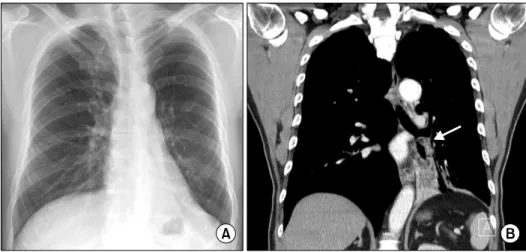
Chest X-ray and computed tomography scan revealed a mass having the following dimensions: 20×10×5 mm. The mass obstructed the secondary bronchus entering into the LLL, which resulted in a total collapse of LLL (Fig. 1). A flexible

bronchoscopy showed an endobronchial mass filling the basal segments of the LLL (Fig. 2). Further, a biopsy indicated a granular cell tumor.

The patient underwent a left lower lobectomy via left post- erolateral thoracotomy through the 5th intercostal space. The left thoracic cavity showed neither pleural adhesion nor seed- ing suggestive of malignancy. The LLL was heavily collapsed due to the obstruction by the endobronchial tumor. We div- ided the LLL bronchus at the level of the left upper lobe spur and performed a left lower lobectomy. The medial side of the left main bronchus was repaired using an interrupted anastomosis of 3-0 Vicryl. The resection margin of the bron- chial stump was clear from the tumor on the frozen section.

All five lymph nodes that were biopsied were tumor-free.

The patient recovered well postoperatively and was dis-

charged on postoperative day 5. Immunohistochemical stain-

ing demonstrated the positivity for S-100 protein, and the

Ki-67 labeling index was low (1%), supporting the current

diagnosis. The final pathology report confirmed the diagnosis

of the granular cell tumor (Fig. 3). As of the writing of this

(2)

Ho Jin Kim, et al

− 194 −

Fig. 1. (A) Preoperative chest X-ray and (B) chest computed tomography that show atelectasis of the left low- er lobe. The endobronchial mass ob- structing the left lower lobe bronchus is clearly visible (arrow).

Fig. 2. Preoperative flexible bronchoscopy shows the endobron- chial mass.

paper, the patient has been free of tumor recurrence for six months.

DISCUSSION

Granular cell tumor (GCT), a rare benign neoplasm that most commonly occurs in the tongue, skin, subcutaneous tis- sue, and breast, was first described by Abrikossoff in 1926.

Pulmonary GCT, known to comprise 6% to 10% of all GTCs [1,2], was first reported by Kramer in 1938, and since then, less than 80 cases of GCT arising in the lung have been re- ported in the English-language literature [3]. In Korea, Seo et

al. [4] first reported a bronchial GCT arising in the left main bronchus in 2006. It was traditionally termed ‘granular cell myoblastoma’ until the late 1980s after Abrikossoff suggested that GCT had a myogenic origin [5]. This traditional theory was challenged by subsequent electron microscopic and im- munohistochemical studies [1,2]. Now, it is believed that GCT has a neural cell origin, thus establishing the current nomenclature.

Although it has been known that most pulmonary GCTs behave in a benign fashion, our review of the literature sug- gests that they have no unique clinical features. Most pulmo- nary GCTs are endobronchial, but sometimes, they can be lo- cated peripherally [6]. Pulmonary GCTs can be associated with synchronous extrapulmonary GCTs occurring in various organs, such as the tongue, kidney, or esophagus [1].

Pulmonary GCTs may occur metachronously in a single lung and thus, can be multicentric in 10% to 20% of the patients, although a majority of the GCTs tend to be solitary.

Pulmonary GCTs can be associated with other malignancies

or infectious diseases such as tuberculosis or human im-

munodeficiency virus [3]. Pulmonary GCTs can be diagnosed

at any age, but most cases of pulmonary GCT present in the

third or the fourth decade [1,2]. Previous clinical series

showed that there is no gender predilection, and GCTs are

equally distributed over both lungs with a predilection for the

upper lobe [2]. However, another study found a slight predi-

lection toward the left lung with a preference for the lower

lobe, as presented in our case [1]. There are no commonly

agreed risk factors, although the association of smoking with

(3)

Granular Cell Tumor with Secondary Changes in an Adult Male

− 195 −

Fig. 3. (A) A photomicrograph showing the tumor cells of a granular cell tumor. The tumor is composed of fusiform or pol- ygonal, histiocyte-like cells (H&E, ×100). (B) Cell borders are in- distinct, and cytoplasm shows a finely granular appearance (H&E, ×400). (C) The tumor cells show diffuse positivity for S-100 protein immunohistochemical staining (×100).

pulmonary GCTs was hypothesized in some studies.

More than half of the GCT patients are asymptomatic at the time of diagnosis, and respiratory symptoms such as cough, dyspnea, hemoptysis, and wheezing present as tumor erosion and bronchial obstruction progress due to the growth of the endobronchial mass. With the onset of the symptoms, the bronchial obstruction causes the suppuration and destruc- tion of the lung parenchyma distal to the obstruction; in this case, surgical resection is clearly indicated. However, the ad- equate treatment strategies for this disease remain controver- sial. Daniel et al. advocated bronchoscopic resection in asymptomatic patients with a tumor having a diameter of less than 8 mm [7], and van der Maten et al. [2] suggested that endobronchial therapy be the primary treatment. However, bronchoscopic removal cannot be a safe treatment option as it does not guarantee complete removal when GCTs infiltrate

through the entire bronchial wall, which is evidenced by the fact that the incidence of recurrence was as high as 54% af- ter bronchoscopic removal [7]. In addition, although ex- tremely rare, it is possible that pulmonary GCTs can be ma- lignant; the first case of malignant pulmonary GCT was re- ported in 2003 [8]. Being relatively young at the time of di- agnosis can be a factor that favors complete surgical resection. In this regard, we believe that adequate surgical re- moval should be the preferred treatment option for all pa- tients among whom GCTs are amenable to surgical resection.

Based on the size, location, and number of masses, a surgical

option, including either segmentectomy, lobectomy with or

without sleeve resection, or rarely pneumonectomy, can be

chosen with a lower incidence of recurrence and long dis-

ease-free survival.

(4)

Ho Jin Kim, et al

− 196 − CONFLICT OF INTEREST

No potential conflict of interest relevant to this article was reported.

REFERENCES

1. Deavers M, Guinee D, Koss MN, Travis WD. Granular cell tumors of the lung: clinicopathologic study of 20 cases. Am J Surg Pathol 1995;19:627-35.

2. Van der Maten J, Blaauwgeers JL, Sutedja TG, Kwa HB, Postmus PE, Wagenaar SS. Granular cell tumors of the tra- cheobronchial tree. J Thorac Cardiovasc Surg 2003;126:

740-3.

3. Yoon Y, Curry K. Concurrence of granular cell tumor and

Mycobacterium tuberculosis. South Med J 2005;98:1034-5.

4. Seo YH, Kim KH, Kim NY, Kuh JH. Granular cell tumor arising from the left main bronchus: a case report. Korean J Thorac Cardiovasc Surg 2006;39:244-7.

5. Kutuya N, Akiduki A. Radiologic appearance of a bronchial granular cell tumor with secondary obstructive changes. Clin Imaging 2010;34:148-51.

6. Lui RC, McKenzie FN, Kim YD, Senderoff E. Primary en- dobronchial granular cell myoblastoma. Ann Thorac Surg 1989;48:113-5.

7. Daniel TM, Smith RH, Faunce HF, Sylvest VM. Transbron- choscopic versus surgical resection of tracheobronchial granular cell myoblastomas: suggested approach based on follow-up of all treated cases. J Thorac Cardiovasc Surg 1980;80:898-903.

8. Jiang M, Anderson T, Nwogu C, Tan D. Pulmonary malig-

nant granular cell tumor. World J Surg Oncol 2003;1:22.

수치

Fig. 2. Preoperative flexible bronchoscopy shows the endobron- endobron-chial mass.

참조

관련 문서

The index is calculated with the latest 5-year auction data of 400 selected Classic, Modern, and Contemporary Chinese painting artists from major auction houses..

Purpose: Giant cell tumor of the tendon sheath are the most common tumors after ganglionic cysts in benign soft tissue tumors which could be recurred after surgical

A retrospective analysis of invasive tumor percentages of GSS tumor samples showed that samples with high tumor content correlated well with FNAB samples

ƒ The amount of a compound per unit cell mass (or cell The amount of a compound per unit cell mass (or cell volume).

In the present study, consistent to that report, up-regulation of VEGF mRNA was observed in the colon cancer cell with the acquired resistance to 5-FU and this

In the lower extremity balance, the change in left unilateral clerk showed a statistically significant difference as the exercise group increased post-test

In the change of active oxygen, As a result of the active oxygen change between the two groups, there was a statistically significant difference according

– Established the fundamentals of high temperature fuel cells such as the molten carbonate and solid oxide fuel cell.. – In 1958, he demonstrated an alkali cell using a