Ⅰ. Introduction
In the modern society the bonding between the human and pet animals are getting stronger and stronger, in such a way that sometimes they are treated as their own kids. As they stay close to us, wellbeing of dogs is essential on these modern days. Since most of the households have pets, especially South Korea, China and European countries and the households are busy with their respected work, most of the time the pets are spending alone in the house. As the wearable sensor based approach is feasible now a days because of low cost of the sensors and able to accurately collecting the data for a long period of time and also powerful machine learning approach to analyze the data and make the system automatic, these methods widely used now a days for tracking various activities in real time that able to achieve the desired objectives. Aich et al., used wearable sensors and machine learning technique for
prediction of freezing of gait in Parkinson’s disease [1]. Aich et al., using wearable sensor data to distinguish shuffling of gait patients from other Parkinson’s disease patients and automated using machine learning techniques [2]. Jeon et al. used wearable sensors based approach to measure the tremor severity and automatic classification of patients using machine learning techniques [3].
Yazdansepas et al., used wearable sensor and machine learning approaches for recognition of human activities. In this paper we have proposed a wearable sensor based approach to track the behavior of dog as well as automate the system using machine learning techniques.
Ⅱ. Methodology
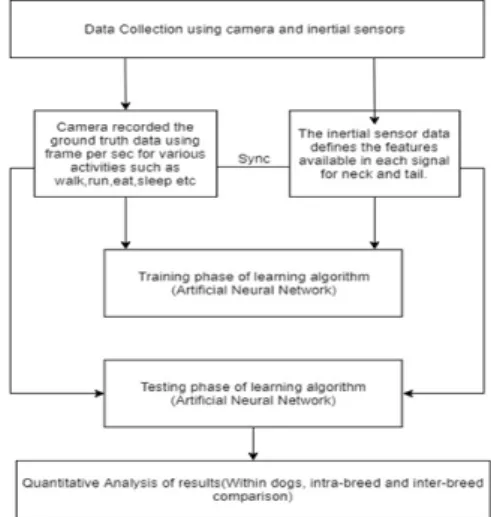
The flow chart of the methodology is shown in the figure 1. The data has been collected using wearable inertial sensors and camera. The data
A Machine Learning Approach to Detect the Dog’s Behavior using Wearable Sensors
Satyabrata Aich · Sabyasachi Chakraborty · Moon-il Joo · Jong Seong Sim · Hee-Cheol Kim
Institute of Digital Anti-aging Healthcare, Inje University E-mail : [email protected], [email protected]
ABSTRACT
In recent years welfare of animals is the biggest challenge because animals, especially dogs are widely recognized as pet as well as they are using as service animals. So, for the wellbeing of the dog it is necessary to perform objective assessment to track their behavior in everyday life. In this paper, we have proposed an automatic behavior assessment system for dogs based on a neck worn and tail worn accelerometer and gyroscope platform, and data analysis techniques that recognize typical dog activities.
We evaluate the system based on the analysis of 8 behavior traits in 3 dogs, incorporating 2 breeds of various sizes. Our proposed framework able to reproduce the manual assessment that is based on the video recording which is treated as gold standard that exhibits the real-life use case of automated dog behavior analysis.
Keyword
Wearable sensors, pet, dog behavior, machine learning, objective assessment
281
한국정보통신학회 2019년 춘계 종합학술대회 논문집
recorded in the camera is the ground truth, where the data recorded using wearable sensors are used to extract the features and both wearable sensor data and ground truth data were synchronized and trained to the Artificial Neural Network(ANN) Model and also validated to check the performance of the model.
Figure 1. Flowchart of Methodology
Ⅲ. Data Analysis and Results
We have analyzed 8 behaviors in this model.
The behaviors those are analyzed in this paper the behaviors those are walk, down, sit, sideway, eat, stay, jump, and shake.
The confusion matrix of the model is shown in the figure 2.
Figure 2. Confusion Matrix
We have used 78869 data for training and 33802 data for testing and found accuracy of 97.2% for classification of different activities.
Ⅳ. Conclusion
In this paper we have analyzed the accelerometer and gyroscope data of the dogs of different size and breed to analyze the dog’s behavior and also recorded the ground truth data. Both the data are synchronized and an automated model is developed using ANN technique, which provides the accuracy of 97.2% for classification of different activities.
This type of model will help the pet owners to track their pets behaviour in real time for better care.
Acknowledgment
This research was supported by the Ministry of Trade, Industry and Energy (MOTIE), KOREA, through the Education program for Creative and Industrial Convergence (Grant number N0000717).
References
[1] S. Aich, P. Pradhan, J. Park, N. Sethi, V.
Vathsa and H.C. Kim, “A Validation Study of Freezing of Gait (FoG) Detection and Machine-Learning-Based FoG Prediction Using Estimated Gait Characteristics with a Wearable Accelerometer,” Sensors, Vol. 17, No. 10, pp.
3287, Sep. 2018.
[2] S. Aich, P. Pradhan, J. Park, H.C. Kim,, “A machine learning approach to distinguish Parkinson’s disease (PD) patient’s with shuffling gait from older adults based on gait signals using 3D motion analysis,” International Journal of Engineering and Technology, Vol. 7, No. 3.29, pp. 153-156, 2018.
[3] H. Jeon, W. Lee, H. Park, H. Lee, S. Kim, H.
Kim B. Jeon, and K. Park, “Automatic classification of tremor severity in Parkinson’s disease using a wearable device,” Sensors, Vol.
17, No. 9, p.2067, 2017.
[4] D. Yazdansepas, A.H. Niazi, J.L. Gay, F.W. Maier, L.Ramaswamy," A multi-featured approach for wearable sensor-based human activity recognition."
In 2016 IEEE International Conference on Healthcare Informatics (ICHI), pp. 423-431. IEEE, 2016.
282