© 2017 The Korean Academy of Medical Sciences.
This is an Open Access article distributed under the terms of the Creative Commons Attribution Non-Commercial License (http://creativecommons.org/licenses/by-nc/4.0) which permits unrestricted non-commercial use, distribution, and reproduction in any medium, provided the original work is properly cited.
pISSN 1011-8934 eISSN 1598-6357
DEND Syndrome with Heterozygous KCNJ11 Mutation Successfully Treated with Sulfonylurea
Permanent neonatal diabetes mellitus (PNDM) is caused by mutations in the ATP-sensitive potassium channel (KATP channel) subunits. Developmental delay, epilepsy, and neonatal diabetes (DEND) syndrome is the most severe form of PNDM and is characterized by various neurologic features. We report on a patient with DEND syndrome following initial
misdiagnosis with type 1 DM, who was successfully switched from insulin to sulfonylurea therapy. A 50-day-old male presented with fever and seizure, complicated by persistent hyperglycemia. Insulin therapy was initiated. At 10 months of age, the patient was unable to hold his head up and make eye contact with others. At 17.9 years of age, direct sequencing of KCNJ11 identified a heterozygous mutation of c.602G>A (p.R201H). Since then, treatment with gliclazide was initiated and the insulin dose was gradually reduced.
Following 3 months, insulin was discontinued with a gliclazide dose of 2.4 mg/kg. The patient continued to have excellent glycemic control with a glycated hemoglobin (HbA1c) level of 5.8% after 5 months. However, the patient’s psychomotor retardation did not improve. This study reports the first case of DEND syndrome in Korea caused by a KCNJ11 mutation and emphasizes the necessity to screen mutations in KATP channel genes in patients with neonatal diabetes.
Keywords: DEND Syndrome; KCNJ11; Neonatal Diabetes; Sulfonylurea Ja Hyang Cho,1 Eungu Kang,1
Beom Hee Lee,1 Gu-Hwan Kim,2 Jin-Ho Choi,1 and Han-Wook Yoo1,2
1Department of Pediatrics, University of Ulsan College of Medicine, Asan Medical Center Children’s Hospital, Seoul, Korea; 2Medical Genetics Center, University of Ulsan College of Medicine, Asan Medical Center Children’s Hospital, Seoul, Korea Received: 3 December 2015
Accepted: 4 April 2016 Address for Correspondence:
Han-Wook Yoo, MD
Department of Pediatrics, University of Ulsan College of Medicine, Asan Medical Center Children’s Hospital, 88 Olympic-ro 43-gil, Songpa-gu, Seoul 05505, Korea E-mail: [email protected]
Funding: This study was supported by a grant from the National Research Foundation of Korea, the Ministry of Education, Science and Technology (No. 2011-0019674).
https://doi.org/10.3346/jkms.2017.32.6.1042 • J Korean Med Sci 2017; 32: 1042-1045
INTRODUCTION
The ATP-sensitive potassium channel (KATP channel) plays a cru- cial role in the regulation of pancreatic β-cell insulin secretion (1). Inactivating mutations in KCNJ11 or ABCC8 cause congeni- tal hyperinsulinism presenting with persistent hypoglycemia in infancy (2,3). The most common causes of permanent neonatal diabetes mellitus (PNDM) are activating mutations in the KCNJ11 or ABCC8 genes that encode Kir6.2 or SUR1, respectively (4,5).
Developmental delay, epilepsy, and neonatal diabetes (DEND) syndrome represents the most severe form of PNDM that is char- acterized by various neurologic features (6). Patients with inter- mediate DEND (iDEND) syndrome demonstrate less severe de- velopmental delay without seizures (7).
A few cases of permanent neonatal diabetes have been re- ported in Korea (8,9). We describe the first case of DEND syn- drome in a patient misdiagnosed with type 1 diabetes with long- term insulin treatment. The clinical course of the patient, mo- lecular genetic analysis for confirmation of PNDM, and a suc- cessful switch to sulfonylurea therapy are reported.
CASE DESCRIPTION
A 50-day-old boy presented with fever and upper respiratory tract infection on May, 1996. The patient was born to non-con-
sanguineous parents and was delivered by cesarean section with a birth weight of 2,750 g (−1.43 standard deviation score [SDS]).
Hyperglycemia (306 mg/dL) was incidentally detected by labo- ratory tests. The infant was initially diagnosed with type 1 dia- betes mellitus (DM) and treatment with subcutaneous insulin was initiated. Frequent partial seizures persisting 2 to 3 minutes were observed in the patient and had developed after birth. There were no loss of consciousness or postictal sleep. At 10 months of age, the patient was unable to hold his head up, make eye con- tact with others, or sit unassisted. Rehabilitation therapy was ini- tiated due to a severe delay in motor development.
At 21 months of age, the Denver developmental test demon- strated a delayed developmental status in regard to visual con- tact, babbling response to name, almost absent facial expression, and a psychomotor developmental level of 3 months. Physical examination revealed generalized hypertonia with no dysmor- phic features. Increased deep tendon reflex with pathologic re- flexes such as Babinski reflex and ankle clonus were observed.
Islet cell autoantibodies and serum insulin level were not deter- mined. Serum C-peptide and 24-hour urine C-peptide levels were < 0.1 ng/mL and 0.2 μg/day, respectively. Abdominal ul- trasound scan demonstrated a normal pancreas.
Electroencephalogram (EEG) showed spike discharges from the right centro-parietal area. At 21 months, magnetic resonance imaging of the brain demonstrated symmetric high signal in- CASE REPORT
Pediatrics
1 / 1 CROSSMARK_logo_3_Test
2017-03-16 https://crossmark-cdn.crossref.org/widget/v2.0/logos/CROSSMARK_Color_square.svg
Cho JH, et al. • DEND Syndrome due to Heterozygous KCNJ11 Mutation
http://jkms.org 1043
https://doi.org/10.3346/jkms.2017.32.6.1042
tensity of the periventricular white matter on T2-weighted and fluid-attenuated inversion recovery (FLAIR) images, suggesting hypoxic encephalopathy or metabolic encephalopathy. No struc- tural abnormalities were detected (Fig. 1). Treatment with anti- epileptic drugs (oxcarbazepine, Trileptal®; Novartis Pharmaceu- ticals Corporation, Basel, Switzerland) was subsequently initiated.
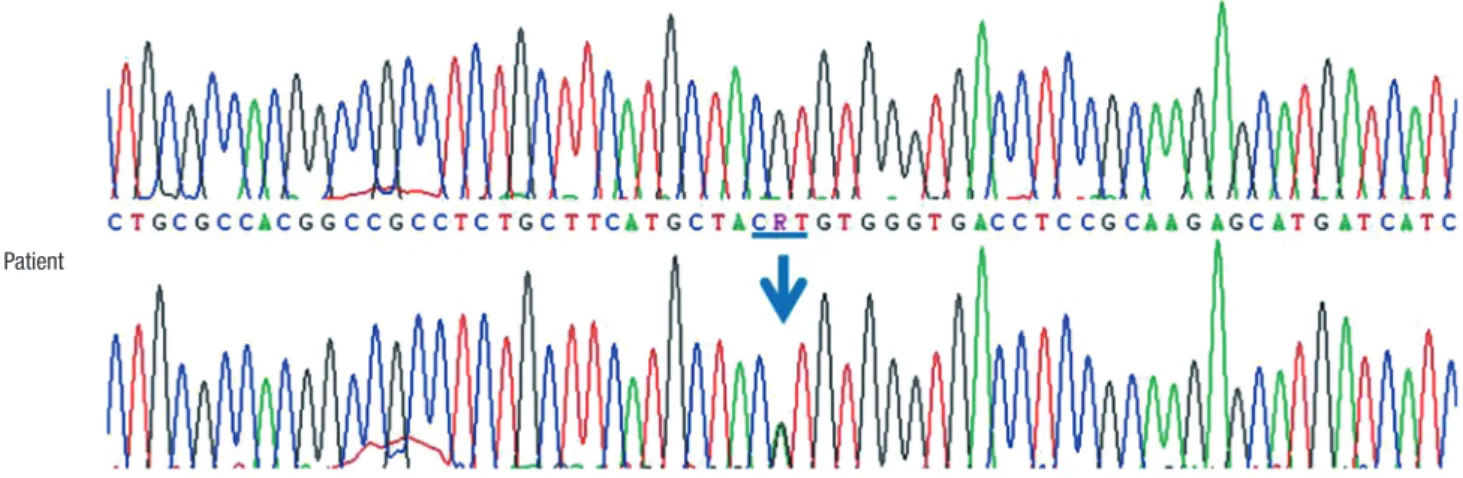
The glycated hemoglobin (HbA1c) levels were up to 10% dur- ing the childhood and adolescent period, however, there were no complications such as diabetic retinopathy nor nephropa- thy. At 17.9 years of age, direct sequencing of the KCNJ11 gene identified a heterozygous mutation of c.602G>A (p.R201H) on February, 2014 (Fig. 2). Since then, treatment with sulfonylurea dose of 40 mg (gliclazide, Diamicron®; Servier Laboratories Ltd., Neuilly-sur-Seine, France) was initiated and well-tolerated. The insulin dose was gradually reduced. Following 3 months, insu- lin was discontinued with a gliclazide dose of 2.4 mg/kg/day
Fig. 1. MRI of the brain at 21 months of age. The brain MRI demonstrates symmetric high signal intensity of periventricular white matter on T2-weighted and FLAIR images, sug- gesting hypoxic anoxic encephalopathy or metabolic encephalopathy. Myelination and migration of the underlying brain is normal. No other structural abnormalities including ventricle dilatation or encephalomalatic change are detected.
MRI = magnetic resonance imaging, FLAIR = fluid-attenuated inversion recovery.
Fig. 2. Direct sequencing of the KCNJ11 gene. Partial sequences of KCNJ11 demonstrate a heterozygous mutation of c.602G>A (p.R201H).
Normal
Patient
Fig. 3. The clinical course of the patient with DEND syndrome. The insulin dose was tapered over 3 months and successfully switched to sulfonylurea (2.4 mg/kg/day).
Serum C-peptide was undetectable (< 0.5 ng/mL) prior to sulfonylurea therapy. At 18.7 years of age, HbA1c was found to be 5.8%, indicating a well-controlled status following the switch to sulfonylurea.
DEND = developmental delay, epilepsy, and neonatal diabetes, HbA1c = glycated he- moglobin.
Insulin (unit/day) Sulfonylurea (mg/kg/day) HbA1c (%)
Age (yr)
17.7 17.8 17.9 18 18.1 18.2 18.4 17.7 19 40
35 30 25 20 15 10 5 0
9 8 7 6 5 4 3 2 1 0
7.7 8 8.4 8.4 8.4
7
6 5.9 5.8
34
0 26
21
10 2.4 3.2 2.4 2.4 2.4
2.4
0.6 2.4 4
Insulin Sulfonylurea HbA1c
Cho JH, et al. • DEND Syndrome due to Heterozygous KCNJ11 Mutation
1044 http://jkms.org https://doi.org/10.3346/jkms.2017.32.6.1042 (Fig. 3). The patient continued to have excellent glycemic con-
trol with a HbA1c level of 5.8% after 5 months. Antiepileptic ther- apy was discontinued following the absence of an abnormal spike or wave on EEG. However, the patient’s psychomotor re- tardation was not observed to improve. Presently, the patient is 19.9 years of age and unable to communicate with others due to severe global developmental delay.
DISCUSSION
This study reports the first case of DEND syndrome in Korea with an activating mutation in KCNJ11 in a patient initially mis- diagnosed with type 1 DM. Neonatal DM is a heterogeneous group of genetic disorders that results from a dysfunction of β-cell insulin secretion. The estimated incidence of neonatal DM has been reported to be 1 in 500,000 neonates (10). Neonatal DM is categorized into transient neonatal DM (TNDM) and PNDM.
TNDM usually resolves within 3 to 6 months; however, long-term treatment is required in patients with PNDM (11). The majority of cases of TNDM result from abnormalities in the imprinted region of the chromosome 6q24 (11,12). The most common cau- ses of PNDM are activating mutations in KCNJ11 or ABCC8 genes (4). Each of these genes encode Kir6.2 and SUR1, which are sub- units of the β-cell KATP channel (1,10,11).
KATP channels are composed of hetero-octameric complexes with 4 SUR1 and Kir6.2 subunits. The KCNJ11 gene consists of a single exon and encodes a 390 amino acid protein. It is a crucial site for the ATP-binding mediating channel that plays an impor- tant role in the control of K+ channel selectivity through the pores (6,7). To date, more than 130 different mutations have been re- ported in the Human Gene Mutation Database (http://www.
hgmd.org). Patients with diabetes due to KCNJ11 mutations af- fect the inhibitory effect of ATP, demonstrating decreased sen- sitivity of KATP channels (6). Consequently, the KATP channels re- main open despite hyperglycemia, thereby reducing insulin se- cretion (7,13). Sulfonylurea inhibits the KATP channel and sub- sequently triggers insulin secretion by binding with its receptor to close the KATP channel (4). Functional studies have revealed that KATP channels that are heterozygous for the p.R201H muta- tion, which was found in our patient, exhibit a marked sensitiv- ity to inhibition by tolbutamide (4).
KATP channels are involved in regulating insulin secretion from β-cells, glucagon secretion from α-cells, and glucagon-like pep- tide 1 (GLP1) secretion from intestinal L-cells (10). KATP chan- nels are expressed in the brain, nerve, muscle, and pancreatic β-cells, implying an association with the neurological features observed in patients with PNDM (10,11). In patients with DEND syndrome, the most severe form of PNDM, psychomotor devel- opmental delay and epilepsy are manifested during the infan- tile period (6,11). The hallmark of DEND syndrome is neonatal DM, although it is not usually associated with diabetic ketoaci-
dosis upon initial presentation. The DEND syndrome is charac- terized by the inability of patients to stand or talk in late child- hood and generalized epilepsy within the first year of life (7).
Most patients show developmental delay, symmetric muscle weakness usually affecting the lower extremities, and epilepsy with generalized EEG abnormalities (14). The patient reported here exhibited global developmental delay and DM at 50 days of age, suggesting DEND syndrome. On the contrary, iDEND syndrome is usually manifested with a less severe developmen- tal delay and without epilepsy (7,14).
In conclusion, this study described the first patient with DEND syndrome in Korea that presented with PNDM, severe develop- mental delay, and seizures. Although neurologic symptoms can- not be corrected, sulfonylurea therapy may close the pancreatic KATP channel and not only improve glycemic control but also seizures, resulting in the discontinuation of antiepileptic drugs.
Patients diagnosed with diabetes within the first 6 months of life should be screened for monogenic diabetes such as defects of the KCNJ11 or ABCC8 genes.
DISCLOSURE
The authors have no potential conflicts of interest to disclose.
AUTHOR CONTRIBUTION
Conceptualization: Yoo HW. Data curation: Cho JH, Kang E, Lee BH, Kim GH, Choi JH. Project administration: Yoo HW. Valida- tion: Choi JH. Writing - original draft: Cho JH, Choi JH, Yoo HW.
ORCID
Ja Hyang Cho http://orcid.org/0000-0002-5562-588X Eungu Kang http://orcid.org/0000-0001-6544-3599 Beom Hee Lee http://orcid.org/0000-0001-9709-2631 Gu-Hwan Kim http://orcid.org/0000-0002-7056-7446 Jin-Ho Choi http://orcid.org/0000-0003-1196-7826 Han-Wook Yoo http://orcid.org/0000-0001-8615-186X
REFERENCES
1. Pearson ER, Flechtner I, Njølstad PR, Malecki MT, Flanagan SE, Larkin B, Ashcroft FM, Klimes I, Codner E, Iotova V, et al. Switching from insulin to oral sulfonylureas in patients with diabetes due to Kir6.2 mutations. N Engl J Med 2006; 355: 467-77.
2. Thomas PM, Cote GJ, Wohllk N, Haddad B, Mathew PM, Rabl W, Aguilar- Bryan L, Gagel RF, Bryan J. Mutations in the sulfonylurea receptor gene in familial persistent hyperinsulinemic hypoglycemia of infancy. Science 1995; 268: 426-9.
3. Nestorowicz A, Inagaki N, Gonoi T, Schoor KP, Wilson BA, Glaser B, Lan- dau H, Stanley CA, Thornton PS, Seino S, et al. A nonsense mutation in the inward rectifier potassium channel gene, Kir6.2, is associated with fa-
Cho JH, et al. • DEND Syndrome due to Heterozygous KCNJ11 Mutation
http://jkms.org 1045
https://doi.org/10.3346/jkms.2017.32.6.1042
milial hyperinsulinism. Diabetes 1997; 46: 1743-8.
4. Gloyn AL, Pearson ER, Antcliff JF, Proks P, Bruining GJ, Slingerland AS, Howard N, Srinivasan S, Silva JM, Molnes J, et al. Activating mutations in the gene encoding the ATP-sensitive potassium-channel subunit Kir6.2 and permanent neonatal diabetes. N Engl J Med 2004; 350: 1838-49.
5. Shimomura K, Hörster F, de Wet H, Flanagan SE, Ellard S, Hattersley AT, Wolf NI, Ashcroft F, Ebinger F. A novel mutation causing DEND syndrome:
a treatable channelopathy of pancreas and brain. Neurology 2007; 69: 1342-9.
6. Shimomura K. The K(ATP) channel and neonatal diabetes. Endocr J 2009;
56: 165-75.
7. Hattersley AT, Ashcroft FM. Activating mutations in Kir6.2 and neonatal diabetes: new clinical syndromes, new scientific insights, and new thera- py. Diabetes 2005; 54: 2503-13.
8. Ahn SY, Kim GH, Yoo HW. Successful sulfonylurea treatment in a patient with permanent neonatal diabetes mellitus with a novel KCNJ11 muta- tion. Korean J Pediatr 2015; 58: 309-12.
9. Kim MS, Kim SY, Kim GH, Yoo HW, Lee DW, Lee DY. Sulfonylurea thera- py in two Korean patients with insulin-treated neonatal diabetes due to
heterozygous mutations of the KCNJ11 gene encoding Kir6.2. J Korean Med Sci 2007; 22: 616-20.
10. Sperling MA. ATP-sensitive potassium channels--neonatal diabetes mel- litus and beyond. N Engl J Med 2006; 355: 507-10.
11. Jones AG, Hattersley AT. Reevaluation of a case of type 1 diabetes mellitus diagnosed before 6 months of age. Nat Rev Endocrinol 2010; 6: 347-51.
12. Temple IK, Gardner RJ, Mackay DJ, Barber JC, Robinson DO, Shield JP.
Transient neonatal diabetes: widening the understanding of the etiopatho- genesis of diabetes. Diabetes 2000; 49: 1359-66.
13. Vaxillaire M, Populaire C, Busiah K, Cavé H, Gloyn AL, Hattersley AT, Cz- ernichow P, Froguel P, Polak M. Kir6.2 mutations are a common cause of permanent neonatal diabetes in a large cohort of French patients. Diabe- tes 2004; 53: 2719-22.
14. Flanagan SE, Edghill EL, Gloyn AL, Ellard S, Hattersley AT. Mutations in KCNJ11, which encodes Kir6.2, are a common cause of diabetes diagnosed in the first 6 months of life, with the phenotype determined by genotype.
Diabetologia 2006; 49: 1190-7.