Interval from Prostate Biopsy to Radical Prostatectomy Does Not Affect Immediate Operative Outcomes for Open or Minimally Invasive Approach
Traditionally, urologists recommend an interval of at least 4 weeks after prostate biopsy before radical prostatectomy. The aim of our study was to evaluate whether the interval from prostate biopsy to radical prostatectomy affects immediate operative outcomes, with a focus on differences in surgical approach. The study population of 1,848 radical prostatectomy patients was divided into two groups according to the surgical approach:
open or minimally invasive. Open group included perineal and retropubic approach, and minimally invasive group included laparoscopic and robotic approach. The cut-off of the biopsy-to-surgery interval was 4 weeks. Positive surgical margin status, operative time and estimated blood loss were evaluated as endpoint parameters. In the open group, there were significant differences in operative time and estimated blood loss between the
< 4-week and ≥ 4-week interval subgroups, but there was no difference in positive margin rate. In the minimally invasive group, there were no differences in the three outcome parameters between the two subgroups. Multivariate analysis revealed that the biopsy-to-surgery interval was not a significant factor affecting immediate operative outcomes in both open and minimally invasive groups, with the exception of the interval
< 4 weeks as a significant factor decreasing operative time in the minimally invasive group.
In conclusion, performing open or minimally invasive radical prostatectomy within 4 weeks of prostate biopsy is feasible for both approaches, and is even beneficial for minimally invasive radical prostatectomy to reduce operative time.
Keywords: Biopsy; Prostate; Prostatectomy; Prostatic Neoplasms Bumsoo Park,1,2* Seol Ho Choo,3*
Hwang Gyun Jeon,1 Byong Chang Jeong,1 Seong Il Seo,1 Seong Soo Jeon,1 Hyun Moo Lee,1 and Han Yong Choi1
1Department of Urology, Samsung Medical Center, Sungkyunkwan University School of Medicine, Seoul; 2Department of Urology, Kangnam General Hospital, Yongin; 3Department of Urology, Ajou University School of Medicine, Suwon, Korea
*Bumsoo Park and Seol Ho Choo contributed equally to this work.
Received: 2 July 2014 Accepted: 12 August 2014 Address for Correspondence:
Han Yong Choi, MD
Department of Urology, Samsung Medical Center, Sungkyunkwan University School of Medicine, 81 Irwon-ro, Gangnam-gu, Seoul 135-710, Korea
Tel: +82.2-3410-3551, Fax: +82.2-3410-6992 E-mail: [email protected]
http://dx.doi.org/10.3346/jkms.2014.29.12.1688 • J Korean Med Sci 2014; 29: 1688-1693
INTRODUCTION
Prostate cancer is the most common cancer and the second leading cause of cancer death in North American men. In Ko- rea, it is the fifth most common cancer and eighth leading cause of cancer death in the male population (1). At the current time, most cases of prostate cancer are diagnosed by transrectal ul- trasound-guided prostate biopsy. For treatment, radical prosta- tectomy is the gold standard for localized prostate cancer. The number of radical prostatectomies performed annually has in- creased over the past decade, and in particular over the past 5 yr (2). Traditionally, urologists tend to recommend an interval of at least 4 weeks after prostate biopsy before radical prostatec- tomy to allow biopsy-induced inflammation or hematoma to subside (3). However, studies have shown that early radical pros- tatectomy does not affect immediate operative outcomes such as operative time, estimated blood loss, and positive surgical margin status for either conventional radical retropubic prosta- tectomy (4-6) or robot-assisted laparoscopic radical prostatec- tomy (7-9). Nonetheless, to our knowledge there are no studies
evaluating this subject with respect to the surgical approach.
Therefore, we aimed to evaluate the influence of biopsy-to- surgery interval on immediate operative outcome with a focus on differences according to the surgical approach, for open radi- cal prostatectomy (perineal and retropubic approach) and min- imally invasive radical prostatectomy (laparoscopic and robotic approach).
MATERIALS AND METHODS Data collection and study design
We retrospectively reviewed and analyzed the medical records of 2,062 patients with prostate cancer who underwent radical prostatectomy, including 573 (31.0%) radical perineal prosta- tectomies, 308 (16.7%) radical retropubic prostatectomies, 158 (8.5%) laparoscopic radical prostatectomies, and 809 (43.8%) robot-assisted laparoscopic radical prostatectomies. All radical prostatectomies were performed by five surgeons in our insti- tution between September 1995 and November 2011. The cut- off value of prostate-specific antigen for prostate biopsy was Urology
mostly 2.5 ng/mL, but it was 4 ng/mL in earlier periods. The majority of prostate biopsies were 12-core biopsies, but 10-core biopsy was performed in earlier periods. If abnormal lesions suspicious for malignancy were detected, additional targeted biopsies were performed. For cancer grading, the conventional Gleason grading system was used before January 2006, and the modified Gleason grading system proposed at the 2005 Inter- national Society of Urological Pathology Consensus Conference (10) has been used since January 2006. Clinical T staging was conducted by digital rectal examination and/or prostatic mag- netic resonance imaging, and the metastatic status was assess- ed by chest radiography and whole-body bone scans.
The exclusion criteria were: 1) patients who underwent neo- adjuvant treatment such as androgen deprivation therapy and/
or radiotherapy before radical prostatectomy; and 2) diagnosis at the time of surgery of benign prostatic hyperplasia such as transurethral resection of the prostate or holmium laser enucle- ation of the prostate. A cohort of 1,848 men was finally included in this study. Patients were divided into two groups according to the surgical approach (open radical prostatectomy and mini- mally invasive radical prostatectomy). Radical perineal prosta- tectomy and radical retropubic prostatectomy were subgroups of open radical prostatectomy, and laparoscopic radical prosta- tectomy and robot-assisted laparoscopic radical prostatectomy were subgroups of minimally invasive radical prostatectomy.
The cut-off for biopsy-to-surgery interval was 4 weeks because it has been the traditional recommendation as mentioned above (3). We recorded demographic and clinicopathologic variables and compared these variables between subgroups of biopsy- to-surgery interval < 4 weeks and ≥ 4 weeks for each group. To assess the immediate operative outcome, we set the primary endpoint as positive surgical margin status and the secondary endpoints as operative time and estimated blood loss, as in most of the previous studies (4-9).
Statistical analyses
To compare the distribution of important clinical and patho- logic variables across the biopsy-to-surgery interval, we used the independent t-test, chi-square test, and Fisher’s exact test.
For multivariate analysis to determine independent predictors for positive surgical margin status, the binary logistic regression test was used. For multivariate analysis to predict factors for op- erative time and estimated blood loss, the multiple linear re- gression test was used. All analyses were performed using SPSS v.19.0 (SPSS Inc., Chicago, IL, USA), and a P < 0.05 was consid- ered statistically significant.
Ethics statement
The study protocol was approved by the institutional review board of the Samsung Medical Center (IRB File No. 2013-09-013). In- formed consent was waived by the board.
RESULTS
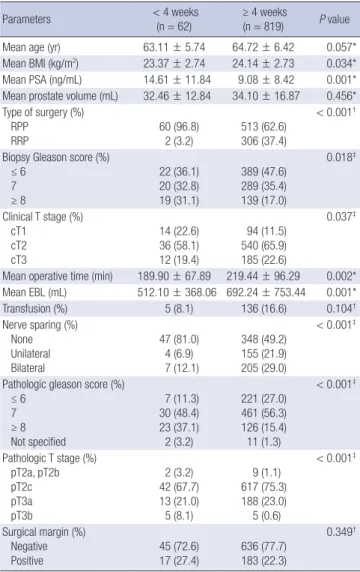
The mean biopsy-to-surgery interval in the overall radical pros- tatectomy cohort was 8.40 ± 6.16 weeks. In the open radical pro- statectomy group, there were significant differences in body mass index, prostate-specific antigen level, type of surgery (radical perineal prostatectomy or radical retropubic prostatectomy), biopsy Gleason score, clinical T stage, nerve sparing procedure, pathologic Gleason score, and pathologic T stage between the
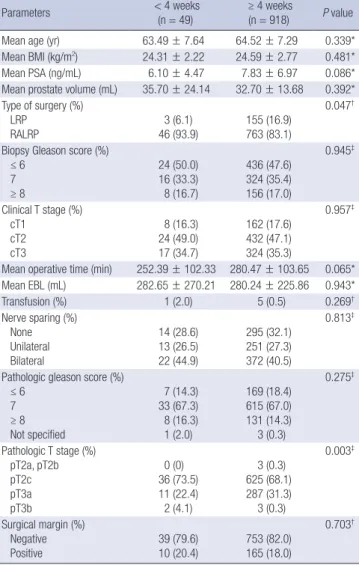
< 4 and ≥ 4 weeks subgroups (Table 1). However, in the mini- mally invasive radical prostatectomy group, only type of surgery and pathologic T stage showed significant differences between the two subgroups. Laparoscopic radical prostatectomy was performed more often after 4 weeks of biopsy and robot-assist- ed laparoscopic radical prostatectomy was performed more of- ten within 4 weeks of biopsy (P = 0.047) (Table 2).
Table 1. Comparison of clinicopathologic features among open radical prostatectomy groups classified by the interval from prostate biopsy to surgery
Parameters < 4 weeks
(n = 62)
≥ 4 weeks
(n = 819) P value
Mean age (yr) 63.11 ± 5.74 64.72 ± 6.42 0.057*
Mean BMI (kg/m2) 23.37 ± 2.74 24.14 ± 2.73 0.034*
Mean PSA (ng/mL) 14.61 ± 11.84 9.08 ± 8.42 0.001*
Mean prostate volume (mL) 32.46 ± 12.84 34.10 ± 16.87 0.456*
Type of surgery (%) RPP
RRP 60 (96.8)
2 (3.2) 513 (62.6) 306 (37.4)
< 0.001†
Biopsy Gleason score (%) ≤ 6
7 ≥ 8
22 (36.1) 20 (32.8) 19 (31.1)
389 (47.6) 289 (35.4) 139 (17.0)
0.018‡
Clinical T stage (%) cT1
cT2 cT3
14 (22.6) 36 (58.1) 12 (19.4)
94 (11.5) 540 (65.9) 185 (22.6)
0.037‡
Mean operative time (min) 189.90 ± 67.89 219.44 ± 96.29 0.002*
Mean EBL (mL) 512.10 ± 368.06 692.24 ± 753.44 0.001*
Transfusion (%) 5 (8.1) 136 (16.6) 0.104†
Nerve sparing (%) None Unilateral Bilateral
47 (81.0) 4 (6.9) 7 (12.1)
348 (49.2) 155 (21.9) 205 (29.0)
< 0.001‡
Pathologic gleason score (%) ≤ 6
7 ≥ 8 Not specified
7 (11.3) 30 (48.4) 23 (37.1) 2 (3.2)
221 (27.0) 461 (56.3) 126 (15.4) 11 (1.3)
< 0.001‡
Pathologic T stage (%) pT2a, pT2b pT2c pT3a pT3b
2 (3.2) 42 (67.7) 13 (21.0) 5 (8.1)
9 (1.1) 617 (75.3)
188 (23.0) 5 (0.6)
< 0.001‡
Surgical margin (%) Negative
Positive 45 (72.6)
17 (27.4) 636 (77.7) 183 (22.3)
0.349†
*Independent t-test; †Fisher’s exact test; ‡Chi-square test. BMI, body mass index; PSA, prostate-specific antigen; RPP, radical perineal prostatectomy; RRP, radical retropubic prostatectomy; EBL, estimated blood loss.
Primary endpoint: positive surgical margin status
Overall positive surgical margin rate in the entire cohort was 20.3% (375/1,848). There were no significant differences in pos- itive surgical margin rate between the < 4 and ≥ 4 weeks sub- groups for both the open radical prostatectomy group (Table 1) and minimally invasive radical prostatectomy group (Table 2).
On binary logistic regression analysis, prostate-specific anti- gen level, prostate volume, and biopsy Gleason score ≥ 8 were independent factors for positive surgical margin status in open radical prostatectomy group (Table 3). With regard to minimal- ly invasive prostatectomy group, independent factors for posi- tive surgical margin status were prostate-specific antigen level, clinical T stage 3, and unilateral and bilateral nerve sparing (Ta- ble 4). However, biopsy-to-surgery interval was not a significant factor for positive surgical margin status for both groups.
Secondary endpoint: operative time
For the entire cohort, the mean operative time was 249.64 min.
In the open radical prostatectomy group, operative time was sig- nificantly shorter when radical prostatectomy was performed Table 2. Comparison of clinicopathologic features among minimally invasive radical
prostatectomy groups classified by the interval from prostate biopsy to surgery
Parameters < 4 weeks
(n = 49)
≥ 4 weeks
(n = 918) P value
Mean age (yr) 63.49 ± 7.64 64.52 ± 7.29 0.339*
Mean BMI (kg/m2) 24.31 ± 2.22 24.59 ± 2.77 0.481*
Mean PSA (ng/mL) 6.10 ± 4.47 7.83 ± 6.97 0.086*
Mean prostate volume (mL) 35.70 ± 24.14 32.70 ± 13.68 0.392*
Type of surgery (%) LRP
RALRP 3 (6.1)
46 (93.9) 155 (16.9) 763 (83.1)
0.047†
Biopsy Gleason score (%) ≤ 6
7 ≥ 8
24 (50.0) 16 (33.3) 8 (16.7)
436 (47.6) 324 (35.4) 156 (17.0)
0.945‡
Clinical T stage (%) cT1
cT2 cT3
8 (16.3) 24 (49.0) 17 (34.7)
162 (17.6) 432 (47.1) 324 (35.3)
0.957‡
Mean operative time (min) 252.39 ± 102.33 280.47 ± 103.65 0.065*
Mean EBL (mL) 282.65 ± 270.21 280.24 ± 225.86 0.943*
Transfusion (%) 1 (2.0) 5 (0.5) 0.269†
Nerve sparing (%) None Unilateral Bilateral
14 (28.6) 13 (26.5) 22 (44.9)
295 (32.1) 251 (27.3) 372 (40.5)
0.813‡
Pathologic gleason score (%) ≤ 6
7 ≥ 8 Not specified
7 (14.3) 33 (67.3) 8 (16.3) 1 (2.0)
169 (18.4) 615 (67.0) 131 (14.3) 3 (0.3)
0.275‡
Pathologic T stage (%) pT2a, pT2b pT2c pT3a pT3b
0 (0) 36 (73.5) 11 (22.4) 2 (4.1)
3 (0.3) 625 (68.1)
287 (31.3) 3 (0.3)
0.003‡
Surgical margin (%) Negative
Positive 39 (79.6)
10 (20.4) 753 (82.0) 165 (18.0)
0.703†
*Independent t-test; †Fisher’s exact test; ‡Chi-square test. BMI, body mass index; PSA, prostate-specific antigen; LRP, laparoscopic radical prostatectomy; RALRP, robot-as- sisted laparoscopic radical prostatectomy; EBL, estimated blood loss.
Table 3. Multivariate analysis of biopsy-to-surgery interval to evaluate factors affect- ing positive surgical margins in patients who underwent open radical prostatectomy
Variables OR (95% CI) P value*
Age 0.996 (0.969-1.023) 0.752
Body mass index 1.007 (0.943-1.074) 0.839
Prostate-specific antigen 1.049 (1.026-1.072) < 0.001
Prostate volume 0.983 (0.969-0.997) 0.015
Types of surgery RPP
RRP 1
1.070 (0.718-1.594) -
0.741 Biopsy Gleason score
≤ 6 7 ≥ 8
1 1.172 (0.776-1.770) 1.657 (1.023-2.684)
- 0.451 0.040 Clinical T stage
cT1 cT2 cT3
1 1.200 (0.623-2.312) 2.030 (0.994-4.145)
- 0.585 0.052 Biopsy to surgery interval
< 4 weeks
≥ 4 weeks 1
1.071 (0.542-2.118) -
0.844 Nerve sparing
None Unilateral Bilateral
1 0.976 (0.604-1.579) 0.928 (0.587-1.468)
- 0.922 0.750
*Binary logistic regression test. OR, odds ratio; CI, confidence interval; RPP, radical perineal prostatectomy; RRP, radical retropubic prostatectomy.
Table 4. Multivariate analysis of biopsy-to-surgery interval to evaluate factors affect- ing positive surgical margins in patients who underwent minimally invasive radical prostatectomy
Variables OR (95% CI) P value*
Age 0.983 (0.957-1.011) 0.230
Body mass index 1.036 (0.968-1.108) 0.304
Prostate-specific antigen 1.094 (1.066-1.123) < 0.001
Prostate volume 0.991 (0.976-1.006) 0.218
Types of surgery LRP
RALRP 1
0.897 (0.542-1.483) -
0.671 Biopsy Gleason score
≤ 6 7 ≥ 8
1 1.153 (0.744-1.786) 1.497 (0.896-2.500)
- 0.524 0.124 Clinical T stage
cT1 cT2 cT3
1 1.518 (0.799-2.881) 2.467 (1.288-4.723)
- 0.202 0.006 Biopsy to surgery interval
< 4 weeks
≥ 4 weeks 1
0.738 (0.333-1.634) -
0.454 Nerve sparing
None Unilateral Bilateral
1 0.509 (0.315-0.821) 0.559 (0.339-0.922)
- 0.006 0.023
*Binary logistic regression test. OR, odds ratio; CI, confidence interval; LRP, laparosco- pic radical prostatectomy; RALRP, robot-assisted laparoscopic radical prostatectomy.
within 4 weeks of prostate biopsy (P = 0.002) (Table 1). Howev- er, in the minimally invasive radical prostatectomy group, there was no significant difference in operative time between the < 4 and ≥ 4 weeks subgroups (Table 2).
On multiple linear regression analysis, factors that increased operative time were body mass index (t = 5.361, P < 0.001), pros- tate-specific antigen level (t = 4.602, P < 0.001), prostate volume (t = 3.605, P < 0.001), and clinical T stage (t = 2.399, P = 0.017 for cT1; t = 6.193, P < 0.001 for cT2; compared to cT3), whereas factors to decrease operative time was radical perineal prosta- tectomy (t = -20.534, P < 0.001) compared to robot-assisted lap- aroscopic radical prostatectomy (data not shown). The biopsy- to-surgery interval was not a significant factor affecting opera- tive time. However, on the multivariate analysis assessed for sur- gical approach, biopsy-to-surgery interval < 4 weeks was a sig- nificant factor to decrease operative time with regard to mini- mally invasive radical prostatectomy (t = -2.064, P = 0.039) (Ta- ble 5).
Secondary endpoint: estimated blood loss
Mean estimated blood loss was 470.55 mL in the entire cohort.
In the open radical prostatectomy group, estimated blood loss was significantly lower when the radical prostatectomy was per- formed within 4 weeks of prostate biopsy (P = 0.001) (Table 1).
However, in minimally invasive radical prostatectomy group, there was no significant difference in estimated blood loss be- tween the < 4 weeks and ≥ 4 weeks subgroups (Table 2).
Multiple linear regression analysis revealed that factors that increased the estimated blood loss were body mass index (t = 2.682, P = 0.007), prostate volume (t = 5.012, P < 0.001), radical perineal prostatectomy (t = 7.105, P < 0.001), radical retropubic prostatectomy (t = 21.442, P < 0.001) compared to robot-assist- ed laparoscopic radical prostatectomy, biopsy Gleason score of 7 (t = 2.035, P = 0.042) compared to a score of ≥ 8, cT2 stage (t = 2.993, P = 0.003) compared to cT3 stage, and not perform- ing nerve sparing procedure (t = 2.049, P = 0.041) compared to
bilateral nerve sparing (data not shown). However, biopsy-to- surgery interval was not a significant factor affecting estimated blood loss. On multivariate analysis assessed with respect to surgical approach, biopsy-to-surgery interval remained not sig- nificant for estimated blood loss (Table 5).
DISCUSSION
The objective of our study was to investigate the impact of the biopsy-to-surgery interval on immediate operative outcome with a focus on differences according to the surgical approach.
Our data showed that the biopsy-to-surgery interval had no im- pact on the positive surgical margin status in both open radical prostatectomy and minimally invasive radical prostatectomy groups. In addition, it did not affect estimated blood loss in both groups or operative time in the open radical prostatectomy group, although biopsy-to-surgery interval < 4 weeks was a significant factor for decreased operative time in the minimally invasive radical prostatectomy group.
The results of the present study are partly consistent with those of earlier studies. Lee and associates reported that the biopsy- to-surgery interval was not an independent factor of positive surgical margin status, operative time, and estimated blood loss in a group of men who underwent a total of 169 radical retropu- bic prostatectomies (4). A larger study with a cohort of 2,996 radical retropubic prostatectomies also showed no significant association between early surgery and positive surgical margin status, operative time, and estimated blood loss using an inter- val of 4 weeks or less (5). For robot-assisted laparoscopic radical prostatectomy, a study of 559 patients who underwent robot- assisted laparoscopic radical prostatectomy reported no asso- ciation between biopsy-to-surgery interval and the three out- come parameters using an interval of 4 weeks or less (7). An- other study used intervals of ≤ 2 weeks, > 2 to ≤ 4 weeks, > 4 to ≤ 6 weeks, > 6 to ≤ 8 weeks, and > 8 weeks with a cohort of 237 robot-assisted laparoscopic radical prostatectomies, and revealed that biopsy-to-surgery interval was not significantly associated with positive surgical margin status, operative time, and estimated blood loss (9). However, our findings are in dis- agreement with the results of Choi et al., who found a strong trend that robot-assisted laparoscopic radical prostatectomy performed within 4 weeks of biopsy was associates with a lon- ger operative time (232.6 vs. 208.8 min, P = 0.07) (8).
An interesting finding in our study, which is not in accord with earlier studies, is that performing minimally invasive radical prostatectomy within 4 weeks of prostate biopsy significantly shortened the operative time. The explanation for this finding is not clear. Inflammatory reaction will occur to some extent in the post-biopsy prostate because the biopsy results in local tis- sue injury. It is known that the presence of histologic inflamma- tion within the prostate correlates significantly with serum pros- Table 5. Multivariate analysis* of biopsy-to-surgery interval to evaluate factors affect-
ing operative time and estimated blood loss overall and according to surgical approach
Variables < 4 weeks vs. ≥ 4 weeks
B (t) P value†
Operative time
Analysis for overall cohort -11.713 (-1.293) 0.196 Analysis according to surgical approach
Open
Minimally invasive
-0.807 (-0.081) -30.665 (-2.064)
0.936 0.039 Estimated blood loss
Analysis for overall cohort 1.065 (0.025) 0.980
Analysis according to surgical approach Open
Minimally invasive 13.523 (0.164)
-30.622 (-0.963) 0.869 0.336
*Other covariates not shown in this table included age, body mass index, prostate- specific antigen, prostate volume, biopsy Gleason score, clinical T stage, and nerve sparing; †Multiple linear regression test.
tate-specific antigen levels (11,12). Oesterling et al. (13) found that the median time required for the serum prostate-specific antigen value to return to a stable level after prostate biopsy was 15-17 days. Thus, it is inferred that the most of the post-biopsy inflammation within the prostate would resolve 15-17 days af- ter biopsy. The resolution of acute inflammation is followed by tissue proliferation and remodeling and it is known that tissue remodeling with collagen scar formation begins 3-4 weeks after tissue injury (14-16). Thus, local tissue remodeling and scar for- mation within the prostate may start 3-4 weeks after biopsy and might lead to intraprostatic tissue adhesions.
A tissue adhesion is known to be one of the factors that make the laparoscopic procedure difficult to perform (17). Studies have shown that the most common cause of a conversion to laparotomy during laparoscopic adhesiolysis for small bowel obstruction was matted, dense adhesions (18-20). Regarding prostatectomy, Jaffe et al. reported that significantly more oper- ative time was needed when performing laparoscopic radical prostatectomy for patients who underwent previous transure- thral resection of the prostate than those who did not, and this finding was explained by the more difficult dissection resulting from periprostatic inflammation and fibrosis (21). For robot- assisted laparoscopic radical prostatectomy, a previous study reported a trend that robot-assisted laparoscopic radical pros- tatectomy with previous transurethral resection of the prostate required more operative time than without previous transure- thral resection of the prostate (200 min vs. 186 min, P = 0.112), although this was not statistically significant (22). Therefore, the longer operative time when performing minimally invasive rad- ical prostatectomy after 4 weeks of biopsy might be explained by the development of intraprostatic or periprostatic adhesions more than 4 weeks after prostate biopsy.
Our study has limitations, including its retrospective design and performance at a single institution. There is a possibility of selection bias associated with the referral patterns to a tertiary medical center. Another limitation is the heterogeneous nature of the cohort with four different prostatectomies performed by five different surgeons in a long time period. Therefore, certain confounding factors such as the difference of surgeon experi- ence and learning curve might have affected the outcomes. The most critical limitation is that many of the baseline demograph- ic data showed significant differences in the open radical pros- tatectomy group (Table 1). This might stem from the heteroge- neity of the radical prostatectomy cohort, which included two different types of open radical prostatectomies (radical perineal prostatectomy and radical retropubic prostatectomy) performed by three different surgeons. As shown in Table 1, significantly more radical perineal prostatectomies were performed within 4 weeks of biopsy, and more radical retropubic prostatectomies were performed after 4 weeks of biopsy. This difference most likely accounts for many of the differences in baseline parame-
ters. However, because multivariate analyses with adjustment for possible confounders showed that the biopsy-to-surgery in- terval was not a significant factor for positive surgical margin status, operative time, and estimated blood loss (except for op- erative time in the minimally invasive radical prostatectomy group analysis), the baseline differences would not have much impact on the conclusions of our study.
In conclusion, our study showed that biopsy-to-surgery in- terval did not affect positive surgical margin status, operative time, or estimated blood loss in both open radical prostatecto- my and minimally invasive radical prostatectomy groups with the exception of a significantly shorter operative time when min- imally invasive radical prostatectomy was performed within 4 weeks of biopsy. Therefore, it is feasible to perform open or min- imally invasive radical prostatectomies within 4 weeks of pros- tate biopsy, and this might even be beneficial when performing minimally invasive radical prostatectomy to reduce the opera- tive time.
DISCLOSURE
The authors have no conflicts of interest to disclose.
ORCID
Bumsoo Park http://orcid.org/0000-0003-4505-2368 Seol Ho Choo http://orcid.org/0000-0003-4357-4330 Han Yong Choi http://orcid.org/0000-0002-1980-4899 REFERENCES
1. Jung KW, Won YJ, Kong HJ, Oh CM, Seo HG, Lee JS. Cancer statistics in Korea: incidence, mortality, survival and prevalence in 2010. Cancer Res Treat 2013; 45: 1-14.
2. Stitzenberg KB, Wong YN, Nielsen ME, Egleston BL, Uzzo RG. Trends in radical prostatectomy: centralization, robotics, and access to urologic cancer care. Cancer 2012; 118: 54-62.
3. Walsh PC, Partin AW. Anatomic radical retropubic prostatectomy. In:
Wein AJ, Kavoussi LR, Novick AC, Peters CA, Partin AW. editors. Camp- bell-Walsh Urology. 9th ed. Philadelphia: W. B. Saunders, 2007, p2956- 78.
4. Lee DK, Allareddy V, O’Donnell M A, Williams RD, Konety BR. Does the interval between prostate biopsy and radical prostatectomy affect the immediate postoperative outcome? BJU Int 2006; 97: 48-50.
5. Eggener SE, Yossepowitch O, Serio AM, Vickers AJ, Scardino PT, East- ham JA. Radical prostatectomy shortly after prostate biopsy does not af- fect operative difficulty or efficacy. Urology 2007; 69: 1128-33.
6. Adiyat KT, Murugesan M, Katkoori D, Eldefrawy A, Soloway MS. Total prostatectomy within 6 weeks of a prostate biopsy: is it safe? Int Braz J Urol 2010; 36: 177-81; discussion 82.
7. Martin GL, Nunez RN, Humphreys MD, Martin AD, Ferrigni RG, An- drews PE, Castle EP. Interval from prostate biopsy to robot-assisted radi-
cal prostatectomy: effects on perioperative outcomes. BJU Int 2009; 104:
1734-7.
8. Choi H, Ko YH, Kang SG, Kang SH, Park HS, Cheon J, Patel VR. Biopsy related prostate status does not affect on the clinicopathological outcome of robotic assisted laparoscopic radical prostatectomy. Cancer Res Treat 2009; 41: 205-10.
9. Kim IS, Na W, Nam JS, Oh JJ, Jeong CW, Hong SK, Byun SS, Lee SE. In- terval from prostate biopsy to robot-assisted laparoscopic radical prosta- tectomy (RALP): effects on surgical difficulties. Korean J Urol 2011; 52:
664-8.
10. Epstein JI, Allsbrook WC Jr, Amin MB, Egevad LL; ISUP Grading Com- mittee. The 2005 International Society of Urological Pathology (ISUP) Consensus Conference on Gleason Grading of Prostatic Carcinoma. Am J Surg Pathol 2005; 29: 1228-42.
11. Okada K, Kojima M, Naya Y, Kamoi K, Yokoyama K, Takamatsu T, Miki T.
Correlation of histological inflammation in needle biopsy specimens with serum prostate- specific antigen levels in men with negative biopsy for prostate cancer. Urology 2000; 55: 892-8.
12. Ozden C, Ozdal OL, Guzel O, Han O, Seckin S, Memis A. The correlation between serum prostate specific antigen levels and asymptomatic inflam- matory prostatitis. Int Urol Nephrol 2007; 39: 859-63.
13. Oesterling JE, Rice DC, Glenski WJ, Bergstralh EJ. Effect of cystoscopy, prostate biopsy, and transurethral resection of prostate on serum pros- tate-specific antigen concentration. Urology 1993; 42: 276-82.
14. Li J, Chen J, Kirsner R. Pathophysiology of acute wound healing. Clin Der- matol 2007; 25: 9-18.
15. Krafts KP. Tissue repair: The hidden drama. Organogenesis 2010; 6: 225- 33.
16. Reinke JM, Sorg H. Wound repair and regeneration. Eur Surg Res 2012;
49: 35-43.
17. Davey AK, Maher PJ. Surgical adhesions: a timely update, a great chal- lenge for the future. J Minim Invasive Gynecol 2007; 14: 15-22.
18. Nagle A, Ujiki M, Denham W, Murayama K. Laparoscopic adhesiolysis for small bowel obstruction. Am J Surg 2004; 187: 464-70.
19. Farinella E, Cirocchi R, La Mura F, Morelli U, Cattorini L, Delmonaco P, Migliaccio C, De Sol AA, Cozzaglio L, Sciannameo F. Feasibility of lapa- roscopy for small bowel obstruction. World J Emerg Surg 2009; 4: 3.
20. Dindo D, Schafer M, Muller MK, Clavien PA, Hahnloser D. Laparosco- py for small bowel obstruction: the reason for conversion matters. Surg Endosc 2010; 24: 792-7.
21. Jaffe J, Stakhovsky O, Cathelineau X, Barret E, Vallancien G, Rozet F. Sur- gical outcomes for men undergoing laparoscopic radical prostatectomy after transurethral resection of the prostate. J Urol 2007; 178: 483-7; dis- cussion 7.
22. Martin AD, Desai PJ, Nunez RN, Martin GL, Andrews PE, Ferrigni RG, Swanson SK, Pacelli A, Castle EP. Does a history of previous surgery or radiation to the prostate affect outcomes of robot-assisted radical prosta- tectomy? BJU Int 2009; 103: 1696-8.