
Printed in the Republic of Korea DOI 10.5012/jkcs.2011.55.2.189
Thiosemicarbazones 의 몇 가지 코팔트(II) 및 니켈(II) 착물에 대한 합성, 항박테리 아 및 항균 활성
Surendra Prasad†,* and Ram K. Agarwal†,‡
†Division of Chemical Sciences, Faculty of Science, Technology and Environment, The University of the South Pacific, Suva, Fiji
†,‡Department of Chemistry, Lajpat Rai Postgraduate College, Sahibabad, Ghaziabad 201005, India (접수 2010. 8. 20; 수정 2010. 10. 18; 게재확정 2010. 12. 28)
Synthesis, Antibacterial and Antifungal Activities of Some Cobalt(II) and Nickel(II) Complexes of Thiosemicarbazones
Surendra Prasad†,* and Ram K. Agarwal†,‡
†Division of Chemical Sciences, Faculty of Science, Technology and Environment, The University of the South Pacific, Suva, Fiji. *Email: [email protected]
†,‡Department of Chemistry, Lajpat Rai Postgraduate College, Sahibabad, Ghaziabad 201005, India Email: [email protected]
(Received August 20, 2010; Revised October 18, 2010; Accepted December 28, 2010)
요 약. 두 가지 새로운 thiosemicarbazone으로, 예를 들면, 4[N-(4'-ethylbenzalidene)amino]antipyrine thiosemicarbazone(EBAAPTS) 및 4[N-(2',4'-dimethylbenzalidene)amino]antipyrine thiosemicarbazone(DMBAAPTS)를 합성하여 그 특성을 규명하였다. 이들 thiosemicarbazone(EBAAPTS 및 DMBAAPTS)의 코발트(II) 및 니켈(II)에 대한 착물화 특성을 조사하였다. EBAAPTS 및 DMBAAPTS와 코발트(II) 및 니켈(II) 염과의 반응을 뜨거운 에탄올 용액에서 수행한 결과, 일반적 조성으로 [MX2(L)H2O]
(M=Co2+ 또는 Ni2+; X=Cl, Br, NO3, NCS 또는 CH3COO; L=EBAAPTS 또는 DMBAAPTS)을 갖는 새로운 착물의 형성을 확인하였다. 새롭게 합성한 이들 착물에 대해 원소분석, 분자량, 몰전도도, 자기수자율, 적외선 및 자외선 분광학 등의 방법으로 특성을 규명하였다. 니트로벤젠 용액에서 이들 착물의 몰전도도를 측정한 결과, 비전해질 성질을 가짐을 알 았다. 또한, 모든 착물은 높은-스핀 형태였다. 분광학적 연구로부터 [MX2(L)H2O] 형의 코발트(II) 및 니켈(II) 착물은 팔면 체의 기하구조를 갖는 것으로 확인되었다. 이들 착물을 이용하여 항박테리아 및 항균 활성을 여러 종류의 병원균, 세균 및 박테리아에 대해 조사하여 생물학적 활성을 고찰하였다.
주제어: 코발트(II), 니켈(II), Thiosemicarbazones, 코발트(II) thiosemicarbazone 착물, 니켈(II) thiosemicarbazone착물, 생물 학적 성질
ABSTRACT. In the present paper two new thiosemicarbazones i.e., 4[N-(4'-ethylbenzalidene)amino]antipyrine thi- osemicarbazone (EBAAPTS) and 4[N-(2',4'-dimethylbenzalidene)amino]antipyrine thiosemicarbazone (DMBAAPTS) have been synthesized and characterized. The complexing abilities of these thiosemicarbazones i.e. EBAAPTS and DMBAAPTS towards cobalt(II) and nickel(II) salts have been explored. The reactions of the hot ethanolic solutions of cobalt(II) and nickel(II) salts with EBAAPTS and DMBAAPTS led to the formation of the novel complexes of general composition [MX2(L)H2O] (M=Co2+ or Ni2+; X=Cl–, Br–, NO3–, NCS– or CH3COO–; L=EBAAPTS or DMBAAPTS). The newly synthesized complexes have been characterized by elemental analyses, molar mass, molar conductance, magnetic susceptibility, infra- red and electronic spectral studies. The molar conductance measurements of the complexes in nitrobenzene correspond to their non-electrolytic nature. All the complexes are of high-spin type. On the basis of spectral studies an octahedral geom- etry has been assigned for Co(II) and Ni(II) complexes of the type [MX2(L)H2O]. These complexes were screened for their antibacterial and antifungal activities on different species of pathogens, fungi and bacteria and their biopotency has been discussed.
Keywords: Cobalt(II), Nickel(II), Thiosemicarbazones, Cobalt(II) thiosemicarbazones complexes, Nickel(II) thiosemicarba- zones complexes, Biological properties
INTRODUCTION
Many thiosemicarbazones possess a wide spectrum of medicinal properties including activity against influenza, protozoa, small pox, certain kinds of tumour, tuberculo- sis, leprosy, bacterial and viral infections, psoriasis, rheu- matism and tripamosomiasis, cocidiosis, malaria and have been suggested as possible pesticides and fungicides.
Their activity has frequently been thought to be due to their ability to chelate trace metals. Thus the metal che- lates with ligands of biological importance have been playing an important role in the development of new coor- dination chemistry. Complexes containing chelating ligands, which show promising biological activity, have been recently studied by ourselves1-11 and others.12-22 We have investigated the synthesis and characterization of cobalt(II),1-2 nickel(II),2-3 oxovanadium(IV),4-5 platinum(II)6 and some lan- thanide(III)7 complexes that contain a range of ancillary ligands such as semicarbazones,7 thiosemicarbazones.1,2,4-6 Recently, we focused our attention to the investigation on transition metal complexes of N and O donor ligands.3,8,9 Very recently we reported the synthesis, characterization and biological activities of nickel(II) and cobalt(II) com- plexes of N and O donor of hydrazones derived from isonicotinic acid hydrazide viz., N-isonicotinamido-furfural- 2'-aldimine (INH-FFL), N-isonicotinamido cinnamalidine (INH-CIN) and N-isonicotinamido-3',4',5'-trimethoxy- benzalaldimine (INH-TMB) ligands.3,10,11 Although many thiosemicarbazones possess a wide spectrum of medici- nal and biological properties23-26 still the metal complexes of the sulphur donor thiosemicarbazones have not been given as much attention as dithiophosphate, dithiocar- bamates, dithiolates, dithio-β-diketonates, dithiooxamide or xanthates. Thus herein we present our studies on two new thiosemicarbazones N, N and S donor ligands i.e., 4[N-(4'-ethylbenzalidene)amino]antipyrine thiosemicar- bazone (EBAAPTS) (Fig. 1) and 4[N-(2',4'-dimethylben- zalidene)amino]antipyrine thiosemicarbazone (DMBAAPTS)
(Fig. 2) have been synthesized and their coordination behaviour towards Co(II) and Ni(II) are reported.
EXPERIMENTAL
Materials
MX2·nH2O (M = Co2+ or Ni2+; X = Cl–, Br–, NO3–, NCS– or CH3COO–) were obtained from SD Fine Chemicals Ltd. (Mumbai, India) and were used as received. M(NCS)2
was prepared by mixing metal chloride (in ethanol) and ethanolic solution of potassium thiocyanate in 1:2 molar ratio. The precipitated KCl was filtered off and the filtrate having respective metal thiocyanate was used immedi- ately for complex formation. The ligands EBAAPTS and DMBAAPTS were synthesized in the laboratory by our reported method.26
Synthesis of the complexes
A general method has been used for the preparation of all the complexes. A hot ethanolic solution of the corre- sponding cobalt(II) or nickel(II) salt was mixed with a hot ethanolic solution of the ligand (EBAAPTS or DMBAAPTS) in 1:1 molar ratio.1,2,10,11 The reaction mixture was refluxed on water bath for ca. 2 h. On cooling in ice cold water, the coloured complexes precipitated out in each case. The products were filtered, washed with ethanol, re-crystal- lized and dried over P4O10 under vacuum.
Instrumentation, physico-chemical measurements and analytical estimations
The cobalt(II) and nickel(II) in their metal complexes were estimated complexometrically with EDTA using murexide and eriochrome black-T as indicators respec- tively after decomposing the complexes with conc. H2SO4
and H2O2.2 The halogens and pseudohalogens were esti- mated by reported method.1,2,10,11 The sulfur content in the complexes was estimated gravimetrically as precipitated Fig. 1. 4[N-(4'-Ethylbenzalidene)amino]antipyrine thiosemi-
carbazone (EBAAPTS) [Mol. formula C21H24N6S].
Fig. 2. 4[N-(2',4'-Dimethylbenzalidene)amino]antipyrine thios- emicarbazone (DMBAAPTS) [Mol. formula C21H24N6S].
BaSO4 while the nitrogen content in the complexes was determined by the Kjeldahl method.
The molecular weight determination of the present com- plexes was carried out cryoscopically in freezing PhNO2
using a Beckmann thermometer of ±0.01 ºC accuracy. A Toshniwal conductivity bridge and dip type cell was used for the conductivity measurements of the complexes in PhNO2 at room temperature. The magnetic susceptibility measurements on powder form of the complexes were carried out at 25oC on Evan’s balance using anhydrous CuSO4 as calibrant. The infrared spectra of the complexes were recorded on a Perkin Elmer infrared spectropho- tometer model 521 KBr pellets in the range of 4000-200 cm-1. Diffused reflectance spectra of the solid compounds were recorded on a Beckmann DK-2A spectrophotome- ter at C.D.R.I. Lucknow, India. Thermogravimetric anal- yses of the complexes were carried out on Perkin-Elmer Pyris Diamond in static air with an unlidded platinum boat sample holder, at the heating rate of 6 ºC/min. The anti- bacterial and antifungal activities of some representative cobalt(II) complexes and standards ampicillin, tetracy- cline and salicylic acid were screened by following our reported methods.1,2,10,11
RESULTS AND DISCUSSION
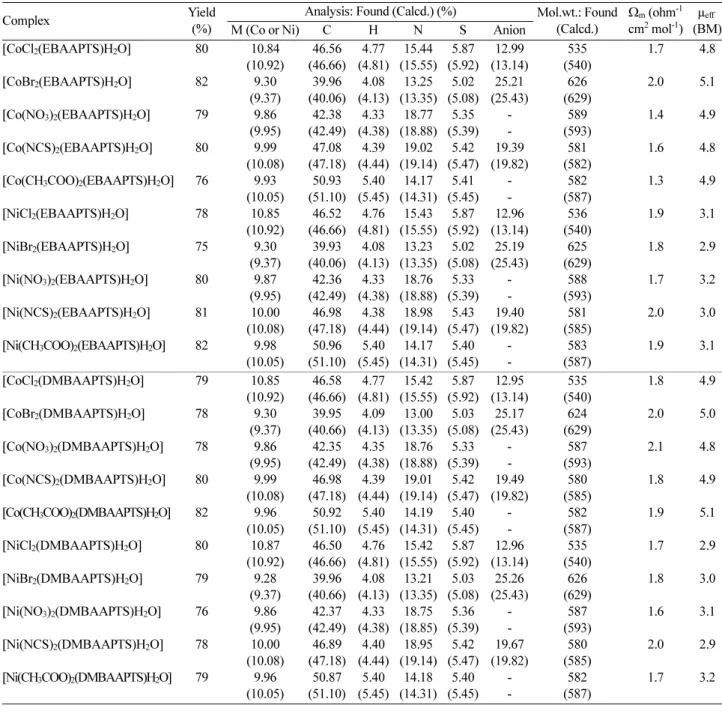
The reaction of Co(II) and Ni(II) with EBAAPTS and DMBAAPTS yielded the complex, [MX2(L)(H2O)] where M=Co2+ or Ni2+; X=Cl–, Br–, NO3–, NCS– or CH3COO– and L=EBAAPTS or DMBAAPTS. The analytical data of these complexes showed that they are stable and can be stored for months without any significant change. These complexes are generally soluble in common organic sol- vents. The molar conductance values of the complexes in nitrobenzene reveal that all the halo, nitrato, isothio- cyanato and acetato complexes are essentially non-elec- trolytes.27 The cryoscopically determined molecular weights and conductivity data are presented in Table 1.
In general, the molecular weight results are good agree- ment with the conductance data suggesting monomeric formulations.
Magnetic susceptibility
The calculated magnetic moment based on magnetic susceptibility measurements of the cobalt(II) and nickel(II) complexes are given in Table 1. The observed values of magnetic moment for cobalt(II) complexes are generally diagnostic of the coordination geometry about the metal ion.1,2,11 The low spin square planar cobalt(II) complexes
may be readily identified by values of µeff in the range 2.1- 2.9 B.M., arising from one unpaired electron plus an apparently large orbital contribution. Both tetrahedral and high-spin octahedral cobalt(II) complexes possess three unpaired electrons but may be distinguished by the mag- nitude of the deviation of µeff from the spin only value1. The magnetic moment of the tetrahedral cobalt(II) com- plexes with an orbitally non-generate ground state is increased above the spin only value via contribution from higher orbitally degenerate terms and occurs in the range 4.2-4.7 B.M.1,2 The octahedral cobalt(II) complexes how- ever maintain a large contribution due to 4Tg ground term and exhibit µeff in the range 4.8-5.6 B.M.1 Few data are available for high spin five-coordinate complexes, how- ever, the range has been given as 4.5-4.8 B.M. The mag- netic moments of the present cobalt(II) complexes are in the range of 4.8-5.1 BM (Table 1) which show that all cobalt(II) complexes are paramagnetic and have three unpaired electrons indicating a high-spin octahedral con- figuration.
Magnetic behavior of the octahedral nickel(II) com- plexes is relatively simple. Nickel(II) has the electronic configuration 3d8 and exhibit a magnetic moment higher than expected for two unpaired electrons in the octahedral environment (2.8-3.2 B.M.) and the tetrahedral (3.4-4.2 B.M.) complexes whereas its square-planar complexes would be diamagnetic.2,11 The paramagnetism observed for the present series of nickel(II) complexes ranges from 2.9-3.2 BM (Table 1), which is consistent with the octa- hedral stereochemistry of these complexes.
Infrared spectra
It is known that the thiosemicarbazide molecule itself exists in the trans configuration (Structure a) and while complexing in this configuration it behaves as a mono- dentate ligand, bonding only through the sulphur atom.1,2,4,6,11 It is also known that bonding can also occur through the hydrazinic nitrogen and the amide nitrogen (Structure b), if the sulphur centre is substituted.1,2,4 On re- investigating the crystal structure of thiosemicarbazide hydrochloride, these conformation changes on the basis of protonated deprotonated isomeric forms and steric effects.
In most of the complexes studied, the thiosemicarbazone function coordinates to the metal ion in the cis-configu- ration (Structure c) as a bidentate ligand bonding through the thione/thiol sulphur atom and the hydrazine nitrogen atom in a bidentate manner.1,2,6,11
When an additional coordinating functionality is present in the proximity of the N,S-donating centres, the ligands are
found to act as tridentate species (Structure d) yielding a polymeric compounds in some cases. It is also shown that alkylation of the thiocarbonyl sulphur of thiosemicarba- zone derivatives induces not only complexation through the terminal amino group, but also has enough acidic character for it to function as a mono acidic ligand. In the presence of various transitions metal ions, the ligands (EBAAPTS and DMBAAPTS) are capable of condens- ing at the terminal amino nitrogen atom through another aldehyde or ketone to yield quadridentate ligands, as shown in Structure e, using such template reactions.
Table 1. Analytical, conductivity and molecular weight data of Co(II) and Ni(II) complexes of EBAAPTS and DMBAAPTS
Complex Yield
(%)
Analysis: Found (Calcd.) (%) Mol.wt.: Found (Calcd.)
Ωm (ohm-1 cm2 mol-1)
µeff M (Co or Ni) C H N S Anion (BM)
[CoCl2(EBAAPTS)H2O]
[CoBr2(EBAAPTS)H2O]
[Co(NO3)2(EBAAPTS)H2O]
[Co(NCS)2(EBAAPTS)H2O]
[Co(CH3COO)2(EBAAPTS)H2O]
[NiCl2(EBAAPTS)H2O]
[NiBr2(EBAAPTS)H2O]
[Ni(NO3)2(EBAAPTS)H2O]
[Ni(NCS)2(EBAAPTS)H2O]
[Ni(CH3COO)2(EBAAPTS)H2O]
80 82 79 80 76 78 75 80 81 82
10.84 (10.92)
9.30 (9.37)
9.86 (9.95)
9.99 (10.08)
9.93 (10.05)
10.85 (10.92)
9.30 (9.37)
9.87 (9.95) 10.00 (10.08)
9.98 (10.05)
46.56 (46.66)
39.96 (40.06)
42.38 (42.49)
47.08 (47.18)
50.93 (51.10)
46.52 (46.66)
39.93 (40.06)
42.36 (42.49)
46.98 (47.18)
50.96 (51.10)
4.77 (4.81)
4.08 (4.13)
4.33 (4.38)
4.39 (4.44)
5.40 (5.45)
4.76 (4.81)
4.08 (4.13)
4.33 (4.38)
4.38 (4.44)
5.40 (5.45)
15.44 (15.55)
13.25 (13.35)
18.77 (18.88)
19.02 (19.14)
14.17 (14.31)
15.43 (15.55)
13.23 (13.35)
18.76 (18.88)
18.98 (19.14)
14.17 (14.31)
5.87 (5.92)
5.02 (5.08)
5.35 (5.39)
5.42 (5.47)
5.41 (5.45)
5.87 (5.92)
5.02 (5.08)
5.33 (5.39)
5.43 (5.47)
5.40 (5.45)
12.99 (13.14)
25.21 (25.43)
- - 19.39 (19.82)
- - 12.96 (13.14)
25.19 (25.43)
- - 19.40 (19.82)
- -
535 (540)
626 (629)
589 (593)
581 (582)
582 (587)
536 (540)
625 (629)
588 (593)
581 (585)
583 (587)
1.7 2.0 1.4 1.6 1.3 1.9 1.8 1.7 2.0 1.9
4.8 5.1 4.9 4.8 4.9 3.1 2.9 3.2 3.0 3.1 [CoCl2(DMBAAPTS)H2O]
[CoBr2(DMBAAPTS)H2O]
[Co(NO3)2(DMBAAPTS)H2O]
[Co(NCS)2(DMBAAPTS)H2O]
[Co(CH3COO)2(DMBAAPTS)H2O]
[NiCl2(DMBAAPTS)H2O]
[NiBr2(DMBAAPTS)H2O]
[Ni(NO3)2(DMBAAPTS)H2O]
[Ni(NCS)2(DMBAAPTS)H2O]
[Ni(CH3COO)2(DMBAAPTS)H2O]
79 78 78 80 82 80 79 76 78 79
10.85 (10.92)
9.30 (9.37)
9.86 (9.95)
9.99 (10.08)
9.96 (10.05)
10.87 (10.92)
9.28 (9.37)
9.86 (9.95) 10.00 (10.08)
9.96 (10.05)
46.58 (46.66)
39.95 (40.66)
42.35 (42.49)
46.98 (47.18)
50.92 (51.10)
46.50 (46.66)
39.96 (40.66)
42.37 (42.49)
46.89 (47.18)
50.87 (51.10)
4.77 (4.81)
4.09 (4.13)
4.35 (4.38)
4.39 (4.44)
5.40 (5.45)
4.76 (4.81)
4.08 (4.13)
4.33 (4.38)
4.40 (4.44)
5.40 (5.45)
15.42 (15.55)
13.00 (13.35)
18.76 (18.88)
19.01 (19.14)
14.19 (14.31)
15.42 (15.55)
13.21 (13.35)
18.75 (18.85)
18.95 (19.14)
14.18 (14.31)
5.87 (5.92)
5.03 (5.08)
5.33 (5.39)
5.42 (5.47)
5.40 (5.45)
5.87 (5.92)
5.03 (5.08)
5.36 (5.39)
5.42 (5.47)
5.40 (5.45)
12.95 (13.14)
25.17 (25.43)
- - 19.49 (19.82)
- - 12.96 (13.14)
25.26 (25.43)
- - 19.67 (19.82)
- -
535 (540)
624 (629)
587 (593)
580 (585)
582 (587)
535 (540)
626 (629)
587 (593)
580 (585)
582 (587)
1.8 2.0 2.1 1.8 1.9 1.7 1.8 1.6 2.0 1.7
4.9 5.0 4.8 4.9 5.1 2.9 3.0 3.1 2.9 3.2
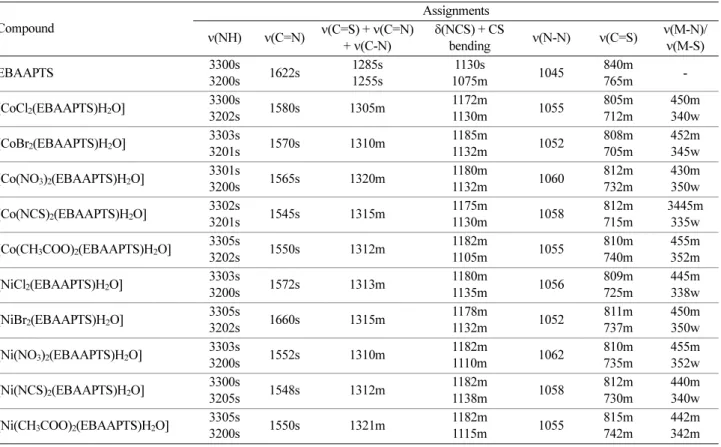
Relevant to the bonding in thiosemicarbazone com- plexes is the ability to locate the various groups infra red (IR) frequencies corresponding to typical linkages. Although there have been many attempts to assign empirically a few infrared bands of metal complexes of thiosemicarbazone ligands,1,2,4,6,11 no complete assignment of their IR spectra have been available. A study and comparison of infrared spectra of EBAAPTS and DMBAAPTS and their [MX2(L) (H2O)] type complexes with Co(II) and Ni(II) are shown in Table 2 and 3 which imply that these ligands behave as neutral tridentate and coordinated through N and N of two azomethine groups and of S of thio-keto group. The strong bands observed at 3322-3200 cm-1 region in both thiosemi- carbazones have been observed due to N-H vibrations.
Practically, there is no effect on these frequencies after complexation exclude the possibility of complexation by this group in ligands; EBAAPTS and DMBAAPTS. The absorptions in 1622-1610 cm-1 range in free ligands (EBAAPTS and DMBAAPTS) may be attributed to C=N stretching vibra- tions of imine-nitrogen which is in agreement with the pre- vious observations.28 On complexation of EBAAPTS (Table 2) and DMBAAPTS (Table 3) with Co(II) and Ni(II) these frequencies are shifted to lower energies. These observa- tions suggest involvement of unsaturated nitrogen atoms
of the two azomethine groups in bonding with the Co(II) and Ni(II) ions.
In substituted thioureas, the C=S stretching vibrations contributed markedly to CN stretching and bending as well as N-C-S bending modes of vibrations. In the spectra of the present ligands (EBAAPTS and DMBAAPTS), the bands observed in the region 1290-1255 cm-1, 1130-1075 cm-1 and 840-760 cm-1 regions are assigned to [ν(C=S) + ν(C=N)+ν(C-N)], [δ(N-C-S)+δ(C=S)] bending and ν(C=S) stretching, respectively, which are in line with the obser- vations of previous researchers.29 The coordination of sul- fur with Co(II) and Ni(II) ions results in donation of electrons towards the metal ions. This results in the weakening of C=S bond. Hence on complexation C=S stretching vibra- tions should decrease and those of C-N should increase. In the present complexes of Co(II) and Ni(II) with EBAAPTS and DMBAAPTS, frequencies in the range 1290-1260 cm-1 increased by 40-50 cm-1. Similarly, bending modes of N-C-S and C=S also increased but to a lesser extent. On the other hand, on complexation the frequencies in region 840-760 cm-1 were shifted to lower wave numbers and intensity of the bands were also reduced. The changes described suggest coordination through S of C=S.
As there were no bands around 2700-2500 cm-1, in the
Table 2. Key infrared bands (cm-1) of EBAAPTS and Co(II) and Ni(II) complexes of EBAAPTS
Compound
Assignments ν(NH) ν(C=N) ν(C=S) + ν(C=N)
+ ν(C-N) δ(NCS) + CS
bending ν(N-N) ν(C=S) ν(M-N)/
ν(M-S)
EBAAPTS 3300s
3200s 1622s 1285s
1255s
1130s
1075m 1045 840m
765m -
[CoCl2(EBAAPTS)H2O] 3300s
3202s 1580s 1305m 1172m
1130m 1055 805m
712m
450m 340w [CoBr2(EBAAPTS)H2O] 3303s
3201s 1570s 1310m 1185m
1132m 1052 808m
705m
452m 345w [Co(NO3)2(EBAAPTS)H2O] 3301s
3200s 1565s 1320m 1180m
1132m 1060 812m
732m
430m 350w [Co(NCS)2(EBAAPTS)H2O] 3302s
3201s 1545s 1315m 1175m
1130m 1058 812m
715m
3445m 335w [Co(CH3COO)2(EBAAPTS)H2O] 3305s
3202s 1550s 1312m 1182m
1105m 1055 810m
740m
455m 352m [NiCl2(EBAAPTS)H2O] 3303s
3200s 1572s 1313m 1180m
1135m 1056 809m
725m
445m 338w [NiBr2(EBAAPTS)H2O] 3305s
3202s 1660s 1315m 1178m
1132m 1052 811m
737m
450m 350w [Ni(NO3)2(EBAAPTS)H2O] 3303s
3200s 1552s 1310m 1182m
1110m 1062 810m
735m
455m 352w [Ni(NCS)2(EBAAPTS)H2O] 3300s
3205s 1548s 1312m 1182m
1138m 1058 812m
730m
440m 340w [Ni(CH3COO)2(EBAAPTS)H2O] 3305s
3200s 1550s 1321m 1182m
1115m 1055 815m
742m
442m 342m
infrared spectra, the possibility of thione-thiol tautome- rism (H-N-C=S C=N-SH) in the ligands, EBAAPTS and DMBAAPTS, has been ruled out. In the far infrared spectral region, some new bands with medium to weak intensity in region 450-335 cm-1 were assigned to ν(M-N) and ν(M-S). Thus the infrared spectral suggested the tri- dentate nature of the thiosemicarbazones and pointed out the N, N, S sites as possible donor atoms. The presence of coordinated water was confirmed by very broad absorp- tions around 3400 cm-1 in the infrared spectra of the com- plexes. Also the bands at ~ 930 and 770 cm-1 may be due to rocking and wagging modes of the coordinated water.30 In thiocyanato complexes, the three fundamental absorp- tion C-N stretch (ν1), C-S stretch (ν3) and N-C-S bending (ν2) were identified in regions 2045-2030, 845-840 and 475-460 cm-1, respectively. These frequencies are asso- ciated with the terminal N-bonded isothiocyanate ions.31 The appearance of two strong absorption bands in 1560- 1520 cm-1 and 1310-1300 cm-1 region for nitrato com- plexes were attributed to ν4 and ν1 modes of vibrations, respectively, of the covalently bonded nitrate groups.32 The (ν4-ν1) values of ~220 cm-1 for these complexes sug- gested strong covalency for the metal-nitrate bonding.2 Lever et al. have shown that the number and relative ener-
gies of nitrate combination frequencies (ν1+ν4) in the region 1800-1700 cm-1 of the infrared spectrum, may be used as an aid to distinguish the various coordination modes of the nitrato group.33 It has been demonstrated that bidentate coordination of the nitrato group involves a greater distortion from D3h symmetry than unidentate coordination, therefore, bidentate nitrate groups should show a larger separation of (ν1+ν4).33 Lever et al. confirmed that the separation for monodentate nitrate appeared to be 5-26 cm-1 and for bidentate nitrate 25-66 cm-1.33 A sep- aration of 15-25 cm-1 in the combination bands (ν1+ν4) in the 1800-1700 cm-1 region in the present complexes con- firmed the monodentate nitrate coordination. The acetato complexes showed infrared absorption frequency bands corresponding to νasym(COO–) and νsym(COO–) at ~1610 and 1370 cm-1, respectively2 confirming that both the ace- tate groups in the present complexes are unidentate.34
Electronic spectra
The electronic spectra of all the Co(II) complexes recorded were quite similar to each other and consist of two bands in the regions 18520-18000 cm-1 and 20840-20000 cm-1, which clearly indicated the octahedral stereochemistry of the complexes. The band maxima and their assignments Table 3. Key infrared bands (cm-1) of DMBAAPTS and Co(II) and Ni(II) complexes of DMBAAPTS
Compound
Assignments ν(NH) ν(C=N) ν(C=S) + ν(C=N) +
ν(C-N) δ(NCS) +
CS bending ν(N-N) ν(C=S) ν(M-N)/
ν(M-S)
DMBAAPTS 3320s
3250s 1610vs 1290s
1260vs
1125s
1080m 1050m 840s
760vs -
[CoCl2(DMBAAPTS)H2O] 3322s
3250s 1572s 1355s
1285m
1170m
1110m 1065m 870m
725m
445m 342m [CoBr2(DMBAAPTS)H2O] 3320s
3252s 1578s 1340s
1282m
1190m
1152m 1060m 872m
730m
440m 340w [Co(NO3)2(DMBAAPTS)H2O] 3320s
3250s 1575s 1350s
1285m
1170m
1132m 1062m 885m
735m
445m 335w [Co(NCS)2(DMBAAPTS)H2O] 3322s
3252s 1560s 1342s
1290m
1175m
1130m 1065m 890m
735m
442m 342w [Co(CH3COO)2(DMBAAPTS)H2O] 3320s
3250s 1565s 1345m
1285m
1178m
1135m 1060m 894m
725m
445m 338w [NiCl2(DMBAAPTS)H2O] 3318s
3252m 1570s 1345m
1292m
1180m
1132m 1065m 892m
730m
448m 350w [NiBr2(DMBAAPTS)H2O] 3321s
3250s 1575s 1340s
1285m
1175m
1138m 1062m 894m
715m
452m 340w [Ni(NO3)2(DMBAAPTS)H2O] 3320s
3252s 1572s 1352s
1280m
1180m
1135m 1067m 892m
720m
447m 342w [Ni(NCS)2(DMBAAPTS)H2O] 3322s
3250s 1575s 1342s
1292m
1182m
1140m 1065m 890m
725m
445m 348w [Ni(CH3COO)2(DMBAAPTS)H2O] 3321s
3250s 1578s 1345m
1290m
1175m
1138m 1062m 892m
730m
448m 340w
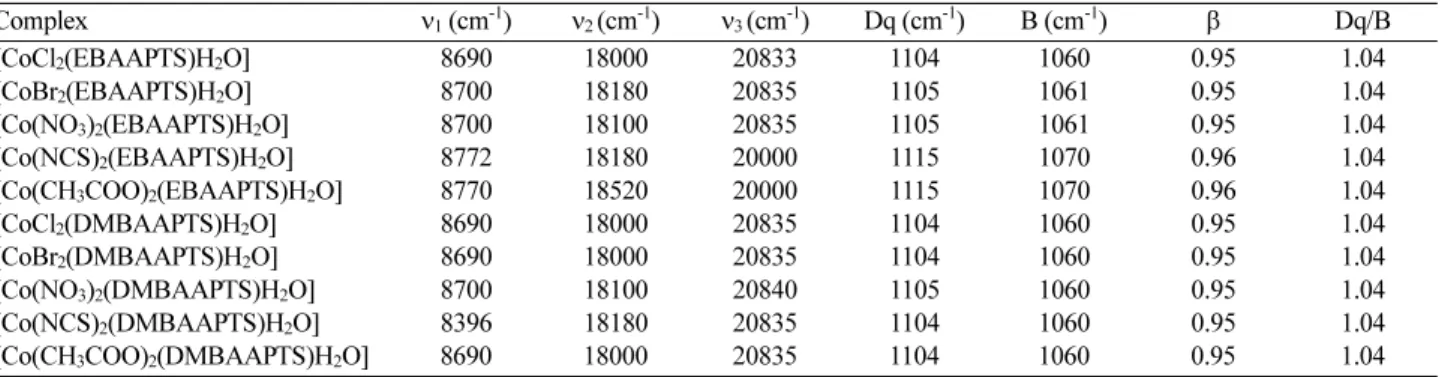
are presented in Table 4. The energy of ν1 corresponds to 10Dq for weak field. The ligand field parameters, Dq, B and nephelauxetic effect (b) have also been calculated, using first order perturbation theory, from the ligand field spectra of octahedral Co(II) complexes, and reported in Table 4. The appreciable intensity enhancement in all the Co(II) complexes studied confirmed the distortion from a regular octahedral structure.
The band maxima, their assignments, the calculated nephelauxetic effect (b) and the ligand field parameters B and Dq for some representative Ni(II) complexes are listed in Table 5. The absorption spectra of the Ni(II) complexes studied displayed bands in 10999-8200 cm-1 (ν1), 17700-15150 cm-1 (ν2) and 27500-24400 cm-1 (ν3) (Table 5) suggested the octahedral stereochemistry of these complexes.35 The comparison of the 10Dq values 7200, 7000 and 9700 cm-1 for [NiCl6]4-, [NiBr6]4- or [Ni(NCS)6]4- complexes, respectively with our results for
the corresponding octahedral [MX2(L)(H2O)] (M=Ni2+, X=Cl–, Br– or NCS–) confirmed the distortion from a regular octahedral structure.2 This due to the fact that the equato- rial ligand’s steric hindrance prevents axial ligands to form optimum covalent bonding with the Ni(II) and Co(II) central metal ions.
Thermogravimetric studies
The thermogravimetric results of few representative cobalt(II) complexes of EBAAPTS (L1) are presented in Table 6. The thermogravimetric data indicated that the complexes were stable up to 85-90 ºC and non-hygro- scopic in nature. In the temperature range of 80-142 ºC, one coordinated water molecule is lost, after which decomposition and deligation processes started. Finally, at ~600 ºC, Co3O4 was obtained as final residue. The ther- mal decomposition may be represented by the following equations:
Table 4. Electronic spectral data and ligand field parameters of Co(II) complexes of EBAAPTS and DMBAAPTS
Complex ν1 (cm-1) ν2 (cm-1) ν3 (cm-1) Dq (cm-1) B (cm-1) β Dq/Β [CoCl2(EBAAPTS)H2O]
[CoBr2(EBAAPTS)H2O]
[Co(NO3)2(EBAAPTS)H2O]
[Co(NCS)2(EBAAPTS)H2O]
[Co(CH3COO)2(EBAAPTS)H2O]
[CoCl2(DMBAAPTS)H2O]
[CoBr2(DMBAAPTS)H2O]
[Co(NO3)2(DMBAAPTS)H2O]
[Co(NCS)2(DMBAAPTS)H2O]
[Co(CH3COO)2(DMBAAPTS)H2O]
8690 8700 8700 8772 8770 8690 8690 8700 8396 8690
18000 18180 18100 18180 18520 18000 18000 18100 18180 18000
20833 20835 20835 20000 20000 20835 20835 20840 20835 20835
1104 1105 1105 1115 1115 1104 1104 1105 1104 1104
1060 1061 1061 1070 1070 1060 1060 1060 1060 1060
0.95 0.95 0.95 0.96 0.96 0.95 0.95 0.95 0.95 0.95
1.04 1.04 1.04 1.04 1.04 1.04 1.04 1.04 1.04 1.04 Table 5. Electronic spectral data and ligand field parameters of Ni(II) complexes of EBAAPTS and DMBAAPTS
Complex ν1 (cm-1) ν2 (cm-1) ν3 (cm-1) Dq (cm-1) B (cm-1) β [NiCl2(EBAAPTS)H2O]
[NiBr2(EBAAPTS)H2O]
[Ni(NO3)2(EBAAPTS)H2O]
[Ni(NCS)2(EBAAPTS)H2O]
[Ni(CH3COO)2(EBAAPTS)H2O]
[NiCl2(DMBAAPTS)H2O]
[NiBr2(DMBAAPTS)H2O]
[Ni(NO3)2(DMBAAPTS)H2O]
[Ni(NCS)2(DMBAAPTS)H2O]
[Ni(CH3COO)2(DMBAAPTS)H2O]
8200 10810
8270 10900
9600 9800 10900
9090 9800 9900 8240 10870 10999
17540 17700 16200 16700 17700 15150 16700 16600 17540 16950
26950 27200 24400 24500 27000 25000 24600 24390 27500 27400
1081 1093 960 980 1093
910 982 990 1087 1099
804 795 1043 1065 794 988 1065 1076 829 750
0.77 0.76 0.96 0.98 0.76 0.91 0.98 0.99 0.79 0.73
Co3O4.
Co3O4.
Co3O4.
The thermal results of few representative Ni(II) com- plexes of DMBAAPTS (L2) are also presented in Table 6.
Ni(II) DMBAAPTS complexes are also stable upto the temp range 75-80 ºC. The careful analysis of thermogravi- metric curves showed the following thermal equations:
NiO.
NiO.
NiO.
Biological properties
The agar-cup method in DMF solvent at a concentra- tion of 50 µg/mL was used to study the antibacterial activ- ities of some representative cobalt(II) complexes and standard drugs. The antibacterial activities of EBAAPTS, DMBAAPTS, their cobalt(II) complexes, and standard:
ampicillin and tetracycline were screened under identical conditions against gram positive bacteria Bacillus subtilis (B.s.) and Staphylococcus aureus (S.a.) and gram nega- tive bacteria Escherichia coli (E.c.) and Salmonella typhi (S.t.). The results are presented in Table 7 in form of the diameters of zone of inhibition (mm). The data presented in Table 7 shows that the cobalt(II) and EBAAPTS or DMBAAPTS complexes have moderate antibacterial activ- ities against these bacteria. It is important to note that these complexes exhibit greater activity than the parent ligand and the same was found during our previous studies.1
The thiosemicarbazones EBAAPTS, DMBAAPTS and Co L( ) H1 ( 2O)Cl2
[ ] 90-138oC [Co L( )Cl1 2] 200-290oC Co L( )1 0.5Cl2
[ ] 320-360oC [CoCl2] 525-620oC Co L( ) H1 ( 2O) NO( 3)2
[ ]87-140oC [Co L( ) NO1 ( 3)2]225-300oC Co L( )1 0.5(NO3)2
[ ]320-365oC[Co NO( 3)2]530-625oC Co L( ) H1 ( 2O) NCS( )2
[ ]85-142oC [Co L( ) NCS1 ( )2]230-315oC Co L( )1 0.5(NCS)2
[ ]330-380oC[Co NCS( )2] 532-640oC
Ni L( ) H2 ( 2O)Br2
[ ]80-130oC [Ni L( )Br2 2] 230-310oC Ni L( )2 0.5Br2
[ ] 340-370oC [NiBr2] 520-605oC Ni L( ) H2 ( 2O) NO( 3)2
[ ] 75-135oC [Ni L( ) NO2 ( 3)2] 210-290oC
Ni L( )2 0.5(NO3)2
[ ] 330-375oC [Ni NO( 3)2] 530-610oC Ni L( ) H2 ( 2O) NCS( )2
[ ]80-145oC [Ni L( ) NCS2 ( )2]225-300oC Ni L( )2 0.5(NCS)2
[ ] 335-380oC [Ni NCS( )2] 535-615oC Table 6. Thermoanalytical results obtained for the Co(II) and Ni(II) complexes of EBAAPTS
Complex Decomp. temp. (ºC)
Decomp. products Weight loss (%)
Initial Final Found Calcd.
[CoCl2(EBAAPTS)H2O]
090 200 320 525
138 290 360 620
CoCl2(EBAAPTS) CoCl2(EBAAPTS)0.5 CoCl2
Co3O4
03.60 40.13 77.29 85.29
03.53 39.26 75.36 83.76
[Co(NO3)2(EBAAPTS)H2O]
087 225 320 530
140 300 365 625
Co(NO3)2(EBAAPTS) Co(NO3)2·(EBAAPTS)0.5 Co(NO3)2
Co3O4
03.48 39.87 74.69 83.39
03.39 38.69 73.86 82.69
[Co(NCS)2(EBAAPTS)H2O]
085 230 330 532
142 315 380 640
Co(NCS)2(EBAAPTS) Co(NCS)2(EBAAPTS)0.5 Co(NCS)2
Co3O4
03.20 37.60 73.89 84.39
03.15 38.10 72.96 83.62
[NiCl2(DMBAAPTS)H2O]
080 230 340 520
130 310 370 605
NiBr2(DMBAAPTS) NiBr2(DMBAAPTS)0.5 NiBr2
NiO
03.59 38.62 72.32 87.39
03.47 37.98 70.86 86.89
[Ni(NO3)2(DMBAAPTS)H2O]
075 210 330 530
135 290 375 610
Ni(NO3)2(DMBAAPTS) Ni(NO3)2(DMBAAPTS)0.5 Ni(NO3)2
NiO
03.40 35.39 69.88 86.49
03.27 34.86 68.36 86.03
[Ni(NCS)2(DMBAAPTS)H2O]
080 225 335 535
142 300 380 615
Ni(NCS)2(DMBAAPTS) Ni(NCS)2(DMBAAPTS)0.5 Ni(NCS)2
NiO
03.10 36.36 70.81 87.52
02.99 35.89 69.77 86.93
their cobalt(II) complexes were also studied for their anti- fungal activities against two fungi: Aspergillus niger and Candida albicans (A. niger and C. albicans) and salicylic acid as standard. On the basis of the results presented in Table 7 it was found that almost all complexes showed nearly the same extent of activity, but they were found less active compared to salicylic acid. However, EBAAPTS complexes showed increased antifungal activity than that of DMBAAPTS complexes. It may be due to presence of furan ring and comparatively faster diffusion of EBAAPTS complexes. These compounds were found to be efficient antifungal agents.
Few researchers have investigated the biological and medicinal properties of transition metal complexes of thiosemicarbazones36-41 where the antitumour activities of Mn(II), Co(II), Ni(II) and Cu(II) chelates of anthracene-9- carboxaldehyde thiosemicarbazone have been studied.37 The cytotoxic activity of phenylglyoxal bis(thiosemicar- bazone) against Ehrlich ascites carcinona cells have also been studied.38 These compounds were also screened for antimicrobial activity on B. subtilis and E. coli. They inhib- ited the bacterial growth considerably.38 The antibacterial and antifungal activities of the present complexes were also compared with the activity results of some other cobalt(II) and nickel(II) complexes having different ligands.42-45 It was found that the present complexes are less potent bactericides with respect to reported cobalt(II) and nickel(II) complexes42,43 while some other complexes have almost comparable44,45 or less45 antibacterial and antifungal activities. However their experimental condi- tions are different.42,45
CONCLUSION
The compounds [MX2(L)H2O] (M=Co2+ or Ni2+; X= Cl-, Br-, NO3-, NCS- or CH3COO-; =EBAAPTS or DMBAAPTS) represent the first example of Co(II) and Ni(II) complexes involving N, N and S donor chelating agents EBAAPTS and DMBAAPTS and X forming six coordinated com- pounds and are stable in solid and solution states. The iso- lated complexes demonstrate that interactions of Co(II) and Ni(II) salts separately with EBAAPTS or DMBAAPTS i.e. thiosemicarbazones lead to 1:1 stoichiometries. Co(II) complexes of EBAAPTS or DMBAAPTS showed mod- erate antibacterial activities against Bacillus subtilis, Sta- phylococcus aureus, Escherichia coli and Salmonella typhi. The present compounds have antifungal activity against A. niger and C. albicans. DMBAAPTS complexes showed lesser antifungal activity than that of EBAAPTS Table 7. Antifungal and antibacterial activities of cobalt(II) complexes of EBAAPTS and DMBAAPTS
Complex
Antibacterial activity
Antifungal action Zone of inhibition (mm)
B. s S. a E.c. S.t. A. niger C. albicans
Ampicillin Tetracycline Salicylic acid DMBAAPTS
[CoCl2(EBAAPTS)H2O]
[CoBr2(EBAAPTS)H2O]
[Co(NO3)2(EBAAPTS)H2O]
[Co(NCS)2(EBAAPTS)H2O]
[Co(CH3COO)2(EBAAPTS)H2O]
DMBAAPTS
[CoCl2(DMBAAPTS)H2O]
[CoBr2(DMBAAPTS)H2O]
[Co(NO3)2(DMBAAPTS)H2O]
[Co(NCS)2(DMBAAPTS)H2O]
[Co(CH3COO)2(DMBAAPTS)H2O]
24 18 - 9 15 13 12 16 11 8 12 12 11 14 11
22 17 - 8 16 11 11 16 12 7 10 11 10 12 10
17 20 - 10 14 11 10 15 11 8 10 11 12 11 11
16 21 - 9 14 11 12 15 11 7 12 10 11 10 11
- - ++++
++
++
++
+++
++
+ + + + +
- - ++++
++
++
++
++
++
+ + + + +
Fig. 3. Proposed structure of [MX2(L)H2O] M=Co(II) or Ni(II);
X=Cl-, Br-, NO3-, NCS- or CH3COO-; L=EBAAPTS or DMBAAPTS.
complexes. The overall experimental evidence shows that these metal ions display a coordination number six and presumably have a distorted octahedral environment around the metal ion as shown in Fig. 3.
Acknowledgments. The authors are thankful to URC of the University of the South Pacific for supporting finance for this research through Project Nos. 6395-1321 and 6394- 1321 (6C127-1321 and 6C126-1321) and Dr. Abdul Mohammed Hatha, Lecturer, Department of Biology, FST, USP for assisting in studying the biological properties of the compounds.
REFERENCE
1. Prasad, S.; Agarwal, R. K. Trans. Metal Chem. 2007, 32, 143 and refs. cited therein.
2. Agarwal, R. K.; Prasad, S. Bioinorg. Chem. Appl. 2005, 3, 271 and refs. cited therein.
3. Prasad, S.; Agarwal, R. K. Res. Lett. Inorg Chem. 2008, 1, 350921.
4. Agarwal, R. K.; Prasad, S.; Gahlot, N. Turk. J. Chem.
2004, 28, 691.
5. Agarwal, R. K.; Prasad, S. Revs. Inorg. Chem. 2006, 26, 471.
6. Agarwal, R. K.; Prasad, S. Turkish J. Chem. 2005, 29, 289.
7. Agarwal, R. K.; Prakash, B. Trans. Metal Chem. 2005, 30, 696.
8. Agarwal, R. K.; Singh, L.; Sharma, D. K.; Singh, R. Turk.
J. Chem. 2005, 29, 309.
9. Agarwal, R. K.; Sharma, S. K. Polish J. Chem. 1993, 67, 581.
10. Prasad, S; Agarwal, R. K. J. Korean Chem. Soc. 2009, 53, 17 and refs. cited therein.
11. Prasad, S.; Agarwal, R. K. J. Korean Chem. Soc. 2009, 53, 683 and refs. cited therein.
12. Murukan, B.; Mohanan, K. Trans. Metal Chem. 2006, 31, 441.
13. Tumer, M.; Ekinci, D.; Tumer, F.; Bulut, A. Spectrochim.
Acta A: Mol. Biomol. Spectrosc. 2007, 66, 1271.
14. Tumer, M.; Deligonul, N.; Golcu, A.; Akgun, E.; Dolaz, M. Trans. Metal Chem. 2006, 31, 1.
15. Pandey, G.; Narang, K. K. Bioinorg. Chem. Appl. 2005, 3, 217.
16. Sharaby, C. M. Spectrochim. Acta A: Mol. Biomol. Spec- trosc. 2007, 66, 1271.
17. Mohamed, G. C.; Sharaby, C. M. Spectrochim. Acta A:
Mol. Biomol. Spectrosc. 2007, 66, 949.
18. Ashok, M.; Prasad, A. V. S. S.; Ravinder, V. J. Braz.
Chem. Soc. 2007, 26, 204.
19. Ferrari, M. B.; Fava, G. G.; Leporti, E.; Pelosi, G.; Tara- sconi, P.; Albertini, R.; Bonati, A.; Lunghi, P.; Pineli, S.
J. Inorg. Biochem. 1998, 70, 145.
20. Srivastava, A. K.; Pandey, O. P.; Sengupta, S. K. Bioinorg.
Chem. Appl. 2005, 3, 289.
21. Chandra, S.; Kumar, A. Spectrochim. Acta A: Mol. Bio- mol. Spectrosc. 2007, 66, 1347.
22. Kilpin, K. J.; Henderson, W.; Nicholson, B. K. Polyhe- dron 2007, 26, 204.
23. Lewis A.; Shepherd R. G., in A. Burger Ed.; Medicinal Chemistry, Wiley: New York, 1970; p 431.
24. Klaymann, D. L.; Scovill, J. P.; Bartosevich J. F.; Mason C. J. Eur. J. Med. Chem. (Theor.) 1981, 16, 317.
25. Shipman (Jr.), C.; Smith, S. H.; Drach J. C.; Klaymann, D. L. Antimicrol. Agents Chemother. 1981, 19, 682.
26. Agarwal, R. K.; Singh, G; Bhushan, B. J. Inst. Chem.
(India) 1993, 65, 131.
27. Geary, W. J. Coord. Chem. Rev. 1971, 7, 110.
28. Agarwal, R. K. Polish. J. Chem. 1991, 65, 1211.
29. Rana, V. B. J. Inorg. Nucl. Chem. 1975, 37, 1826.
30. Ferraro, J. R. Low Frequency Vibrations of Inorganic and Coordination Compounds, Plenum: New York, 1971.
31. Burmeister, J. L. Coord. Chem. Rev. 1966, 1, 205; 1968, 3, 225; 1990, 105, 77.
32. Addison, C. C.; Logan, N. Quart. Chem. Rev. 1971, 25, 289.
33. Lever, A. B. P.; Mantiovani, E.; Ramaswamy, B. S. Can.
J. Chem. 1971, 49, 1957.
34. Almja, I. S.; Yadava, C. L.; Tripathi, S. Asian J. Chem.
1989, 1, 195.
35. Lever, A. B. P.; Lewis, J.; Nyholm, R. S. J. Chem. Soc.
1964, 4751.
36. Padhye, S.; Kaufhnan, G. B. Coord. Chem. Revs. 1985, 63, 127.
37. Thomas J.; Parameswaran, G. Asian J. Chem. 2002, 14, 1354; 2002, 14, 1370.
38. Murthy, N.; Dharamarajan, T. S. Asian J. Chem. 2002, 14, 1325.
39. Taylor, M. R.; Glusker, J. P.; Grabe E. J.; Minldns, J. A.
Bioinorg. Chem. 1994, 3, 89.
40. Ferrari, M. B.; Fava, G. G.; Tarasconi, P.; Albertini, R.;
Pineli, S.; Starcich, R. J. Inorg. Biochem. 1994, 53, 13.
41. Ferrari, M. B.; Fava, G. G.; Leporti, E.; Pelosi, G.; Tara- sconi, P.; Albertini, R.; Bonati, A.; Lunghi P.; Pineli, S. J.
Inorg. Biochem. 1998, 70, 145.
42. Murukan, B.; Mohanan, K. Trans. Metal Chem. 2006, 31, 441.
43. Tumer, M.; Ekinci, D.; Tumer, F.; Bulut A. Spectrochim.
Acta A: Mol. Biomol. Spectrosc. 2007, 67, 916.
44. El-Ayaam, U.; Abdel-Aziz, A.A.-M. Euro. J. Med. Chem.
2005, 40, 1214.
45. Al-Bari, M. A. A.; Chowdhury, M. K. B.; Hossen, M. F.;
Hossain, M. M.; Zakaria, C. M.; Islam, M. A. U. J. Appl.
Scs. Res. 2007, 3, 1251.
![Fig. 3. Proposed structure of [MX 2 (L)H 2 O] M=Co(II) or Ni(II);](https://thumb-ap.123doks.com/thumbv2/123dokinfo/5299445.154599/9.892.371.804.169.706/fig-proposed-structure-mx-l-ii-ni-ii.webp)
