INTRODUCTION
Smith-Lemli-Opitz syndrome (SLOS, OMIM 270400) is an autosomal recessive disorder caused by mutations of 7- dehydrocholesterol reductase gene (DHCR7) (1-4). DHCR7 deficiency impairs cholesterol production, resulting in accu- mulation of precursor sterols, 7-dehydrocholesterol (7DHC) (5). The estimated incidence of SLOS is 1 in 20,000-40,000 births in the Caucasian population (6-8). On the other hand, the incidence is low in African and Asian populations (9-11) and only one case has been reported in Korea thus far (12).
Patients with SLOS show a wide variability of congenital anomalies, including dysmorphic facies, microcephaly, cleft palate, syndactyly of toes 2 and 3, visceral malformations, congenital heart defects, and ambiguous genitalia (7). Fail- ure to thrive, behavior problems, and mental retardation are hallmarks of the disorder. The spectrum of phenotype is vari- able, from early embryonal non-viability to patients with min- imal physical abnormalities and normal intelligence or mini- mal intellectual impairment. Liver disease has been report- ed infrequently in SLOS (13). We found a case of SLOS who presented with neonatal cholestasis and identified a novel mutation of the DHCR7 gene.
CASE REPORT Patient
A boy, weighing 1,780 g at birth, was born in a breech pre- sentation by cessarian section to a 27-yr-old primigravida at 36 weeks of gestation. An obstetrical ultrasound evaluation had shown oligohydramnios and ambiguous genitalia. Apgar scores were 2 at one minute and 5 at five minutes. He was intubated for poor respiratory function and positive airway pressure was administered. Physical examination disclosed microcephaly, micrognathia, a small nose with anteverted nares, ambiguous genitalia, cleft palate, simian line, and bilat- eral syndactyly of the second and third toes. Chromosomal analysis showed a 46,XY karyotype. Echocardiography re- vealed large patent ductus arteriosus (PDA) and atrial septal defect. PDA ligation was done because of progressive heart failure. At 1 month of age, he exhibited feeding intolerance.
Abdominal ultrasonography and upper GI series showed hyper- trophic pyloric stenosis, and pyloromyotomy was done.
Persistent jaundice and failure to thrive were noted at 4 months of age. The infant weighed 2,900 g. Physical exam- ination showed ptosis and hypotonia. The hard liver was pal-
159
Jae Sung Ko1, Byung Sam Choi1, Jeong Kee Seo1, Jee Yeon Shin1, Jong Hee Chae1, Gyeong Hoon Kang2, Ran Lee3, Chang-Seok Ki4,
and Jong-Won Kim4
Departments of Pediatrics1and Pathology2, Seoul National University College of Medicine, Seoul;
Department of Pediatrics3, Kunkuk University School of Medicine, Seoul; Department of Laboratory Medicine4, Sungkyunkwan University School of Medicine, Seoul, Korea
Address for correspondence Jeong Kee Seo, M.D.
Department of Pediatrics, Seoul National University Children’s Hospital, 101 Daehang-no, Jongno-gu, Seoul 110-769, Korea
Tel : +82.2-2072-3467, Fax : +82.2-743-3455 E-mail : [email protected]
This work was Supported by grant no 04-2007-0230 from SNUH Research Fund.
J Korean Med Sci 2010; 25: 159-62 ISSN 1011-8934
DOI: 10.3346/jkms.2010.25.1.159
A Novel DHCR7 Mutation in a Smith-Lemli-Opitz Syndrome Infant Presenting with Neonatal Cholestasis
Smith-Lemli-Opitz syndrome (SLOS) is an autosomal recessive malformation syn- drome caused by a defect in cholesterol biosynthesis. The incidence is very low in Asians and only one case has been reported in Korea thus far. Recently, we found an infant with neonatal cholestasis. He had microcephaly, ambiguous genitalia, cleft palate, syndactyly of toes, patent ductus arteriosus and hypertrophic pyloric steno- sis. The serum cholesterol was decreased and serum 7-dehydrocholesterol was markedly elevated. Genetic analysis of the DHCR7 gene identified a novel missense mutation (Pro227Ser) as well as a known mutation (Gly303Arg) previously identi- fied in a Japanese patient with SLOS. Although rare in Korea, SLOS should be con- sidered in the differential diagnosis of neonatal cholestasis, especially in patients with multiple congenital anomalies and low serum cholesterol levels.
Key Words : Smith-Lemli-Opitz Syndrome; Cholestasis; 7-dehydrocholesterol reductase; Mutation
ⓒ 2010 The Korean Academy of Medical Sciences.
This is an Open Access article distributed under the terms of the Creative Commons Attribution Non-Commercial License (http://creativecommons.org/licenses/by-nc/3.0) which permits unrestricted non-commercial use, distribution, and reproduction in any medium, provided the original work is properly cited.
Received : 22 February 2008 Accepted : 18 August 2008
pable 3 cm below the costal margin. Blood chemistry showed a total bilirubin of 8.6 mg/dL direct bilirubin of 4.7 mg/dL, aspartate aminotransferase of 176 IU/L, alanine aminotrans- ferase of 86 IU/L, and GGT of 13 IU/L. Prothrombin time was prolonged (INR 1.85). Leukocytosis (white blood cell count 20,000/mL) and anemia (hemoglobin 8.8 g/dL) were noted. Serology for hepatitis A, B, and C, toxoplasma, rubel- la, cytomegalovirus, herpes simplex was negative. Screening tests for metabolic disorders were negative. The serum choles- terol level was reduced (21 mg/dL) and serum 7DHC level by gas chromatography-mass spectrometry was markedly ele- vated (567 mg/mL).
Ultrasonography of the abdomen showed hepatomegaly with increased echogenicity and bilateral cystic renal disease.
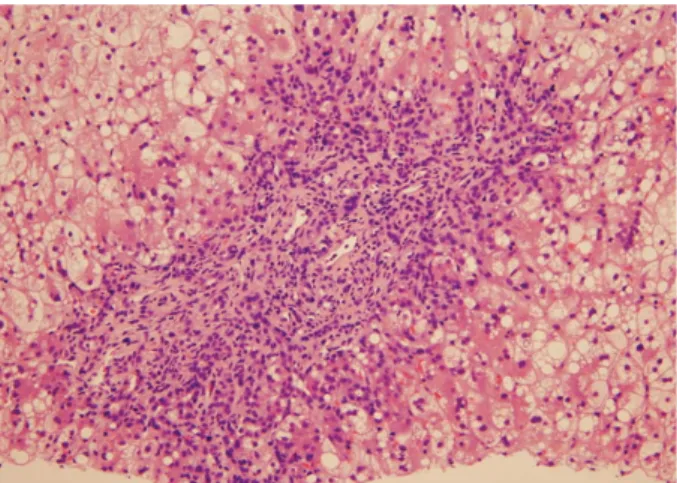
A liver biopsy revealed the ballooning or feathery degenera- tion and macro-vesicular fatty change of hepatocytes, peripor- tal fibrosis, and ductular proliferation associated with neu- trophilic infiltration (Fig. 1). He developed fever, and broad- spectrum antibiotics were given. Dietary cholesterol (egg yolk)
and fat soluble vitamins were supplemented. Generalized tonic seizure with apnea developed and electroencephalography revealed a partial seizure. The disease severity was scored as reported previously (14). The clinical severity score was 55 and he was classified into the severe phenotype.
Genetic analysis
Genomic DNA was extracted from whole blood, in accor- dance with standard methods. Informed consent was obtained from the parents. Mutation analysis of DHCR7 was performed using PCR amplification and direct sequencing of DHCR7 coding exons and their intron/exon boundaries as previously described (12).
DISCUSSION
Two missense variations were identified in the patient. One was a C to T transition at nucleotide 679 (c.679C>T) in exon 7, resulting in a Pro to Ser substitution at the 227th residue (Pro227Ser; Fig. 2A). The other was a G to A transition at nucleotide 907 (c.907G>A) in exon 8, resulting in a Gly to Arg substitution at the 303rd residue (Gly303Arg; Fig. 2A).
Both variations were inherited from the patient’s mother and father, respectively. While Gly303Arg has been reported in a Japanese patient with SLOS (15), Pro227Ser variation has not been reported previously and it alters conserved residue among different species (Fig. 2B).
The frequency of hepatic manifestation in SLOS was report- ed to be low, ranged from 2.5% to 16% (9, 13, 15). Although cholestatic liver disease and isolated hypertransaminasemia were reported in SLOS, there are few studies investigating the histological abnormalities of the liver. In the present study, histologic findings showed septal fibrosis, ductular prolifer- ation, and ballooning degeneration of hepatocytes, which are consistent with those of Rossi et al. (13). Since bile acids are synthesized from cholesterol, cholestasis may be caused by im-
160 J.S. Ko, B.S. Choi, J.K. Seo, et al.
Fig. 1. Percutaneous liver biopsy exhibited ballooning or feathery degeneration and macrovesicular fat droplets in lobular hepato- cytes and periportal fibrosis and ductular proliferation in a portal space.
A
B H. sapiens DHCR7 (NP_001351.2) E F N P R I G M. musculus Dhcr7 (NP_031882.1) E F N P R I G G. gallus Dhcr7 (XP_420914.1) E F N P R I G D. rerio dhcr7 (NP_958487.1) E F N P R I G B. taurus DHCR7 (NP_001014927.1) E F N P R I G X. tropicalis dhcr7 (NP_989235.1) E F N P R I G R. norvegicus Dhcr7 (NP_071784.1) E F N P R I G Father
cDNA sequence Amino acid
sequence
Motehr
Patient
Fig. 2. (A) Direct sequencing of the DHCR7 gene. A novel mis- sense mutation (c.679C>T; Pro227Ser) was identified in the patient and his mother (filled arrow) and a known mutation was found in the patient and his father (open arrow). (B) The Pro227Ser muta- tion was evolutionary conserved residue among different species.
(http://www.ncbi.nlm.nih.gov/sites/entrez?db=protein)
paired bile acid synthesis due to a severe deficiency of DHCR.
Severe cholestasis in SLOS was reported to be associated with severe phenotypes, while isolated hypertransaminasemia was associated with milder phenotypes (16). Our patient presented with severe cholestasis and severe phenotype. Serum GGT levels were normal in our case in spite of severe cholestasis.
Normal GGT with neonatal cholestasis is also shown in pro- gressive familial intrahepatic cholestasis 1 and 2, ARC syn- drome, and inborn errors of bile acid synthesis.
To date more than 120 mutations have been identified (17).
The missense mutations account for 87% of the total muta- tions. Fifty percent of the missense mutations are located in one of the nine predicted transmembrane domains. The p.- Gly303Arg mutation was previously reported in Japanese SLOS patients and it is located in the seventh transmembrane domain, which represent a highly conserved sterol-sensing domain (14). The p.Pro227Ser mutation is located in the second cytoplasmic loop, and previously described mutations in this loop are p.Gln224Lys and p. Arg228Trp (18). Three mutations including IVS-1G→C, p.Thr93Met, and p.Va- l326Leu account for 50% of the spectrum of mutations in Caucasian patients (19). On the other hand, p.Arg325Gln is the most common mutation in Japanese SLOS patients (14). The previously reported case of SLOS in Korea harbored compound heterozygous mutations including p.Arg352Trp and p.Lys376ArgfsX37 (12). DHCR7 mutation patterns in Asian patients are different from those observed among Cau- casians.
The genotype-phenotype analysis showed that most homo- zygotes for frameshift and nonsense mutations had the severe phenotypes (20). However, Yu et al. (17) showed that there was great variation in severity in patients that had the same type of mutations.
In summary, we found a case of SLOS with mutations of the DHCR7 gene and neonatal cholestasis. SLOS should be considered in the differential diagnosis of neonatal cholesta- sis, especially in patients with multiple congenital anoma- lies and low serum cholesterol levels.
REFERENCES
1. Moebius FF, Fitzky BU, Lee JN, Paik YK, Glossmann H. Molecular cloning and expression of the human delta7-sterol reductase. Proc Natl Acad Sci USA 1998; 95: 1899-902.
2. Fitzky BU, Witsch-Baumgartner M, Erdel M, Lee JN, Paik YK, Gloss- mann H, Utermann G, Moebius FF. Mutations in the Delta7-sterol reductase gene in patients with the Smith-Lemli-Opitz syndrome.
Proc Natl Acad Sci USA 1998; 95: 8181-6.
3. Wassif CA, Maslen C, Kachilele-Linjewile S, Lin D, Linck LM, Connor WE, Steiner RD, Porter FD. Mutations in the human sterol delta7-reductase gene at 11q12-13 cause Smith-Lemli-Opitz syn- drome. Am J Hum Genet 1998; 63: 55-62.
4. Waterham HR, Wijburg FA, Hennekam RC, Vreken P, Poll-The
BT, Dorland L, Duran M, Jira PE, Smeitink JA, Wevers RA, Wan- ders RJ. Smith-Lemli-Opitz syndrome is caused by mutations in the 7-dehydrocholesterol reductase gene. Am J Hum Genet 1998; 63:
329-38.
5. Tint GS, Irons M, Elias ER, Batta AK, Frieden R, Chen TS, Salen G.
Defective cholesterol biosynthesis associated with the Smith-Lemli- Opitz syndrome. N Engl J Med 1994; 330: 107-13.
6. Opitz JM. RSH/SLO (‘‘Smith-Lemli-Opitz’’) syndrome: historical, genetic, and developmental considerations. Am J Med Genet 1994;
50: 344-6.
7. Kelley RI. RSH/Smith-Lemli-Opitz syndrome: mutations and metabol- ic morphogenesis. Am J Hum Genet 1998; 63: 322-6.
8. Ryan AK, Bartlett K, Clayton P, Eaton S, Mills L, Donnai D, Win- ter RM, Burn J. Smith-Lemli-Opitz syndrome: a variable clinical and biochemical phenotype. J Med Genet 1998; 35: 558-65.
9. Cunniff C, Kratz LE, Moser A, Natowicz MR, Kelley RI. Clinical and biochemical spectrum of patients with RSH/Smith-Lemli-Opitz syndrome and abnormal cholesterol metabolism. Am J Med Genet 1997; 68: 263-9.
10. Kelley RI. A new face for an old syndrome. Am J Med Genet 1997;
68: 251-6.
11. Tsukahara M, Fujisawa K, Yamamoto K, Hasui M, Saito C, Yama- maka T, Honda A, Honda M, Tint GS, Salen G, Opitz JM. Smith- Lemli-Opitz syndrome in Japan. Am J Med Genet 1998; 75: 118-9.
12. Chae JH, Kim KJ, Hwang YS, Ki CS, Kim JW. Identification of a novel DHCR7 mutation in a Korean patient with Smith-Lemli-Opitz syndrome. J Child Neurol 2007; 22: 1297-300.
13. Rossi M, Vajro P, Iorio R, Battagliese A, Brunetti-Pierri N, Corso G, Di Rocco M, Ferrari P, Rivasi F, Vecchione R, Andria G, Parenti G.
Characterization of liver involvement in defects of cholesterol biosyn- thesis: long-term follow-up and review. Am J Med Genet A 2005;
132: 144-51.
14. Matsumoto Y, Morishima K, Honda A, Watabe S, Yamamoto M, Hara M, Hasui M, Saito C, Takayanagi T, Yamanaka T, Saito N, Kudo H, Okamoto N, Tsukahara M, Matsuura S. R352Q mutation of the DHCR7 gene is common among Japanese Smith-Lemli-Opitz syndrome patients. J Hum Genet 2005; 50: 353-6.
15. Herman GE. Disorders of cholesterol biosynthesis: prototypic meta- bolic malformation syndromes. Hum Mol Genet 2003; 12 Spec No 1: R75-88.
16. Kelley RI, Hennekam RC. The Smith-Lemli-Opitz syndrome. J Med Genet 2000; 37: 321-35.
17. Yu H, Patel SB. Recent insights into the Smith-Lemli-Opitz syndrome.
Clin Genet 2005; 68: 383-91.
18. Witsch-Baumgartner M, Clayton P, Clusellas N, Haas D, Kelley RI, Krajewska-Walasek M, Lechner S, Rossi M, Zschocke J, Utermann G. Identification of 14 novel mutations in DHCR7 causing the Smith- Lemli-Opitz syndrome and delineation of the DHCR7 mutational spectra in Spain and Italy. Hum Mutat 2005; 25: 412.
19. Yu H, Lee MH, Starck L, Elias ER, Irons M, Salen G, Patel SB, Tint GS. Spectrum of Delta(7)-dehydrocholesterol reductase mutations in patients with the Smith-Lemli-Opitz (RSH) syndrome. Hum Mol Genet 2000; 9: 1385-91.
20. Witsch-Baumgartner M, Fitzky BU, Ogorelkova M, Kraft HG, Moe-
Smith-Lemli-Opitz Syndrome Presenting with Neonatal Cholestasis 161
bius FF, Glossmann H, Seedorf U, Gillessen-Kaesbach G, Hoffmann GF, Clayton P, Kelley RI, Utermann G. Mutational spectrum in the Delta7-sterol reductase gene and genotype-phenotype correlation
in 84 patients with Smith-Lemli-Opitz syndrome. Am J Hum Genet 2000; 66: 402-12.
162 J.S. Ko, B.S. Choi, J.K. Seo, et al.