Journal of Internet Computing and Services(JICS) 2016. Jun: 17(3): 115-128 115
Designing a Crime-Prevention System by Converging Big Data and IoT
Jin-ho Jeon
1Seung-Ryul Jeong
1*1ABSTRACT
Recently, converging Big Data and IoT(Internet of Things)has become mainstream, and public sector is no exception. In particular, this combinationis applicable to crime prevention in Korea. Crime prevention has evolved from CPTED (Crime Prevention through Environmental Design) to ubiquitous crime prevention;however, such a physical engineering method has the limitation, for instance, unexpected exposureby CCTV installed on the street, and doesn't have the function that automatically alarms passengers who pass through a criminal zone.To overcome that, this paper offers a crime prevention method using Big Data from public organizations along with IoT. We expect this work will help construct an intelligent crime-prevention system to protect the weak in our society.
☞
keyword : Big Data, IoT, Crime Prevention, Public Sector1. Introduction
Crime is a major concern for many urban residents [1].
Various theories have been applied to solve it, e.g., sociological crime theories and economic crime theories, such as rational choice theory and the conception of peer effects as positive and negative externalities[2], Furthermore, the advancement of ICT (information communication technology) has rendered a great service to the physical crime prevention area.
Nevertheless, vicious crimes, sexual assault crimes in particular, have risen steadily in Korea during the past 10 years [3].
(Figure 1) Sexual-assault crime progress in Korea
The question in this work is how to reduce the sexual crime increase, as shown in (Figure1) We propose a solution to not
1
Graduate School of Business IT, Kookmin Univ., Seoul, 136-702, Korea.
*
Corresponding author ([email protected])
[Received 24 April 2016, Reviewed 26 May 2016, Accepted 14 June 2016]
only decrease sexual crime but also to defend citizens’ rights through ICT, especially Big Data and IoT (Internet of Things).
General criminology emphasizes that preventing a crime before it takes place is more efficient than powerfully executing the law after the crime occurs[4]. In such situations, crime prevention is gradually advancing with the increase in information technology.
In this paper, we present a crime-prevention system converging Big Dataand IoT. The methodology is as follows:
1) Collect and analyze Big Data from structured data in crime-related government organizations, like the Ministry of Justice, and unstructured social network data like tweets;
2) Send the results to IoT devices installed throughout the dangerous places; and
3) Alert a woman with a wearable device as she passes a hotspot so she can recognize that she is in a dangerous place and avoid becoming the victim of a sexual crime.
The remainder of the paper is organized as follows. Section 2 discusses related work on converging Big Data and IoT.
Section 3 presents an intelligent crime-prevention system.
Section 4 lists potential obstacles to the system and, finally, conclusions are presented in Section 5.
2. Related Work
2.1 Advances in Technical Crime Prevention ISSN 2287-1136 (Online)
http://www.jksii.or.kr
Category Apt House In the
street Shop Accommoda tion
Entertain ment
Offic
e Station Transpor
tation Park School Bank Others
2014 Year
Total 5,671 7,325 39,067 5,068 2,320 5,993 2,940 874 2,079 1,057 679 1,530 56,071
Murder 22 36 33 - 8 6 9 - 1 1 - - 42
Robbery 37 36 92 45 10 17 11 2 1 5 - - 87
Rape/
molestation 296 404 1,007 102 471 364 127 144 694 48 26 1 1778
Burglary 2,765 3,655 11,931 3,988 1,506 2,452 1,216 401 936 472 425 1,482 28,164
Violence 2,551 3,194 26,004 933 325 3,154 1,577 327 447 531 228 47 26,000
(Table 2) Violent crimes by place in 2014
Technology
Category Concept Studies
HCI Most of this research focuses on preventing face-to-face crimes and increasing
the feeling of safety. [6],[7],[8],[9],[10],[11],[12]
Data
Various data are used in crime prevention technologies.
• Analyzing crime data produced by the government information system
• Visualizinga crime map using Big Data techniques with social network data, e.g., online newspaper articles, Twitter, etc.
[13],[14],[15],[16],[17],[18],[19],[20], [21],[22],[23],[24]
Mobile Prototyping mobile crime-prevention system, and emerging mobile platforms
and crime maps. [1],[25]
IoT Appling wearable computing technologies in crime-prevention sectors [26],[27],[28],[29],[30],[31]
Algorithm Predicting and preventing criminal hot spots through algorithms. [4],[32],[33],[34]
(Table 3) Literature history of ICT crime-prevention technology Technical crime-prevention methods traditionally depend on
CPTED(Crime Prevention through Environmental Design) like CCTV (closed-circuit television) surveillance. However ,physically surveilling, controlling, and monitoring citizens is a privacy invasion[5].
The growth of ICT, e.g., electronic engineering, computerization, artificial intelligence, biochemistry, architecture, material science, etc., not only provides a technical basis to not violate a citizen’s rights by analyzing and visualizing data related to society; it also serves as momentum for the crime-prevention industry and allows new technical crime-prevention systems to emerge. (Table1) shows how crime prevention has advanced technically from CPTED to ubiquitous. Further, to realize a safe society, such technical advancements in crime prevention must be constantly pursued.
On the other hand, according to the “Top five violent-crime locations in 2014,” announced by the Supreme Public
Prosecutors Office in Korea [49], the most frequent place where sexual crimes like rape or molestation occur proves to be ‘in the street’. Even though a local government has installed and monitored surveillance devices like CCTV in the street to prevent sexual violence from happening, sexual crime occurs ‘in the street’ more often than in any other place (see Table 2).
(Table 1) Growth phases of technical crime prevention
Category Phase 1 Phase 2
Crime prevention theory
CPTED (Environmental prevention)
Ubiquitous crime prevention
Crime prevention method
Crime prevention through environmental designs like CCTV
Backing all lifestyle sfaced by people in society
Year Jeffery(1971) Michel
Walter(2012)
Additionally, Information Communication Technology has become an important element in crime prevention.
Approximately 50–60 papers on ICT crime prevention from 2004 to 2015 were reviewed and categorized, as shown in(Table3). Through a literature review of ICT crime-prevention technology, five groups were categorized: HCI(Human Computer Interaction), Data, Mobile, IoT, and Algorithm. A summary of the literature review is also given in (Table 3).
2.2 Big Data in the Public Sector
We have already entered an era of Big Data: data sets that are characterized by high volume, velocity, and variety[35, 36].
Furthermore, Big Data has had a huge impact on the public sector, and has begun to provide insight to help support real-time decision-making from fast-growing in-motion data from multiple sources, e.g., the Web, biological and industrial sensors, video, email, and social communications [37]. Korea is no different, and Big Data is being used in various areas like government agencies, e.g., the Ministry of Government Administration and Home Affairs, the Ministry of Health and Welfare, etc.[38].
(Figure 2)Usage of Big Data in the public sector
2.3 Big Data in Crime Part of the Public Sector The use of Big Data in the public sector is actively spreading in Korea. As shown in (Figure 3), the Busan police agency analyzed habitual criminals' data (1,575) in each commune in Busan city along with geographical information, and found that the crime distribution in a low-income group in the west range
of Busan was wider than the other areas. Therefore, it was recognized that the crime prevention system for the area should be reinforced [39].
(Figure 3)Analysis of habitual criminals’ data in Busan city
2.4 IoT in the Public Sector
Gartner says that the Internet of Things Architecture and Platforms, which is one of the top 10 strategic technology trends for 2016[50], has remarkable worth. According to the EuroTech Group, one of the most important aspects of the IoT vision is that smart objects can communicate effectively with each other and with applications residing in data centers or the cloud.
As shown in (Figure 4), EuroTech Group develops and offers medical and healthcare IoT[51]. The Korean government also tries to apply it in the public sector.
(Figure 4) Medical and healthcare IoT applications
2.5 Converging Big Data and IoT
Big Data and IoT have been variously re-interpreted and
studied extensively in academia, at least in the last decade, with
very diverse proposals. For instance, there is a smart city, and due to theirevolution, the city environment is expected to make more effective[26]. (Figure 5) shows the convergence of users’
Smartphones, open data infrastructure, and positioning infrastructure, including GPS (global positioning service), Wi-Fi, and cellular networks. The Talking Transit system allows the user to find his current location and search for nearby stops and stations[40].
(Figure 5) Talking Transit system architecture
3. PROPOSED SYSTEM ARCHITECTURE DESIGN
According to (Table 2), most sexual crime takes place ‘in the street’. As such, women or students passing a crime-ridden area cannot help being scared. To solve this problem, ICPS(Intelligent Crime-Prevention System) has been designed.
The main concept is to prevent crimes against the weaker members of society, e.g., women, by alerting their smartphone if they approach a dangerous location, as noted by the crime-risk analysis center.
As illustrated in Figure 6, ICPS consists of a crime-danger analysis component and a localization component.
• Crime-danger analysis component; it discerns dangerous areas by analyzing Big Data obtained by crawling through related organizations and SNSs (social network services).
• Localization component; it notifies a user of a dangerous location through their wearable device as they pass the area, based on an M2M(Machine to Machine) Access Node.
(Figure 6) Concept of crime-prevention system converging Big Data and IoT
3.1 Conceptual CDAC(Crime-Danger Analysis Center)
3.1.1 CDAC Concept
The crime-danger analysis center has the infrastructure to collect and analyze unstructured data produced by the Ministry of Justice, the national police, and social network services like crime-related newspapers.
(Figure 7) Image of the Crime Danger Analysis
Center
3.1.2 CDAC Procedure (Table 4) Data analysis procedure
Procedure Contents
1) Data acquisition
Data source
- Structured data:Crime data produced by crime-related government organizations like prosecution, police, and Ministry of Justice - Unstructured data:Crime-related SNS like
tweets, news portals, etc.
Method
- System connection and data crawling
2) Data storage
Data type
- SQL data acquired from a system - Unstructured data like text Method
- Distributed storage using Map Reduce
3) Data analysis
Text analysis - Morphemic analysis
- Predict dangerous area by applying DF-IDF and similarity algorithms
- Combine the latitude and longitude of the relevant location
- Deduct crime danger area Opinion analysis
- Split sentence
- Analyze sentiment by applying algorithm - Combine the latitude and longitude of the
relevant location - Deduct crime danger area
3.1.3 Data Acquisition
To design and construct the proposed system, the most important question is how to collect crime-related data. The target and method are as follows.
1) Acquisition target
Crime data are connected to government organizations, e.g., prosecutor, police, and Ministry of Justice, and SNS data generated by portal sites and tweets.
• Crime and criminal data in police and prosecution crime-information systems. (e.g., KICS crime data) KICS(Korea Information System of Criminal-Justice Services) is an electronic work system by which the four criminal-justice agencies (police, prosecution service, courts, and the Ministry of Justice) perform investigation, indictment, trial, and execution work through the standard information system, and jointly use the resulting information and other documents[52].
In addition, the crime prevention bureau at the Korean Ministry of Justice has collected a huge amount of unstructured text data from monitoring and recording probationers' situations in detail,as well as data generated by the location-tracking system that monitors probationers using an electronic monitoring anklet[53].
(Figure 8) Producing unstructured data using an electronic anklet
• Crime-related SNS data: Various Korean news portal sites, e.g., naver.co.kr, daum.co.kr, nate.co.kr, etc. provide accident and incident news reports.
2) Collection method
The data acquisition method differs depending on whether the data is structured or unstructured (Table5)[41].
(Table 5) Data collection methods
Data type Data kinds Technology
Structured RDB, spreadsheet EAI, ETL, FTP, Open API
Semi-structured
HTML, XML, JSON, web document, web log, sensor data
Crawling, RSS, OpenAPI, FTP
Unstructured Social data(text), image, audio, video, IoT
Crawling, RSS,Open API, Streaming, FTP
The data-collection method for the proposed design must account for structured data from crime-related government organizations and unstructured data from web sites. The former is collected by system connections and the latter by web crawling.
• Acquisition from government crime-information systems
synchronizes mutual protocols, transmits the data to the
connection server at the CDAC, and stores it to a
distributed system through an XML parser (Figure 9).
(Figure 9) Data Acquisition –EAI(Enterprise Application Integration)
• Acquisition of SNS data is accomplished by web crawling because accident and incident data comes from portal sites with varying data types; the configuration is as follows (Figure 10) [54].
(Figure 10) Data Acquisition – Crawling
3.1.4 Data Storage
Various technologies have been introduced to store big data.
The proposed system utilizes Apache Hadoop technology, and the mechanism is as follows.
(Figure 11) Data Storage
• Distributed process layer and storage layer: Materials collected through web crawling are treated through Map-Reduce, and stored in the HDFS(Hadoop Distributed File System). HDFS is not an OS(Operating System) that stores, reads, and writes the files on the local disk of the distributed server, but a file system that handles files with an API. The data storage infrastructure consists of a distributed treatment method like HDFS because of the immense amount of data from crime-related systems and portal sites[55].
3.1.5 Data Analysis
Text mining, opinion analysis, social network analysis, and cluster analysis are Big Data analysis techniques[42, 43]. We decided that text mining and opinion analysis were the proper techniques for crime-danger analysis, for the reasons listed in Table 6.
1) Text mining (Morphological analysis)
The collected data is analyzed using the R tool, and the procedure and processing are as (Table 7).
Algorithm 1 applied in morphological analysis
In this design, the TF-IDF (Term Frequency-Inverse Document Frequency) algorithm is used to omit words that cannot discriminate against danger-related words[45]. This technique determines how important a word is to a document in a collection, and scores the importance of words or terms in a document based on how frequently they appear across multiple documents[46].
DF is the counterpart of TF in TF-IDF. The difference is
that DF only counts the number of documents containing the
word; this is necessary in the context of the writer who writes
the document, since multiple appearances of the same word are
usually associated with the same event in a single document.
Variable identifier Analysis processing Explanation
danger_analysis <- file(big data storage location) Put the big data in physical storage device to variable danger_analysis.lines <- readLines(danger_analysis) Read texts in variable 'danger_analysis'
danger_analysis.nouns <- sapply(danger_analysis.lines, extractNoun,
USE.NAMES = F) Extract the crime words from each line of text
danger_analysis.data <- data(danger_analysis.nouns) Deduct the nouns
danger_area_analysis
<- colnames(danger_analysis.data.datacounts) [order(sdev(tfidf(danger_analysis.data.datacounts))) [1:10]][44]
Deduce the ten highly dangerous areas from the TF-IDF terms
danger_analysis.wordc
ount <- table(unlist(Cosine_sim(danger_area_analysis))) Apply vector space modelto compare the similarity among given word clusters
seoul_map <- danger_analysis.wordcount Find the most dangerous areas on the Seoul map to determine their longitude and latitude
mapIt <- geom_point(aes(x = lon, y = lat, size = freq), data = seoul_map)
Apply the longitude and latitude of the relevant dangerous areas to the danger index
(Table 7) Morphological analysis process using the R tool
Analysistechnique Technique purpose Technique utilization for crime
danger analysis
Utilization Suitability
(1–5)
Text Mining Purpose
Extracting and treating useful information based on natural language processing technology
Method
Using statistical algorithms to analyze natural languages Applied fields
Document classification, document clustering, information extraction, document summarization, etc.
Filtering words about crime dangerthat are missing from the assessment function using TF-IDF
5
Opinion Mining
Purpose
Assigning positive, negative, or neutral preferences to social media unstructured data
Method
Classifying the polarity of a given text at the document or sentence level Applied fields
Reviews and social media for a variety of applications, ranging from marketing to customer service
Using analysis algorithms like the Naïve Bayesian algorithm to predict potential criminals and the dangerous areas where they act
5
Social Network Analysis
Purpose
Discovering viral objects by measuring a user’s reputation or influence based on their connection structure or the connection strength of their social network
Method
Connectivity-based clustering, centroid-based clustering, density-based clustering, etc.
Applied fields
Biology, computational biology, bioinformatics, etc.
Improve analysis accuracy
through information reliability 2
Cluster Analysis
Purpose
Grouping a set of objects such that objects in the same group are more similar to each other than to those in other groups
Method
Connectivity-based clustering, centroid-based clustering, density-based clustering, etc.
Applied fields
Biology, medicine, business, and marketing
Distinguish latent criminal
clusters 2
(Table 6) Suitability of analysis techniques for crime-danger analysis
For a term i in document j:
Algorithm 2 applied in morphological analysis
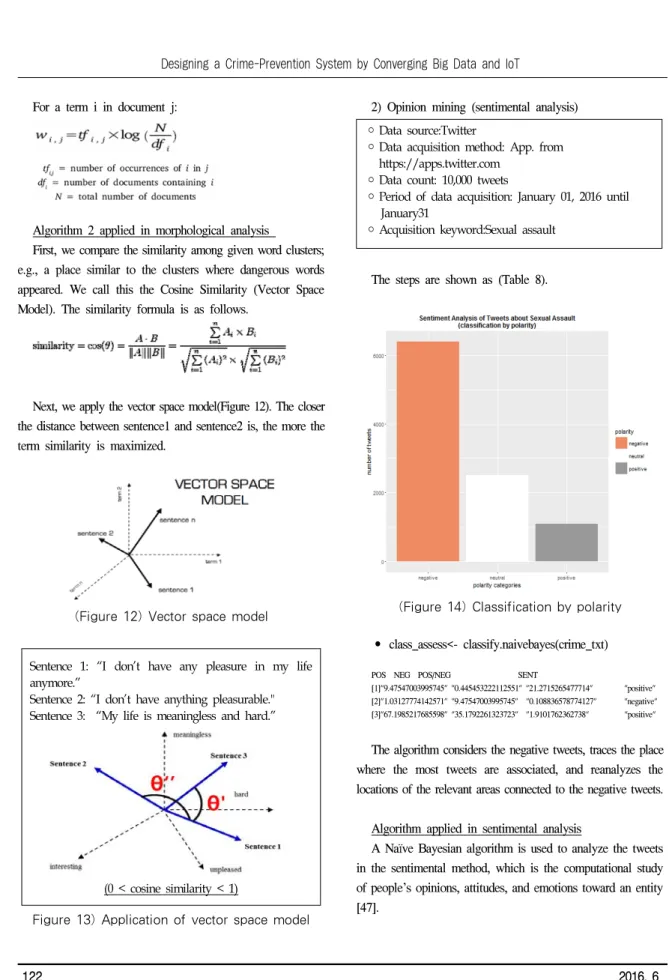
First, we compare the similarity among given word clusters;
e.g., a place similar to the clusters where dangerous words appeared. We call this the Cosine Similarity (Vector Space Model). The similarity formula is as follows.
Next, we apply the vector space model(Figure 12). The closer the distance between sentence1 and sentence2 is, the more the term similarity is maximized.
(Figure 12) Vector space model
Sentence 1: “I don’t have any pleasure in my life anymore.”
Sentence 2: “I don’t have anything pleasurable."
Sentence 3: “My life is meaningless and hard.”
(0 < cosine similarity < 1)
Figure 13) Application of vector space model
2) Opinion mining (sentimental analysis)
○ Data source:Twitter
○ Data acquisition method: App. from https://apps.twitter.com
○ Data count: 10,000 tweets
○ Period of data acquisition: January 01, 2016 until January31
○ Acquisition keyword:Sexual assault
The steps are shown as (Table 8).
(Figure 14) Classification by polarity
• class_assess<- classify.naivebayes(crime_txt)
POS NEG POS/NEG SENT
[1]"9.47547003995745" "0.445453222112551" "21.2715265477714" "positive"
[2]"1.03127774142571" "9.47547003995745" "0.108836578774127" "negative"
[3]"67.1985217685598" "35.1792261323723" "1.9101762362738" "positive"
The algorithm considers the negative tweets, traces the place where the most tweets are associated, and reanalyzes the locations of the relevant areas connected to the negative tweets.
Algorithm applied in sentimental analysis
A Naïve Bayesian algorithm is used to analyze the tweets
in the sentimental method, which is the computational study
of people’s opinions, attitudes, and emotions toward an entity
[47].
Variable identifier Analysis processing Explanation
require (devtools, sentR, twitteR, etc) Include package 'devtools', 'sentR', etc. for sentimentally analyzing dangerous situation in R
crime_txt <- gsub() Acquire and clean the data using 'gsub', 'sapply', etc.
class_emo <- classify_emotion(crime_txt,
algorithm=”bayes”,prior=1.0) Apply the Bayesian sentimental algorithm
ggplot(sent_df, aes(x=polarity)) <- data(danger_analysis.nouns) Analyze the crime-related sentiment to divide tweet sentences into positive, negative, or neutral
(Table 8) Sentimental process analyzed by using the R tool
• P(c|x) is the posterior probability of a class (target) given a predictor (attribute).
• P(c) is the prior probability of a class.
• P(x|c) is the likelihood,i.e., the probability of the predictor, of a given class.
• P(x) is the prior probability of a predictor.
(Figure 15) Naïve Bayesian algorithm[56]
3) Analyze result values
We filter the words with no danger discrimination capacity against danger-related words using the TD-IDF and Naïve Bayesian algorithms, and connect the words to dangerous areas, obtaining the results in (Table 9).
(Table 9) Crime-danger area result values
DA NC Latitude Longitude
Hwagok 430 37.538118 126.847102
Mok 327 37.537019 126.873530
Deungchon 319 37.558653 126.853251
Yeouido 317 37.528573 126.928974
Bulgwang 152 37.618309 126.939045
Banghwa 134 37.576456 126.813873
Junggok 131 37.562620 127.085367
Singil 120 37.506249 126.913952
Sillim 116 37.462618 126.938325
Bon 98 37.512442 126.953403
❈ DA: Dangerous Area, NC: Number of counts
Continuing, we connect a specific criminal with a dangerous area by assessing the crime-danger similarity analysis; the
results are shown in (Table10).
(Table 10) Crime-danger area and criminal result values
DA Criminal Latitude Longitude
Hwagok Criminal 1 37.538118 126.847102
Mok Criminal 2 37.537019 126.873530
Deungchon Criminal 3 37.558653 126.853251
Yeouido Criminal 4 37.528573 126.928974
Bulgwang Criminal 5 37.618309 126.939045
Banghwa Criminal 6 37.576456 126.813873
Junggok Criminal 7 37.562620 127.085367
Singil Criminal 8 37.506249 126.913952
Sillim Criminal 9 37.462618 126.938325
Bon Criminal 10 37.512442 126.953403
❈ DA: Dangerous Area
3.2 Localization Service
The values, words (sorted), crime-danger area information, specific criminal information, and other CDAC results are transmitted to the M2M gateway in each place through an AP (access point), which is a TCP/IP transmitter and receiver.
3.2.1IoT Crime-alarm service architecture
The architecture of the crime-alarm service using IoT depends on the M2M standard technology established by the ESTI (European Telecommunications Standards Institute)[57].
The M2M configuration is as follows.
(Figure 16) M2M Architecture
IoT Applications Algorithm Explanation
AP transmitting the crime-danger analysis results
{main begin
1) wait param_src:cm:00 lop:==
param_src:m2m_connect_num:0 rop:then 2) load param_dest:m2m_connect:
param_src:scrrot_num:0 3) put param_dest:aux:0:00 param_src:dir_num:0000 end}
end}
1) Wait until being connected to M2M gateway of relevant crime danger area 2) Connect to the M2M gateway of the
relevant crime-danger area 3) Send the danger value to the M2M
gateway
M2M Gateway AP
{main begin
1) standby param_dest:aux:0:00 param_src:dir_num:0000
2) {if param_src:user_device:000:000 lop:==
param_src:smsnum_num:1 rop:then end}
end}
end}
1) Stand by to transmit crime danger information to a user passing a relevant danger area
2) Transmit the information when the user passes the relevant area
User AP
{main begin
1) load param_dest:m2m_connect:
param_src:scrrot_num:0
2) {if param_src:user_device:000:000 lop:==
param_src:smsnum_num:1 rop:then load param_text : “This is a dangerous area! The risk ratio is over 80%."
alarm end}
end}
end}
1) Connect wearable user device to the M2M gateway
2) If there is crime-danger information at the M2M gateway of the relevant area, display an alarm danger signal. “This is a dangerous area! The risk ratio is over 80%.”