1. INTRODUCTION
Mobile sensor networks(MSN) have recently emerged as an important research area. It consists of one or multiple sinks and many low-cost and low-powered mobile sensor nodes, for example, mobile robots or mobile vehicles etc, distributed over some areas that form an ad-hoc network Mobility gives some obvious significances and potentials. Mobility makes the sensor network bet- ter acquire information. Each mobile sensor node has the ability of sensing data, processing data, and communicating with others via radio transceivers with some limited memory and processing capa- bilities, multiple sensing modalities and communi- cation capabilities. The communication between the sink and sensor nodes relies on the relay by intermediate sensor nodes.
Mobility of sensor network can let the sensor network move to collect information that is needed, for example, when a sudden incident occurs, MSN can move, cover the interesting place and sense more the incident information. Moreover, mobility
makes the whole sensor networks possess the self configuration ability. If some nodes in network cannot work because of some causes, the rest no- des can organize the sensor network again through moving, repair the network topology automatically and complete self-deployment [1].
The deployment of distributed mobile nodes in complex environments creates demands for MSN in order to provide information, guide actions and decisions. This development has been spurred by advances in wireless sensor networks technology, computer networking, distributed computing and mobile robots technology [2]. In fact, mobile sensor networks have broad applications, such as envi- ronment monitoring, traffic surveillance, building structures monitoring, military sensing and in- formation gathering, and so on [3].
Data routing is an important function accom- plished by a collection of sensor nodes which form a MSN while monitoring a specific phenomenon.
Collected data are normally disseminated to a sink.
The major challenge imposed by MSN lies in diffi- culty establishing routing paths due to dynamic
Limited Flooding Scheme in Mobile Sensor Networks
Ick-Soo Lee † , Eung-Joo Lee ††
ABSTRACT
Mobile Sensor Networks (MSN) is composed of a distributed collection of mobile sensor nodes, each of which has sensing, computation, communication and locomotion capabilities. Since the routing path can be broken when some nodes on the path move to other position, MSN may have a high rate of communication failure. So, MSN has to provide a means for low-cost and low-power routing to support mobility of sensor nodes. In this paper, a limited flooding scheme for routing in MSN is proposed to allow efficient energy utilization without requiring any complicated tasks for path maintenance.
Key words: Mobile Sensor Networks, Routing, Flooding
※ Corresponding Author : Eung-Joo Lee, Address: (48520) Sinseon-ro 428, Nam-gu, Busan, Korea, TEL : +82-51- 629-1143, FAX : +82-51-629-1169, E-mail : [email protected] Receipt date : July 31, 2015, Revision date : Oct. 1, 2015 Approval date : Oct. 2, 2015
††
Dept. of Information and Communication Engineering, Tongmyong University
(E-mail : [email protected])
††
Dept. of Information and Communication Engineering,
Tongmyong University
behavior of topology configuration and the com- munication failure due to mobility of sensor nodes.
Another challenge is the limited battery power (or energy), which is a critical resource since most of- ten sensor batteries cannot be replaced or recharged.
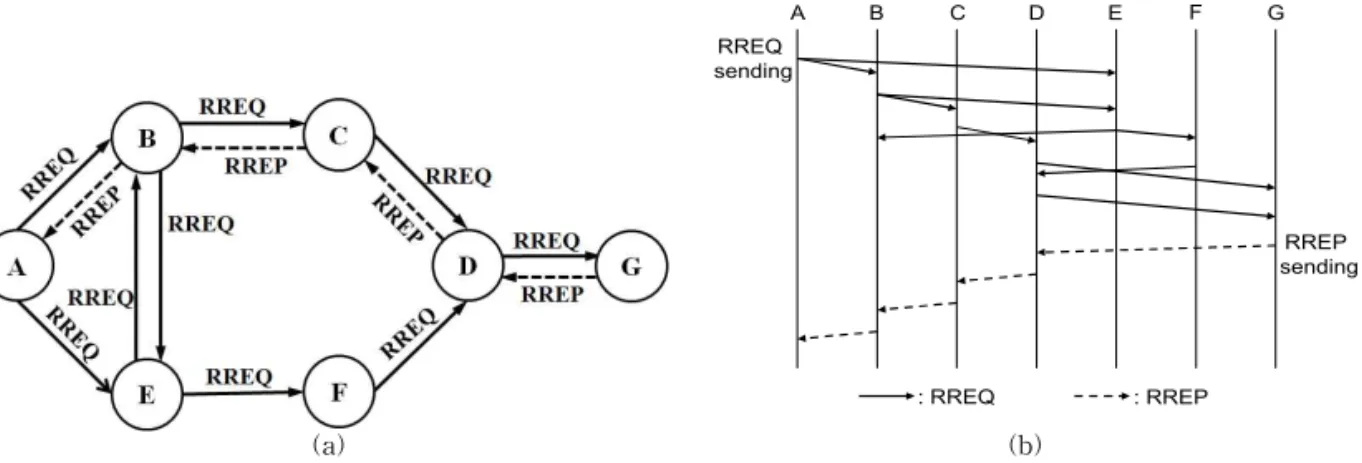
AODV(Ad-Hoc On-Demand Distance Vector) shares on-demand behavior with DSR and the use of hop-by-hop routing and destination based se- quence numbers with DSDV. Routes are obtained via a discovery process similar to DSR. A node satisfies the ROUTE REQUEST by sending a ROUTE REPLY back to the Source or by increas- ing the hop count and re-broadcasting to its neighbors. As the ROUTE REQUEST propagates from the source to various nodes, a reverse path is set up from these nodes back to the source.
AODV ensures wider propagation of ROUTE ERRORS than DSR, achieved using a per destina- tion predecessor list at each node[5]. Fig. 1(a) and 1(b) show an example of AODV operation [4].
In simple flooding technique each intermediate node forwards the incoming packet until it reaches the destination node. The simplicity of flooding makes it suitable for resource constrained net- works such as MANETs or Wireless Sensor Networks (WSNs). Flooding schemes can be clas- sified into four groups [5]: (1) simple or blind flooding, (2) probabilistic or gossip flooding [6], (3)area based flooding [7], and (4) neighbor knowl- edge flooding [8]. Simple flooding causes a high
network routing load in the network due to the broadcast storm problem [6], and as a result con- sumes high energy. Probabilistic flooding scheme has been proved to be more efficient than the sim- ple flooding scheme[6]. However, the main chal- lenge in the probabilistic scheme is to find the opti- mum probability P of the forwarded packets.
One way of establishing the optimum value for P is using simulations for a typical wireless scenario. However, as this optimum value for P could vary from scenario to scenario, this would require repeated simulations for all possible sce- narios being considered. Therefore, it is not prac- tical to identify a single optimum value for P. In [6] the authors established that the optimum value for P lies within the interval [0.65, 0.75] in networks with fewer than 1000 nodes. They also proposed P = 0.5 as an optimum value for network scenarios with certain node densities (150 nodes in a rec- tangular grid of 1650 × 1200 m
2). Furthermore, it has also been demonstrated that for high node den- sities, the value of P should be set at lower values to avoid redundant packets. On the other hand, if the node density is low the value of P should be set higher to avoid die out problem [6]. Area based methods suffer from nodes’ mobility since nodes should update their locations periodically which causes an additional overhead [9]. Gossiping algo- rithm in WSN is able to reduce the overhead and transmit packets through already set up the path
A B C D E F G
: RREQ : RREP
RREQ sending
RREP sending
(a) (b)
Fig. 1. Routing protocols for mobile ad-hoc network; (a)AODV, (b)Timing diagram of control message exchange,
but it takes place the data delivery and problem of worst-case [10].
As described above, routing protocols used for ad-hoc networks have to maintain path in- formation for path reset process when the path is disconnected due to mobility of nodes. Connection failures bring about exchange of control messages between nodes for path reset. This may be a seri- ous problem in MSN since a sensor node is gen- erally configured to be suitable to special applica- tion, not common one, unlike ad-hoc, so utilized hardware also has limited calculating ability and memory. Actually, the size of a sensor node is very small, additional energy supply is limited once it is arranged to a sensor field. So, mobility of sensor nodes and thus frequent change of topology will shorten network life time of MSN due to frequent exchange of control messages for path re- establishment. Fig. 2 shows a situation when a communication failure occurs because of move- ment of a node.
In this paper, Zone Flooding Routing protocol is suggested in which the sensor nodes in MSN setup a flooding zone that can secure connectivity in the mobile environments and transmit data generated by the mobile nodes to a mobile sink.
The paper is organized as follows. Section 2 provides a detailed description of Zone Flooding Routing protocol. Section 3 provides the perform- ance evaluation of the protocol. Section 4 concludes and points out future work.
2. PROPOSED ROUTING SCHEME
In this paper, we propose a routing protocol based on a limited flooding strategy to perform communications between a set of mobile sensors and a fixed sink in MSN. The model we assume constitutes of a uniformly distributed set of sensors inside a given flat surface. The only thing that each sensor needs to know in order to participate in the protocol is its own location and the location of the sink. We suppose that one sink is fixed and that the sensor nodes move with a certain mobility characteristics at a certain speed.
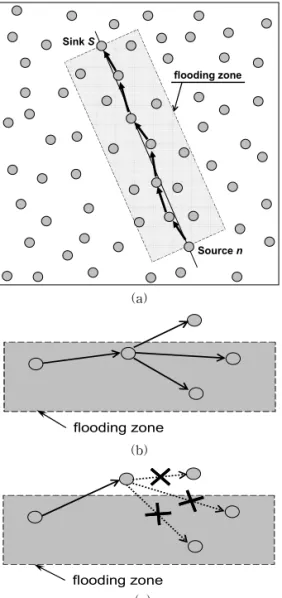
In our scheme, each node sets up a flooding zone to forward its data to the sink once it has sensed data. The flooding zone has a shape of narrow band which is made using a straight line connecting the sink and the source node as illustrated in Fig. 3(a).
The flooding zone is used to limit the flooding process in a specific area. In other words, only no- des inside the flooding zone can forward data to- ward the sink on receiving it as shown in Fig. 3(b).
Nodes located outside the flooding zone cannot participate in the flooding process as depicted in Fig. 3(a).
In our scheme, each node determines whether or not to forward a message to its neighbors when it receives one. If the distance from a node to a straight line which falls plumb down on a straight line connecting between the sink and the source in the node is shorter than the flooding zone width(denoted by W), it is considered to be located within the flooding zone as shown in Fig. 3(a).
Assuming that a mobile sensor node is located at
A D
B C A
D B
C
A D
B
C
(a) (b) (c)
Fig. 2. An example showing path failure due to a moving node; (a) Path is established, (b) A mobile node moves,
and (c) Path is disconnected.
a coordinate (x
1, y
1), then the distance(denoted by d) from the node to line connecting between the sink and the source, expressed by a linear equation ax+by+c=0, is given by
2 2
1
1
|
| b a
c by d ax
+ +
= + (1)
So, we can say that each node joins data for- warding process if d ≤ W. To put it the other way around, the node discards a message if the distance to the straight line is greater than the flooding zone width if d > W.
This kind of flooding can be an efficient method
for data delivery when there is a possibility of fre- quent changes of topology due to connection failure by movement of nodes. This scheme can reduce energy consumption and overhead for path reset necessary against the problems such as path setup, maintenance and disconnection. The most im- portant factor affecting performance of our scheme is zone width.
3. SIMULATIONS
We evaluate the performance of our Zone Flood- ing Routing protocol through computer simulation.
We focus on evaluation of the performance meas- ures in the connectivity, energy consumption, and number of transmissions required sends to data from sources and sink. Simulation is carried out using a random deployed network whose size is 100×100m
2. Other simulation parameters used for simulation are listed in Table 1.
Fig. 4(a) shows the average energy consumption as we vary zone width and/or node density. We can see that the average energy consumption at each node increases as node density gets higher or the zone becomes wider. Fig. 4(b) and 4(c) also show that the average energy consumption in- creases as the distance from source to sink gets away, or the zone gets wider, or the transmission range becomes larger. This is because more nodes will participate in transmission tasks for these cases.
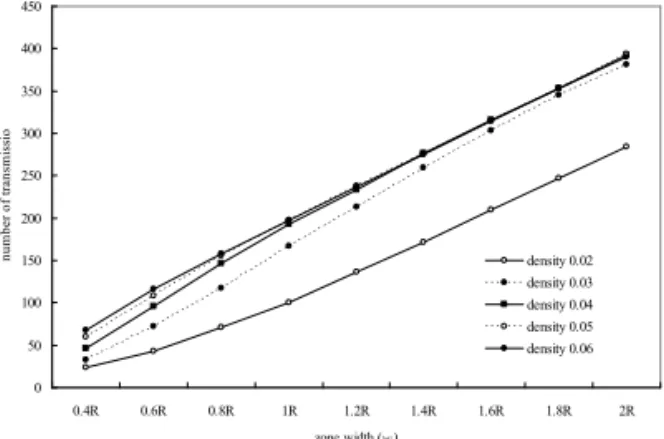
Fig. 5 shows the average number of trans- missions at each node when the zone width is varied. This Fig. 5. indicates that average number
Sink S
Source n flooding zone
(a)
flooding zone flooding zone
(b)
flooding zone flooding zone
(c)
Fig. 3. Concept of limited flooding method; (a) Flooding Zone, (b) Nodes inside flooding zone, and (c) Node outside flooding zone.
Table 1. Simulation parameters
Sink & Event occurred location fixed
Transmission radius 10m
Power for radio electronics 50nJ /bit Power for transmit amplifier 100pJ /bit/m
2Initial energy at each node 1J /battery Mobility model(speed) Gauss-Markov
(variable)
of transmissions also increases as node density be- comes higher or as the flooding zone gets wider.
This can be inferred from the fact that as there are more nodes participating in flooding, the num- ber of transmissions for sending and receiving increases.
4. CONCLUSION
We resented a Zone Flooding Routing protocol for Mobile Sensor Networks to save energy con- sumption necessary for path reset when a routing path is disconnected due to frequent movement of nodes. In Zone Flooding Routing protocol, a flood- ing zone is setup and data forwarding is performed only at nodes located within it; data is discarded at nodes outside the flooding zone.
One of the important factors in flooding zone setup is how to determine the zone width. The fac- tors to be considered for determining the zone width include node distribution density in a sensing field, distance between a sink and a source node, mobile speed, transmission radius of a node, etc.
We evaluate our scheme by examining energy effi- ciency, and number of transmissions with varying node density, distance from source to sink, and transmission range.
REFERENCE
[ 1 ] P. Corke, S. Hrabar, R. Peterson, D. Rus, S.
Saripalli, G. Sukhatme, “Autonomous Deploy- ment and Repair of a Sensor Network using an Unmanned Aerial Vehicle,” Proceeding of IEEE International Conference on Robotics and Automation, pp. 3602-3608, 2004.
[ 2 ] P. Gupta and P.R. Kumar, “The Capacity of
0 1000 2000 3000 4000 5000 6000 7000 8000
0.4R 0.6R 0.8R 1R 1.2R 1.4R 1.6R 1.8R 2R
zone width (w )
average energy consumption of node (Joule)
density 0.02 density 0.03 density 0.04 density 0.05 density 0.06
(a) When zone width(W) and node density are varied (R=10m)
0 1000 2000 3000 4000 5000 6000
0.4R 0.6R 0.8R 1R 1.2R 1.4R 1.6R 1.8R 2R
zone width (w )
average energy consumption of node (Joule)
Distance from source to sink 3.75R Distance from source to sink 5R Distance from source to sink 6.25R Distance from source to sink 7.5R Distance from source to sink 8.75R Distance from source to sink 10R
(b) When zone width(W) and d are varied (R=10m)
0 1000 2000 3000 4000 5000 6000 7000 8000 9000
0.4R 0.6R 0.8R 1R 1.2R 1.4R 1.6R 1.8R 2R
zone width (w )
average energy consumption of node (Joule)
transmission radius 0.7R transmission radius 0.9R transmission radius 1.1R transmission radius 1.3R
(c) When zone width(W) and transmission radius are varied (R=10m)
Fig. 4. Average energy consumption at each node.
0 50 100 150 200 250 300 350 400 450
0.4R 0.6R 0.8R 1R 1.2R 1.4R 1.6R 1.8R 2R
zone width (w )
number of transmission
density 0.02 density 0.03 density 0.04 density 0.05 density 0.06