Assessment Methodology of Junction Temperature of Light-Emitting Diodes (LEDs)
Moon-Hwan Chang
†and Michael Pecht
Center for Advanced Life Cycle Engineering, Department of Mechanical Engineering, University of Maryland, College Park, MD 20742
(Received April 4, 2016: Corrected May 24, 2016: Accepted July 22, 2016)
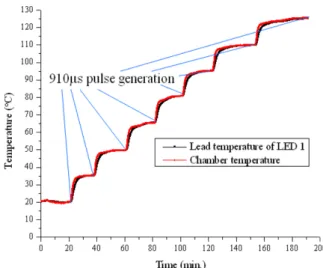
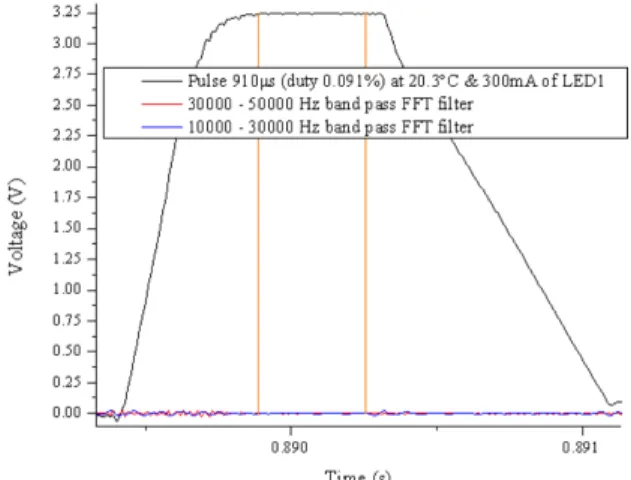
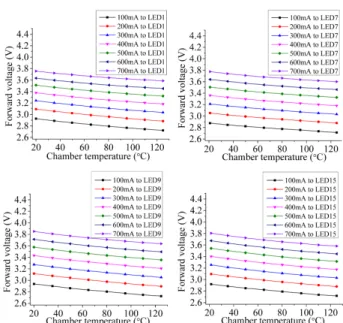
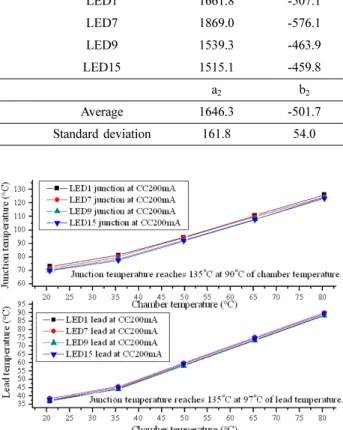
Abstract: High junction temperature directly or indirectly affects the optical performance and reliability of high power LEDs in many ways. This paper is focused on junction temperature characterization of LEDs. High power LEDs (3W) were tested in temperature steps to reach a thermal equilibrium condition between the chamber and the LEDs. The LEDs were generated by pulsed currents with duty ratios (0.091% and 0.061%) in multiple steps from 0mA and 700mA. The diode forward voltages corresponding to the short pulsed currents were monitored to correlate junction temperatures with the forward voltage responses for calibration measurement. In junction temperature measurement, forward voltage responses at different current levels were used to estimate junction temperatures. Finally junction temperatures in multiple steps of currents were estimated in effectively controlled conditions for designing the reliability of LEDs.
Keywords: Light-emitting diode, Reliability, Junction temperature
1. Introduction
High-power LEDs are used for a wide variety of applica- tions, such as display backlighting, communications, med- ical services, signage, and general illumination.
1-8)LEDs offer design flexibility; easy adjustment of line-scale, area- scale, and color dimming; high energy efficiency resulting in low power consumption; long lifetimes up to 50,000 hrs;
micro-second-level on-off switching enabling ultrahigh speed response time; wide range of color temperature; and no low-temperature startup problems.
The LED industry, despite exciting innovations driven by technological advances and ecological/energy-saving concerns, still faces a challenge in attracting widespread adoption. The issue of concern is the lack of information and confidence regarding reliability. Data sheets of manu- facturers provide user information on optical and electrical characteristics of high power LEDs at room temperature (or 25
oC junction temp.) or thermal resistance including package and built on printed circuit board. This informa- tion cannot guarantee the performance and reliability of high power LEDs because usage conditions of LED based electronic products are not matched with the conditions in the data sheets. Absolute maximum rating of junction tem- perature on data sheets is either 125
oC or 135
oC. Users are
required to design LED packages (and products) within this junction temperature guideline.
The LED die is a semiconductor, and the nature of man- ufacturing of LED packages is similar to that of micro- electronics. But there are unique functional requirements, materials, and interfaces in LEDs resulting in different fail- ure modes and mechanisms. The failure sites of LEDs are dies, interconnects, and packages. The die-related failures are severe light output degradation and burned or broken metallization on the die. The interconnect failures of LED packages are electrical overstress-induced bond wire frac- ture and wire ball bond fatigue, electrical contact metallur- gical interdiffusion, and electrostatic discharge, which leads to catastrophic failures of LEDs. Package-related failure mechanisms include carbonization of encapsulant, encapsulant yellowing, delamination, lens cracking, phos- phor thermal quenching, and solder joint fatigue. These result in optical degradation, color change, electrical opens/
shorts, and severe discoloration of the encapsulant. Many of these failures are related to thermal stress as well as electrical stress and hygromechanical stress. Thermal stress affects die cracking, wire ball bond fatigue, delamination, lens cracking, encapsulant yellowing, and phosphor ther- mal quenching. The failure modes of LEDs relate to light output and optical characteristics as well as change of elec-
†