혼합 발광다이오드와 형광등에서 자란 적치마 상추의 생육 및 광 이용 효율 비교
손기호1,2· 송민정1,2· 오명민1,2*
1충북대학교 축산·원예·식품공학부 원예학전공
2생물건강소재산업화사업단
Comparison of Combined Light-emitting Diodes and Fluorescent Lamps for Growth and Light Use Efficiency of Red Leaf Lettuce
Ki-Ho Son1,2, Min-Jeong Song1,2, and Myung-Min Oh1,2*
1Division of Animal, Horticultural and Food Sciences, Chungbuk National University, Cheongju 28644, Korea
2Brain Korea 21 Center for Bio-Resource Development, Chungbuk National University, Cheongju 28644, Korea
Abstract. The objective of this study was to compare the growth and light use efficiency of red leaf lettuce grown under three types of combined light-emitting diodes (LEDs) and fluorescent lamps (FL) in a closed-type plant production system.
The eighteen days-old lettuce seedlings of red leaf lettuce (Lactuca sativa L., ‘Jeokchima’) were transplanted to the close- type plant production system equipped with three types of combined LEDs with red (R, 655 nm), blue (B, 456 nm), green (G, 515 nm), and white (W, 456 nm + 558 nm) (R:B=8:2, R:W:B=8:1:1, R:G:B=8:1:1) and FL. The seedlings were grown under normal growth conditions (20oC, 181±4 µmol·m-2·s-1, 12 h photoperiod) for four weeks. Lettuce plants grown under FL had significantly higher leaf shape index than those under all LED treatments. Although growth of shoots and roots was not show any significant difference among LED treatments, all of the LED treatments induced about 34% higher shoot fresh weight than that of the FL. On the other hands, the total power consumption of FL was 145 kW for 4 weeks, while the mean value of LED treatments was 54 kW, which was about 3 times lower value than that of the FL. The light use effi- ciency based on dry matter in LED treatments was about 34 mg/W and this was about 3.5 times higher energy saving value than the FL. In conclusion, this study showed that irradiation of optimal combined LEDs in closed-type plant production systems can improve the lettuce growth as well as maximize in light use efficiency through energy saving than the FL.
Additional key words : artificial light source, energy saving, plant factory
서 론
식물공장은 외부환경에 관계없이 광, 온도, 습도, 이산 화탄소, 무기양분 등 작물의 생장과 발육에 필요한 요인 을 효율적으로 조절하여, 대상 작물을 계획적으로 생산 할 수 있는 자동화된 식물생산시스템을 말한다(Kozai, 2013). 이 시스템은 깨끗하고 신선한 작물을 안정적으로 공급할 수 있고, 환경제어를 통하여 생산량뿐만 아니라 품질을 향상시킬 수 있다(Cha와 Cho, 2013). 몇 가지 식물공장의 형태 중, 폐쇄형 식물생산시스템은 작물 생 산에 필요한 광에너지를 태양광 대신에 인공광원에 전적 으로 의존하는 시스템이다(Wheeler, 2008). 이 시스템은
인공광원을 사용하기 때문에 자연광하에서의 시설재배시 발생하는 피복재, 시설 자재 등으로 인한 광질의 변환, 광도의 감소, 광 분배의 불균형 등 단점을 해소 할 수 있 으며, 작물 생산 목적에 맞는 최적의 광 환경을 조성할 수 있다(Samuolienė 등, 2012). 따라서 최적의 광 환경의 조성은 대규모 상업적 폐쇄형 식물생산시스템을 운용하 는데 우선시 되어야 하는 해결과제이다(Goto, 2012).
폐쇄형 식물생산시스템에서 인공광원으로 많이 이용되 는 Light Emitting Diode(LED; 발광다이오드)는 기존에 이용되었던 고압나트륨등, 메탈할라이드등, 형광등과 달 리 특별한 장점들을 갖고 있어 폐쇄형 식물생산시스템의 효과적인 인공광원으로 인식되고 있다. LED는 크기가 작고, 가볍고, 발열이 적은 대신 높은 광전환율과 반영 구적이고 소비전력이 낮아 경제적이며, 특정 파장을 갖 고 있는 LED의 조합으로 재배 공간에 조사되는 광질을 인위적으로 조절할 수 있다(Yeh와 Chung, 2009). 최근
*Corresponding author: [email protected]
*Received June 13, 2016; Revised July 04, 2016;
*Accepted August 04, 2016
에는 LED의 출력, 전력 효율, 파장의 다양성 등을 포함 한 제조 기술의 발전과 산업적 수요 증가에 힘입어 시 장 가격이 지속적으로 하락하고 있어 앞으로 그 이용이 더욱 확대될 것으로 전망된다(Stutte, 2015). 원예 산업에 서 LED는 화훼 및 채소류의 생산, 육묘, 개화 등의 목 적으로 온실과 폐쇄형 식물생산시스템에서 새로운 인공 광원으로 적용되고 있다(Mitchell 등, 2015). 그러나 폐 쇄형 식물생산시스템은 초기투자비와 관리비용이 높기 때문에 경제성을 갖추기 위해서는 다양한 방면에서의 노 력이 필요하다(Ikeda 등, 1992). 특히, 폐쇄형 식물공장 에서는 인공광원이 에너지 소비의 주 요인이기 때문에, 실용적 측면에서는 인공광원에 대한 경제적 효율을 증진 시키는 연구가 필요하다(Um 등, 2010).
따라서, 본 연구의 목적은 폐쇄형 식물생산시스템에서 몇 가지 혼합 LED 광원과 형광등을 상추의 생육과 광 이용효율 측면에서 비교하여, 작물 재배 시 광 이용 효 율 증진을 위한 기초 자료를 확보하는 것이다.
재료 및 방법
1. 식물재료 및 재배환경
환경 조절이 가능한 폐쇄형 식물생산시스템(8 × 4 × 3m, L× W × H)에서 105공 플러그트레이(32mL/cell)의 각 셀에 파종용 우레탄 스펀지를 넣고 그 위에 상추 종자(Lactuca sativa L. ‘적치마’, (주)아시아종묘, Korea)를 파종하였다.
파종 후 플러그트레이를 별도로 제작한 용기(45 × 45
× 7cm, L × W × H)에 놓고 저면관수하였다. 이 폐쇄형 식물 생산 시스템에서 18일간 20oC, 형광등(광합성 유효 광량자
속 밀도 177±3µmol·m-2·s-1, 광주기 12시간) 하에서 재배된 상추 묘를 3개의 혼합 LED 처리구와 형광등(대조구)이 설 치된 2단의 수경재배(NFT) 시스템이 총 4구역(각 4 × 2 × 3 m, L× W × H)으로 구성된 환경에 정식하였다(Fig. 1). 상추 전용 일본원시 배양액(pH 6.0, EC 1.2dS·m-1, macro elements; NO3- 8.0, NH4+ 2.0, H2PO4- 2.0, K+ 4.0, Ca+2 4.0, Mg+2 2.0, SO4- 2.0 me·L-1, micro elements; Fe 3.0, B 0.3, Mn 1.5, Cu 0.08, Mo 0.02 mg·L-1)을 매 30분 간격으로 5 분간 공급하였으며, 정식 전 상추묘와 동일한 재배환경 (20oC, 광합성 유효 광량자속 밀도 181±4µmol ·m-2·s-1, 광 주기 12시간)에서 4주 동안 재배하였다. 실험기간 동안의 폐쇄형 식물생산시스템의 습도 및 이산화탄소 농도는 각각 60%, 1000ppm 으로 설정하였다. 재배 베드에서 광원까지 의 높이는 30cm이었으며, 재식밀도는 20 × 20cm로 식물 위
Fig. 1. Nutrient film technique (NFT) systems equipped with 3 types of combined LEDs and control (fluorescent lamps) in a closed-type plant production system used in this study.
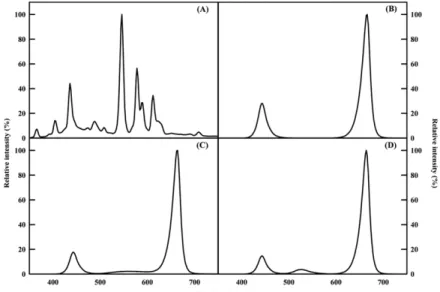
Fig. 2. Relative spectral distribution of 3 types of combined light-emitting diodes (LEDs) and control (fluorescent lamps). (A) control, (B) red and blue (R:B = 8:2), (C) red, white, and blue (R:W:B = 8:1:1), and (D) red, green, and blue (R:G:B = 8:1:1) LEDs. Total photosynthetic photon flux density (PPFD) was 181±4 μmol·m-2·s-1 in each treatment. Spectral scans were measured at the top of the pot.
치에 따른 광분포의 불균일함을 줄이기 위하여 재배 포트의 위치를 이틀에 한 번씩 규칙적으로 변경시켰다.
2. LED 처리
대조구는 형광등을 사용하였고, LED 처리구는 이전 실 험(Son과 Oh, 2013)에서 상추의 생장률이 가장 좋았던 적 색 LED(Red, 최대파장 655nm, (주)하나마이크론, Korea)의 비율 80%(칩수)를 기준으로 하였다. 청색(Blue, 456nm), 녹 색(Green, 515nm), 백색(White, 456nm 69%+ 558nm 31%) LED 칩을 사용하여 광질의 비율을 RB(R:B=8:2), RWB(R:W:B=8:1:1), RGB(R:G:B=8:1:1)의 3가지 조합으로 처리하였다. 광 스펙트럼 분포는 휴대형 분광 복사계(Li- 1800, Li-Cor, USA)로 300-1000nm 범위를 2nm 간격으로 측정하였다(Fig. 2와 Table 1). 각 광원의 방열량을 비교하 기 위하여 열화상카메라(Ti25, Fluke, USA)로 측정하여 관 련 소프트웨어(SmartView, Fluke, USA)로 분석하였다.
3. 생육 특성
상추의 생장을 비교하기 위하여 정식 후 4주째에 각 처 리구 별로 지상부와 지하부의 생체중을 측정하였다. 조사 한 시료는 항온 건조기(VS-120203, (주)비전과학, Korea)에 서 70oC로 72시간 건조시킨 후 건물중을 측정하였다. 엽면 적은 엽면적계(Li-3000C, Li-Cor Inc., USA)로 측정하였다.
엽형지수는 하단엽에서부터 5번째 상추 잎의 엽장과 엽폭 을 측정한 후 엽장을 엽폭으로 나누어 표현하였으며, 잎의
두께를 나타내는 비엽중(Specific leaf weight; SLW)은 지 상부 건물중(mg)을 지상부 엽면적(cm2)으로 나누어 나타냈 다. 엽록소 함량은 정식 후 4주차 상추의 잎을 Arnon (1949)의 방법으로 분석하였다. 각 처리 별 약 0.2g의 샘플 을 액체질소를 이용하여 파쇄한 후 5mL의 80%(v/v) 아세톤 으로 추출하였다. 추출한 시료액의 1.5mL를 마이크로 튜 브에 옮겨 5분간 905×g으로 원심분리 하였다. 그 후 분광 계(UV-1800; Shimadzu, Kyoto, Japan)를 이용하여, 상층액 을 663nm(Chl a)와 645nm(Chl b)에서 흡광도를 측정하였 다. 다음과 같은 공식에 의해 총 엽록소 함량, 엽록소 a, b 의 함량을 생체량 0.2g 당 µg Chl로 산출하였다:
Total Chl content [µg·mL-1] = (20.3× A645) + (7.22× A663) Chl a [µg·mL-1] = (12.72× A663)− (2.58 × A645) Chl b [µg·mL-1] = (22.88× A645)− (5.50 × A663)
* A645, A663: 각 샘플의 흡광도 4. 광 이용 효율
소비전력 기준 광 이용 효율을 계산하기 위해 각 처리 구와 대조구의 전류와 전압을 멀티미터(FLUKE-115, (주) Fluke, USA)로 측정하여 소비전력을 확인하였으며, 재배 기간 동안 소비된 총전력량을 계산하였다. 광 이용 효율 은 재배기간 동안 소비된 전력량과 지상부의 건물량으로 계산하였으며, 1Watt 당 생산할 수 있는 상추 지상부 건 물의 mg(DW mg/W)으로 표현하였다.
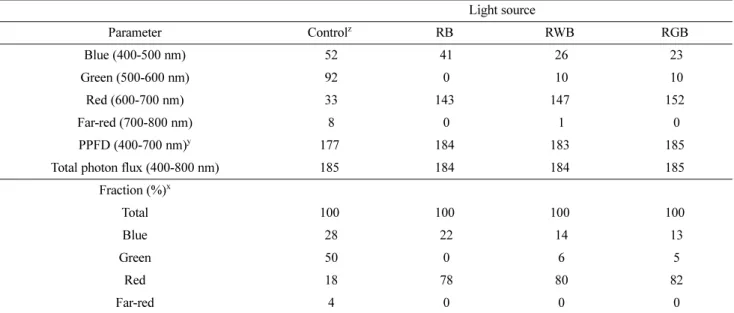
Table 1. Spectral data for 3 types of combined light-emitting diodes (LEDs) and control (fluorescent lamps). Data were recorded at the plant canopy (25 cm from LED lighting sources) with a spectroradiometer. The spectral data were acquired from five points (a center and four edges of each tray of pots) and the means were shown (n = 5).
Light source
Parameter Controlz RB RWB RGB
Blue (400-500 nm) 52 41 26 23
Green (500-600 nm) 92 0 10 10
Red (600-700 nm) 33 143 147 152
Far-red (700-800 nm) 8 0 1 0
PPFD (400-700 nm)y 177 184 183 185
Total photon flux (400-800 nm) 185 184 184 185
Fraction (%)x
Total 100 100 100 100
Blue 28 22 14 13
Green 50 0 6 5
Red 18 78 80 82
Far-red 4 0 0 0
zFluorescent lamps.
yPhotosynthetic photon flux density (µmol·m-2·s-1).
xFraction of far-red, red, green, and blue wavelengths in terms of total photon flux (400-800 nm).
5. 통계처리
상추의 엽형태 및 엽록소를 포함한 생장 측정은 각 처리 구별 6반복으로 실시하였다. 총 실험은 2번 반복하여 재현 성을 검증하였다. 통계분석은 SAS 프로그램(SAS 9.2, SAS Institute Inc., USA)을 이용하였다. 분산분석(ANOVA)을 실 시하였으며, 평균간 비교는 Tukey HSD test를 이용하였다.
결과 및 고찰
1. 인공광원 발열량
인공광원으로부터의 발열은 환경 제어 측면에서 소요 되는 냉난방 부하에 영향을 주는 요인임으로 각 광원의 발열정도를 평가하였다(Fig. 3). 형광등의 최고온도는 51.3oC였고 LED 처리구 RB, RWB, RGB의 최고온도는
각 38.9, 42.13, 38.5°C로 형광등과 LED간 약 9-13oC의 차이가 나는 것을 확인할 수 있었다. LED의 적은 열 방 출은 식물 조직을 뜨겁게 하지 않기 때문에 식물 표면 에 가깝게 조사시킬 수 있다. LED는 기존의 광원들에 비해 소비 전력을 줄이면서 원하는 광양자속 밀도를 유 지할 수 있다는 측면과 설계적으로 안정적인 장기간 사 용이 가능하다는 측면에서, 식물 재배에 LED의 사용이 용이하다는 것을 의미할 수 있다(Mitchell 등, 2015).
2. 생육 특성
정식 후 4주간 재배된 상추의 엽형, 생육, 엽면적, 엽 록소 함량(SPAD값)을 조사한 결과, 엽형지수는 형광등 처리가 모든 LED 처리구에 비해 유의적으로 높은 값을 나타냈다(Fig. 4A). 외형상으로 보았을 때 또한 형광등 Fig. 3. Heat dissipation of 3 types of combined light-emitting diodes (LEDs) and control (fluorescent lamps). (A) control, (B) red and
blue (R:B = 8:2), (C) red, white, and blue (R:W:B = 8:1:1), and (D) red, green, and blue (R:G:B = 8:1:1) LEDs used in this study.
Fig. 4. Leaf shape index (A) and lettuce plants (B) grown under 3 types of combined light-emitting diodes (LEDs) and control (fluorescent lamps) at 4 weeks after transplanting. The data indicate the means ± S.E. (n=12). Significant at p ≤ 0.001.
과 LED 처리구에서 자란 상추의 확연한 크기 차이를 볼 수 있었다(Fig. 4B). 지상부와 지하부의 생체중 및 건물중은 형광등 보다 LED 처리구에서 높은 값을 기록 하였다(Table 2). LED 처리구에서 대조구에 비해 지상 부의 생체중 및 건물중이 최소 34% 높았으나, LED 처 리구들 사이에는 유의적 차이를 나타내지는 않았다. 지 하부의 생체중과 건물중도 지상부와 유사한 패턴으로 대 조구에 비해 LED 처리구에서 각각 최소 29, 35%로 유 의적으로 높았다.
본 실험에서 형광등과 LED 처리구의 뚜렷한 생장 차 이의 원인은 조사되는 광질의 차이로 설명할 수 있다.
형광등의 적색파장은 전체 광량의 18%로 차지한 반면, 3가지 LED 처리구들은 78-82%의 적색파장을 함유하였 다(Table 1). 적색광은 식물의 광합성 기관 발달과 전분 축적을 위한 중요한 에너지원으로 이용(Saebo 등, 1995) 되기 때문에 작물 생육에 효과적인 광 스펙트럼으로 잘 알려져 있다(Folta와 Childers, 2008). 실제로 상추의 생 육에 있어 적색 LED의 긍정적인 효과가 보고되었다 (Heo 등, 2012; Johkan 등, 2010; Son 등, 2012). 또한, 이전 연구에서 다양한 적색과 청색의 혼합광에 따른 상 추의 생육을 검토한 결과, 적색과 청색이 8:2 비율에서 상추의 생육이 형광등보다 높게 보고되었다(Son과 Oh, 2013). 본 실험의 3가지 LED광원 조합의 적색의 비율이 78-82%였으며 청색의 비율은 13-22%였다는 점에서 형 광등 보다 월등한 생장결과를 뒷받침할 수 있다. 식물 생장에 있어 단일 파장의 광 조사보다 청색 또는 원적 색 파장을 같이 조사하는 것이 광합성을 촉진시켜 생장 증진에 더욱 효율적으로 알려져 있는데(Whitelam과 Halliday, 2007), 이는 phytochrome(적색과 원적색 파장 흡수)과 chryptochrome(자외선-A와 청색 파장 흡수)의 시너지효과로 설명될 수 있다(Usami 등, 2004). 실제로 Stutte 등(2009)과 Yorio 등(2001)은 단색의 적색 LED보 다 적색 LED에 청색 LED를 추가한 것이 상추 건물중 증진에 효과적임을 보고하였다. 한편, 최근 녹색광은 식 물에 광합성을 포함한 광형태형성 반응에도 유효하다는
보고와 더불어(Folta, 2004), 적색과 청색의 혼합 LED에 녹색 LED의 추가는 상추의 지상부 생육과 광합성 증진 에 긍정적인 효과가 입증되었다(Kim 등, 2004; Son과 Oh, 2015). 하지만, 본 연구에서는 RB LED와 녹색 파 장이 추가된 RWB, RGB LED 사이에 유의적 차이를 보이지 않았다. 이는 광량, LED 조합 비율뿐만 아니라 재배환경조건(온도, 습도, CO2)의 차이가 영향을 미쳤을 수도 있으며, 식물의 종과 품종에 따른 차이 또한 영향 을 주었을 것으로 생각된다.
잎의 두께를 나타내는 비엽중(SLW)값 역시 형광등보 다 LED 처리구에서 높았으며, 엽면적은 형광등보다 높 은 수치를 나타냈지만 유의적인 차이는 없었다. 청색광 은 잎의 엽육조직 형성을 유도하므로, 청색광 수준이 증 가함에 따라 잎 두께가 증가된다(XiaoYing 등, 2011).
그러나, 본 연구에서 사용된 형광등의 청색광이 28% 임 에도 불구하고 청색광이 적은 LED 처리구들(13-22%)의 잎 두께가 높았던 이유는 형광등에 포함된 녹색광의 비 율이 50%로 다소 높았기 때문으로 생각된다. 녹색광은 잎의 확장을 유도하는 반면, 비엽중 값을 감소시켰다 (Son과 Oh, 2015). LED 처리한 상추 잎에서 추출한 엽 록소 함량은 대조구와 유의적 차이를 보였다. 엽록소 b 를 제외하고 형광등에서 LED 처리들 보다 높은 값을 보였으며, LED 처리간에서는 RB가 수치적으로 높은 엽 록소 값을 보였다. 엽록소 형성은 주로 청색광에 의존된 다고 알려져 있으며(Banaś 등, 2012), 이번 결과에서도 특 히 청색파장이 주로 영향을 주었음을 확인할 수 있었다.
3. 광 이용효율
4주 동안 LED 처리구와 대조구(형광등)의 광 이용 효 율은 분석한 결과, 형광등의 총 소비전력은 145kW인 반 면 LED 처리구는 평균 약 54kW로 형광등의 약 37%
수준이었다. 총 소비전력을 기반으로 LED 처리구들의 광 이용효율은 약 34mg/W으로 형광등보다 약 3.4배 높 은 에너지 효율이었다(Table 3). 이러한 결과는 LED가 기존 사용되었던 백열등, 형광등, 고압나트륨 등에 비해
Table 2. Growth characteristics (n=12) and chlorophyll (Chl) contents (n=6) of lettuce plants grown under 3 types of combined LEDs and control at 4 weeks after transplanting.
Light source Fresh weight (g) Dry weight (g) Leaf area (cm2)
Specific leaf weight (mg/cm2)
Total Chl
(μg/mL) Chl a
(μg/mL) Chl b (μg/mL)
Shoot Root Shoot Root
Controlz 24.82by 3.29b 1.35b 0.18b 826.50 1.65b 122.03a 91.21a 30.82
RB 36.98a 4.04ab 1.87a 0.23ab 950.17 1.98a 101.09ab 73.13ab 24.96
RWB 37.43a 4.53ab 1.89a 0.24ab 980.19 1.93a 96.10b 72.20b 23.90
RGB 34.00ab 4.89a 1.83ab 0.28a 929.22 1.97a 93.47b 69.39b 24.09
zFluorescent lamps.
yMean separation within columns by Tukey’s test at p≤0.05.
낮은 소비 전력으로 에너지 효율을 높일 수 있다는 결 과와 일치하였으며(Chang 등, 2012), 고압나트륨등에 비 해 LED가 최소 33.8% 에너지를 절감할 수 있음을 확 인할 수 있었다(Martineau 등, 2012). LED를 통한 소비 전력의 절약뿐만 아니라 작물의 생장량을 증진시킬 수 있는 LED의 조합, 즉 적절한 광질 조사처리 또한 광 이 용효율을 증진시킬 수 있었던 요인으로 생각된다. 추가 적으로 본 연구에서는 전체 식물공장의 소비전력을 측정 하지 않았지만, 폐쇄형 식물공장에서 기온을 조절하는데 형광등에 의한 발열은 부가적인 냉·난방 부하를 발생시 키기 때문에 총 소비전력의 증가가 예상된다. LED 처리 간 광 이용효율에는 큰 차이가 없었는데, 이는 LED 처 리간 총 소비전력에서 큰 차이가 없었고, 80%의 적색광 이 포함된 세가지 LED 처리는 적치마 상추에서 유사한 생장을 유도하였기 때문이다. 추후 상업적 폐쇄형 식물 공장의 광원 선정을 위해서는 LED 칩 종류별 단가, 칩 의 개수, 제작 비용 등을 추가적으로 고려한 비교 데이 터의 제시가 필요할 것으로 판단된다.
적 요
본 연구의 목적은 폐쇄형 식물생산시스템에서 세가지 혼합 LED와 형광등에서 자란 적치마 상추의 생육과 광 이용효율을 비교하는 것이다. 18일간 육묘한 적치마상추 묘를 적색(R, 655nm), 청색(B, 456nm), 녹색(G, 515nm), 백색(W, 456nm + 558nm)의 혼합 LED(R:B=8:2, R:W:B
=8:1:1, R:G:B=8:1:1)와 형광등이 설치된 폐쇄형 식물생 산시스템에 정식하였다. 형광등에서 자란 상추는 모든 LED 처리에 비해 유의적으로 높은 엽형지수를 보였다.
지상부와 지하부 생육에서 LED 처리간 유의적 차이를 보이지 않았으나, 모든 LED 처리가 형광등에 비해 약 34% 지상부 생체중의 증가를 유도시켰다. 한편, 정식 후 4주차에 형광등의 총 소비 전력은 145kW인 반면, LED 처리구들에서 형광등의 약 1/3배인 54kW를 나타냈다.
LED 처리구들의 건물중에 대비한 광 이용 효율은 약
34mg/W였으며, 이는 형광등 보다 약 3.5배 높은 값이었 다. 결론적으로, 본 연구는 식물 생산 시스템에서 적절 한 조합의 LED 조사는 형광등에 비해 상추 생장을 증 진시킬 수 있으며 추가적으로 에너지 절감을 통해 광 이용효율도 극대화 할 수 있음을 보여주었다.
추가 주제어 : 식물공장, 인공광원, 에너지 절감
Literature Cited
Arnon, D.I. 1949. Copper enzymes in isolated chloroplasts.
Polyphenoloxidase in Beta vulgaris. Plant Physiol. 24:1-15.
Banaś, A.K., C. Aggarwal, J. Łabuz, O. Sztatelman, and H.
Gabryś. 2012. Blue light signaling in chloroplast move- ments. J. Exp. Bot. 63:1559-1574.
Cha, M.K. and Y.Y. Cho. 2013. Growth characteristics of let- tuce under different planting distance in a plant factory. J.
Asian Agric. Biotechnol. 29:19-22 (in Korean).
Chang, M.H., D. Das, P.V. Varde, and M. Pecht. 2012. Light emitting diodes reliability review. Microelectron. Reliab.
52:762-782.
Folta, K.M. 2004. Green light stimulates early stem elonga- tion antagonizing light-mediated growth inhibition. Plant Physiol. 135:1407-1416.
Folta, K.M. and K.S. Childers. 2008. Light as a growth regu- lator: controlling plant biology with narrow-bandwidth solid-state lighting systems. HortScience 43:1957-1964.
Goto, E. 2012. Plant production in a closed plant factory with artificial light. Acta Hort. 956:37-49.
Heo, J.W., D.H. Kang, H.S. Bang, S.G. Hong, C. Chun, and K.K. Kang. 2012. Early growth, pigmentation, protein con- tent, and phenylalanine ammonia-lyase activity of red curled lettuces grown under different lighting conditions. Kor. J.
Hort. Sci. Technol. 30:6-12.
Ikeda, A., Y. Tanimura, K. Ezaki, Y. Kawai, S. Nakayama, K.
lwao, and H. Kageyama. 1992. Environmental control and operation monitoring in a plant factory using artificial light.
Acta Hort. 304:151-158.
Johkan, M., K. Shoji, F. Goto, S. Hashida, and T. Yoshihara.
Table 3. Total power consumption and light use efficiency of 3 types of combined LEDs and control.
Light source Total power consumptionz (kW)
Power savings compared with control (%)
Light use efficiencyy (DW mg/W)
Controlx 145 ± 1.8 0 9.99
RB 55 ± 0.8 62.0 34.01
RWB 54 ± 0.2 62.5 34.76
RGB 55 ± 0.6 63.0 34.17
zElectric power consumed by only lighting sources.
yProduction of shoot biomass per unit energy consumption (biomass/energy).
xFluorescent lamps.
2010. Blue light-emitting diode light irradiation of seed- lings improves seedling quality and growth after transplant- ing in red leaf lettuce. HortScience 45:1809-1814.
Kim, H.-H., G.D. Goins, R.M. Wheeler, and J.C. Sager. 2004.
Green-light supplementation for enhanced lettuce growth under red- and blue-light-emitting diodes. HortScience 39:1617-1622.
Kozai, T. 2013. Sustainable plant factory: Closed plant pro- duction systems with artificial light for high resource use efficiencies and quality produce. Acta Hort. 1004:27-40.
Martineau, V., M. Lefsrud, M.T. Naznin, and D.A. Kopsell.
2012. Comparison of light-emitting diode and high-pres- sure sodium light treatments for hydroponics growth of bos- ton lettuce. HortScience 47:477-482.
Mitchell, C. A., M.P. Dzakovich, C. Gomez, R. Lopez, J.F.
Burr, R. Hernández, C. Kubota, C.J. Currey, Q. Meng, E.S.
Runkle, C.M. Bourget, R.C. Morrow, and A.J. Both. 2015.
Light-Emitting Diodes in Horticulture. in Horticultural Reviwes: Volume 43 (ed J. Janick), John Wiley & Sons, Inc., Hoboken, New Jersey. USA. p. 5-11.
Saebo, A., T. Krekling, and M. Appelgren. 1995. Light qual- ity affects photosynthesis and leaf anatomy of birch plant- lets in vitro. Plant Cell Tissue Organ Cult. 41:177-185.
Samuolienė, G. R. Sirtautas, A. Brazaitytė, and P. Duchovskis.
2012. LED lighting and seasonality effects antioxidant prop- erties of baby leaf lettuce. Food Chem. 134:1494-1499.
Son, K.H., J.H. Park, D. Kim, and M.M. Oh. 2012. Leaf shape, growth, and phytochemicals in two leaf lettuce culti- vars grown under monochromatic light-emitting diodes.
Kor. J. Hort. Sci. Technol. 30:664-672 (in Korean).
Son, K.H. and M.M. Oh. 2013. Leaf shape, growth, and anti- oxidant phenolic compounds of two lettuce cultivars grown under various combinations of blue and red light-emitting diodes. HortScience 48:988-995.
Son, K.H. and M.M. Oh. 2015. Growth, photosynthetic and antioxidant parameters of two lettuce cultivars as affected by red, green, and blue light-emitting diodes. Hort. Envi- ron. Biotechnol. 56:639-653.
Stutte, G.W., S. Edney, and T. Skerritt. 2009. Photoregulation of bioprotectant content of red leaf lettuce with light-emit- ting diodes. HortScience 44:79-82.
Stutte, G.W. 2015. Commercial transition to LEDs: A path- way to high-value products. HortScience 50:1297-1300.
Um, Y.C., S.S. Oh, J.G. Lee, S.Y. Kim, and Y.A. Jang. 2010.
The development of container-type plant factory and growth of leafy vegetables as affected by different light sources. J.
Bio-Environ. Control 19:333-342.
Usami, T., N. Mochizuki, M. Kondo, M. Nishimura, and A.
Nagatani. 2004. Cryptochromes and phytochromes synergis- tically regulate Arabidopsis root greening under blue light.
Plant Cell Physiol. 45:1798-1808.
Wheeler, R.M. 2008. A historical background of plant light- ing: an introduction to the workshop. HortScience 43:1942- 1943.
Whitelam, G.C. and K.J. Halliday. 2007. Light and plant development. Blackwell Publishing Ltd., Oxford, UK.
Yeh, N. and J.P. Chung. 2009. High-brightness LEDs-energy efficient lighting sources and their potential in indoor plant cultivation. Renew. Sustain. Energy Rev. 13:2175-2180.
Yorio, N.C., G.D. Goins, J.C. Sager, R.M. Wheeler, and J.C.
Sager. 2001. Improving spinach, radish, and lettuce growth under red light-emitting diodes (LEDs) with blue light sup- plementation. HortScience 36:380-383.
XiaoYing, L., G. ShiRong, X. ZhiGang, J. XueLei, and T.
Tezuka. 2011. Regulation of chloroplast ultrastructure, cross-section anatomy of leaves, and morphology of sto- mata of cherry tomato by different light irradiations of light- emitting diodes. HortScience 46:217-221.