청주지역 도매시장과 재래시장 유통 엽채류 중 농약의 잔류 특성
노현호 ・ 이광헌 ・ 이재윤 ・ 박효경 ・ 박소현 ・ 김선호 ・ 경기성*
충북대학교 농업생명환경대학
(2011년 12월 5일 접수, 2011년 12월 17일 수리)
Characteristics of Pesticide Residues in Leafy Vegetables Collected from Wholesale and Traditional Markets in Cheongju
Hyun Ho Noh, Kwang Hun Lee, Jae Yun Lee, Hyo Kyoung Park, So Hyun Park, Sun Ho Kim and Kee Sung Kyung*
Department of Environmental & Biological chemistry, College of Agriculture, Life and Environment Sciences, Chungbuk National University, Cheongju 361-763
This study was carried out to survey the residual characteristics of pesticides and assess their safety. Nineteen agricultural commodities, collected from wholesale and traditional markets in Cheongju. Nineteen agricultural commodities including perilla leaves were collected from the markets on October 29th, 2010. Total 240 pesticides which can be analyzed by multiresidue analysis method by GLC and HPLC were monitored and the pesticides detected were confirmed by GC-MSD and LC-MS. Five pesticides, alachlor, bifenthrin, endosulfan, procymidone and triflumizole, were detected from five samples, such as welsh onion, leek and celery in case of wholesale market and perilla leaves and welsh onion in case of traditional market. Detection rate of 13.2%
was obtained as a result of pesticide analysis but 2.6% of the pesticides detected exceeded their maximum residue limits. The estimated daily intakes (EDIs) and maximum permissible intakes (MPIs) of the pesticides detected were less than 26% and 0.05% of their acceptable daily intakes (ADIs) respectively, representing that residue levels of the pesticides detected would be safe.
Key words pesticide residue, monitoring, EDI, ADI
Abstract*연락저자 : Tel. +82-43-261-2562, Fax. +82-43-271-5921 E-mail: [email protected]
서 론
현대 소비자들은 삶의 질 향상으로 인해 고품질의 식품을 선호하고 있고 국가에서도 다양한 규제를 통하여 안전한 먹 거리 생산에 힘을 쏟고 있다. 실제로 2005년 농촌진흥청 농 촌자원개발연구소에서 실시한 농·축산 식품의 품질 및 안전 성에 대한 소비자 인식 조사 결과 소비자들의 식품 선택 기준 이 안전성으로 전체 41.5%로 많은 소비자가 식품의 안전성 을 중요하게 생각하는 것으로 나타났다(양 등, 2006). 또한
농약은 농업에 있어서 반드시 필요한 농자재로 사용이 불가 피함에도 불구하고 소비자들은 막연한 불안감으로 농약을 거 부하고 있다. 하지만 농약이 과거 식량문제 해결, 노동력 절 감 및 병해충을 예방하여 고소득을 올리는데 일조한 것은 자 명한 사실이다(전 등, 2006). 물론 농약을 오남용하여 농업인 에게는 중독을 야기하고 농산물 중 잔류농약이 잔류허용기준 (maximum residue limit, MRL)을 초과하여 용도전환 및 폐 기와 같은 행정 처분을 받음으로써 경제적 손실의 피해도 생길 수 있다. 또한 환경 파괴와 생태계에 영향을 미치는 것은 물론 식품에 잔류하여 인간에게도 악영향을 미친다(김 등, 2008).
이렇듯 농약의 사용은 분명 우리 삶에 이익을 가져다줌과 동 연구보문/잔류・안전성
453
시에 피해도 일으키고 있다. 이런 피해를 줄이기 위하여 농민 은 농약사용지침서에 준하여 농약을 살포하고, 국가에서는 출하된 농산물에 대하여 잔류농약 검사를 실시하여 농산물에 대한 안전성을 확보해야 한다.
우리나라에서는 1968년에 국립보건원 주관으로 농산물에 대한 잔류농약 모니터링을 처음 실시하였고, 1988년에는 17 종의 농약에 대하여 잔류허용기준을 설정하여 현재까지 관리 하고 있다(전 등, 2006). 미국 식품의약국(Food and Drug Administration, FDA)과 미국 농무부(US Department of Agriculture, USDA)에서는 매년 농산물과 축산물에 대하여 잔 류농약 모니터링을 실시하고 그 결과를 공개하고 있다(FDA, 2001). 유럽연합(European Union, EU)에서는 회원국이 연 합하여 유럽 전역을 모니터링하고 있으며, 각국에서 잔류농 약 모니터링 결과를 매년 발표하고 있다(EU, 2004).
현재까지 실시해온 잔류농약 모니터링은 검출된 농약이 해 당 작물에 등록되었는지, 잔류허용기준을 초과했는지에 대한 적합여부만 판단하여 왔다. 하지만 이제는 적합여부를 판단 하는데 국한되지 않고 농약이 검출된 농산물을 소비자가 섭 취하였을 경우의 안전성 평가도 함께 진행되어야 한다(박 등, 2010).
보건복지부의 국민건강영양조사(보건복지부, 2006)에 따 르면 식품군별 다소비 식품은 곡류(28%), 채소류(25.9%), 음 료 및 주류(7.9%) 순서로 주식인 곡류 다음 채소류의 섭취율 이 높았다. 또한 국립농산물품질관리원의 안전성 조사 결과(국 립농산물품질관리원, 2008)에서 채소류의 부적합율이 2.17%
로 가장 높다고 보고하였는데 이는 채소류가 작물의 생육 기 간이 짧고 작물 표면에 부착되는 농약 양이 많아 엽채류에 농 약이 잔류할 가능성이 높기 때문인 것으로 판단된다고 하였다.
따라서 본 연구는 실제 도매시장과 재래시장에서 판매중인 엽 채류 중 농약의 잔류실태를 조사하고 안전성을 평가하기 위하 여 수행하였다.
재료 및 방법
시료채취
분석용 농산물 시료는 2010년 10월 29일에 청주지역 유일 의 농산물도매시장인 청주 농수산물도매시장과 청주 대표적 인 재래시장인 육거리 재래시장에서 채취하였으며, 대상 작 물은 상추, 근대, 깻잎, 대파, 미나리, 부추, 브로콜리, 시금치, 셀러리, 신선초, 쑥갓, 아욱, 얼갈이, 양배추, 양상추, 열무, 청 경채, 치커리 그리고 취나물로 총 19종의 엽채류 38점 채취
하였다.
분석 대상농약 및 검출기별 그룹화
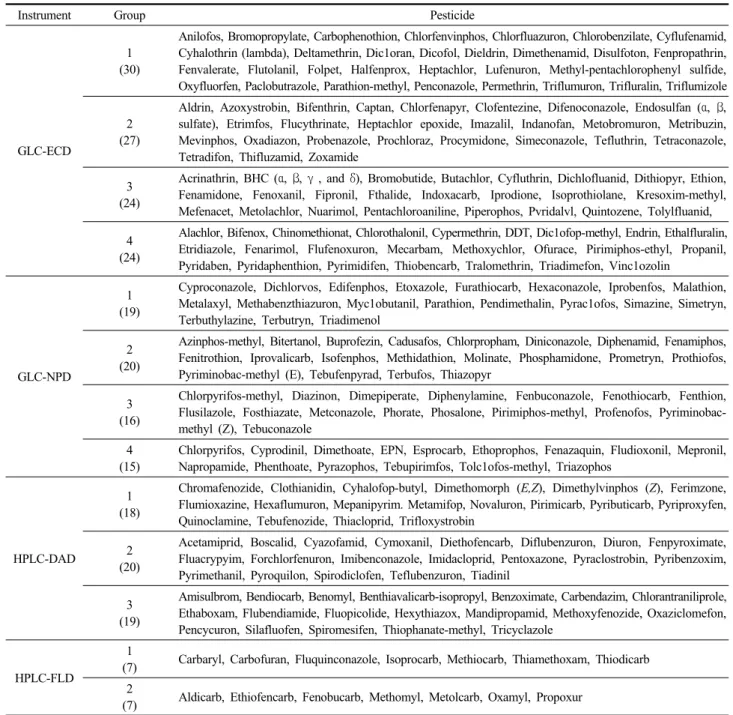
분석 대상농약은 국립농산물품질관리원(2010)에서 시행 중인 240종 농약을 대상으로 하였으며, 이를 Table 1에 제시 하였다. 또한 분석대상 농약은 대상 농약을 개별 분석한 후 피크(peak)의 머무름 시간(retention time)이 겹치지 않도록 분석기기 및 검출기별로 그룹화하였다.
분석용 시료 조제 및 기기분석
GC분석용 시료 조제
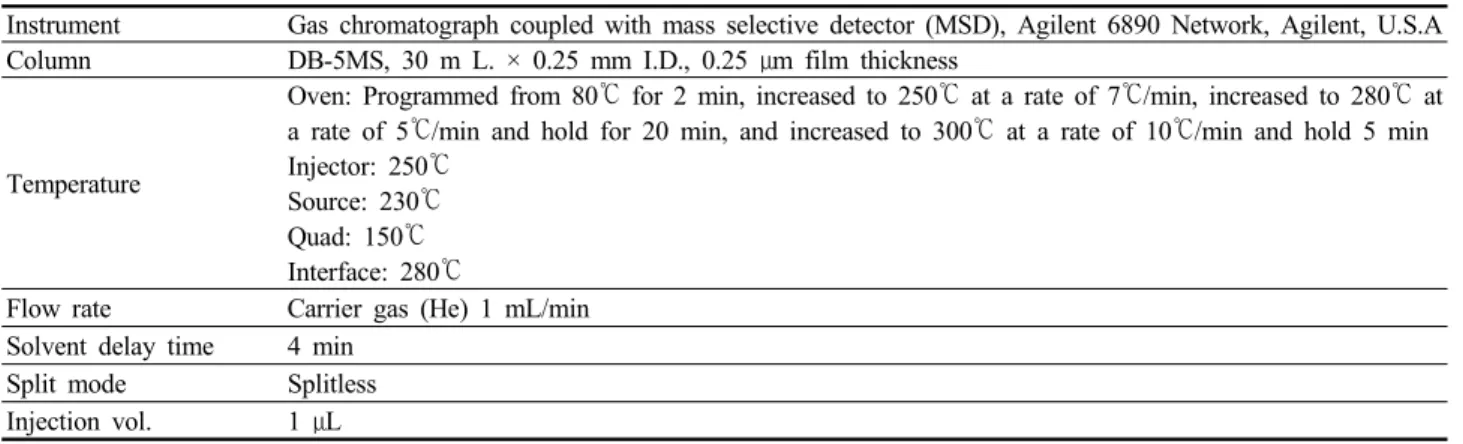
균질화한 시료 50 g을 200 mL polyethylene bottle에 넣 고 100 mL의 acetonitrile을 넣어 Ultra-Turrax(T25 basic, IKA, 독일)을 이용하여 3분간 blending한 후 20 g의 NaCl을 첨가하고 재차 blending하였으며, 이를 3,000 rpm으로 3분 간 원심 분리하였다. 원심분리 한 시료 상징액(acetonitrile 층) 20 mL을 test tube에 옮기고 질소미세농축기를 이용하여 농 축하였다. 건고농축 시료를 5 mL의 acetone:n-hexane(20:80, v/v) 혼합용매로 재용해하여 5 mL의 n-hexane과 5 mL의 acetone:n-hexane(20:80, v/v) 혼합용매로 안정화시킨 SPE cartridge(Florisil, 1,000 mg)에 2 mL을 상부에 가하여 흘려 버리고 5 mL의 acetone:n-hexane(20:80, v/v) 혼합용매로 잔류농약을 용출하였다. 용출액을 질소미세농축기로 농축한 후 2 mL의 acetone:n-hexane(20:80, v/v) 혼합용매에 재용해한 후 GLC-ECD/NPD를 이용하여 Table 2의 조건에서 분석하였 으며, 분석 결과 농약으로 추정되는 peak가 검출될 경우 GLC- MSD로 재확인하였고 GLC-MSD의 분석조건은 Table 3과 같다.
LC 분석용 시료 조제
균질화한 시료 50 g를 200 mL polyethylene bottle에 넣 고 100 mL의 acetonitrile을 넣어 Ultra-Turrax을 이용하여 3분간 blending한 후 NaCl 20 g을 첨가하여 다시 blending 하였으며, 상기 시료를 3,000 rpm으로 3분간 원심분리하였 다. 원심분리한 시료의 상징액(acetonitrile 층) 20 mL을 test tube에 옮기고 질소미세농축기를 이용하여 농축하였다. 건고 농축 시료를 2 mL의 methanol:dichloromethane(5:95, v/v) 혼합용매로 재용해하여 5 mL의 dichloromethane으로 안정 화시킨 SPE cartridge(NH2,, 1,000 mg)에 1 mL을 상부에 가 하여 흘려버리고 5 mL의 methanol:dichloromethane(5:95, v/v) 혼합용매로 잔류농약을 용출하였다. 용출액을 질소미
Table 1. Target pesticides for residue monitoring of pesticides from agricultural products
Classification Pesticide
Insecticide (120)
Acetamiprid, Acrinathrin, Aldicarb, Aldrin, Azinphos-methyl, Bendiocarb, Benzoximate, BHC, Bifenthrin, Bromopropylate, Buprofezin, Cabudafos, Carbaryl, Carbofuran, Carbophenothion, Chlorantranililprole, Chlorfenapyr, Chlorfenvinphos, Chlorfluazuron, Chromafenozide, Chlorobenzilate, Chlorpropham, Chlorpyrifos, Chlorpyfos-methyl, Clofentezine, Clothianidin, Cyfluthrin, lambda-Cyhalorhtion, Cypermethrin, DDT, Diflubenzuron, Deltamethrin, Diazinon, Dichlorvos, Dicofol, Dimethoate, Dimethylvinphos (Z), Disulfoton, Endosulfan, Endrin, EPN, Ethiofencarb, Ethion, Ethoprophos, Etoxazole, Etrimfos, Fenamifos, Fenazaquin, Fenitrothion, Fenothiocarb, Fenpropathrion, Fenthion, Fenobucarb, Fenpyroximate, Fenvalerate, Fipronil, Fluacrypyrim, Flubendiamide, Flucythrinate, Flufenoxuron, Fosthiazate, Forchlorfenuron, Furathiocarb, Halfenprox, Heptachlor, Hexaflumuron, Hexythiazox, Indoxacarb, Imidacloprid, Isofenphos, Isoprocarb, Lufenuron, Malathion, Mecarbam, Methidathion, Methiocarb, Methomyl, Methoxychlor, Methoxyfenozide, Metolcarb, Mevinphos, Novaluron, Oxamyl, Paclobutrazole, Parathion, Parathion- methyl, Permethrin, Phenthoate, Phorate, Phosalone, Phosphamidone, Pirimicarb, Pirimiphos-ethyl, Pirimifos-methyl, Probenazole, Profenofos, Prothiofos, Propoxur, Pyraclofos, Pyridaben, Pyridalyl, Pyridaphenthion, Pyrimidifen, Pyriproxyfen, Silafluofen, Spirodiclofen, Spiromesifen, Tebufenozide, Tebufenpyrad, Tebupirimifos, Teflubenzuron, Tefluthion, Terbufos, Tetradifon, Thiacloprid, Thiamethoxam, Thiodicarb, Tralmethion, Triazophos, Triflumuron
Fungicide (77)
Amisulbrom, Azoxystrobin, Benthiavalicarb-isopropyl, Benomyl, Bitertanol, Boscalid, Captan, Carbendazim, Chinomethionat, Chlorothalonil, Cyazofamid, Cyflufenamid, Cymoxanil, Cyproconazole, Cyprodinil, Dichlofluanid, Dicloran, Difenoconzole, Diethofencarb, Dimethomorph (E,Z), Diniconazole, Diphenylamine, Edifenphos, Ethaboxam, Etridiazole, Fenamidone, Fenarimol, Fenbuconazole, Fenoxanil, Ferimzone, Fludioxonil, Fluopicolide, Flusilazole, Flutolanil, Fluquinconazole, Folpet, Fthalide, Hexaconazole, Imazalil, Imibenconazole, Iprobenfos, Iprodione, Iprovalicarb, Isoprothiolane, Kresoxim-methyl, Mandipropamid, Mepanipyrim, Mepronil, Metalaxyl, Metconazole, Myclobutanil, Nuarimol, Ofurace, Penconazole, Pencycuron, Prochloraz, Procymidone, Pyroquilon, Quintozene, Simeconazole, Tebuconazole, Tetraconazole, Thifluzamid, Thiophanate-methyl, Tiadiinl, Tolclofos-methyl, Tolylfluanid, Triadimefon, Triadimenol, Tricyclazole, Triflumizole, Trifloxystrobin Vinclozolin, Zoxamide
Herbicide (43)
Alachlor, Anilofos, Bifenox, Butachlor, Cyhalofop-butyl, Diclofop-methyl, Diuron, Dimepiperate, Dimethenamid, Diphenamid, Esprocarb, Ethalfluralin, Flumioxazine, Methabenzthiazuron, MEtobromuron, Metolachlor, Metribuzin, Molinate, Napropamide, Oxadiazon, Oxyfluorfen, Oxaziclomefon, Pendimethalin, Pentoxazone, Piperophos, Prometryn, Propanil, Pyrazophos, Pyribenzoxim, Pyributicarb, Pyriminobac, methyl (E,Z), Simazinw, Simetryn, Terbuthylazine, Terbutryn, Thiazopyr, Thiobencarb, Trifluralin, Quinoclamine
Total 240
Table 2. Gas chromatographic conditions for the analysis of the pesticide residues
Instrument Gas chromatograph equipped with ECD and NPD, Agilent 7890 Network, agilent, U.S.A Column HP-5, 30 m L. × 0.32 mm I.D., 0.25 μm film thickness
Temperature
Oven: Programmed from 80℃ for 2 min, increased to 200℃ at a rate of 10℃/min, increased to 220℃ at a rate of 2℃/min and hold for 4 min, and increased to 300℃ at a rate of 10℃/min and hold 8 min Injector: 250℃
Detector: 320℃
Flow rate
Carrier N2 : 1 mL/min for ECD and NPD Detector H2 : 3 mL/min for NPD
Air : 60 mL/min for NPD Make-up N2 : 60 mL/min for ECD 5 mL/min for NPD Split ratio 30:1 for GLC-ECD and splitless for GLC-NPD Injection vol. 1 μL
Table 3. GC-MSD operating conditions for the identification of pesticides
Instrument Gas chromatograph coupled with mass selective detector (MSD), Agilent 6890 Network, Agilent, U.S.A Column DB-5MS, 30 m L. × 0.25 mm I.D., 0.25 μm film thickness
Temperature
Oven: Programmed from 80℃ for 2 min, increased to 250℃ at a rate of 7℃/min, increased to 280℃ at a rate of 5℃/min and hold for 20 min, and increased to 300℃ at a rate of 10℃/min and hold 5 min Injector: 250℃
Source: 230℃
Quad: 150℃
Interface: 280℃
Flow rate Carrier gas (He) 1 mL/min Solvent delay time 4 min
Split mode Splitless Injection vol. 1 μL
Table 4. HPLC-DAD chromatographic conditions for the analysis of the pesticide residues Instrument 1200 Series High Performance Liquid Chromatograph, Agilent, U.S.A Column Agilent zorbax 80 Å extend C-18, 4.6 mm I.D. × 150 mm L. (5 μm) Detector Diode array detector (DAD)
Wavelength 230 nm for UVD 3 group, 254 nm for UVD 1 and 2 group Mobile phase Gradient (A:acetonitrile, B:water)
Time A (%) B (%) Flow
0 15 85 1
10 60 40 1
25 80 20 1
26 85 15 1
28 85 15 1
30 90 10 1
35 90 10 1
35 100 0 1
40 100 0 1
41 15 85 1
45 15 85 1
Injection vol. 10 μL
Table 5. HPLC-FLD chromatographic conditions for the analysis of the pesticide residues Instrument 1200 Series High Performance Liquid Chromatograph, Agilent, U.S.A Post reactor VECTOR PCX, Pickering laboratories
Detector Fluorescence detector (Ex.:230, Em.:425)
Column Shiseido C-18, 4.6 mm I.D. × 250 mm L. (5 μm) Reactor Temp. 100℃
Post reactor pump Pump 1: Hydrolysis regent (0.3 mL/min) Pump 2: O-Phthalaldehyde (0.3 mL/min) Mobile phase Gradient (A:acetonitrile, B:water)
Time A (%) B (%) Flow
0 20 80 1
2 20 80 1
20 70 30 1
25 70 30 1
30 20 80 1
Injection vol. 10 μL
Table 6. Classification of agricultural products by types of agricultural commodities and characteristics of pesticide residues (KFDA, 2009)
Type Group Commodity
Cereal
grains - Rice, Barley, Wheat, Buckwheat, Foxtail millet, Sorghum, Corn, Oats, Rye, Great millet, Japanese- barnyard millet, Quinoa, Triticale etc
Potatoes - Potato, Sweet potato, Taro, Yam, Cassave (tapioca), Elephant food etc
Beans - Soybean, Mungbean, Pea, Kidney bean, Cowpea, Red bean, Broad bean, Pigean pea, Lima bean, Cicer arietinum, Green bean, Black bean, Lentils etc
Nuts and seeds
Nuts Chestnut, Walnut, Gingko nut, Pine nut, Peanut, Almond, Pecan, Cashew nut, Hazel nut, Macadamia, Pistachio, Acorn etc
Seeds Seasam, Cotten seed, Sunflower seed, Pumpkin seed, Perilla-seed, Olive, Evening primrose seed, Cotton seed, Rape seed, Palm tree, Safflower etc
Fruits
Pome fruites Apple, Pear, Persimmon, Quince, Pomegranate etc
Citrus fruits Mandarin, Orange, Grapefruit, Lemon, Korean lemon, Lime, Oval kunquat, Hardy orange, Citron etc Stone fruits Peach, Jujube, Apricot, Plum, Korean Plum, Cherry, Prynus persica, Korean cherry etc Berries and other
small fruits
Grape, Strawberry, Fig, Mulberry, Cowberry, Currant, Berry, Chinese matrimony vine, Maximowiczia chinensis, Wild grape, Rubi fructus (Wild berry, Raspberry) etc
Assorted tropical and
sub-tropical fruits Banana, Pineapple, Kiwifruit, Abocado, Papaya, Date palm, Mango, Guava, Coconut etc
Vegetables
Leafy vegetables
Korean cabbage, Cabbage, Lettuce (leaf), Lettuce (head), Spinach, Perilla leaves, Crown daisy, Marsh mallow, Chard, Butterbur, Radish leaves, Chwinamul, Papper leaves, Chamnamul, Kale, Broccoli, Chinese vegetable, Mustard leaf, Shepherd’s purse, Chicory (leaves), Endive, Water dropwort, Pumpkin young leaves, Shinsuncho, Korean wasabi (leaves), Amaranth, Sowthistle, Burdock leaves, Gyeojachae, New green, Dachunchae, Danggi leaf etc
Stalk and stem vegetables
Welsh onion, Leek, Water dropwort, Sweet potato stalk, Taro stem, Bracken, Asparagus, Celery, Bamboo Shoot, Kohlrabi, Kuansh, Bud of aralia, Wild garlic, Royal fern, Green garlic, Sedum etc Root and tuber
vegetables
Radish (root), Onion, Garlic, Carrot, Ginger, Lotus root, Burdock, Ballon flower, Bonnet bellflowere), Beat, Turnip, Wild parsnip, Yacon, Korean wasabi (root), Chicory (root), Ginseng etc Fruiting vegatables Cucumber, Squash, Tomato, Green & Red pepper (Fresh), Sweet pepper, Eggplant, Korean melon,
Watermelon, Melon, Okra, Unrioe bean etc
Mushrooms - Oyster mushroom, Pin mushroom, Oak mushroom, Mushroom, Edible mushroom, Winter mushroom, Juda’s ear, Ganoderm aliucidum karst, New matsutake fungus etc
Tea leaves - Tea
Hops - Hop
Other plants - Mustard, Pepper, Curry, Pimenta dioica, Coffee bean, Cacao bean
세농축기로 농축한 후 2 mL의 acetonitrile로 재용해한 후 HPLC-DAD/FLD를 이용하여 Table 4와 5의 방법으로 분 석하였다.
농약 잔류허용기준에 의한 부적합 농산물 판정 농산물에서 검출된 농약의 잔류량이 잔류허용기준을 초과 할 경우 부적합 농산물로 판정하였다. 검출된 농약이 해당 작 물에 잔류허용기준이 설정되지 않은 경우 다음의 순서로 판 정하였다(식품의약품안전청, 2009).
① 당해 농산물에 대한 Codex 기준
② 식품의 기준 및 규격 중 별표 4 농산물의 농약 잔류허 용기준의 그 농약기준 중 당해농산물과 ④에서 정한 동
일 대분류군(단, 견과종실류, 과실류 및 채소류에 한해 서는 소분류를 우선 적용)에 속한 농산물의 최저기준
③ 식품의 기준 및 규격 중 별표 4 농산물의 농약 잔류허 용기준의 그 농약기준 중 최저기준
④ 농산물의 분류(Table 6)
안전성 평가
검출농약의 안전성은 일일섭취허용량(acceptable daily intake, ADI) 및 최대섭취허용량(maximum permissible intake, MPI) 대비 일일섭취추정량(estimate daily intake, EDI)으로 평가하였으며, 아래의 식을 이용하여 산출하였다. 농약 일일 섭취허용량 산출 시 필요한 일일식품섭취량은 농산물 중 중
Table 7. Pesticide groups categorized by instruments and detectors for multiresidue analysis
Instrument Group Pesticide
GLC-ECD
1 (30)
Anilofos, Bromopropylate, Carbophenothion, Chlorfenvinphos, Chlorfluazuron, Chlorobenzilate, Cyflufenamid, Cyhalothrin (lambda), Deltamethrin, Dic1oran, Dicofol, Dieldrin, Dimethenamid, Disulfoton, Fenpropathrin, Fenvalerate, Flutolanil, Folpet, Halfenprox, Heptachlor, Lufenuron, Methyl-pentachlorophenyl sulfide, Oxyfluorfen, Paclobutrazole, Parathion-methyl, Penconazole, Permethrin, Triflumuron, Trifluralin, Triflumizole
2 (27)
Aldrin, Azoxystrobin, Bifenthrin, Captan, Chlorfenapyr, Clofentezine, Difenoconazole, Endosulfan (α, β, sulfate), Etrimfos, Flucythrinate, Heptachlor epoxide, Imazalil, Indanofan, Metobromuron, Metribuzin, Mevinphos, Oxadiazon, Probenazole, Prochloraz, Procymidone, Simeconazole, Tefluthrin, Tetraconazole, Tetradifon, Thifluzamid, Zoxamide
3 (24)
Acrinathrin, BHC (α, β, γ , and δ), Bromobutide, Butachlor, Cyfluthrin, Dichlofluanid, Dithiopyr, Ethion, Fenamidone, Fenoxanil, Fipronil, Fthalide, Indoxacarb, Iprodione, Isoprothiolane, Kresoxim-methyl, Mefenacet, Metolachlor, Nuarimol, Pentachloroaniline, Piperophos, Pvridalvl, Quintozene, Tolylfluanid, 4
(24)
Alachlor, Bifenox, Chinomethionat, Chlorothalonil, Cypermethrin, DDT, Dic1ofop-methyl, Endrin, Ethalfluralin, Etridiazole, Fenarimol, Flufenoxuron, Mecarbam, Methoxychlor, Ofurace, Pirimiphos-ethyl, Propanil, Pyridaben, Pyridaphenthion, Pyrimidifen, Thiobencarb, Tralomethrin, Triadimefon, Vinc1ozolin
GLC-NPD
1 (19)
Cyproconazole, Dichlorvos, Edifenphos, Etoxazole, Furathiocarb, Hexaconazole, Iprobenfos, Malathion, Metalaxyl, Methabenzthiazuron, Myc1obutanil, Parathion, Pendimethalin, Pyrac1ofos, Simazine, Simetryn, Terbuthylazine, Terbutryn, Triadimenol
2 (20)
Azinphos-methyl, Bitertanol, Buprofezin, Cadusafos, Chlorpropham, Diniconazole, Diphenamid, Fenamiphos, Fenitrothion, Iprovalicarb, Isofenphos, Methidathion, Molinate, Phosphamidone, Prometryn, Prothiofos, Pyriminobac-methyl (E), Tebufenpyrad, Terbufos, Thiazopyr
3 (16)
Chlorpyrifos-methyl, Diazinon, Dimepiperate, Diphenylamine, Fenbuconazole, Fenothiocarb, Fenthion, Flusilazole, Fosthiazate, Metconazole, Phorate, Phosalone, Pirimiphos-methyl, Profenofos, Pyriminobac- methyl (Z), Tebuconazole
4 (15)
Chlorpyrifos, Cyprodinil, Dimethoate, EPN, Esprocarb, Ethoprophos, Fenazaquin, Fludioxonil, Mepronil, Napropamide, Phenthoate, Pyrazophos, Tebupirimfos, Tolc1ofos-methyl, Triazophos
HPLC-DAD
1 (18)
Chromafenozide, Clothianidin, Cyhalofop-butyl, Dimethomorph (E,Z), Dimethylvinphos (Z), Ferimzone, Flumioxazine, Hexaflumuron, Mepanipyrim. Metamifop, Novaluron, Pirimicarb, Pyributicarb, Pyriproxyfen, Quinoclamine, Tebufenozide, Thiacloprid, Trifloxystrobin
2 (20)
Acetamiprid, Boscalid, Cyazofamid, Cymoxanil, Diethofencarb, Diflubenzuron, Diuron, Fenpyroximate, Fluacrypyim, Forchlorfenuron, Imibenconazole, Imidacloprid, Pentoxazone, Pyraclostrobin, Pyribenzoxim, Pyrimethanil, Pyroquilon, Spirodiclofen, Teflubenzuron, Tiadinil
3 (19)
Amisulbrom, Bendiocarb, Benomyl, Benthiavalicarb-isopropyl, Benzoximate, Carbendazim, Chlorantraniliprole, Ethaboxam, Flubendiamide, Fluopicolide, Hexythiazox, Mandipropamid, Methoxyfenozide, Oxaziclomefon, Pencycuron, Silafluofen, Spiromesifen, Thiophanate-methyl, Tricyclazole
HPLC-FLD
1
(7) Carbaryl, Carbofuran, Fluquinconazole, Isoprocarb, Methiocarb, Thiamethoxam, Thiodicarb 2
(7) Aldicarb, Ethiofencarb, Fenobucarb, Methomyl, Metolcarb, Oxamyl, Propoxur
금속 실태조사 연구 보고서(식품의약품안전청, 2006)를 이용 하였다. 또한 농약의 일일최대섭취허용량은 농약의 일일섭 취허용량에 한국인 평균 체중인 55 kg(식품의약품안전청, 2004)을 곱하여 산출하였다.
EDI = 평균잔류량(mg/kg) × 일일식품섭취량(g/day)/1,000 MPI = ADI × 55 kg
ADI 대비 EDI = (EDI/ADI) × 100 MPI 대비 EDI = (EDI/MPI) × 100
결과 및 고찰
표준용액의 검출기별 그룹화
240종의 모니터링 대상 농약은 Table 7에 제시한 바와 같이 머무름 시간이 겹치지 않도록 분석 대상 농약을 GC-ECD/
NPD 각각 4개 그룹, HPLC-DAD/FLD 각각 3개와 2개 그 룹으로 그룹화하였다.
Table 8. List of pesticides detected and their MRLs from the agricultural products collected from markets
Market Agricultural product Detected pesticide Concentration (mg/kg) MRL1) (mg/kg)
Wholesale Welsh onion Alachlor 1.181 0.2 (pepper)
Leek Endosulfan 0.088 0.1 (eggplant)
Celery Procymidone 0.004 0.2 (onion)
Traditional Perilla leaves Bifenthrin 0.012 2.0 (perilla leaves)
Welsh onion Triflumizole 0.124 1.0 (welsh onion)
1)Maximum residue limit
Fig. 1. Typical GLC-ECD chromatograms showing detection of bifenthin from perilla leaves collected form traditional market (A) and procymidone detected from celery collected from wholesale market (B).
농약 검출 내역
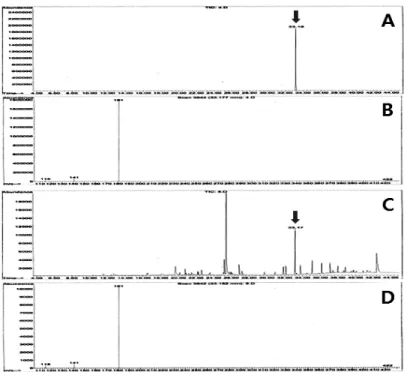
잔류농약 분석 결과는 Table 8에 제시한 바와 같이 도매시 장의 경우 대파 중 alachlor가 1.18 mg/kg 검출되었고 부추 에서 endosulfan이 0.09 mg/kg 검출되었다. 또한 셀러리에 서 procymidone이 0.004 mg/kg 검출되었으며 Fig. 1에 대 표적인 분석 크로마토그램과 Fig. 2와 3에 GC-MSD를 이용 하여 재확인한 TIC(total ion chromatogram)와 spectra를 제시하였다. 채 등(2004)은 식품의 농약 잔류실태조사 및 안 전성 평가 연구에서 900점의 시료 중 부추에서 endosulfan이 0.02-0.23 mg/kg의 범위로 잔류하였다고 보고하였다. 도 등(2010)이 보고한 국내 유통 농산물 중 잔류농약 모니터 링에서 1,604점의 시료를 잔류농약 분석한 결과 상추에서 procymidone이 0.04 mg/kg 검출되었다고 하였다.
재래시장의 경우 깻잎에서 bifenthrin이 검출되었고 잔류 량은 0.012 mg/kg이었으며, 대파에서 검출된 triflumizole 의 잔류량은 0.124 mg/kg이었다. 재래시장 깻잎에서 검출된 bifenthrin을 제외한 나머지 농약은 해당작물에 등록되지 않 은 농약이었다. 전 등(2006)은 인천광역시 유통 농산물의 최
근 3년간의 잔류농약 실태 조사연구에서 10,403점의 시료 중 대파에서 bifenthrin이 0.3 mg/kg 검출되었다고 보고하였다.
박 등(2009)은 2007년 10월부터 2008년 9월에 걸쳐 대형 마트에서 판매중인 배추를 수거하여 잔류농약 분석한 결과 2007년 11월에 수거한 시료에서 bifenthrin이 0.03 mg/kg 검출되었고 보고하였다. 김 등(2008)은 지역특산품 중 잔류 농약 실태조사에서 302점의 시료 중 구기자에서 0.1 mg/kg 의 triflumizole이 검출되었다고 보고하였고, 홍 등(2002)은 식품 중 잔류농약 모니터링에서 792점의 시료 중 셀러리에서 procymidone과 triflumizole이 검출되었다고 보고하였다. 검 출된 농약 중 procymidone과 endosulfan은 검출빈도가 높 은 농약으로 승 등(2009)는 2008년 1월부터 12월까지 서울 강북 지역의 농산물을 대상으로 잔류농약 분석한 결과 전체 시료 3,735점 중 procymidone이 168점에서 검출되어 가장 높은 검출빈도를 보였고, endosulfan은 108점의 시료에서 검 출되어 2번째로 높은 검출빈도를 보였다는 보고와 2007년도 에 수행한 결과에서도 procymidone과 endosulfan이 가장 높은 검출빈도를 보였다는 연구결과와 유사하였다.
Fig. 2. Typical total ion chromatograms (TICs) and GC-MSD spectra of bifenthrin standard and extract of perilla leaves.
A: TIC of bifenthrin standard, B: mass spectrum of bifenthrin standard, C: TIC of bifenthrin detected in perilla leaves collected from traditional market, D: mass spectrum of bifenthrin detected in perilla leaves collected from traditional market.
Fig. 3. Typical total ion chromatograms (TICs) and GC-MSD spectra of procymidone standard and extract of celery.
A: TIC of procymidone standard, B: Mass spectrum of procymidone standard, C: TIC of procymidone detected in celery collected from wholesale market, D: Mass spectrum of procymidone detected in celery collected from market.
검출농약의 등록현황
재래시장의 깻잎에서 검출된 bifenthrin은 등록되어 사용 중인 농약이지만 그 외 검출농약은 해당작물에 등록되지 않은 농약이었다. 도매시장의 셀러리의 경우 abamectin과 spinosad
만이 등록되어 있어 셀러리에서 검출된 농약은 미등록 농약 이었다. 전 등(2006)과 채 등(2004)은 셀러리 중 농약이 검출 되었는데 모두 미등록 농약이었다고 보고하였다. 또한 양 등(2009)은 경상북도 내 유통 농산물 중의 잔류농약 동향
Table 9. Safety assessment of pesticide residues in agricultural products collected from wholesale and traditional markets in Cheongju Market Agricul-tural
product
Pesticide detected
Concent- ration (mg/kg)
Daily food intake
(g/day)
ADIa) (mg/kg/man)
EDIb) (mg/day)
MPIc)
(mg/man/day) %ADId) %MPIe) Whole-
sale Welsh onion Alachlor 1.181 10.95 0.05 0.01293 0.275 25.864 0.0470
Leek Endo-
sulfan 0.088 2.2 0.006 0.00003 0.33 2.596 0.000472
Celery Procy-
midone 0.004 1.77 0.1 0.00016 5.5 0.0003 0.00000006
Tradi- tional
Perilla leaves
Bifen-
thrin 0.012 0.08 0.02 0.0000003 1.1 0.132 0.000024
Welsh onion
Triflu-
mizole 0.124 10.95 0.0185 0.00136 1.018 7.339 0.001334
a)Acceptable daily intake
B)Concentration (mg/kg) × daily food intake (g/day)
c)ADI × 55 kg
d)%ADI = (EDI/ADI) × 100
e)%MPI = (EDI/MPI) × 100
(2004~2008년)에서 셀러리 중 procymidone 등 9종의 농약이 검출되었는데 모두 미등록 농약이었다. 이 등(2010)은 22개 지역에서 16종의 농산물 총 510점에 대하여 잔류농약 분석 한 결과 깻잎에서 isoprothiolane 등 7종의 농약이 검출되었 다고 보고하였는데, 이 중 tebufenpyrad를 제외하고 모두 미 등록 농약이었다. 미등록 농약이 검출되는 이유는 소면적 재 배 작물에 등록된 농약이 많지 않아 미등록 농약을 사용하였 기 때문인 것으로 판단되었다.
잔류허용기준 초과현황
잔류허용기준을 근거로 하여 부적합 농산물 여부를 판정 한 결과 검출된 농약이 해당 작물에 잔류허용기준이 설정된 농약은 재래시장의 깻잎에서 검출된 bifenthrin과 대파에서 검출된 triflumizole이었으며, 잔류허용기준이 각각 2 mg/kg 과 1 mg/kg으로써 검출된 농약은 해당작물의 잔류허용기준 미만으로 적합한 것으로 판단되었다. 나머지 농약은 잔류허 용기준이 설정되지 않아 같은 분류군 중 최저기준을 적용한 결과 도매시장의 부추에서 검출된 endosulfan과 셀러리에서 검출된 procymidone은 잔류허용기준을 초과하지 않아 적합 하였지만 도매시장에서 검출된 alachlor의 경우 고추의 잔류 허용기준을 적용한 결과 잔류허용기준을 초과하여 부적합 농 산물로 판정하였으며, 본 연구에서 사용된 엽채류의 부적합 율은 2.6%이었다. 남 등(2006)은 5개 도시에서 15종의 농산 물을 355점을 수거하여 잔류농약 분석한 결과 15점의 시료 가 부적합 판정을 받아 4.2%의 부적합율을 보였다고 보고하
였다. 국립농산물품질관리원은 2005년에 63,724점의 시료 중 잔류농약을 분석한 결과 730점의 시료가 부적합 판정을 받아 1.1%의 부적합율을 보였다고 보고하였다(국립농산물품질관 리원, 2006). 미국 FDA(2002)에서는 2000년과 2001년에 농 산물 중 잔류농약을 모니터링한 결과 부적합율이 각각 0.7%
와 1.1%로 보고하였다. EU(2002; 2003)의 농산물 중 잔류 농약 모니터링 보고서에서 부적합율이 2000년에는 4.5%이 었고, 2001년에는 3.9%라고 보고하였다.
검출농약의 안전성 평가
검출된 농약의 안전성을 평가하기 위한 ADI 대비 농약섭 취율과 MPI 대비 농약섭취율은 Table 9에 제시한 바와 같 이 도매시장의 대파, 부추 및 셀러리에서 검출된 alachlor, endosulfan 및 procymidone의 식이섭취율은 각각 ADI의 25.9%, 2.6% 및 0.00032%이었다. 재래시장의 경우 깻잎과 대파에서 bifenthrin과 triflumizole이 검출되었는데 농약 섭 취율은 각각 ADI의 0.132%와 7.34%로 안전하다고 판단되 었다. 또한 MPI 대비 농약 섭취율은 검출 농약 모두 0.05%
미만으로 안전하다고 판단되었다. 김 등(2008)은 지역 특산 물 302점을 대상으로 잔류농약 분석한 결과 40점의 시료에 서 농약이 검출되었는데 검출된 농약의 식이섭취율은 모두 ADI의 17.2%이하로 안전하다는 보고와 김 등(2008)은 국내 유통농산물 중 잔류농약 모니터링 및 안전성 평가에서 검출 된 농약 모두 ADI 대비 식이섭취율은 0.36%이하로 안전하 다는 보고와 유사하였다.
청주지역 도매시장과 재래시장 유통 엽채류 중 농약의 잔류 특성
노현호 ・ 이광헌 ・ 이재윤 ・ 박효경 ・ 박소현 ・ 김선호 ・ 경기성*
충북대학교 농업생명환경대학
요 약 청주지역 소재 도매시장과 재래시장에서 유통 중인 농산물 중 농약의 잔류 특성을 조사하고 검출농약의 안전성을 평가하기 위하여 도매시장과 재래시장에서 총 38점의 농산물을 채취한 후 240종의 농약을 대상으로 GLC, HPLC 및 GC-MSD를 이용한 다성분동시분석법으로 농산물 중 잔류농약을 분석하였다. 잔류농약 분석 결과 도매시장에서 채취한 대 파에서 alachlor, 부추에서 endosulfan, 셀러리에서 procymidone이 검출되었으며, 재래시장의 경우 깻잎에서 bifenthrin, 대파에서 triflumizole이 검출되어 13.2%의 검출율을 보였지만 잔류허용기준 초과율은 검출 농약의 2.6%이었다. 검출된 농약의 일일섭취추정량(EDI)과 최대섭취허용량(MPI)은 각각 일일섭취허용량(ADI)의 26%와 0.05% 미만으로 안전한 것으 로 판단되었다.
색인어 잔류농약, 모니터링, 일일섭취허용량, 일일섭취추정량
인 / 용 / 문 / 헌
European commission (2002) Monitoring of pesticide residue in products of plant origin in the european union.
European commission (2003) Monitoring of pesticide residue in products of plant origin in the european union.
European Commission (2004) Monitoring of pesticide residues in products of plant origin in the European Union, Norway, Iceland and Liechtenstein 2002 Report, SANCO/17/04 final.
U.S. Food and Drug Administration (2001) Food and Drug Administration, Pesticide Program, Residue Monitoring.
U.S FDA (2002) Food and drug administration pesticide program, residue monitoring 2001 report.
국립농산물품질관리원 (2006) 2005년 농산물 안전성 조사 결과.
국립농산물품질관리원 (2009) 2008년 농산물 안전성 조사 결과.
국립농산물품질관리원 (2010) 잔류농약 분석법 편람.
김미라, 나미애, 정우영, 감창수, 선남규, 서은채, 이은미, 박유경, 변 정아, 엄준호, 정래석, 이진하 (2008) 지역특산품 중 잔류농약 실태조사, 농약과학회지 12(4):323-334.
김성훈, 최원조, 백용규, 김우성 (2008) 국내유통농산물 중 잔류 농약 모니터링 및 안전성 평가, 한국식품영양과학회지 12(4):
323-334.
남혜선, 최용훈, 윤상현, 홍혜미, 박용춘, 이진하, 강윤숙, 이종옥, 안 영순, 홍영표, 김희연 (2006) 유통중인 농산물의 잔류농약 모니 터링, 한국식품과학회지 38(3):317-324.
도정아, 이희정, 신용운, 최원조, 채갑용, 강찬순, 김우성 (2010) 국 내 유통 농산물 중 잔류농약 모니터링, 한국식품영양과학회지 39(6):902-908.
박병준, 손경애, 백민경, 김진배, 권혜영, 홍수명, 임건재, 홍무기 (2010) 과채류 중 Neonicotinoid계 농약의 모니터링 및 인체노 출평가, 농약과학회지 14(2)104-109.
박소연, 정지강, 강정미, 김소희, 양지영, 강순아, 전혜경, 박건영 (2009) 연중 시중유통 배추에서의 160가지 농약의 잔류실태 모 니터링, 한국식품영양과학회지 38(7):970-975.
보건복지부 (2006) 국민건강영양조사 제3기(2005), 영양조사(1).
승형정, 박성규, 하광태, 김욱희, 최영희, 김시정, 이경아, 장정임, 조 한빈, 최병현 (2009) 서울특별시 강북지역 유통 농산물 중 농약 잔류실태조사(2008), 한국식품위생안전성학회지, 24(4):357-367.
식품의약품안전청 (2004) 식품 중 동시다성분 분석법 개선 연구.
식품의약품안전청 (2006) 농산물 중 중금속 실태 조사.
식품의약품안전청 (2008) 식품공전 (제Ⅱ권) pp.10-9-1-1 - 10-15-5-52.
식품의약품안전청 (2009) 식품의 농약 잔류허용기준.
양승태, 손진창, 정광현, 이창일, 김미정, 박희숙, 차춘근 (2009) 경 상북도 내 유통 농산물 중의 잔류농약 동향(2004~2008), 한국 식품위생안전성학회지 24(4):338-347.
양용식, 서정미, 김종필, 오무술, 정재근, 김은선 (2006) 광주지역에 서 유통되고 있는 수입 농산물의 잔류농약 실태조사, 보건환경 연구원보 21(2):52-59.
이주영, 최원조, 이희정, 신용운, 도정아, 김우성, 최종미, 채갑용, 강 찬순 (2010) 2009년 유통 농산물 중 잔류농약 실태조사, 한국 식품위생안전성학회지 25(2):192-202.
전종섭, 권문주, 오세홍, 남화정, 김혜영, 고종명, 김용희 (2006) 인 천광역시 유통 농산물의 최근 3년간의 잔류농약 실태 조사연구, 한국환경농학회지 25(2):180-89.
채갑용, 이영자, 이종옥, 김우성, 김소희, 강윤숙, 이선화, 김상엽, 정 동윤, 김형수, 김영탁, 김홍표, 최재천, 마정애, 최희주, 김양선, 남혜선, 치용훈, 이진하, 오해성, 윤상현, 홍혜미, 이주연, 최수 영, 방옥균, 안상회 (2004) 식품의 농약 잔류실태조사 및 안전 성 평가 연구, 식품의약품안전청연구보고서 8(2):1960-1968.
한국작물보호협회 (2009) 농약사용지침서, p.262, pp.323-326.
홍무기, 원경풍, 황인균, 최동미, 이강봉, 오금순, 허수정, 서정혁, 임 무혁, 정석윤, 유정림, 이경진, 이은경 (2002) 식품중 잔류농약 모니터링-소면적 재배 채소류, 견과 종실류, 콩류 및 서류를 대 상으로-, 식품의약품안전청연구보고서 6:67-75.