차량 운행기록정보와 통행배정 모형을 이용한 교차로 영향권의 공간적 패턴에 관한 연구
박승준1・ 홍기만2・ 김태균2・ 서현3・ 조중래1・ 홍영석4*
1
명지대학교 교통공학과,
2명지대학교 산학협력단,
3(주)큐빅웨어,
4명지대학교 대학부설연구소 산업기술연구소
A Study on Spatial Pattern of Impact Area of Intersection Using Digital Tachograph Data and Traffic Assignment Model
PARK, Seungjun
1・ HONG, Kiman
2・ KIM, Taegyun
2・ SEO, Hyeon
3CHO, Joong Rae
1・ HONG, Young Suk
4*1
Department of Transportation Engineering, Myongji University, Gyeonggi 17058, Korea
2
Industry and Academia Cooperation Foundation, Myongji University, Gyeonggi 17058, Korea
3
QBicware Corporation, Gyeonggi 14048, Korea
4
Industrial Technology Research Institute, Research Institutes, Myongji University, Gyeonggi 17058, Korea
*Corresponding author: [email protected]
Abstract
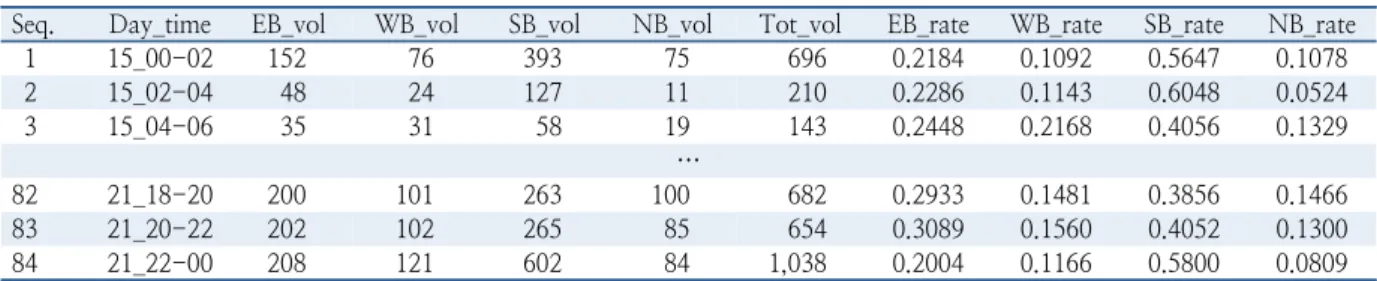
In this study, we studied the directional pattern of entering the intersection from the intersection upstream link prior to predicting short future (such as 5 or 10 minutes) intersection direction traffic volume on the interrupted flow, and examined the possibility of traffic volume prediction using traffic assignment model. The analysis method of this study is to investigate the similarity of patterns by performing cluster analysis with the ratio of traffic volume by intersection direction divided by 2 hours using taxi DTG (Digital Tachograph) data (1 week).
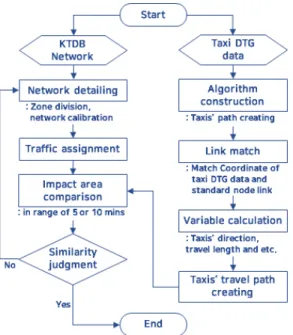
Also, for linking with the result of the traffic assignment model, this study compares the impact area of 5 minutes or 10 minutes from the center of the intersection with the analysis result of taxi DTG data. To do this, we have developed an algorithm to set the impact area of intersection, using the taxi DTG data and traffic assignment model. As a result of the analysis, the intersection entry pattern of the taxi is grouped into 12, and the Cubic Clustering Criterion indicating the confidence level of clustering is 6.92. As a result of correlation analysis with the impact area of the traffic assignment model, the correlation coefficient for the impact area of 5 minutes was analyzed as 0.86, and significant results were obtained. However, it was analyzed that the correlation coefficient is slightly lowered to 0.69 in the impact area of 10 minutes from the center of the intersection, but this was due to insufficient accuracy of O/D (Origin/
Destination) travel and network data. In future, if accuracy of traffic network and accuracy of O/D traffic by time are improved, it is expected that it will be able to utilize traffic volume data calculated from traffic assignment model when controlling traffic signals at intersections.
Keywords: digital tachograph, impact area, intersection, intersection traffic volumes, traffic assignment, traffic network, traffic pattern
ARTICLE HISTORY Received: 7 March 2018 Revised: 27 March 2018 Accepted: 27 March 2018
Copyright Ⓒ
Korean Society of Transportation
This is an Open-Access article distributed under the terms of the Creative Commons Attribution Non-Commercial License(http://creativecommons.org/licenses/by-nc/3.0) which permits unrestricted non-commercial use, distribution, and reproduction in any medium, provided the original work is properly cited.
J. Korean Soc. Transp.
Vol.36, No.2, pp.155-168, April 2018 https://doi.org/10.7470/jkst.2018.36.2.155 pISSN: 1229-1366
eISSN: 2234-4217