• 검색 결과가 없습니다.

FFT analysis of load data during field operations using a 75-kW agricultural tractor

N/A
N/A
Protected

Academic year: 2021

Share "FFT analysis of load data during field operations using a 75-kW agricultural tractor"

Copied!
7
0
0

로드 중.... (전체 텍스트 보기)

전체 글

(1)

FFT analysis of load data during field operations using a 75-kW agricultural tractor

Myong-Jin Ryu

1

, Sun-Ok Chung

1

*, Yong-Joo Kim

2

, Dae-Hyun Lee

2

, Chang-Hyun Choi

3

, Kyeong-Hwan Lee

4

1

Dept. of Biosystems Machinery Engineering, Chungnam National University, Daejeon 305-764, Korea

2

Machinery Technology Group, Advanced R&D Center, LS Mtron Ltd., Gunpo 435-831, Korea

3

Dept. of Bio-mechatronic Engineering, Sungkyunkwan University, Suwon 440-746, Korea

4

Dept. of Rural & Bio-Systems Engineering, Chonnam National University, Gwangju 500-757, Korea

Received on 30 December 2012, revised on 19 March 2013, accepted on 19 March 2013

Abstract : Analysis of load data during field operations is highly important for optimum design of power drive lines for agricultural tractor. Objective of the paper was to analyze field load data using FFT to determine frequency and the energy levels of meaningful cyclic patterns. Rotary tillage, plowing, baling, and wrapping operations were selected as major field operations of agricultural tractor. An agricultural tractor with power measurement system was used. The tractor was equipped with strain-gauge sensors to measure torque of four driving axles and a PTO axle, speed sensors to measure rotational speed of the driving axles and an engine shaft, pressure sensors to measure pressure of hydraulic pumps, an I/O interface to acquire the sensor signals, and an embedded system to calculate power requirement. In rotary tillage, calculated frequency was decreased as travel speed increased. In baler operation, calculated frequency was increased as PTO speed was increased. The calculated peak frequency levels and expected levels were similar. Results of the study would provide information on power utilization patterns and on better design of power drive lines.

Key words : Agricultural tractor, Field operation, Load, FFT

*Corresponding author: Tel: +82-42-821-6712 E-mail address: [email protected]

I. Introduction

Study for improving the efficiency of fuel use is on-going in various industrial sectors due to both rising fuel prices caused by the decrease of fossil fuels and pollution problems in the global ecosystem caused by the excessive consumption. In case of automotive industry, study and development hybrid cars and electric vehicles to reduce fuel consumption has been progressed (DACO Industrial Research Institute, 2010).

Study to reduce fuel consumption has been pro- gressed also in agricultural sector. Kim et al. (2010) developed a mathematical model to predict the fuel consumption rate of agricultural tractors under various load conditions. Percent errors of the predicted fuel consumption model were from 0.36 to 2.86%, which

provided the high performance in various conditions.

Park et al. (2010) investigated decreasing rate of fuel consumption by economic drive of 37-kW tractor, and found that fuel consumption rates were decreased by 69% in plow tillage and 54% in rotary tillage, respectively.

The load on an agricultural tractor is dependent on travelling speed and field operations. The loads would vary differently by type of field work, environmental conditions, tractor driving condition. By the accurate information about the load characteristics depending on the type of operations and the status of the tractor, fuel consumption can be reduced with the appropriate driving. Therefore, the load analysis of tractor is highly required to estimate the proper output according to each field operation.

Mclaughlin and Heslop (1993) developed an instrumented

tractor and a data logging system to test field ex-

periments for 97-kW agriculture tractors. The developed

(2)

Table 1. Experiment condition of field operations.

Plow tillage

Rotary tillage

Baler operation

Wrapping operation Levels of

transmission speed

L3(3.77 km/h) L1(1.87 km/h) L4(5.41 km/h)

H1(13.08 km/h) L4(5.41 km/h) L2(2.64 km/h) M1(5.11 km/h)

Levels of

PTO speed - P1(585 rpm) P1(585 rpm)

P2(756 rpm) P2(756 rpm) - system was equipped with various sensors to measure

fuel consumption, engine speed, wheel speed, ground speed, weight of front and rear axle, and toque of front and rear axle. Also a signal converter was used to measure the load from three-point hitch. The signals from each sensor were stored into data logging device through the preprocessing by dividing, amplifying and filtering.

Tractor load can be largely divided into two parts:

drawbar load and PTO load. Kim et al. (2009) carried out a study of comparative analysis between the engine full load and drawbar load. At the condition of the engine's maximum output, ratio of drawbar load was generally from 70% to 90%. Also, study of analysis power consumption of a 30-kW tractor during major operations was reported (Kim et al., 2011).

Power consumption in major field operations (plow, rotary tillage, loader operation) were examined during total operation period and actual field operation period.

Results of averaged power requirement for total operation and actual field operation were 17.5 and 23.1 kW, 19.1 and 24.6 kW, and 8.9 and 14.9 kW, respectively.

FFT (Fast Fourier Transform) converts signals in the time domain into signals in the frequency domain.

Periodic characteristic in raw signal can be identified by observing the converted signals in the frequency domain. FFT analysis has been used in various fields.

This method is useful for the characterization of video and audio, and noise reduction (Ingle and Proakis, 2007). And the data processing method has been used in medical devices, and fault diagnosis and accident prevention with mechanical system.

Utilization of the FFT analysis were also conducted in the section of agricultural machinery. Cerruto et al. (2010) reported the results of the FFT analyses to evaluate the vibration level from the tractor driver during the operation of pesticide application in a citrus orchard. As results of the FFT analysis, main frequency corresponding to the engine speed was from 35 Hz to 37 Hz. Also, other lower frequency was found at from 2 Hz to 3 Hz that was due to the tractor travels.

Nguyen and Inada (2011) identified the characteristics of variations in wheel-load and vibrations from the tractor of rear axle using the FFT. The experiments were conducted on an asphalt road and sandy loam field at different experimental conditions with approxi- mate forward speeds of 0.6, 1.6 and 2.6 m/s, and tire inflation pressures of 330 and 80 kPa. Results showed that there was no significant relation between wheel- loads and vibrations while wheel loads were remarkably affected by the change of tire pressure and travelling speed.

Objectives of this study were 1) to measure the load data of major components in an agricultural tractor by field operations, and 2) to investigate the char- acteristics of the load data using FFT analysis.

II. Materials and methods

1. Experimental design

Experiments were conducted from April 1

st

to June

30

th

, 2011, at paddy fields. Field conditions were after

barley harvesting and before rice transplanting. Plow

tillage, rotary tillage, baler operation and wrapping

(3)

Fig. 1. 75-kW agricultural tractor used in the study.

Table 2. Specifications of the 75-kW agricultural tractor.

Item Specifications

Size (mm) 4,000×2,677×2,640

Weight (kg) 3,260

Engine power (kW) 75

PTO power (kW) 65

Table 3. Specifications of the implements used.

Plow tillage Rotary tillage Baler operation Wrapping operation Size (mm) 2,395×2,420×1,165 1,050×2,580×1,380 4,050×2,550×2,450 2,500×2,100×2,650

Weight (kg) 502 815 3,500 820

Working width (mm) 2,488 2320 1230 Bale 1500

Characteristic 2ⅹ4 blades 9ⅹ6 blades 18 rollers Cable control

Table 4. Selected major components and specifications of the sensors.

Sensor Measurement data Model Range Accuracy

Strain gauge Toque CEA-06-250US-350 0∼350 Ohms ± 0.4%

Encoder Rotational speed SR-10M/E60 0∼6000 rpm ± 1 rpm

Pressure sensor Hydraulic pressure P6A 0∼500 bar ± 0.2%

Flowmeter Fuel consumption M05 0.003∼0.8 L/min ± 0.5%

Radar speed sensor Travel speed Radar sensor 3 0.53∼107.8 km/h ± 3 %

Thermocouple Temperature Thermocouple T -200∼350 °C ± 1°C

operation were selected as the major field operations.

Levels of transmission and PTO speed of each operation were selected through interview with farmers. Experimental conditions were two levels of plow tillage, four levels of rotary tillage and baler operation, and one level of wrapping operation (Table 1).

2. Specifications of agricultural tractor and implements

Figure 1 and Table 2 show photo and specifications of the agricultural tractor (L7040, LS Mtron Ltd., Korea) used in this research. Dimensions of the tractor were 4,000ⅹ2,677ⅹ2,640 (LⅹWⅹH) mm, and total mass was 3,260 kg. Tractor rated output of engine was 75 kW at 2,500 rpm and the output of PTO was 65 kW. The theoretical efficiency of transfer power is 85 to 95% with the type of mechanical manual transmission. Hydraulic pump was directly connected to the engine. The theoretical discharge rates of main and auxiliary pump were 12 and 6 cc/rev, respectively.

Table 3 is specifications of the implements used.

Plow (SW-PS2408, Sewoong Machinery Co., Korea) had blades and rotary (WJ230E, Woongjin Machinery Co., Ltd., Korea) had 54 blades. And, baler (F550, MCHale Engineering Ltd., Ireland) has 18 rollers and bale wrapper (RF1500, ELHO Co., Netherlands) has cable control system.

3. Major components and load measurement system

Table 4 shows the selected major measurement and

(4)

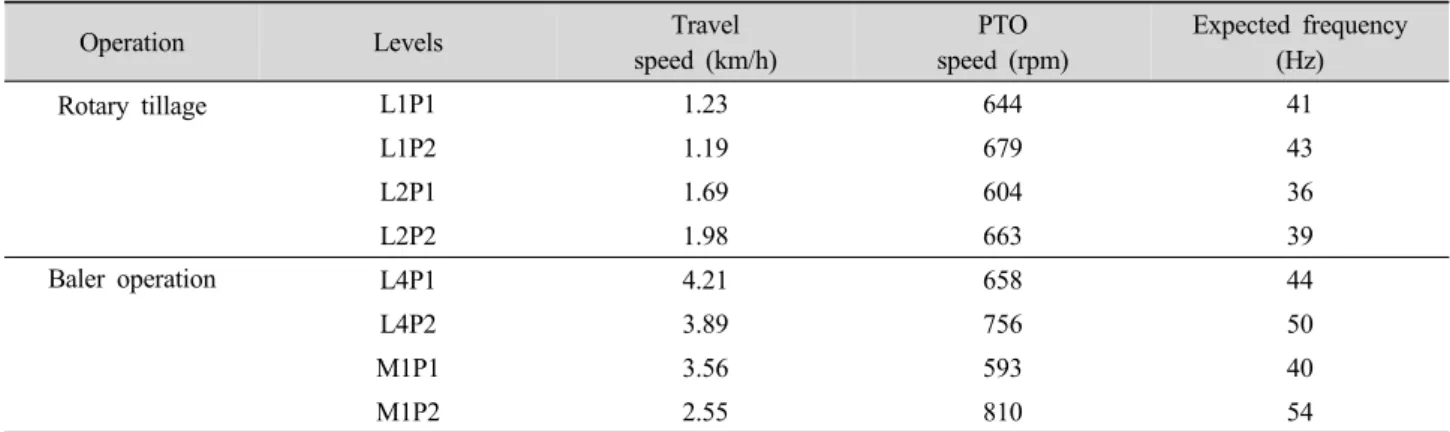
Table 5. Expected frequency in rotary tillage and baler operation by FFT analysis.

Operation Levels Travel

speed (km/h)

PTO speed (rpm)

Expected frequency (Hz)

Rotary tillage L1P1 1.23 644 41

L1P2 1.19 679 43

L2P1 1.69 604 36

L2P2 1.98 663 39

Baler operation L4P1 4.21 658 44

L4P2 3.89 756 50

M1P1 3.56 593 40

M1P2 2.55 810 54

specifications of sensor. Measurement method of rotation speed and torque of transmission input shaft and the PTO input shaft were the same. Rotation speed of transmission and engine were at a 1:1 ratio.

Rotational speed of transmission input shaft was measured using a built-in tachometer. Torque of the transmission and PTO input shaft were measured using strain gauge (CEA-06-250US-350, Micro Measurement Co., USA). To monitor signals generated from the strain gauge, the principle of wheatstone bridge was applied.

Rotational speed of the four-axle were measured by encoder (60 pulse encoder) embedded in the slip ring (SR-10M/E60, MI-Scientific Co., USA). And, torque of four-axle was measured using four element full-bridge strain gauge which was same to transmission and PTO torque.

The required pressure and flow rate of the hydraulic pump power were measured and calculated. The pressures of main and auxiliary hydraulic pump were measured using installed pressure sensor (P6A, HBM, Germany).

Because rotational speed of the engine and hydraulic pump are proportional, flow rate was calculated by using the rotational speed and the theoretical discharge rates of each pump.

Fuel consumption by the engine was measured using a flow meter (M05, NURITECH, Korea) that was installed at fuel supply hose. Radar speed sensor (Radar sensor 3, DICKEY-John, USA) was measure ground speed at the under the bonnet, center to the

front axle. Temperature of fuel, transmission, oil and ambient were measured using T type of thermocouple to ensure the reliability of accurate measurement.

Load measurement system was consisted of three 8-channel data acquisition unit (QuantumX MX840, HBM, and Germany) in order to concurrently measure 18 signals. A data acquisition device has advantage of receiving both analog and digital signals simul- taneously, and easily removes noise by their own built-in FPGA (Field Programmable Gate Array). Torque and pressure signal were transferred to analog input channels with sampling rate of 19.2 kHz and resolution of 24 bit per channel. And, rotational speed of the engine and four-axle were transferred to digital input channels with sampling rate of 1 MHz. The measured sensor signals were transmitted to the laptop using the firewire (IEEE 1394) communication. Measurement program was developed using Catman (version 3.1, HBM, Germany).

4. Analytical method of load data

In this study, periodic characteristic of load data

of an agricultural tractor was analyzed by FFT

method. The maximum number of rotational speed of

the engine was 2600rpm. So, measured rate should be

greater than 217 Hz to confirm the accurate periodic

characteristics. Measured rate of data acquisition

unit of used in this study was 200 Hz. Load data of

(5)

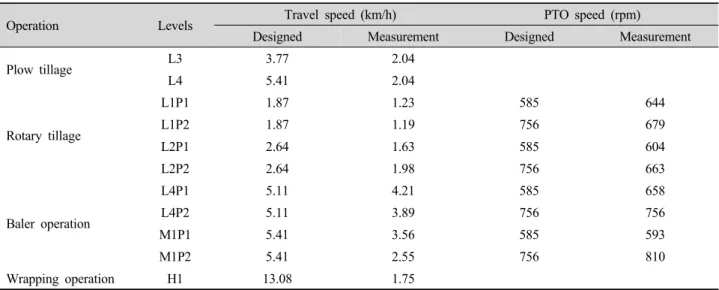
Table 6. Comparison of designed and actual speed of travel and PTO.

Operation Levels Travel speed (km/h) PTO speed (rpm)

Designed Measurement Designed Measurement

Plow tillage L3 3.77 2.04

L4 5.41 2.04

Rotary tillage

L1P1 1.87 1.23 585 644

L1P2 1.87 1.19 756 679

L2P1 2.64 1.63 585 604

L2P2 2.64 1.98 756 663

Baler operation

L4P1 5.11 4.21 585 658

L4P2 5.11 3.89 756 756

M1P1 5.41 3.56 585 593

M1P2 5.41 2.55 756 810

Wrapping operation H1 13.08 1.75

Table 7. FFT analysis results for rotary tillage.

Level of transmission and PTO speed

Travel Speed (km/h)

PTO Speed (rpm)

Expected frequency (Hz)

Calculated frequency (Hz)

L1P1 1.23 644.17 41 42

L1P2 1.19 678.67 43 43

L2P1 1.69 604.10 34 35

L2P2 1.98 663.12 39 36

PTO shaft in rotary tillage and baler operation were analyze. FFT analysis was performed using Matlab (version 2010a, The MathWorks Inc., USA) and 'Pwelch' function with 50% overlap and hamming window.

Considering the rotational speed of PTO shaft and characteristics of implements, load patterns could be predict. In case of rotary, 6 blades were attached around each of 9 flanges. If the rotary shaft makes one turn, soil would be failed 6 times. Frequency levels of 41, 43, 36 and 39 Hz were predicted using a rotational speed of shaft (Table 5). And, in case of baler, 44, 50, 40 and 54 Hz were predicted, because number of the pick-up device blades was four.

III. Results and discussion

1. Comparison of designed and actual speed of travel and PTO

Table 6 shows difference of designed and actual

levels of travel and PTO speeds. In all operation, measured travel speeds were slower than the designed speed. Actual travel speeds were slower than the designed speeds due to load and slip by soil strength at working. But, overall, actual PTO speeds were higher than designed speeds. In rotary tillage, PTO speed at P1 level was higher, and at P2 level was lower. And in the baler operation, measured PTO speed was greater than the designed speed.

2. FFT analysis results

Table 7 and figure 2 show specific frequency by FFT

analysis in rotary tillage. Overall, calculated frequency

was decreased as travel speed increased. In the L1

level of transmission speed, expected and calculated

frequency levels were very similar. The peak frequency

levels of PTO input shaft torque was found at 42 and

43 Hz with L1P1 and L1P2 l levels, respectively. But,

in the L2 level, calculated frequency and expected

(6)

(a) (b)

Fig. 2. Result of FFT analysis of rotary tillage: (a) L1P1 and L1P2 level of transmission and PTO speed, (b) L2P1 and L2P2 level of transmission and PTO speed.

Table 8. FFT analysis results of baler operation.

Level of transmission and PTO speed

Travel Speed (km/h)

PTO Speed (rpm)

Expected frequency (Hz)

Investigated frequency (Hz)

L1P1 4.21 657.51 44 44

L1P2 3.89 756.04 50 50

L2P1 3.56 593.17 40 40

L2P2 2.55 810.80 54 54

(a) (b)

Fig. 3. Result of FFT analysis of baler operation: (a) L4P1 and L4P2 level of transmission and PTO speed, (b) M1P1 and M1P2 level of transmission and PTO speed.

were a little different. The calculated peak frequency levels of PTO input shaft torque were found at 35 and 36 Hz, and expected peak frequency were found at 34 and 39 Hz. In L2P2 level, calculated frequency was more less than expected. One of possible explanation of this result is the change of soil failure distance by

increase of working speed.

In baler operation, the calculated peak levels were 44, 50, 40 and 54 Hz at L1P1, L1P2, L2P1 and L2P2 levels (Table 8 and Fig. 3). The calculated frequency levels were increased as PTO speed was increased.

Results showed that the calculated peak frequency levels

(7)

and expected levels were similar, possibly because the PTO load patterns were not affected by working speed and soil characteristics.

IV. Conclusions

In the study, load data of an agricultural tractor at major field operations (plow tillage, rotary tillage, baler operation and wrapping operation) were analyzed by FFT method. Major findings were summarized as followings.

1. In the rotary tillage, calculated frequency was decreased as travel speed increased. And, at the L1 level of transmission speed, expected and calculated frequency levels were very similar.

But, at the L2 level, calculated frequency and expected were a little different.

2. In baler operation, calculated frequency was increased as PTO speed was increased. And, the calculated peak frequency levels and expected levels were similar.

In the future, study of development of load simu- lation and performance evaluation will be carried out.

Acknowledgements

“This report was supported by the leading industry

development project for economic region (Project No.

A0022 01090) and equipments of the Honam Leading Industry Office of the Korean Ministry of Knowledge Economy.”

References

Cerruto E, Emma G, Manetto G. 2010. Whole body vibrations of tractor driver in citrus orchard. In: Proceedings of the International Conference Ragusa SHWA2010. pp. 396-403, Ragusa, Italy.

DACO Industrial Research Institute. 2010. Development Trends and Market Outlook of Global Hybrids Cars and Electric Vehicles. DACOIRI Publishing Co., Seoul, Korea.

Ingle VK, Proakis JG. 2007. Digital Signal Processing Using MATLAB. Cengage Leaning, Stamford, CT, USA.

Kim SC, Kim KU, Kim DC. 2009. Analysis drawbar load acting on tractor engine at maximum drawbar power. Journal of Biosystems Engineering 34(2):71-76.

Kim SC, Kim KU, Kim SS. 2010. Modeling of fuel consumption rate for agricultural tractors. Journal of Biosystems Engineering 35(1):1-9.

Kim YJ, Chung SO, Park SJ, Choi CH. 2011. Analysis of power requirement of agricultural tractor by major field operation. Journal of Biosystems Engineering 36(2):79-88.

Mclaughlin NB, Heslop LC. 1993. A general purpose tractor instrumentation and data logging system. Transactions of the ASAE 36(2):265-273.

Nguyen VN, Inaba S. 2011. Effects of tire inflation pressure and tractor velocity on dynamic wheel load and rear axle vibrations. Journal of Terramechanics 48:3-16.

Park SH, Kim YJ, Kim DH, Kim CK, Jung SC, Kim HJ, Jang

Y, Kim SS. 2010. Development of eco driving system for

agricultural tractor. Journal of Biosystems Engineering

35(2):77-84.

수치

Table 1. Experiment condition of field operations. Plow tillage Rotarytillage Baler operation Wrappingoperation Levels of  transmission speed L3(3.77 km/h) L1(1.87 km/h) L4(5.41 km/h) H1(13.08 km/h) L4(5.41 km/h) L2(2.64 km/h) M1(5.11 km/h) Levels of PTO s
Table 5. Expected frequency in rotary tillage and baler operation by FFT analysis.
Table 6. Comparison of designed and actual speed of travel and PTO.
Fig. 2. Result of FFT analysis of rotary tillage: (a) L1P1 and L1P2 level of transmission and PTO speed, (b) L2P1 and L2P2 level  of transmission and PTO speed.

참조

관련 문서

Fig. Location of gauge stations.. Reservoir storage rate and precipitation data for test stations.. Analyzed agricultural and meteorological drought for test stations.. 지점별

Aspects of the gear-strength such as bending stress, contact stress, and safety factors were analyzed under two torque conditions: the equivalent torque at the highest plow

The purpose of this study is to analyze power requirement of the underground crop harvester attached on agricultural tractor for traction operation.. First, a power