• 검색 결과가 없습니다.

IEG 환경지질연구정보센터

N/A
N/A
Protected

Academic year: 2021

Share "IEG 환경지질연구정보센터"

Copied!
11
0
0

로드 중.... (전체 텍스트 보기)

전체 글

(1)

Geosciences Journal

Vol. 11, No. 4, p. 357 − 367, December 2007

Sulfur and oxygen isotopic compositions of the dissolved sulphate in the meteoric water in Chuncheon, Korea

ABSTRACT: The meteoric water deposited in the Chuncheon area was collected from July 2002 to May 2004 and its chemical and isotopic compositions were analyzed to examine if the isotopic data can help trace the sources of the sulfur pollutant and under- stand the details of acid formation processes in the air. The chem- ical compositions of the meteoric water indicate that the sulfate mostly comes from anthropogenic sources. The sulfur isotopic compositions of the dissolved sulfate in the meteoric water ( δ

34

S

SO4

) vary from 2.6 to 7.5‰ with little seasonal differences, which are significantly different from those of the sulfur in the coal being locally consumed ( −4.5 to −0.7‰). This difference indicates that the local coal consumption gives insignificant contribution to the pollutant sulfur in the acid deposition of the area. The relationship between δ

34

S

SO4

and the concentration of sulfate suggests that the sources of pollutant sulfur are variable and inhomogeneous. The oxygen isotopic compositions of the dissolved sulfate in the mete- oric water ( δ

18

O

SO4

) range from 9.0 to 17.2‰, which are generally lower in winter than in spring. Comparison between the measured and calculated values of δ

18

O

SO4

suggests that the oxygen isotopic exchange between sulfite and water occurs before its oxidation to sulfate. The extent of isotopic exchange seems to be not controlled by equilibrium but by kinetic fractionation. The poor correlation between δ

18

O

SO4

and the oxygen isotopic composition of the meteoric water confirms the disequilibrium nature of the isotopic exchange.

Key words: sulfur and oxygen isotope, meteoric water, pollutant sulfur sources, acid forming processes

1. INTRODUCTION

The rapid industrial growth of East Asia forces the coun- tries in the region, including Korea, Japan, and China, to face a number of serious environmental problems. One of the environmental problems more concerned is the acid deposition caused by the anthropogenic sulfur and nitrogen emission into the air. Sulfur has been considered to be a greater contributor to the acid deposition than nitrogen, although the importance of nitrogen is increasing as the controls on sulfur emission have been tightened in recent years (Han et al., 2006). The chemical compositions of the

precipitation from Yu and Park (2004) and Jeon and Chung (2005) indicated that pollutant sulfur plays bigger role in forming acid deposition than nitrogen in the southern Korean peninsular.

Like most of the other air pollutants, sulfur can travel a fairly long distance and make a transboundary pollution.

Since there has been dispute on the estimation on the amount of transboundary pollution of sulfur, especially in East Asia (Huang et al., 1995; Ichikawa and Fujita, 1995;

Streets et al., 2000; Carmichael et al., 2002), the sulfur pol- lution may raise a delicate conflict among neighboring countries in the region. An appropriate estimation of the transboundary pollution may first require tracing the sources of the acid and understanding the principles of the acid formation. Tracing the sources of the pollutant sulfur has mostly relied on the physical models (e.g. Dastoor and Pudykiewicz, 1996). An addition of another tracer, e.g. a chemical or an isotopic tracer, to the physical models can enhance the efficiency and accuracy of the source tracking.

Isotopic compositions of the acids in the precipitation can be used as an effective tool for tracing the acid sources and elucidate the details of the acid formation processes. The sulfur isotopic compositions ( δ

34

S) of atmospheric sulfur dioxide (SO

2

) or sulfate (SO

4

) have been investigated to trace the sulfur sources, as summarized by Krouse (1980) for the researches before 1980. Recently, Na et al. (1995), Ohizumi et al. (1997), McArdle et al. (1998) Pichlmayer et al. (1998), Panettiere et al. (2000), and Yu and Park (2004) studied δ

34

S of sulfate ( δ

34

S

SO4

) in the atmospheric precip- itation. The results from these previous investigations show that the δ

34

S values of atmospheric pollutant sulfur are gen- erally lower than that of sea sulfate and could be indicative of the pollution sources. In many cases, however, the sources not only produce variable amount of sulfur but also have inhomogeneous δ

34

S values (Krouse, 1980), which may be partly responsible for the disagreements in identifying the sources of sulfur pollutants among investigations.

Sulfur is mainly emitted as SO

2

, most of which is prob- ably an oxidation product of sulfide in the fossil fuels dur- ing combustion. SO

2

is hydrated to sulfite (SO

3

) and then Jae-Young Yu*

Youngyun Park

Randall E. Mielke Max L. Coleman

} }

Department of Geology, Kangwon National University, Chuncheon, Kangwon-Do 200-701, Korea Center for Life Detection, Jet Propulsion Laboratory, 4800 Oak Grove Drive, Pasadena, CA 91109, USA

*Corresponding author: [email protected]

Present address: Environmental Tracer Team, Korea Basic Science

Institute, 52 Yeon-dong, Yusung-gu, Daejeon 305-333, Korea

(2)

further oxidized to SO

4

which forms sulfuric acid causing acid rain:

M-S + 3O

2

→ MO + SO

2

, (R1)

SO

2

+ H

2

O → H

2

SO

3

, and

39)

(R2)

H

2

SO

3

+ 0.5O

2

→ H

2

SO

4

(R3)

As shown in the above reactions, the oxygen in the sulfur oxides comes from two sources; water and free oxygen whose isotopic compositions are remarkably different. The oxygen isotopic composition of meteoric water ( δ

18

O

w

) is commonly less than 0‰ (Epstein and Mayeda, 1953; Tor- ran and Harris, 1989), while that of free oxygen ( δ

18

O

a

) is 23.5‰ (Kroopnick and Craig. 1972). This big difference in δ

18

O between the two sources may enable to estimate the relative contribution of each source to the sulfate oxygen with the oxygen isotopic composition of sulfate ( δ

18

O

SO4

) and to check if the estimated contribution is pertinent to that expected from the stoichiometry given by the above reac- tions. The investigations on δ

18

O

SO4

, however, have been relatively rare. A few studies on δ

18

O

SO4

showed that the oxygen in sulfate mainly originates from water (Lloyd, 1968; Mizutani and Rafter, 1969; Cortecci and Longinelli, 1970; Holt et al., 1981), which is quite contrary to what the stoichiometry of the above reactions suggest, that is, most of the sulfate oxygen should come from free oxygen.

The purposes of this study are to examine δ

34

S

SO4

and δ

18

O

SO4

in the meteoric water in Chuncheon, Korea, and to see if the combination of these two isotopes helps trace the sources of the sulfur pollutant and understand the acid for- mation processes further. As mentioned earlier, δ

18

O

SO4

is rarely investigated and this study is probably one of the few combining sulfur and oxygen isotopes for the investigation on pollutant sulfur.

2. METHODS

Samples of meteoric water (rain + snow) were collected at each precipitation event with a homemade sampler placed at the top of Natural Science building 3 of Kangwon National University in Chuncheon from July 2002 to May 2004. The collected water samples were filtered through a 0.2 μm micropore membrane and an aliquot of 250 ml of each filtered sample was acidified with approximately 0.2 ml HNO

3

. The filtered and acidified samples were refrigerated at 4

o

C for later analysis. The samples of the coal and petro- leum being locally consumed for heating and automobiles were also collected.

The pH, Eh, conductivity (K

25

) and temperature (T) of water samples were measured when the samples were being collected at the site. The alkalinities of the water samples were determined using Gran method (Wetzel and Likens, 1991) on a 50 ml aliquot of the filtered sample on the same day of sample collection. The carbonate concentrations were calculated from the measured alkalinities assuming that

only carbonates significantly contribute to the alkalinity (Stumm and Morgan, 1981). The chemical compositions of the water samples were analyzed with an inductively cou- pled plasma atomic emission spectrometer (ICP-AES; for Si, Al, Ca, Mg, K, and Na) at the Seoul Branch of the Korean Basic Science Institute (KBSI) and an ion chro- matograph (IC; for NH

4

, Cl, NO

3

, and SO

4

) at the Depart- ment of Geology, Kangwon National University.

δ

18

O

w

and hydrogen isotopic compositions of water ( δD

w

) were obtained from the analysis of CO

2

equilibrated with the water (Epstein and Mayeda, 1953) and H

2

released from the water by Zn-reduction (Coleman et al., 1982), respectively.

The dissolved sulfate in the water samples was precipitated as BaSO

4

(Kolthoff et al., 1969), which was then analyzed for sulfur and oxygen isotopic compositions. δ

34

S

SO4

was determined by analyzing SO

2

released from the BaSO

4

mixed with V

2

O

5

and quartz glass at 1120

o

C (Yanagisawa and Sakai, 1983). δ

18

O

SO4

was measured with CO generated from the mixtures of BaSO

4

and Ag

2

S in the presence of graphite and glassy carbon in the Finnigan Thermal Com- bustion/Elemental Analyzer (TC/EA) at 1450

o

C. Sulfur in the petroleum samples were attempted to extract with com- bustion in an oxygen bomb (Na et al., 1995) and in a fur- nace while the exhaustion gas was being bubbled through 1% H

2

O

2

solution (Lodge, 1990). None of these methods gave enough sulfur for isotopic analyses of petroleum. Sul- fur in the coal samples were extracted by igniting coal with CuO in an electric furnace, from which the evolved SO

2

was directly trapped and analyzed.

The standards for reporting the isotopic compositions are Standard Mean Oceanic Water (SMOW) for δ

18

O and δD and the troilite from Cañon Diablo meteorite (CDT) for δ

34

S. All the isotopic analyses except δ

18

O

SO4

were per- formed with a mass spectrometer, model PRISM II of Micromass UK Ltd. at KBSI in Daejeon, Korea. δ

18

O

SO4

were measured with Finnigan Conflo III and Finnigan MAT 253 SIR-MS in Jet Propulsion Laboratory (JPL) in Pasa- dena, USA. The reference materials used in the analyses were: SMOW ( δ D=0.0‰) and SLAP (δ D=428‰) from International Atomic Enery Agency (IAEA) for δD

w

; KBSI Lab standard KBSI-27 ( δ

18

O=9.6‰) and SMOW (δ

18

O=0.0‰) for δ

18

O

w

, NBS-127 BaSO

4

( δ

34

S=20.3‰) for δ

34

S

SO4

, NBS- 127 BaSO

4

( δ

18

O=8.6‰) and JPL Lab standard BaSO

4

( δ

18

O=11.6‰) for δ

18

O

SO4

, and NBS-123 sphalerite ( δ

34

S=

17.4‰) for δ

34

S of coal. The standard errors of the mea- surements were estimated to be less than 2‰ for δD

w

, 0.1‰

for δ

18

O

w

, 0.2‰ for δ

34

S, and 0.3‰ for δ

18

O

SO4

. 3. RESULTS AND DISCUSSION

Appendix I lists the chemical and isotopic compositions

of the collected meteoric water samples. The chemical com-

positions of the meteoric water in the study area indicate

that Ca-(Mg)-SO

4

rather than Na-CO

3

is the dominant cat-

(3)

Sulfur and oxygen isotopic compositions of the dissolved sulphate 359

ion-anion couple. The sources of Ca, Mg and SO

4

in the meteoric water could be the natural mineral dust, artificial gases and airbone particles, or the sea salt spray. Park et al.

(2006) described detailed chemistries and the possible sources of the dissolved components in the meteoric water in the Chuncheon area.

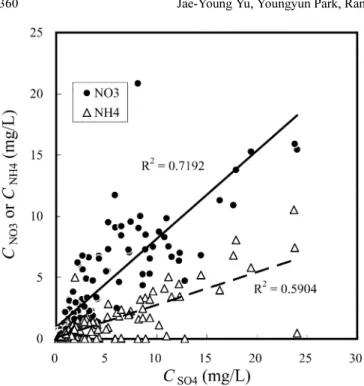
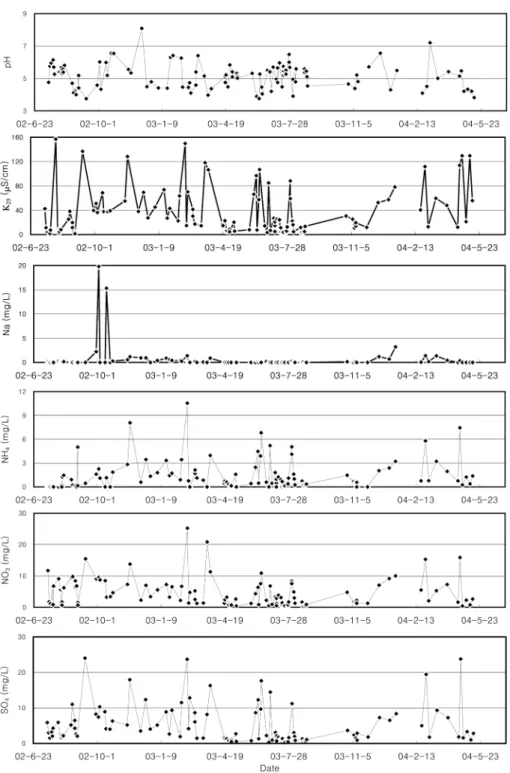
Fig. 1 compares the concentration variations of some of the major dissolved components in the meteoric water. The variation patterns of the conductivity (K

25

), and three major air pollutants (NH

4

, NO

3

, and SO

4

) are similar to one another, but significantly different from those of the rest.

The correlation coefficients are fairly high among the three pollutants (Fig. 2), but those among other dissolved com- ponents are generally very low. It implies that the extent of air pollution is the key factor in controlling the chemistry of the meteoric water.

δD

w

and δ

18

O

w

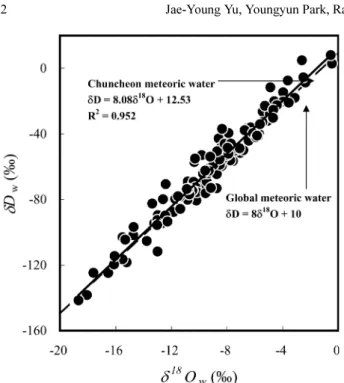
show good correlation to each other, but both of them are poorly correlated with the air temperature (Fig. 3). Fig. 4 shows that the meteoric water aligns along a line parallel to the global meteoric water line, indicating that the water vapor formed at various locations and trans- ported to Chuncheon with little fractionation before deposition.

Fig. 1. Temporal variations of some of

the dissolved components in the mete-

oric water.

(4)

δ

34

S

SO4

and δ

18

O

SO4

were measured only for the meteoric water samples having enough amount of the dissolved SO

4

to produce recoverable BaSO

4

precipitate. Fig. 5 shows that δ

34

S

SO4

varies from 2.6 to 7.5‰ and its variation is inde- pendent of the concentration of the sulfate ( C

SO4

), suggesting that the sources are not only variable but also inhomoge- neous (Krouse, 1980). Seasonal difference in δ

34

S

SO4

is not distinct. δ

34

S of the coal being locally consumed has the values ranging from −4.5 to −0.7‰ with an average of

−2.7‰ (n=7), which is significantly different from δ

34

S

SO4

of the local meteoric water. Thus, the local sulfur emission from the coal combustion may insignificantly contribute to the local acid deposition.

One of the sources of SO

4

in the meteoric water is the sea salt spray, whose fraction, A, in the total dissolved SO

4

can be calculated from

(1) where C

Cl

is the concentration of the dissolved Cl in the meteoric water (Mizutani and Rafter, 1969). The rest of the dissolved sulfate may originate primarily from pollution sources. The calculated A values range from 0.006 to 0.15, but only a few are greater than 0.1. The isotopic composi- tions of non-sea-salt-spray SO

4

(nssSO

4

) can be calculated from δ

34

S

SO4

of meteoric water and sea salt spray together with the A values obtained from equation (1) (Yu and Park, 2004). The calculated δ

34

S

SO4

of nssSO

4

are little different from that of total SO

4

in the meteoric water.

δ

18

O

SO4

values range from 9.0 to 17.2‰ and show a little seasonal difference; the values in winter (from December to

February) are generally lower than those in spring (from March to May) (Fig. 6). δ

18

O

SO4

values are considerably scat- tered, especially at low C

SO4

, but tend to increase with increas- ing C

SO4

.

If there is little oxygen isotope fractionation or exchange during the oxidation and hydration of sulfide to form SO

4

(from reactions (R1) to (R3)), δ

18

O

SO4

should be determined by 3:1 mixing of free oxygen and water oxygen, that is,

δ

18

O

SO4

= 0.75 δ

18

O

a

+ 0.25 δ

18

O

w

. (2) δ

18

O

a

has been known to have a fairly constant value of 23.5‰ (Kroopnick and Craig, 1972). δ

18

O

w

values from this study vary from −16.1 to 0.5‰. With these oxygen iso- topic data, equation (2) gives δ

18

O

SO4

values between 13.6 and 17.5‰.

Fig. 6 indicates many of the measured δ

18

O

SO4

falls below the range defined by equation (2) (window A in Fig. 6), especially when C

SO4

is low. This discrepancy is probably due to the isotope exchange between sulfite and water.

Lloyd (1968) compared the oxygen isotope exchange rate of sulfate-water with sulfite-water pair. The former is a function of pH and extremely slow at ambient pH. The latter is approximately 10

5

times faster than the former. Stempvroot and Krouse (1980) confirmed that δ

18

O

SO4

was little affected by SO

4

-H

2

O exchange reaction. Holt et al. (1981) showed that δ

18

O of sulfite was completely controlled by δ

18

O

w

and enriched by 24‰ with respect to δ

18

O

w

in an equilibrium condition. Recently, Brunner et al. (2006) reported that the equilibrium fractionation at 23

o

C produced the sulfite enriched by 11.5 and 7.9‰ with respect to the water at pH=7 and 8, respectively. The enrichment factor of Brunner et al. (2006) becomes fairly close to that of Holt et al.

(1981), if the values of Brunner et al (2006) are extrapo- lated to the pH of 4.5 corresponding to that of acid rain.

If SO

2

is hydrated to form sulfite (reaction R2) and have enough time to be in equilibrium with water before further oxidation to sulfate (reaction R3), δ

18

O of sulfite would be determined totally by the equilibrium fractionation between sulfite and water regardless of the amount of free oxygen constituting the sulfite. Then, if there is little oxygen isotope fractionation during the oxidation of sulfite, the resultant δ

18

O

SO4

should be given by

δ

18

O

SO4

= 0.75( δ

18

O

w

+ e

w

) + 0.25 δ

18

O

a

, (3) where ε

w

is the enrichment factor between sulfite and water given by Holt et al. (1981). Putting δ

18

O

w

= −16.1 to 0.5‰, ε

w

=24‰, and δ

18

O

a

=23.5‰ into equation (3) gives δ

18

O

SO4

values ranging from 11.8 to 23.5‰. Fig. 6 shows that δ

18

O

SO4

limits calculated with equation (3) (window B in Fig. 6) enclose most of the measured δ

18

O

SO4

values of the samples, but there are still a few samples below the lower limit.

Moreover, the distribution of the δ

18

O

SO4

values are biased A C

Cl

7.1 C

SO4

---

=

Fig. 2. Variations of the concentrations of NH

4

and NO

3

as a func-

tion of the concentration of SO

4

in the meteoric water.

(5)

Sulfur and oxygen isotopic compositions of the dissolved sulphate 361

towards the lower part of window B.

The biased distribution and the presence of outliers of δ

18

O

SO4

are possibly caused by the disequilibrium between sulfite and water, the non-zero oxygen isotopic fractionation during the sulfite oxidation, or the combination of the above two. Holt et al. (1981) performed numerous experiments of abiotic oxidation of sulfite and summarized the results with the following equation;

δ

18

O

SO4

= 0.75 δ

18

O

w

+ K. (4) where K varies depending on the experimental conditions.

From equations (3) and (4), the parameter K becomes

K = 0.75ε

w

+ 0.25 δ

18

O

a

. (5)

Thus, the experiments by Holt et al. (1981) confirm that δ

18

O

SO4

is primarily determined by δ

18

O

w

and the fraction- ation of the oxygen isotopes between sulfite and water, where the fractionation occurs not necessarily under equi- librium condition.

It is worth noting that the lower C

SO4

the meteoric water

shows, the lower δ

18

O

SO4

values and the wider concentra-

tion range the dissolved SO

4

has. The low C

SO4

often results

from the dilution by water. The longer the sulfur stays in the

air, the more water it would be diluted with and exchange

oxygen isotopes with. Thus, C

SO4

may inversely propor-

tional to the residence time or the travel distance of sulfur

in the air and proportional to δ

18

O

SO4

. The wide variation of

δ

18

O

SO4

may result from isotopic inhomogeneity of the

Fig. 3. Temporal variations of the air

temperature and hydrogen and oxygen

isotopic compositions. The hydrogen

and oxygen isotopic compositions are

from Park et al. (2006).

(6)

remote water sources or variation in the extent of isotopic exchange depending on the physicochemical conditions of air mass. Fig. 7 shows that δ

18

O

SO4

has little correlation with δ

18

O

w

, which indicates that the variation not only in oxygen isotopic composition of the meteoric water but also in the extent of the isotopic exchange is responsible for the vari-

ation in δ

18

O

SO4

.

4. SUMMARY AND CONCLUSIONS

The sulfate in the meteoric water in Chuncheon, Korea comes primarily from anthropogenic sources. δ

34

S

SO4

of the Fig. 4. Variations of hydrogen isotopic composition as a function

of oxygen isotopic composition of the meteoric water.

Fig. 5. Sulfur isotopic compositions (δ

34

S

SO4

) plotted against the concentrations (C

SO4

) of the dissolved sulfate in the meteoric water.

The spring, summer, fall and winter samples include those samples collected in March to May. June to August, September to November, and December to February, respectively.

Fig. 6. Variation of the oxygen isotopic compositions ( δ

18

O

SO4

) as a function of the concentrations ( C

SO4

) of the dissolved sulfate in the meteoric water. Windows A and B are the oxygen isotopic compositional limits calculated by equation (2) and (3), respectively.

Fig. 7. Oxygen isotopic compositions of the dissolved sulfate

18

O

SO4

) plotted against those of water of the precipitation (δ

18

O

w

).

(7)

Sulfur and oxygen isotopic compositions of the dissolved sulphate 363 meteoric water collected from July 2002 to May 2004 var-

ies from 2.6 to 7.5‰ without a significant seasonal varia- tion. δ

34

S of the sulfur in the coal being locally consumed has the values ranging from −4.5 to −0.7‰, indicating that the local coal consumption gives a minor contribution to the pollutant sulfur in the acid deposition of the area. The plot of δ

34

S

SO4

against C

SO4

reveals that the sources of pollutant sulfur are not only variable but also inhomogeneous.

114)
δ

18

O

SO4

of the meteoric water ranges from 9.0 to 17.2‰

and are generally lower in winter than in spring. The reason for this seasonal variation needs further investigation. Com- parison of the measured with the calculated δ

18

O

SO4

values suggests that oxygen isotopic exchange between sulfite and water occurs during the acid forming processes, especially before the oxidation of sulfite. The lower C

SO4

the meteoric water shows, the lower δ

18

O

SO4

the dissolved sulfate has.

C

SO4

may inversely proportional to the residence time of the sulfur in the air. Then, the decrease of C

SO4

means an increase in the isotopic exchange between the sulfite and water, which resulted a decrease in δ

18

O

SO4

. The poor cor-

relation between δ

18

O

SO4

and δ

18

O

a

indicates a disequilib- rium nature of the isotopic exchange.

This study demonstrates that utilizing isotopic data can help understand the characteristics of the sources of the pol- lutant sulfur as well as the acid forming processes between sulfur and water. However, it is inappropriate to trace the pollution sources or to elucidate the acid generation mech- anisms based on the isotopic fingerprints only. Combining the isotopic data with other physical models such as a back trajection modeling may provide a powerful tool for study- ing the atmospheric pollutant sulfur.

ACKNOWLEDGEMENTS: This study was financially supported by grant No. R02-2002-000-00032-0 from the Basic Research Pro- gram by Korean Science and Engineering Foundation. A few key iso- topic analyses were performed at the Center for Life Detection (CLD), Jet Propulsion Laboratory (JPL), during the first author’s visit from 2005 to 2006 supported by the visiting program of Research Founda- tion of Kangwon National University and CLD. The authors appreci- ate Prof. M. Cho and two anonymous reviewers for their helpful comments on the manuscript.

Sampling date

*

type

**

pH T (

o

C)

Eh (mV)

K

25

(mS/cm)

Chemical compositions (mg/L) Isotopic compositions (‰) Fe Si Mg Ca Al Na NH

4

K F Cl NO

3

SO

4

CO

3

δ

18

O

w

δ

18

D

w

δ

34

S

SO4

δ

34

O

SO4

02/7/15-7/17 R 4.8 24.8 557 42.6 - - 0.1 1.4 - 0.1 - 0.3 0.4 1.6 11.7 5.8 2.3 -10.2 -74.5 3.3 13.9

02/7/17-7/19 R 5.8 25.0 518 11.2 - - - 0.5 - 0.0 - 0.0 0.1 0.8 1.7 3.0 - -7.0 -51.6 - 14.2

02/7/19 R 6.0 25.2 506 4.3 - - - 0.2 - - - 0.0 0.1 0.5 1.1 1.5 1.0 -9.6 -72.2 - -

02/7/22 R 6.1 25.1 518 7.8 - - - 0.2 0.5 0.0 - 0.0 0.4 1.2 6.6 3.2 0.7 -15.2 -118.3 - -

02/7/22-7/23 R 5.7 24.3 526 1.9 - - - 0.1 - - - - 0.0 0.5 0.9 2.0 0.5 -11.8 -87.6 - -

02/7/23-7/24 R 5.3 25.5 469 7.5 - - - 0.3 0.5 - - - 0.4 1.3 6.8 4.3 0.1 -7.6 -56.5 - -

02/8/1-8/3 R 5.4 25.2 450 157 - - 0.1 1.1 0.5 0.3 - 0.3 0.4 1.7 9.1 5.9 1.0 -5.7 -40.1 - 15.1

02/8/4-8/5 R 5.7 25.3 446 6.6 - - - - 0.5 0.2 0.2 - 0.1 1.8 5.7 2.6 0.1 -8.4 -59.6 - 10.5

02/8/5 R 5.2 25.3 459 8.0 - - - - - 0.1 0.2 - 0.0 0.8 1.2 2.3 - -9.5 -69.0 - -

02/8/5-8/6 R 5.3 25.4 455 5.3 - - - - - 0.1 0.1 - 0.0 0.6 0.6 2.0 - -11.7 -79.7 - -

02/8/6 R 5.5 25.4 459 1.9 - - - - - - - - 0.0 0.2 0.8 1.7 - -13.2 -94.4 - -

02/8/6 R 5.5 24.9 469 5.2 - - - - - - 0.2 - 0.0 0.2 1.7 1.7 - -11.3 -85.7 - -

02/8/6-8/7 R 5.6 24.5 468 2.3 - - - - - - - - 0.0 0.4 0.7 2.3 0.7 -15.5 -116.5 - -

02/8/7 R 5.4 21.9 463 4.8 - - - 0.8 0.5 0.1 1.2 - - 1.3 6.1 2.2 0.6 -18.1 -138.3 - -

02/8/9-8/10 R 5.8 22.0 455 8.1 - - - 0.5 0.5 0.2 1.5 - - 1.3 6.2 2.1 1.8 -7.8 -56.1 - -

02/8/21 R 4.7 23.9 574 25.2 - - - 0.5 0.5 - 0.9 - 0.4 1.5 9.5 5.2 - -5.1 -32.1 - -

02/8/23 R 4.1 26.2 527 38.3 - - - - 0.5 - 0.2 - 0.5 2.2 9.8 11.0 - -7.4 -50.1 5.5 14.3

02/8/27 R 4.3 26.2 539 19.7 - - - 0.3 0.5 - 0.0 - 0.4 1.4 8.4 6.5 - -6.4 -44.2 - -

02/8/27 R 4.0 26.6 370 11.5 - - - 0.3 0.5 - 0.1 - 0.1 1.4 6.5 4.3 - -9.4 -64.1 - -

02/8/29 R 4.4 23.7 485 4.8 - - - - 0.5 - - - 0.1 1.5 6.8 2.6 - -6.8 -49.9 - -

02/8/31 R 5.2 24.8 463 3.8 - - - 1.2 - - 5.0 - 0.0 0.5 1.5 1.9 1.0 -10.2 -80.6 - -

02/8/31-9/1 R 4.4 24.7 477 1.6 - - - - - - 0.2 - 0.0 0.4 0.7 2.0 - -10.8 -80.2 - -

02/9/12 -9/13 R 3.8 23.1 644 137 - - - 0.3 0.5 - 0.5 - 0.5 2.3 15.4 24.0 - -4.6 -20.1 3.6 16.6

02/9/29 R 4.6 21.1 506 39.7 - - 0.2 1.6 0.5 2.2 1.6 - 0.5 1.4 9.0 8.2 - -6.6 -36.6 6.7 15.6

02/10/3 R 6.0 19.7 452 51.3 - - 0.4 2.4 0.5 19.8 2.3 - 0.5 5.5 9.6 7.4 2.4 -5.4 -26.4 7.3 13.2

02/10/5-10/6 R 4.3 19.9 523 36.3 - - - 0.6 0.5 - 1.1 - - 1.4 8.7 10.2 - -6.3 -36.1 6.5 16.3

Appendix I. The chemical and isotopic compositions and other water quality parameters of the meteoric water.

(8)

Sampling date

*

type

**

pH T (

o

C)

Eh (mV)

K

25

(mS/cm)

Chemical compositions (mg/L) Isotopic compositions (‰) Fe Si Mg Ca Al Na NH

4

K F Cl NO

3

SO

4

CO

3

δ

18

O

w

δ

18

D

w

δ

34

S

SO4

δ

34

O

SO4

02/10/13 R 6.0 23.1 444 68.7 - 0.14 - - - - - - 0.1 2.3 8.5 8.9 °° -3.1 -18.0 - -

02/10/15 R 5.2 15.0 485 38.0 0.02 0.04 0.3 1.3 - 15.3 1.2 - 0.0 3.5 3.2 4.1 0.1 -4.9 -27.7 - -

02/10/21 R 6.6 19.1 452 37.9 - 0.11 - - - - - - 0.0 1.5 3.4 4.0 3.4 -3.6 -7.4 - -

02/10/25 R 6.5 15.0 467 39.2 - 0.02 0.3 2.3 - 0.3 1.8 - 0.0 1.3 4.6 6.3 1.1 -9.8 -52.9 6.2 12.6

02/11/17 S 5.6 18.7 429 55.2 - 0.07 0.3 3.2 - 0.6 2.8 - 0.1 1.5 7.3 5.2 1.8 -15.5 -103.1 - -

02/11/21 R 5.3 19.8 420 128 0.13 0.17 0.5 5.7 0.2 1.2 8.1 0.8 0.2 2.7 13.8 17.9 3.3 -8.6 -42.8 - -

02/12/8 S 8.1 15.3 429 38.1 - 0.06 0.2 4.1 - 1.0 0.6 - 0.0 1.1 2.3 3.5 15.9 -13.4 -82.5 3.0 10.9

02/12/16 R 4.5 14.3 513 69.5 0.07 0.08 0.2 4.2 0.1 1.0 3.5 - 0.1 1.5 7.0 12.3 - -4.9 -11.6 - -

02/12/23-12/24 R+S 4.8 10.2 527 27.5 - - - 0.8 - - 1.3 - 0.0 0.3 3.4 4.0 - -12.6 -79.8 - -

03/1/3 S 4.4 19.2 487 45.2 0.05 0.04 0.2 1.3 0.1 0.4 1.8 - 0.0 2.2 5.6 5.1 - -12.4 -70.6 7.4 12.6

03/1/17 S 4.4 16.8 462 73.8 0.06 0.02 0.2 2.2 0.1 0.9 3.3 0.2 0.1 2.0 7.3 8.9 - -7.9 -39.5 - -

03/1/22 S 6.3 20.3 450 27.1 - 0.04 - 1.7 - 0.5 1.4 - 0.1 0.8 3.2 2.6 1.9 -18.7 -141.6 - -

03/1/26-1/27 S 6.4 16.4 480 43.0 - 0.05 - 3.5 - 0.4 1.7 - 0.1 2.2 6.6 9.3 4.7 -14.7 -101.8 - -

03/2/8 R+S 6.3 16.0 445 22.7 - 0.04 - 1.3 - 0.4 0.9 - 0.0 1.0 2.2 1.9 1.4 -17.6 -124.8 - -

03/2/10-2/11 R+S 4.5 14.9 525 63.7 0.02 0.03 0.1 1.8 0.0 0.2 3.4 - 0.1 0.9 6.7 11.5 - -10.8 -69.0 - -

03/2/19 R+S 4.5 13.4 499 150 0.28 0.18 0.6 6.1 0.3 1.4 10.5 1.3 0.2 3.8 25.2 23.7 - -8.4 -48.3 - -

03/2/21-2/22 R+S 4.7 9.5 525 14.8 - 0.00 - 0.2 - - 0.8 - 0.0 0.3 1.4 4.2 - -10.4 -69.3 - -

03/2/23 R+S 4.1 13.3 562 70.3 0.03 0.05 - - 0.0 - - - 0.1 0.8 4.7 12.8 - -5.3 -22.9 - -

03/3/3 R 4.6 13.5 538 41.4 0.03 0.04 0.1 1.6 0.0 0.2 1.7 - 0.1 0.8 5.3 8.6 - -8.8 -57.0 - -

03/3/3 S 5.4 12.5 477 30.3 0.01 0.03 - 1.0 0.0 0.1 2.1 - 0.0 0.9 2.5 6.0 0.4 -13.0 -89.5 - -

03/3/6-3/8 R 6.4 18.2 474 17.3 - 0.02 - 1.0 - - 1.1 - 0.0 0.4 1.2 1.4 3.0 -9.1 -60.1 - -

03/3/16-3/17 R 5.2 10.9 489 14.7 - 0.01 - 0.7 0.0 0.1 0.9 - 0.0 0.2 1.4 1.5 0.4 -9.1 -62.3 - -

03/3/22 R 4.0 21.8 467 118 0.12 0.15 - - 0.2 - - - 0.0 1.5 20.9 8.1 - -10.3 -72.6 - -

03/3/27 R 4.4 15.5 285 107 0.08 0.12 0.5 6.6 0.2 0.9 4.0 - 0.1 1.2 11.3 16.3 - -2.4 -8.6 - -

03/4/18 R 5.1 18.7 513 16.8 0.01 - - - - - 0.8 - 0.3 0.4 1.8 1.7 1.8 -4.0 -14.6 - -

03/4/18 R 4.8 20.4 499 13.4 - - - - - - 0.5 - 0.3 0.3 1.3 1.1 - -2.5 -5.6 - -

03/4/19-4/20 R 5.2 13.9 520 14.8 - - - - - - 0.7 - 0.3 0.3 2.4 1.3 - -2.5 -5.5 - -

03/4/22-4/23 R 4.5 19 541 22.9 0.01 - - - - - 0.6 - 0.3 0.4 3.2 1.3 - -4.0 -20.3 - -

03/4/25 R 5.9 19.1 507 5.4 0.01 - - - - - 0.2 - 0.3 0.3 0.7 0.8 2.5 -5.4 -32.8 - -

03/4/25 R 5.8 11.6 507 6.3 0.01 - - - - - 0.3 - 0.3 0.3 0.8 0.8 1.6 -10.2 -75.5 - -

4/29/03 R 5.1 15.1 541 8.6 0.01 - - 0.2 - - 0.3 - 0.3 0.4 1.0 1.0 - -7.8 -48.3 - -

4/29/03 R 5.4 17.2 493 4.6 0.01 - - - - - 0.1 - 0.2 0.2 0.7 0.5 - -9.7 -64.2 - -

03/5/6 R 5.3 21.3 475 20.4 0.01 - - 0.4 - - 1.6 - 0.3 0.4 2.6 2.7 8.6 -4.4 -22.5 3.7 14.9

03/5/7 R 5.1 20.9 489 5.6 0.01 - - - - - 0.1 - 0.2 0.3 0.6 0.7 - -6.7 -37.7 - -

03/5/7 R 5.0 20.9 505 5.7 0.01 - - - - - - - 0.2 0.3 0.4 0.5 - -7.1 -49.1 - -

03/5/30 R 5.3 24.9 466 8.0 0.01 - - - - - 0.4 - 0.3 0.4 1.2 0.8 - -8.4 -56.1 3.5 -

03/6/6 R 3.9 26.2 491 66.4 0.04 0.04 - 0.6 0.1 - 2.5 - 0.3 0.7 4.4 8.6 - -4.7 -25.3 3.0 15.3

03/6/10 R 3.8 24.7 526 97.0 0.09 0.07 0.1 1.0 0.1 0.2 4.5 - 0.2 0.8 6.4 12.2 - -0.4 2.8 - -

03/6/11-6/12 R 5.3 23.7 479 7.5 0.01 - - - - - 0.5 - 0.2 0.3 0.9 1.3 14.4 -9.1 -72.4 - -

03/6/14 R 4.5 24.4 411 57.5 0.02 0.05 0.1 1.5 0.1 0.1 3.9 - 0.3 1.1 7.5 9.6 - -8.1 -52.3 6.0 16.0

03/6/15 R 4.1 25.0 506 107 0.04 0.07 - 2.1 0.1 - 6.8 0.4 0.3 1.3 10.9 17.7 - -8.7 -58.6 - -

03/6/23-6/25 R 5.5 25.0 477 14.5 - 0.06 - 0.8 - 0.2 0.6 - 0.2 0.4 2.3 2.2 9.9 -9.5 -76.2 4.7 12.2

03/6/27 R 5.4 25.2 464 3.5 - - - - - - - - 0.2 0.2 0.5 0.3 2.4 -16.5 -124.8 - -

Appendix I. (continued).

(9)

Sulfur and oxygen isotopic compositions of the dissolved sulphate 365

Sampling date

*

type

**

pH T (

o

C)

Eh (mV)

K

25

(mS/cm)

Chemical compositions (mg/L) Isotopic compositions (‰) Fe Si Mg Ca Al Na NH

4

K F Cl NO

3

SO

4

CO

3

δ

18

O

w

δ

18

D

w

δ

34

S

SO4

δ

34

O

SO4

03/6/29 R 4.2 23.4 518 85.0 0.02 0.04 - - 0.1 - 5.2 - 0.3 0.6 6.8 14.4 - -10.5 -74.6 3.2 14.8 03/7/2-7/3 R 5.7 25.7 464 6.9 - - - - - - 0.5 - 0.2 0.2 0.9 0.9 4.0 -13.0 -111.8 - - 03/7/7 R 5.0 26.7 496 26.9 0.01 0.03 - - - - 1.8 - 0.2 0.3 3.4 3.1 12.8 -8.7 -64.5 - - 03/7/9 R 4.7 25.1 503 14.8 - - - - - - 0.5 - 0.2 0.3 1.3 1.6 - -11.4 -78.4 - - 03/7/9 R 5.7 24.8 495 5.0 - - - - - - - - 0.2 0.2 0.5 0.7 - -13.2 -94.5 - - 03/7/9 R 4.8 25.2 512 20.9 0.01 - - - - - 1.0 - 0.2 0.2 2.8 2.1 - -13.0 -92.5 - - 03/7/12-7/13 R 6.0 24.6 442 25.2 - - - 1.8 - - 1.2 - 0.2 0.4 3.8 1.7 19.4 -8.7 -73.2 - - 03/7/16 R 4.5 24.8 516 24.5 0.01 - - - - - 0.9 - 0.2 0.3 3.1 1.3 - -5.8 -41.5 - - 03/7/18 R 5.5 22.0 507 2.7 - - - - - - - - 0.2 0.2 0.2 0.3 - -12.6 -94.4 - - 03/7/18 R 5.2 23.9 486 3.9 - - - - - - - - - 0.2 0.7 0.2 - -12.4 -89.9 - - 03/7/18-7/19 R 5.7 24.0 484 11.4 - - - - - - 0.7 - 0.2 0.3 1.4 1.3 - -10.5 -74.6 - - 03/7/21-7/22 R 5.6 27.4 517 3.6 - - - - - - - - 0.2 0.2 0.2 0.5 - -8.0 -52.9 - - 03/7/22 R 5.2 26.3 481 6.4 - - - - - - 0.1 - 0.2 0.2 0.7 0.6 - -6.1 -39.6 - - 03/7/22 R 5.5 26.2 476 2.1 - - - - - - 0.2 - - - 0.1 0.2 - -7.5 -48.9 - - 03/7/22-7/23 R 5.3 26.1 486 3.9 - - - - - - 0.1 - - - 0.5 0.3 - -8.0 -51.5 - - 03/7/27 R 6.5 26.6 296 3.9 - - - - - - 0.2 - 0.2 0.2 0.3 0.3 - -7.9 -52.1 - - 03/7/27 R 6.0 25.3 403 6.1 - - - - - - 0.4 - 0.2 0.2 0.8 0.5 2.0 -7.1 -48.8 - - 03/7/28-7/29 R 5.7 26.0 456 12.7 - - 0.4 - - - 1.1 - 0.2 0.3 1.7 1.7 - -8.5 -58.8 - - 03/8/2 R 3.9 25.5 524 88.3 0.04 0.05 0.6 - 0.1 - 4.1 - 0.2 0.6 8.3 10.8 - -5.9 -42.0 - - 03/8/2-8/3 R 4.9 27.6 463 59.2 0.01 0.07 1.0 - - 0.2 5.0 - 0.2 0.8 7.5 11.2 - -4.7 -30.2 - - 03/8/5 R 5.6 26.4 442 22.1 - 0.08 1.0 - - 0.1 1.6 - 0.2 0.5 4.9 3.0 4.9 -5.8 -41.1 - - 03/8/6 R 4.8 26.2 502 16.3 - - 0.3 - - - 1.0 - 0.2 0.4 3.0 2.0 - -9.0 -58.9 - - 03/8/7 R 5.6 25.2 497 4.8 - - - - - - 0.2 - - 0.3 1.3 0.8 - -9.3 -62.5 - - 03/8/18 R 5.6 24.9 462 11.8 - 0.06 0.9 - - 0.1 0.7 - 0.2 0.5 1.7 1.2 13.0 -9.2 -72.9 - - 03/8/19 R 5.6 24.7 466 2.7 - - - - - - 0.3 - - 0.2 0.3 0.4 - -16.1 -119.6 - - 03/8/19-8/20 R 5.4 22.5 475 2.8 - - - - - - 0.2 - - 0.3 0.4 0.3 - -11.5 -78.0 - - 03/8/20 R 5.6 23.0 483 3.9 - - - - - 0.1 0.2 - 0.2 0.4 0.4 0.4 - -8.5 -55.5 - - 03/8/23 R 5.5 25.4 493 4.2 - - - - - - 0.2 - - 0.2 0.5 0.4 - -10.7 -76.9 - - 03/8/24 R 5.1 25.6 490 5.2 - - - - - - 0.2 - - 0.2 0.4 0.5 - -13.0 -95.6 - - 03/8/25 R 4.5 22.5 511 13.5 - - - - - - 0.4 - - 0.2 0.9 1.1 - -10.8 -73.5 - - 03/10/28 R 4.7 17.0 502 30.6 0.01 0.05 0.9 0.1 - 0.1 1.5 0.0 0.2 0.6 4.8 3.7 - -8.7 -50.6 6.9 11.4 03/11/7 R 4.4 11.6 528 25.3 0.01 - 0.2 - - - 0.7 0.3 0.2 0.3 1.7 2.4 - -8.2 -46.1 - - 03/11/10-11/11 R 5.2 20.0 510 10.8 - - 0.5 - - 0.1 0.6 0.6 0.2 0.4 1.6 1.5 - -9.2 -54.0 - - 03/11/12 R 4.8 14.8 511 14.0 - - 0.3 - - - 0.6 - 0.2 0.3 2.2 0.9 - -10.3 -57.1 - - 03/11/13 R 5.62 464 19.5 - - - - - - - - 0.2 0.4 1.3 2.8 - -5.6 -34.1 - - 03/11/29 R 5.7 18.5 447 12.0 - - - - - - - - 0.2 0.4 1.3 1.8 8.4 -7.7 -46.0 - - 03/12/17 S 6.6 17.6 427 52.5 0.01 0.12 4.4 0.3 - 1.2 2.0 - 0.2 2.3 7.1 7.3 8.0 -8.4 -37.0 5.9 9.0 04/1/2 S 4.3 19.0 495 57.4 0.03 0.05 1.9 0.2 0.1 0.7 2.4 0.3 0.2 1.1 9.2 6.5 - -16.1 -114.5 7.1 12.5 04/1/12-1/13 S 5.5 18.1 397 78.3 0.02 0.12 3.3 0.5 - 3.2 3.2 - 0.2 6.5 10.0 8.4 21.2 -10.3 -55.1 7.5 12.9 04/2/21 R 4.1 10.4 517 40.7 - - 0.8 - - 0.1 0.8 - 0.2 2.0 5.5 5.0 - -14.7 -96.8

04/2/28 R 4.5 12.6 412 112 0.09 0.12 5.7 0.5 0.2 1.4 5.8 - 0.3 2.3 15.3 19.4 - -2.6 4.9 6.5 14.0

04/3/4 S 7.2 18.6 480 12.8 - - 0.6 - - 0.2 0.8 0.5 0.2 0.5 2.1 1.7 0.7 -15.3 -104.5 - -

04/3/16-3/17 R 5.0 14.6 471 59.6 0.02 0.04 2.4 0.4 - 1.4 3.2 - 0.2 2.8 5.3 9.3 - 5.1 16.3

Appendix I. (continued).

(10)

REFERENCES

Brunner, B., Mielke, R.E., and Coleman, M.L., 2006, Abiotic oxygen isotope equilibrium fractionation between sulfite and water. EOS transaction, AGU, Vol.87, No.52, Suppl.26, Dec.

Carmichael, G.R., Calori, G., Hayami, H., Uno, I., Cho, S.Y., Engardt, M., Kim, S.-B., Ichikawa, Y., Ikeda, Y., Woo, J.-H., Ueda, H., and Amann, M., 2002 The MICS-Asia study: model intercomparison of long-range transport and sulfur deposition in East Asia. Atmos.

Environ., 36, 175 −199.

Coleman, M.L., Shepherd, T.J., Durham, J.J., Rouse, J.E., and Moore, G.R., 1982. Reduction of water with zinc for hydrogen isotope analysis. Anal. Chem., 54, 993 −995.

Cortecci, G. and Longinelli, A., 1970, Isotopic composition of sulfate in rainwater, Pisa, Italy. Earth Planet. Sci. Lett., 8, 36 −40.

Dastoor, A.P. and Pudykiewicz, J., 1996, A numerical global mete- orological sulfur transport model and its application to Arctic air pollution. Atmos. Environ., 30, 1501 −1522.

Epstein S. and Mayeda T.K., 1953, Variation of

18

O content of waters from natural sources. Geochim. Cosmochim. Acta, 4, 213 −224.

Han, Z., Ueda, H., and Sakurai, T., 2006, Model study on acidifying dry

124)

deposition in East Asia during wintertime. Atmospheric Environment, 2006, 2360 −2373.

Holt, B.D., Kumar. R., and Cunningham, P.T., 1981, Oxygen-18 study of aqueous-phase oxidation of sulfur dioxide. Atmos. Envi- ron., 15, 557 −566.

Huang, M., Wang, Z., He, D., Xu, H., and Zhou, L., 1995. Modeling studies on sulfur deposition and transport in East Asia. Water, Air, & Soil Poll., 85, 1927 −1932.

Ichikawa, Y. and Fujita, S., 1995. An analysis of wet deposition of sulfate using a trajectory model for East Asia. Water, Air & Soil Poll., 85, 1921 −1926.

Jeon, S.-R. and Chung, J.-I., 2005, The Sr and Pb isotope and geochem- ical properties of the atmospheric bulk deposition of Jeonju, Gun- san, and Namweon areas. Econ. Environ. Geol., 38, 463 −479.

Kolthoff, J.M., Meehan, E.J. Sandell. E.B., and Bruckenstein, S., 1969, Quantitative Chemical Analysis, 4

th

Ed., MacMillan, New York.

Kroopnick, P. and Craig, H., 1972, Atmospheric oxygen: isotopic composition and solubility fractionation. Science, 175, 54 −55.

Krouse, H.R., 1980, Ch. 11. Sulphur isotopes in our environment. In Handbook of Environmental Isotope Geochemistry (Ed. P. Fritz and J.Ch. Fontes). Vol.1. Elsevier Sci., 435 −471.

Holt, B.D., Kumar, R. and Cunningham, P.T., 1981, Oxygen-18 study of the aqueous phase oxidation of sulfur dioxide. Atmos. Envi- ron., 15, 557 −566.

Lloyd, R.M., 1968, Oxygen isotopic behavior in the sulfate-water system. J. Geophys. Res., 73, 6099 −6110.

Lodge, J.P. Jr., 1990, Methods of Air Sampling and Analysis, 4

th

Ed.

Lewis Pub., 763p.

McArdle, N., Liss, P., and Dennis, P., 1998, An isotopic study of atmospheric sulphur at three sites in Wales and Mace Head, Eire.

J. Geophy. Res., 103(D23), 31079 −31094.

Min, B.S., 2001, Regional cooperation for control of transboundary air pollution in East Asia. J. Asian Econo., 12, 137 −153.

Mizutani, Y. and Rafter, T.F., 1969, Oxygen isotopic composition of sulphates, 5. Isotopic composition of sulphate in rain water, Grace- field, New Zealand. N.Z. J. Sci., 12, 69 −80.

Na, C.-K., Kim, S.-Y., Jeon, S.-R., Lee, M.-S., and Chung, J.-I., 1995, Sulfur isotopic ratios in precipitation around Chonju-city, Korea and its availability as a tracer of the source of atmospheric pol- lutants. Econ. Environ. Geol., 28, 243 −249. (in Korean with English abstract).

Ohizumi, T., Fukuzaki, N., and Kusakabe, M., 1997, Sulfur isotopic view on the sources of sulfur in atmospheric fallout along the coast of the Sea of Japan. Atmos. Environ., 31, 1339 −1348.

Panettiere, P., Cortecci, G., Dinelli, E., Bencini, A., and Guidi, M., 2000, Chemistry and sulfur isotopic composition of precipitation at Bologna, Italy. Appl. Geochem., 15, 1455 −1467.

Park, Y., Lee, K.-S., and Yu. J.-Y., 2006, Seasonal variations of dis- solved ions and oxygen and hydrogen isotopic compositions of precipitation in Chuncheon, Korea. J. Geol. Soc. Kor., 42, 283 −292.

Pichlmayer, F., Schöner, W., Seibert, P., Stichler, W., Wagenbach, D., 1998, Stable isotope analysis for characterization of pollutants at high elevation Alpine sites. Atmos. Environ., 32, 4075 −4085.

Seinfeld, J. H. and Pandis, S.N., 2006, Atmospheric Chemistry and Physics - From Air Pollution to Climate Change. John Wiley and Sons, 1203p.

Stempvroot, van D.R. and Krouse, H.R., 1994, Ch.29. Controls of δ

18

O in sulfate. In Environmental Geochemistry of Sulfide Oxi- dation (Ed. C.N. Alpers and D.W. Blowes). ACS Symposium Series, V.550, pp.446 −480.

Streets, D.G., Tsai, N.Y., Akimoto, H., and Oka, K., 2000, Sulfur dioxide emissions in Asia in the period 1985-1997. Atmos. Envi- ron., 34, 4413 −4424.

Stumm, W. and Morgan, J.J., 1981, Aquatic Chemistry, 2

nd

Ed. Wiley Sampling date

*

type

**

pH T

(

o

C) Eh (mV)

K

25

(mS/cm)

Chemical compositions (mg/L) Isotopic compositions (‰) Fe Si Mg Ca Al Na NH

4

K F Cl NO

3

SO

4

CO

3

δ

18

O

w

δ

18

D

w

δ

34

S

SO4

δ

34

O

SO4

04/4/2 R 5.4 17.1 486 48.1 0.01 0.07 4.2 0.2 - 0.4 2.0 - 0.2 1.0 7.3 7.2 39.6 -9.6 -62.4 - - 04/4/19 R 5.1 20.5 495 12.3 - - 0.6 - - - 0.8 - 0.2 0.3 1.6 1.8 21.1 -10.9 -73.7 - - 04/4/22 R 5.5 19.6 507 114 - 0.23 6.2 0.5 - 0.4 7.4 - 0.4 1.5 15.9 23.8 14.7 -0.5 8.1 5.5 16.2 04/4/26-4/27 R 4.2 22.0 514 130 - - 0.6 - - - 0.2 - 0.2 0.2 0.4 1.5 - -12.3 -93.5 3.6 - 04/5/2-5/4 R 4.3 21.9 538 21.3 - 0.04 0.8 - - - 1.2 - 0.2 0.4 2.3 3.3 - -3.6 -20.9 4.2 15.2 04/5/8-5/10 R 4.2 20.9 514 129.6 - - 0.5 - - - 0.4 - 0.2 0.2 0.8 1.0 - -13.8 -105.3 2.6 13.4 04/5/12 R 3.8 20.8 515 56.0 - - 0.6 - - - 1.4 - 0.2 0.3 2.6 2.8 - -7.9 -48.5 4.1 -

*: R=rain, S=snow.

**: Date format=year/month/day

Appendix I. (continued).

(11)

Sulfur and oxygen isotopic compositions of the dissolved sulphate 367 Intersci., 780p.

Toran L. and Harris R.F., 1989, Interpretation of sulfur and oxygen isotopes in biological and abiological sulfide oxidation. Geochim.

Cosmochim. Acta, 53, 2341−2348.

Wetzel, R.G. and Likens, G.E., 1991, Limnological Analysis, 2

nd

ed.

Springer-Verlag, New-York.

Yanagisawa, F. and Sakai, H., 1983, Thermal decomposition of bar- ium sulfate-vanadium pentaoxide-silica glass mixtures for prep-

aration of sulfur dioxide in sulfur isotope ratio measurements.

Anal. Chem., 55, 985 −987.

Yu, J.-Y. and Park, Y., 2004, Sulfur isotope and chemical composi- tions of the natural waters in the Chuncheon area, Korea. Applied Geochemistry, 19, 843 −853.

Manuscript received June 2, 2007

Manuscript accepted December 11, 2007

수치

Fig. 1 compares the concentration variations of some of the major dissolved components in the meteoric water
Fig. 6 indicates many of the measured  δ 18 O SO4  falls below the range defined by equation (2) (window A in Fig
Fig. 5. Sulfur isotopic compositions (δ 34 S SO4 ) plotted against the concentrations (C SO4 ) of the dissolved sulfate in the meteoric water.

참조

관련 문서

This study investigated to distribute of Lepidoptera on the forest stands of central Ganwon area from July to August in 2004.. Collected species in the study

A large number of cheirolepidiaceous shoots and some associated male and female cones collected from the Lower Cretaceous Youngdong Group in the Youngdong area of

ZSM-5 products were analyzed by XRD, SEM and BET specific surface area

List of Chengjiang Biota Species by Phylum (Shu et al., 1999; Shu et al., 2001; Xian-guang, et al., 2002; Zhang et al., 2003; Conway-Morris, 2003; Shu et al., 2003; Shu et al.,

Theoretical models of microwave scattering from rough surfaces, such as semi-empirical model Oh, 2004, and Extended Bragg model Schuler et al., 2002; Hajnsek et al., 2003, were