• 검색 결과가 없습니다.

First Report of Macrophomina phaseolina Causing Charcoal Rot in Bottle Gourd in Korea

N/A
N/A
Protected

Academic year: 2021

Share "First Report of Macrophomina phaseolina Causing Charcoal Rot in Bottle Gourd in Korea"

Copied!
5
0
0

로드 중.... (전체 텍스트 보기)

전체 글

(1)

This is an Open Access ar ticle distributed under the terms of the Creative Commons Attribution Non-Commercial License (http:

//creativecommons.org/licenses/by-nc/4.0/) which permits unrestricted non-commercial use, distribution, and reproduction in any medium, provided the original work is properly cited.

© 2021 THE KOREAN SOCIETY OF MYCOLOGY.

Accepted: September 17, 2021 Revised: September 15, 2021 Received: July 02, 2021

https://doi.org/10.4489/KJM.20210037 Kor. J. Mycol. 2021 September , 49(3): 399-403

OPEN ACCESS pISSN : 0253-651X eISSN : 2383-5249

RESEARCH NOTE

First Report of Macrophomina phaseolina Causing Charcoal Rot in Bottle Gourd in Korea

Sang Gyu Kim

*

, Tae Bok Kim, and Oak Jin Lee

Vegetable Research Division, National Institute of Horticultural and Herbal Science, Rural Development Administration, Wanju 55365, Korea

*
Corresponding author: [email protected]

ABSTRACT

Stem blight symptoms were observed in greenhouse-grown bottle gourds (Lagenaria siceraria) in Wanju, Korea. Infected plants showed leaf chlorosis and wilting; the plants eventually died with the infected leaves remaining attached, and black sclerotia formed on the diseased stem. Based on the morphological characteristics and pathogenicity results and sequence analyses of the internal transcribed spacer, translation elongation factor 1-α, β-tubulin, and calmodulin regions, the isolated fungus was Macrophomina phaseolina. This is the first report of charcoal rot in Lagenaria siceraria caused by Macrophomina phaseolina in Korea.

Keywords: Bottle gourd, Charcoal rot, Lagenaria siceraria, Macrophomina phaseolina

Bottle gourd ( Lagenaria siceraria) is widely used as a rootstock in watermelon cultivation to reduce soil-borne diseases and increase resistance to abiotic stresses [1-3]. Bottle gourds are the most popular rootstocks compared to pumpkin and wild watermelon, because they allow high-quality watermelon production in Korea and Japan [4,5].

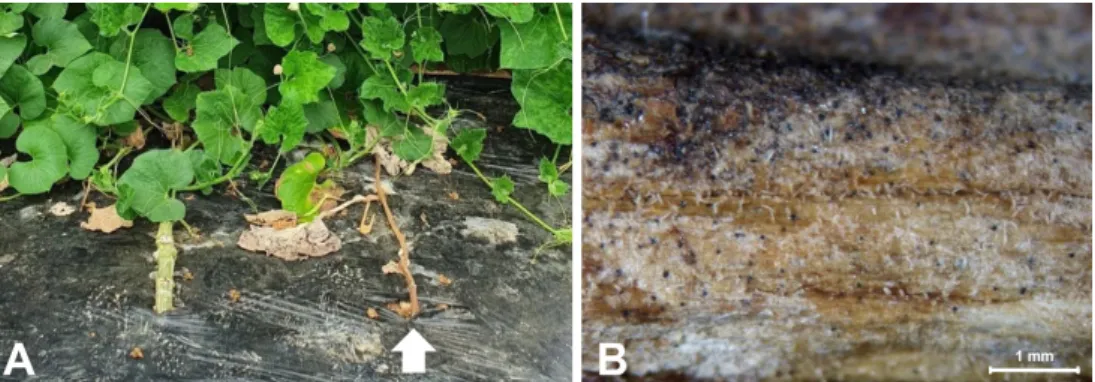
In 2020, stem blight symptoms were observed in bottle gourd plants in plastic houses in Wanju, Korea (GPS “35.83840, 127.03734”) (Fig. 1A). The incidence of disease was approximately 30%. Symptomatic plants showed leaf chlorosis, wilting, and progressive death with the infected leaves remaining attached. Sclerotia formed on the stem surface of the diseased plant was observed under a Stemi SV11 stereomicroscope (Carl Zeiss, Oberkochen, Germany) (Fig. 1B).

The main fungal pathogens in bottle gourds are Botrytis cinerea (gray mold), Colletotrichum orbiculare (anthracnose), Monosporascus cannonballus (black root rot), Pseudoperonospora cubensis (Downy mildew), Sphaerotheca fusca (Powdery mildew), and Fusarium oxysporum (Fusarium wilt) [6]. Recently, we observed blight symptoms in bottle gourds in plastic houses in Wanju, Korea, thus leading to the identification of the causal agent of blight disease in this study.

Small pieces of stems from lesion margins were sliced into 5 mm sections, surface sterilized with 75%

ethanol and 1% sodium hypochlorite for 30 s, and rinsed twice with sterile distilled water. They were

placed on water agar plates and the plates were incubated at 25℃ for 3 days. Hyphal tips of the emerging

(2)

fungus were transferred onto potato dextrose agar (PDA; Difco, Sparks, MD, USA) plates to obtain pure cultures. The mycelia were initially hyaline but gradually became dark with sclerotia after three days. The isolated pathogen was kept in 20% (v/v) glycerol at -70 ℃ for further study.

Fig. 1. Symptoms of stem blight (arrow) were observed in bottle gourd plants in the plastic house in Wanju, Korea. (A) Infected plants showing leaf chlorosis and wilting; the plants eventually died with the infected leaves remaining attached. (B) Sclerotia formed on the stem surface of the diseased plant observed under a stereomicroscope.

Pycnidia and sclerotia were observed under an Axioskop light microscope (Carl Zeiss, Oberkochen, Germany) equipped with an Optinity KCS3-160S digital camera (Korea Lab Tech, Seoul, Korea) and a Stemi SV11 stereomicroscope (Carl Zeiss, Oberkochen, Germany) equipped with an Optinity KCS-31S digital camera (Korea Lab Tech, Seoul, Korea). At least 50 individuals were measured for each structure.

Fungal isolates were grown on PDA at 25℃ for five days. The mycelia of isolated fungi 20G01 were initially hyaline but gradually turned charcoal gray with sclerotia (Fig. 2A). Sclerotia formed abundantly 3 days after inoculation, but spores didn't form until a month of culturing in the PDA medium (Fig. 2B).

Black pycnidia and sclerotia were formed on barley leaves on a water agar medium (Fig. 2C). The sclerotia size (n=66) ranged from 52.3 to 123.1 μm in length and 47.7 to 103.1 μm in width (average 80.2×78.1 μm).

Pycnidiospores (n=56), 18.7~31.5 ×9.0~13.5 μm in size, were colorless and without a septum (Fig. 2D).

Based on the morphological features, the isolated fungus was assumed to be M. phaseolina [7,8].

Molecular identification and genomic DNA from the isolated fungus 20G01 were extracted. Genomic DNA was extracted using the HiGene Genomic DNA Prep Kit (Biofact, Daejeon, Korea). Four DNA regions were amplified and sequenced, namely the internal transcribed spacer (ITS) region, translation elongation factor 1-α (TEF-1α), β-tubulin (β-TUB), and calmodulin (CAL). The ITS was amplified using ITS5 and ITS4 primers [9], TEF-1 α using the EF1-728F and EF1-986R primers [10], β-TUB using the BT2a and BT2b primers [11], and CAL using the CAL-228F and CAL-737R primers [10].

Each amplified fragment was sequenced by a DNA sequencing service (Biofact, Daejeon, Korea) with the

same primers used for the amplification and compared with fungal sequences from the National Center

for Biotechnology Information using basic alignment search tool (BLAST) algorithms. Along with our

sequences, reference sequences of related fungi were used for the phylogenetic analysis. A neighbor-joining

tree was constructed using the Tajima-Nei parameter model of MEGA X [12].

(3)

Fig. 2. Morphology of Macrophomina phaseolina isolated from bottle gourd. (A) Fungal colony on a potato dextrose agar (PDA) after 7 days of inoculation at 25℃. The isolates show a black colored colony on the PDA and sclerotia. (B) Sclerotia formed in PDA. (C) Pycnidia (P) and sclerotia (S) formed on barley leaf on water agar medium. (D) Pycnidiospores.

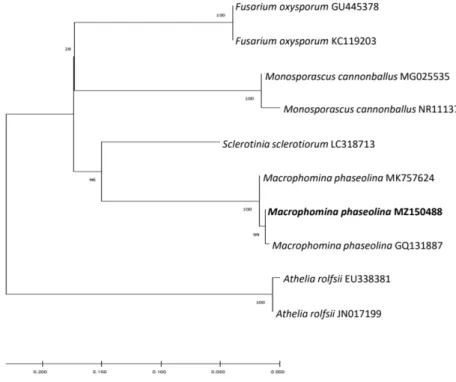
The sequences were deposited in GenBank as accession nos. MZ150488 (ITS), MZ358917 (TEF-1 α), MZ358915 (β-TUB), and MZ358916 (CAL). A BLAST nucleotide search in the GenBank database indicated that all the four protein sequences had 100% similarity with respective protein sequences of M. phaseolina. Phylogenetic analysis of the ITS region sequence revealed that the 20G01 isolate (accession no. MZ150488) belongs to the M. phaseolina group (Fig. 3). This isolate was deposited in the Korean Agricultural Culture Collection (accession No. KACC 49876).

The pathogenicity test was conducted on 4 week-old bottle gourd ‘Bulrojangsaeng’ (Syngenta Korea, Seoul, Korea). The pathogen 20G01 was grown on PDA for 5 days at 25℃ and allowed to colonize a sterile 8 mm wooden toothpick placed on the medium for 10 days. The colonized toothpick was inserted at the bottom of the stem [8]. 15 plants were inoculated with the colonized toothpicks. The control plants were inoculated with sterile toothpicks. The inoculated site was wrapped with water-soaked gauze, and the plants were maintained at 32 ℃ during the daytime and 25℃ at night in the growth chamber.

Symptoms of stem blight and leaf discoloration were observed 9 days after inoculation, and no

symptoms were observed in the control plants (Fig. 4). The fungus was successfully re-isolated from

artificially inoculated plants, fulfilling Koch’s postulates.

(4)

Our results suggest that based on morphology, DNA sequence analysis, and pathogenicity tests, the 20G01 isolate was M. phaseolina.

M. phaseolina infects more than 500 plant species worldwide [6]. It has been reported to cause charcoal rot in Glycine max in Korea [13]. However, this pathogen is not known to infect any species belonging to the genus Lagenaria. To our knowledge, this is the first study reporting charcoal rot in L. siceraria caused by M. phaseolina in Korea.

Fig. 3. Phylogenetic analysis of sequence of internal transcribed spacer ribosomal DNA (rDNA) region of isolated fungus and that of other related fungi retrieved from GenBank. The tree was constructed based on the neighbor joining method with 1,000 replicates. The numbers above the branches represent the bootstrap value. The fungus identified in this study is boldfaced.

Fig. 4. Symptoms induced by the isolate 9 days after (A) artificial inoculation, (B) control plant, and (C)

bottle gourd stem with dark gray lesion of charcoal rot at 30 days after inoculation.

(5)

ACKNOWLEDGEMENT

This study was supported by a grant (Project No. PJ01260801) funded by the National Institute of Horticultural and Herbal Science, Rural Development Administration.

REFERENCES

1. Davis AR, Perkins-Veazie P, Hassell R, Levi A, King SR, Zhang X. Grafting effects on vegetable quality. HortScience 2008;43:1670-2.

2. King SR, Davis AR, Liu W, Levi A. Grafting for disease resistance. HortScience 2008;43:1673-6.

3. Lee JM, Kubota C, Tsao SJ, Bie Z, Echevarria PH, Morra L, Oda M. Current status of vegetable grafting: Diffusion, grafting techniques, automation. Sci Hortic 2010;127:93-105.

4. Turhan A, Ozmen N, Kuscu H, Serbeci MS, Seniz V. Influence of rootstocks on yield and fruit characteristics and quality of watermelon. Hortic Environ Biotechnol 2012;53:336-41.

5. Karaca F, Yetişir H, Solmaz I, Candir E, Kurt Ş, Sari N, Güler Z. Rootstock potential of Turkish Lagenaria siceraria germplasm for watermelon: Plant growth, yield and quality. Turk J Agric For 2012;36:167-77.

6. Farr DF, Rossman AY. Fungal databases [Internet]. Washington, D.C.: U.S. National Fungus Collections, ARS, USDA; 2021. [cited 2021 Jan 7]. Available from https://nt.ars-grin.gov/

fungaldatabases/

7. Mertely J, Seijo T, Peres N. First report of Macrophomina phaseolina causing a crown rot of strawberry in Florida. Plant Dis 2005;89:434.

8. Qamar MI, Ghanzafar MU, Abbas MF, Zainab R, Andleeb S, Shafiq M, Mushtaq S. First report of Macrophomina phaseolina causing crown and root rot on strawberry in Sargodha, Pakistan. Plant Dis 2019;103:1420.

9. White TJ, Bruns TD, Lee S, Taylor J. Amplification and direct sequencing of fungal ribosomal RNA genes for phylogenetics. PCR protocols: A guide to methods and applications. In: Innis MA, Gelfand DH, editors. London: Academic Press; 1990. p. 315-22.

10. Carbone I, Kohn LM. A method for designing primer sets for speciation studies in filamentous ascomycetes. Mycologia 1999;91:553-6.

11. Glass NL, Donaldson GC. Development of primer sets designed for use with the PCR to amplify conserved genes from filamentous ascomycetes. Appl Environ Microb 1995;61:1323- 30.

12. Kumar S, Stecher G, Li M, Knyaz C, Tamura K. MEGA X: Molecular evolutionary genetics analysis across computing platforms. Mol Biol Evol 2018;35:1547-9.

13. Ko YM, Choi J, Lee YH, Kim HT. First report of charcoal rot caused by Macrophomina

phaseolina on Glycine max in Korea. Res Plant Dis 2020;26:29-37.

수치

Fig. 1. Symptoms of stem blight (arrow) were observed in bottle gourd plants in the plastic house in  Wanju, Korea
Fig. 2. Morphology of Macrophomina phaseolina isolated from bottle gourd. (A) Fungal colony on a  potato dextrose agar (PDA) after 7 days of inoculation at 25℃
Fig. 3. Phylogenetic analysis of sequence of internal transcribed spacer ribosomal DNA (rDNA) region  of isolated fungus and that of other related fungi retrieved from GenBank

참조

관련 문서

2001.. to determine influence of planting space and the number of plants per hill on agronomic characters, forage yield and quality of Jeju Italian millet..

That is, the dry powder of the sludge wastes, generated during the decommissioning of nuclear power plants, were compacted, and a study, focused on

On the basis of the detailed professional studies on the topic of reconciliation for all times and places, I will vision the unified Korea in peace with

If the volume of the system is increased at constant temperature, there should be no change in internal energy: since temperature remains constant, the kinetic

□ Heat is defined as transferred energy dew to temperature differences through boundary.. - Conduction by molecular

The index is calculated with the latest 5-year auction data of 400 selected Classic, Modern, and Contemporary Chinese painting artists from major auction houses..

1 John Owen, Justification by Faith Alone, in The Works of John Owen, ed. John Bolt, trans. Scott Clark, "Do This and Live: Christ's Active Obedience as the

Such characteristics influenced the views on colors and each period showed the following views on colors: In Three Kingdoms of Korea, natural and light