PtdIns(3,5)P 2 5-phosphatase Fig4 Interacts with Kinesin Superfamily 5A (KIF5A)
Won Hee Jang and Dae-Hyun Seog*
Departments of Biochemistry, College of Medicine and UHRC, Inje University, Busan 614-735, Korea Received November 28, 2013 /Revised December 19, 2013 /Accepted December 19, 2013
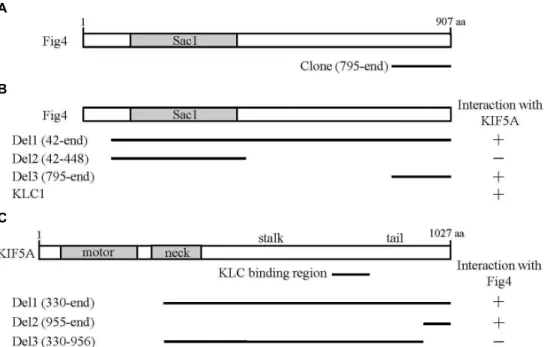
Kinesin-1 consists of two heavy chains (KHCs), also called KIF5s, and two light chains (KLCs) that form a heterotetrameric complex. Here, we demonstrate the binding of a neuronal KHC, KIF5A, to the carboxyl (C)-terminal tail region of Fig4 (also known as Sac3), a phosphatase that removes the 5-phosphate from phosphatidylinositol-3,5-bisphosphate (PtdIns(3,5)P
2
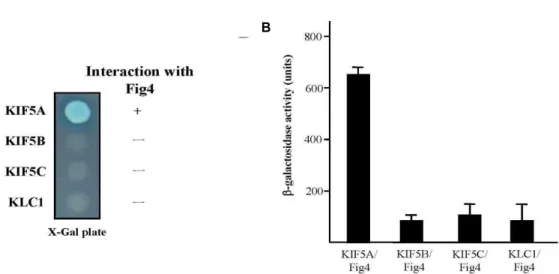
). Fig4 bound to the C-terminal region of KIF5A but not to other KHCs (KIF5B and KIF5C) and KLC1 in yeast two-hybrid assays.
The interaction was further confirmed in a glutathione S-transferase pull-down assay and by co-immunoprecipitation. Anti-KIF5A antibody co-immunoprecipitated Fig4 with KIF5A from mouse brain extracts. These results suggest that kinesin-1 could transport the Fig4-associated protein complex or cargo in cells.
Key words : Adaptor protein, Fig4, protein-protein interaction, kinesin-1, microtubule motors, Sac3
*Corresponding author
*Tel : +82-51-890-6974, Fax : +82-51-894-5801
*E-mail : [email protected]
This is an Open-Access article distributed under the terms of the Creative Commons Attribution Non-Commercial License (http://creativecommons.org/licenses/by-nc/3.0) which permits unrestricted non-commercial use, distribution, and reproduction in any medium, provided the original work is properly cited.
Journal of Life Science 2014 Vol. 24. No. 1. 14~19 DOI : http://dx.doi.org/10.5352/JLS.2014.24.1.14
Introduction
Compared with other cells, neurons with long neurites have a well-developed transport system. Intracellular trans- port mechanism is controlled by microtubule-dependent mo- tor proteins [5]. Kinesin-1 is a motor protein that utilizes ATP hydrolysis to drive the intracellular transport along mi- crotubules and has been reported to transport various types of cargoes, including organelles, synaptic vesicle precursors, neurotransmitter receptors, cell signaling molecules, and mRNAs in the neurons [5, 10]. Kinesin-1 is a heterotetramer composed of two kinesin heavy chains (KHCs, also called KIF5s) and two kinesin light chains (KLCs) [10]. KHC has a motor domain that hydrolyzes ATP. KLC is involved in modulation of KHC motor activity [5]. KHC has specific car- go-binding regions and KLC-binding domains in its carboxyl (C)-terminus [11]. There are three KHCs (KIF5A, KIF5B, and KIF5C), which are encoded by different genes and possess a similar motor domain containing a microtubule-binding motif in the amino (N)-terminus and a different carboxyl (C)-terminus. KIF5B appears to be ubiquitously expressed, whereas KIF5A and KIF5C appear to be expressed in neuron [14].
Using the many new methods makes it possible to identi- fy the binding proteins of kinesin-1 [11]. KIF5s-binding pro- teins include glutamate receptor-interacting protein 1 (GRIP1) [21], mRNA/protein (mRNP) complex [13], SNAP25 [6], syntabulin [22], β-dystrobrevin [11], DISC1 [11], and GABARAP [18]. The proteins that bind to the tetratricopep- tide repeat (TRP) domain of KLC have also been identified.
These include c-jun NH
2
-terminal kinase (JNK)-interacting proteins (JIPs) [4] and amyloid-β precursor protein (APP) [17].
To investigate in vivo functions of KIF5s, kif5 knockout (KO) mice were generated. Kif5b-KO mice are embryonic le- thal and show abnormal localization of mitochondria [24].
Kif5c-KO mice are normal in their appearance but show a smaller brain size [14]. Kif5a-KO mice are neonatal lethal but show no apparent histological abnormalities in their brains except that the nuclei and cell bodies of spinal cord motor neurons appear to be larger than the wild-type (WT) [25].
More than 75% of conditional Kif5a-KO mice undergo seiz-
ures and die within 3 weeks [25]. KIF5A has been suggested
to be important for the viability of neurons [25]. KIF5A mu-
tations have been found to cause SPG10, a rare form of he-
reditary spastic paraplegia (SPG) in human [19]. However,
despite increasing number of reports for cargoes carried by
kinesin-1, KIF5A-specific cargo or binding protein(s) capable
of explaining these phenotypes are still unknown. Thus, we
searched for KIF5A-specific binding partners that bind to the
C-terminal region of KIF5A and found an interaction with
Fig4, a phosphatidylinositol-3,5-bisphosphate (PtdIns(3,5)P
2
)
5-phosphatase [12]. The KIF5A and Fig4 interaction suggests