199 Corresponding to: Dae-Hyun Seog, Department of Biochemistry, College of Medicine, Inje University, 633-165, Gaegeom-dong, Busanjin-gu, Busan 614-735, Korea. (Tel) 82-51-890-6974, (Fax) 82-51-894-4500, (E-mail) [email protected]
ABBREVIATIONS: KIF, kinesin superfamily protein; SNX, sorting nexin; CMT2A, Charcot-Marie-Tooth disease type 2A; PX, phox homology.
Sorting Nexin 17 Interacts Directly with Kinesin Superfamily KIF1Bβ Protein
Dae-Hyun Seog1 and Jin Han2
Departments of 1Biochemistry, 2Physiology, National Research Laboratory for Mitochondrial Signaling, College of Medicine, Cardiovascular and Metabolic Disease Center, Inje University, Busan 614-735, Korea
KIF1Bβ is a member of the Kinesin superfamily proteins (KIFs), which are microtubule-dependent molecular motors that are involved in various intracellular organellar transport processes. KIF1Bβ is not restricted to neuronal systems, however, is widely expressed in other tissues, even though the function of KIF1Bβ is still unclear. To elucidate the KIF1Bβ-binding proteins in non-neuronal cells, we used the yeast two-hybrid system, and found a specific interaction of KIF1Bβ and the sorting nexin (SNX) 17. The C-terminal region of SNX17 is required for the binding with KIF1Bβ. SNX17 protein bound to the specific region of KIF1Bβ (813-916. aa), but not to other kinesin family members. In addition, this specific interaction was also observed in the Glutathione S-transferase pull-down assay.
An antibody to SNX17 specifically co-immunoprecipitated KIF1Bβ associated with SNX17 from mouse brain extracts. These results suggest that SNX17 might be involved in the KIF1Bβ-mediated transport as a KIF1Bβ adaptor protein.
Key Words: Kinesin, Molecular motors, Microtubule, Adaptor proteins, SNX
INTRODUCTION
Many members of kinesin, dynein, and myosin family have been implicated as molecular motors in the transport of intracellular organelles such as mitochondria, protein complexes, and mRNAs to specific destinations in ATP-de- pendent manner (Hirokawa, 1998; Karcher et al, 2002; Seog et al, 2004). The kinesin superfamily proteins (KIFs) of mo- lecular motor proteins drive movement toward the plus ends of microtubules at the cell periphery (Aizawa et al, 1992; Hirokawa, 1998; Karcher et al, 2002). All superfamily members have similar motor domains, which may have been evolved by multiple gene duplications. The remaining portions of the molecules are greatly diverged, presumably allowing association with multiple classes of cargo proteins (Goldstein et al, 2001; Miki et al, 2001; Karcher et al, 2002;
Seog et al, 2004; Paik et al, 2004).
Within KIFs, the KIF1 subgroup comprises N-type motor proteins classified as fast anterograde plus-end-directed monomeric motor protein. Kif1 genes are divided into Kif1A, Kif1B, Kif1C and Kif1D which are thought to be the antergrade molecular motors and are responsible for the transport of presynaptic vesicle, protein complexes and mi- tochondria (Hirokawa, 1998; Miki et al, 2001; Dorner et al, 1999; Nangaku et al, 1994; Okada et al, 1995). KIF1 pro- teins contain a highly conserved motor domain in their N-terminal region, whereas a tail domain in their C-termi- nal regions is less well conserved. The C-terminal regions of KIF1 protein are responsible for the cargo-binding region. KIF1A is the fastest among the KIFs (moving at
2∼3 fold faster rates than conventional kinesin such as KIF5B), and the mechanism of its motility has been the subject of structural and molecular investigations (Okada and Hirokawa, 1999; Okada et al, 2003). Targeted deletion of the KIF1A gene in mice yields a presynaptic vesicle transport defect and results in death shortly after birth (Yonegawa et al, 1998). On the other hand, the isoform of KIF1B was originally reported as a mitochondria motor transporter (Nangaku et al, 1994). KIF1B is further divided into two major splicing isoforms, KIF1Bα and KIF1Bβ, produced by alternative splicing of the KIF1B gene, which contains at least 47 exons (Zhao et al, 2001). The primary structure of 660 amino acids in the N-terminal region is conserved between KIF1Bα and KIF1Bβ, however, their C-terminal sequences are completely different (Zhao et al, 2001). Previous studies demonstrated that KIF1Bα inter- acts with the PDZ domains of MALS-3, PSD-95 and S-SCAM, and that it was involved in dendritic and axonal transport (Mok et al, 2002; Kim et al, 2006). In addition, PDZ domain of glucose transporter 1 binding protein is re- sponsible for interaction with KIF1Bα as well (Bunn et al, 1999). KIF1Bβ consists of 1770 amino acids and has a pre- dicted molecular weight of 200 kDa (Zhao et al, 2001). A longer splice variant of KIF1Bβ in neuronal cells has been shown to be associated with synaptic vesicles containing synaptic vesicle protein 2 (SV2), synaptotagmin and syn- aptophysin (Zhao et al, 2001). Genetic alteration of the KIF1B gene causes a substantial decrease in the survival of neuron and perinatal death in kif1b-/- mice as well as progressive muscle weakness in heterozygote mice. A loss-
of-function point mutation in the motor domain of KIF1B was detected in human patients with Charcot-Marie-Tooth disease type 2A (CMT2A), which is the most common form of inherited peripheral neuropathies (Zhao et al, 2001).
KIF1A is neuronal-specific, however, KIF1Bβ has a broader spectrum of tissue distribution, indicating that KIF1Bβ could also play some roles in transporting vesicles in cells. In this study, we identified sorting nexin 17 (SNX17) as a protein that interacts with KIF1Bβ in vitro and in vivo.
METHODS Plasmid constructs
The region of SNX17 was cloned into T-vector (Invitro- gen, Carlsbad, CA, USA) using by reverse transcriptase pol- ymerase chain reaction (RT-PCR). After EcoRI digestion, the SNX17 fragment was inserted into the EcoRI site of pB42AD (Clontech, Palo Alto, CA, USA). A previously de- scribed mouse KIF1Bβ (Zhao et al, 2001) was utilized as a template to amplify the region coding for amino acids (a.a) 813-916 using appropriate primers. The amplified fragment was sub-cloned into T-vector. The fragment was then EcoRI-digested and sub-cloned into the EcoRI site of pLexA.
The correct orientation of the cDNA inserts was verified by restriction enzyme analysis, and sequence analysis was used to check that they were in-frame. Other molecular pro- cedures were performed according to the standard protocols (Sambrook et al, 1989).
Screening of KIF1Bβ-binding proteins by the yeast two-hybrid assay
The Matchmaker LexA two-hybrid system was used for screening according to the manufacturer's manual (Clon- tech). In brief, a part of the kif1bβ gene ([aa] 813-916) was fused to the DNA-BD region of the pLexA vector, and the plasmid DNA was transformed into yeast strain EGY48 carrying the p8op-lacZ gene. Transformed EGY48 yeast strains containing the KIF1Bβ bait plasmid were trans- formed with a mouse brain cDNA library (Takeda et al, 2000), and the cells were grown on synthetic dextrose (SD) plates supplemented with glucose, but with no histidine, tryptophan, or uracil (SD/-His/-Trp/-Ura). The selection of positive clones was performed on an SD/-His/-Trp/-Ura/-Leu plate containing galactose, raffinose, and X-gal. Library plasmids from positive colonies were isolated and rescued using E. coli strain (KC8 strain) on ampicillin-resistant plates. Library inserts were then amplified by PCR and an- alyzed by restriction enzyme digestion. Unique inserts were sequenced, and DNA and protein sequence analyses were performed with the BLAST algorithm at the National Center for Biotechnology Information (NCBI). After iso- lation of the plasmids encoding the library clones, these plasmids were tested for interactions of the reporter gene in yeast by the retransformation. Activation of the reporter genes in the positive colonies was confirmed in the same experiments.
β-Galactosidase activity in liquid cultures of yeast The strength of the interactions between SNX17 and KIF1Bβ constructs was assessed by measuring β-galac-
tosidase activity in liquid cultures or using the two-hybrid system. Yeast was co-transformed with the expression plas- mids of the positive clones and the plasmids expressing KIF1Bβ (described above) or other KIFs. Plasmids express- ing the tails of KIF1A (aa 400 to the C-terminus) (Okada et al, 1995), KIF1Bα (aa 810 to the C-terminus) (Zhao et al, 2001), KIF3A (aa 413 to the C-terminus) (Kondo et al, 1994), KIF5B (aa 810 to the C-terminus) (Kanai et al, 2000) and KIF17 (aa 939 to the C-terminus) (Setou et al, 2000) were tested for binding with SNX17. The β-galactosidase activity in liquid cultures of yeast was assayed as described previously (Takeda et al, 2000). In brief, mid-log phase transformed yeast cells were collected and permeabilized with 0.1% sodium dodecyl sulphate (SDS) and chloroform.
An excess amount of chromogenic substrate o-nitrophenyl- β-D-galactoside was added to this lysate, and the mixture was incubated at 30oC and then the reaction was stopped by increasing pH to 11 by the addition of 1 M Na2CO3. The formation of the reaction product, o-nitrophenol, was de- termined by measuring absorbance at 420 nm on a spec- trophotometer and normalizing for the reaction time and the cell density.
Subcellular fractionation, co-immunoprecipitation and western blot analysis
Subcellular fractionation was performed as previously de- scribed (Takeda et al, 2000; Setou et al, 2000). Mouse brains were homogenized in ice-cold homogenization buffer (0.32 M sucrose, 4 mM HEPES, pH 7.3) supplemented with protease inhibitors. The homogenate was clarified by cen- trifugation at 900×g for 10 min followed by centrifugation at 1,000×g for 10 min, producing a pellet (P1) and super- natant (S1). The S1 supernatant was centrifuged again at 12,000 x g for 15 min, and the resulting supernatant (S2) was saved. For immunoprecipitation of the S2 fraction, the samples were diluted in the same volume of 2X binding buf- fer (50 mM HEPES, 240 mM KCl, 2 mg/ml BSA, 0.2%
Triton X-100, pH 7.4) and incubated overnight with an an- ti-SNX17 antibody (Biocompare) or with control IgG at 4oC, followed by precipitation with protein-A Sepharose (Amer- sham Pharmacia, Piscataway, NJ, USA). The beads were collected by brief centrifugation and washed three times with TBS-T (20 mM Tris-HCl, pH 7.5, 0.15 M NaCl, 0.1%
tween 20). The pellets were eluted and denatured by boiling for 2 min in Laemmli,s loading buffer and then resolved by SDS-PAGE. The gel was transferred to a nitrocellulose membrane and incubated with antibodies against the KIF1A (Okada et al, 1995), KIF1Bα (Nangaku et al, 1994), KIF1Bβ (Zhao et al, 2001), KIF5B (Kanai et al, 2000) and KIF17 (Setou et al, 2000). Rabbit horseradish-linked secon- dary antibody (Sigma-Aldrich, St. Louis, MO, USA) was used at a final dilution of 1:2000, and inmmunoreactivities were detected using the ECL Western blotting system.
Glutathione S-transferase (GST) pull-down assays Pull-down assays using GST fusion proteins were per- formed as follows. cDNAs encoding the domains of SNX17 were cloned in pET41, and the recombinant GST-SNX17 fusion proteins were expressed in bacterial strain BL21 GOLD (Stratagene, La Jolla CA, USA) after induction with 1 mM isopropyl thio-β-D-galactopyranoside (Fisher Biotech, South Australia, Australia). The fusion proteins were puri- fied using glutathione-agarose beads (Sigma-Aldrich, St.
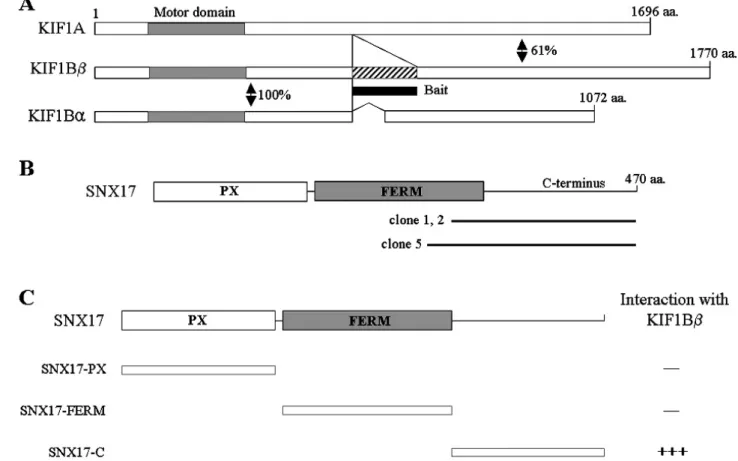
Fig. 1. Identification of the proteins interacting with KIF1Bβ by yeast two-hybrid screening. (A) Schematic illustrations of KIF1A and KIF1B isoforms. Motor domain and KIF1Bβ specific region are indicated gray and hatched box, respectively. Amino acid homology in KIF1A and KIF1B isoforms are represented as a percentage. The positions of the amino acids are indicated. (B) Schematic diagram of domain structure of SNX17. The open box corresponds to PX domain and the filled box to the B41 (FERM) domain. Clone 1, 2 and 5 were found in yeast two-hybrid screen. Clone 1, 2 and 5 were overlapped at the C-terminal region of SNX17. aa, the amino acid residue number. (C) Schematic representation of the SNX17 truncation clones. Several truncated forms of SNX17 were tested in the yeast two-hybrid assay for interaction with KIF1Bβ. +, interaction with KIF1Bβ; , no interaction with KIF1Bβ.
Louis, MO, USA) according to the manufacturer's protocol.
GST alone or GST fusion proteins were dialyzed for 2 h in PBS using Slide-A-Lyzer (Pierce, Rockford, IL, USA).
Ten μg each of the GST fusion proteins was then coupled to 50μl of glutathione-agarose beads for each reaction by incubating at room temperature for 1 h, followed by rinsing several times with PBS. The mouse brain S2 fraction was incubated overnight at 4oC with the GST fusion pro- tein-coupled glutathione beads. The beads were pelleted by centrifugation, washed three times with the extraction buf- fer (1% Triton X-100 in PBS containing 10μg/ml each apro- tinin, leupeptin, and pepstatin and 1μM phenylmetha- nesulfonyl fluoride), and once with PBS. The bound pro- teins were eluted from the glutathione beads with 100μl of SDS sample buffer. The samples were boiled for 5 min and then processed for SDS-PAGE and Western blotting with antibodies to KIF1Bβ.
RESULTS
Identification of KIF1Bβ interacting proteins by yeast two-hybrid screening
KIF1Bβ belongs to the KIF1 subgroup, and has a chi-
meric structure comprising N-terminal region of KIF1Bα and KIF1A like the C-terminal region, respectively. C-ter- minal region exhibits high homology to that of KIF1A (61%
identity) rather than that of KIF1Bα (Fig. 1A). The N-ter- minal motor domain (1-660 aa) of KIF1Bα and KIF1Bβ was 100% identical at the a.a level. The tail domain of the two proteins, however, shared no significant homology (Fig.
1A). Since the C-terminal region of KIFs plays a key role in the recognition and binding of their cargos, KIF1Bβ is expected to have physiologically different functions from those of KIF1Bα. To identify proteins that interact with KIF1Bβ, we used the yeast two-hybrid system. The KIF1B β specific region (813-916 aa) was used as a bait. Seven potential clones were identified from approximately 1×10⁷ independent mouse pB42AD-cDNA transformants on se- lection medium. These clones were individually isolated, se- quenced and subjected to further yeast two-hybrid filter as- say to confirm the interactions. We obtained three positive clones which were turned out to be cDNA fragments con- taining SNX17 (Fig. 1B). The three positive SNX17 clones (clones 1, 2 and 5) overlapped at the C-terminal region of SNX17 (Fig. 1B). SNX17 consists of an N-terminal phox homology (PX) domain, followed by a four. 1-protein, Ezrin, Radixin, Moesin family (FERM) domain covering residues 113-274, which is found in proteins that act as linkers con-
Fig. 2. Interaction between KIFs and SNX17. The C-terminal regions of each KIF protein were fused to the pLexA DNA binding domain. SNX17 specifically interacted with KIF1Bβ, but not with KIF1A, KIF1Bα, KIF3A, KIF5B, or KIF17 (+++, interaction with SNX17; , no interaction with SNX17).
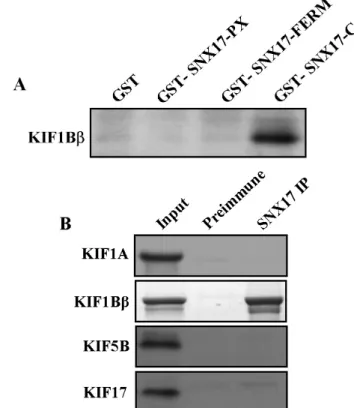
Fig. 3. Association of KIF1Bβ with SNX17 in the GST pull-down assay and co-immunoprecipitation. (A) Proteins in the mouse brain lysate were allowed to bind to GST alone, GST-SNX17-PX, GST-SNX17-FERM and GST-SNX17-C fusion proteins. The elution fractions were resolved by SDS-PAGE, and Western blotting was performed using an antibody to KIF1Bβ. (B) Mouse brain lysates were immunoprecipitated with an anti-SNX17 antibody or preimmune serum, and the precipitates were immunoblotted with anti-KIF antibodies. Input: 10% of the mouse brain lysates used for each co-immunoprecipitation assay.
necting cell surface transmembrane proteins to the actin cytoskeleton (Chishti at al, 1998). To identify the region of SNX17 required for the interaction with KIF1Bβ, we constructed deletion mutants of SNX17 and analyzed their interactions with KIF1Bβ using the yeast two-hybrid assay. PX domain and FERM domain did not bind KIF1Bβ.
The C-terminus of SNX17 interacted with KIF1Bβ in the yeast two-hybrid assay, as shown in Fig. 1C, demonstrating that the binding domain was located in the C-terminus re- gion of SNX17 corresponding to amino acids 275-470. In addition, we quantified the binding affinity of SNX17 to KIF1Bβ by measuring β-galactosidase activity in liquid cultures of yeast transformed with the appropriate con- structs. Fig. 2 shows that the interaction of SNX17 with KIF1Bβ yielded approximately 580 U of β-galactosidase activity, reflecting a binding strength that is sufficient to mediate molecular sorting in vivo (Takeda et al, 2000).
To clarify whether SNX17 interacts specifically with KIF1Bβ or with other KIFs, we performed yeast two-hy- brid assay. Thus, the tails of KIF1A, KIF1Bα, KIF3A, KIF5B and KIF17 were tested for binding with SNX17 (Fig.
2). However, there was no detectable binding between SNX17 and the tail domains of the other major neuronal KIFs, such as KIF1A, and KIF17. The ubiquitous KIFs, such as KIF3A, KIF1Bα, and KIF5B also did not bind SNX17. These data indicate that SNX17 binds specifically to KIF1Bβ.
SNX17 is associated with KIF1Bβ at protein level In order to further confirm the SNX17-KIF1Bβ inter- action found in the yeast two-hybrid assay, we employed GST pull-down assay. Thus, recombinant GST-SNX17-PX, GST-SNX17-FERM and GST-SNX17-C fusion proteins
were expressed in E. coli, and the purified GST fusion pro- teins were allowed to interact with mouse brain extracts.
This experiment revealed that KIF1Bβ interacted with GST-SNX17-C, but not with GST alone, consistent with the results of yeast two-hybrid assay (Fig. 3A). However, SNX17 PX domain and FERM domain did not interact with KIF1Bβ (Fig. 3A), as expected on the basis of yeast two-hy- brid assay result. This result suggests that the C-terminus of SNX17 interacts with KIF1Bβ.
In order to determine whether the interaction between SNX17 and KIF1Bβ occurs in vivo, we performed co-im- munoprecipitation experiments using mouse brain extracts.
Thus, lysates from mouse brain were incubated with an an- ti-SNX17 antibody, and the immuno-complexes were se- lectively precipitated with protein G-agarose beads, which were then subsequently separated by SDS-PAGE and im- munoblotted with anti-KIFs antibodies (Fig. 3B). As shown in Fig. 3B, SNX17 was co-immunoprecipitated with KIF1Bβ, but not with KIF1A, KIF5B and KIF17, which are con- sistent with the result from yeast two-hybrid assay. This result indicates that SNX17 is a specific binding partner of KIF1Bβ in vivo.
DISCUSSION
Previous studies revealed that KIF1A and KIF1Bβ me- diate the transport of synaptic vesicle precursor in neuronal cells (Zhao et al, 2001). However, the receptors of KIF1Bβ in non-neuronal cells have not yet been reported. The pres- ent findings provide evidence that SNX17 is a candidate molecule receptor of KIF1Bβ. First, we showed that SNX17 interacts directly with KIF1Bβ in the yeast two-hy- brid system (Fig. 1). Secondly, we demonstrated the inter- action of SNX17 with KIF1Bβ in GST-pulldown assay and co-immunoprecipitation study (Fig. 3). Furthermore, we demonstrated that the C-terminal domain of SNX17 is re- quired for the interaction with KIF1Bβ (Fig. 1C).
Increasing evidence suggests that KIFs-cargo interaction is mediated by an adaptor protein (Seog et al, 2004). For examples, mitochondria and syntaxin-1-containing vesicles are attached to the KIF5s cargo binding domain by an adaptor protein, syntabulin, for their transport to synapse (Su et al, 2004); KIF17 forms a complex with mLin10 in the transportation of N-methyl-D-aspartate receptor NR2B subunits to the synapse (Setou et al, 2000); glutamate re- ceptor interacting protein 1 is an adaptor protein linking the α-amino-3-hydroxy-5-methylisoxazole-4-propionate sub- type of glutamate receptor containing vesicles to KIF5 (Setou et al, 2002); KIF3 forms a complex with CAP3 in the transporting of fordrin coated vesicle to the cell periph- ery (Takeda et al, 2000); and β1-adaptin subunit of the AP-1 complex binds to KIF13A to transport the man- nose-6-phosphate receptor containing vesicle (Nakagawa et al, 2000). Although we did not identify the cargo of KIF1Bβ, our results suggest that SNX17 may play a role as an adap- tor protein in KIF1Bβ-mediate transport.
It has recently been suggested that the family of SNX proteins may play an important role in protein trafficking among various organelles (Chishti et al, 1998; Worby et al, 2002). A role for SNXs in transmembrane protein traffick- ing has been being established by demonstrating that these proteins are located on endosomes, and that their over- expression can modulate cell surface receptor trafficking.
Importantly, they can bind a number of receptors in a varie- ty of assay (Worby et al, 2002; Williams et al, 2004). For examples, SNX1 was identified in a two-hybrid screen by its ability to bind to a cytosolic region of epidermal growth factor receptor (Wang et al, 2002). SNX17 was recently shown to accelerate P-selectin trafficking as an intra- cellular binding protein for P-selectin (Florian et al, 2001;
Williams et al, 2004). Recently, it was reported that SNX17 binding to LDL receptor-related protein plays a role in the cellular trafficking of the LDL receptor (Burden et al, 2004).
SNX17 consists of three different parts: a PX domain, a truncated FERM domain, and a C-terminus (Chishti et al, 1998). Outside the PX domain there is no significant homol- ogy between SNX17 and other SNXs. The PX domain of SNX17 plays important roles in the membrane localization of binding proteins through their binding to various phos- phatidylinositol 3-phosphate (PtdIns(3)P). FERM domain and C-terminal region participate in cargo proteins like P-selectin, Patched and LRP binding (Florian et al, 2001;
Williams et al, 2004; Knauth et al, 2005; van Kerkhof et al, 2005). The simplest model for SNX17 action is that it is an adaptor protein in KIF1Bβ dependent trafficking of LRP or P-selectin containing vesicle pools. To address this issue, it would be worth to study whether LRP and P-se- lectin can co-immunoprecipitate with KIF1Bβ. Although
we did not demonstrate the interaction of KIF1Bβ with LRP or P-selectin containing vesicle, our observations sug- gest a novel mechanism by which SNX17 could mediate in- teraction between KIF1Bβ and LRP or P-selectin contain- ing vesicles. It is not yet known, however, how and where SNX17 binds to KIF1Bβ. Future physiological studies are needed to address this issue.
ACKNOWLEDGEMENT
This work was supported by an Inje University Research Grant for 2007.
REFERENCES
Aizawa H, Sekine Y, Takemura R, Zhang Z, Nangaku M, Hirokawa N. Kinesin family in murine central nervous system. J Cell Biol 119: 1287−1296, 1992
Bunn RC, Jensen MA, Reed BC. Protein interactions with the glucose transporter binding protein GLUT1CBP that provide a link between GLUT1 and the cytoskeleton. Mol Biol Cell 10: 819−
832, 1999
Burden JJ, Sun XM, Garcia AB, Soutar AK. Sorting motifs in the intracellular domain of the low density lipoprotein receptor interact with a novel domain of sorting nexin-17. J Biol Chem 279: 16237−16245, 2004
Chishti AH, Kim AC, Marfatia SM, Lutchman M, Hanspal M, Jindal H, Liu SC, Low PS, Rouleau GA, Mohandas N, Chasis JA, Conboy JG, Gascard P, Takakuwa Y, Huang SC, Benz EJ Jr, Bretscher A, Fehon RG, Gusella JF, Ramesh V, Solomon F, Marchesi VT, Tsukita S, Tsukita S, Arpin M, Louvard D, Tonks NK, Anderson JM, Fanning AS, Bryant PJ, Woods DF, Hoover KB. The FERM domain: aunique module involved in the linkage of cytoplasmic proteins to the membrane. Trends Biochem Sci 23: 281 282, 1998
Dorner C, Ullrich A, Haring HU, Lammers R. The kinesin-like motor protein KIF1C occurs in intact cells as a dimer and associates with proteins of the 14-3-3 family. J Biol Chem 274:
33654−33660, 1999
Florian V, Schluter T, Bohnensack R. A new member of the sorting nexin family interacts with the C-terminus of P-selectin. Bio- chem Biophys Res Commun 281: 1045−1050, 2001
Goldstein LS. Kinesin molecular motors: transport pathways, re- ceptors, and human disease. Proc Natl Acad Sci U S A 98: 6999−
7003, 2001.
Hirokawa N. Kinesin and dynein superfamily proteins and the mechanism of organelle transport. Science 279: 519−526, 1998 Kanai Y, Okada Y, Tanaka Y, Harada A, Terada S, Hirokawa N.
KIF5C, A novel neuronal kinesin enriched in motor neurons. J Neurosci 20: 6374−6384, 2000
Karcher RL, Deacon SW, Gelfand VI. Motor-cargo interactions: the key to transport specificity. Trends Cell Biol 12: 21−27, 2002 Kim SJ, Lee CH, Park HY, Yea SS, Jang WH, Lee SK, Park YH,
Jung YW, Seog DH. Kinesin superfamily KIF1B alpha protein binds to the PDZ domain of MALS-3. The Korean Journal of Anatomy 39: 375−382, 2006
Knauth P, Schluter T, Czubayko M, Kirsch C, Florian V, Schrecken- berger S, Hahn H, Bohnensack R. Functions of sorting nexin 17 domains and recognition motif for P-selectin trafficking. J Mol Biol 347: 813−825, 2005
Kondo S, Sato-Yoshitake R, Noda Y, Aizawa H, Nakata T, Matsuura Y, Hirokawa N. KIF3A is a new microtubule-based anterograde motor in the nerve axon. J Cell Biol 125: 1095−1107, 1994 Miki H, Setou M, Kaneshiro K Hirokawa N. All kinesin superfamily
protein, KIF, genes in mouse and human. Proc Natl Acad Sci USA 98: 7004−7011, 2001
Mok H, Shin H, Kim S, Lee JR, Yoon J, Kim E. Association of the kinesin superfamily motor protein KIF1Balpha with
postsynaptic density-95 (PSD-95), synapse-associated protein- 97, and synaptic scaffolding molecule PSD-95/discs large/zona occludens-1 proteins. J Neurosci 22: 5253−5258, 2002 Nakagawa T, Setou M, Seog D, Ogasawara K, Dohmae N, Takio
K, Hirokawa N. A novel motor, KIF13A, transports mannose-6- phosphate receptor to plasma membrane through direct interac- tion with AP-1 complex. Cell 103: 569−581, 2000
Nangaku M, Sato-Yoshitake R, Okada Y, Noda Y, Takemura R, Yamazaki H, Hirokawa N. KIF1B, a novel microtubule plus end-directed monomeric motor protein for transport of mito- chondria. Cell 79: 1209−1220, 1994
Okada Y, Higuchi H, Hirokawa N. Processivity of the single-headed kinesin KIF1A through biased binding to tubulin. Nature 424:
574−577, 2003
Okada Y, Hirokawa N. A processive single-headed motor: kinesin superfamily protein KIF1A. Science 283: 1152−1157, 1999 Okada Y, Yamazaki H, Sekine-Aizawa Y, Hirokawa N. The neuron-
specific kinesin superfamily protein KIF1A is a unique monomeric motor for anterograde axonal transport of synaptic vesicle precursors. Cell 81: 769−780, 1995
Paik JE, Kim N, Yea AA, Jang WH, Chung JY, Lee SK, Park YH, Han J, Seog DH. Kinesin superfamily KIF5 proteins bind to (III spectrin. Korean J Physiol Pharmacol 8: 167−172, 2004 Sambrook J, Fritsch EF, Maniatis T. Molecular cloning: a labora-
tory manual. 3rd ed. Cold Spring Harbor Laboratory, Cold Spring Harbor, New York, 1989
Seog DH, Lee DH, Lee SK. Molecular Motor Proteins of the Kinesin superfamily proteins (KIFs): structure, cargo and disease. J Korean Medical Science 19: 1−7, 2004
Setou M, Nakagawa T, Seog DH, Hirokawa N. Kinesin superfamily motor protein KIF17 and mLin-10 in NMDA receptor-containing vesicle transport. Science 288: 1796−1802, 2000
Setou M, Seog DH, Y. Tanaka Y, Kanai Y, Takei Y, Kawagishi M, Hirokawa N. Glutamate-receptor-interacting protein GRIP1 directly steers kinesin to dendrites. Nature 417: 83−87, 2002 Su Q, Cai Q, Gerwin C, Smith CL, Sheng ZH. Syntabulin is a
microtubule-associated protein implicated in syntaxin transport in neurons. Nat Cell Biol 6: 941−953. 2004
Takeda S, Yamazaki H, Seog DH, Kanai Y, Terada S, Hirokawa N. Kinesin superfamily protein 3 (KIF3) motor transports fodrin-associating vesicles important for neurite building. J Cell Biol 148: 1255−1265, 2000
van Kerkhof P, Lee J, McCormick L, Tetrault E, Lu W, Schoenfish M, Oorschot V, Strous GJ, Klumperman J, Bu G. Sorting nexin 17 facilitates LRP recycling in the early endosome. EMBO J 24:
2851−2861, 2005
Wang Y, Zhou Y, Szabo K, Haft CR, Trejo J. Down-regulation of protease-activated receptor-1 is regulated by sorting nexin 1.
Mol Biol Cell 13: 1965−1976, 2002
Williams R, Schluter T, Roberts MS, Knauth P, Bohnensack R, Cutler DF. Sorting nexin 17 accelerates internalization yet retards degradation of P-selectin. Mol Biol Cell 15: 3095−3105, 2004
Worby CA, Dixon JE. Sorting out the cellular functions of sorting nexins. Nat Rev Mol Cell Biol 3: 919−931, 2002
Yonekawa Y, Harada A, Okada Y, Funakoshi T, Kanai Y, Takei Y, Terada S, Noda T, Hirokawa N. Defect in synaptic vesicle precursor transport and neuronal cell death in KIF1A motor protein-deficient mice. J Cell Biol 141: 431−441, 1998 Zhao C, Takita J, Tanaka Y, Setou M, Nakagawa T, Takeda S,
Yang HW, Terada S, Nakata T, Takei Y, Saito M, Tsuji S, Hayashi Y, Hirokawa N. Charcot-Marie-Tooth disease type 2A caused by mutation in a microtubule motor KIF1Bbeta. Cell 105:
587−597, 2001