Triptolide Mimics the Effect of Dietary Restriction on Lifespan and Retards Age-related Diseases in Caenorhabditis elegans
Sun-Mi Beak and Sang-Kyu Park*
Department of Medical Biotechnology, College of Medical Sciences, Soonchunhyang University, Asan, Chungnam 31538, Korea Received March 19, 2018 /Revised August 7, 2018 /Accepted August 8, 2018
Triptolide is a compound found in Tripterygium wilfordii and reported to have an anti-inflammatory and anti-oxidant activities. A previous study shows that the dietary supplementation with triptolide increases resistance to environmental stressors, including oxidative stress, heat shock, and ultraviolet irradiation, and extends lifespan in C. elegans. Here, we investigated the underlying mechanisms in- volved in the lifespan-extending effect of triptolide. The effect of triptolide on age-related diseases, such as diabetes mellitus and Alzheimer’s disease, was also examined using animal disease models.
The longevity phenotype conferred by triptolide was not observed in the eat-2 mutant, a well-known genetic model of dietary restriction, while there was an additional lifespan extension with triptolide in age-1 and clk-1 mutants. The long lifespan of age-1 mutant is resulted from a reduced insulin/
IGF-1-like signaling and the clk-1 mutant lives longer than wild-type due to dysfunction of mitochon- drial electron transport chain reaction. The effect of dietary restriction using bacterial dilution on life- span also overlapped with that of triptolide. The toxicity of high glucose diet or transgenic human amyloid beta gene was significantly suppressed by the supplementation with triptolide. These findings suggest that triptolide can mimic the effect of dietary restriction on lifespan and onset of age-related diseases. We conclude that triptolide can be a strong candidate for the development of dietary re- striction mimetics.
Key words : Alzheimer’s disease, C. elegans, diabetes mellitus, dietary restriction, triptolide
*Corresponding author
*Tel : +82-41-530-3094, Fax : +82-41-530-3085
*E-mail : [email protected]
This is an Open-Access article distributed under the terms of the Creative Commons Attribution Non-Commercial License (http://creativecommons.org/licenses/by-nc/3.0) which permits unrestricted non-commercial use, distribution, and reproduction in any medium, provided the original work is properly cited.
Journal of Life Science 2018 Vol. 28. No. 8. 931~937 DOI : https://doi.org/10.5352/JLS.2018.28.8.931
Introduction
Aging is one of the most complicated biological processes observed in all organisms. To explain aging process, many theories of aging have been suggested. The genomic in- stability theory emphasizes the role of genome integrity on aging and the telomere theory suggests telomere shortening causes aging. These two theories can be classified as ‘the genetic control theory of aging’ [4]. The free radical theory of aging suggests that the accumulation of free radicals with aging can lead to cellular damages and is one of causal fac- tors of aging [6]. The mitochondrial theory of aging focuses on harmful effect of reactive oxygen species (ROS), free radi- cals produced from mitochondria as byproducts of ATP gen- eration [29]. In spite of numerous theories intending to eluci- date aging process, there is no single theory of aging that
can explain diverse phenomena observed with aging. People believe that those aging theories are interlinked each other.
Besides the understanding the aging process, people have sought to find the intervention that can extend lifespan and delay age-related pathophysiological changes. So far, the on- ly intervention showing lifespan extension and retardation of age-related alterations in experimental organisms is diet- ary restriction (DR). The effect of DR on lifespan was first reported in rats, showing that DR in rats can increase life- span, extend reproductive period, and reduce cancer [22].
Then, the lifespan-extending effect of DR has been reported in Saccaromyces cerevisiae, Caenorhabditis elegans, Drosophila
melanogaster [2, 7, 8]. Gene expression profiling studies showthat DR can reverse transcriptional alterations observed with normal aging in different tissues of mice [14, 15]. A recent study found that dietary-restricted rhesus monkeys live lon- ger and are less susceptible to many age-related diseases, including cancer, type 2 diabetes, and cardiovascular disease [3].
Triptolide is found in Tripterygium wilfordii, which is
widely used as a traditional medicine in China. It has anti-in-
flammatory activity and is used for the treatment of rheuma-
toid arthritis [35]. Triptolide also shows a therapeutic effect
on pancreatic cancer and polycystic kidney disease through the induction of apoptotic cell death [34]. Recent studies re- veal that triptolide can retard the onset of age-related neuro- degenerative diseases, including Alzheimer’s disease (AD) and Parkinson’s disease (PD) [9, 13]. Our previous study shows that dietary supplementation with triptolide can in- crease resistance to environmental stressors, such as oxida- tive stress, heat shock, and ultraviolet irradiation, and extend both mean and maximum lifespan in C. elegans [12].
In the present study, we intend to identify the underlying mechanisms involved in the lifespan extension with tripto- lide. Three different long-lived mutants, which represent known lifespan-extending mechanisms in C. elegans, are em- ployed for this purpose. In addition, the effect of triptolide on age-related diseases is determined using disease model animals. The results of this study will broaden the under- standing of anti-aging activity of triptolide and provide sci- entific backgrounds for the practical application of triptolide in medical and pharmaceutical fields.
Materials and Methods
Worm strains and culture conditions
All the strains used in this study were purchased from the C. elegans Genetics Center (CGC, Minneapolis/St. Paul, MN, USA). The N2 strain was used as a wild-type and age-1 (hx546), clk-1 (e2519), and eat-2 (ad465) mutants were studied for lifespan assay. The CL4176 containing muscle-specific human amyloid beta (Aβ)
1-42(dvls27 [myo-3/Aβ
1-42/let UTR,
rol-6]) were used for Aβ-induced toxicity assay. Wormswere grown on solid Nematode Growth Media (NGM) plates containing 1.7% agar, 2.5 mg/ml peptone, 25 mM NaCl, 50 mM KH
2PO
4pH6.0, 5 μg/ml cholesterol, 1 mM CaCl
2, and 1 mM MgSO
4. Escherichia coli OP50 was pro- vided as a food source.
Lifespan assay
To obtain age-synchronized worms, five young adult worms were let lay eggs on a fresh NGM plate for 4 hr at 20℃. After removing all adult worms, the remaining eggs were allowed to hatch and grow at 20℃ for 3 days. Then, sixty age-synchronized worms were transferred to fresh NGM plates with or without 50 μg/l of triptolide, which was the most effective concentration on stress response and lifespan extension in the previous study [12]. 5-fluoro-2’- de- oxyruridine (12.5 mg/l) was also added to prevent a bagging
(internal hatching). The number of dead worms was re- corded every day until all worms were dead. Killed, lost, or bagged worms were eliminated from the assay. For the statistical analysis, we employed the log-rank test [25].
DR using bacterial dilution
Sixty age-synchronized worms were transferred to fresh NGM plates containing triptolide (50 μg/l) and 5-fluoro-2’- deoxyuridine (12.5 mg/l). Ampicillin (500 μl of 1,000x Ampi- cillin, final 100 mg/l) was added to prevent the change in bacterial concentration during the assay by inhibiting bacte- rial growth. For the control group, we fed worms with 200 μl of OP50 (5×10
9bacteria/ml) and for the DR group, 200 μl of OP50 (5×10
8bacteria/ml) were spotted on NGM plates.
Diabetes Mellitus (DM) disease model
Sixty age-synchronized worms were randomly selected from NGM plates and transferred to a fresh NGM plate con- taining 5-fluoro-2’-deoxyruridine (12.5 mg/l). To induce DM, glucose (40 mM) was added to NGM plates. The surviv- al of DM-induced worms was compared between the un- treated control and triptolide-treated group at 20℃. The number of living and dead worms was recorded every day, until all worms were dead.
Paralysis assay using AD model
Five L4/young adult CL4176 worms were transferred to a fresh NGM plate and the eggs laid for 5 hr were incubated at 15℃ for 5 d after removing all adults. Thirty young-adult worms were transferred to a fresh NGM plate and allowed to lay eggs for 2 hr at 15℃. The eggs were maintained at 25℃ for 24 hr. Then, paralyzed worms were counted every hours until all worms were paralyzed. A worm not respond- ing to mechanical stimuli or moving only head part after stimuli was considered to be paralyzed.
Measurement of ROS level
After age-synchronization, young adult worms were
treated with or without 50 μg/l of triptolide at 20℃ for 5
days. Twenty worms were transferred individually to a 96-
well black plate containing 190 μl of PBST and 10 μl of
H
2DCF-DA (Sigma-Aldrich, St. Louis, USA). The fluorescence
intensity of each well was measured at 1, 2, and 3 hr after
transferring worms using a fluorescence multi-reader (Infin-
ite F200, Tecan, Grodig, Austria).
A B
C D
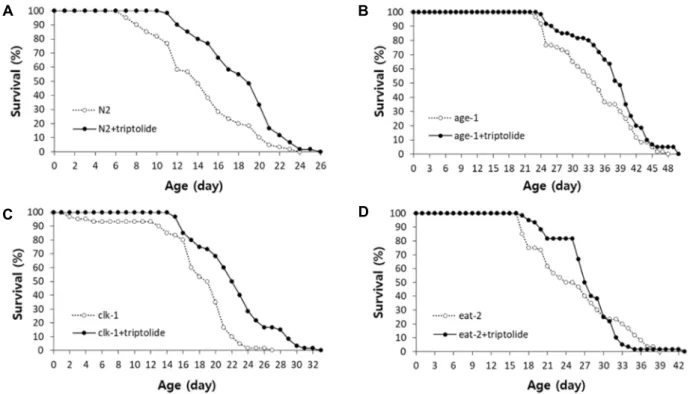
Fig. 1. The effect of triptolide on lifespan of long-lived mutants. The lifespan of N2 (A), age-1 (B), clk-1 (C), and eat-2 (D) was compared between the untreated control and worms treated with 50 μg/l of triptolide. Sixty age-synchronized worms were counted every day until all worms were dead.
Results and Discussion
The effect of triptolide overlaps with that of eat-2 mutation on lifespan
A previous study revealed that dietary supplementation with triptolide can increase lifespan in C. elegans [12]. In this study, we investigated the underlying mechanism involved with the lifespan-extending effect of triptolide using three well-known genetic mutants showing a longevity phenotype through a different cellular mechanism. As shown in Fig.
1A, the supplementation with triptolide increased lifespan significantly. The mean lifespan was increased from 14.4 d in the untreated control to 18.3 d with the supplementation with triptolide (p<0.001). The lifespan of age-1 and clk-1 mu- tants, which confer an increased lifespan due to reduced in- sulin/IGF-1-like signaling and reduced function in mi- tochondrial electron transport chain reaction, respectively, was also significantly extended by triptolide (Fig. 1B and Fig. 1C). The mean lifespan of age-1 mutant was 34.1 d and that of age-1 mutant treated with triptolide was 37.7 d (p=0.037). In the clk-1 mutants, the mean lifespan was in- creased up to 24% (from 18.1 d to 22.4 d, p<0.001). However, the supplementation with triptolide did not affect the life- span of eat-2 mutants (Fig. 1D). The mean lifespan was 25.7
and 27.3 d in the untreated eat-2 mutant and tripto- lide-treated eat-2 mutant, respectively. Independent repeated experiments showed the same eat-2-specific overlapping ef- fect of triptolide on lifespan (data not shown). These findings suggest that the lifespan-extending effect of triptolide over- laps with the longevity phenotype conferred by eat-2 mutation. The eat-2 mutant is a widely-used genetic model of DR in C. elegans due to its reduced pharyngeal food pumping rate [17]. Anti-oxidant N-acetyl-L-cysteine has a lifespan-extending activity in C. elegans [19]. A recent study revealed that N-acetyl-L-cysteine and eat-2 mutation modu- late the same cellular pathway for lifespan extension [20].
Novel DR-specific genes, nlp-7 and cup-4, were also found to be required for the longevity phenotype of eat-2 mutant, but not for the lifespan extension observed in age-1 or clk-1 mutants [23]. Therefore, our data indicate that triptolide can increase lifespan of C. elegans via modulating DR response specifically.
Triptolide can mimic the lifespan-extending effect of DR
Having observed the overlapping effect of triptolide with
eat-2 mutation, we next examined the effect of triptolide ondietary-restricted animals. DR markedly increased both
Fig. 2. Overlapping effect of triptolide and DR on lifespan. The bacterial dilution method was used for DR: 5×10⁹ and 5×10⁸ bacteria/ml culture media was used as a food source for the control and DR group, respectively. The effect of simultaneous treatment with 50 μg/l of tripto- lide and DR was also examined.
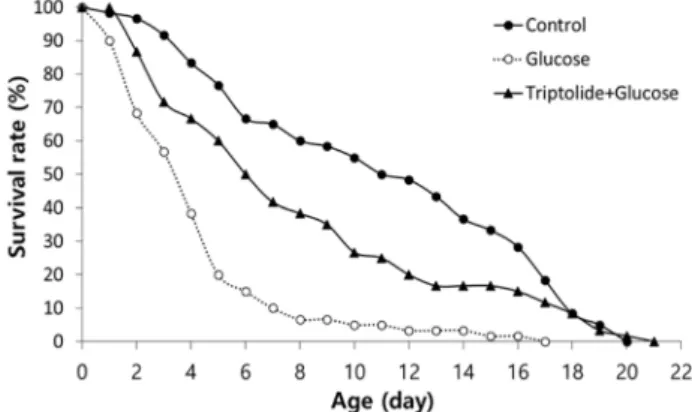
Fig. 3. Suppression of high-glucose-diet-induced toxicity. The survival under high glucose diet (40 mM) was compared to that of the untreated control. The effect of triptolide on reduced survival by high glucose diet was monitored.
mean and maximum lifespan in C. elegans (Fig. 2). The mean lifespan of DR group was 22.0 d, while the mean lifespan of the untreated control was 17.8 d (24% increase, p<0.001).
The supplementation of triptolide also extended mean life- span up to 21. 3 d (20% increase, p<0.001). The maximum lifespan was increased from 24 d in the untreated control to 30 d with DR or triptolide supplementation. Interestingly, simultaneous intervention with DR and triptolide failed to show an additional increase in the lifespan of C. elegans. The lifespan of worms treated DR and triptolide simultaneously was not significantly different from that of worms treated DR or triptolide alone (Fig. 2). Since lifelong DR is not suit- able for humans, people has been focusing on the identi- fication of DR mimetics. Resveratrol, a polyphenol com- pound rich in red wine, increased lifespan of many species via stimulating SIR2 signaling, which mediates DR-induced lifespan extension [8, 33]. Dietary supplementation with cur- cumin from larval stage extended lifespan in Drosophila mela-
nogaster and its effect overlapped with DR on lifespan [32].A recent study reported that D-allulose can increase both resistance to oxidative stress and lifespan by mimicking DR response in C. elegans [30]. Our result shows that triptolide can be a novel mimetic for DR-induced longevity. Further studies focusing on genetic pathways involved with the ef- fect of triptolide and possible role of triptolide on age-related physiological changes in other model organisms should be followed in the foreseeable future.
The survival of DM disease model was enhanced by triptolide
In addition to the longevity phenotype, DR retards many age-related pathophysiological changes, including immune dysfunction, cognitive decline, and muscle dysfunction [1, 18]. DR improves glucose homeostasis modulating glucose intolerance and insulin resistance [1]. High glucose diet causes reduced lifespan in C. elegans due to glucose toxicity [28]. Here, we determined the effect of triptolide on glucose toxicity using high-glucose-diet-induced DM model. As shown in Fig. 3, high glucose diet significantly reduced the survival. However, dietary supplementation with triptolide partially restored the survival of worms with high-glu- cose-diet. The mean survival time was decreased from 11.2 d in the control to 4.4 d with high glucose diet. The mean survival time was recovered up to 8.1 d by the supplementa- tion with triptolide (55% increase, p<0.001) (Fig. 3). Previous studies found that metformin, a drug used for type 2 dia- betes, can increase lifespan via DR process and chicoric acid also has both lifespan-extending and anti-diabetic activities [21, 27]. Our findings suggest that triptolide can ameliorate glucose toxicity and support our hypothesis that triptolide can be a possible mimetic for DR.
Triptolide reduced Aβ-induced toxicity
DR decreases incidence or delays onset of many age-re-
lated diseases, including cancer, AD, and cardiovascular dis-
ease [1, 5]. We examined the effect of triptolide on Aβ-induc-
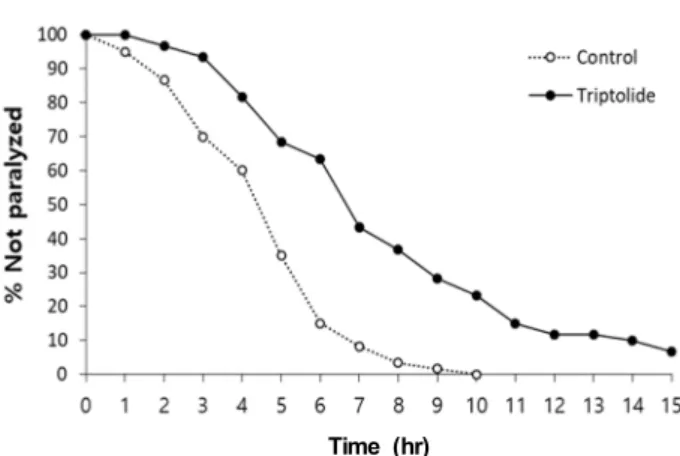
ed toxicity using C. elegans AD model. The rate of paralysis
caused by transgenic human Aβ was significantly reduced
by the supplementation with triptolide (Fig. 4). The time
when 50% of worms were paralyzed were 4.8 d in the un-
treated control and 7.3 d in the triptolide-treated worms
Time (hr)
Fig. 4. Delayed paralysis induced by transgenic Aβ. Muscle-spe- cific expression of human Aβ leaded to paralysis in animals. The supplementation with triptolide on paraly- sis caused by the induction of Aβ was determined.
Time (hr)
Fig. 5. Reduced ROS levels by triptolide. Cellular ROS levels were compared between the untreated control and trip- tolide-treated 5-day-old worms. Fluorescence intensity was measured at 1, 2, and 3 hr after H2DCF-DA treatment. Asterisk indicates a significant difference (p<0.05 by the student’s t test). Error bars indicate SEM.
(54% increase, p<0.001). Recent studies revealed that cysteine derivatives, N-acetyl-L-cysteine and S-ally cysteine, increased resistance to oxidative stress and significantly reduced para- lysis caused by Aβ in C. elegans [11, 20]. N-acetyl-L-cysteine also showed a lifespan-extending effect, which overlaps with that of DR [20]. Triptolide also has a strong anti-oxidant ac- tivity and increases lifespan in C. elegans in the previous study [12]. Taken together, our findings suggest that tripto- lide can increase resistance to oxidative stress and lifespan via DR responses, possibly using its anti-oxidant activity.
Cellular ROS levels was decreased by triptolide The free radical theory of aging suggests that age-related accumulation of cellular oxidative damage resulted from ROS is one of major causal factors of aging [6]. Cellular ROS is also associated with onset of age-related diseases. Many anti-oxidants reducing cellular ROS levels increase lifespan and reduce the incidence of age-related diseases [10, 16, 24, 26, 27]. Based on the effect of triptolide on lifespan and DM/AD animal model, we asked whether triptolide can re- duce cellular ROS levels. The fluorescence intensity de- termined by cellular ROS levels was significantly decreased by the supplementation with triptolide (Fig. 5). The fluo- rescence intensity observed in 5-day-old worms was 12,213±
1,648.7(mean of 20 individuals ± SEM) after 1 hr and in- creased up to 18,670±2,030.6 after 3 hr in the untreated control. However, the treatment with triptolide reduced the fluorescence intensity to 6,531±652.9 after 1 hr and 13,771±
1,810.9 after 3 hr (p<0.05). Fluoxetine, an anti-oxidant drug used for depression, significantly extends lifespan and re- duces Aβ-induced toxicity in C. elegans [10, 26]. Electrolyzed-
reduced water are produced by electrolysis of water and can scavenge cellular ROS [31]. A recent study reveals that elec- trolyzed-reduced water increases lifespan and has a ther- apeutic effect on AD [16, 24]. Chicoric acid is also known to reduce cellular ROS levels and shows lifespan-extending and anti-diabetic effect [27]. These findings suggest that the effect of triptolide on lifespan and DM/AD model animals may depend on the ROS-reducing activity. In this study, we identify the underlying mechanism involved with the life- span-extending activity of triptolide and report a possibility of triptolide to be developed as a therapeutic for age-related diseases. Our data also suggest that the previously men- tioned effect of triptolide on age-related diseases, including cancer, AD, and PD, could be based on the mimicking of DR, found for the first time in this study. The study on mo- lecular basis of triptolide’s activity as a DR mimetic should be followed for a deeper understanding of the effect of trip- tolide on aging and age-related diseases.
Acknowledgements
This work was supported by the Soonchunhyang Univer- sity and the Basic Science Research Program through the National Research Foundation of Korea funded by the Min- istry of Education (2015R1D1A1A01057435).
References
1. Barger, J. L., Walford, R. L. and Weindruch, R. 2003. The
retardation of aging by caloric restriction: its significance in the transgenic era. Exp. Gerontol. 38, 1343-1351.
2. Clancy, D. J., Gems, D., Hafen, E., Leevers, S. J. and Partridge, L. 2002. Dietary restriction in long-lived dwarf flies. Science 296, 319.
3. Colman, R. J., Anderson, R. M., Johnson, S. C., Kastman, E. K., Kosmatka, K. J., Beasley, T. M., Allison, D. B., Cruzen, C., Simmons, H. A., Kemnitz, J. W. and Weindruch, R. 2009.
Caloric restriction delays disease onset and mortality in rhe- sus monkeys. Science 325, 201-204.
4. Fossel, M. 1998. Telomerase and the aging cell: implications for human health. JAMA. 279, 1732-1735.
5. Halagappa, V. K., Guo, Z., Pearson, M., Matsuoka, Y., Cutler, R. G., Laferla, F. M. and Mattson, M. P. 2007. Intermittent fasting and caloric restriction ameliorate age-related behav- ioral deficits in the triple-transgenic mouse model of Alzheimer's disease. Neurobiol. Dis. 26, 212-220.
6. Harman, D. 1956. Aging: a theory based on free radical and radiation chemistry. J. Gerontol. 11, 298-300.
7. Houthoofd, K., Johnson, T. E. and Vanfleteren, J. R. 2005.
Dietary restriction in the nematode Caenorhabditis elegans.
J. Gerontol. A Biol. Sci. Med. Sci. 60, 1125-1131.
8. Howitz, K. T., Bitterman, K. J., Cohen, H. Y., Lamming, D.
W., Lavu, S., Wood, J. G., Zipkin, R. E., Chung, P., Kisielew- ski, A., Zhang, L. L., Scherer, B. and Sinclair, D. A. 2003.
Small molecule activators of sirtuins extend Saccharomyces cerevisiae lifespan. Nature 425, 191-196.
9. Hu, G., Gong, X., Wang, L., Liu, M., Liu, Y., Fu, X., Wang, W., Zhang, T. and Wang, X. 2016. Triptolide promotes the clearance of alpha-synuclein by enhancing autophagy in neuronal cells. Mol. Neurobiol. 54, 2361-2372.
10. Keowkase, R., Aboukhatwa, M. and Luo, Y. 2010. Fluoxetine protects against amyloid-beta toxicity, in part via daf-16 mediated cell signaling pathway, in Caenorhabditis elegans.
Neuropharmacology 59, 358-365.
11. Kim, J. S. and Park, S. K. 2017. Supplementation of S-allyl cysteine improves health span in Caenorhabditis elegans.
Biosci. J. 33, 411-421.
12. Kim, S. J., Beak, S. M. and Park, S. K. 2017. Supplementation with triptolide increases resistance to environmental stres- sors and lifespan in C. elegans. J. Food Sci. 82, 1484-1490.
13. Kupchan, S. M., Court, W. A., Dailey, R. G., Jr., Gilmore, C. J. and Bryan, R. F. 1972. Triptolide and tripdiolide, novel antileukemic diterpenoid triepoxides from Tripterygium wilfordii. J. Am. Chem. Soc. 94, 7194-7195.
14. Lee, C. K., Allison, D. B., Brand, J., Weindruch, R. and Prolla, T. A. 2002. Transcriptional profiles associated with aging and middle age-onset caloric restriction in mouse hearts.
Proc. Natl. Acad. Sci. USA. 99, 14988-14993.
15. Lee, C. K., Klopp, R. G., Weindruch, R. and Prolla, T. A.
1999. Gene expression profile of aging and its retardation by caloric restriction. Science 285, 1390-1393.
16. Lee, J. S., Park, S. K. and Park, S. K. 2016. Electrolyzed-re- duced water mitigates myloid beta toxicity via DAF-16 in C. elegans. Toxicol. Environ. Health Sci. 8, 56-61.
17. Mair, W. and Dillin, A. 2008. Aging and survival: the genet-
ics of life span extension by dietary restriction. Annu. Rev.
Biochem. 77, 727-754.
18. McKiernan, S. H., Bua, E., McGorray, J. and Aiken, J. 2004.
Early-onset calorie restriction conserves fiber number in ag- ing rat skeletal muscle. FASEB J. 18, 580-581.
19. Oh, S. I., Park, J. K. and Park, S. K. 2015. Lifespan extension and increased resistance to environmental stressors by N-acetyl-L-cysteine in Caenorhabditis elegans. Clinics (Sao Paulo) 70, 380-386.
20. Oh, S. I. and Park, S. K. 2017. N-acetyl-L-cysteine mimics the effect of dietary restriction on lifespan and reduces amy- loid beta-induced toxicity in Caenorhabditis elegans. Food Sci. Biotechnol. 26, 783-790.
21. Onken, B. and Driscoll, M. 2010. Metformin induces a diet- ary restriction-like state and the oxidative stress response to extend C. elegans Healthspan via AMPK, LKB1, and SKN-1. PLoS One 5, e8758.
22. Osborne, T. B., Mendel, L. B. and Ferry, E. L. 1917. The effect of retardation of growth upon the breeding period and duration of life of rats. Science 45, 294-295.
23. Park, S. K., Link, C. D. and Johnson, T. E. 2010. Life-span extension by dietary restriction is mediated by NLP-7 sig- naling and coelomocyte endocytosis in C. elegans. FASEB J. 24, 383-392.
24. Park, S. K. and Park, S. K. 2013. Electrolyzed-reduced water increases resistance to oxidative stress, fertility, and lifespan via insulin/IGF-1-like signal in C. elegans. Biol. Res. 46, 147- 152.
25. Peto, R. and Peto, J. 1972. Asymptotically efficient rank in- variant test procedures. J. R. Statist. Soc. A 135, 185-207.
26. Rangaraju, S., Solis, G. M., Andersson, S. I., Gomez-Amaro, R. L., Kardakaris, R., Broaddus, C. D., Niculescu, A. B. and Petrascheck, M. 2015. Atypical antidepressants extend life- span of Caenorhabditis elegans by activation of a non-cell- autonomous stress response. Aging Cell 14, 971-981.
27. Schlernitzauer, A., Oiry, C., Hamad, R., Galas, S., Cortade, F., Chabi, B., Casas, F., Pessemesse, L., Fouret, G., Feillet- Coudray, C., Cros, G., Cabello, G., Magous, R. and Wrut- niak-Cabello, C. 2013. Chicoric acid is an antioxidant mole- cule that stimulates AMP kinase pathway in L6 myotubes and extends lifespan in Caenorhabditis elegans. PLoS One 8, e78788.
28. Schlotterer, A., Kukudov, G., Bozorgmehr, F., Hutter, H., Du, X., Oikonomou, D., Ibrahim, Y., Pfisterer, F., Rabbani, N., Thornalley, P., Sayed, A., Fleming, T., Humpert, P., Schwenger, V., Zeier, M., Hamann, A., Stern, D., Brownlee, M., Bierhaus, A., Nawroth, P. and Morcos, M. 2009. C. ele- gans as model for the study of high glucose- mediated life span reduction. Diabetes 58, 2450-2456.
29. Shigenaga, M. K., Hagen, T. M. and Ames, B. N. 1994.
Oxidative damage and mitochondrial decay in aging. Proc.
Natl. Acad. Sci. USA. 91, 10771-10778.
30. Shintani, T., Sakoguchi, H., Yoshihara, A., Izumori, K. and Sato, M. 2017. d-Allulose, a stereoisomer of d-fructose, ex- tends Caenorhabditis elegans lifespan through a dietary re- striction mechanism: A new candidate dietary restriction
초록:트립톨라이드가 식이제한에 의한 수명연장과 노화관련 질환에 미치는 영향
백선미․박상규*
(순천향대학교 의료과학대학 의료생명공학과)
뇌공등에 함유되어있는 트립톨라이드는 뛰어난 항염증, 항산화 효능을 가지고 있음이 보고되었다. 예쁜꼬마선 충을 이용한 이전 연구에서 트립톨라이드의 섭취가 개체의 항스트레스 효능을 높이고, 수명을 연장시킴이 밝혀졌 다. 본 연구에서는 트립톨라이드에 의한 수명연장에 관여하는 세포 내 기전과 트립톨라이드가 노화관련 질환인 당뇨병과 알츠하이머병에 미치는 영향을 평가하였다. 트립톨라이드는 인슐린/IGF-1-like 신호전달 저하에 의한 수명연장 돌연변이인 age-1과 미토콘드리아 전자 전달계 저하에 의한 수명연장 돌연변이인 clk-1의 수명을 유의적 으로 증가시킨 반면, 식이제한 유도 돌연변이인 eat-2의 수명에는 유의적인 변화를 유도하지 못했다. 또한 박테리 아 희석을 이용한 식이제한에 의해 연장된 수명을 추가적으로 더 연장시키지 못했다. 트립톨라이드 섭취는 고농 도의 당 섭취에 의한 체내 독성과 사람 아밀로이드 베타 형질전환 유전자로 인한 체내 독성을 유의적으로 저하시 켰다. 이러한 결과들은 트립톨라이드에 의한 수명연장이 식이제한에 의한 수명연장 기전과 중복되며, 트립톨라이 드가 노화관련 질환을 저해하는 효능이 있음을 보여준다. 따라서, 트립톨라이드는 식이제한 효능을 대체할 수 있 는 식의약품 개발에 활용될 수 있다.
mimetic. Biochem. Biophys. Res. Commun. 493, 1528-1533.
31. Shirahata, S., Kabayama, S., Nakano, M., Miura, T., Kusu- moto, K., Gotoh, M., Hayashi, H., Otsubo, K., Morisawa, S. and Katakura, Y. 1997. Electrolyzed-reduced water scav- enges active oxygen species and protects DNA from oxida- tive damage. Biochem. Biophys. Res. Commun. 234, 269-274.
32. Soh, J. W., Marowsky, N., Nichols, T. J., Rahman, A. M., Miah, T., Sarao, P., Khasawneh, R., Unnikrishnan, A., Heydari, A. R., Silver, R. B. and Arking, R. 2013. Curcumin is an early-acting stage-specific inducer of extended func- tional longevity in Drosophila. Exp. Gerontol. 48, 229-239.
33. Wood, J. G., Rogina, B., Lavu, S., Howitz, K., Helfand, S.
L., Tatar, M. and Sinclair, D. 2004. Sirtuin activators mimic caloric restriction and delay ageing in metazoans. Nature 430, 686-689.
34. Zhao, F., Huang, W., Zhang, Z., Mao, L., Han, Y., Yan, J.
and Lei, M. 2016. Triptolide induces protective autophagy through activation of the CaMKKbeta-AMPK signaling pathway in prostate cancer cells. Oncotarget 7, 5366-5382.
35. Ziaei, S. and Halaby, R. 2016. Immunosuppressive, anti-in- flammatory and anti-cancer properties of triptolide: A mini review. Avicenna J. Phytomed. 6, 149-164.